~/sacred-texts/coffin-texts-book-of-two-ways
Coffin Texts of the Coiled One: The Creator's Four Deeds
Translated by AI straight from the Middle Egyptian, not from a modern translation, then checked against the editions and studies listed below. How we translate
- Text
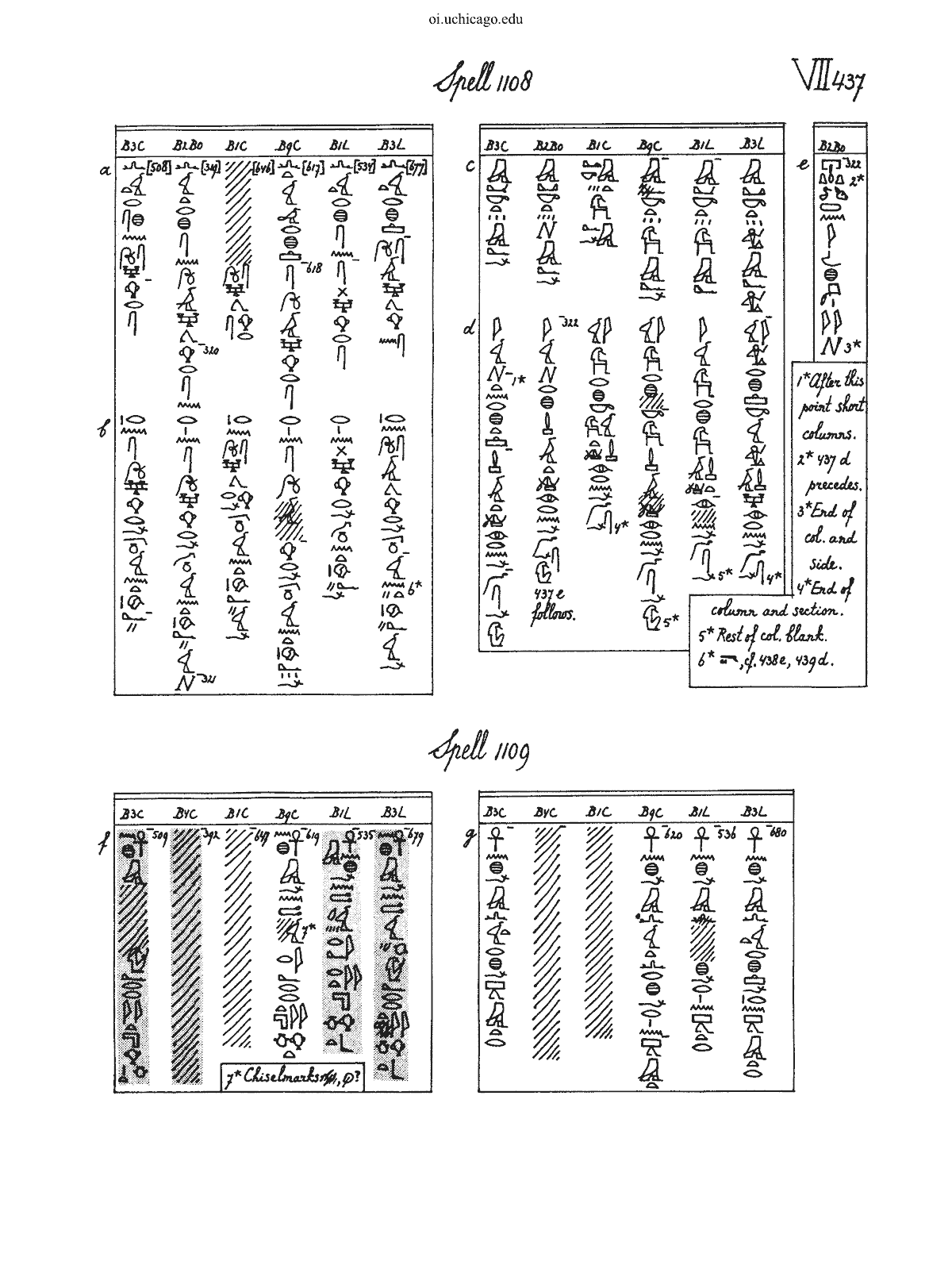
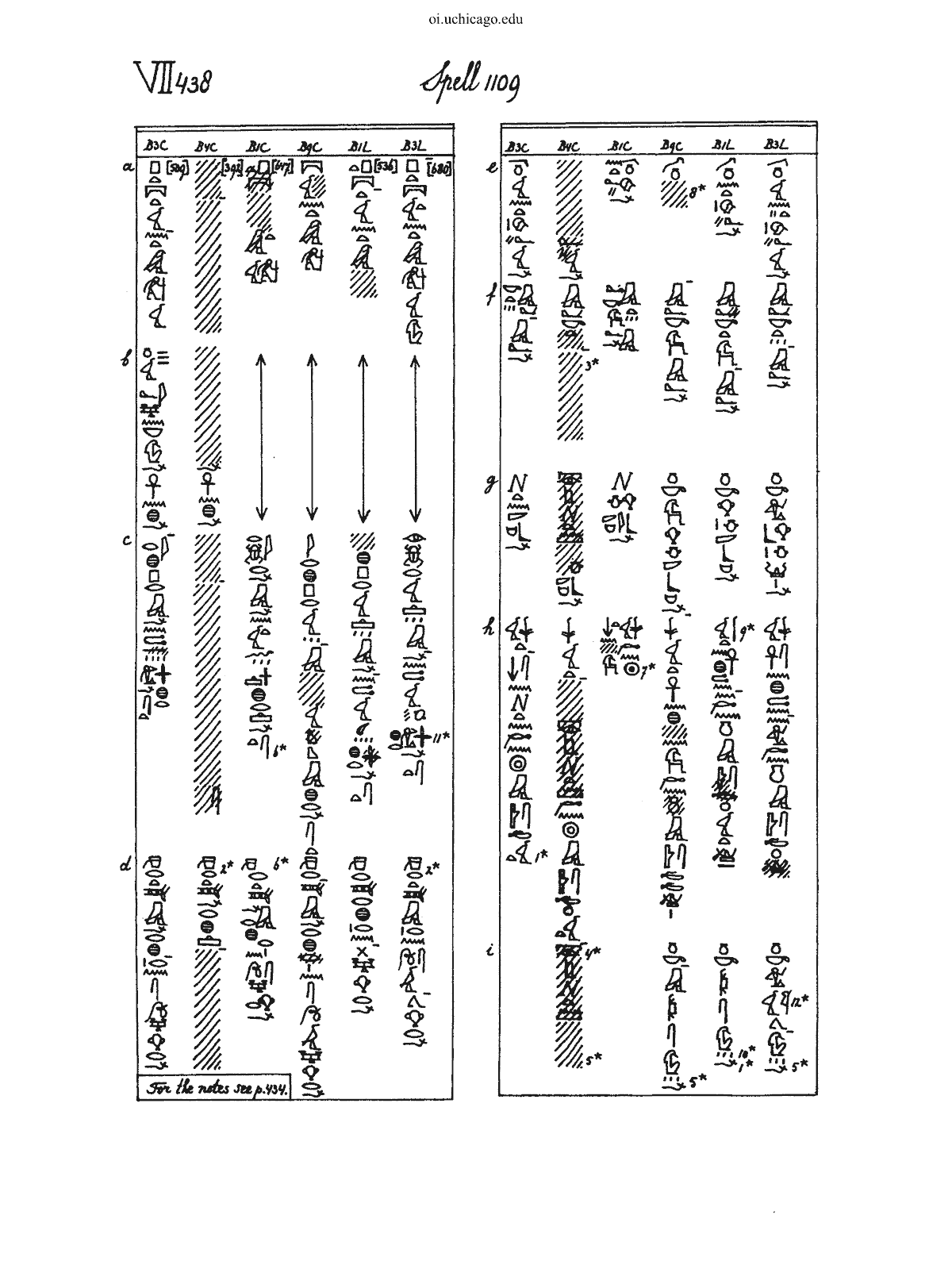
- Coffin Texts (Book of Two Ways), Coffin Texts spells 1130 and 1109 (de Buck VII 461–471, 262, 437–438)
- Date
- Middle Kingdom, c. 2000–1800 BC
- Found
- Inner coffins from the tombs of the governors of the Hare nome at Deir el-Bersha, Middle Egypt (B1Bo, B9C, B3C, B1L, B3L and others)
- Language
- Middle Egyptian · Cursive hieroglyphic (painted on coffins)
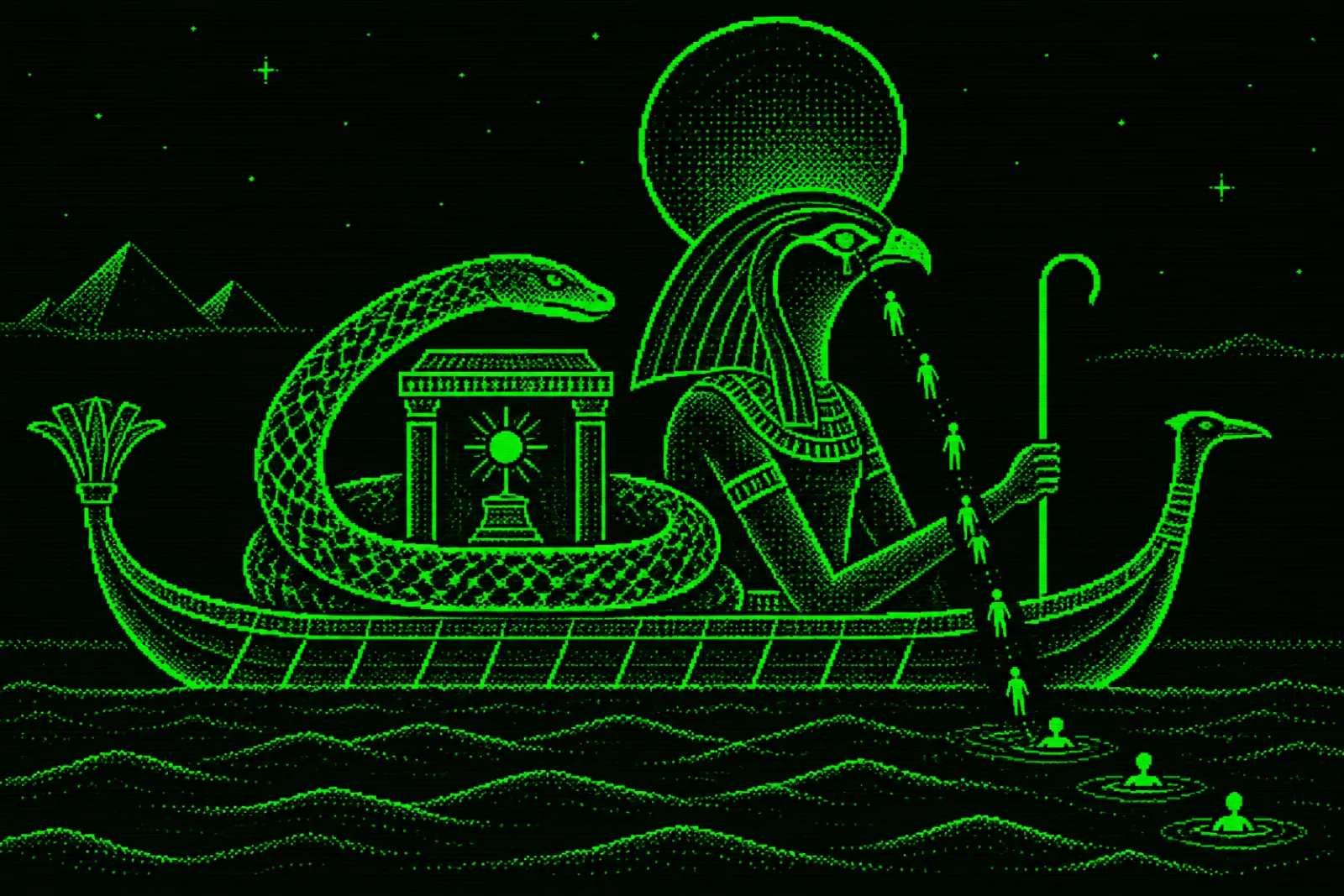
The Coffin Texts are the spells painted inside the wooden coffins of Middle Kingdom Egypt, around 2000 to 1800 BC. Both spells here come from the coffins of the governors of the Hare nome, buried at Deir el-Bersha in Middle Egypt, where the floor of the coffin carries a map of the next world, the Book of Two Ways. In that world the sun god sails at night inside Mehen, “the Coiled One”, a serpent wrapped round his shrine; in the later Amduat the same coil shelters him while the other serpent, Apophis, is cut down.
Spell 1130 is the speech of the creator, “Him whose names are secret”, given to the gods as they row the sun. He says what his own heart did for him inside the Coiled One: “two good deeds”, the text says, and then lists four, each closed with the same refrain. Then he speaks of gods made from his sweat and people from his tears, of the night he made for the dead Osiris, of the end of the world, and of himself as the lord of fire who keeps the snakes from rising against him. The last lines turn the speech over to the dead owner of the coffin, who knows the secret name and goes down into the circle of fire unburnt. Spell 1109 is a gate on the Book of Two Ways. Its keeper lives on maggots and on whoever does not know the spell; the dead man passes by naming the serpent round the sun as his brother.
These spells are not in the Thesaurus Linguae Aegyptiae, so the transliteration was made here from de Buck’s hand copy of the coffins, and every line can be checked against his pages. Both spells are given whole. The coffins differ in many small ways, and the notes name the copy each line follows. A few words are still not understood: rftt in 468e and 470b, whatever it means, belongs to the snakes and to the equipped spirit alike. Where the scribes garbled a line, the notes give the variants rather than a guess.
Each numbered line gives the Middle Egyptian first, in Latin letters. Our English is underneath. Tap a dotted word for its meaning, and Note for our comment on the line; our comments are in the right margin.
Coffin Text 1130: the Lord of All speaks from inside the Coiled One
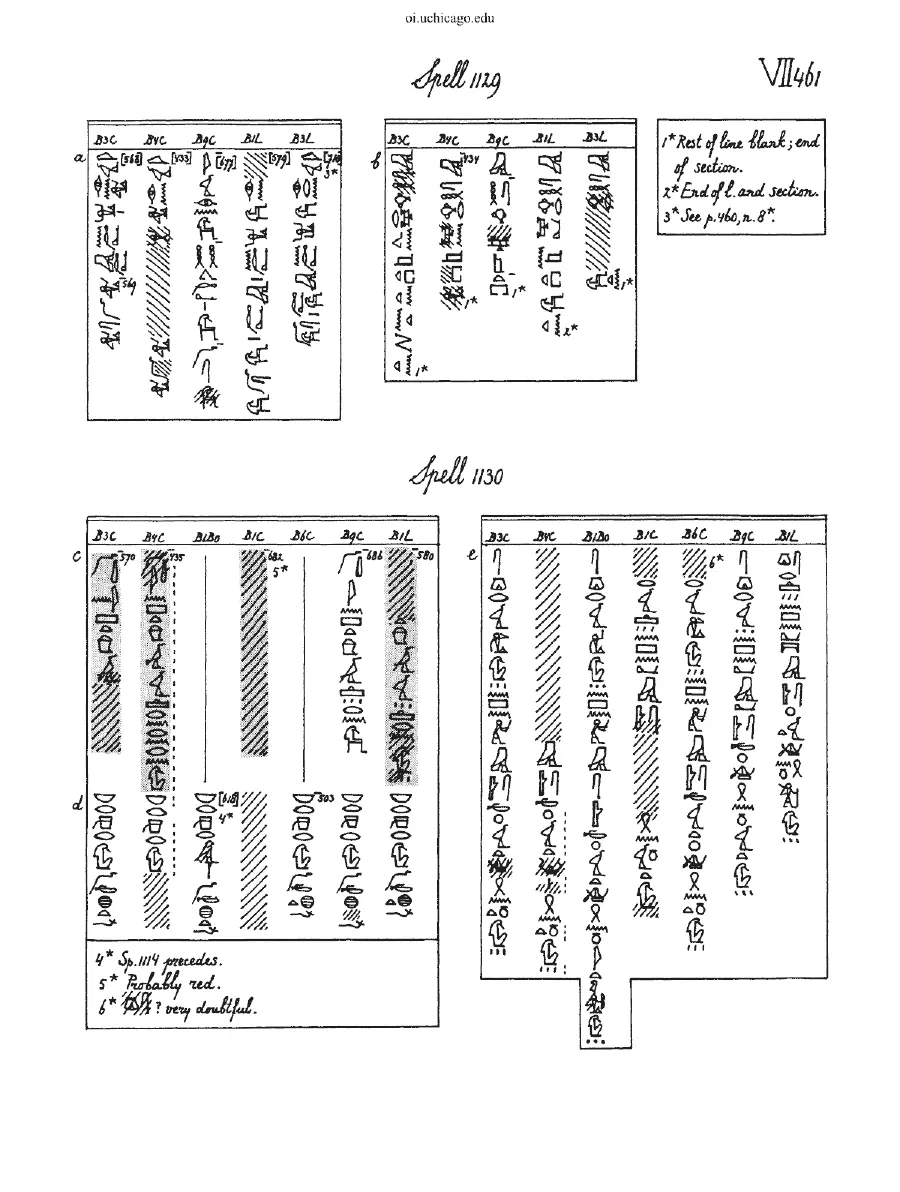
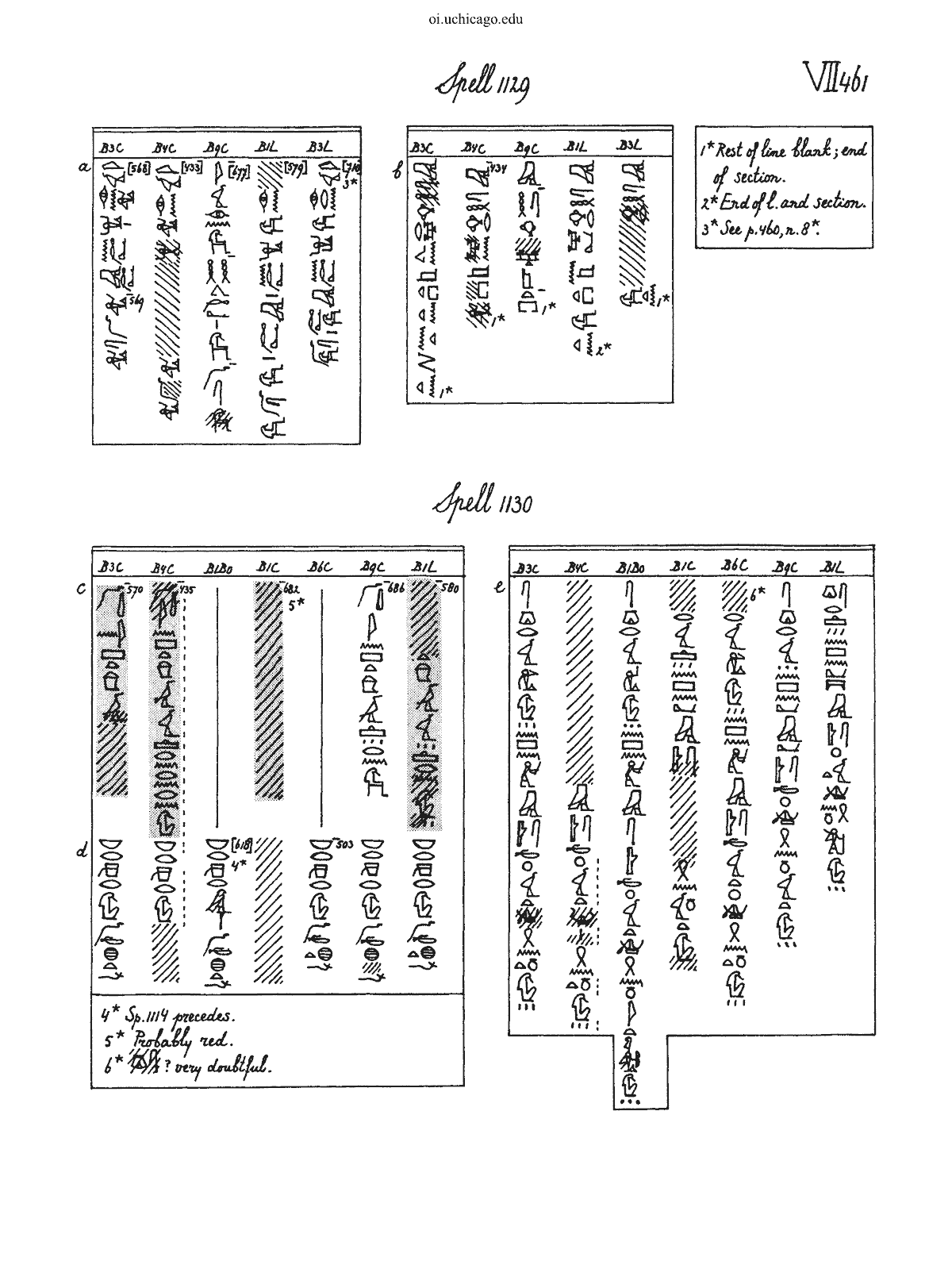
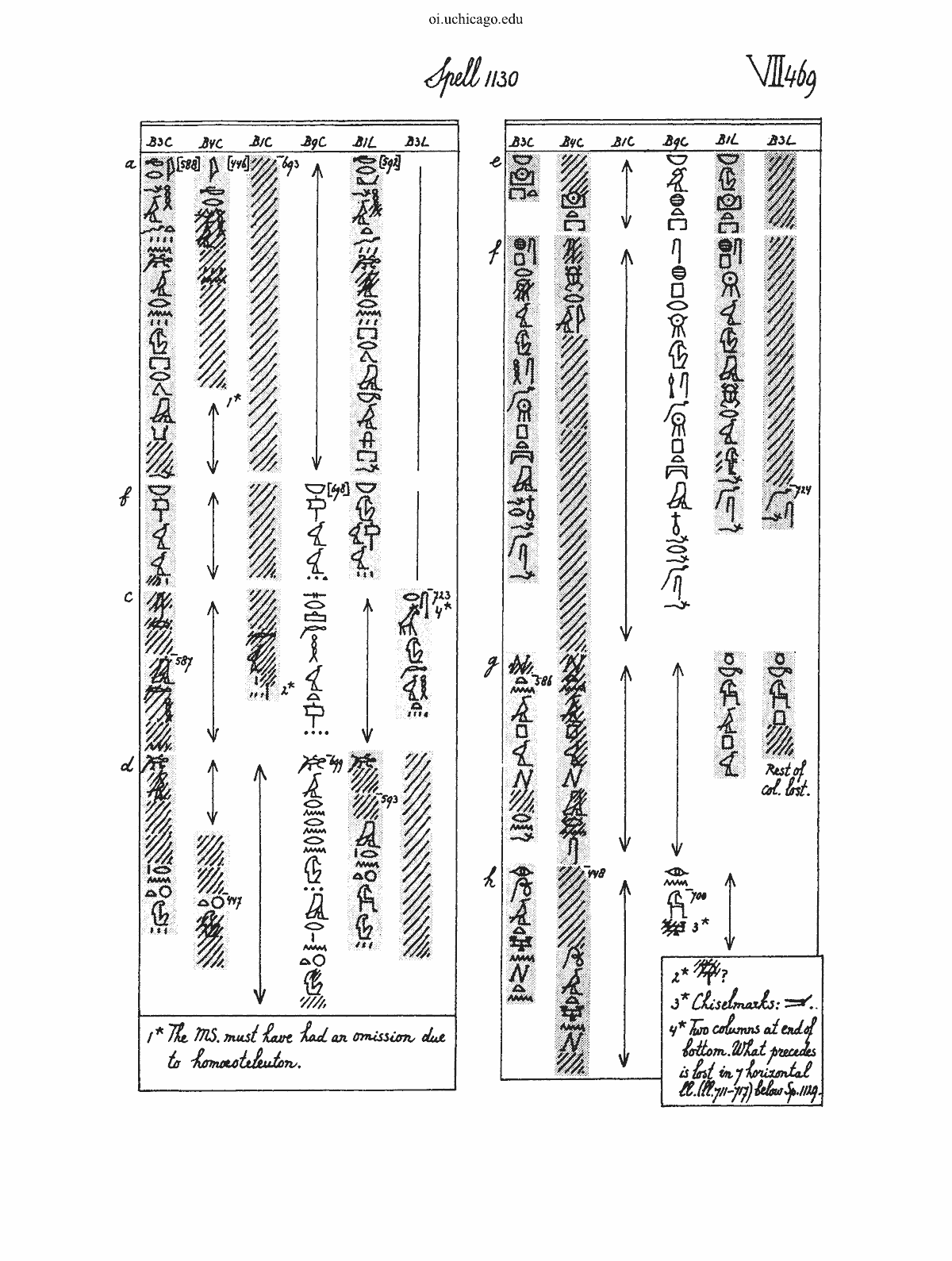
Page 461. De Buck, Coffin Texts VII (1961), hand copy Full source - 461c461,c
ḏd mdw jn štꜣ secret, hidden rn.w names
Words spoken by Him whose štꜣ: secret, hidden,
Note on line 461c
The spell opens the speech of the creator. All the Bersha coffins that have this line agree. - 461d461,d
nb-r-ḏr Lord to the Limit, Lord of All: the creator ḏd ḫft sgr.w the Silent Ones
the nb-r-ḏr: Lord to the Limit, Lord of All: the creator, speaking before the sgr.w: the Silent Ones
Note on line 461d
ḫft means “before, in the presence of”. - 461e461,e
nšn.w those who rage; *nšn* is storm, fury m ẖnj.t šnw.t the Entourage; also a circle, an enclosure
who nšn.w: those who rage; nšn is storm, fury at the rowing of the šnw.t: the Entourage, the gods around the sun; from šn, “to encircle”:
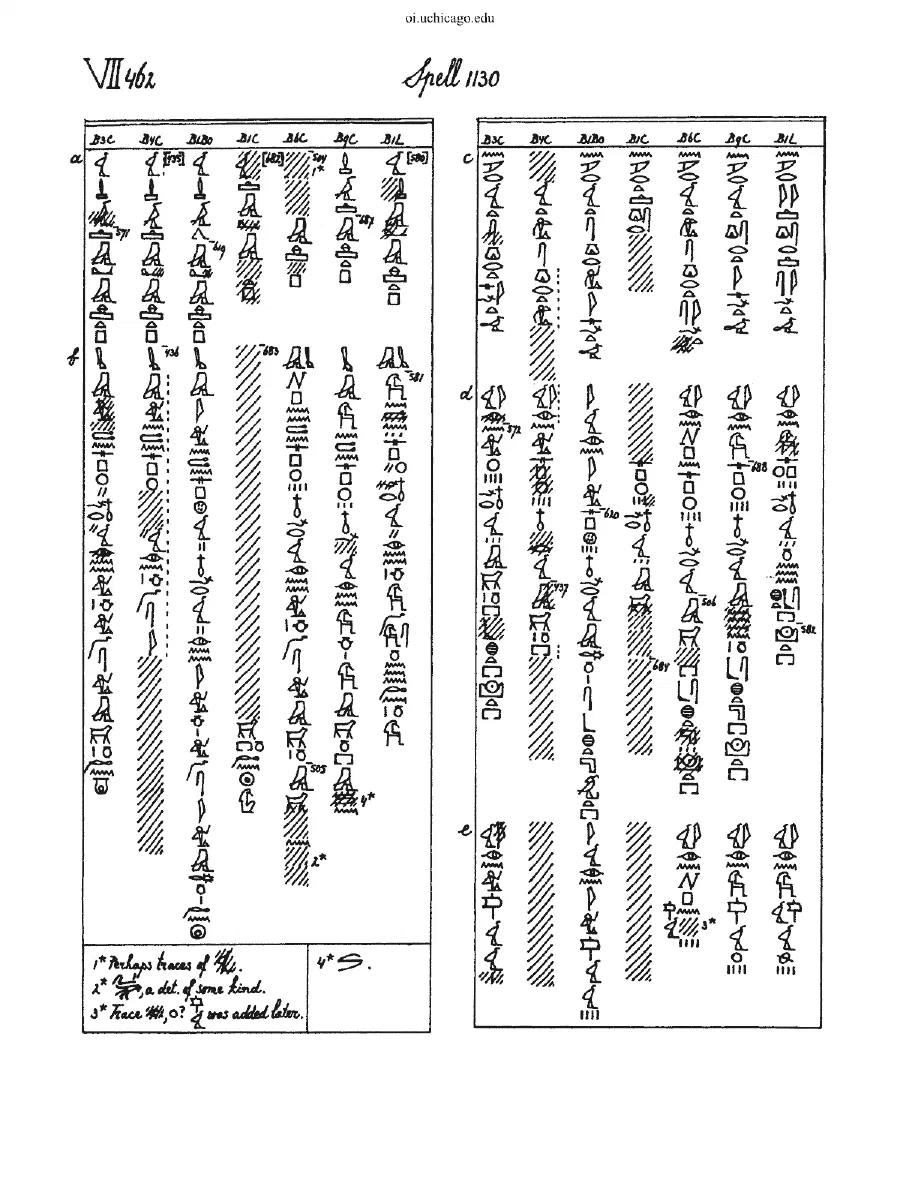
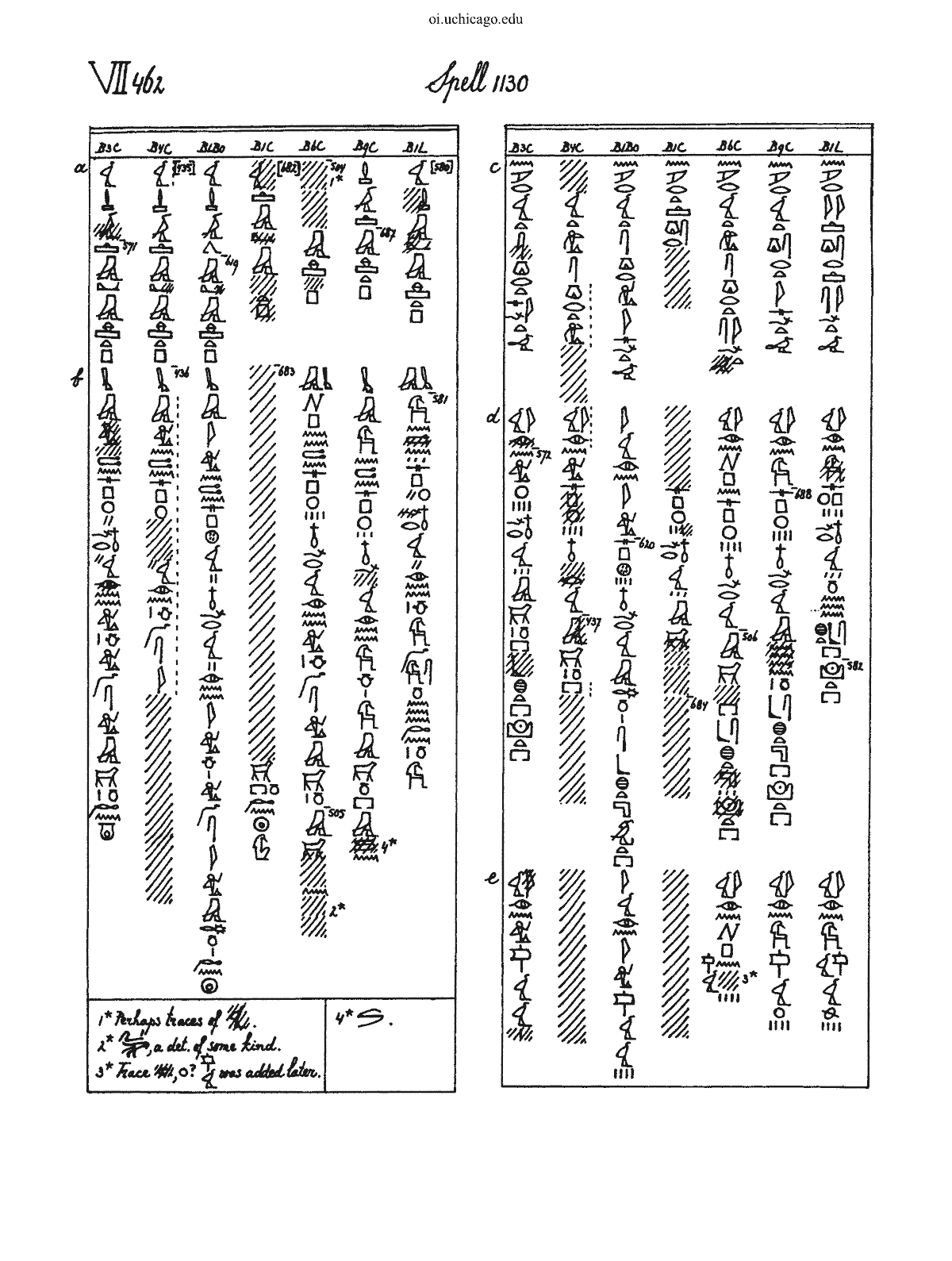
Page 462. De Buck, Coffin Texts VII (1961), hand copy Full source - 462a462,a
wḏꜣ m ḥtp
“Go in peace!
Note on line 462a
Written with the fire-drill sign and walking legs in B1Bo. - 462b462,b
smj=j n=ṯn sp.wj two deeds (dual of *sp*, deed, occasion) nfr.wj good (dual) jr.n n=j jb heart, the inner self that wills ḏs self, own m-ẖnw mḥn Mehen, “the Coiled One”, the serpent that coils round the sun god; written with a coil sign
I report to you the sp.wj: two deeds (dual of sp, deed, occasion) that my own jb: heart, the inner self that wills did for me inside the mḥn: Mehen, “the Coiled One”, the serpent that coils round the sun god; written with a coil sign,
Note on line 462b
The deeds are done by the god’s heart, m-ẖnw mḥn, “inside Mehen”. The creator speaks of what was done inside the serpent that coils round the sun. The dual “two good deeds” clashes with the four deeds listed next; B6C has “four good deeds”. - 462c462,c
n mrw.t sgr to silence (causative of *gr*, be still) ꜥḏꜣ falsehood, wrong; written with the bad-bird sign
so that ꜥḏꜣ: falsehood, wrong; written with the bad-bird sign might be sgr: to silence (causative of gr, be still).
Note on line 462c
B1L reads “because I wish falsehood to be silenced”. - 462d462,d
jr.n=j sp 4 nfr m-ẖnw sbḫ.t portal, gateway ꜣḫ.t horizon, the place where light comes into being
I did four good deeds inside the sbḫ.t: portal, gateway of the ꜣḫ.t: horizon, the place where light comes into being.
- 462e462,e
jr.n=j ṯꜣw wind, breath 4
I made the four ṯꜣw: wind, breath,
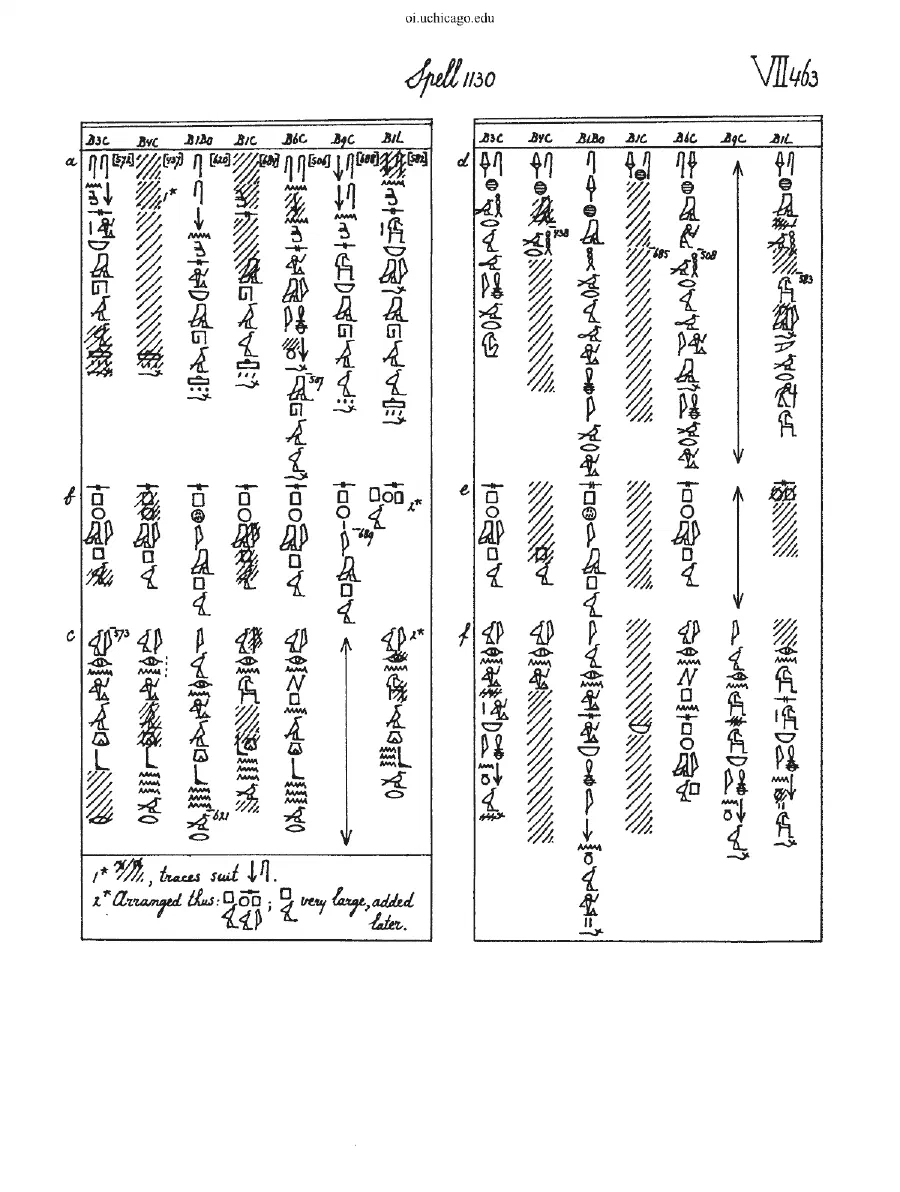
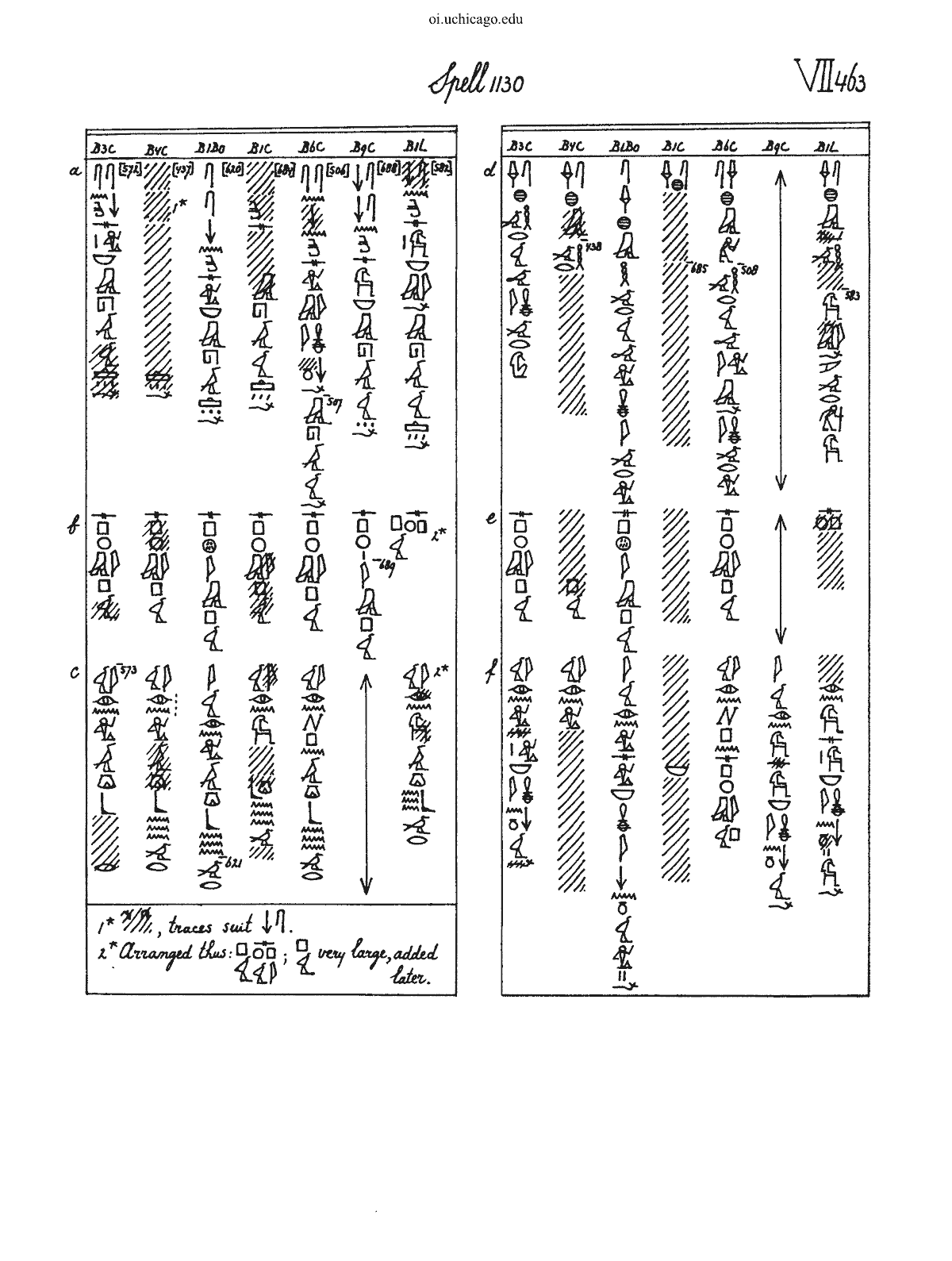
Page 463. De Buck, Coffin Texts VII (1961), hand copy Full source - 463a463,a
ssn to breathe s nb m hꜣw time, lifetime; also neighbourhood
so that every man might ssn: to breathe in his hꜣw: time, lifetime; also neighbourhood.
Note on line 463a
B6C writes “breathe” twice over (ssnsn) and has “there, like his fellows” instead of “every man”. - 463b463,b
sp jm pw
That was one deed of them.
Note on line 463b
jm is “thereof”: one of the four. The refrain closes each deed. Faulkner: “Such was my deed in the matter”. - 463c463,c
jr.n=j ꜣgb flood, the high inundation wr
I made the great ꜣgb: flood, the high inundation,
- 463d463,d
sḫm to have power over, to prevail ḥwrw poor man, wretch mj wr
so that the ḥwrw: poor man, wretch might sḫm: to have power over, to prevail like the great.
Note on line 463d
B6C and B1L add jm=f: “have power over it”, the flood. - 463e463,e
sp jm pw
That was one deed of them.
- 463f463,f
jr.n=j s nb mj snnw fellow, second, equal
I made every man like his snnw: fellow, second, equal.
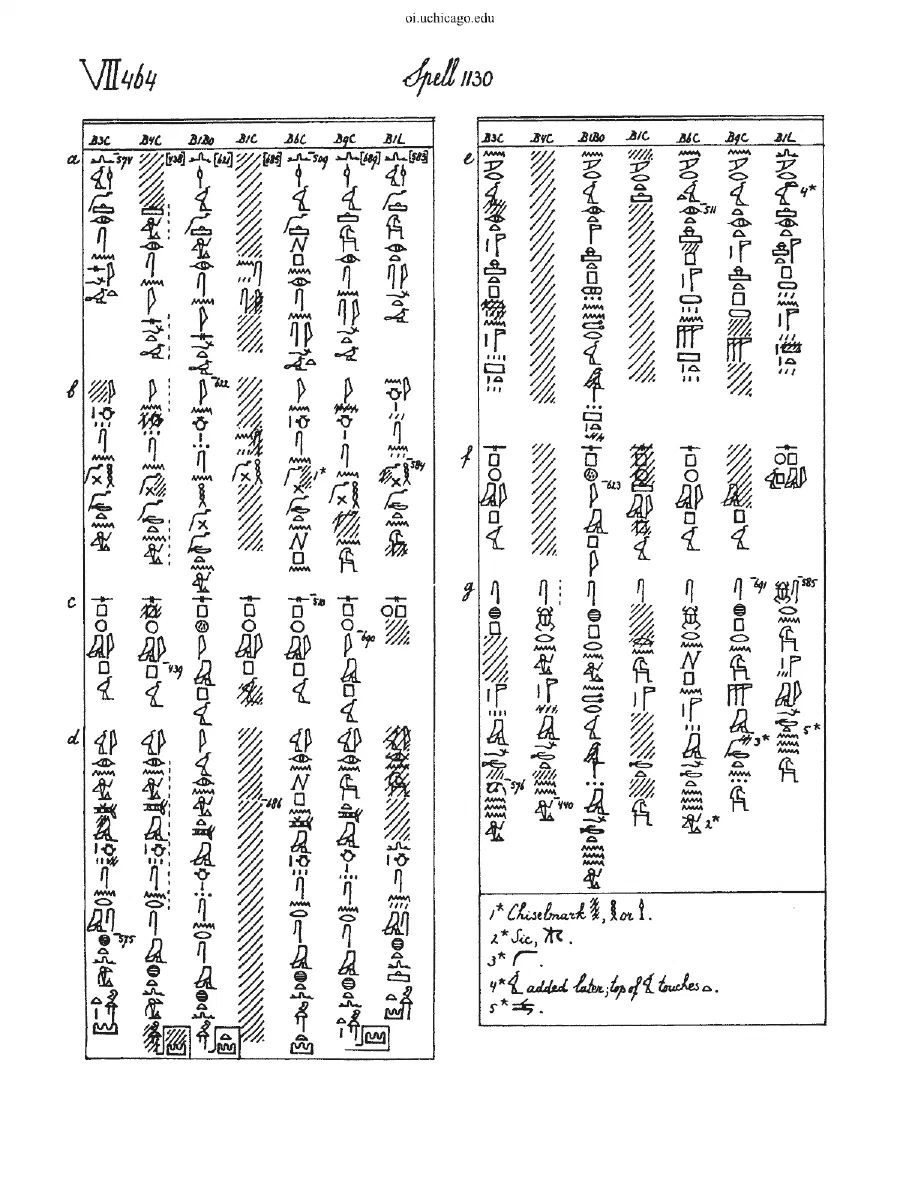
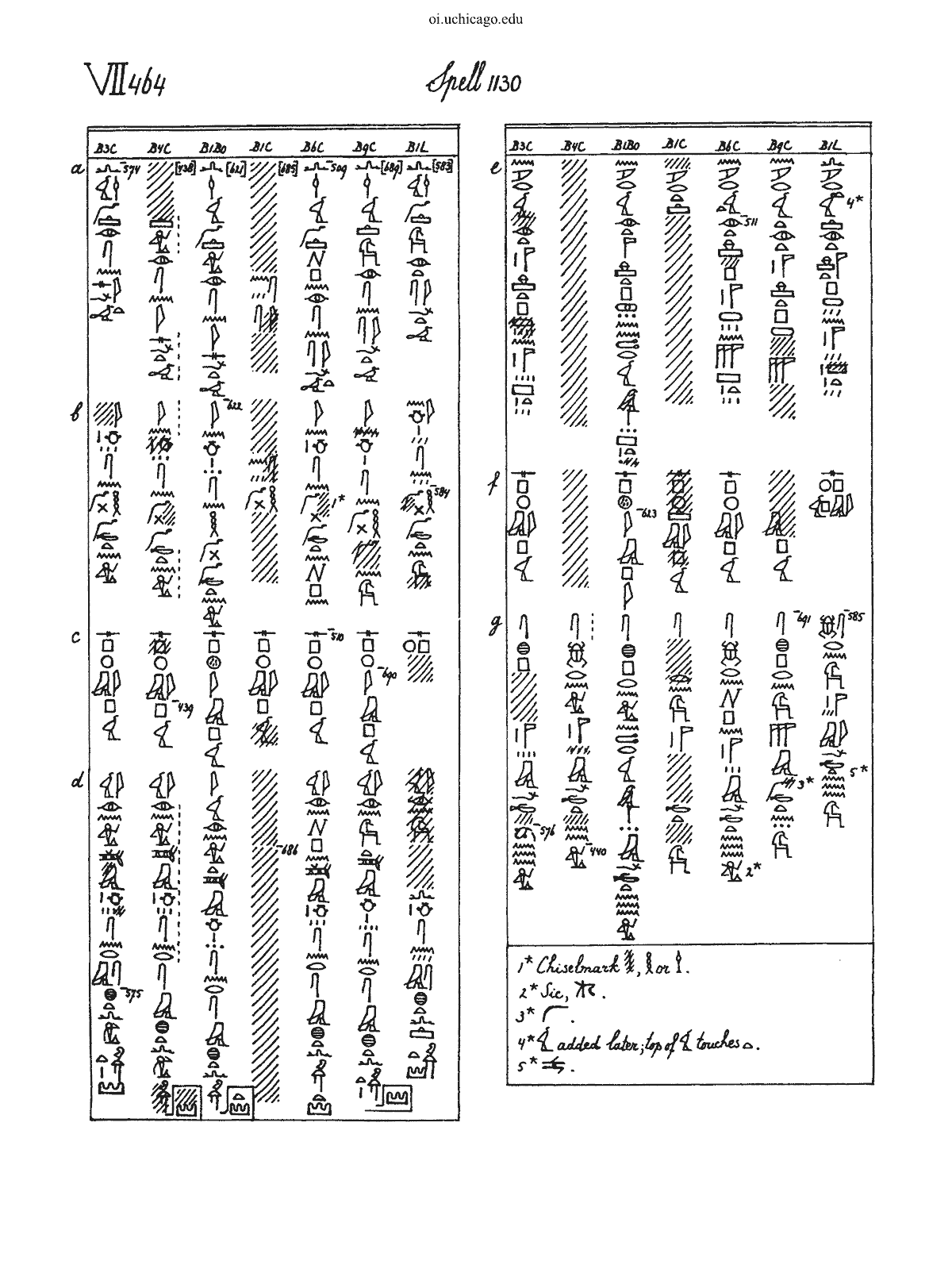
Page 464. De Buck, Coffin Texts VII (1961), hand copy Full source - 464a464,a
n wḏ.n=j jr=sn jzf.t wrong, disorder, the opposite of Maat
I did not wḏ: to command, decree that they do jzf.t: wrong, disorder, the opposite of Maat.
Note on line 464a
Faulkner: “I forbade them to do wrong”. We keep the negated command: the god never ordered disorder. - 464b464,b
jn jb.w=sn ḫnn to disturb, to break (an order); written with crossed sticks ḏd.t.n what (I) said
It was their jb: heart, the inner self that wills that ḫnn: to disturb, to break (an order); written with crossed sticks ḏd.t.n: what (I) said.
Note on line 464b
jn puts the weight on the hearts: they, not the god, broke the word. Faulkner: “their hearts disobeyed what I had said”. - 464c464,c
sp jm pw
That was one deed of them.
- 464d464,d
jr.n=j tm jb.w=sn smḫ to forget jmn.t the West, the land of the dead
I made their hearts unable to smḫ: to forget the jmn.t: the West, the land of the dead,
- 464e464,e
n mrw.t jr.t ḥtp.w-nṯr god's-offerings n nṯr.w spꜣ.wt nomes, districts
so that ḥtp.w-nṯr: god's-offerings would be made to the gods of the spꜣ.wt: nomes, districts.
- 464f464,f
sp jm pw
That was one deed of them.
- 464g464,g
sḫpr.n=j nṯr.w m fdw sweat
I sḫpr: to cause to come into being, to create the gods from my fdw: sweat,
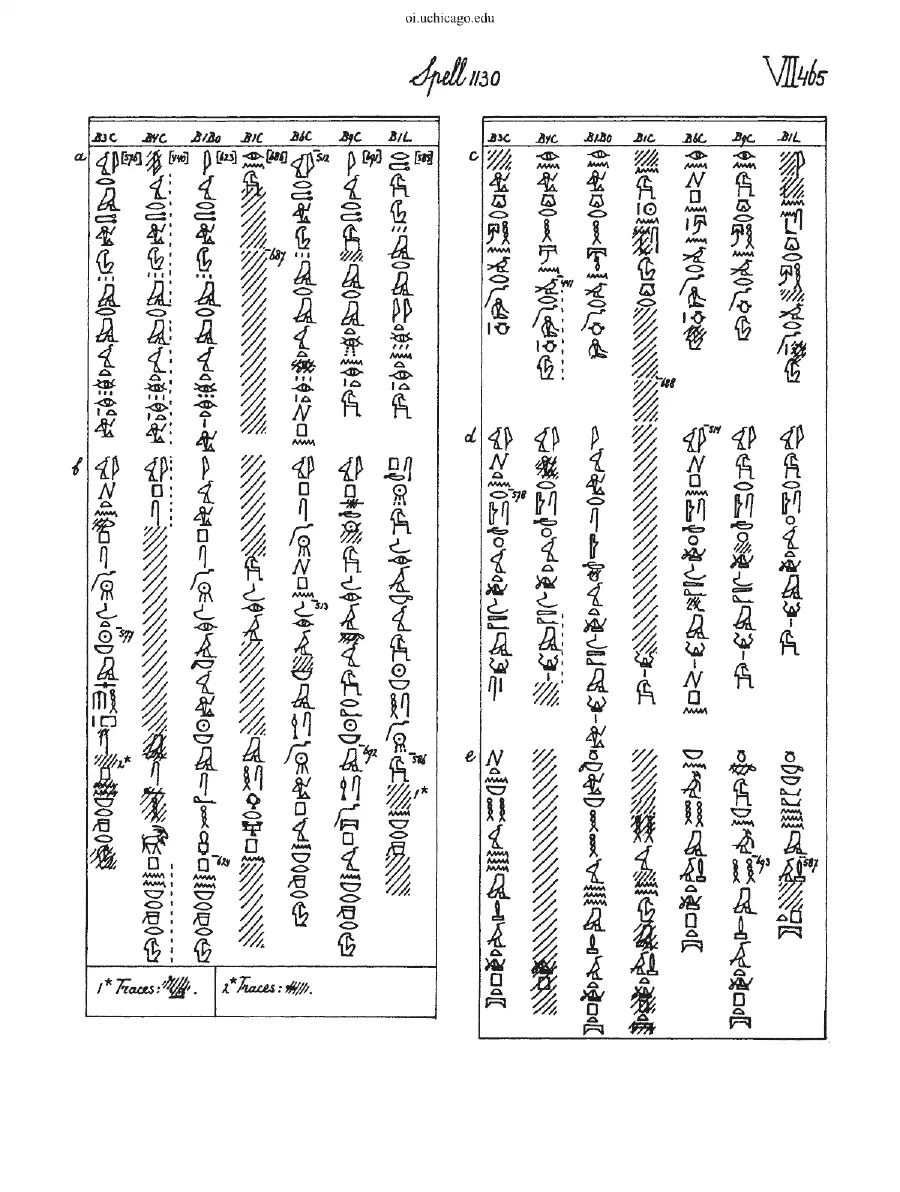
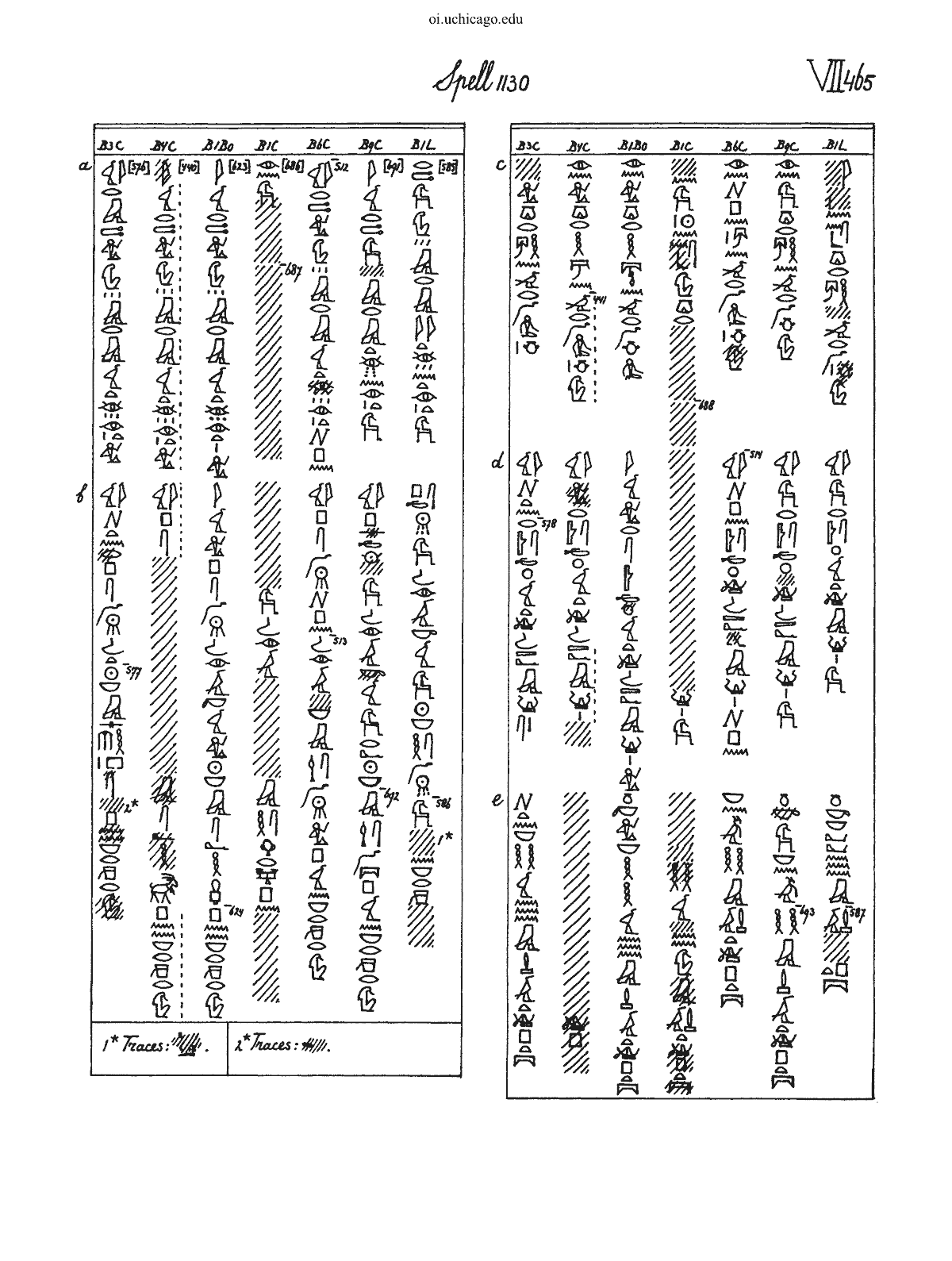
Page 465. De Buck, Coffin Texts VII (1961), hand copy Full source - 465a465,a
jw rmṯ people, humankind m rmy.t tears; the pun *rmṯ*/*rmy.t* makes people the tears of the god n.t jr.t=j
and rmṯ: people, humankind are from the rmy.t: tears; the pun rmṯ/rmy.t makes people the tears of the god of my eye.
Note on line 465a
The pun rmṯ “people” / rmy.t “tears” is the text’s own: humankind is what the god wept. - 465b465,b
jw=j psḏ to shine mꜣꜣ.tw=j rꜥ nb m sꜥḥ dignity, noble rank nb-r-ḏr Lord to the Limit, Lord of All: the creator
I will psḏ: to shine and be seen every day in the sꜥḥ: dignity, noble rank of the Lord to the Limit.
Note on line 465b
This follows B1Bo. B3C, which Faulkner follows, has “I will shine anew every day in their booth for the Lord of All”; B1L garbles psḏ=j into spḏ=j. - 465c465,c
jr.n=j grḥ night n wrḏ-jb “Weary of Heart”, Osiris lying in death
I made the grḥ: night for the wrḏ-jb: “Weary of Heart”, Osiris lying in death.
Note on line 465c
The Weary of Heart is Osiris, the dead god, whose epithet it is. - 465d465,d
jw=j r ẖnj to row m wjꜣ bark of the sun
I shall ẖnj: to row in my wjꜣ: bark of the sun,
- 465e465,e
jnk nb ḥḥw flood-waters ḏꜣ p.t
for I am lord of the ḥḥw: flood-waters that cross the sky.
Note on line 465e
Faulkner attaches “crossing the sky” to the speaker; we attach it to the waters. B9C and B6C have “lord of eternity” (nḥḥ) for “lord of the waters” (ḥḥw); B1L “I am the lord who gives water”. 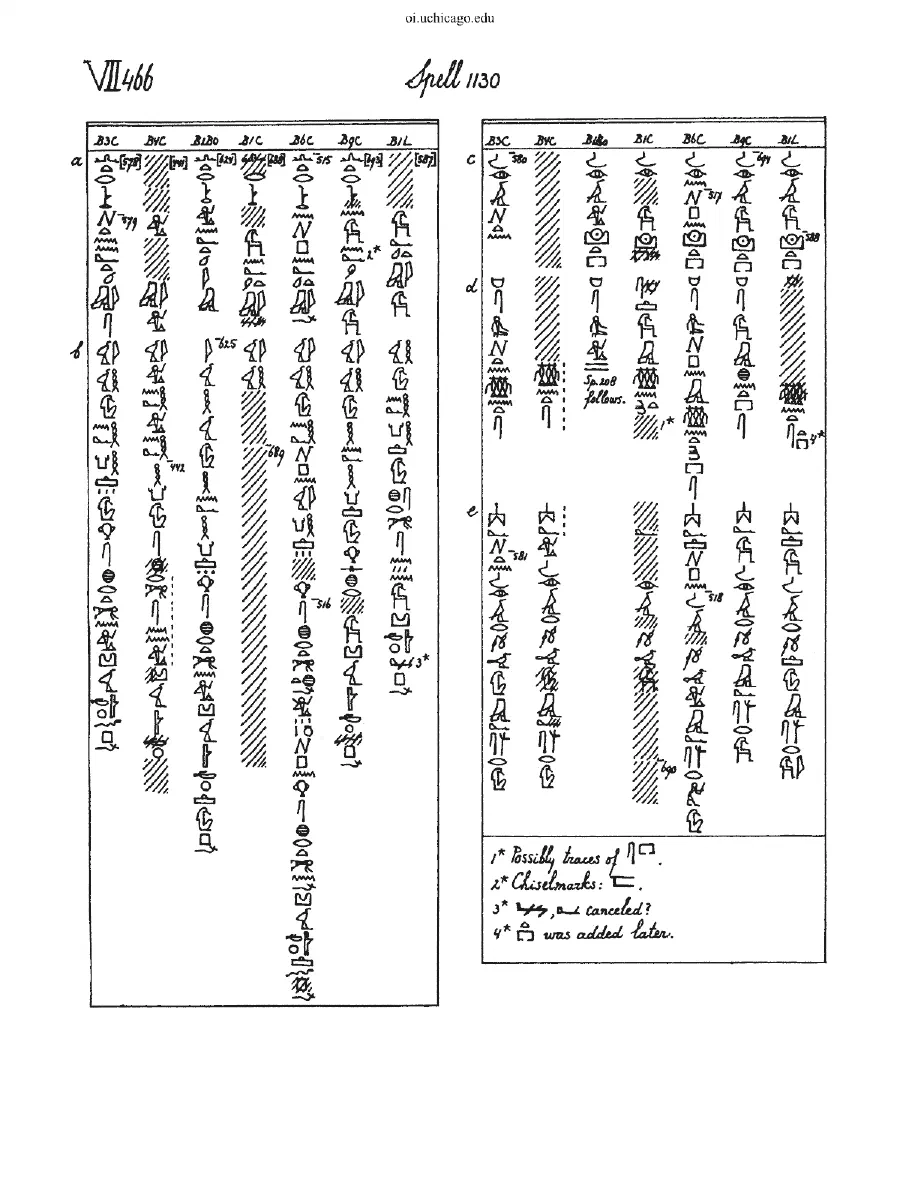
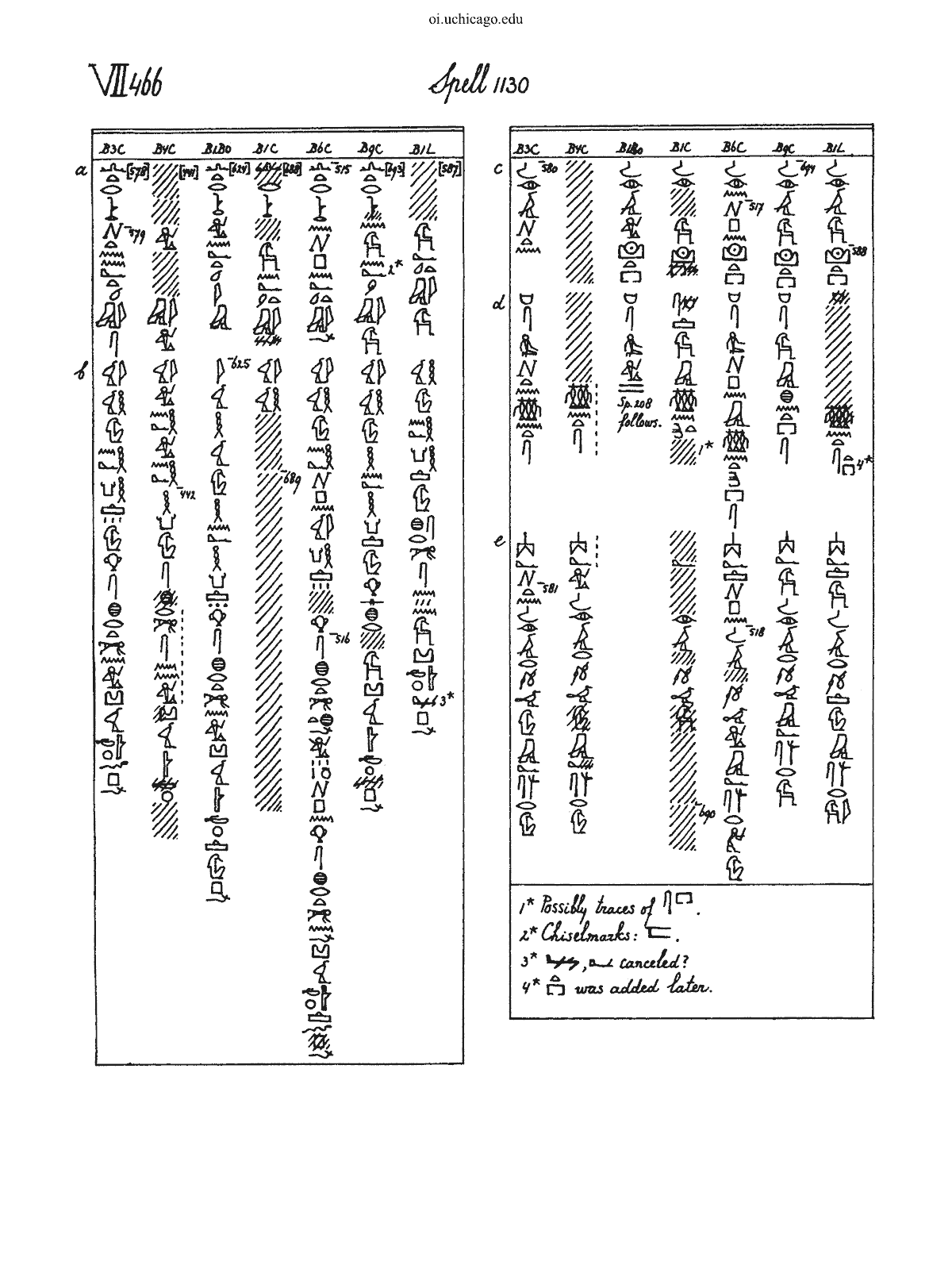
Page 466. De Buck, Coffin Texts VII (1961), hand copy Full source - 466a466,a
n tr to reject m ꜥ.t=j nb.t
I am not tr: to reject for any limb of mine.
- 466b466,b
jw Ḥw Hu, the creative Utterance, a god ḥnꜥ Ḥkꜣ Heka, Magic, a god ḥr sḫr to fell, to overthrow n=j nbd the Evil One, the Ill-disposed pf
Ḥw: Hu, the creative Utterance, a god is with Ḥkꜣ: Heka, Magic, a god, sḫr: to fell, to overthrow for me that nbd: the Evil One, the Ill-disposed.
Note on line 466b
Utterance and Magic are the god’s weapons. B6C expands: “felling N’s enemies and felling that Evil One for him”. - 466c466,c
mꜣꜣ=j ꜣḫ.t horizon, the place where light comes into being
I see the horizon,
Note on line 466c
B3C leaves out “horizon”. - 466d466,d
ḥms=j ḫnt=s
I sit before it,
Note on line 466d
B1Bo stops here; the rest of the spell is read from B9C, B3C and B1L. - 466e466,e
wḏꜥ to judge, to separate mꜣr wretched, poor ḥnꜥ wsr powerful, rich
I wḏꜥ: to judge, to separate between the mꜣr: wretched, poor and the wsr: powerful, rich,
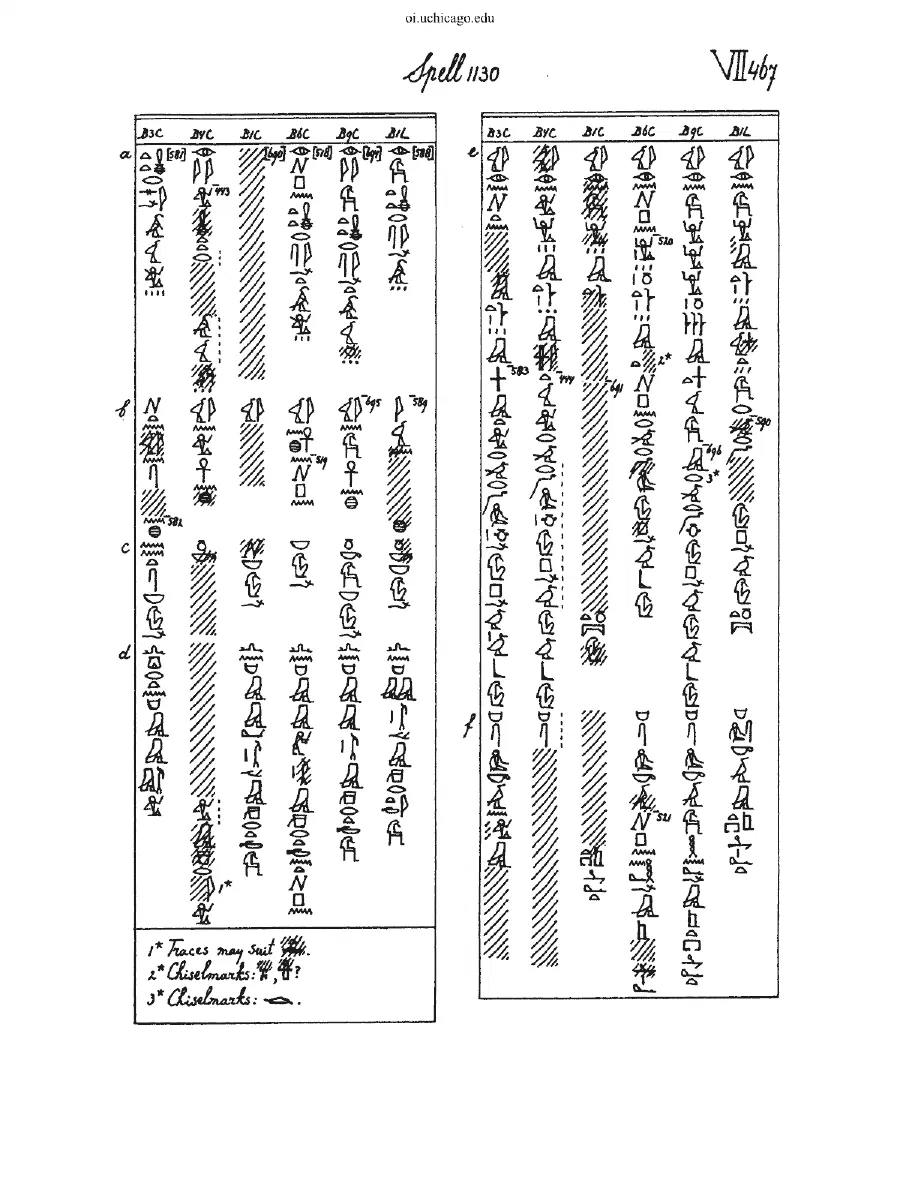
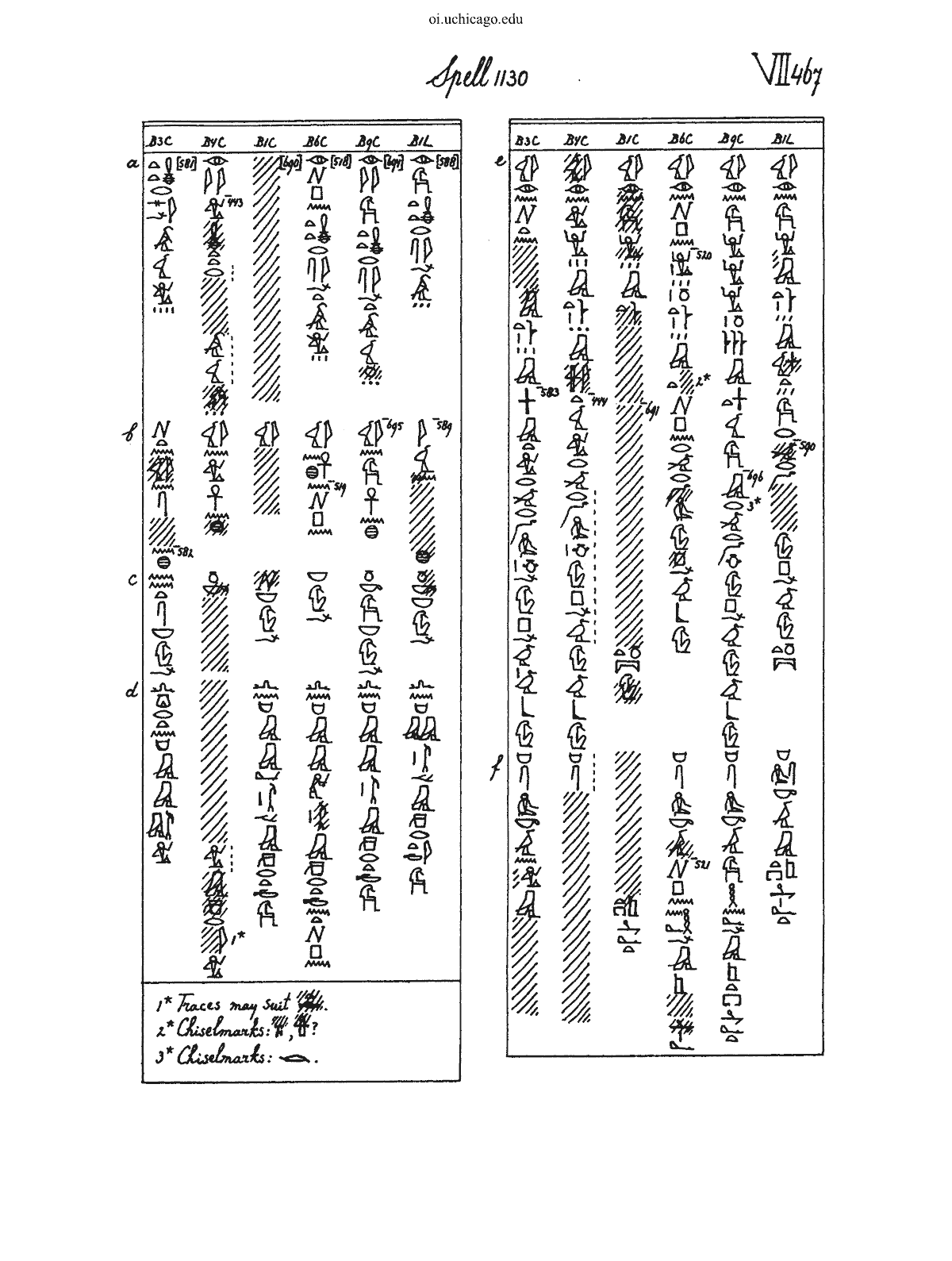
Page 467. De Buck, Coffin Texts VII (1961), hand copy Full source - 467a467,a
jr=j mj.tt r jzf.tjw wrongdoers
and I do the same for the jzf.tjw: wrongdoers.
- 467b467,b
jw n=j ꜥnḫ life; to live
ꜥnḫ: life; to live is mine,
- 467c467,c
jnk nb=f
for I am its lord,
- 467d467,d
n nḥm.tw ꜥwt staff
and my ꜥwt: crook-staff will not be taken away.
Note on line 467d
Variant: “the staff will not be taken from my hand”. - 467e467,e
jr.n=j ḥḥ a million, myriads m rnp.wt jmj.tw=j r wrḏ-jb “Weary of Heart”, Osiris lying in death pf sꜣ Gbb Geb, the earth god
I have spent ḥḥ: a million, myriads of years between me and that wrḏ-jb: “Weary of Heart”, Osiris lying in death, the son of Gbb: Geb, the earth god.
Note on line 467e
Faulkner takes this as the interval between the coming into being of the creator and of the Inert One. - 467f467,f
ḥms=j ḥnꜥ=f m s.t wꜥ.t
Then I will sit with him in one place,
Note on line 467f
This is the end of the world: creator and dead god sit together, and what follows is the undoing of the made world. 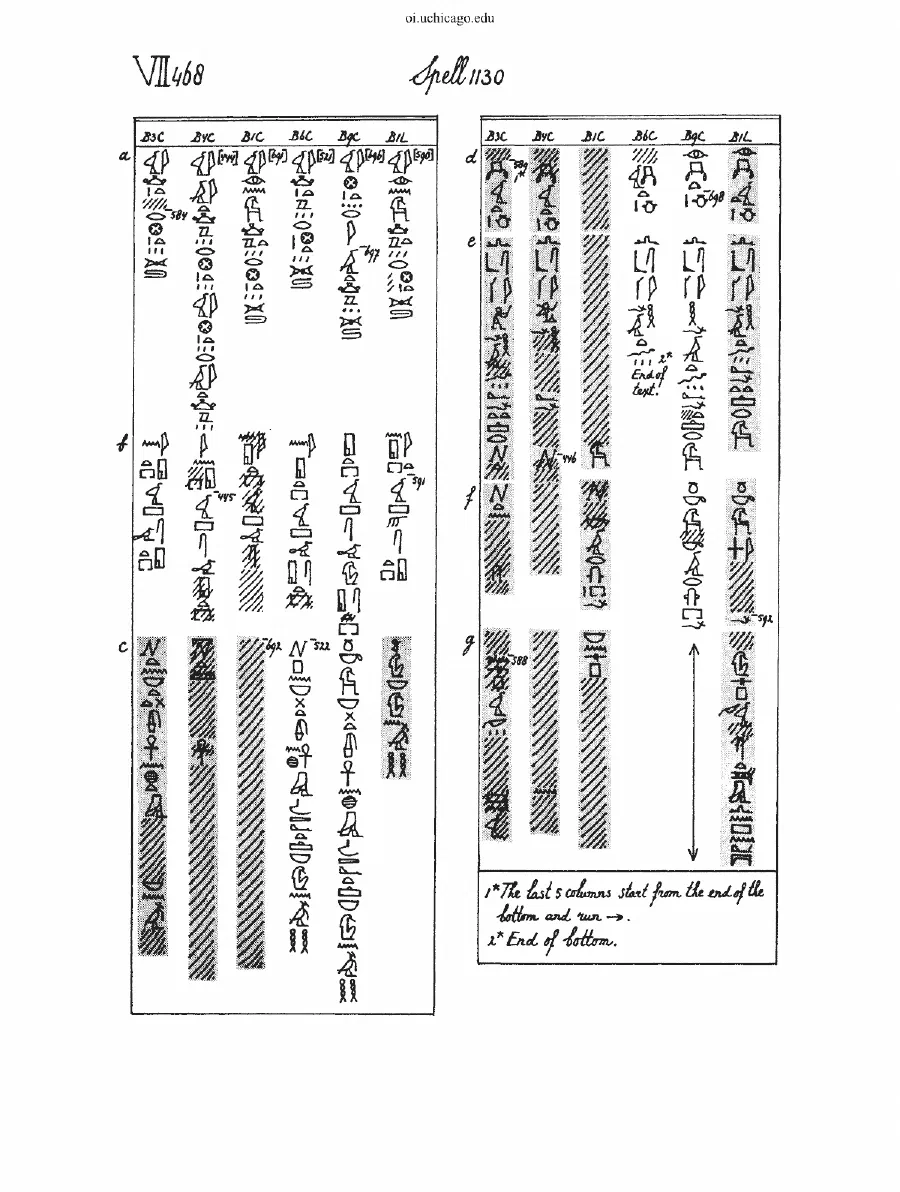
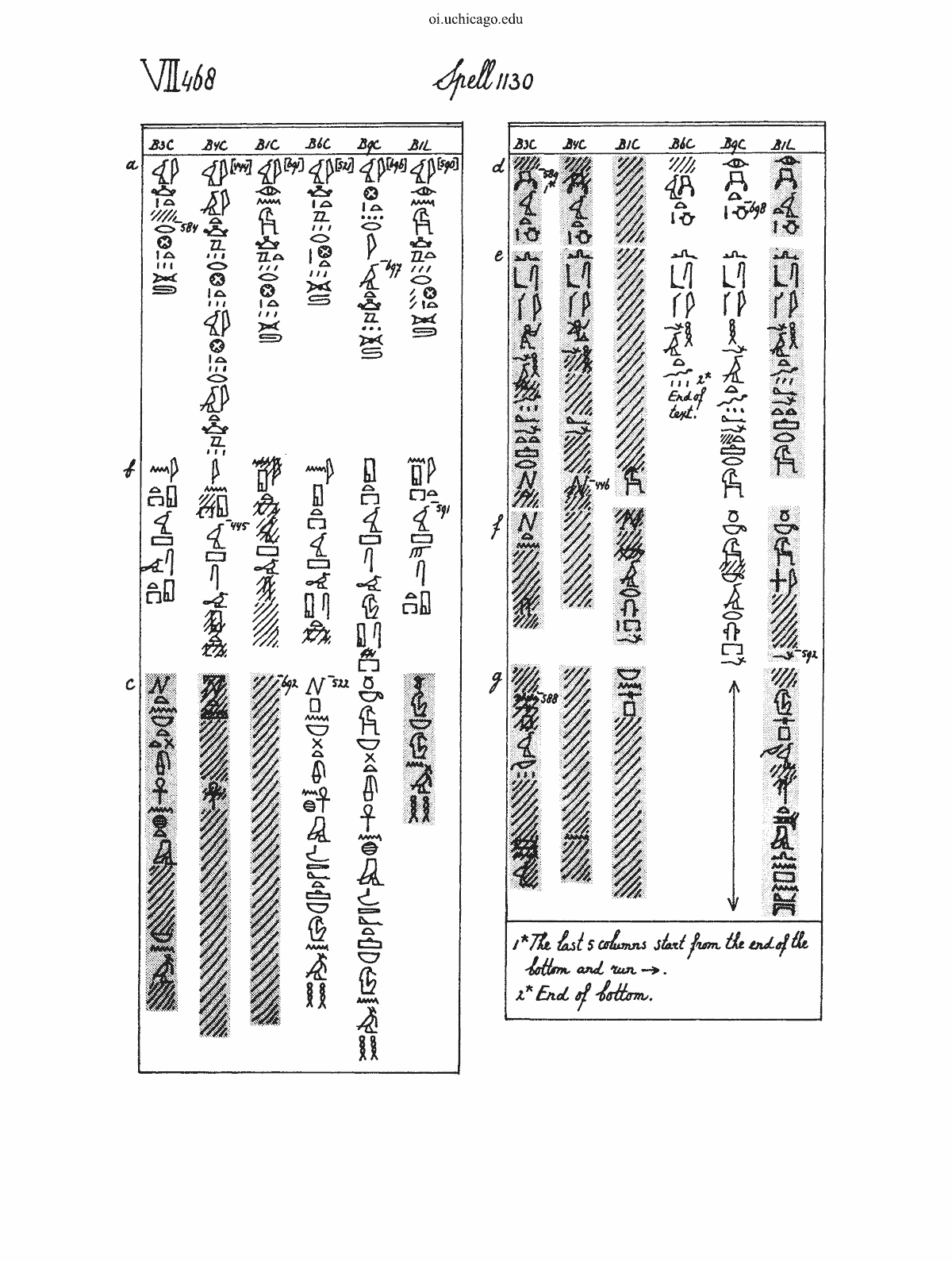
Page 468. De Buck, Coffin Texts VII (1961), hand copy Full source - 468a468,a
jw jꜣ.wt mounds, ruin-heaps r njw.wt towns njw.wt towns r jꜣ.wt mounds, ruin-heaps
and jꜣ.wt: mounds, ruin-heaps will be njw.wt: towns, and towns mounds;
- 468b468,b
ḥw.t wꜣs to ruin, to lay waste ḥw.t
house will wꜣs: to ruin, to lay waste house.
Note on line 468b
ḥw.t is a great house or temple; Faulkner: “mansion will desolate mansion”. - 468c468,c
jnk nb ḫ.t fire ꜥnḫ life; to live m mꜣꜥ.t Maat, right order, truth nb nḥḥ eternity (cyclic)
I am the lord of ḫ.t: fire, who lives on mꜣꜥ.t: Maat, right order, truth, lord of nḥḥ: eternity (cyclic),
- 468d468,d
jr ꜣw.t-jb joy, “wideness of heart”
who makes ꜣw.t-jb: joy, “wideness of heart”.
- 468e468,e
n sbj to rebel ḥfꜣ.w snakes rftt a word of unknown meaning, found in several Coffin Texts spells (paths, gods of the *rftt*) r=j
The ḥfꜣ.w: snakes of the rftt: a word of unknown meaning, found in several Coffin Texts spells will not sbj: to rebel against me.
Note on line 468e
rftt occurs in about ten spells (“paths of the rftt”, “gods of the rftt”), but its meaning is unknown; Faulkner leaves it untranslated. B6C ends at this line. - 468f468,f
jnk kꜣr shrine
My kꜣr: shrine belongs to me:
Note on line 468f
B9C. B1L: “I am the one in his [shrine]”. - 468g468,g
nb [...] tm nšn rage, storm
lord of [wounds], who ends the nšn: rage, storm,
Note on line 468g
The word after “lord” is damaged in B3C and B1L; Faulkner restores “wounds”. tm is “who ends”. 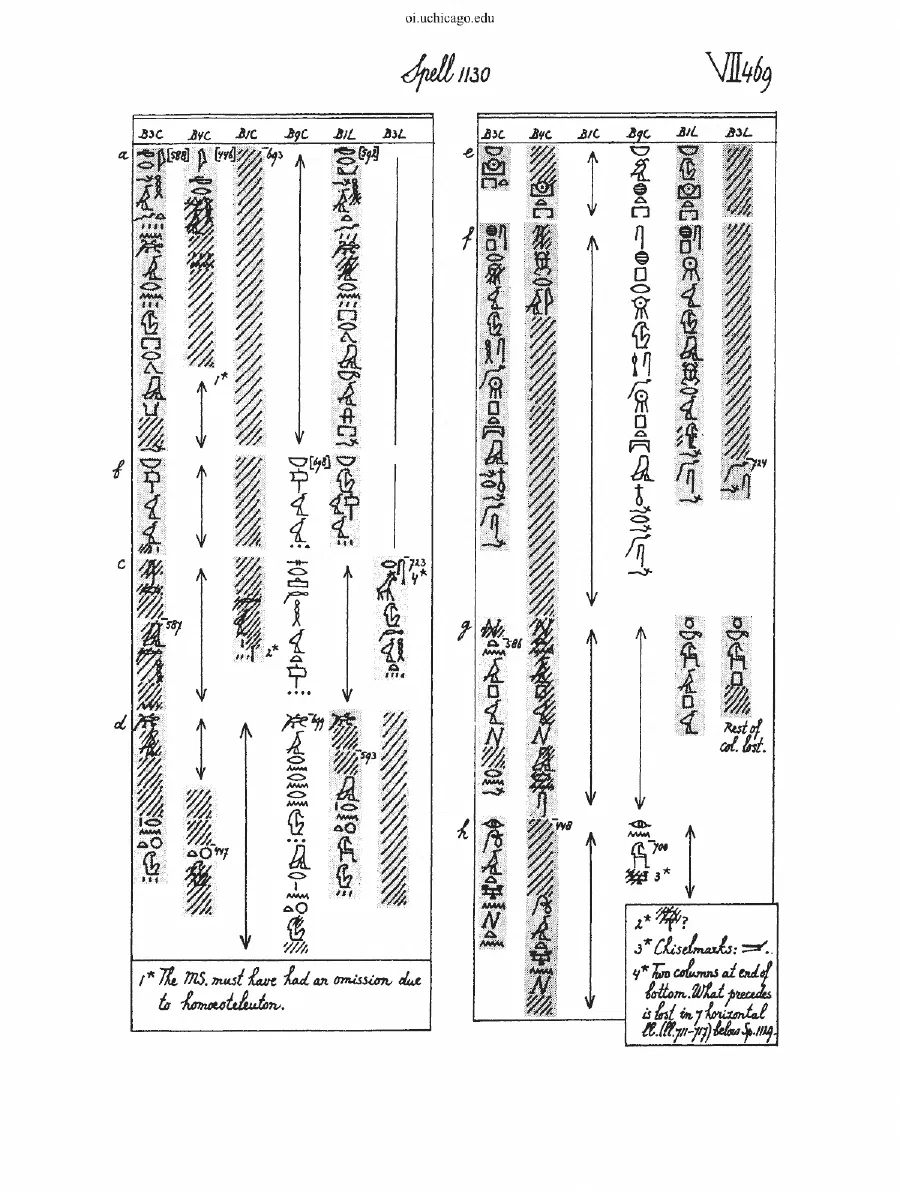
Page 469. De Buck, Coffin Texts VII (1961), hand copy Full source - 469a469,a
dr to drive off, to expel ḥfꜣ.w snakes n ꜥšꜣ many rn.w names pr m kꜣr shrine
who dr: to drive off, to expel the snakes for Him of ꜥšꜣ: many Names when he comes out of his shrine;
Note on line 469a
B4C skips this line; de Buck notes an omission by homoeoteleuton. - 469b469,b
nb ṯꜣw.w
lord of the winds,
- 469c469,c
sr to foretell, to announce; written with the giraffe mḥy.t the north wind
who sr: to foretell, to announce; written with the giraffe the mḥy.t: the north wind;
- 469d469,d
ꜥšꜣ many rn.w names m rꜣ spell, utterance; mouth n psḏ.t the Ennead, the Nine gods
many of names in the mouth of the psḏ.t: the Ennead, the Nine gods;
- 469e469,e
nb ꜣḫ.t horizon, the place where light comes into being
lord of the horizon,
- 469f469,f
sḫpr to cause to come into being, to create stw.t sunlight, rays sḥḏ to illuminate p.t m nfr.w beauty
who brings stw.t: sunlight, rays into being and sḥḏ: to illuminate the sky with his nfr.w: beauty.
- 469g469,g
jnk pw
That is who I am.
- 469h469,h
jr wꜣ.t way, road n=j
Make a wꜣ.t: way, road for me,
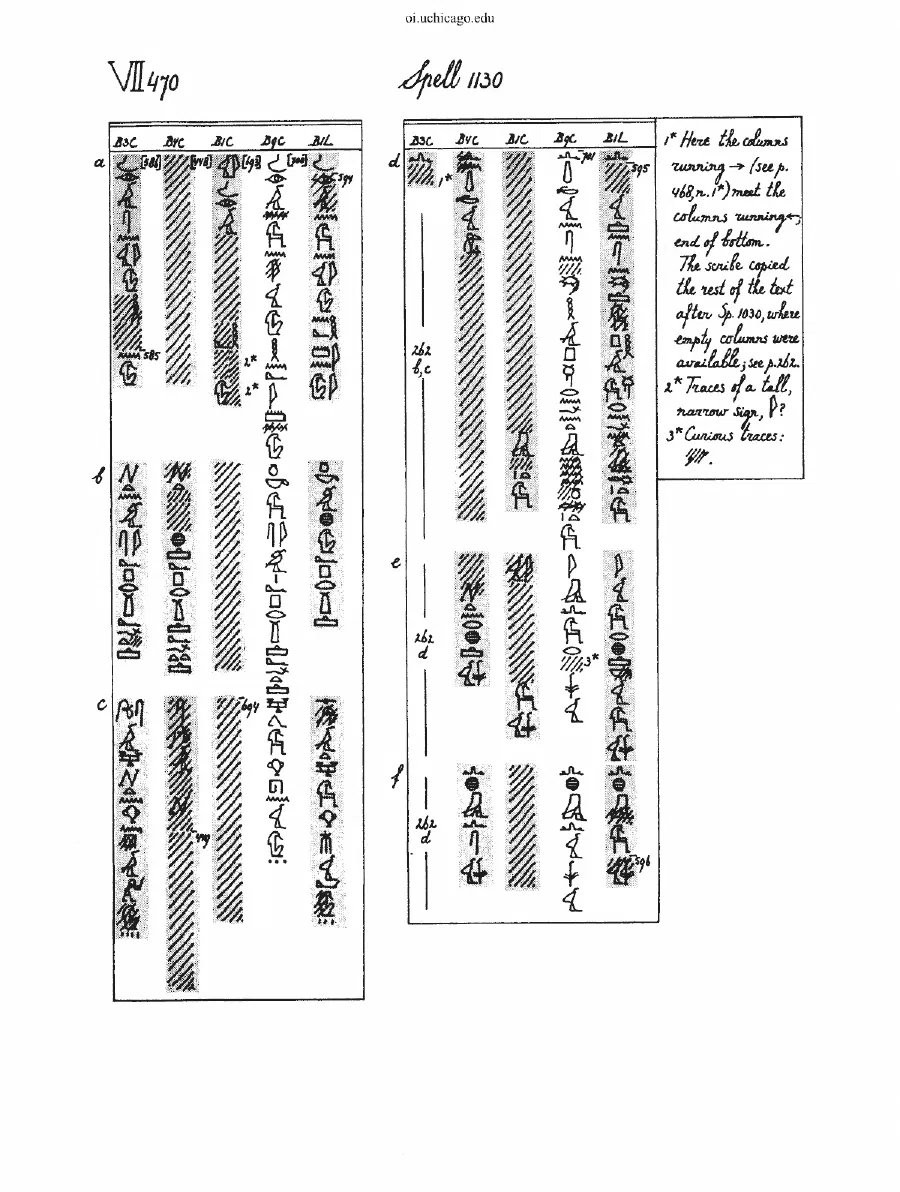
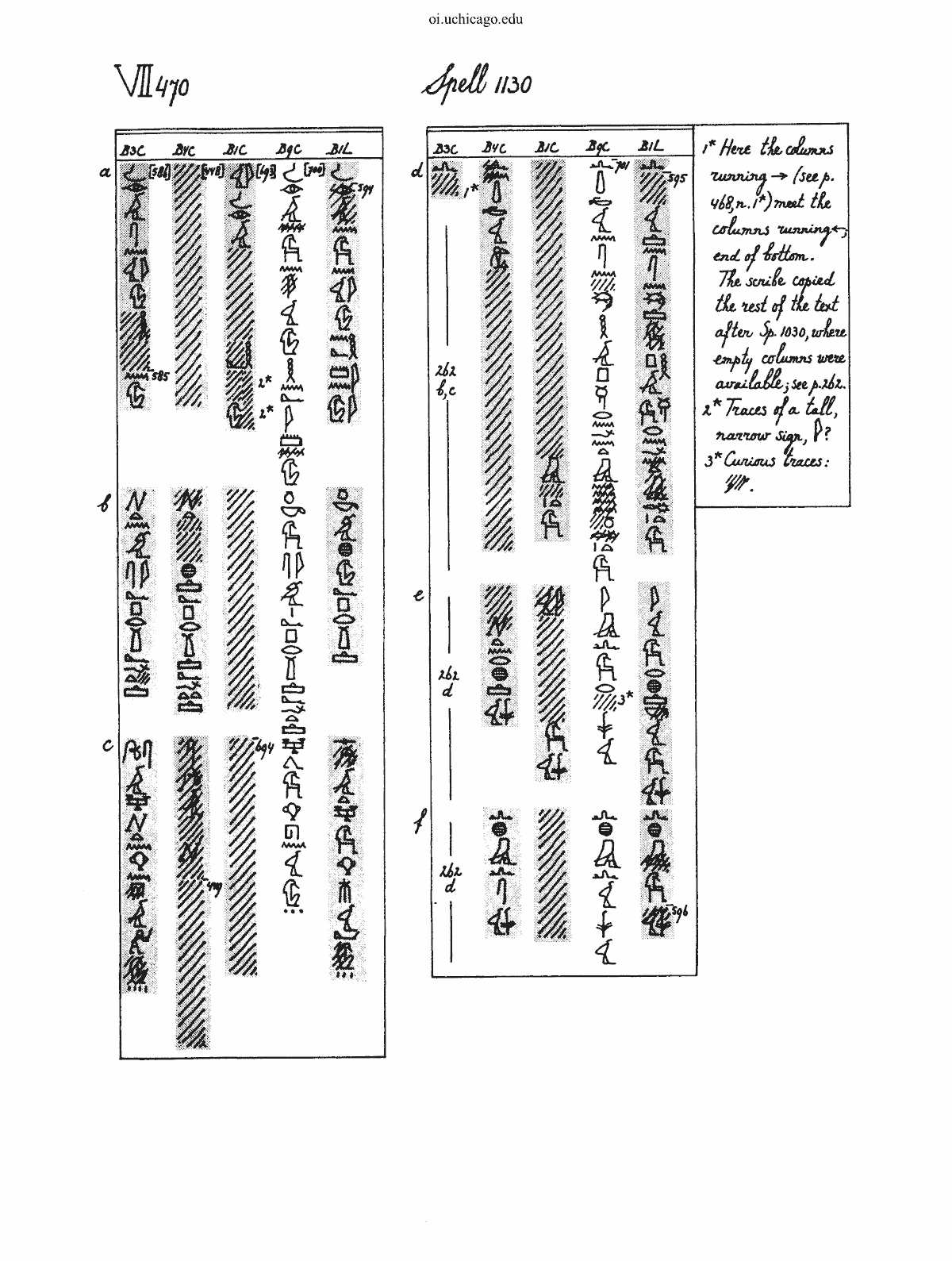
Page 470. De Buck, Coffin Texts VII (1961), hand copy Full source - 470a470,a
mꜣꜣ=j Nyw Niu, one of the primeval gods ḥnꜥ Jmn Amun, “the Hidden One”
that I may see Nyw: Niu, one of the primeval gods and Jmn: Amun, “the Hidden One”.
Note on line 470a
Niu and Amun are two of the primeval gods of Hermopolis, the powers before creation. - 470b470,b
jnk ꜣḫ spirit, an effective transfigured being ꜥpr equipped rftt a word of unknown meaning, found in several Coffin Texts spells (paths, gods of the *rftt*)
I am a ꜣḫ: spirit, an effective transfigured being, ꜥpr: equipped with the rftt;
Note on line 470b
rftt again, unknown. Faulkner: “I am a spirit who has acquired …”. - 470c470,c
swꜣ to pass by ḥr nḥꜣ.w the Nehau, unknown beings (variants *ḥnw*, *msw*)
I swꜣ: to pass by the nḥꜣ.w: the Nehau, unknown beings (variants ḥnw, msw).
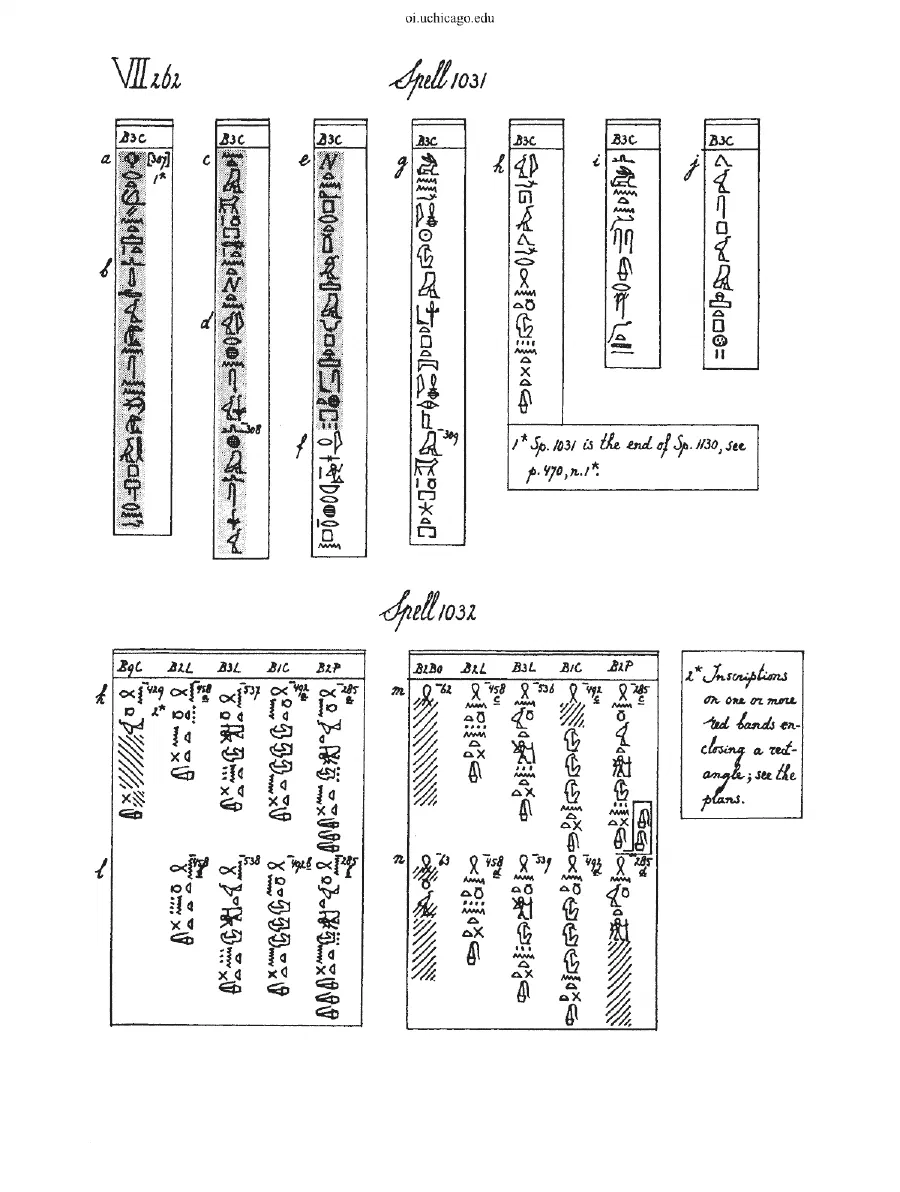
Page 262. De Buck, Coffin Texts VII (1961), hand copy Full source - 262a262,a
ḥr.t sky, firmament pḥ.wj back, hind part n mḏꜣ.t book, papyrus roll
[They will not speak the word] that is on the pḥ.wj: back, hind part of the mḏꜣ.t: book, papyrus roll,
Note on line 262a
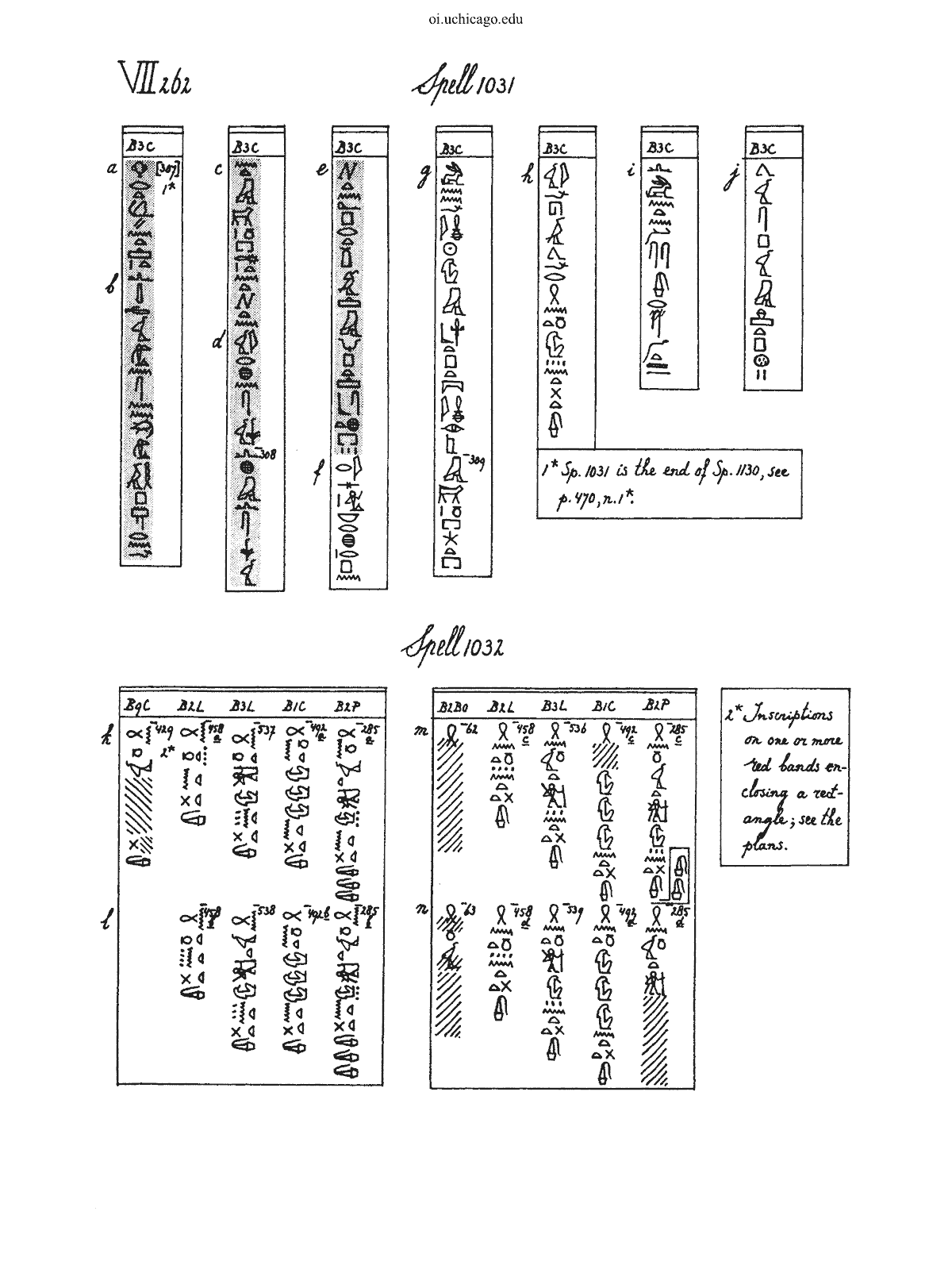
From here B3C’s text stands on another part of the coffin (de Buck’s Spell 1031, VII 262), where the scribe found empty columns. In B9C and B1L (VII 470d) the line is damaged, and every copy lacks the start of the sentence: the bracket is Faulkner’s restoration. - 262b262,b
n mdw=sn n snḏ fear n štꜣ secret, hidden rn name jmj ẖ.t belly, body
they will not speak, for snḏ: fear of Him whose name is secret, who is in my ẖ.t: belly, body.
Note on line 262b
The speaker carries the god of the secret name inside his own body. - 262d262,d
jw=j rḫ.kwj I know sw n ḫm not to know, to be ignorant of sw
I rḫ.kwj: I know him; I am not ḫm: not to know, to be ignorant of of him.
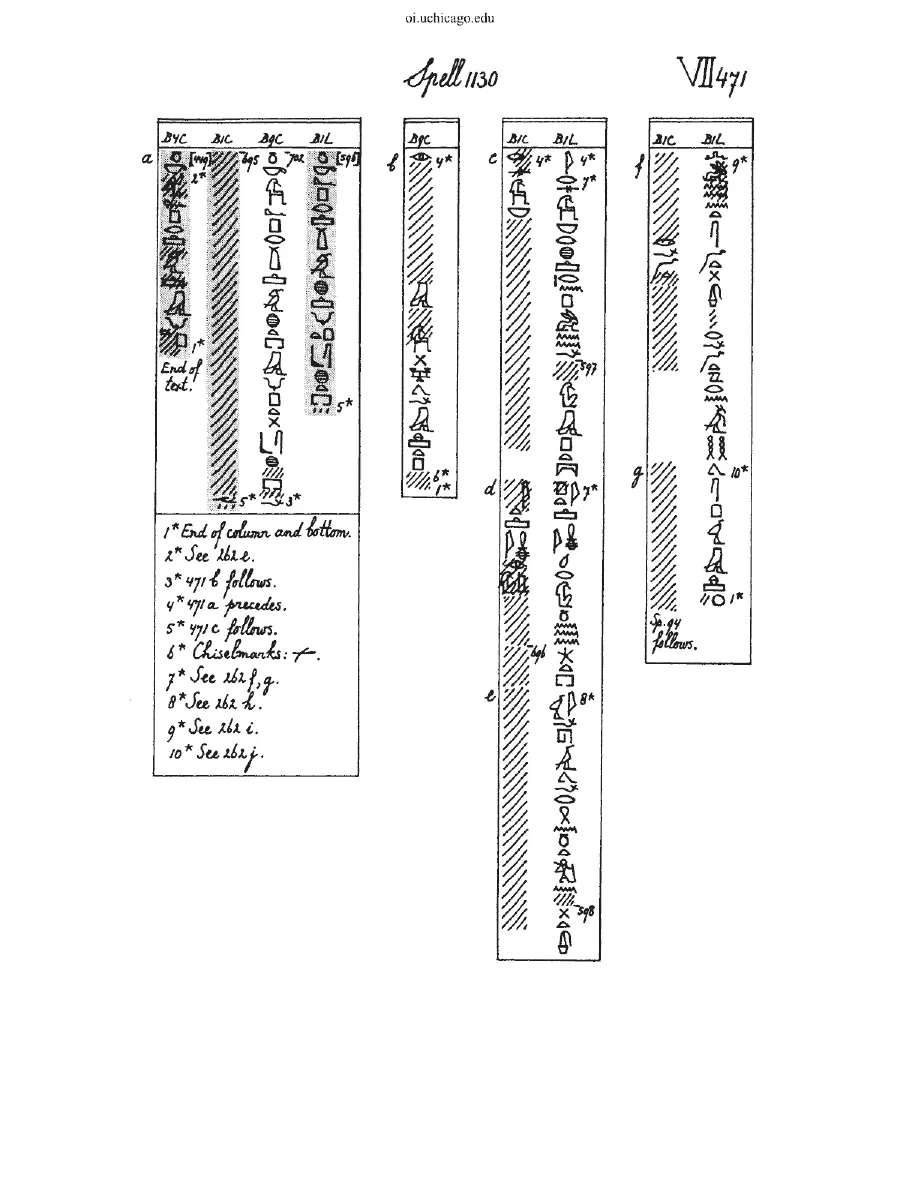
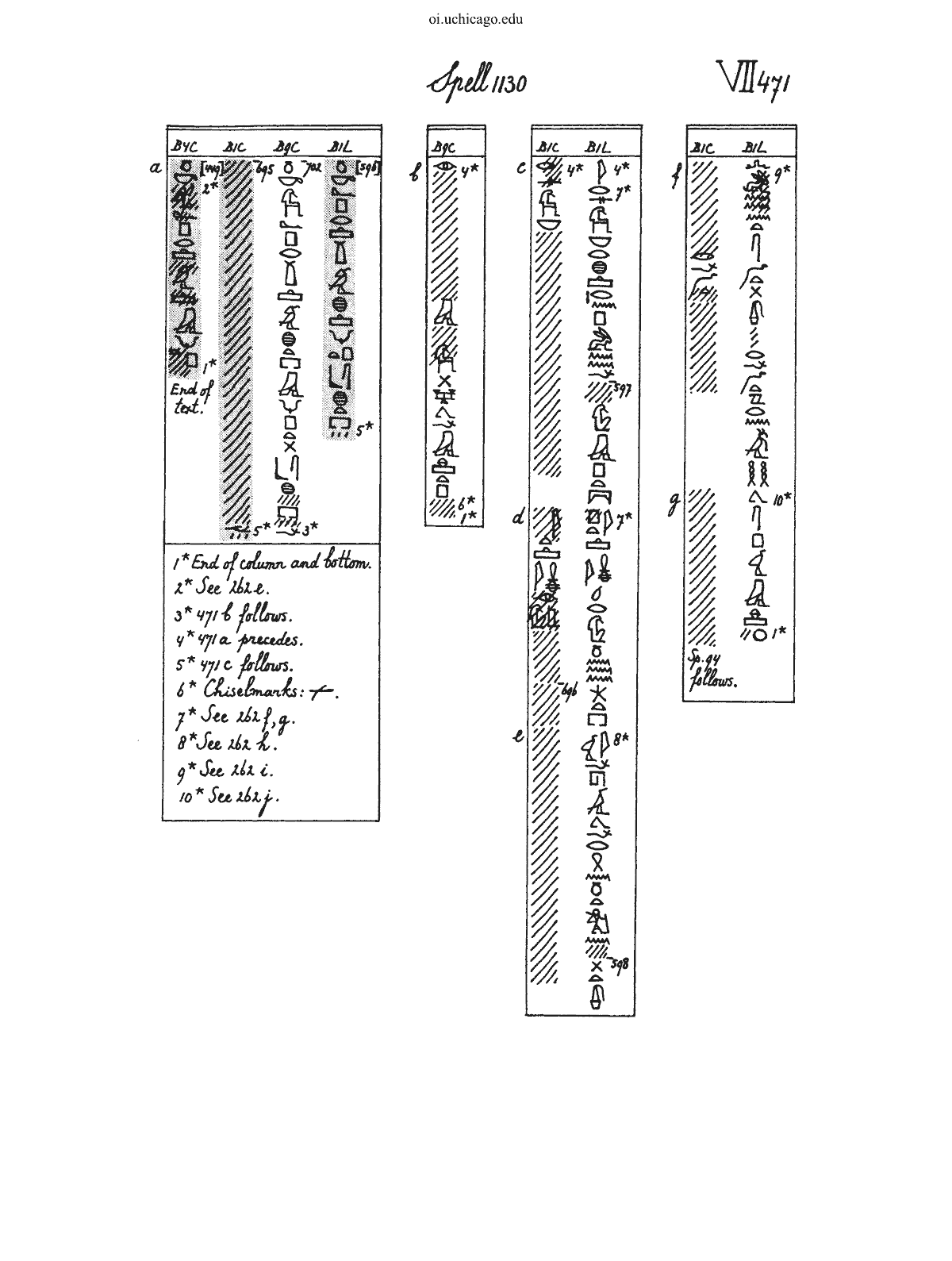
Page 471. De Buck, Coffin Texts VII (1961), hand copy Full source - 471a471,a
jnk ꜥpr equipped rḫ wn to open sbḫ.wt portals
I am one ꜥpr: equipped, who knows how to wn: to open the sbḫ.wt: portals.
Note on line 471a
B9C here adds a damaged sentence of which only “he will pass safely” is left. - 471b471,b
jr rḫ rꜣ spell, utterance; mouth pn wnn=f mj Rꜥ m jꜣb.t the east p.t mj Wsjr Osiris m-ẖnw Dwꜣ.t the Duat, the underworld
Whoever knows this rꜣ: spell, utterance; mouth will be like Re in the jꜣb.t: the east of the sky, like Wsjr: Osiris inside the Dwꜣ.t: the Duat, the underworld.
Note on line 471b
B1L transposes the words: m p.t jꜣb.t. - 471d471,d
hꜣ=f r šnw.t the Entourage; also a circle, an enclosure ḫ.t fire
He will go down to the šnw.t: the Entourage; also a circle, an enclosure of fire,
Note on line 471d
šnw.t is the same word as “Entourage” in the opening line: the ring of fire round the sun. - 471e471,e
n wnn nsr.t flame r=f ḏ.t
and there will be no nsr.t: flame against him, ever.
- 262j262,j
jw=f pw m ḥtp
It has come to its end, in peace.
Note on line 262j
The closing formula, from B3C. Coffin Text 1109: the Coiled One is my brother
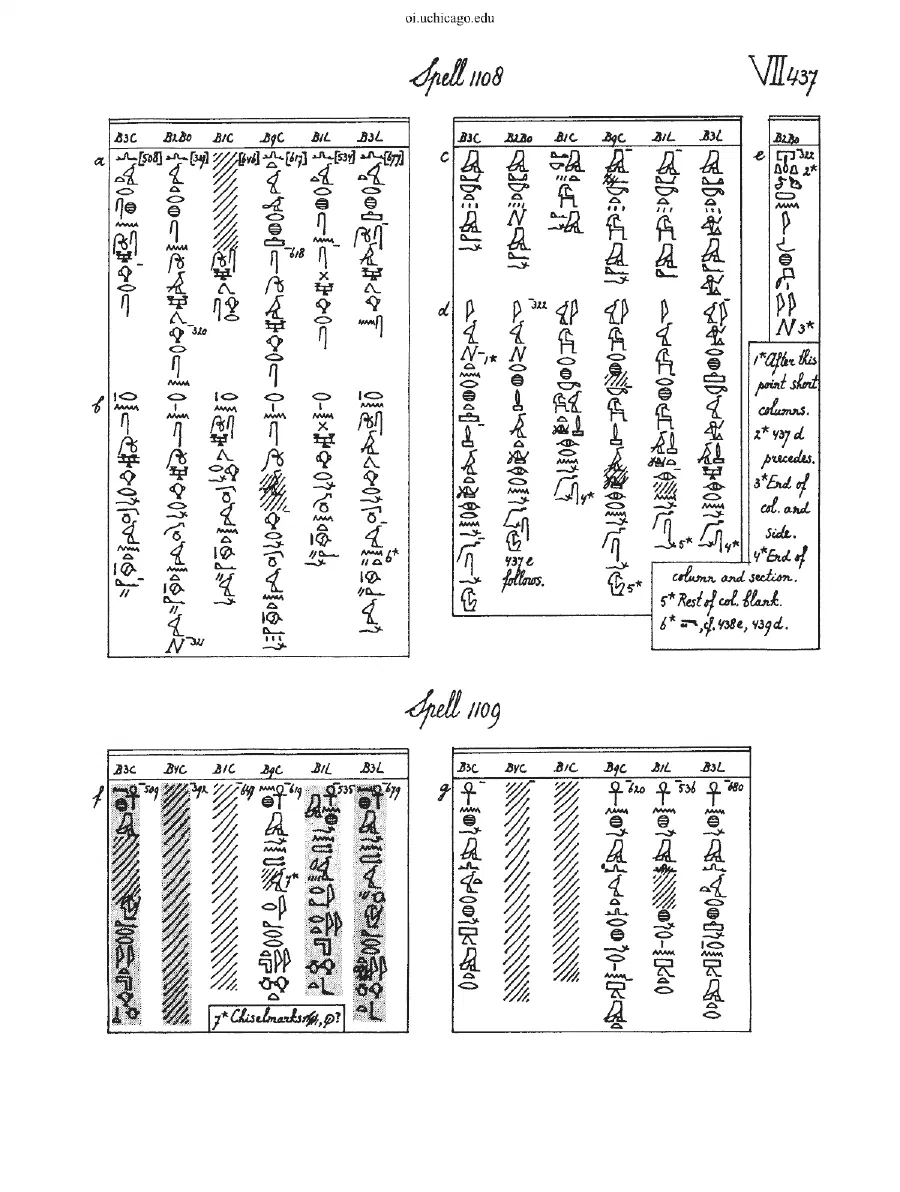
Page 437. De Buck, Coffin Texts VII (1961), hand copy Full source - 437f437,f
ꜥnḫ life; to live m fnṯw maggots, worms jrj-ꜥꜣ doorkeeper ḥrj-jb middle, “in the midst”
He Who Lives on fnṯw: maggots, worms is the jrj-ꜥꜣ: doorkeeper in the ḥrj-jb: middle, “in the midst”.
Note on line 437f
One of the gatekeepers of the Book of Two Ways. The spell before it (CT 1108) names the keeper of the first gate. - 437g437,g
ꜥnḫ life; to live m tm rḫ šm.t going
He lives on whoever does not know how to go
Note on line 437g
Variant: “whoever does not know the spell for going”. 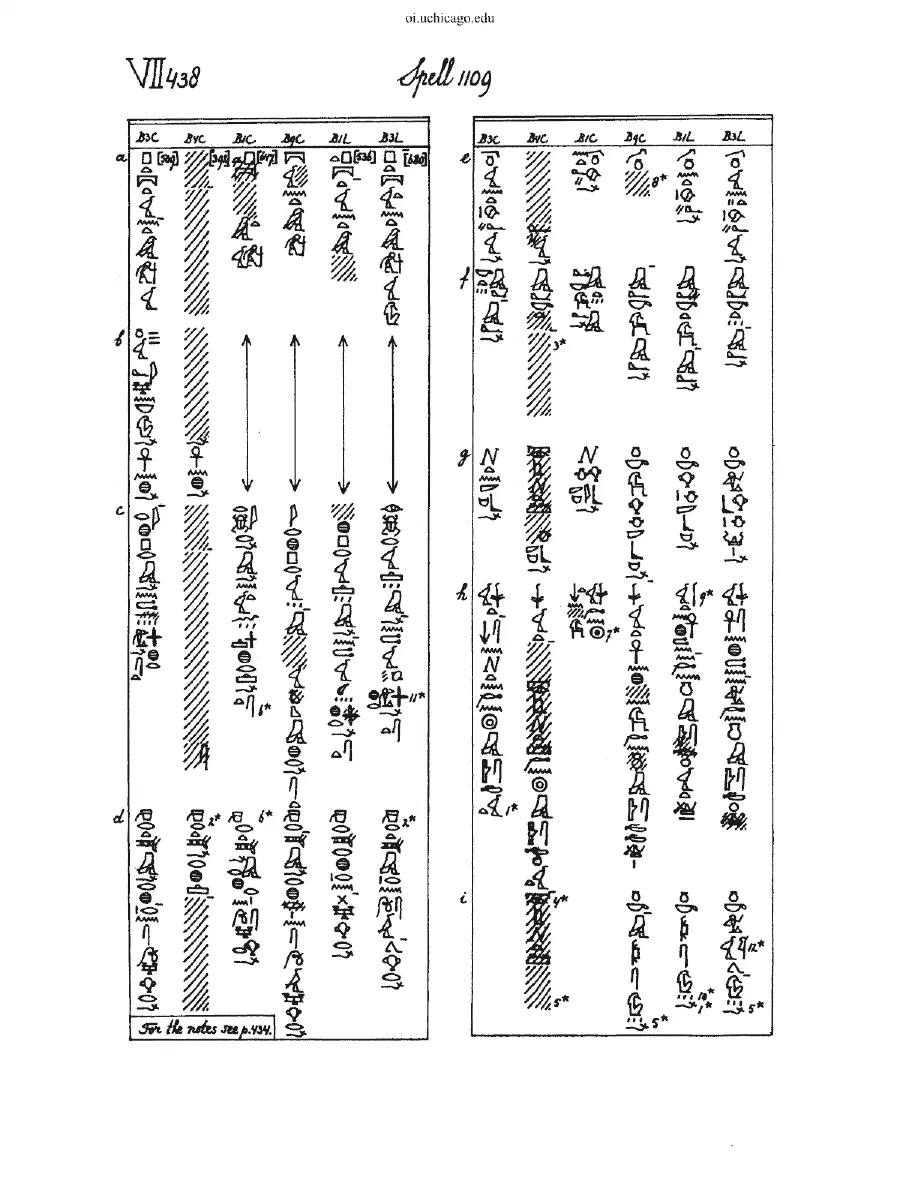
Page 438. De Buck, Coffin Texts VII (1961), hand copy Full source - 438a438,a
r p.t n.t Ḥr smsw eldest, the Elder
to the sky of Horus the smsw: eldest, the Elder.
Note on line 438a
Faulkner: “Horus the first-born”. - 438b438,b
ḫmt-nw tkn to approach n nb=f ꜥnḫ life; to live
The third one, who tkn: to approach his lord so that he may live.
Note on line 438b
Only in B3C, borrowed from the next spell (CT 1110). - 438c438,c
jr ḫpr m fnṯw maggots, worms wnm to eat st
Whoever comes to be among the maggots will wnm: to eat them,
Note on line 438c
This is the traveller who failed to learn the spell: he ends up on the gatekeeper’s diet. - 438d438,d
[...] tm=f rḫ rꜣ spell, utterance; mouth pw n swꜣ to pass by ḥr=f
because he does not know that this is the rꜣ: spell, utterance; mouth for swꜣ: to pass by him
Note on line 438d
We cannot read the first word, a jar sign; the sense “because” is clear from the rest. - 438e438,e
ntj m-bꜣḥ=f mk.t protection jm=f
who is before him. It is my mk.t: protection from him.
Note on line 438e
“Him” first means the gatekeeper, then the traveller; Faulkner notes how loosely these spells use their pronouns. - 438f438,f
jnk m ḥrj-jb middle, “in the midst” ḥr.t sky, firmament
I am in the ḥrj-jb: middle, “in the midst” of his ḥr.t: sky, firmament,
Note on line 438f
“His” here is the sun god’s. B3L has “his bark” for “his sky”. - 438g438,g
swt sn brother
and he is my sn: brother:
Note on line 438g
B3C, with the owner’s name for “my”. Faulkner notes that B9C and other copies corrupt swt sn=j, B9C into swt ꜥnḫ n=j, “he is life for me”. - 438h438,h
Mḥn m nꜥ.t sailing
the mḥn: Mehen, “the Coiled One”, the serpent that coils round the sun god; written with a coil sign, when nꜥ.t: sailing.
Note on line 438h
The brother is Mehen, the serpent that coils round the sun god’s shrine in the bark. - 438i438,i
jnk m šms.w following, retinue
I am in his šms.w: following, retinue.
Note on line 438i
Not in the B3C group: this line follows B9C and B1L, which leave out m; it is restored, as Faulkner restores “”.