~/sacred-texts/scholia-on-clement-of-alexandria
Scholia on Clement: The Mysteries Glossed
Translated by AI straight from the Ancient Greek, not from a modern translation, then checked against the editions and studies listed below. How we translate
- Text
- Scholia on Clement of Alexandria, On Protrepticus 2.12–22 (Stählin, Scholia pp. 300–304)
- Date
- Written c. AD 914 in the margins of Parisinus gr. 451 by the scribe Baanes and by Arethas of Caesarea, drawing on older lexica (Diogenianus, 2nd century AD) and on Pollux
- Found
- Paris, Bibliothèque nationale de France, gr. 451; copied with its scholia in M, the Modena manuscript
- Language
- Ancient Greek · Greek minuscule, in the margins of codex Parisinus graecus 451
Clement of Alexandria’s Protrepticus, written about AD 200, attacks the Greek mysteries by telling what they contained. Its whole text rests on one manuscript, Parisinus graecus 451, copied in AD 914 for Arethas, archbishop of Caesarea. In its margins the scribe Baanes and Arethas himself wrote short notes on hard words and names: glosses from the old lexica, a myth retold, a cross-reference to scripture. Otto Stählin printed these scholia in 1905, keyed to the lines of Clement they explain. This page translates the whole run of them on Clement’s chapter on the mysteries, sections 2.12–22, in order: 50 notes, set out in 53 lines, from Alcibiades’ profanation to the torch of Iakchos. The scholia on the rest of chapter 2, on the gods and their shrines, run to ten more pages and are not translated here.
The notes are short and of uneven worth. Some only swap one word for another. Others keep what is found nowhere else: the stage machinery, from Pollux; the Kouretes hiding the infant’s cry with their clashing arms; Rhea gathering the torn Dionysus and finding everything but his genitals. One is the best ancient statement of what the rhombos was. Copied from the second-century lexicographer Diogenianus, it calls the rhombos a little piece of wood tied to a cord and “whirled in the rites so that it would whir”, which is to say a bullroarer. It stands in the margin beside the Orphic line on the cone and the rhombos, and the older printings cut its headword, so it was long quoted as a definition of the cone. The headword is rhombos.
As far as we can find, these scholia have not been translated into English before. We searched the Loeb and Ante-Nicene Clement (neither includes the scholia), Marcovich’s edition (Brill, 1995, Greek with Latin notes), and the web for English versions of single notes. One line has been in English since 1884: Andrew Lang translated the rhombos gloss, from Lobeck’s cut-down excerpt, as a definition of the kōnos, and Jane Harrison discussed it in 1912. The rest is translated here for the first time, as far as we know.
Each line gives Clement’s word first, in italics (the lemma), and then the note. The note in the margin gives Clement’s own sentence, so the gloss can be read against what it glosses. Clement’s kteis, the “woman’s comb” among the secret things of the chests, has no scholion; the note on the sesame cakes quotes the passage.
Each numbered line gives the Ancient Greek first. Our English is underneath. Tap a dotted word for its meaning, and Note for our comment on the line; our comments are in the right margin.
Stripping the mysteries bare (Protrepticus 2.12–13)
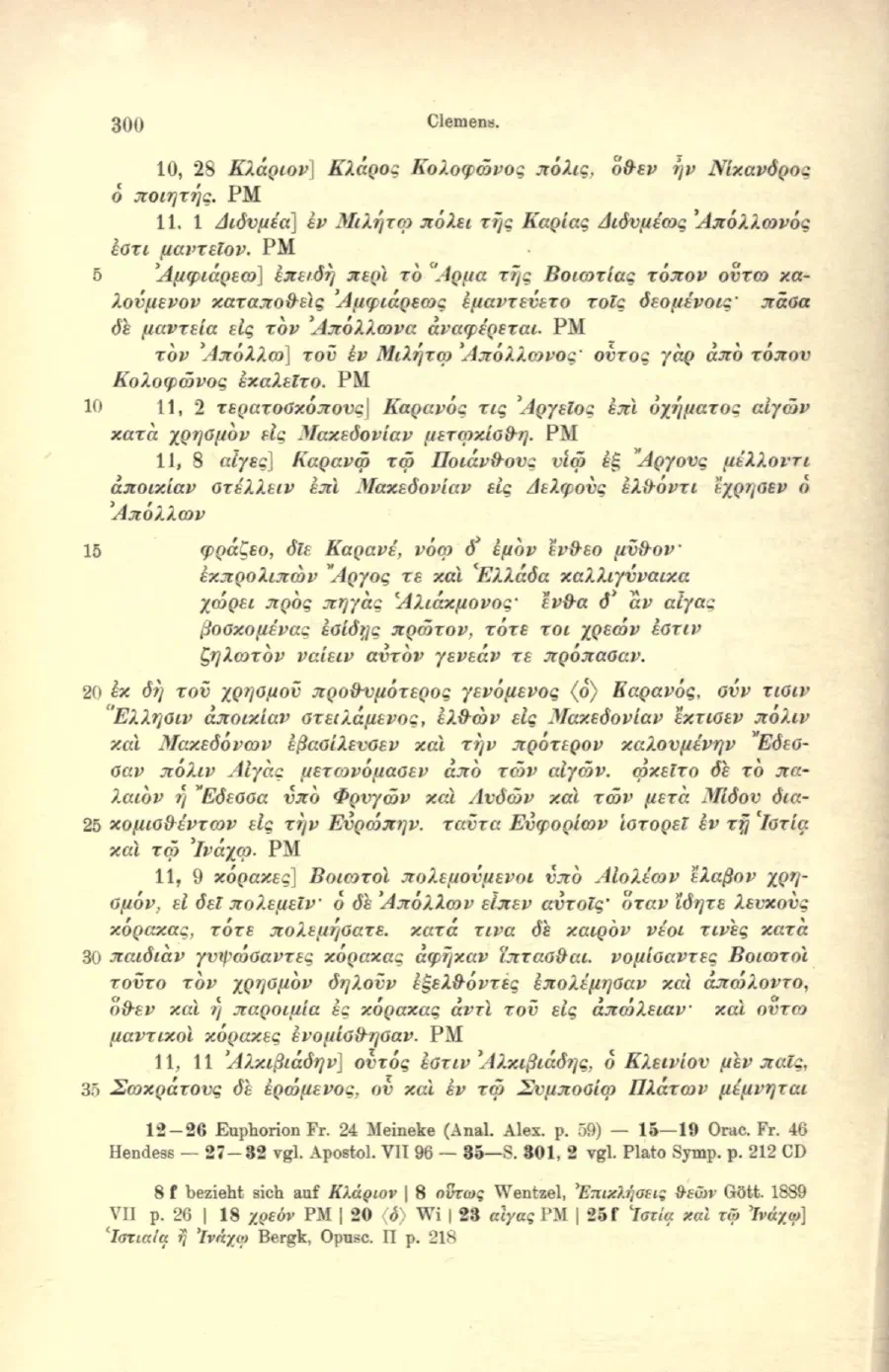
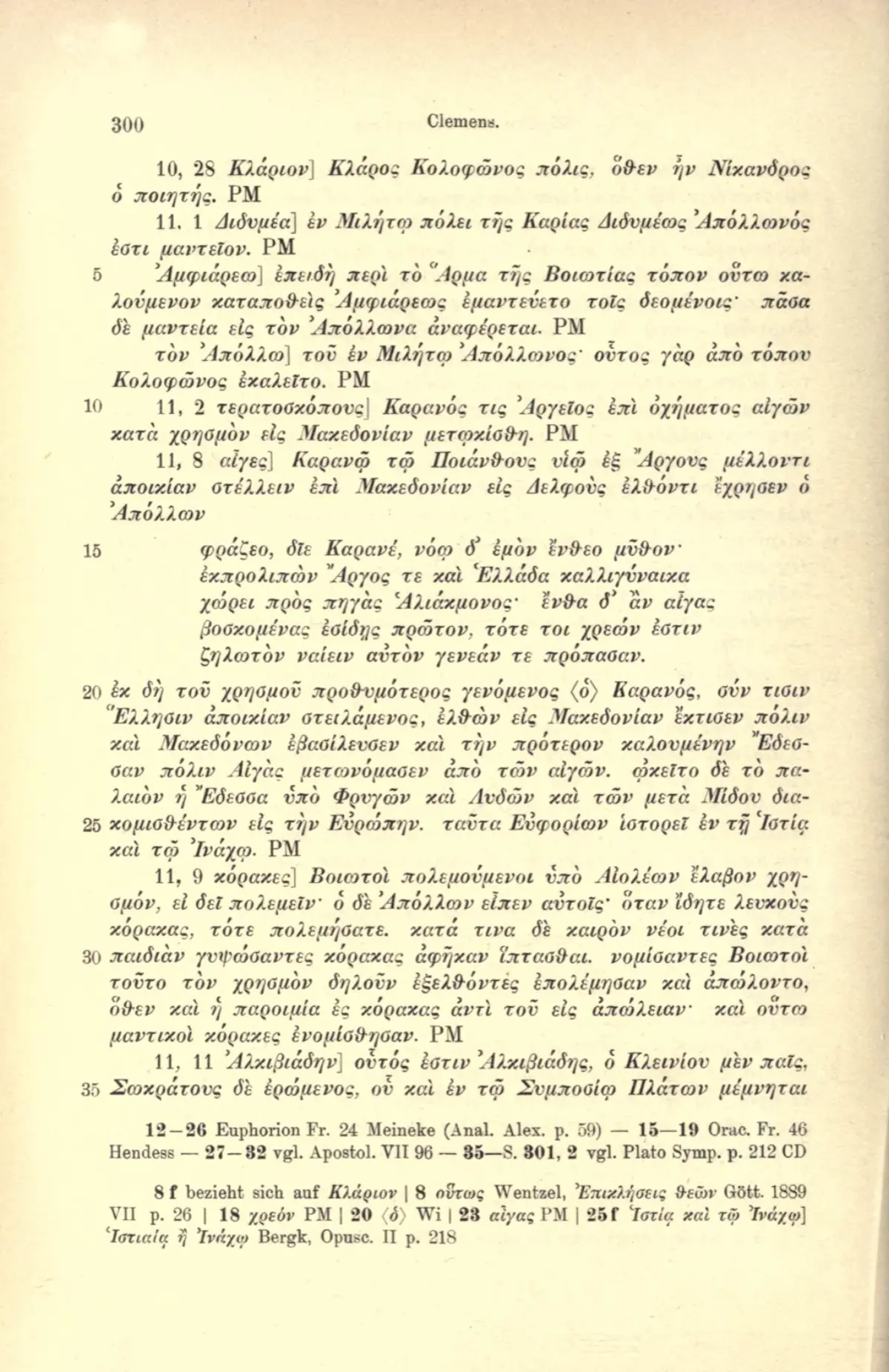
Page 300. Stählin 1905, Scholia p. 300: the run on the mysteries begins at line 34, Alcibiades. Scans of Otto Stählin's edition (Leipzig, 1905), Scholia pp. 300–304, from the University of Toronto copy on the Internet Archive Full source - 1300,34
Ἀλκιβιάδην] οὗτός ἐστιν Ἀλκιβιάδης, ὁ Κλεινίου μὲν παῖς, Σωκράτους δὲ ἐρώμενος, οὗ καὶ ἐν τῷ Συμποσίῳ Πλάτων μέμνηται ὡς ἐπεισελθόντος τοῖς φιλοσόφοις συμποσιάζουσιν μετά τινος ἑταίρας καὶ ἐπικωμάσαντος τὴν ἀρχήν.
Alcibiades: This is Ἀλκιβιάδης: Alcibiades, Athenian general, accused of profaning the Eleusinian mysteries in 415 BC, the son of Kleinias and the beloved of Socrates, whom Plato also mentions in the Symposium, as having come in on the philosophers at their drinking party with a ἑταίρα: courtesan, paid companion and ἐπικωμάζω: to burst in on someone in a drunken revel from the start.
Note on line 1
Clement 11,11 (2.12.1): “I will not dance out the mysteries, as they say Alcibiades did.” Clement means the charge of 415 BC, that Alcibiades parodied the Eleusinian rite at a drinking party (Plutarch, Alcibiades 19). The scholiast thinks of the wrong party, Plato’s, where Alcibiades arrives drunk with a flute-girl. Tēn archēn here means “from the start”. Symposiazousin is Schwartz’s correction; the manuscripts have symplēsiazousin. 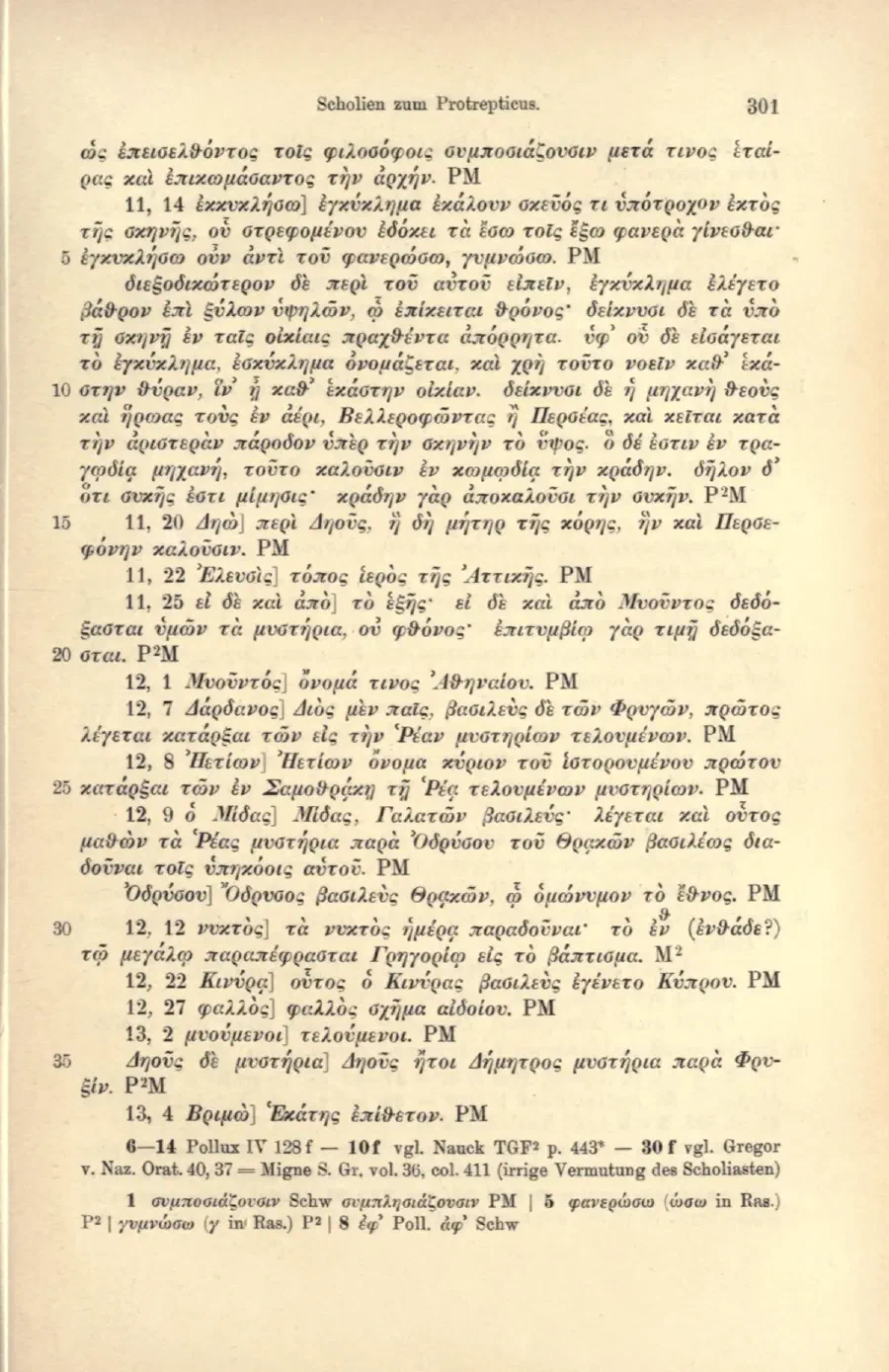
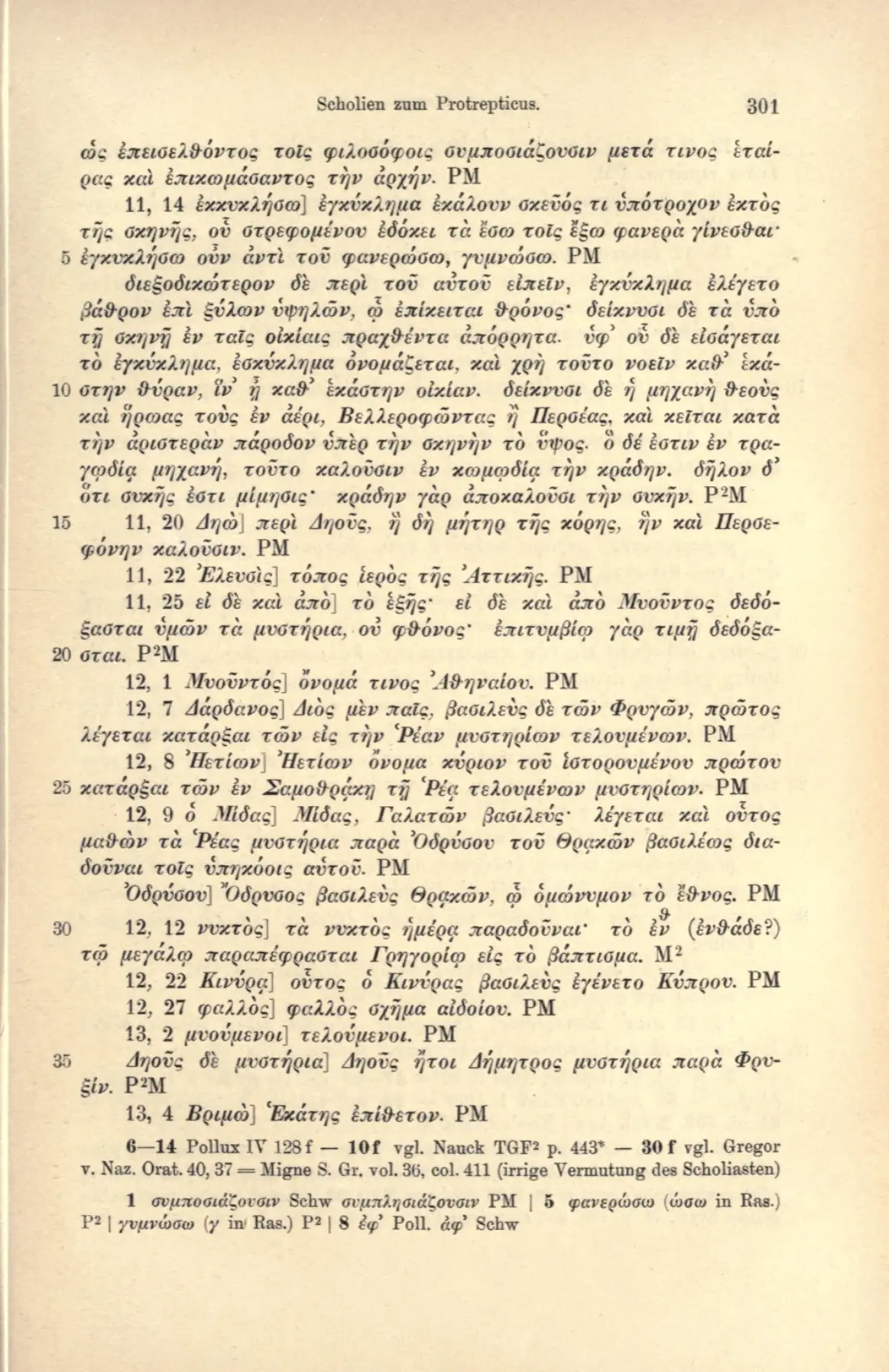
Page 301. Stählin 1905, Scholia p. 301. Scans of Otto Stählin's edition (Leipzig, 1905), Scholia pp. 300–304, from the University of Toronto copy on the Internet Archive Full source - 2301,3
ἐκκυκλήσω] ἐγκύκλημα ἐκάλουν σκεῦός τι ὑπότροχον ἐκτὸς τῆς σκηνῆς, οὗ στρεφομένου ἐδόκει τὰ ἔσω τοῖς ἔξω φανερὰ γίνεσθαι· ἐγκυκλήσω οὖν ἀντὶ τοῦ φανερώσω, γυμνώσω.
I will roll out: They called ἐγκύκλημα: the rolling platform of the Greek stage a contraption on wheels outside the stage building; when it was turned, the things inside seemed to become visible to those outside. So “ἐκκυκλέω: to roll out on the ekkyklema, the stage trolley that showed what happened indoors” stands for “I will make visible, γυμνόω: to strip naked, to lay bare.”
Note on line 2
Clement 11,14 (2.12.1): he will roll the gods of the mysteries out onto the stage of life for the spectators of truth. The scholiast’s “strip naked” matches Clement’s own verb three lines earlier, apogymnōsō. In the manuscript the last words are rewritten over an erasure (P²). - 3301,6
διεξοδικώτερον δὲ περὶ τοῦ αὐτοῦ εἰπεῖν, ἐγκύκλημα ἐλέγετο βάθρον ἐπὶ ξύλων ὑψηλῶν, ᾧ ἐπίκειται θρόνος· δείκνυσι δὲ τὰ ὑπὸ τῇ σκηνῇ ἐν ταῖς οἰκίαις πραχθέντα ἀπόρρητα. ὑφ᾽ οὗ δὲ εἰσάγεται τὸ ἐγκύκλημα, ἐσκύκλημα ὀνομάζεται, καὶ χρὴ τοῦτο νοεῖν καθ᾽ ἑκάστην θύραν, ἵν᾽ ᾖ καθ᾽ ἑκάστην οἰκίαν.
To speak of the same thing at more length: enkyklēma was the name for a platform on high timbers, with a throne set on it; it shows the ἀπόρρητος: forbidden to be spoken, secret done in the houses behind the stage. The thing by which the enkyklēma is brought in is called the eskyklēma, and one must imagine this at each door, so that there is one for each house.
Note on line 3
This longer note (by the later hand P², and in M) is copied from the stage chapter of Pollux, Onomasticon 4.128–129, as Stählin shows. The secret things done indoors are the point of Clement’s image: the mysteries are wheeled out to be seen. - 4301,10
δείκνυσι δὲ ἡ μηχανὴ θεοὺς καὶ ἥρωας τοὺς ἐν ἀέρι, Βελλεροφῶντας ἢ Περσέας, καὶ κεῖται κατὰ τὴν ἀριστερὰν πάροδον ὑπὲρ τὴν σκηνὴν τὸ ὕψος. ὃ δέ ἐστιν ἐν τραγῳδίᾳ μηχανή, τοῦτο καλοῦσιν ἐν κωμῳδίᾳ τὴν κράδην. δῆλον δ᾽ ὅτι συκῆς ἐστι μίμησις· κράδην γὰρ ἀποκαλοῦσι τὴν συκῆν.
The μηχανή: the stage crane that flew gods and heroes shows the gods and heroes who are in the air, Bellerophons or Perseuses, and it stands by the left side-entrance, above the stage building in height. What in tragedy is the crane, in comedy they call the κράδη: fig-branch; in comedy, the stage crane. Plainly it is an imitation of a fig tree, for they call the fig tree kradē.
Note on line 4
Still Pollux 4.128–130. The fig-branch returns in Clement’s list of what the mystic chests hold (2.22.4), where Morellus restored kradai, “fig-branches”, for the manuscript’s kardiai, “hearts” (Stählin text 17,8). - 5301,15
Δηώ] περὶ Δηοῦς, ἣ δὴ μήτηρ τῆς κόρης, ἣν καὶ Περσεφόνην καλοῦσιν.
Deo: About Δηώ: Deo, a name of Demeter, who is the mother of Κόρη: the Maiden, Persephone, whom they also call Persephone.
Note on line 5
Clement 11,20 (2.12.2): “Deo and the Maiden have become a mystic drama, and Eleusis lights with torches their wandering, the rape and the grief.” - 6301,17
Ἐλευσίς] τόπος ἱερὸς τῆς Ἀττικῆς.
Eleusis: a holy place in Attica.
- 7301,18
εἰ δὲ καὶ ἀπὸ] τὸ ἑξῆς· εἰ δὲ καὶ ἀπὸ Μυοῦντος δεδόξασται ὑμῶν τὰ μυστήρια, οὐ φθόνος· ἐπιτυμβίῳ γὰρ τιμῇ δεδόξασται.
But if also from: The order of the words is: “But if your mysteries have been glorified even from Myous, no grudge: for they have been glorified with a ἐπιτύμβιος: at the tomb, funeral honour.”
Note on line 7
Clement 11,25 (2.13.1) derives mysteria either from mysos, the pollution done to Dionysus, or, after Apollodorus, from Myous, an Athenian killed hunting. Either way, he says, the rites are a funeral cult. The scholiast only puts Clement’s clauses in order. The hand is P². - 8301,21
Μυοῦντος] ὄνομά τινος Ἀθηναίου.
Of Myous: the name of an Athenian.
Who began the rites (Protrepticus 2.13–14)
- 9301,22
Δάρδανος] Διὸς μὲν παῖς, βασιλεὺς δὲ τῶν Φρυγῶν, πρῶτος λέγεται κατάρξαι τῶν εἰς τὴν Ῥέαν μυστηρίων τελουμένων.
Dardanus: Δάρδανος: Dardanus, son of Zeus, ancestor of the Trojans, a son of Zeus and king of the Phrygians, is said to have been the first to begin the mysteries performed for Ῥέα: Rhea, mother of the gods, the Phrygian Mother.
Note on line 9
Clement 12,7 (2.13.3): whoever began this deceit, “Dardanus, who showed the mysteries of the Mother of the Gods”, or Eetion, or Midas. The scholiast takes Clement’s Mother of the Gods as Rhea throughout. - 10301,24
Ἠετίων] Ἠετίων ὄνομα κύριον τοῦ ἱστορουμένου πρώτου κατάρξαι τῶν ἐν Σαμοθρᾴκῃ τῇ Ῥέᾳ τελουμένων μυστηρίων.
Eetion: Ἠετίων: Eetion, brother of Dardanus, founder of the Samothracian rites is the proper name of the man recorded as the first to begin the mysteries performed for Rhea in Σαμοθρᾴκη: Samothrace, island of the northern Aegean and of the Great Gods' mysteries.
- 11301,26
ὁ Μίδας] Μίδας, Γαλατῶν βασιλεύς· λέγεται καὶ οὗτος μαθὼν τὰ Ῥέας μυστήρια παρὰ Ὀδρύσου τοῦ Θρᾳκῶν βασιλέως διαδοῦναι τοῖς ὑπηκόοις αὐτοῦ.
Midas: Μίδας: Midas, king of Phrygia, king of the Γαλάται: Galatians, the Celts settled in Phrygia from the 3rd century BC; he too is said to have learned the mysteries of Rhea from Odrysos, the king of the Thracians, and passed them on to his subjects.
Note on line 11
“Galatians” is the scholiast’s anachronism for Phrygians: in his day central Anatolia was Galatia. The chain he gives runs from Thrace to Phrygia, the reverse of the usual direction of the Mother’s cult. - 12301,29
Ὀδρύσου] Ὄδρυσος βασιλεὺς Θρᾳκῶν, ᾧ ὁμώνυμον τὸ ἔθνος.
Odrysos: Odrysos, king of the Thracians, whose name the people bears.
Note on line 12
The people is the Odrysians, whose kingdom ruled much of Thrace from the 5th century BC. - 13301,30
νυκτὸς] τὰ νυκτὸς ἡμέρᾳ παραδοῦναι· τὸ ἐν (ἐνθάδε?) τῷ μεγάλῳ παραπέφρασται Γρηγορίῳ εἰς τὸ βάπτισμα.
Out of night: “To hand over the things of night to the day”: the [phrase] en (enthade, “here”?) is paraphrased in the great Gregory, in the oration on baptism.
Note on line 13
Clement 12,12 (2.13.4): Kinyras of Cyprus “dared to bring Aphrodite’s lewd orgies out of night into day”, eager to make a city whore a goddess. The note is in M’s later hand only. Stählin calls the scholiast’s reference to Gregory of Nazianzus, Oration 40.37, a mistaken guess. The word printed en has a th written over it, and Stählin asks whether enthade, “here”, was meant. - 14301,32
Κινύρᾳ] οὗτος ὁ Κινύρας βασιλεὺς ἐγένετο Κύπρου.
Kinyras: This Κινύρας: Kinyras, priest-king of Cyprus and of Aphrodite at Paphos became king of Cyprus.
Note on line 14
Clement 12,22 (2.14.1): Aphrodite, “dear to Kinyras”, born from the cut-off genitals of Ouranos, “those lustful ones that after the cutting raped the wave”. - 15301,33
φαλλὸς] φαλλὸς σχῆμα αἰδοίου.
Phallus: a φαλλός: phallus, a model of the erect penis carried in rites is the shape of a αἰδοῖον: the genitals; of a man, the penis.
Note on line 15
Clement 12,27 (2.14.2): in Aphrodite’s rites, as a token of her birth from the sea, “a lump of salt and a phallus are handed to those being initiated into the art of adultery, and they bring her a coin, as lovers do to a whore.” Deo, the Mother and Sabazios (Protrepticus 2.14–16)
- 16301,34
μυούμενοι] τελούμενοι.
Being initiated (myoumenoi): τελέω: to complete; to initiate into a rite (teloumenoi).
Note on line 16
The scholiast swaps one verb of initiation, myeō, for another, teleō, “to complete, to perfect”, from which teletē, “rite”, comes. - 17301,35
Δηοῦς δὲ μυστήρια] Δηοῦς ἤτοι Δήμητρος μυστήρια παρὰ Φρυξίν.
And the mysteries of Deo: the mysteries of Deo, that is, of Demeter, among the Phrygians.
Note on line 17
Clement 13,2 (2.15.1): “The mysteries of Deo are Zeus’s sexual couplings with his mother Demeter”, and her rage at it, for which she is called Brimo. The scholiast places these mysteries among the Phrygians, as Clement does a few lines on. Added by P². - 18301,37
Βριμώ] Ἑκάτης ἐπίθετον.
Brimo: an epithet of Ἑκάτη: Hekate, goddess of crossroads, night and the dead.
Note on line 18
Clement makes Brimo Demeter’s name for her fury at the rape. The scholiast gives it to Hekate, as other Greek sources do. 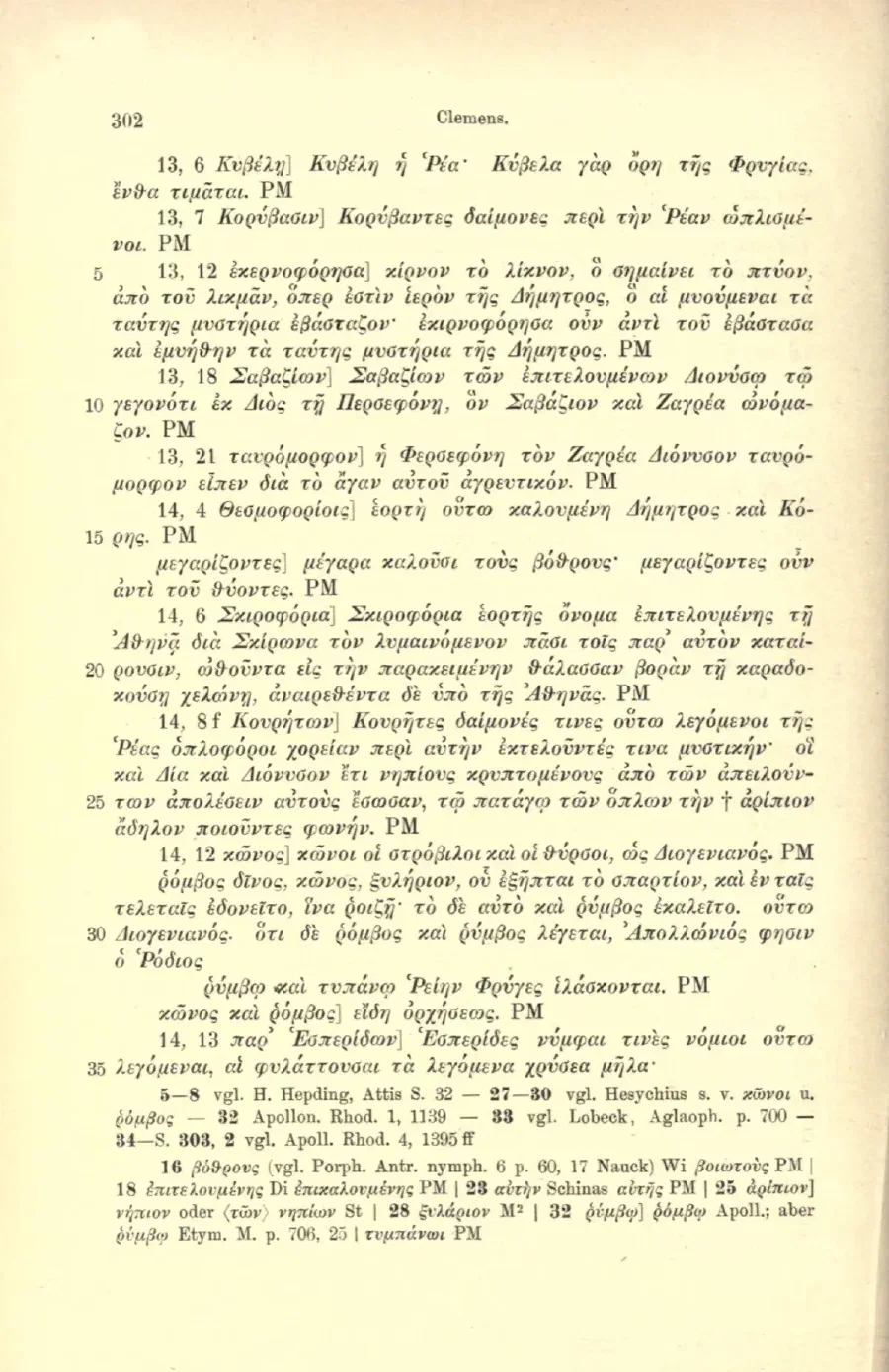
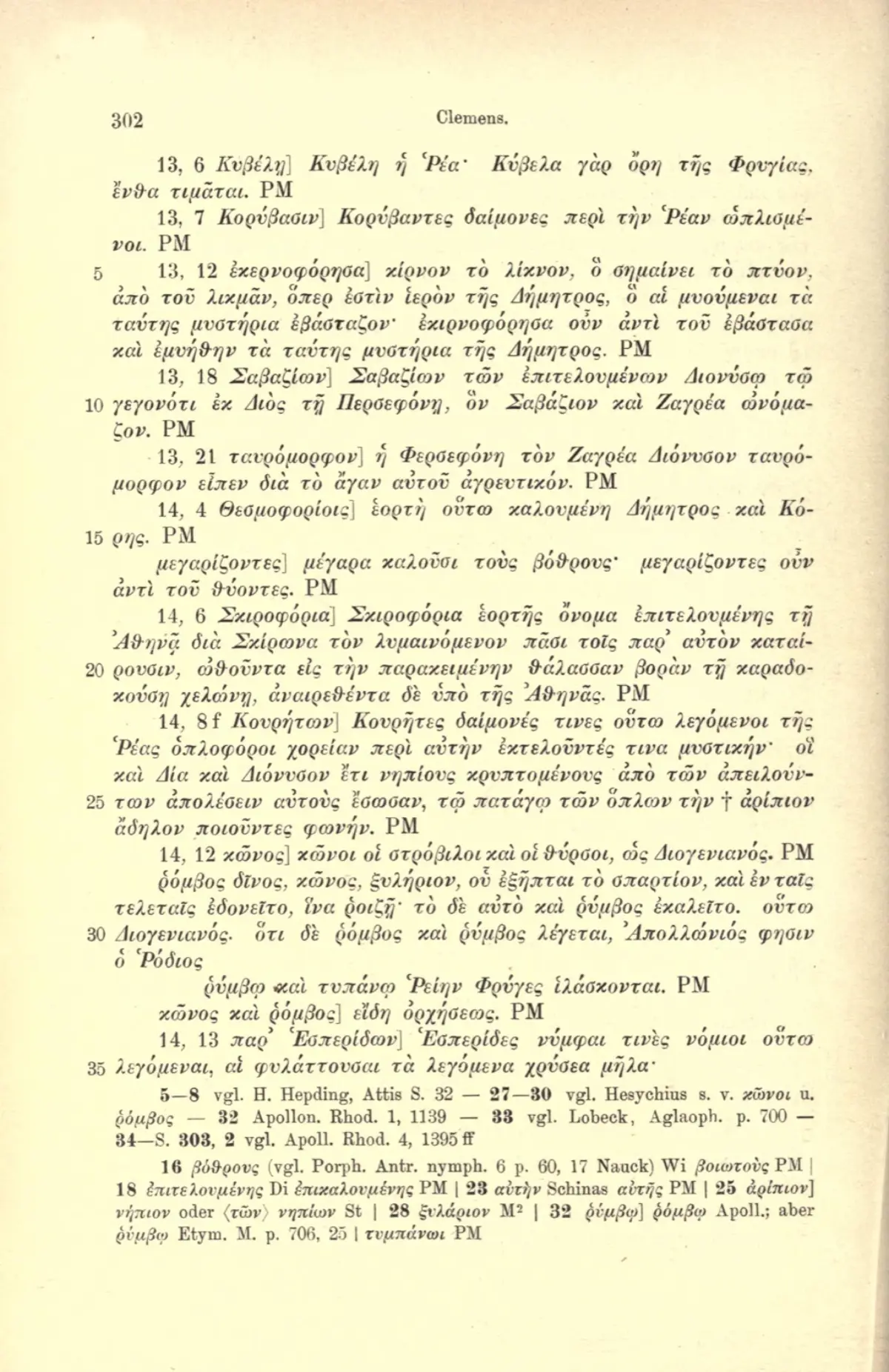
Page 302. Stählin 1905, Scholia p. 302: the cone and the rhombos, lines 27–33. Scans of Otto Stählin's edition (Leipzig, 1905), Scholia pp. 300–304, from the University of Toronto copy on the Internet Archive Full source - 19302,1
Κυβέλῃ] Κυβέλη ἡ Ῥέα· Κύβελα γὰρ ὄρη τῆς Φρυγίας, ἔνθα τιμᾶται.
Cybele: Κυβέλη: Cybele, the Phrygian Mother is Rhea; for the Kybela are mountains of Phrygia, where she is worshipped.
- 20302,3
Κορύβασιν] Κορύβαντες δαίμονες περὶ τὴν Ῥέαν ὡπλισμένοι.
Korybantes: The Κορύβαντες: the Korybantes, armed dancers of the Mother are armed δαίμων: divine being, spirit around Rhea.
Note on line 20
Clement 13,7 (2.15.2): Zeus, to make amends for raping Demeter, tears the testicles off a ram and throws them into her lap as if they were his own; the Phrygians perform these rites for Attis, Cybele and the Korybantes. - 21302,5
ἐκερνοφόρησα] κίρνον τὸ λίκνον, ὃ σημαίνει τὸ πτύον, ἀπὸ τοῦ λικμᾶν, ὅπερ ἐστὶν ἱερὸν τῆς Δήμητρος, ὃ αἱ μυούμεναι τὰ ταύτης μυστήρια ἐβάσταζον· ἐκιρνοφόρησα οὖν ἀντὶ τοῦ ἐβάστασα καὶ ἐμυήθην τὰ ταύτης μυστήρια τῆς Δήμητρος.
I carried the kernos: The kirnos is the λίκνον: liknon, the winnowing-fan or basket, Dionysus's cradle in the rites, which means the πτύον: winnowing-shovel, winnowing-fan, from likman, “to winnow”; it is a sacred thing of Demeter, which the women being initiated into her mysteries carried. So “I carried the kirnos” stands for “I carried it, and was initiated into the mysteries of this Demeter.”
Note on line 21
Clement 13,12 (2.15.3) gives the password of the Phrygian rite: “I ate from the drum; I drank from the cymbal; I carried the kernos; I slipped down under the bridal bed.” The scholiast spells the word kirnos and makes it the winnowing basket. The liknon was Dionysus’s cradle and, in Bacchic rites, the basket in which a phallus lay under the fruit. The initiates here are women (hai myoumenai). Hepding, Attis (1903) p. 32, collects the note. - 22302,9
Σαβαζίων] Σαβαζίων τῶν ἐπιτελουμένων Διονύσῳ τῷ γεγονότι ἐκ Διὸς τῇ Περσεφόνῃ, ὃν Σαβάζιον καὶ Ζαγρέα ὠνόμαζον.
Of the Sabazia: of the Σαβάζια: the Sabazia, the rites of Sabazios, which are performed for the Dionysus born to Persephone from Zeus, whom they named Sabazios and Ζαγρεύς: Zagreus, the first Dionysus, son of Zeus and Persephone.
Note on line 22
Clement 13,18 (2.16.2): “The token of the Sabazian mysteries for the initiates is the god through the lap: he is a serpent, drawn through the lap of those being initiated, proof of Zeus’s incontinence.” The scholiast makes the serpent-god of that rite Zagreus, Persephone’s son by Zeus, whom Zeus fathered as a serpent (2.16.1). - 23302,12
ταυρόμορφον] ἡ Φερσεφόνη τὸν Ζαγρέα Διόνυσον ταυρόμορφον εἶπεν διὰ τὸ ἄγαν αὐτοῦ ἀγρευτικόν.
Bull-shaped: Phersephone called Zagreus Dionysus ταυρόμορφος: bull-shaped because he was so ἀγρευτικός: given to hunting.
Note on line 23
Clement 13,21 (2.16.3): Pherephatta “bears a bull-shaped child”, and the poet says “the bull is the serpent’s father and the serpent the bull’s”. As written, the scholion makes Persephone the speaker; it is compressed. The reason given glosses the name, not the bull: it is the etymology of Zagreus from za-, “very”, and agreus, “hunter”. Kore’s pigs and the toys of Zagreus (Protrepticus 2.17–18)
- 24302,14
Θεσμοφορίοις] ἑορτὴ οὕτω καλουμένη Δήμητρος καὶ Κόρης.
At the Thesmophoria: a festival so called, of Demeter and the Maiden.
Note on line 24
Clement 14,4 (2.17.1): when the earth swallowed Kore, the swine of the swineherd Eubouleus went down with her; so at the Thesmophoria the women throw piglets into the megara. - 25302,16
μεγαρίζοντες] μέγαρα καλοῦσι τοὺς βόθρους· μεγαρίζοντες οὖν ἀντὶ τοῦ θύοντες.
Doing the megara: They call the βόθρος: pit, trench for offerings to the powers below μέγαρον: chamber; at the Thesmophoria, the pit into which piglets were thrown; so “doing the megara” stands for “sacrificing”.
Note on line 25
“Pits” is Wilamowitz’s correction, after Porphyry, Cave of the Nymphs 6. The manuscripts read “they call the Boeotians megara”, which Dindorf printed, suspecting that words had dropped out. - 26302,17
Σκιροφόρια] Σκιροφόρια ἑορτῆς ὄνομα ἐπιτελουμένης τῇ Ἀθηνᾷ διὰ Σκίρωνα τὸν λυμαινόμενον πᾶσι τοῖς παρ᾽ αὐτὸν καταίρουσιν, ὠθοῦντα εἰς τὴν παρακειμένην θάλασσαν βορὰν τῇ καραδοκούσῃ χελώνῃ, ἀναιρεθέντα δὲ ὑπὸ τῆς Ἀθηνᾶς.
Skirophoria: Σκιροφόρια: the Skirophoria, an Athenian midsummer festival is the name of a festival held for Athena on account of Σκίρων: Skiron, the robber of the Megarian cliffs, who did violence to everyone who put in at his place, shoving them into the sea that lay beside as food for the turtle waiting there, and who was killed by Athena.
Note on line 26
Clement 14,6 (2.17.1) names the Athenian Skirophoria beside the Thesmophoria as rites that act out the rape of Kore. In the common myth Theseus kills Skiron; here Athena does. “Held” is Dindorf’s correction; the manuscripts have “called”. - 27302,22
Κουρήτων] Κουρῆτες δαίμονές τινες οὕτω λεγόμενοι τῆς Ῥέας ὁπλοφόροι χορείαν περὶ αὐτὴν ἐκτελοῦντές τινα μυστικήν· οἳ καὶ Δία καὶ Διόνυσον ἔτι νηπίους κρυπτομένους ἀπὸ τῶν ἀπειλούντων ἀπολέσειν αὐτοὺς ἔσωσαν, τῷ πατάγῳ τῶν ὅπλων τὴν † ἀρίπιον ἄδηλον ποιοῦντες φωνήν.
Of the Kouretes: The Κουρῆτες: the Kouretes, armed young dancers who guarded the infant Zeus are certain spirits so called, the armed guards of Rhea, who perform a mystic dance around her. They saved both Zeus and Dionysus, while they were still infants in hiding, from those who threatened to destroy them, by making the † child's † voice inaudible with the πάταγος: clatter, crash of their weapons.
Note on line 27
Clement 14,8 (2.17.2): “the Kouretes dancing round in arms” while the Titans steal in on the child Dionysus with toys. Aripion is corrupt; Stählin suggests nēpion, “infant”, or “of the infants”. The noise that hid the baby’s crying is the same office the Korybantes and Idaean Dactyls have in the Latin sources. - 28302,27
κῶνος] κῶνοι οἱ στρόβιλοι καὶ οἱ θύρσοι, ὡς Διογενιανός.
Cone: κῶνος: cone; a spinning top; a pine cone are the στρόβιλος: spinning top; whirl; pine cone and the θύρσος: thyrsus, the Bacchic wand tipped with a pine cone, as Diogenianus says.
Note on line 28
Clement 14,12 (2.17.2) quotes the Orphic poet on the toys: “cone and rhombos and limb-bending playthings, and fair golden apples from the clear-voiced Hesperides.” Diogenianus was a lexicographer of Hadrian’s time, the main source of Hesychius. Strobilos is both a spinning top and a pine cone, which is how a cone can also be a thyrsus. - 29302,28
ῥόμβος δῖνος, κῶνος, ξυλήριον, οὗ ἐξῆπται τὸ σπαρτίον, καὶ ἐν ταῖς τελεταῖς ἐδονεῖτο, ἵνα ῥοιζῇ· τὸ δὲ αὐτὸ καὶ ῥύμβος ἐκαλεῖτο. οὕτω Διογενιανός.
ῥόμβος: rhombos, the bullroarer; anything whirled: a δῖνος: whirl, rotation; a round vessel, a cone, a ξυλήριον: a little piece of wood to which the σπαρτίον: cord, small rope is tied, and in the rites it was δονέω: to shake, to whirl, to set in motion so that it would ῥοιζέω: to whir, to whiz, to make a rushing noise; the same thing was also called ῥύμβος: rhymbos, another form of rhombos. So Diogenianus.
Note on line 29
This is the plainest ancient statement of the rhombos as a slat of wood on a cord, whirled in the rites to whir: a bullroarer. It stands among the notes on the line kōnos kai rhombos, but its headword is rhombos, and the cone is only one of its synonyms. Bast’s excerpt, printed by Lobeck (Aglaophamus, 1829, p. 700), began at Kōnos xylarion, so Lang (Custom and Myth, 1884, p. 39) translated it as a definition of the kōnos. Dindorf (1869, I p. 420) prints xylarion, from a correction written over xylērion in P; Stählin assigns the correction to M’s second hand. - 30302,30
ὅτι δὲ ῥόμβος καὶ ῥύμβος λέγεται, Ἀπολλώνιός φησιν ὁ Ῥόδιος· ῥύμβῳ καὶ τυπάνῳ Ῥείην Φρύγες ἱλάσκονται.
That it is called both rhombos and rhymbos, Apollonius of Rhodes says: “With rhymbos and τύπανον: hand-drum, tambourine the Phrygians propitiate Rhea.”
Note on line 30
Apollonius, Argonautica 1.1139, where the Argonauts dance in arms for the Mother on Mount Dindymon. Modern editions of Apollonius read rhombō; the Etymologicum Magnum has rhymbō, as here. Because the scholiast proves the word with the Mother’s rite, he takes her rhymbos for the same whirled wood. - 31302,33
κῶνος καὶ ῥόμβος] εἴδη ὀρχήσεως.
Cone and rhombos: kinds of ὄρχησις: dancing, a dance.
Note on line 31
A second, separate note on the same pair; Stählin and Dindorf both refer to Lobeck, Aglaophamus p. 700. A whirling dance named for a whirled thing fits the Kouretes, whom Orphic Hymn 31.2 calls rhombētai, “rhombos-whirlers”; the scholiast does not make that link himself. - 32302,34
παρ᾽ Ἑσπερίδων] Ἑσπερίδες νύμφαι τινὲς νόμιοι οὕτω λεγόμεναι, αἱ φυλάττουσαι τὰ λεγόμενα χρύσεα μῆλα· ἡ δὲ Ἐρύθεια καὶ Ἑσπερέθουσα βοῶπις, ὥς φησιν Ἀπολλώνιος ὁ Ῥόδιος.
From the Hesperides: The Ἑσπερίδες: the Hesperides, nymphs of the golden apples are certain pastoral nymphs so called, who guard the so-called golden apples: “and Erytheia and ox-eyed Hesperethousa”, as Apollonius of Rhodes says.
Note on line 32
The verse is not in Apollonius; Stählin gives it to Hesiod (fr. 270 Rzach), and Unger restored its start from Apollodorus as “Aigle and Erytheia”. The golden apples are the last of the Orphic toys. 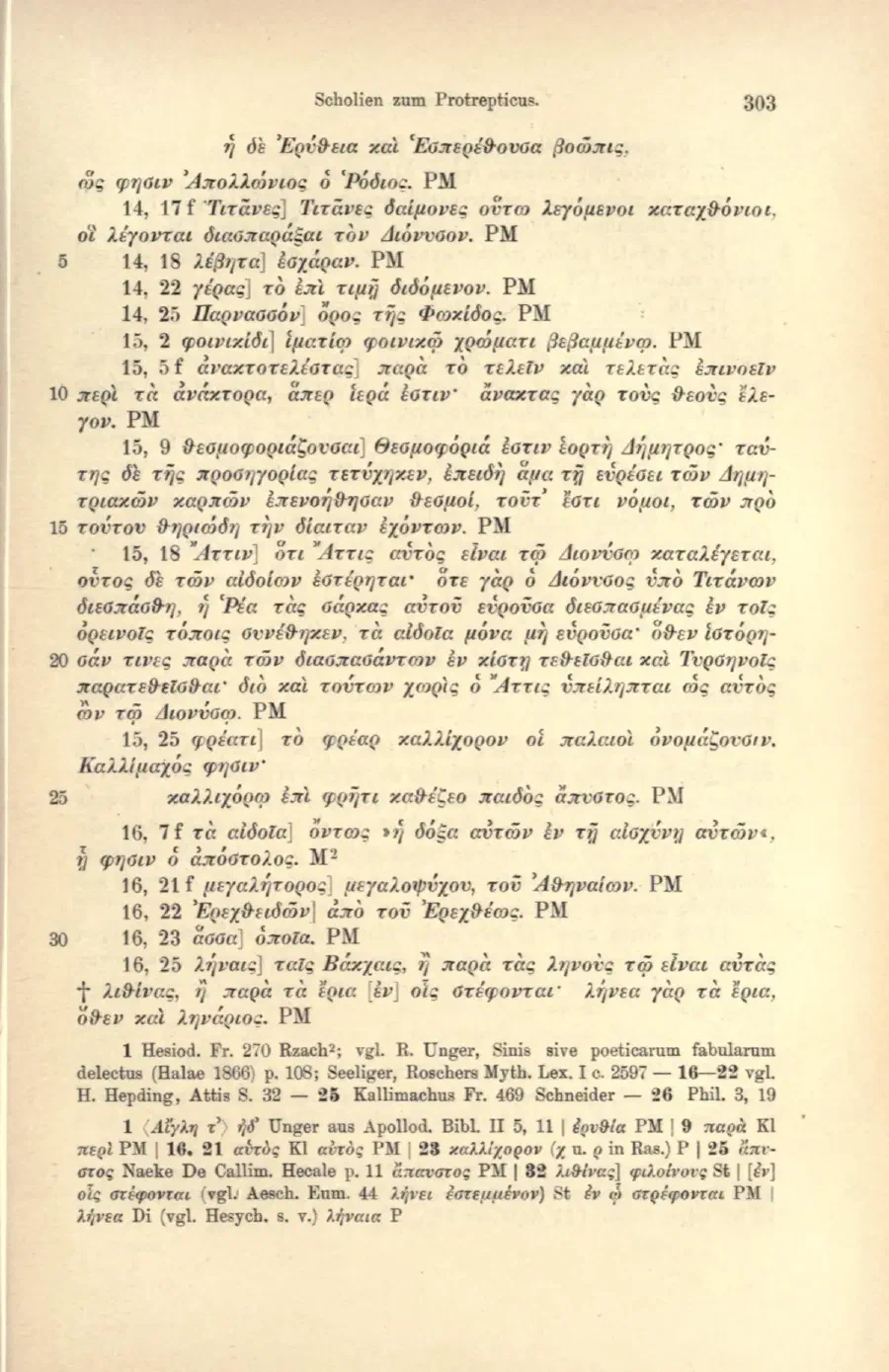
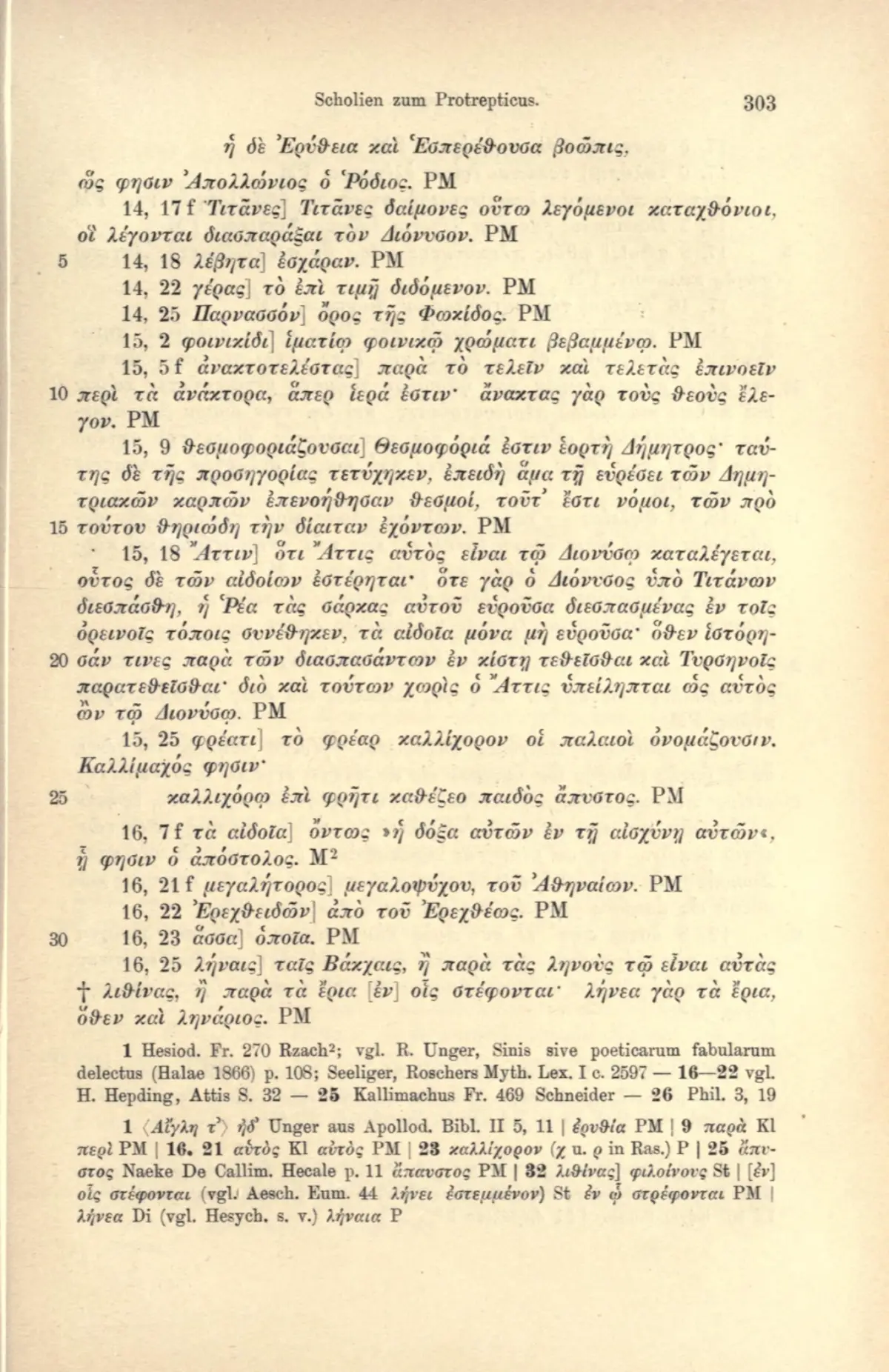
Page 303. Stählin 1905, Scholia p. 303. Scans of Otto Stählin's edition (Leipzig, 1905), Scholia pp. 300–304, from the University of Toronto copy on the Internet Archive Full source - 33303,3
Τιτᾶνες] Τιτᾶνες δαίμονες οὕτω λεγόμενοι καταχθόνιοι, οἳ λέγονται διασπαράξαι τὸν Διόνυσον.
Titans: The Τιτᾶνες: the Titans are spirits so called, καταχθόνιος: under the earth, of the underworld, who are said to have διασπαράσσω: to tear apart.
Note on line 33
Clement 14,17 (2.17.2–18.1): the Titans lure the child with the toys and tear him apart. - 34303,5
λέβητα] ἐσχάραν.
Cauldron: a ἐσχάρα: hearth, brazier.
Note on line 34
Clement 14,18 (2.18.1): the Titans set a cauldron on a tripod, threw in Dionysus’s limbs and boiled them first; then they spitted them and held them over the fire. The scholiast’s gloss puts a fire where Clement has a pot. - 35303,6
γέρας] τὸ ἐπὶ τιμῇ διδόμενον.
Honour-share: what is given as an honour.
Note on line 35
Clement 14,22 (2.18.2): Zeus appears, perhaps, Clement jokes, because he had a share of the smell of the roasting meat, the honour-share that the gods admit is theirs (Homer, Iliad 4.49), and blasts the Titans with his thunderbolt. - 36303,7
Παρνασσόν] ὄρος τῆς Φωκίδος.
Parnassus: a mountain of Phocis.
Note on line 36
Clement 14,25 (2.18.2): Zeus gives the limbs to Apollo to bury, and he lays the torn corpse on Parnassus. The Korybantes, the pomegranate and Attis (Protrepticus 2.19)
- 37303,8
φοινικίδι] ἱματίῳ φοινικῷ χρώματι βεβαμμένῳ.
In a purple cloth: in a cloak dyed φοινικίς: a red or purple cloth or cloak in colour.
Note on line 37
Clement 15,2 (2.19.1): two Korybantes killed their third brother, “wrapped his head in a crimson cloth, crowned it and buried it”, carrying it on a bronze shield to the foot of Mount Olympus. - 38303,9
ἀνακτοτελέστας] παρὰ τὸ τελεῖν καὶ τελετὰς ἐπινοεῖν περὶ τὰ ἀνάκτορα, ἅπερ ἱερά ἐστιν· ἄνακτας γὰρ τοὺς θεοὺς ἔλεγον.
Anaktotelestai: from performing and devising rites around the ἀνάκτορον: shrine, sanctuary; the hall of the Eleusinian mysteries, which are sanctuaries; for they called the gods ἄναξ: lord; in the plural, a title of gods, “lords”.
Note on line 38
Clement 15,5 (2.19.2): the priests of the Korybantes’ rite are called anaktotelestai, and they forbid celery on the table, believing it sprang from the murdered brother’s blood. “From” is Klotz’s correction; the manuscripts have “around” twice. - 39303,12
θεσμοφοριάζουσαι] Θεσμοφόριά ἐστιν ἑορτὴ Δήμητρος· ταύτης δὲ τῆς προσηγορίας τέτυχηκεν, ἐπειδὴ ἅμα τῇ εὑρέσει τῶν Δημητριακῶν καρπῶν ἐπενοήθησαν θεσμοί, τοῦτ᾽ ἔστι νόμοι, τῶν πρὸ τούτου θηριώδη τὴν δίαιταν ἐχόντων.
The women keeping the Thesmophoria: The Thesmophoria is a festival of Demeter. It got this name because, with the discovery of Demeter's crops, θεσμός: law, ordinance (thesmoi) were devised, since those before that time lived like beasts.
Note on line 39
Clement 15,9 (2.19.3): the women at the Thesmophoria will not eat pomegranate seeds that have fallen to the ground, believing that pomegranates sprang from the drops of Dionysus’s blood. - 40303,16
Ἄττιν] ὅτι Ἄττις αὐτὸς εἶναι τῷ Διονύσῳ καταλέγεται, οὗτος δὲ τῶν αἰδοίων ἐστέρηται· ὅτε γὰρ ὁ Διόνυσος ὑπὸ Τιτάνων διεσπάσθη, ἡ Ῥέα τὰς σάρκας αὐτοῦ εὑροῦσα διεσπασμένας ἐν τοῖς ὀρεινοῖς τόποις συνέθηκεν, τὰ αἰδοῖα μόνα μὴ εὑροῦσα·
Attis: Why Ἄττις: Attis, the castrated consort of the Mother is counted the same as Dionysus: he has been robbed of his genitals. For when Dionysus was torn apart by the Titans, Rhea found his torn-up flesh in the mountain places and put it back together; only the αἰδοῖον: the genitals; of a man, the penis she did not find.
Note on line 40
Clement 15,18 (2.19.4): the two brother-killing Korybantes took up “the chest in which Dionysus’s penis was stored” and brought it to Etruria, teaching the Etruscans to worship “genitals and chest”; “so some, not unreasonably, will have Dionysus called Attis, since he was robbed of his genitals.” The scholiast adds what Clement leaves out: how the penis came to be missing. - 41303,19
ὅθεν ἱστόρησάν τινες παρὰ τῶν διασπασάντων ἐν κίστῃ τεθεῖσθαι καὶ Τυρσηνοῖς παρατεθεῖσθαι· διὸ καὶ τούτων χωρὶς ὁ Ἄττις ὑπείληπται ὡς αὐτὸς ὢν τῷ Διονύσῳ.
Hence some have recorded that the genitals were put in a κίστη: chest, the sacred box of the mysteries by those who tore him apart and handed over to the Τυρσηνοί: the Tyrrhenians, Etruscans. And that is why Attis, being without them, is taken to be the same as Dionysus.
Note on line 41
The scholion fills the gap in Clement’s story: Rhea’s reassembly of the torn god, and the one part she could not find, which some said went into the chest. Hepding, Attis (1903) p. 32, cites it. Klotz reads hautos, “the same”, with the rough breathing; Stählin’s text keeps the manuscripts’ autos, which with the dative has the same sense here. The scholion only reports, after “some”, that the genitals went into the chest, and it gives the chest to those who tore the god apart, where Clement has the Korybantes carry it. Demeter at the well, and Baubo (Protrepticus 2.20–21)
- 42303,23
φρέατι] τὸ φρέαρ Καλλίχορον οἱ παλαιοὶ ὀνομάζουσιν. Καλλίμαχός φησιν· Καλλιχόρῳ ἐπὶ φρητὶ καθέζεο παιδὸς ἄπυστος.
At the well: The ancients name the well Καλλίχορον: Kallichoron, “of the beautiful dances”, the well at Eleusis. Callimachus says: “At the well Kallichoron you sat down, with no news of your child.”
Note on line 42
Clement 15,25 (2.20.1): Demeter, searching for her daughter, sits down worn out at a well near Eleusis. Callimachus fr. 469 Schneider. “With no news” (apystos) is Naeke’s correction; the manuscripts have apaustos, “unceasing”. - 43303,26
τὰ αἰδοῖα] ὄντως »ἡ δόξα αὐτῶν ἐν τῇ αἰσχύνῃ αὐτῶν«, ᾗ φησιν ὁ ἀπόστολος.
The genitals: Truly “their glory is in their αἰσχύνη: shame, disgrace; in the Septuagint, exposed nakedness”, as the apostle says.
Note on line 43
Clement 16,7 (2.20.3): Baubo offers Demeter the kykeōn; the grieving goddess will not drink, so Baubo “uncovers her genitals and shows them to the goddess”. Demeter, delighted at the sight, takes the drink. The scholiast (M’s later hand) answers with Philippians 3.19. Aischynē is also the Septuagint’s word for a body’s exposed parts (Isaiah 20.4), so the verse puns on the genitals she showed. Fit for night and fire (Protrepticus 2.22)
- 44303,28
μεγαλήτορος] μεγαλοψύχου, τοῦ Ἀθηναίων.
Great-hearted: high-souled; [the people] of the Athenians.
Note on line 44
Clement 16,21 (2.22.1): “The rites are worthy of night and fire, and of the great-hearted, or rather empty-minded, people of the Erechtheids.” - 45303,29
Ἐρεχθειδῶν] ἀπὸ τοῦ Ἐρεχθέως.
Of the Erechtheids: from Erechtheus.
Note on line 45
The Erechtheids are the Athenians, named for their earth-born king Erechtheus. - 46303,30
ἅσσα] ὁποῖα.
Such things: of what kind.
Note on line 46
Clement quotes Heraclitus (fr. 27 DK): what awaits men when they die is “such things as they do not expect”. The scholiast swaps the poetic hassa for the plain word. - 47303,31
λήναις] ταῖς Βάκχαις, ἢ παρὰ τὰς ληνοὺς τῷ εἶναι αὐτὰς † λιθίνας, ἢ παρὰ τὰ ἔρια [ἐν] οἷς στέφονται· λήνεα γὰρ τὰ ἔρια, ὅθεν καὶ ληνάριος.
To the lēnai: to the Bacchants; named either from the ληνός: wine-press, wine-vat, through their being † of stone †, or from the wool with which they are wreathed: for wool is lēnea, whence also lēnarios.
Note on line 47
Clement 16,25 (2.22.2): against whom does Heraclitus prophesy? “Night-wanderers, magi, bacchants, lēnai, initiates” (fr. 14 DK), threatening them with fire after death. “Of stone” makes no sense; Stählin suggests philoinous, “wine-loving”. The manuscripts read “in which they turn about” for “with which they are wreathed”, Stählin’s correction after Aeschylus, Eumenides 44. Lēnea is Dindorf’s correction for P’s lēnaia. The scholiast does not say what lēnarios means. 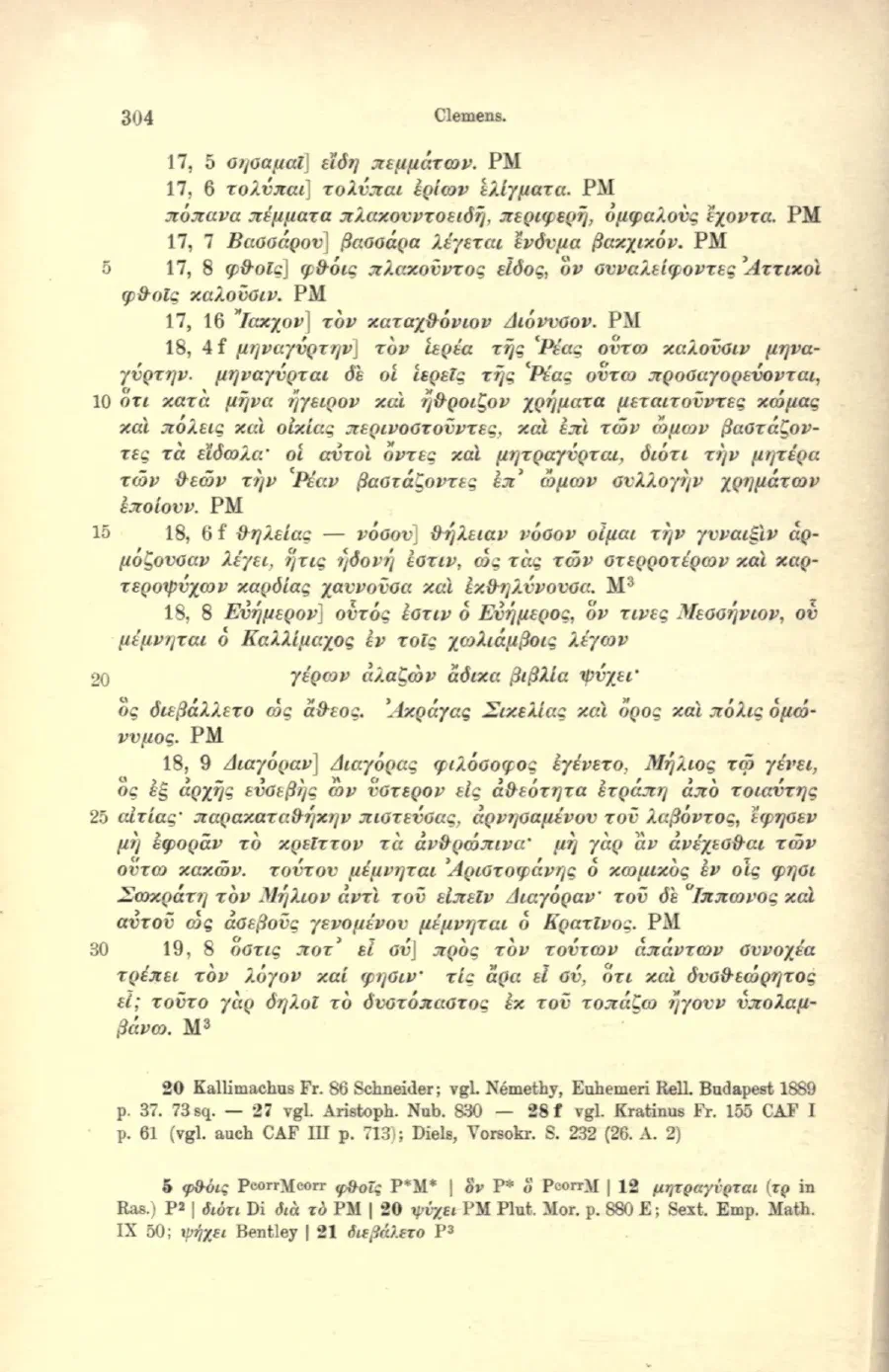
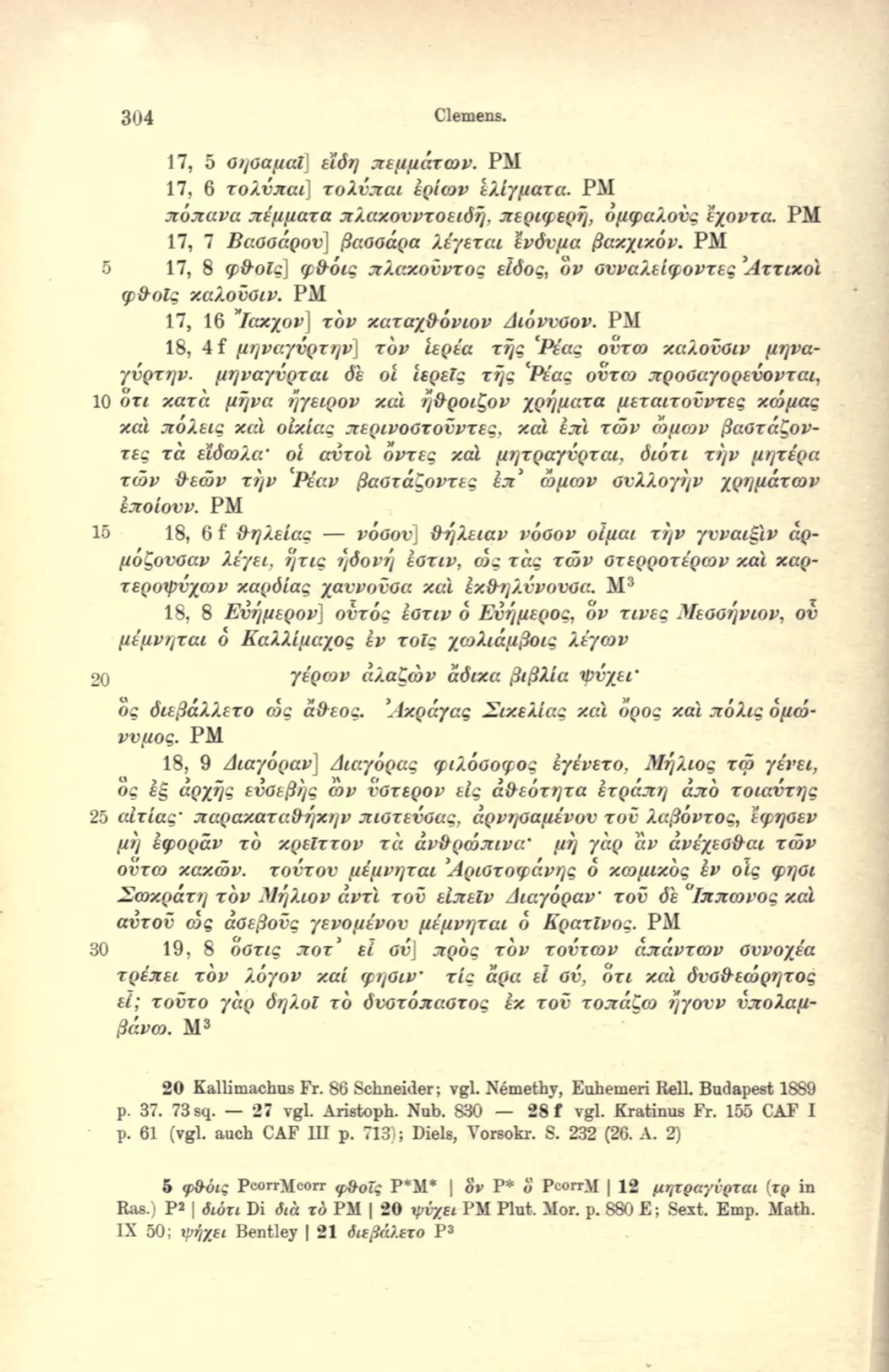
Page 304. Stählin 1905, Scholia p. 304: the run ends at line 7, Iakchos. Scans of Otto Stählin's edition (Leipzig, 1905), Scholia pp. 300–304, from the University of Toronto copy on the Internet Archive Full source - 48304,1
σησαμαῖ] εἴδη πεμμάτων.
Sesame cakes: kinds of cakes.
Note on line 48
Clement 17,5 (2.22.4): “What are the mystic chests? I must strip their holy things and speak the unspeakable. Are they not sesame cakes, pyramid cakes, balls of wool, many-bossed round cakes, lumps of salt and a serpent, the rite of Dionysus Bassareus? And besides these, pomegranates, fig-branches, fennel stalks and ivy, and phthois cakes and poppies?” Then the secret symbols of Themis: marjoram, a lamp, a sword, “and a woman’s comb (kteis), which is, to say it decently and in the language of the mysteries, a woman’s part”: her genitals. The scholia print no note on the kteis. - 49304,2
τολύπαι] τολύπαι ἐρίων ἑλίγματα.
Balls of wool: τολύπη: ball of wool are windings of wool.
- 50304,3
πόπανα πέμματα πλακουντοειδῆ, περιφερῆ, ὀμφαλοὺς ἔχοντα.
πόπανον: round flat cake offered to the gods are flat cakes, round, with bosses (“navels”).
Note on line 50
Clement’s phrase is popana polyomphala, “cakes with many navels”. - 51304,4
Βασσάρου] βασσάρα λέγεται ἔνδυμα βακχικόν.
Of Bassareus: a βασσάρα: bassara, a Bacchic garment; Bassareus is a name of Dionysus is the name of a Bacchic garment.
Note on line 51
Clement 17,7: “a serpent, the rite of Dionysus Bassareus”. The scholiast glosses bassara as a Bacchic garment and leaves the link to the title Bassareus implied; he passes over the serpent in the chest. - 52304,5
φθοῖς] φθόις πλακοῦντος εἶδος, ὃν συναλείφοντες Ἀττικοὶ φθοῖς καλοῦσιν.
Phthois cakes: phthois is a kind of flat cake, which the Attic speakers, contracting the word, call φθοῖς: phthois, a kind of flat cake.
Note on line 52
The difference is of accent and contraction (phthóïs against phthoîs). P and M first wrote phthoîs in the lemma’s place and were corrected to phthóïs. - 53304,7
Ἴακχον] τὸν καταχθόνιον Διόνυσον.
Iakchos: the underworld Dionysus.
Note on line 53
Clement 17,16 (2.22.7): “Put out the fire, hierophant; torchbearer, respect the torches: the light convicts your Iakchos.” The scholiast makes the god of the Eleusinian torches the Dionysus under the earth. This is the last note on Clement’s chapter on the mysteries.