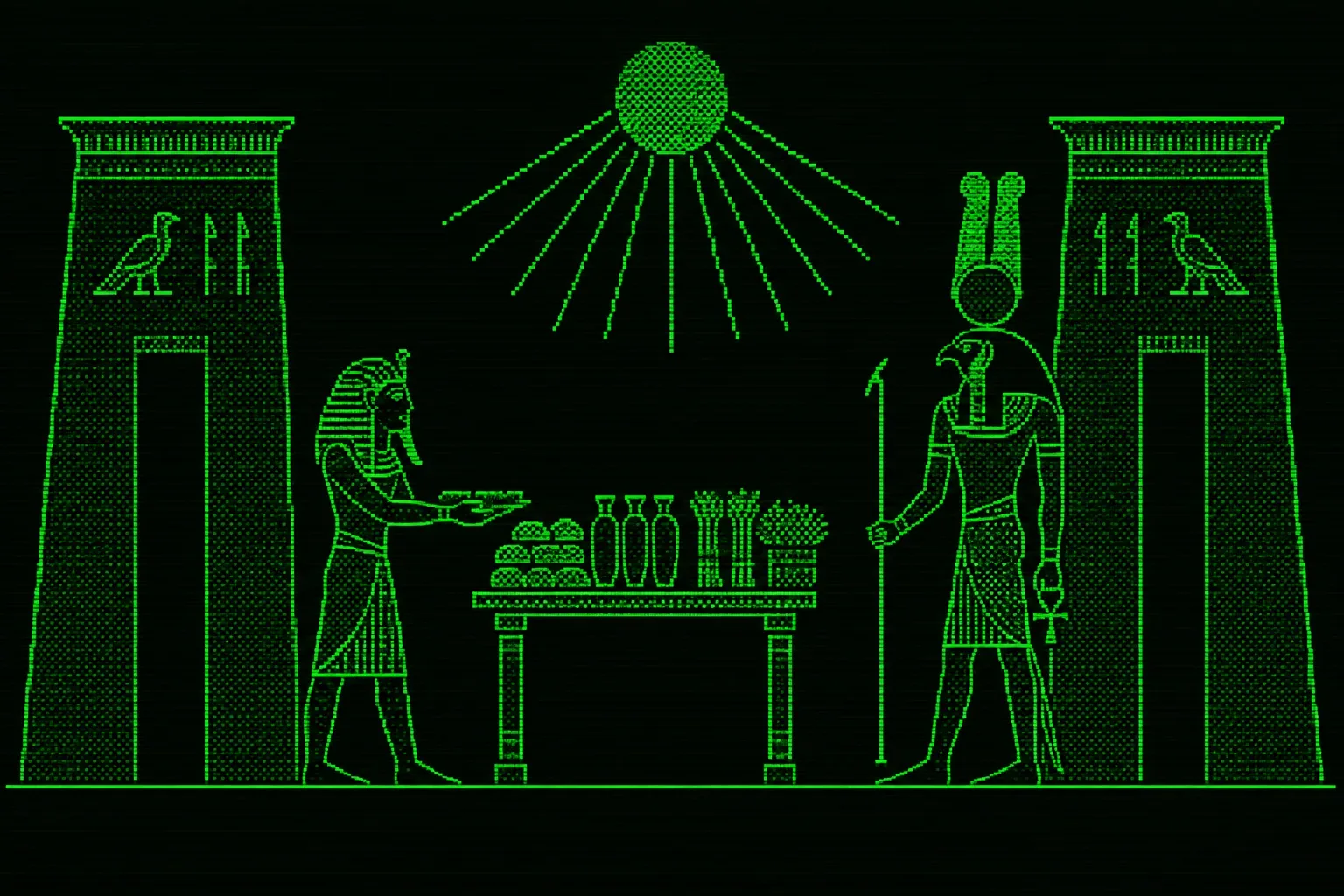
~/sacred-texts/ramesside-royal-inscriptions
Buhen Stela of Ramesses I: Temple Offerings and War Slaves
- Date
- Inscribed in the 19th Dynasty, regnal year 2 of Ramesses I (c. 1292–1290 BC), on a stela for the temple of Min-Amun at Buhen
- Found
- Found at Buhen in Nubia (modern Sudan); now in the Louvre Museum, Paris (C 57)
- Language
- Ancient Egyptian · Hieroglyphic
- 1
rnp,t-zp 2 ꜣbd 2 pr,t sw 20
Regnal year 2, second month of Peret, day 20.
Note · Line 1
Peret was the growing season, when the Nile flood had receded and crops grew in the fields. - 2
ꜥnḫ Ḥr,w Kꜣ-nḫt-wꜣḏ-nsyt nb,tj ḫꜥi̯-m-nswt-m[j-Jtm] [Ḥr,w-nbw] [smn-Mꜣꜥ,t]-ḫt-tꜣ,wj nswt-bj,tj Mn-pḥ,tj-Rꜥw zꜣ-Rꜥw Rꜥw-msi̯-sw [mry] 〈Jmn-Rꜥw〉 〈nb-ns,t.pl-tꜣ,du〉 Mnw zꜣ ⸢ꜣs,t⸣ ḫꜥi̯(.w) ḥr s,t Ḥr,w n.t ꜥnḫ mj jtj =f Rꜥw r rꜥw-nb
Long live Horus, Strong Bull Whose Kingship Flourishes; the Two Ladies, He Who Appears as King like Atum; the Golden Horus, He Who Establishes Maat throughout the Two Lands; the King of Upper and Lower Egypt, Menpehtyre; the Son of Ra, Ramesses, beloved of Amun-Ra, lord of the thrones of the Two Lands, and of Min, son of Isis, risen upon the throne of Horus among the living like his father Ra, day after day.
Note · Line 2
These are five royal names of one king. - 3
jst ḥm =f m dmj [Ḥw,t-kꜣ-Ptḥ] [ḥr] [jri̯.t] [ḥ]ss jtj =f Jmn-Rꜥw Ptḥ rs,j-jnb≡f nb-ꜥnḫ-tꜣ,wj nṯr.pl nb.w.pl Tꜣ-mrj mj rḏi̯ =sn n =f [qn,t] [nḫt] [tꜣ.pl] [nb.w.pl] dmd m jb wꜥ 〈ḥr〉 swꜣš kꜣ =k tꜣ.pl nb.pl ḫꜣs,t nb Pḏ,wt-9 ẖdb.⸢w⸣ [...]
Now His Majesty was in the city of Memphis, doing what his father Amun-Ra, Ptah who is south of his wall, lord of Ankhtawy, and all the gods of Egypt praise, as they grant him valor and might. All lands are joined in one heart to praise your ka. All lands, every foreign land, the Nine Bows lie slain …
Note · Line 3
The inscription turns to address the king directly. His ka is his vital power; the Nine Bows stand for the whole array of Egypt’s traditional enemies. - 4
jw wḏ.n ḥm =f nswt-bj,tj Mn-pḥ,tj-Rꜥw ḏi̯ ꜥnḫ wꜣḥ ḥtp-nṯr n jtj =f Mnw-Jmn ḥr,j-jb [Bhn]
His Majesty, the King of Upper and Lower Egypt, Menpehtyre, given life, commanded that a divine offering be laid before his father Min-Amun, who dwells in Buhen.
Note · Line 4
Buhen was an Egyptian fortress town on the Nile in Nubia. Here Min and Amun were worshipped together as one god. - 5
[tp] [n] [wꜣḥ] =f m ḥw,t-nṯr =f pzn 12 bj,t 100 ḥ(n)q,t dz 4 sm,w ḫrš 10
Account of what he laid in his temple: 12 pesen-loaves, 100 bit-loaves, 4 jars of beer and 10 bunches of greens.
- 6
m-mj,tt [mḥ] [rʾ-pr] [pn] [m] [ḥm-nṯr.pl] wꜥb.pl mḥ šnꜥ,w =f m ḥm.pl ḥm,t.pl n.t ḥꜣq ḥm =f nswt-bj,tj Mn-[pḥ,tj]-Rꜥw [ḏi̯] [ꜥnḫ] [mj] [Rꜥw] [ḏ,t] [nḥḥ]
He likewise commanded that this temple be filled with priests and wab-priests, and its storehouse filled with male and female slaves, both drawn from the war captives of His Majesty, the King of Upper and Lower Egypt, Menpehtyre, given life like Ra for ever and ever.
Note · Line 6
Wab means “pure.” These priests had to be ritually clean to serve in the temple. - 7
wn.jn ḥm =f jw [jb] [=f] rs tp nn ꜥwn =f ḥr ḥjḥj mn(,w)[.pl] [n] [jtj] [=f] Mnw-Jmn ḥr,j-jb Bhn ⸢ḥr⸣ jri̯ n =f ḥw,t-nṯr mj ꜣḫ,t n.t p,t rꜥw [ḥr] [wbn] j:m =s
Then His Majesty’s heart was watchful. He did not sleep as he sought out the monuments of his father Min-Amun, who dwells in Buhen, and built him a temple like the horizon of heaven when the sun rises there.
- 8
nswt-bj,tj nb-tꜣ,du Mn-Mꜣꜥ,t-Rꜥw zꜣ-Rꜥw n ⸢ẖ,t⸣ =f mry =f nb-[ḫꜥ,pl] Stẖ,y-mr-n-Ptḥ ⸢ḏi̯⸣ ⸢ꜥnḫ⸣ [mj] [Rꜥw]
The King of Upper and Lower Egypt, lord of the Two Lands, Menmaatre; the Son of Ra, of his own body, whom he loves, lord of crowns, Seti-Merenptah, given life like Ra.
Note · Line 8
The closing names belong to Seti I, son and successor of Ramesses I.