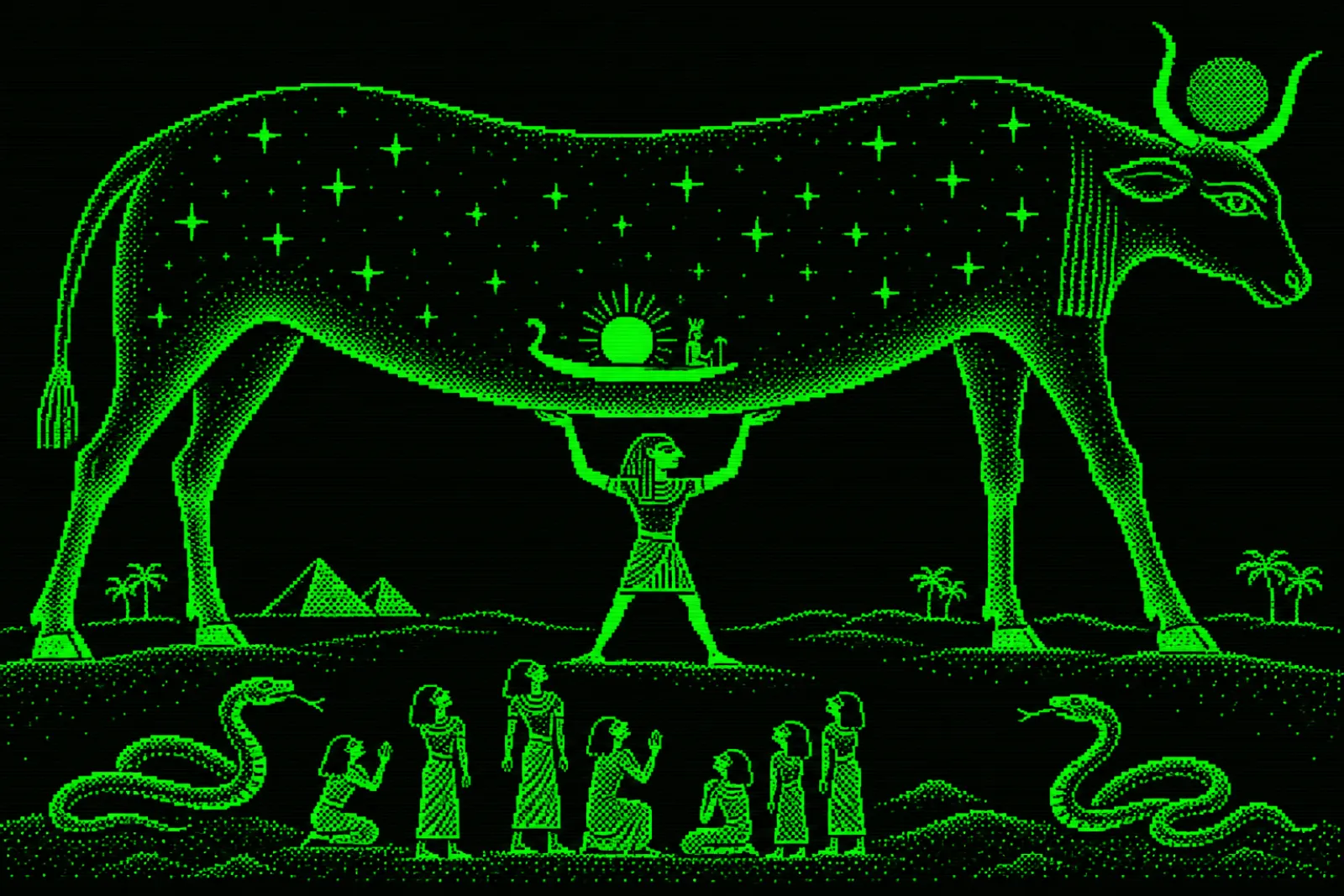
~/sacred-texts/book-of-the-heavenly-cow
Book of the Heavenly Cow: Re Leaves, the Snakes Stay
Translated by AI straight from the Middle Egyptian (New Kingdom), not from a modern translation, then checked against the editions and studies listed below. How we translate
- Text
- Book of the Heavenly Cow, Seti I copy, lines 1–95, with the end from Tutankhamun's shrine
- Date
- Copied c. 1290–1279 BC (Seti I); first attested c. 1330 BC (Tutankhamun)
- Found
- Tomb of Seti I (KV 17), Valley of the Kings; first gilded shrine of Tutankhamun, now in Cairo
- Language
- Middle Egyptian (New Kingdom) · Hieroglyphic
The Book of the Heavenly Cow was written on the shrines and tomb walls of New Kingdom kings, first on the outer gilded shrine of Tutankhamun, then in the tombs of Seti I, Ramesses II, Ramesses III and Ramesses VI. Seti I’s copy, in a side room of his tomb beside a painting of the sky-cow, is the fullest, and it is the one translated here. The story is told in the third person, with long speeches by Re, Nun, Nut and the gods.
It runs in four movements. Re is old and humans plot against him; his Eye goes down as Hathor and kills them, becomes Sekhmet, and wades in their blood, until Re floods the fields with beer reddened with ochre and she drinks, gets drunk and stops seeing people. Then Re, weary of humankind, leaves: Nut becomes a cow, he rides on her back, she becomes the sky, and the fields of the beyond and the stars are named by puns on his words. On the ground he gives the earth’s snakes to Geb and Osiris, and makes Thoth his deputy in the night, naming the ibis, the moon and the baboon. The last part is a rite: how to recite the book, what to paint on the cow, and a list of the bas, the visible powers, of the gods.
Every line of Seti I’s text in the open edition is translated, ninety-five of Hornung’s numbered lines and the captions on the painted cow. Where the wall is broken, the edition restores words from the other copies in square brackets; places still lost are marked [ … ]. Seti I’s text breaks off near the end, and the closing lines, about the scribe who knows the book, come from Tutankhamun’s shrine (lines t30 to tx4). For how this story sits beside Genesis, see Within the Coiled One.
Each numbered line gives the Middle Egyptian (New Kingdom) first: the original script, then the same words in Latin letters. Our English is underneath. Tap a dotted word for its meaning, and Note for our comment on the line; our comments are in the right margin.
- 1
𓊹𓀭 𓆣𓂋𓆓𓂧𓆑 𓅓𓆱𓐍𓏏𓂻 𓃹𓈖𓈖 𓆑 𓐛 𓇓𓏏𓈖𓇋𓏏𓇋𓏛 𓂋𓍿𓀀𓁐𓏥 𓊹𓊹𓊹 𓐛 𓐍𓏏𓏛𓏥 𓃹𓈖𓇋𓋔
ḫpr to come into being, to become · TLA [swt] [wbn] Rꜥw Re, the sun god · TLA nṯr god · TLA ḫpr-ḏs=f the one who came into being by himself · TLA m-ḫt wnn =f m nsw,yt rmṯ people, humankind; punned on rmj.t, tears · TLA nṯr god · TLA m jḫ.t thing · TLA 〈wꜥ.t〉 wn.jn rmṯ people, humankind; punned on rmj.t, tears · TLA [ḥr] [kꜣi̯.t] mdw.t matter; a plot, words against someone · TLA […] mdw.t matter; a plot, words against someone · TLA r ḫft.j enemy · TLA Rꜥw Re, the sun god · TLA
[Now it happened that Re rose], the god who ḫpr-ḏs=f: “the one who came into being by himself”, after he had held the kingship, when rmṯ: people, humankind and nṯr: god were jḫ.t wꜥ.t: literally “one thing”. Then people [were plotting a plot …] a mdw.t: a matter; a plot, words against someone against the enemies of Re.
Note on line 1
Seti I’s wall is broken at the start; the words in square brackets in the transliteration are restored by the edition from the other copies. The opening state is attested in plain words: rmṯ nṯr.w m jḫ.t wꜥ.t, “people and gods were one thing”. The rebellion is a mdw.t, a word from mdw “to speak”: what humans do against the god is talk. The edition notes a variant, “a plot against the enemies of Re”: a scribe’s way of not writing a plot against Re himself. - 2
𓂋 𓆑 𓍛𓏤𓀭 𓆑 𓋹𓍑𓋴 𓇋𓄿𓅱𓅱𓀗 𓌟𓏤𓏥 𓆑 𓐛 𓌉𓋞𓈒𓏥 𓎛𓂝𓄹𓄹𓄹 𓆑 𓅓 𓋞𓏥 𓍲𓈖𓏭𓁸𓏥 𓆑 𓅓 𓐍𓊃𓃀𓂧𓏥 𓃹𓈖𓇋𓋔 𓂋 𓆑 𓇋𓈖 𓂋𓍿𓀀𓁐𓏥
[jstw] r =f ḥm =f ꜥnḫ-(w)ḏꜣ-s(nb) jꜣwi̯.w qs.pl =f m ḥḏ ḥꜥ,pl =f m nbw šnj =f m ḫsbd 〈mꜣꜥ〉 wn.jn [ḥm] =[f] [ḥr] sjꜣ to perceive, to recognize · TLA mdw.t matter; a plot, words against someone · TLA [n,t(t)] [kꜣi̯.t(j)] r =f jn rmṯ people, humankind; punned on rmj.t, tears · TLA
For His Majesty, life, prosperity, health, had grown jꜣwi̯: to be old: his bones were silver, his flesh was gold, his hair was true lapis lazuli. Then [His Majesty] sjꜣ: to perceive, to recognize [the plot that was plotted] against him by people.
Note on line 2
The god is old in a body made of precious metal and stone, the stuff of cult statues. He perceives the plot with sjꜣ, the same verb that the drunk goddess will lose in line 23. - 3
𓆓𓂧𓇋𓋔 𓍛𓏤𓀯 𓆑 𓋹𓍑𓋴 𓈖 𓈖𓏏𓏭𓅂𓏥 𓐛 𓆱𓐍𓏏𓂻𓅂𓀭𓏥 𓆑 𓈖𓇋𓋴𓀞 𓐛𓂝 𓈖 𓀀 𓂋 𓁹𓏏𓏤𓆗 𓀀 𓂋 𓆄𓅱𓀭 𓎛𓈖𓂝 𓇋𓏏𓆑𓅱𓀭𓏥 𓏏𓅐𓁐𓏥 𓃹𓈖𓈖𓇋𓇋𓅱𓏥 𓎛𓈖𓂝 𓀀 𓇋𓋴𓏏 𓅱𓀀 𓐛 𓏌𓏌𓏌𓇯𓀭 𓎛𓈖𓂝 𓎼𓂋 𓊹𓀭 𓏌𓏌𓏌𓇯𓈗𓀭
ḏd.jn ḥm =f ꜥnḫ-(w)ḏꜣ-s(nb) n n,tj.w.pl m ḫt,jw.pl =f njs m~ꜥ n =j r jr.t eye; the Eye of the sun, a goddess · TLA =j r Šw Shu, god of air, who holds up the sky · TLA Tfn.t Tefnut, goddess of moisture · TLA Gbb Geb, the earth god · TLA Nw.t Nut, the sky goddess · TLA ḥnꜥ jt.w.pl mw,t.pl wnn.yw.pl ḥnꜥ =j jst(w) wj m Nw.w the Nun, the dark primeval water, and its god · TLA ḥnꜥ gr nṯr god · TLA Nw.w the Nun, the dark primeval water, and its god · TLA
Then His Majesty, life, prosperity, health, said to those who were in his following: “Call for me my jr.t: eye; the Eye of the sun, a goddess, and Shu, Tefnut, Geb and Nut, and the fathers and mothers who were with me when I was in the Nw.w: the Nun, the dark primeval water, and also the god Nun.”
- 4
𓏎𓈖𓈖 𓆑 𓍲𓍘𓇋𓇋𓀙𓀭𓏥 𓆑 𓎛𓈖𓂝 𓆑 𓏎𓈖𓈖 𓎡 𓋴𓏏𓏥 𓅓 𓎡𓏏𓎡𓏏𓀁
jnn =f šn,ty =f ḥnꜥ =f jnn =k st m ktkt stealth, secrecy · TLA
“Let him bring his courtiers with him. You shall bring them in ktkt: stealth, secrecy.”
Note on line 4
The speech shifts from “he” to “you” in mid-sentence. The point is secrecy: the council must not be seen by people. - 5
𓇋𓅓𓂜 𓌳𓁹𓄿𓄿 𓂋𓍿𓀀𓁐𓏥 𓇋𓅓𓂜 𓅱𓂝𓂋𓂾𓂻 𓄣𓏤 𓊃𓈖𓏥 𓎡 𓎛𓈖𓂝 𓊃𓈖𓏥 𓂋 𓏏�𓉐 𓆓𓂧 𓊃𓈖𓏥 𓋴𓐍𓂋𓅱𓏛𓏥 𓊃𓈖𓏥 𓇥𓂋𓏏𓅱𓏥𓀢 𓂻𓅱 𓀀 𓐛 𓏌𓏌𓏌𓇯𓈗𓀭 𓂋 𓃀𓅱 𓆣𓂋𓈖 𓀀 𓇋𓅓
jmi̯ mꜣꜣ to see, to look at · TLA rmṯ people, humankind; punned on rmj.t, tears · TLA jmi̯ wꜥr to flee · TLA jb =sn jwi̯ to come, to return · TLA =k ḥnꜥ =sn r ḥw,t-ꜥꜣ(.t) ḏd =sn sḫr to fell, to overthrow · TLA =sn ḏr(j).w.pl jwi̯ to come, to return · TLA =j m Nw.w the Nun, the dark primeval water, and its god · TLA r bw ḫpr to come into being, to become · TLA =j jm
“People must not see. Their hearts must not wꜥr: to flee, when you come with them to the Great House. Let them speak their firm counsels, so that I may jwi̯: to come, to return to the Nun, to the place where I ḫpr: to come into being.”
Note on line 5
The withdrawal is already in Re’s first speech: he means to go back into the water he came from. Budge reverses the direction (“I will go from Nu”); the Egyptian has jwi̯=j m Nwn, “that I may come (back) into the Nun”. - 6
𓏎𓈖𓀀𓇋𓈖 𓏏𓅱 𓇑𓇑𓈖𓈖 𓊹𓊹𓊹 𓇑𓇑𓈖𓈖 𓊹𓊹𓊹 𓇋𓊪𓈖 𓁷𓏤 𓐞𓏤 𓆑𓏭 𓁷𓏤 𓂧𓉔𓈖𓁶 𓇾𓏤𓈅 𓐛𓂺𓏤𓏛 𓍛𓀯 𓆑
jni̯.jn =tw nn-n nṯr god · TLA [ḥr-ꜥ,wj] [ꜥḥꜥ].j[n] nn-n nṯr god · TLA jpn ḥr gs(.wj) =fj ḥr dhn tꜣ m-bꜣḥ ḥm =f
The gods were brought [at once], and these gods [stood] at his two sides, dhn tꜣ: to touch the ground with the brow before His Majesty.
- 7
𓆓𓂧 𓆑 𓌃𓂧𓏏𓀁𓏥 𓆑 𓐛𓂺𓏤𓏛 𓇋𓏏𓆑𓀭 𓋴𓅓𓋴𓅱𓀙𓀭𓀀𓏥 𓁹𓂋 𓍿𓀀𓁐𓏥 𓆓𓂧𓇋𓋔 𓋴𓈖𓏥 𓐍𓆑𓏏 𓍛𓏤𓀯 𓆑 𓌃𓂧𓅱𓀁𓏥 𓈖 𓈖𓏥 𓂋 𓄔𓅓𓏏 𓈖𓏥 𓊃𓏏
ḏd =f md,t =f m-bꜣḥ jt sms,w.pl jri̯ rmṯ people, humankind; punned on rmj.t, tears · TLA nsw r[ḫ],yt.pl ḏd.jn =sn ḫft ḥm =f mdwi̯ n =n r sḏm.t =n st
He told his matter before the father of the eldest, who made people, the king of the rḫ.yt: the rekhyt, the common people. They said to His Majesty: “Speak to us, so that we may hear it.”
Note on line 7
The epithets “who made people, the king of the common folk” can belong to the speaker or to the father he speaks before. Budge gives them to Re (“the maker of men and women … spake his words in the presence of the Father of the first-born gods”); the edition’s German keeps them with the father. - 8
𓆓𓂧𓇋𓈖 𓂋𓂝𓇳𓏤𓀭 𓈖 𓏌𓏌𓏌𓇯𓈗𓀭 𓊹𓀭 𓋴𓅓𓋴𓀙𓀭 𓆣𓂋𓈖 𓀀 𓇋𓅓 𓆑 𓊹𓊹𓊹𓏥 𓁶𓏤𓂝𓏤𓀭𓏥 𓐛𓂝 𓏏𓈖𓏥 𓂋𓍿𓀀𓁐𓏥 𓆣𓂋𓅱𓏥 𓐛 𓁹𓏏𓏤𓆗 𓀀 𓎡𓄿𓀁𓈖 𓋴𓈖𓏥 𓌃𓂧𓏏𓀁𓏥 𓂋 𓀀
ḏd.jn Rꜥw Re, the sun god · TLA n Nw.w the Nun, the dark primeval water, and its god · TLA nṯr god · TLA sms ḫpr to come into being, to become · TLA =j jm =f nṯr god · TLA dp-ꜥ.pl m =tn rmṯ people, humankind; punned on rmj.t, tears · TLA ḫpr to come into being, to become · TLA m jr.t eye; the Eye of the sun, a goddess · TLA =j kꜣi̯.n =sn mdw.t matter; a plot, words against someone · TLA r =j
Then Re said to Nun: “Eldest god, in whom I came into being, and you ancestor gods: look, the rmṯ ḫpr.w m jr.t=j: humankind, born from the creator's eye have plotted a plot against me.”
Note on line 8
Rmṯ “people” sounds like rmj.t “tears”: people came from the creator’s weeping eye, as in the Bremner-Rhind creation and Coffin Text 1130. Here the pun stays implicit; the text says only “from my Eye”. - 9
𓆓𓂧𓏥 𓈖 𓀀 𓁹𓏏𓏥 𓏏𓈖𓏥 𓂋 𓊃 𓐛𓂝 𓏏𓈖𓏥 𓅱𓀀 𓎛𓎛𓏭𓂻 𓀀 𓂜 𓋴𓌳𓄿𓌫𓂡𓈖 𓀀 𓋴𓏏 𓂋 𓄔𓅓𓏏𓅱 𓀀 𓏏𓈖𓏥 𓂋 𓊃
ḏd.pl n =j jr,t.pl =tn r =s m =tn wj ḥḥj =j n smꜣ to kill · TLA =j st r sḏm.ṱ =j ḏ[d].tj =tn r =s
“Tell me what you would do about it. Look, I am ḥjḥj: to seek; to consider. I will not smꜣ: to kill them until I have heard what you say about it.”
- 10
𓆓𓂧𓇋𓈖 𓍛𓏤 𓈖 𓏌𓏌𓏌𓇯𓈗𓀭 𓅭𓏤 𓀀 𓇳𓏤𓀭 𓊹𓀭 𓉻𓂝𓏛 𓂋 𓁹𓇓𓅱 𓀗𓀭 𓂋 𓈎𓌳𓄿𓇋𓇋𓅱𓌙𓅯𓏛𓏥𓇓𓅱𓀭𓏥 𓈞𓊃𓀀
ḏd.jn ḥm n Nw.w the Nun, the dark primeval water, and its god · TLA zꜣ =j Rꜥw Re, the sun god · TLA nṯr god · TLA ꜥꜣ r jri̯-sw wr r qmꜣ.yw.pl-sw ḥmsi̯ s,t =[k]
Then the Majesty of Nun said: “My son Re, god greater than the one who made him, mightier than those who created him: sit on your throne!”
- 11
𓅨𓂋 𓅾𓀁 𓎡 𓇋𓅱 𓁹𓏏𓏤𓆗 𓎡 𓂋 𓍯𓄿𓇋𓇋𓅱𓀁𓏥 𓇋𓅓 𓎡 𓆓𓂧𓇋𓋔 𓍛𓏤 𓈖 𓇳𓏤𓀭 𓅕 𓏏𓈖𓏥 𓋴𓏏𓏥 𓅱𓂝𓂋𓂾𓂻 𓂋 𓈉𓏏𓏤 𓄣𓏤𓏥 𓋴𓈖𓏥 𓋴𓈖𓂧𓅱𓀁 𓋴𓈖𓏥
wr snḏ =k jw jr.t eye; the Eye of the sun, a goddess · TLA =k r wꜣi̯.yw.pl jm =k ḏd.jn ḥm n Rꜥw Re, the sun god · TLA m =tn st wꜥr to flee · TLA r ḫꜣs.t desert, hill country, foreign land · TLA jb.pl =sn snd.w ḥr ḏ[d] =[j] [n] =sn
“Great is the fear of you when your Eye is against those who plot against you.” Then the Majesty of Re said: “Look, they have fled to the ḫꜣs.t: hill country, foreign land, desert; their hearts are afraid because of what [I said] to them.”
- 12
𓆓𓂧𓇋𓋔 𓋴𓈖𓏥 𓐍𓏏𓆑 𓍛𓏤𓀭 𓆑 𓂞 𓈝𓐛𓂻 𓁹𓏏𓏤𓆗 𓎡 𓎛𓄿𓅱𓂡 𓋴 𓈖 𓎡 𓋴𓏏𓏭 𓍯𓄿𓀁𓏥 𓅓 𓈋𓅱𓅪𓏥𓏥𓀐 𓂜𓈖 𓁹𓏏𓏤 𓏃𓈖𓏏𓏭 𓇋𓅓
ḏd.jn =sn ḫft ḥm =f ḏi̯ šmi̯ jr.t eye; the Eye of the sun, a goddess · TLA =k ḥ〈m〉w =s n =k stj wꜣi̯.pl m ḏw.pl nn jr.t eye; the Eye of the sun, a goddess · TLA ḫnt,j(.t) jm =[s] [r] [ḥwi̯.t] [n] =[k] [st]
They said to His Majesty: “Send your Eye, that it may ḥmw: to crush, to smash for you those who plot evil as Ḏw: the evil one. There is no eye more ḫnt.j: foremost, pre-eminent than it [for striking them for you].”
- 13
𓉔𓄿𓂻 𓋴 𓅓 𓉡 𓂻𓅱𓇋𓈖 𓂋 𓆑 𓊹𓏏𓂋𓏏𓁐 𓏏𓈖 𓋴𓌳𓄿𓅓𓌫𓂡𓈖 𓊃 𓂋𓍿𓀀𓁐𓏥 𓁷𓏤 𓈉𓏏𓏤 𓆓𓂧𓇋𓋔 𓍛𓏤 𓈖 𓊹 𓊪𓈖 𓇍𓇋𓏭𓂻𓏭𓅱 𓐛𓊵𓏏𓊪 𓉡 𓁹𓏏 𓈖
hꜣi̯ =s m Ḥw.t-Ḥr.w Hathor · TLA jwi̯ to come, to return · TLA r =f nṯr.t goddess · TLA tn smꜣ to kill · TLA =s rmṯ people, humankind; punned on rmj.t, tears · TLA ḥr ḫꜣs.t desert, hill country, foreign land · TLA ḏd.jn ḥm n nṯr god · TLA pn jwi̯ to come, to return · TLA m-ḥtp Ḥw.t-Ḥr.w Hathor · TLA jri̯.t n jr.w maker; rite · TLA jwi̯ to come, to return · TLA =[j] [r] =[s]
“Let it go down as Ḥw.t-Ḥr.w: Hathor, “House of Horus”.” This goddess came, having smꜣ: to kill people in the desert. The Majesty of this god said: “Welcome in peace, Hathor, who has done (it) for the jr.w: maker; the creator, Re, [after I had come to her]!”
Note on line 13
The Eye goes out as Hathor and comes back a killer. Wilson and Lichtheim stop the story soon after this; the snakes, the ascent and the rite are cut. - 14
𓆓𓂧𓀀𓇋𓋔 𓊹𓂋𓏏𓁐 𓏏𓈖 𓋹𓈖𓐍 𓎡 𓈖 𓀀 𓇋𓅱 𓌂𓐛𓂡𓈖 𓀀 𓐛 𓂋𓍿𓀀𓁐𓏥 𓇋𓅱 𓇛𓐛𓏛𓏥 𓁷𓏤 𓄣𓏤 𓀀 𓆓𓂧𓇋𓋔 𓍛𓏤 𓈖 𓇳𓏤𓀭 𓇋𓅱 𓀀 𓂋 𓌂𓐛𓂡 𓇋𓐛 𓊃𓈖𓏥
ḏd.jn nṯr.t goddess · TLA tn ꜥnḫ =k n =j jw sḫm to have power over · TLA =j m rmṯ people, humankind; punned on rmj.t, tears · TLA jw nḏm to be sweet, pleasant · TLA ḥr jb =j ḏd.jn ḥm n Rꜥw Re, the sun god · TLA jw =j r sḫm to have power over · TLA jm =sn [m] [nsw]
Then this goddess said: “As you live for me, I have sḫm: to have power over, to overpower people, and it was nḏm: to be sweet, pleasant to my heart.” Then the Majesty of Re said: “I will have power over them [as king].”
Note on line 14
Her verb is sḫm, “to have power over”, and the next line takes the name Sekhmet, “the Powerful One”, from it. What she has just done is kill (line 13), and she says it was nḏm ḥr jb, sweet to her heart. - 15
𓅓 𓋴𓂝𓈖𓂧𓅱𓅪𓏥 𓋴𓏏𓏥 𓆣𓂋 𓌂𓐍𓏏𓀭 𓊪𓅱 𓈙𓃀𓃀𓏏𓏴𓏒𓏥 𓈖𓏏 𓎼𓂋𓎛� 𓂋 𓂋𓉔𓏏𓂾𓂻 𓁷𓏤 𓊃𓈖𓆑𓂐𓏥 𓊃𓈖𓏥 𓆷𓄿𓂝𓏛𓀀𓐛 𓇓𓏏𓈖𓀔𓈖𓈖𓊖 𓆓𓂧𓇋𓈖
m sꜥnd.w st ḫpr to come into being, to become · TLA Sḫm.t Sekhmet, “the Powerful One” · TLA pw šbb.t beer mash · TLA n.t grḥ r rhni̯ to wade · TLA ḥr znf blood · TLA =sn šꜣꜥ-m Nn-nsw ḏd.jn Rꜥw Re, the sun god · TLA
“Do not sꜥnḏ: to diminish!” So Sḫm.t: Sekhmet, “the Powerful One”, the lion goddess came into being, the šbb.t: beer mash of the night, to rhni̯: to wade in their znf: blood from Herakleopolis on. Then [Re] said:
Note on line 15
The name Sekhmet is drawn from sḫm in line 14: an Egyptian etymology the text makes itself. Then she wades in human blood. Budge’s “Sekhet of the offerings” is a misreading; the edition has “das Gebräu der Nacht”, the beer mash of the night (Roeder: “Nachtmahlzeit”), which anticipates the drink that will stop her. - 16
𓈖𓇋𓋴𓀁𓏥 𓐛𓂝 𓈖 𓀀 𓄋𓊪𓅱𓏏𓏭𓅂𓏴𓂻𓀀𓏥 𓆼𓄿𓐍𓅱𓏥 𓋴𓇋𓆛𓈖𓏌𓅱𓂻𓏥 𓋴𓐍𓋴𓂾𓂻𓀀 𓋴𓈖𓏥 𓆄𓅱𓏏𓇳 𓈖 𓆱𓏏𓏤 𓏎𓈖𓇋𓋔 𓏏𓅱 𓇑𓇑𓈖𓈖 𓁷𓏤𓂝𓏤𓏭𓅱
njs.pl m~ꜥ n =j wpw,tj.w.pl ḫꜣḫ,w.pl sjn.w.pl sḫs =sn 〈mj〉 šw,t n ẖ.t belly, body · TLA jni̯.jn =tw nn-n wpw,tj[.w.pl] [jpn] ḥr-ꜥ,wj
“Call for me wpw.tj: messenger, swift and quick, that they may run like the šw.t: shadow of a body!” These messengers were brought at once.
- 17
𓆓𓂧𓇋𓈖 𓍛𓏤 𓈖 𓊹 𓊪𓈖 𓆷𓄿𓊃 𓈖𓏥 𓂋 𓋁𓃀𓅱𓐎𓈉 𓏎𓈖𓏥 𓈖 𓀀 𓂞𓂞𓇋𓏏𓈒𓏥 𓂋𓅨𓂋 𓏎𓈖𓇋𓈖 𓏏𓅱 𓈖 𓆑 𓇑𓇑𓈖𓈖 𓂞𓂞𓇋𓏏𓏭𓈒𓏥 𓂋𓂝𓏏𓇋𓋔 𓈖𓏏𓏭 𓅓 𓉺𓏌𓊖 𓁷𓏤 𓐩𓏌𓀁 𓂞𓂞𓇋𓏏𓏭𓈒𓏥 𓇋𓊪𓈖
ḏd.jn ḥm n nṯr god · TLA pn šꜣs n r Ꜣbw Elephantine, at the First Cataract · TLA jni̯.pl n =j ddj,t r-wr jni̯.jn =tw n =f nn-n ddj,tj rḏi̯.jn [ḥm] [n] nṯr god · TLA [pn] [ꜥꜣ] Ḥnk.tj “the side-locked one”, a priest's title · TLA n,tj m Jwn,w ḥr nḏ to grind · TLA ddj,tj jpn
The Majesty of this god said: “Go to Ꜣbw: Elephantine, at the First Cataract and bring me ddj.t: haematite, red ochre in great quantity.” This ochre was brought to him. [The Majesty of this great god] had the Ḥnk.tj: “the one with the side-lock”, a priest's title who is in Heliopolis nḏ: to grind this ochre.
Note on line 17
Ddj.t is fetched from Elephantine and ground by a priest of Heliopolis, so it is a mineral: red ochre or haematite, as Wilson read it. Budge’s “mandrakes” and Roeder’s “pomegranates (?)” are not in this copy. - 18
𓇋𓋴𓏏𓅱 𓎼𓂋 𓍛𓏏𓏤𓁐𓏥 𓁷𓏤 𓏏𓈙𓏴𓂡𓇠 𓌾𓏥 𓂋 𓎛𓈎𓏏𓏊𓏥 𓂋𓂝𓇋𓋔 𓏏𓅱 𓂞𓂞𓇋𓏏𓏭𓈒𓏥 𓇋𓊪𓈖 𓁷𓏤 𓈙𓃀𓃀𓏏𓏴𓏊𓏥 𓏏𓈖 𓈖 𓂋𓍿𓀀𓁐𓏥
jstw gr ḥm,t.pl ḥr tš jt r ḥnq.t beer · TLA rḏi̯.jn =tw ddj,tj jpn ḥr šbb.t beer mash · TLA tn [wn.jn] [mj] znf blood · TLA n rmṯ people, humankind; punned on rmj.t, tears · TLA
Meanwhile serving women were crushing barley for beer. This ochre was put into this mash, [and it was like] the znf: blood of people.
Note on line 18
Mj snf n rmṯ, “like the blood of people”; mj “like” is itself restored by the edition from another copy. Budge has “some of the blood of the men and women” put into the beer; the Egyptian has only a likeness. - 19
𓁹𓏏𓇋𓋔 𓏏𓅱 𓎛𓈎𓏏𓏊𓏥 𓍁𓈖𓏏𓏊 𓆼𓆼𓆼𓆼𓆼𓆼𓆼 𓂻𓅱𓇋𓈖 𓂋 𓆑 𓍛𓏤 𓈖 𓇓𓆤𓏏𓏏 𓂋𓂝𓇳𓏤𓀭 𓎛𓈖𓂝 𓊹𓊹𓊹 𓇋𓊪𓈖 𓂋 𓌳𓁹𓄿𓄿 𓇑𓇑𓈖𓈖 𓎛𓈎𓏏𓏊𓏥 𓇋𓋴𓏏𓅱 𓌉𓆓𓇳 𓇾𓏤𓈅 𓈖 𓋴𓌳𓄿𓅓𓄿𓌫𓂡 𓂋𓍿𓀀𓁐𓏥 𓇋𓋔 𓊹𓂋𓏏𓀗𓆗 𓅓 𓋴𓋴𓋴𓅱𓇳𓏥 𓋴𓈖𓏥 𓏌𓏤 𓏃𓈖𓏏𓏭𓍘𓇋𓇋𓏏𓊛
jri̯.jn =tw ḥnq.t beer · TLA hbn,t 7000 jwi̯ to come, to return · TLA r =f ḥm n nsw-byt Rꜥw Re, the sun god · TLA ḥnꜥ nṯr god · TLA jpn r mꜣꜣ to see, to look at · TLA nn-n ḥnq.t beer · TLA jstw ḥḏ tꜣ n smꜣ to kill · TLA rmṯ people, humankind; punned on rmj.t, tears · TLA jn nṯr.t goddess · TLA m sw.pl =sn n.w ḫnty.t
Seven thousand jars of beer were made. Then the Majesty of the King of Upper and Lower Egypt, Re, came with these gods to look at this beer. The land was about to grow light for the smꜣmꜣ: to kill, to slaughter of people by the goddess, in their days of going south.
- 20
𓌃𓆓 𓇋𓈖 𓍛𓏤 𓈖 𓇳𓏤𓀭 𓄤𓆑𓏭𓂋𓏭𓅱 𓋴𓏏𓏭 𓇋𓅱 𓀀 𓂋 𓐛𓂝𓎡𓏏𓏛𓏥 𓂋𓍿𓀀𓁐𓏥 𓁷𓂋 𓋴
ḏd-mdw jn ḥm n Rꜥw Re, the sun god · TLA nfr.wj stj jw =j r mki̯ to protect · TLA rmṯ people, humankind; punned on rmj.t, tears · TLA ḥr =s
Words spoken by the Majesty of Re: “How good it is! I will mki̯: to protect people from her.”
- 21
𓆓𓂧𓇋𓋔 𓇳𓏤𓀭 𓅓𓂝 𓋴𓏏𓏭 𓂋 𓃀𓅱 𓄿𓈖 𓊃 𓋴𓌳𓄿𓌫𓂡 𓀀 𓂋𓍿𓀀𓁐𓏥 𓇋𓅓 𓉔𓊪𓇳𓇋𓋔 𓍛𓏤 𓈖 𓇓𓆤𓏏𓏏 𓂋𓂝𓇳𓏤𓀭 𓅓 𓄤𓄤𓄤𓎼𓂋𓎛� 𓂋 𓂋𓂝𓏏 𓋫𓏏𓏏𓄯𓈖𓈖𓏏𓅱 𓇑𓇑𓈖𓈖 𓋴𓇥𓂋𓏏𓁀𓏊𓏥
ḏd.jn Rꜥw Re, the sun god · TLA fꜣy.pl m~ꜥ stj r bw 〈ḏd〉.n =s smꜣ to kill · TLA =j rmṯ people, humankind; punned on rmj.t, tears · TLA jm 〈n〉hp.jn ḥm n nsw-byt Rꜥw Re, the sun god · TLA m nfr,w-grḥ r rḏi̯.t stt.tw nn-n sḏr.t sleep-drink, “the one that makes lie down” · TLA
Then Re said: “Carry it to the place where she said she would kill people.” The Majesty of the King of Upper and Lower Egypt, Re, rose early, at the end of the night, to have this sḏr.t: “the one that makes lie down”, a sleeping draught poured out.
Note on line 21
Sḏr.t is from sḏr, “to lie down, to sleep”. The edition glosses it “Schlaftrank” here and “Rauschtrank”, intoxicating drink, in line 24. The red ochre is a colouring; what stops the goddess is drink. - 22
𓃹𓈖𓇋𓋔 𓄿𓎛𓏏𓈅𓏥 𓈖𓏏𓏭 𓇹 𓏤𓏤𓏤 𓎔𓏛 𓅓 𓈗 𓅓 𓅢𓏛𓏥 𓈖 𓍛𓏤 𓈖 𓊹 𓊪𓈖 𓈝𓐛𓏏𓂻𓏭𓋔 𓊹𓏏𓂋𓏏𓆗 𓏏𓈖 𓅓 𓇼𓄿𓇳𓏭𓅱
wn.jn ꜣḥ,t.pl n,tj šzp 3 mḥ(.tj) m mw m bꜣ.w ba-power, manifest might · TLA n ḥm n nṯr god · TLA pn šmi̯.jn nṯr.t goddess · TLA tn m dwꜣ,wj
The fields were full to three palms' depth with mw: water, by the bꜣ.w: ba-power, the manifest might of the Majesty of this god. This goddess went out in the morning,
- 23
𓅠𓅓𓈖 𓊃 𓇑𓇑𓈖𓈖 𓁷𓏤 𓎔𓎛𓏏𓈗 𓄤𓆑𓂋𓇋𓋔 𓁷𓏤 𓋴𓏏 𓇋𓅓 𓃹𓈖𓇋𓋔 𓋴𓏏 𓁷𓏤 𓋴𓅨𓂋𓇋𓈗𓀁 𓄤𓆑𓂋 𓁷𓏤 𓄣𓏤 𓊃𓏏 𓇍𓂻𓇋𓈖 𓊃 𓏏𓐍𓏭𓏊𓍘𓇋 𓂜𓈖 𓋷𓄿𓀁𓈖 𓊃 𓂋𓍿𓀀𓁐𓏥
gmi̯.n =s nn-n ḥr mḥi̯.t nfr.jn ḥr =st jm wn.jn =st ḥr swrj nfr ḥr jb =st jwi̯ to come, to return · TLA =s tḫi̯ to be drunk · TLA nn sjꜣ to perceive, to recognize · TLA =s rmṯ people, humankind; punned on rmj.t, tears · TLA
and found it flooded. Then her ḥr: face was beautiful in it. Then she drank, and it was sweet to her heart. She came back tḫi̯: to be drunk, and she did not sjꜣ: to perceive, to recognize people.
Note on line 23
Nfr ḥr=s jm, “her face was beautiful in it”: her reflection. She sees her own face in the flood of reddened beer, drinks, and loses sjꜣ, the faculty of perception. Naville’s “son visage en fut joyeux” and Budge’s “she was pleased thereat” lose the “in it”. - 24
𓆓𓂧𓇋𓈖 𓍛𓏤 𓈖 𓇳𓏤𓀭 𓈖 𓊹𓂋𓏏𓀗𓆗 𓏏𓈖 𓇍𓇋𓏏𓂻𓏭𓅱 𓐛𓊵𓏏𓊪 𓇋𓅓𓇋𓏏𓇋𓏛𓆗 𓆣𓂋 𓄤𓆑𓂋𓏏𓏛𓁐𓏥 𓅓 𓆭𓆭𓆭𓊖 𓆓𓂧𓇋𓋔 𓍛𓏤 𓈖 𓇳𓏤𓀭 𓈖 𓊹𓏏𓂋𓏏𓆗 𓏏𓈖 𓁹 𓈖 𓊃𓏏 𓋴𓇥𓂋𓏏𓁀𓏏𓏊𓏥 𓅓 𓏏𓂋𓅱 𓆴𓊗𓏥𓆳𓏏𓏤𓎱𓇳 𓇋𓊪𓈖𓏛 𓋴𓏏 𓂋 𓍛𓏏𓏤𓁐𓏥
ḏd.jn ḥm n Rꜥw Re, the sun god · TLA n nṯr.t goddess · TLA tn jwi̯ to come, to return · TLA m-ḥtp jꜣm.yt the gracious one, a name of Hathor · TLA ḫpr to come into being, to become · TLA nfr,t m Jꜣm.w Imau, a town in the western Delta · TLA 〈pw〉 ḏd.jn ḥm n Rꜥw Re, the sun god · TLA n nṯr.t goddess · TLA tn jri̯(.w) n =st sḏr.t sleep-drink, “the one that makes lie down” · TLA m tr.w.pl (n) rnp,t jp(.w) =st r ḥm,t.pl
Then the Majesty of Re said to this goddess: “Welcome in peace, jꜣm.yt: the gracious one, a name of Hathor!” So the nfr.t: the beautiful one of Jꜣm.w: Imau, a town in the western Delta came into being. The Majesty of Re said to this goddess that a sḏr.t: the same word as the sleep-drink of line 21; here the edition: “Rauschtrank”, intoxicating drink be made for her at the seasons of the year festival, and that it be jp: to count, to assign to the serving women.
Note on line 24
Two puns: jꜣm.yt “Gracious One” gives the town Imau, and jp … r ḥm.wt, “assigned to the serving women”, gives the festival named in line 25. - 25
𓆣𓂋 𓁹𓏏 𓋴𓇥𓂋𓁀𓏏𓏊𓏥 𓊪𓅱 𓅓 𓎛𓎱𓃀 𓈖 𓉡 𓇋𓈖 𓂋𓍿𓀀𓁐𓏥 𓎟 𓇥𓂋 𓉔𓂋𓇳𓅱𓏤 𓁶𓊪𓏭
ḫpr to come into being, to become · TLA jri̯.t sḏr.t sleep-drink, “the one that makes lie down” · TLA pw m 〈jp-ḥm,t(=s)〉 ḥb n Ḥw.t-Ḥr.w Hathor · TLA jn rmṯ people, humankind; punned on rmj.t, tears · TLA nb(.w) ḏr hrw dp,j
So the making of the drink of drunkenness came about at the Jp-ḥm.t=s: a festival name, “she is assigned to the serving women” festival of Hathor, by all people, from the first day.
Note on line 25
A charter for a drinking festival of the killing goddess: people still brew the sleep-drink for her. The festival’s name is restored from the pun in line 24. - 26
𓆓𓂧𓇋𓈖 𓍛𓏤 𓈖 𓇳𓏤𓀭 𓈖 𓊹𓏏𓂋𓏏𓀗𓆗 𓏏𓈖 𓇋𓋔 𓇋𓅱 𓍋𓅓𓂋𓅪𓈖 𓉔𓉔𓊮 𓈖 𓍋𓐛𓂋𓅪 𓆣𓂋 𓐍𓂋 𓏏𓂋𓇋𓆴𓀁 𓏭𓅱 𓇋𓈖 𓍋𓐛𓂋𓅪
ḏd.jn ḥm n Rꜥw Re, the sun god · TLA n nṯr.t goddess · TLA tn jn jw mḥr.n hh n mḥr ḫpr to come into being, to become · TLA ḫr〈,t〉 trj 〈p〉w jn mḥr
Then the Majesty of Re said to this goddess: “Does the hh: hot breath, heat of mḥr: pain, sickness hurt?” So [need] came into being through pain.
Note on line 26
Mḥr is pain or sickness. Budge reads Re as speaking of his own pain: “I am smitten with the pain of the fire of sickness”. The Egyptian is a question to the goddess. - 27
𓆓𓂧𓇋𓋔 𓍛𓏤 𓈖 𓇳𓏤 𓋹𓈖𓐍 𓀀 𓈖 𓀀 𓇋𓅱 𓄣𓏤 𓀀 𓅨𓂋𓂧𓅱𓀉 𓅨 𓂋 𓃹𓈖𓈖 𓎛𓈖𓂝 𓋴𓈖𓏥 𓋴𓌳𓄿𓐛𓌫𓂡 𓀀 𓋴𓏏𓏥 𓊃𓊪𓊗𓈖𓂜𓏏𓏤𓅪 𓂜𓈖𓃹𓈖 𓂝𓈖𓂧𓅪 𓄫𓏏𓅱𓏛 𓂝𓏤 𓀀
ḏd.jn ḥm n Rꜥw Re, the sun god · TLA ꜥnḫ =j n =j jw jb =j wrḏ to be weary · TLA wr r wnn ḥnꜥ =sn smꜣ to kill · TLA =j st sp-n-jwtj nn-wn ꜥnd ꜣw,t ꜥ =j
Then the Majesty of Re said: “As I live for myself, my heart is very wrḏ: to be weary of being with them. I will not kill them, not once more. The reach of my arm is not small.”
Note on line 27
Re is tired of humankind. The middle clause, smꜣm=j st sp-n-jwtj, is a refusal: he will not kill them again. Budge reads the opposite: “I have slain [some of] them, but there is a remnant of worthless ones”. - 28
𓆓𓂧𓏏𓈖 𓊹𓊹𓊹 𓈖𓏏𓏭𓅂 𓅓𓆱𓐍𓏏𓂻 𓆑 𓅓 𓃀𓉔𓄹 𓅓 𓅨𓂋𓂧𓀉𓏥 𓎡 𓇋𓅱 𓎡 𓌂𓅓𓂡𓍘𓇋 𓅓 𓌸𓂋𓂋𓏏𓀁𓏥 𓎡 𓆓𓂧𓇋𓈖 𓊹𓏤 𓊪𓈖 𓈖 𓍛𓏤 𓈖 𓏌𓏌𓏌𓇯𓈗𓀭
ḏd.t.n nṯr god · TLA n,tj.w m-ḫt =f m bhꜣ to turn back, to flee · TLA m wrd,pl =k jw =k sḫm to have power over · TLA m mrr,t.pl =k ḏd.jn ḥm [n] nṯr god · TLA pn n ḥm n Nw.w the Nun, the dark primeval water, and its god · TLA
What the gods in his following said: “Do not bhꜣ: to turn back, to flee in your weariness, since you have power over what you wish.” Then the Majesty of this god said to the Majesty of Nun:
Note on line 28
The gods beg him not to withdraw. Budge’s “Be not overcome by thy inactivity” loses bhꜣ, to turn back or run away: the gods see the withdrawal coming. - 29
𓎛𓂝𓇠 𓀀 𓄿𓉔𓂧𓅪 𓅓 𓊃𓊪𓊗 𓁶𓊪𓏤 𓂜𓈖 𓀀 𓂋 𓄖𓏏𓂻 𓅱𓀀 𓎡𓇋𓇋 𓆓𓂧𓇋𓋔 𓍛𓏤 𓈖 𓏌𓏌𓏌𓇯 𓅭𓏤 𓆄𓅱𓀭 𓁹𓏤𓏏 𓈖 𓇋𓏏𓆑𓀀 𓅓 𓐩𓏤𓏥 𓆑
ḥꜥ,pl =j ꜣhd to be weak, exhausted · TLA m sp dp,j nn 〈zꜣy〉 =j r pḥ.t wj ky ḏd.jn ḥm n Nw.w the Nun, the dark primeval water, and its god · TLA zꜣ Šw Shu, god of air, who holds up the sky · TLA jr.t eye; the Eye of the sun, a goddess · TLA =[k] n jt =[k] m nḏ,pl =f
“My body is ꜣhd: to be weak, exhausted for the first time. I will not wait until another attacks me.” Then the Majesty of Nun said: “Son Shu, [your] Eye for [your] father, as his nḏ.w: protection!”
Note on line 29
Nun calls Shu zꜣ “son” and Nut zꜣ.t “daughter”, and Nut calls Nun jt “father”; by the genealogy they are grandson, great-granddaughter and grandfather, as the edition glosses them. The Egyptian words are the plain kin terms. M sp tpj, “for the first time”: the creator’s body fails for the first time. Budge’s “I will not permit this to come upon me a second time” is not what the next clause says: “I will not wait until another attacks me”. - 30
𓅭𓏏𓁐 𓏌𓏏𓇯 𓂞 𓏏 𓆓𓂧𓇋𓋔 𓏌𓏏𓇯𓁐 𓏇𓇋 𓐛𓂝 𓇋𓂋 𓆑 𓇋𓏏𓆑𓀭 𓀀 𓏌𓏌𓏌𓇯𓈗𓀭 𓇋𓀁𓇋𓋔 𓏌𓏏𓇯
zꜣ,t Nw.t Nut, the sky goddess · TLA ḏi̯ =t sw [ḥr] psḏ back · TLA =[ṯ] ḏd.jn Nw.t Nut, the sky goddess · TLA mj m jr =f jt =j Nw.w the Nun, the dark primeval water, and its god · TLA j.jn Nw.t Nut, the sky goddess · TLA
“Daughter Nut, put him [on your back]!” Then Nut said: “How so, my father Nun?” Nut said:
- 31
𓅓 𓆣𓂋 𓏌𓏏𓇯𓁐 𓇓𓏏𓅱 𓍛𓏤 𓈖 𓂋𓂝𓇳𓏤𓀭 𓁷𓏤 𓊪𓊃𓂧𓄦𓄹 𓊃 𓊪𓅱 𓁹𓈖 𓇑𓇑𓈖𓈖 𓂋𓍿𓀀𓁐𓏥
m … Nw.w the Nun, the dark primeval water, and its god · TLA ḫpr to come into being, to become · TLA Nw.t Nut, the sky goddess · TLA [m] jḥ.t cow · TLA [__].jn swt ḥm n Rꜥw Re, the sun god · TLA ḥr psḏ back · TLA =s jwi̯ to come, to return · TLA pw jri̯.n nn-n rmṯ people, humankind; punned on rmj.t, tears · TLA [m] [bw] wꜥr to flee · TLA =[sn] [r] =[f]
“… not, Nun!” Nut became [a jḥ.t: cow]. The Majesty of Re [climbed] onto her psḏ: back. These people [came from the place to which they had fled].
- 32
𓊢𓂝𓂻 𓌳𓁹𓄿𓄿𓈖 𓋴𓈖𓏥 𓁷𓏤 𓊪𓊃𓂧𓄦𓄹 𓈖 𓆓𓂧𓈖 𓈖 𓆑 𓇑𓇑𓈖𓈖 𓂋𓍿𓀀𓁐𓏥
ꜥḥꜥ〈.n〉 mꜣꜣ to see, to look at · TLA =sn sw ḥr psḏ back · TLA n jḥ.t cow · TLA [ꜥḥꜥ〈.n〉] ḏd.n n =f nn-n rmṯ people, humankind; punned on rmj.t, tears · TLA
Then they saw him on the back of the cow. Then these people said to him:
- 33
𓈖 𓈖𓏥 𓈖𓏥 𓐍𓆑𓏏𓅂𓈒𓏥 𓎡 𓍯𓄿𓅱𓀁𓏥 𓌃𓂧𓏏𓀁𓏥 𓂋 𓁹𓏥𓅱 𓋴𓏏 𓅱𓍑𓄿𓂻 𓍛𓀯 𓆑 𓂋 𓈖 𓄰𓏏𓄹𓃒 𓏏𓈖
[s]b[i̯.n] =[tw] [r] =[k] [mj] n =n sḫr to fell, to overthrow · TLA =n ḫft.j enemy · TLA =k wꜣ.w.pl mdw.t matter; a plot, words against someone · TLA r jri̯.w st wḏꜣ ḥm =f r ꜥḥ =[f] […] n jd.t cow · TLA tn
“[A rebellion has been made against you?]. [Come] to us, that we may sḫr: to fell, to overthrow your enemies who plot a plot against the one who made them.” His Majesty went to his palace […] of this cow,
Note on line 33
The restorations are the edition’s. The humans now take Re’s side and offer to fight his enemies; the god leaves anyway. - 34
𓆑 𓎛𓈖𓂝 𓋴𓈖𓏥 𓊢𓂝𓂻𓇋𓈖 𓂋 𓆑 𓇾𓏤𓈅 𓅓 𓎡𓎡� 𓇳𓌉 𓂋 𓆑 𓇾𓏤𓈅 𓇼𓄿𓇳𓏭𓅱 𓇋𓅱 𓇑𓇑𓈖𓈖 𓂋𓍿𓀀𓁐𓏥 𓉐𓂋𓂻 𓌨𓂋 𓌔𓏏𓏥 𓆱𓏥
[nn] [zb]j =f ḥnꜥ =sn ꜥḥꜥ.jn r =f tꜣ m kk.w darkness · TLA ḥḏ r =f tꜣ dwꜣ,wj jw nn-n rmṯ people, humankind; punned on rmj.t, tears · TLA (ḥr) pri̯ ẖr pḏ,t.pl ḫt.pl […]
[and did not] zbi̯: to go with them. The land was in kk.w: darkness. When the land grew light at dawn, these people came out with pḏ.t: bow and sticks […].
- 35
𓋴𓈖𓏥 𓂝𓏤 𓈖 𓋫𓏏𓏏𓌕𓂡 𓂋 𓐍𓆑𓏏𓅂𓈒𓏥𓀀 𓆓𓂧𓇋𓈖 𓍛𓏤 𓈖 𓊹 𓊪𓈖 𓐍𓂤𓅱𓅨𓏥 𓏏𓈖𓏥 𓇉𓄿𓁶𓏥 𓏏𓈖𓏥 𓈙𓂝𓏏𓅂𓄦𓀐𓏥
[fꜣi̯] =sn ꜥ n sti̯.t r ḫft.j enemy · TLA ḏd.jn ḥm n nṯr god · TLA pn ḫw,pl =tn ḥꜣ =tn šꜥ.tj slaughterer, butcher · TLA
They [raised] the arm to sti̯: to shoot at the enemies. Then the Majesty of this god said: “May your ḫww: evil, wrongdoing be around you, you šꜥ.tj: butcher, slaughterer!”
- 36
𓁷𓂋𓈐 𓈙𓂝𓏏𓄦𓌫𓏥 𓈙𓂝𓏏𓄦𓌫𓏥 𓊪𓅱 𓅓 𓆓𓂧𓇋𓈖 𓊹 𓊪𓈖 𓈖 𓏌𓏏𓇯 𓂞𓈖 𓅱𓀀 𓁷𓏤 𓐟𓏤 𓀀 𓂋 𓂝𓐍𓏏𓇯 𓅱𓀀
ḥri̯ to be far, to keep away · TLA šꜥ.t slaughter, massacre · TLA [r] [šꜣꜥ] ḫpr to come into being, to become · TLA šꜥ.t slaughter, massacre · TLA pw m rmṯ people, humankind; punned on rmj.t, tears · TLA ḏd.jn nṯr god · TLA pn n Nw.t Nut, the sky goddess · TLA ḏi̯.n =〈j〉 wj ḥr sꜣ =〈t〉 r ꜥḫi̯.t wj
“šꜥ.t: slaughter, massacre is far from [the beginning].” So slaughter came into being among [people]. Then this god said to Nut: “I have put myself on your back to ꜥḫi̯: to raise up.”
Note on line 36
The first killing of humans by humans: ḫpr šꜥ.t pw m rmṯ, “so slaughter came into being among people”. The edition restores šꜣꜥ, “beginning”, a pun on šꜥ.t. Budge turns this into “the slaughter [of sacrifice]”; the word is slaughter, and the text has no sacrifice here. He also adds “he united (?) himself with Nut”, which this copy does not have. - 37
𓊪𓅱𓏏𓂋𓇋𓆴𓀁 𓋴𓏭 𓊤𓆑𓏥 𓋴𓏏 𓆣𓂋𓏏 𓇋𓅓 𓐛 𓍛𓏤 𓈖 𓊹𓀭 𓊪𓈖 𓁷𓂋𓏭𓈐 𓍘𓇋 𓂋 𓋴𓈖𓏥 𓂝𓂋𓈐𓂻 𓅱𓀀 𓌳𓁹𓄿𓄿 𓅱𓀀
pw-trj sj ḫru̯ st Nw.t Nut, the sky goddess · TLA ḫpr to come into being, to become · TLA jm m p,t[,du].t.j.w 〈ḏd〉 ḥm n nṯr god · TLA pn ḥri̯ to be far, to keep away · TLA tj r =sn jꜥr to approach · TLA wj mꜣꜣ to see, to look at · TLA wj
“pw-tr: what is it?” she said, Nut, having become [the p.tjw: the heavenly ones]. The Majesty of this god said: “ḥri̯: to be far, to keep away from them! jꜥr: to approach, to come near to me! mꜣꜣ wj: see me, look at me!”
Note on line 37
The pronoun tj is the feminine “you”, addressed to Nut, who is spoken to in the lines before and after. At the moment the god leaves humankind he tells the sky-mother to keep away from them, come close and look at him. Budge reads these same words as the god announcing his own departure: “I am departing from them, and he must come after me who would see me”. The Egyptian is three commands: be far, come near, look. - 38
𓆣𓂋 𓋴 𓍛𓏤 𓈖 𓊹𓀭 𓌳𓁹𓄿𓄿 𓅓 𓄚𓈖𓏌𓅱𓉐 𓊃𓏏 𓆓𓂧 𓋴 𓎛𓏭𓅱𓅱𓀁 𓎼𓂋𓍅 𓎡 𓈖 𓀀 𓅓 𓆈𓏥𓀀𓁐𓏥
ḫpr to come into being, to become · TLA =s [p]w [m] [ḥr,t] wn.jn ḥm n nṯr god · TLA [pn] (ḥr) mꜣꜣ to see, to look at · TLA m ẖnw the inside, interior · TLA =st ḏd =s ḥwj.w grg =k n =j m ꜥšꜣ multitude · TLA
So she became [the ḥr.t: the sky, “the upper one”]. Then the Majesty of [this] god was looking m ẖnw=s: into her interior. She said: “Oh, would that you grg: to equip, to furnish me with a ꜥšꜣ: multitude, crowd!”
Note on line 38
The god gazes into the body of the cow who has become the sky; she asks to be filled with a multitude, and the stars follow in line 40. - 39
𓆣𓂋 𓆑 𓋹𓍑𓋴 𓊵𓏏𓊪 𓇏𓏏𓈅𓏤 𓉻𓂝𓈐 𓆣𓂋 𓇏𓏏𓈅𓏤𓊵𓏏𓊪 𓊪𓅱 𓇋𓄿 𓂋𓇋𓂧𓂡 𓀀 𓋴𓄦𓐛𓅱𓆰𓏥 𓇋𓅓 𓊃
ḫpr to come into being, to become · TLA … [pw] [ḏd.jn] [ḥm] =f ꜥnḫ-(w)ḏꜣ-s(nb) ḥtp sḫ,t ꜥꜣ ḫpr to come into being, to become · TLA sḫ.t-ḥtp the Field of Offerings · TLA pw jꜣ rjd =j sm,w.pl jm =s
So […] came into being. [Then] His Majesty, life, prosperity, health, said: “ḥtp: to be at peace, content is the sḫ.t: field, marsh here.” So the sḫ.t-ḥtp: the Field of Offerings, in the beyond came into being. “Truly, I will make plants grow in it.”
- 40
𓆣𓂋 𓎼𓂋𓍅𓏛 𓋴𓀀𓏥 𓐛 𓐍𓏏𓏛𓏥 𓎟𓏏 𓇋𓐍𓇋𓐍𓇼𓏥 𓊪𓅱 𓇼𓏤𓏥 𓃹𓈖𓇋𓋔 𓏌𓏏𓇯𓁐 𓁷𓏤 𓊃𓂧𓄿𓂧𓄿𓅚𓅪 𓈖
ḫpr to come into being, to become · TLA sḫ.t-jꜣr.w the Field of Reeds · TLA [p]w grg =[j] st m jḫ.t thing · TLA nb.(w)t ḫpr to come into being, to become · TLA Ꜣḫꜣḫ the Akhakh stars, punned on jḫ.t “things” · TLA pw sbꜣ.pl wn.jn Nw.t Nut, the sky goddess · TLA ḥr sdꜣdꜣ n [qꜣi̯.t]
So the sḫ.t-jꜣr.w: the Field of Reeds, the paradise of the dead came into being. “I will furnish it with all jḫ.t: thing.” So the Ꜣḫꜣḫ: a group of stars, punned on jḫ.t “things”, the stars, came into being. Then Nut sdꜣdꜣ: to tremble because of [the height].
Note on line 40
Each place is named by a pun on what Re says: ḥtp “at peace” gives the Field of Offerings (sḫ.t-ḥtp), jꜣ “truly” the Field of Reeds (sḫ.t-jꜣr.w), jḫ.t “things” the ꜣḫꜣḫ stars. - 41
𓈖 𓎛𓏭𓅱 𓄿𓀁 𓈖 𓀀 𓏤𓁨𓏥 𓁷𓏤 𓏏𓍯𓄿𓀢𓂡 𓋴 𓆣𓂋 𓏤𓁨𓏥 𓊪𓅱 𓆓𓂧𓇋𓈖 𓍛𓏤 𓈖 𓇳𓏤𓀭
[ḏd.jn] ḥm [n] Rꜥw Re, the sun god · TLA ḥwj ꜣ n =j ḥḥ million · TLA ḥr twꜣ =s ḫpr to come into being, to become · TLA Ḥḥ the Heh gods, who hold up the sky-cow · TLA pw ḏd.jn ḥm n Rꜥw Re, the sun god · TLA
[Then] the Majesty of Re said: “Oh, would that I had ḥḥ: million to hold her up!” So the Ḥḥ: the Heh gods, who hold up the sky-cow came into being. Then the Majesty of Re said:
- 42
𓅭𓏤 𓀀 𓆄𓅱𓀭 𓇋𓅓𓅕 𓏏𓅱 𓌨𓂋 𓏏𓅭𓁗 𓏌𓏏𓇯𓁗 𓀸𓄿𓂡 𓈖 𓀀 𓁨𓏤𓏥 𓏤𓁨𓏥 𓇋𓅓 𓋹𓈖𓐍 𓊃𓈖𓏥 𓅓 𓐍𓐍𓅱�𓏥 𓇋𓅓𓐛𓂝 𓋴𓏭 𓁷𓏤𓁶𓏤 𓎡 𓏠𓈖𓂝𓂑𓂡 𓎡 𓋴𓏏
zꜣ =j Šw Shu, god of air, who holds up the sky · TLA jmm tw ẖr zꜣ,t =(j) Nw.t Nut, the sky goddess · TLA zꜣu̯ n =j Ḥḥ the Heh gods, who hold up the sky-cow · TLA Ḥḥ the Heh gods, who hold up the sky-cow · TLA jm ꜥnḫ =sn m (j)ḫḫ,w jmm sj ḥr-dp =k mnꜥ to nurse, to nourish · TLA =k st
“My son Šw: Shu, god of air, put yourself under my daughter Nut! Guard for me the Hehs, the Hehs there, who live in jḫḫ.w: dusk, darkness. Put her on your head and mnꜥ: to nurse, to nourish her!”
- 43
𓆣𓂋 𓂋𓂝𓏏 𓏠𓈖𓂝𓏏𓂑 𓊪𓅱 𓈖 𓅭𓏤𓀀 𓈖 𓏏𓅭𓁗 𓆣𓂋 𓂋𓂝𓏏 𓅭𓏤𓀀 𓊪𓅱 𓇋𓋔 𓇋𓏏𓆑𓀭 𓆑 𓁷𓏤 𓍑𓄿𓍑𓄿𓁶 𓆑
ḫpr to come into being, to become · TLA rḏi̯.t mnꜥ.t nurse · TLA pw n zꜣ n zꜣ,t ḫpr to come into being, to become · TLA rḏi̯.t zꜣ pw jn jt =f ḥr ḏꜣḏꜣ =f
So came about the giving of a mnꜥ.t: nurse to a son and to a daughter. So came about a father's putting his son on his head.
- 44
𓆓𓂧𓏏𓅱 𓂋𓏤 𓊪𓈖 𓁷𓏤 𓄰𓏏𓏤𓃒 𓁨𓁨𓁨 𓈖𓅂𓏏𓏥 𓁷𓏤 𓈎𓅓𓃀𓏏𓄹 𓋴𓏏 𓁨𓁨𓁨 𓈖𓅂𓏏𓏥 𓁷𓏤 𓐟𓏤 𓋴𓏏
ḏd.tw rʾ pn ḥr jd.t cow · TLA Ḥḥ the Heh gods, who hold up the sky-cow · TLA n,tj.w.pl ḥr qꜣb,t =st Ḥḥ the Heh gods, who hold up the sky-cow · TLA n,〈tj.w〉.pl ḥr sꜣ =st
This spell is said over a jd.t: cow, with Heh gods who are at her breast and Heh gods who are at her back.
Note on line 44
Here the book becomes instructions for drawing the sky-cow, the picture painted beside the text in Seti I’s tomb. - 45
𓎔𓂝 𓇹 𓋴 𓏤𓏤𓏤𓏤 𓅓 𓂋𓏤𓇋𓈒𓇋𓏥 𓏤𓏤𓏤𓏤𓏤𓏤𓏤𓏤𓏤𓏏 𓇼 𓁷𓏤 𓄡𓏏𓏤 𓋴𓏏 𓋴𓏏 𓉐 𓅓 𓄖𓏭𓅱 𓇋𓂋𓏭 𓌨𓂋𓄂𓏏𓏤 𓏠𓈖𓏏𓏭𓂾𓂾 𓋴𓏭 𓆄𓅱𓀭 𓌨𓂋 𓄡𓏏𓏤 𓋴𓏏
mḥ šzp =s 4 m rꜥ~y(,t) psḏ,t sbꜣ ḥr ẖ.t belly, body · TLA =st st pr(i̯.tj) m pḥ,wj jr,j ẖr-ḥꜣ,t mn,t.j-du =sj Šw Shu, god of air, who holds up the sky · TLA ẖr ẖ.t belly, body · TLA =st
A cubit and four palms of her are in paint. The Nine Stars are on her belly; they come out from her hindquarters, in front of her hind legs. Shu is under her belly.
- 46
𓁹𓅱 𓅓 𓈎𓈖𓇋𓏏𓈒𓏥 𓎼𓄿𓃀𓂢𓂢 𓆑𓏭 𓌨𓂋 𓈖𓄿𓈖 𓇼𓇼𓇼 𓁹𓅱 𓐛 𓂋𓈖𓀁 𓆑 𓂋𓏶𓅓𓏏𓅱𓈖𓀀 𓋴𓈖𓏥 𓅓𓆓𓂧 𓆄𓅱𓀭 𓆓𓊃 𓆑
jri̯.w m qnj.t orpiment, yellow pigment · TLA gꜣb.du =fj ẖr nꜣ-n sbꜣ.pl jri̯.w m rn =f r-jm,wt =sn m-ḏd Šw Shu, god of air, who holds up the sky · TLA ḏs =f
He is made in qnj.t: orpiment, yellow pigment. His arms are under these stars. His name is written between them, as follows: “Shu himself”.
- 47
𓅱𓇋𓄿𓊞 𓈞𓅓𓇋𓇋𓊦 𓂓𓂋𓇋𓏭𓉐 𓇋𓅓 𓆑 𓇋𓏏𓈖𓇳𓀭 𓁷𓏤𓂋 𓆑 𓇳𓏤𓀭 𓇋𓅓 𓆑 𓌨𓂋𓄂𓏏𓏤 𓆄𓅱𓀭 𓂋𓐞𓏤 𓂧𓏏𓏤 𓆑 𓎡𓇋𓇋𓆓𓂧 𓇉𓄿𓁶 𓆑 𓂋𓐞𓏤 𓂧𓏏𓏤 𓆑
wjꜣ barque, sacred boat · TLA ḥm,y(t) kꜣ~rjj jm =f jtn ḥr-r =f Rꜥw Re, the sun god · TLA jm =f ẖr-ḥꜣ,t Šw Shu, god of air, who holds up the sky · TLA r-gs ḏr,t =f ky-ḏd ḥꜣ =f r-gs ḏr,t =f
A wjꜣ: barque, sacred boat, with a steering oar and a shrine in it, a sun disk above it and Re in it, in front of Shu, beside his hand. Another version: behind him, beside his hand.
- 48
𓁹𓅱 𓏠𓈖𓂧𓂑𓂑 𓊃 𓅓𓁷𓂋𓏭𓄣 𓏠𓈖𓂾𓂾 𓊃𓏏 𓋁𓃀𓏭𓂢 𓁹𓅱 𓐞𓏤 𓊃𓈖𓏥 𓅓 𓏞𓏛𓏥 𓅓𓁷𓂋𓏭𓄣 𓄿𓏏 𓏠𓈖𓏏𓂾𓂻 𓅓𓆓𓂧 𓂋𓅱𓏏𓏭𓇯
jri̯.w mnḏ udder, breast · TLA =s m-ḥr,j-jb mn(,t).du =st jꜣb.(t)j jri̯.w gs =sn m zẖꜣ.w scribe · TLA m-ḥr,j-jb tꜣ mn,t m-ḏd rw,tj
Her mnḏ: udder, breast is made in the middle of her left hind legs. Half of them is made as drawings in the middle of the leg, outside, saying:
- 49
𓇋𓅱 𓀀 𓇋𓅓 𓀀 𓂜𓈖 𓂞 𓀀 𓁹 𓋴𓈖𓏥 𓐛 𓋴𓉔𓄿𓏏𓂻 𓈖𓏏𓏭 𓌨𓂋 𓅮𓄿 𓅱𓇋𓄿𓊞𓀭 𓈖𓏏𓏭 𓐍𓏏𓆑𓁷𓏤 𓅓𓆓𓂧 𓂜 𓅨𓂋𓂧𓅱𓀉𓅪 𓎡 𓅭𓏤𓀭 𓀀
jw =j jm =j nn ḏi̯ =j jri̯ sn m shꜣi̯.t n,tj ẖr pꜣ wjꜣ barque, sacred boat · TLA n,tj ḫft-ḥr m-ḏd n wrḏ to be weary · TLA =k zꜣ =j
“jw=j: I am m: in; or the m of identity, “as” me. I do not let (them) act.” These words run downward. What is under the barque that is in front: “You will not wrḏ: to be weary, my son.”
Note on line 49
The caption written by the cow’s udder is jw=j jm=j: “I am in me”, or, if the m is read as identity, as the edition does, “I am (as) me”, which its German renders “Ich bin, der ich bin”, I am who I am. Budge: “I am what is in me”; Roeder: “Ich bin in mir”. It is in Seti I’s copy alone. “You will not grow weary” answers Re’s weariness in lines 27–29. - 50
𓊃𓈖𓏥 𓅓 𓋴𓉔𓄿𓏭𓂻 𓅓𓆓𓂧 𓐍𓂋𓏏𓏛 𓎡 𓏇𓇋 𓋹𓈖𓐍 𓅓𓆓𓂧 𓇋𓅓 𓅭𓀭 𓎡 𓇋𓅓 𓀀 𓋹𓍑𓋴 𓂋 𓂉𓏤 𓎡 𓊪𓅱𓇋𓇋
sn m shꜣj m-ḏd ḫr,t =k mj ꜥnḫ ḏ.t eternity, unchanging time; body · TLA m-ḏd jm zꜣ =k jm =j ꜥnḫ-(w)ḏꜣ-s(nb) r fnḏ =k pwy
These words run downward, saying: “Your state is like one who ꜥnḫ: to live forever.” Saying there: “zꜣ=k jm=j: your son (is) in me. Life, prosperity, health to this your nose!”
Note on line 50
Zꜣ=k jm=j has the same shape as line 49: “your son is in me”. The cow is speaking: she carries the god inside her as the sky. The edition takes it as identity: “I am your son”. - 51
𓈖𓏏𓏭 𓇉𓄿𓁶 𓆄𓅱𓀭 𓂋𓐞𓏤 𓎼𓄿𓃀𓂢𓏤𓄹 𓆑 𓅓𓆓𓂧 𓀸𓄿𓅱𓂡 𓊃𓈖𓏥 𓈖𓏏𓏭 𓇉𓄿𓁶 𓆑 𓂋 𓇥𓂋𓅱𓅱𓄹 𓆑 𓅓 𓋴𓉔𓄿𓏏𓂻 𓅓𓆓𓂧
n,tj ḥꜣ Šw Shu, god of air, who holds up the sky · TLA r-gs gꜣb =f m-ḏd zꜣw sn n,tj ḥꜣ =f r ḏr,ww =f m shꜣi̯.t m-ḏd
What is behind Shu, beside his arm, saying: “zꜣu̯: to guard, to protect them!” What is behind him, at his ḏr.w: rear, hindquarters, running downward, saying:
- 52
𓅧𓂻 𓊃𓈖𓏥 𓇋𓅱 𓀀 𓈞𓅓𓂡 𓂋𓂝𓇳𓏤𓎟 𓈖𓏏𓏭 𓌨𓂋 𓎼𓄿𓃀𓂢𓏤𓄹 𓈖 𓅮𓄿 𓏏𓅱𓀾𓀭 𓈖𓏏𓏭 𓌨𓂋 𓏠𓈖𓏏𓂾 𓋁𓃀𓏭𓂢 𓐛𓇉𓄿𓁶𓏏 𓋴𓏏 𓅓𓆓𓂧
〈mꜣꜥ〉 ꜥq =sn jw =j ḥmi̯ to retreat, to withdraw · TLA =〈j〉 rꜥ-nb n,tj ẖr gꜣb n pꜣ tw〈t〉 n,tj ẖr mn,t jꜣb,j(.t) m-ḥꜣ =st m-ḏd
“Their entering is right, while I ḥmi̯: to retreat, to withdraw every day.” What is under the arm of the figure under the left leg, behind it, saying:
- 53
𓐍𓏏𓅓𓋨𓂡 𓐍𓏏𓏛𓏥 𓎟 𓈖𓏏𓏭 𓁷𓏤 𓍑𓄿𓍑𓄿𓁶 𓆑 𓌨𓂋 𓄖𓏭𓅱 𓈖 𓄿𓏏 𓄰𓏏𓏤𓃒 𓈖𓏏𓏭 𓅓 𓏠𓈖𓏏𓏭𓂾𓂾 𓋴𓏏 𓅓𓆓𓂧
ḫtm to seal · TLA jḫ.t thing · TLA nb(.wt) n,tj ḥr ḏꜣḏꜣ =f ẖr pḥ,wj n tꜣ jd.t cow · TLA n,tj m mn,t.j.du =st m-ḏd
“ḫtm: to seal all things.” What is over his head, under the hindquarters of the cow, in her hind legs, saying:
- 54
𓇋𓂋 𓉐𓂋𓂻𓏏 𓆑 𓈖𓏏𓏭 𓇉𓄿𓁶 𓏏𓅱𓀾𓏭 𓈖𓏏𓏭 𓅓 𓏠𓈖𓏏𓂾𓂾 𓋴𓏭 𓁷𓏤 𓍑𓄿𓍑𓄿𓁶𓏥 𓋴𓈖𓏥 𓇋𓄿𓀘 𓄿 𓇋𓀁𓎼𓂋𓏏𓈖𓄿𓉐 𓇋𓅱 𓂞 𓏏𓅱 𓇋𓄿𓏏𓅱𓀢 𓎼𓂋𓏏 𓅧𓈎𓂻𓏏𓅱 𓆑
jr(,j) pr.t =f n,tj ḥꜣ tw〈t〉.〈w〉j n,tj m mn,t.du =sj ḥr ḏꜣḏꜣ.pl =sn jꜣ(w) 〈m〉 Jgr.t “the silent one”, the realm of the dead · TLA jw ḏi̯ =tw jꜣ,wt gr,t ꜥq =f
“He who belongs to his pr.t: the going forth of a god.” What is behind the two figures in her hind legs, over their heads: “Old one in the Jgr.t: “the silent one”, the realm of the dead. Praise is given too when he enters.”
- 55
𓈖𓏏𓏭 𓁷𓏤 𓍑𓄿𓍑𓄿𓁶 𓈖 𓅮 𓏏𓅱𓏏𓀾𓏭 𓈖𓏏𓏭 𓂋𓏶𓅓𓏭𓅱 𓄗𓄗 𓋴𓏭 𓂸𓏏𓏏𓏛 𓄔𓅓 𓌀𓁷𓂋𓅱�
n,tj ḥr ḏꜣḏꜣ n pꜣ twt.〈w〉j n,tj r-jm,jw ḫpš.du =sj 〈Dwꜣ-〉m,t〈=f〉 Jtm.w Atum · TLA wꜣs-ḥrw(,t)
What is over the head of the two figures between her ḫpš: foreleg: “Duamutef, Jtm.w: Atum, the creator in his evening form, Wꜣs-ḥr.t: a support of the sky.”
- 56
𓆓𓂧𓇋𓋔 𓍛𓏤 𓈖 𓊹 𓊪𓈖 𓈖 𓏏𓏭𓅝 𓈖𓇋𓋴𓀞 𓅕 𓈖 𓀀 𓂋 𓍛𓏤 𓈖 𓅬𓃀𓀭 𓂋𓆓𓂧 𓐛𓂝𓇋𓂻 𓋴𓇋𓆛𓈖𓂻 𓁷𓏤𓂝𓏤𓅱𓏭 𓂻𓅱𓇋𓋔 𓂋 𓆑 𓍛𓏤 𓈖 𓅬𓃀𓀭 𓆓𓂧𓇋𓋔 𓍛𓏤 𓈖 𓊹 𓊪𓈖 𓂚𓅂𓂡 𓏏𓅱 𓁷𓏤 𓎛𓆑𓏏𓅱𓆙𓏥 𓎡 𓏶𓐛𓏏𓏥 𓎡
ḏd.jn ḥm n nṯr god · TLA pn n Ḏḥw.tj Thoth, god of writing and the moon · TLA njs m~ꜥ n =j r ḥm n Gbb Geb, the earth god · TLA r-ḏd mj sjn ḥr-ꜥ,wj jwi̯ to come, to return · TLA r =f ḥm n Gbb Geb, the earth god · TLA ḏd.jn ḥm n nṯr god · TLA pn ꜥḥꜣ to fight; to be on guard · TLA tw ḥr ḥfꜣ.wt snakes · TLA =k jm.t.pl =k
Then the Majesty of this god said to Ḏḥw.tj: Thoth, god of writing and the moon: “Call for me the Majesty of Gbb: Geb, the earth god, saying: ‘Come, hurry at once!’” The Majesty of Geb came. The Majesty of this god said: “ꜥḥꜣ: to fight; to be on guard against your ḥfꜣ.wt: snakes that are jm.j=k: that are in you.”
Note on line 56
Re turns from the sky to the earth and its serpents. The earth god’s snakes are jm.jw=k, “in you”: inside the body of Geb. The verb ꜥḥꜣ is “to fight”; the edition takes it as “be on your guard”. Budge’s “Let war be made against thy worms” keeps the literal sense. - 57
𓐛𓂝 𓎡 𓅾𓀁𓈖 𓋴𓈖𓏥 𓈖 𓀀 𓐛 𓃹𓈖 𓀀 𓇋𓅱 𓎼𓂋𓏏 𓂋𓐍𓏛𓈖 𓎡 𓅜𓐍𓏛𓏥 𓋴𓈖𓏥 𓁹 𓂋 𓎡 𓎼𓂋𓏏 𓆷𓄿𓋴𓂻 𓂋 𓃀𓅱 𓈖𓏏𓏭 𓇋𓆑𓀭 𓀀 𓏌𓏌𓏌𓇯𓈗𓀭 𓆓𓂧 𓎡 𓈖 𓆑 𓀸𓄿𓅱𓂡 𓏶𓐛𓏭𓇾𓏤𓈅𓈗𓆙𓏥 𓎛𓈖𓂝 𓎼𓂋𓏏 𓁹𓏏 𓏞𓏛𓏥 𓈖𓏏𓎡 𓂋 𓇋𓄿𓏏𓄹𓈅𓏤 𓎟 𓈖 𓎛𓆑𓄫𓏏𓅱𓆙𓏥 𓎡 𓈖𓏏𓏭 𓇋𓅓 𓂋𓆓𓂧
m =k snḏ.n =sn n =j m wn =j 〈jm〉 jw gr,t rḫ to know · TLA =k ꜣḫ.w effective power, spell-power; the shining one · TLA =sn jri̯ r =k gr,t šꜣs r bw n,tj jt =j Nw.w the Nun, the dark primeval water, and its god · TLA 〈jm〉 ḏd =k n =f zꜣw jm.j-tꜣ-mw “those in the earth and water”, a name for snakes · TLA ḥnꜥ gr,t jri̯.t zẖꜣ.w scribe · TLA ntk r jꜣ.t mound, hill · TLA nb(.t) n ḥfꜣ.wt snakes · TLA =k n,tj jm r-ḏd
“Look, they feared me while I was [there]. And you know their ꜣḫ.w: effective power, spell-power, from ꜣḫ “to be effective, to shine”. Go then to the place where my father Nun is, and tell him to guard jm.j-tꜣ-mw: “those who are in the earth and water”, a name for snakes. And make zẖꜣ: writing, document for every jꜣ.t: mound, hill of your snakes that are there, saying:”
Note on line 57
The snakes have ꜣḫ.w, the power that makes a spell work and a spirit shine, and Geb knows it. Naville read “tu connaîtras leur sagesse”, Budge “thou knowest their magical powers”. Jm.jw-tꜣ-mw, “those in earth and water”, is a standard name for serpents in the edition’s lexicon. - 58
𓀸𓄿𓂡𓏥 𓏏𓈖𓏥 𓎛𓂝𓃀𓂡 𓐍𓏏𓏛𓏥 𓎟𓏏 𓂋𓐍𓏛 𓊃𓈖𓏥 𓏏𓅱𓀀 𓉻𓂝𓏛𓈐
zꜣu̯.pl tn ḥꜥb to play · TLA jḫ.t thing · TLA nb.(w)t rḫ to know · TLA =sn 〈n,tt〉 tw=j ꜥꜣ
“‘Beware of ḥꜥb: to play with anything!’ Let them know that I am here.”
Note on line 58
Ḥꜥb is to play; the edition: “keine Spielchen treiben”. Budge’s “[lest ye] cause injury” supplies the sense. The snakes are told to behave, since Re is still there. - 59
𓐛𓂝 𓎡 𓅱𓀀 𓅱𓃀𓈖𓇳 𓀀 𓅱𓃀𓈖𓇳 𓀀 𓈖 𓋴𓈖𓏥 𓐛𓂝 𓎡 𓎼𓂋 𓇋𓂋 𓎼𓂋𓏏𓏛 𓋴𓈖𓏥 𓈖𓏏𓆑 𓊪𓅱 𓃹𓈖𓎡 𓏏𓆑 𓐛 𓇾𓏤𓈅 𓊪𓈖 𓈖𓆓𓏏𓇾 𓀸𓄿𓅱𓂡 𓏏𓅱 𓎼𓂋𓏏 𓂋 𓈖𓍉𓏌𓅱𓈖 𓎛𓂓𓄿𓇋𓇋𓅱𓀀𓀀𓏥 𓂋𓐍𓅱𓏛𓏥 𓂋𓏥 𓋴𓈖𓏥
m =k wj wbn =j […] wn =j n =sn m =k gr,t jr gr〈g〉 =sn ntf pw wn〈n〉.t(j) =f(j) m tꜣ pn n-ḏ,t zꜣw tw gr,t r nw-n ḥkꜣ.yw magicians · TLA rḫ to know · TLA rʾ.pl =sn
“Look, I wbn: to rise (of the sun) […] for them. Look, as for their grg: equipment, provisions, it is what will exist in this land forever. Beware too of those ḥkꜣ.yw: magicians who know their rʾ: mouth; spell.”
Note on line 59
Rḫ.w rʾ.w=sn, literally “who know their mouths”: a mouth is a spell. Another copy writes “I bind them” for “I rise for them”, the edition notes. - 60
𓐛𓂝 𓎡 𓎛𓂓𓄿𓅱𓀁𓀭 𓇋𓅓 𓆓𓊃 𓆑 𓐛𓂝 𓎡 𓇋𓂋 𓅕𓄈𓀁 𓇓𓅱 𓐛𓂝 𓎡 𓂜𓈖 𓆣𓂋𓈖 𓊃𓅭𓄿𓏏𓀸𓂡 𓀀 𓐛𓂝 𓉻𓂝𓄿𓏏𓏛 𓆣𓂋𓈖 𓆑 𓐛𓄂𓏏𓏤 𓀀
m =k ḥkꜣ.w magic; Heka, magic as a god · TLA jm ḏs =f m =k jr ꜥm to swallow; to take in, to learn · TLA sw m =k 〈wj〉 nn ḫpr to come into being, to become · TLA sꜣu̯.t(w) =j m-ꜥ ꜥꜣ,t ḫpr to come into being, to become · TLA =f m-ḥꜣ,t =j
“Look, ḥkꜣ.w: magic; Heka, magic as a god himself is there. Look, as for the one who ꜥm: to swallow; to take in, to know him: look, it is I. It will not happen that I am guarded from the great one; it happened before me.”
Note on line 60
The line that matters most here. Jr ꜥm sw, m=k wj: “as for the one who swallowed him (Heka), look, it is I”. Ꜥm is the verb “to swallow”, which also means to learn or take in; the edition renders “verinnerlicht”, internalized. Roeder read it as a god “Wissen” (Knowledge), and Budge as “my own words of power are there”. For the last sentence Budge has “it shall not happen that any shall participate with me in my protection”. - 61
𓎗𓅱𓏛 𓀀 𓋴𓈖𓏥 𓈖 𓅭𓏤 𓎡 𓁹𓊨𓀭 𓀸𓄿𓅱𓂡 𓈙𓂋𓂋𓅱𓀔𓏥 𓋴𓈖𓏥 𓋴𓅓𓂝𓉔𓏭𓅪 𓄣𓏤 𓈖 𓀗𓅱𓏥 𓋴𓈖𓏥 𓇋𓅓 𓅱𓅜𓐍𓏛𓏥 𓋴𓈖𓏥 𓈖𓅂𓏏𓏥 𓁹 𓋴𓈖𓏥 𓐛 𓌸𓂋𓂋𓀁𓏥 𓊃𓈖𓏥 𓂋 𓇾𓏤𓈅 𓂋𓇥𓂋 𓆑 𓅓 𓎛𓂓𓄿𓅱𓀁𓏥 𓊃𓈖𓏥 𓏶𓅓𓅱𓏥 𓄡𓏏𓏤𓏥 𓋴𓈖𓏥
wḏ =j sn n zꜣ =k Wsjr Osiris · TLA zꜣw šrr.pl =sn smhi̯ to make forget · TLA jb n sms,w.pl =sn jm ꜣḫ akh, a transfigured spirit; to be effective · TLA =sn n,tj.w.pl jri̯ =sn m mrr.pl =sn r tꜣ r-ḏr =f m ḥkꜣ.w magic; Heka, magic as a god · TLA =sn jm,j.w.pl ẖ.t belly, body · TLA =sn
“I hand them over to your son Wsjr: Osiris, who guards their šrr: child, the young, who makes the hearts of their elders smhi̯: to make forget, there; (that) they may be useful, they who act as they wish against the whole earth with their ḥkꜣ.w: magic, spells that is jm.jw ẖ.wt=sn: that is in their bellies.”
Note on line 61
The text does not say who “them” are. The edition reads the snakes, and the young, the elders and the magic in the belly fit them best; Budge reads people and magicians. Either way the god, leaving, gives the snakes in the earth to Osiris, and their magic stays where the text puts it: in their bellies. In line 87 the same Heka is “in the mouth and belly of Re”. - 62
𓆓𓂧𓇋𓋔 𓍛𓏤 𓈖 𓊹 𓊪𓈖 𓈖𓇋𓋴𓀞 𓐛𓂞 𓈖 𓀀 𓈖 𓏏𓏭𓅝 𓏎𓈖𓇋𓈖𓏏𓅱 𓆑 𓁷𓏤𓂝𓏤 𓆓𓂧𓇋𓋔 𓍛𓏤 𓈖 𓊹 𓊪𓈖 𓈖 𓅝
ḏd.jn ḥm n nṯr god · TLA pn njs m~〈ꜥ〉 n =j n Ḏḥw.tj Thoth, god of writing and the moon · TLA jni̯.jn.tw =f ḥr-ꜥ〈,wj〉 ḏd.jn ḥm n nṯr god · TLA pn n Ḏḥw.tj Thoth, god of writing and the moon · TLA
Then the Majesty of this god said: “Call for me Thoth!” He was brought at once. Then the Majesty of this god said to Thoth:
- 63
𓐛𓂝 𓏏𓈖𓏥 𓉻𓈐 𓐛 𓊪𓏏𓇯 𓐛 𓊨𓏏𓉐 𓀀 𓇥𓂋𓈖𓏏𓏭 𓂋 𓁹𓏏 𓊏𓊪𓇳 𓅜𓐍𓅱𓇶𓀭 𓐛 𓇼𓏏𓉐 𓎛𓈖𓂝 𓈀𓏤𓈅𓈖𓊸𓅡𓊸𓅡𓊖𓏏𓏤
m =tn 〈wj〉 ꜥꜣ m p,t m s,t =j ḏr-n,t〈t〉 〈wj〉 r jri̯.t sšp ꜣḫ,w m dwꜣ.t the Duat, the underworld · TLA ḥnꜥ Jw-n-bꜣ,du
“Look, I am here in the p.t: sky, in my place, because I will make the sšp: light, brightness of the ꜣḫ.w: the shining one in the dwꜣ.t: the Duat, the underworld and the Jw-n-bꜣ.wj: Island of the Two Bas, a place in the beyond.”
- 67
𓏞𓏛 𓎡 𓇋𓅓 𓋴𓇋𓂧𓂡 𓎡 𓈖𓏏 𓏶𓅓𓅱𓏥 𓋴𓈖𓏥 𓁹𓂋𓇋𓇋𓅱 𓈖𓏥 𓁹𓅱𓏥 𓋴𓃀𓇋𓏏𓌙𓈒𓏥 𓇋𓋔 𓇋𓂋𓎡𓂋𓅱𓀭 𓌞𓂻𓋴𓏥𓀭𓏥 𓈖 𓈙𓊪𓏏𓆞𓂻𓄣𓏤 𓊪𓈖
zẖꜣ =k jm sjd =k n,t〈j.w〉 jm,j.w.pl =sn jr.y.w =n jri̯.w.pl sbj.t rebellion · TLA 〈m〉 Ꜣkr.yw the Akeru, earth gods, often serpents · TLA šms.pl n Špt-jb “Discontented-of-Heart”, a demon · TLA pn
“You shall write there. You shall sjdi̯: to calm, to make rest those who are in them, whom we made, who made sbj.t: rebellion as Ꜣkr.yw: the Akeru, earth gods, often in serpent form, followers of this Špt-jb: “angry of heart”, a demon.”
Note on line 67
The rebels are now underground: Ꜣkr.yw, the Akeru, earth gods whom the edition’s lexicon glosses as snakes. The humans’ rebellion of line 1 has become a rebellion of earth-serpents, under a leader named for an angry heart. The edition’s line numbers jump from 63 to 67 and 67 to 71 here, but the text runs on; nothing is lost. - 71
𓇋𓅱 𓎡 𓐛 𓊨𓏏𓉐 𓀀 𓊨𓏏𓏭𓉐𓀭 𓇋𓐍𓏛 𓆓𓂧 𓏏𓅱 𓈖 𓎡 𓏏𓏭𓅝 𓊨𓏏𓏭𓀭 𓇳𓏤 𓇋𓅱 𓎼𓂋𓏏 𓂋 𓂋𓂝 𓉔𓄿𓃀𓍁𓂻 𓎡 𓂋 𓎡 𓆣𓂋 𓉐𓄿𓃀𓏭𓅝 𓊪𓅱 𓈖 𓏏𓏭𓅝 𓇋𓅱 𓀀 𓎼𓂋 𓂋 𓂋𓂝𓏏 𓂧𓃹𓈖𓈅𓂡 𓎡 𓂧𓏏𓏤 𓎡 𓂋𓐍𓆑𓏏 𓁷𓏤 𓈖 𓅮𓄿𓏏𓅱𓄿𓏖𓏖𓏥𓀭𓏥 𓉻𓂝𓄿𓅱𓏛𓏥 𓂋 𓎡 𓇋𓅱 𓄤𓆑𓂋 𓐍𓈖 𓀭 𓁹 𓎡
jw =k m s,t =j 〈m〉 s.tj deputy, stand-in · TLA jḫ ḏd =tw n =k Ḏḥw.tj Thoth, god of writing and the moon · TLA s.tj deputy, stand-in · TLA Rꜥw Re, the sun god · TLA jw =〈j〉 gr,t r rḏi̯ hꜣb to send · TLA =k wr.w.pl r =k ḫpr to come into being, to become · TLA hbj ibis · TLA pw n Ḏḥw.tj Thoth, god of writing and the moon · TLA jw =j gr r rḏi̯.t dwn =k ḏr,t =k r-ḫft ḥr n pꜣw,t〈tj.w〉.pl ꜥꜣ.w.pl r =k jw nfr ḫn =j jri̯ =k
“You are in my place, as s.tj: deputy, stand-in, punned on s.t “place”. So you shall be called: ‘Thoth, the deputy of Re.’ I will also have you hꜣb: to send those greater than you.” So the hbj: ibis, punned on hꜣb “send” of Thoth came into being. “I will also have you dwn: to stretch out your hand before the pꜣw.tj: the primeval ones who are greater than you; my ḫn: matter, affair is good when you do it.”
Note on line 71
Thoth’s names are made by puns on Re’s words: s.t “place” gives s.tj “deputy”; hꜣb “send” gives hbj, the ibis. The god’s withdrawal leaves a stand-in on duty in the night. - 72
𓆣𓂋 𓏏𓐍𓈖𓏭𓀭𓅝 𓊪𓅱 𓈖 𓏏𓏭𓅝 𓇋𓅱 𓀀 𓎼𓂋𓀁 𓂋 𓂋𓂝𓏏 𓇋𓆛𓎛𓂃𓈅𓂡 𓎡 𓊪𓏏𓏭𓇯𓇯 𓐛 𓄤𓏤𓏛𓏥 𓎡 𓐛 𓌉𓏏𓅱𓇶𓏥 𓎡
ḫpr to come into being, to become · TLA tḫn an ibis of Thoth · TLA pw n Ḏḥw.tj Thoth, god of writing and the moon · TLA jw =j gr r rḏi̯.t jnḥ to surround, to encircle · TLA =k p,t.j.du m nfr,pl =k m ḥḏw,t =k
So the tḫn: an ibis of Thoth, punned on ḫn “affair” of Thoth came into being. “I will also have you jnḥ: to surround, to encircle the two skies with your beauty and your light.”
- 73
𓆣𓂋 𓇋𓂝𓎛� 𓊪𓅱 𓈖 𓏏𓏭𓅝 𓇋𓅱 𓀀 𓎼𓂋𓀀 𓂋 𓂋𓂝𓏏 𓂝𓈖𓂝𓈖𓂻 𓎡 𓇉𓎟𓎟𓎟𓌙𓈉 𓆣𓂋 𓂝𓈖𓂝𓈖𓃻 𓊪𓅱 𓈖 𓏏𓏭𓅝 𓆣𓂋 𓂋 𓆑 𓊪𓅱 𓐛 𓅷𓏏𓏤𓀀 𓃹𓈖𓈖 𓎡 𓎼𓂋 𓐛 𓊨𓏏𓏭𓀭 𓀀
ḫpr to come into being, to become · TLA jꜥḥ moon · TLA pw n Ḏḥw.tj Thoth, god of writing and the moon · TLA jw =j gr r rḏi̯.t ꜥnꜥn to turn back, to repel · TLA =k ḥꜣ〈,w〉-nb(,t),pl ḫpr to come into being, to become · TLA jꜥnꜥ baboon · TLA pw n Ḏḥw.tj Thoth, god of writing and the moon · TLA ḫpr to come into being, to become · TLA r =f pw m ṯꜣ.tj vizier · TLA wnn =k gr m s.tj deputy, stand-in · TLA =j
So the jꜥḥ: moon, punned on jnḥ “encircle” of Thoth came into being. “I will also have you ꜥnꜥn: to turn back, to repel the ḥꜣ.w-nb.wt: the Haunebu, the peoples of the northern islands.” So the jꜥnꜥ: baboon, punned on ꜥnꜥn of Thoth came into being. “So you have become ṯꜣ.tj: vizier; you shall be my deputy.”
Note on line 73
Roeder notes that the clause with the pun behind “vizier” has dropped out of the text. Budge’s “dog-headed Ape” is the baboon of Thoth. - 74
𓁷𓏤 𓌳𓁹𓄿𓇋𓇋𓏥𓅱 𓏏𓅱 𓎟𓏥𓅱 𓍏𓃀𓅡𓏛 𓇋𓅓 𓎡 𓇋𓅱 𓁹𓏏𓈖 𓎟 𓁷𓏤 𓇼𓄿𓀢𓏛 𓈖 𓎡 𓊹𓀭 𓆓𓂧 𓊃𓀀𓏤 𓌃𓂧𓏏𓀁𓏥 𓊪𓈖 𓁷𓂋 𓆑 𓆓𓊃 𓆑 𓋴𓇋𓆛𓈖𓐎𓂡 𓅓 𓃀𓅡𓈎𓆭𓏊𓏥 𓌸𓂋𓎛𓏏𓏊𓏥
ḥr mꜣꜣ to see, to look at · TLA tw nb.w.pl wbꜣ jm =k jw jri̯.t.n =〈j〉 nb(.t) ḥr dwꜣ n =k nṯr god · TLA ḏd s md(w) pn ḥr =f ḏs =f sjn m bꜣq mrḥ,t
“The face of all who see you is wbꜣ: to open through you. All that I made gives thanks to you, god.” A man shall say this speech ḥr=f ḏs=f: over himself, zjn: to rub, to anoint with ben-oil and unguent,
Note on line 74
Thoth as the moon opens the eyes of those who see at night. Then the rubric begins: the reciter says the book over himself, a rite applied to one’s own body. - 75
𓁷𓏤 𓂝𓂝𓏭𓅱 𓆑𓏭 𓐛 𓊹𓌢𓍘𓂋𓈒𓈒𓈒
〈sḥtp,w〉 ḥr ꜥ.wj.du =fj m snṯr
a sḥtp.y: censer, “the one that pacifies” on his arms, with snṯr: incense.
- 76
𓇉𓄿𓁶 𓄟𓋴𓇥𓂋𓂈𓂈𓁹 𓆑𓏭 𓎛𓋴𓏠𓈖𓊺𓈒𓏥 𓃀𓌟𓂧𓈒𓏥 𓁶𓏤 𓂋𓏤 𓆑 𓃹𓈖𓐍𓍼𓏏𓏥 𓆑 𓍱𓍱𓏭𓅱 𓐛𓌳𓄿𓏏𓅱𓏛
ḥꜣ msḏr.du =fj ḥsmn bd natron · TLA dp rʾ =f wnḫ,t =f (m) sšr.wj.du m-mꜣw,t
The back of his ears is cleansed. bd: natron is in his mouth. His clothing is two pieces of new linen.
- 77
𓃂𓈗 𓆑 𓇓𓅱 𓐛 𓈗 𓎔𓎛𓅱𓇋𓇋𓅱𓈗 𓏏𓃀𓇋𓇋𓋸 𓅓 𓍘𓇋𓅱𓋸𓋸 𓈖𓏏𓏭 𓌉𓏏𓏭𓋸𓋸
wꜥb pure; to purify; a wab-priest · TLA =f sw m mw mḥw,yw tbi̯.y m tjw.du n,tj ḥḏ,tj.du
He wꜥb: to be pure, to purify himself with flood water, shod in sandals of white leather.
- 78
𓏞 𓁦 𓁷𓏤 𓄓𓏤𓄹 𓆑 𓐛 𓂋𓏤𓇋𓇋𓈒𓏥 𓈖𓏏 𓏞𓀀 𓇋𓂋 𓃹𓈖𓈖 𓄣𓏤 𓈖 𓏏𓏭𓅝 𓂋 𓄞𓂧𓀁 𓋴𓏏 𓁷𓏤 𓂋𓂝𓇳𓏤𓀭 𓃂𓈗𓐍𓂋 𓆑 𓐛 𓃂𓈗𓏏 𓏤𓏤𓏤𓏤𓏤𓏤𓏤𓏤𓏤 𓉔𓂋𓇳𓅱𓏥
zẖꜣ(.w) mꜣꜥ.t Maat, truth and right order · TLA ḥr ns tongue · TLA =f m rʾ~y(,t) 〈wꜣḏ.t〉 n.t zẖꜣ.w scribe · TLA jr wnn jb n Ḏḥw.tj Thoth, god of writing and the moon · TLA r šdi̯ =st ḥr Rꜥw Re, the sun god · TLA wꜥb pure; to purify; a wab-priest · TLA =f m wꜥb pure; to purify; a wab-priest · TLA 9 hrw.pl
mꜣꜥ.t: Maat, truth and right order, a goddess is written on his ns: tongue with the wꜣḏ: green; the edition: a euphemism for red ink of a scribe. If Thoth wishes to recite it for Re, he purifies himself with a purification of nine days.
Note on line 78
The word mꜣꜥ.t is damaged; it is Maat, drawn as a figure, as Roeder and Budge read it. The spell is put physically into the mouth that will speak it. “Green” ink is a euphemism for red; the edition translates “red ink”, Budge “green-coloured ochre”. Budge’s “sevenfold (?) purification for three days” is not what this copy writes: nine days. - 79
𓁹𓂋 𓍛𓅱𓀀𓏥 𓂋𓍿𓀀𓁐𓏥 𓐛𓏇𓏏𓏏𓏛𓇋𓂋𓏭
jrr ḥm.w.pl (n) rmṯ people, humankind; punned on rmj.t, tears · TLA m-mj,tt-jr,j
Servants and people do the same.
- 80
𓇋𓂋 𓄞𓂧𓂧 𓁹𓂋 𓆑 𓇋𓁹𓅱𓀾𓏛𓏥 𓊪𓈖 𓈖𓏏𓏭 𓂋 𓏛𓏏𓏤𓍼 𓏏𓈖 𓇋𓅱 𓆑 𓁹𓂋 𓆑 𓊢𓂝𓏤𓅱𓇳 𓆑 𓇉𓄿𓅱𓏛𓏥
jr šdd(.w) s[t] j[r] jrr =f jr.w maker; rite · TLA pn n,tj r mḏꜣ.t book, scroll · TLA tn jw =f jrr =f ꜥḥꜥ,w =f m-q(ꜣ)b … [__]j[_].n.t ḥꜣ,w
As for the one who recites it: if he performs this jr.w: rite, what is to be done that is in this mḏꜣ.t: book, scroll, he will spend his lifetime amid […] abundance.
- 81
𓇋𓅱 𓁹𓁹 𓆑𓏭 𓂋 𓆑 𓂝𓏏𓄹𓄹𓄹 𓆑 𓎟 𓂋 𓆑
jw jr.t eye; the Eye of the sun, a goddess · TLA =fj r =f ꜥ,t.pl =f nb(.wt) r =f
His eyes will be his, all his limbs will be his.
Note on line 81
Jw jr.tj=fj r=f, “his eyes will be toward him / for him”. Budge’s “his two eyes shall be fixed upon himself” takes r=f as “toward himself”; the parallel “all his limbs (will be) for him” shows a promise of health, as Roeder and the edition read. - 82
𓂜 𓊃𓈖� 𓈝𓐛𓏏𓂻𓏥 𓆑 𓆓𓂧𓅱 𓂋 𓆑 𓇋𓋔 𓂋𓍿𓀀𓁐𓏥 𓇋𓅱 𓆑 𓏇𓇋 𓇳𓏤𓀭 𓉔𓂋𓇳𓏤 𓈖 𓄟𓋴𓁒𓏏𓅱 𓆑
n sni̯ šm,t.pl =f jw ḏd.w r =f jn rmṯ people, humankind; punned on rmj.t, tears · TLA jw =f mj Rꜥw Re, the sun god · TLA hrw n msi̯ to give birth, to be born · TLA =f
His šm.t: business, errands; Roeder and Budge: steps will not go astray. People will say of him: “He is like Re on the day he was msi̯: to give birth, to be born.”
- 83
His goods will not be few; his doorway will not be damaged.
- 84
𓍱𓏤𓏛𓏥𓌳𓐙𓂝 𓁨 𓈖 𓊃𓊪𓊗 𓏌𓏌𓏌𓇯𓈗𓀭 𓇋𓈖 𓀙 𓆓𓊃 𓆑 𓆓𓂧 𓆑 𓈖 𓊹𓊹𓊹 𓉐𓂋𓇋𓇋𓅱𓂻𓏥 𓐛 𓋁𓏏𓏏𓈉 𓊪𓏏𓇯 𓇋𓐛𓐛𓂝𓏥 𓇋𓄿𓅱𓀢𓏛𓏥 𓈖 𓊹𓀭 𓀗𓅱𓀭 𓆣𓂋𓈖 𓀀 𓇋𓐛 𓆑
šs-mꜣꜥ ḥḥ million · TLA n sp sḫni̯(.w) Nw.w the Nun, the dark primeval water, and its god · TLA jn wr ḏs =f ḏd =f n nṯr god · TLA pri̯.yw.pl m jꜣb,tt (n.t) p,t jmm.pl jꜣ,w.pl n nṯr god · TLA sms,w ḫpr to come into being, to become · TLA =j jm =f
A truly excellent thing, a million times. Nun was zḫni̯: to embrace by the Great One himself. He said to the gods who come out of the east of the sky: “Give praise to the eldest god, in whom I came into being!”
- 85
𓏌𓎡𓀀 𓁹 𓊪𓏏𓇯 𓇋𓅱 𓀀 𓎛𓈖𓂝 𓊃𓈖𓏥 𓎛𓇳𓎛 𓄟𓋴𓁒𓈖 𓊪𓅱 𓊸𓅡𓏤𓀭 𓀀 𓅨𓂋 𓇓𓅱 𓂋 𓋴 𓅡𓏤 𓊪𓅱 𓈖 𓆄𓅱𓀭 𓎸𓅓𓀭 𓊸𓅡𓀭 𓊪𓅱 𓈖 𓎛𓇳𓎛 �𓏏𓀭
jnk jri̯ p,t smn [sj] [r] [rḏi̯.t] bꜣ ba, the manifest power of a god · TLA nṯr god · TLA [jm] =[st] jw =j ḥnꜥ =sn 〈r〉 nḥḥ eternity, cyclical time · TLA msi̯ to give birth, to be born · TLA rnp,t[.pl] ḥkꜣ.w magic; Heka, magic as a god · TLA pw bꜣ ba, the manifest power of a god · TLA =j wr sw r =s bꜣ ba, the manifest power of a god · TLA pw n Šw Shu, god of air, who holds up the sky · TLA H̱nm,w bꜣ ba, the manifest power of a god · TLA pw n nḥḥ eternity, cyclical time · TLA Ḥwj,t
“I am the one who made the sky and set it firm [to put the bꜣ: ba, the manifest power of a god of the gods in it], and I am with them for the eternity that the years bore. ḥkꜣ: magic, Heka is my ba; it is older than it. The ba of Shu is H̱nm.w: Khnum, the ram god. The ba of eternity is Ḥw.t: rain.”
Note on line 85
Ḥkꜣ pw bꜣ=j, “Magic is my ba”. This answers line 60: the Heka the god swallowed is now his own soul. In the Ramesses VI copy Shu’s ba is the wind and the ba of Re is “as magic throughout the whole land”. - 86
𓊸𓅡𓏤 𓈖 𓎡𓎡� 𓎼𓂋𓎛�𓀭 𓊸𓅡𓏤 𓊪𓅱 𓈖 𓏌𓏌𓏌𓇯𓈗𓀭 𓇳𓏤𓀭 𓊸𓅡𓏤 𓊪𓅱 𓈖 𓁹𓊨𓀭 𓊸𓃝 𓊽𓏭𓏏𓊖 𓊸𓅡𓏤𓏥 𓊪𓅱 𓈖 𓋴𓃀𓇋𓎡 𓆋𓏥𓐛𓋴𓎛𓅱𓆌𓏥 𓇋𓅱 𓊸𓅡𓏤 𓈖 𓊹𓀭 𓎟 𓐛 𓎛𓆑𓄫𓅱𓆙𓏥𓀭 𓇋𓅱 𓊸𓅡𓏤𓀐 𓈖 𓉻𓊪𓊪� 𓐛 𓃀𓅡𓄿𓄡𓁺𓏥 𓇋𓅱 𓊸𓅡𓏤 𓈖 𓇳𓏤 𓆱𓐍𓏏𓂻 𓇾𓏤𓈅 𓂋𓇥𓂋 𓆑
bꜣ ba, the manifest power of a god · TLA [pw] n kk.w darkness · TLA Grḥ bꜣ ba, the manifest power of a god · TLA pw n Nw.w the Nun, the dark primeval water, and its god · TLA Rꜥw Re, the sun god · TLA bꜣ ba, the manifest power of a god · TLA pw n Wsjr Osiris · TLA bꜣ Ḏd,tj bꜣ ba, the manifest power of a god · TLA pw n Sbk Sobek, the crocodile god · TLA msḥ.w.pl jw bꜣ ba, the manifest power of a god · TLA n nṯr god · TLA nb m ḥfꜣ.w snake · TLA jw bꜣ ba, the manifest power of a god · TLA n Ꜥꜣpp Apophis, the serpent enemy of the sun · TLA m bꜣẖ.t the white of the eye; in other copies Mount Bakhu · TLA jw bꜣ ba, the manifest power of a god · TLA n Rꜥw Re, the sun god · TLA ḫt tꜣ r-ḏr =f
“The ba of darkness is Night. The ba of Nun is Re. The ba of Osiris is the Ram of Mendes. The bas of Sbk: Sobek, the crocodile god are the crocodiles. The ba of every god is m ḥfꜣ.w: “as snakes”, the m of identity. The ba of Ꜥꜣpp: Apophis, the great serpent, enemy of the sun is the bꜣẖ.t: written with the eye sign; the edition reads “the white of the eye”, other copies the eastern mountain Bakhu. The ba of Re is throughout the whole land.”
Note on line 86
Jw bꜣ n nṯr nb m ḥfꜣ.w: the m is identity, so every god’s ba is snakes. Roeder takes it as locative: “wohnt in den Schlangen”. The Ramesses VI copy writes “every god and every goddess” and replaces the name of Apophis with “So-and-so”. Seti I spells bꜣẖ.w with the eye sign; Budge and Roeder read Mount Bakhu, the eastern horizon where Apophis lives. - 87
𓊃𓀀𓏤 𓁹𓂋 𓆑 𓐛𓂝𓎡𓏏𓏛𓏥 𓆑 𓐛 𓎛𓂓𓄿𓅱𓀁𓏥 𓏌𓎡𓀀 𓎛𓂓𓄿𓅱𓀭 𓊪𓅱𓇋𓇋 𓃂𓈗 𓏶𓅓𓏭 𓂋𓏤 𓄡𓏏𓏤 𓇳𓏤𓀭
ḏd.ḫ[r] s jrr =f mꜥ~k,t =f m ḥkꜣ.w magic; Heka, magic as a god · TLA jnk ḥkꜣ.w magic; Heka, magic as a god · TLA pwy wꜥb pure; to purify; a wab-priest · TLA jm,j rʾ ẖ.t belly, body · TLA (n) Rꜥw Re, the sun god · TLA
A man says, making his mkw.t: protection by magic: “I am that pure Heka who is in the rʾ: mouth and the ẖ.t: belly, body of Re.”
Note on line 87
Magic is in the creator’s mouth and belly, as it is in the snakes’ bellies in line 61. The edition offers a second reading, “the mouthpiece and embodiment of Re”, but the words are mouth and belly. - 88
𓊹𓊹𓊹 𓁷𓂋𓏭𓈐𓅂𓈖𓏭 𓂋 𓀀 𓏌𓎡𓀀 𓇳𓏤𓀭 𓅱𓅜𓐍𓇶𓀭 𓆓𓂧 𓎡 𓏴𓂻 𓎡 𓐛 𓐛𓂝𓈙𓂋𓃭𓅱� 𓐛 𓂝𓈖𓈋𓅱𓇶 𓁷𓏤 𓁷𓏤𓂋 𓎡 𓀒𓂡 𓎡 𓐍𓏏𓆑𓏏𓏭𓈒𓏥𓈖𓇳𓏤𓀭
nṯr god · TLA ḥri̯ to be far, to keep away · TLA r =j jnk Rꜥw Re, the sun god · TLA ꜣḫ,w ḏd =k swꜣi̯ =k m mšr,w m ꜥnḏ,w ḥr ḥr =k ḫr =k ḫft,j-n-Rꜥ
“Gods, keep far from me! I am Re, the ꜣḫ.w: the shining one.” You shall say, when you pass in the mšr.w: evening, in the twilight glow: “On your face! May you fall, ḫft.j-n-Rꜥw: the enemy of Re, Seth or Apophis!”
- 89
𓏌𓎡𓀀 𓊸𓅡𓀭 𓆑 𓎛𓂓𓄿𓅱𓀭 𓇋𓀁 𓎟𓎛𓇳𓎛 𓈎𓌳𓄿𓌙𓅯𓏛 𓆓𓏏𓇾 𓋴𓎝𓎡𓎡 𓆳𓏏𓏥 𓊹𓊹𓊹 𓉔𓅓𓄿𓅱𓂻 𓇳𓏤𓀭 𓇋𓅓 𓆑 𓎟 𓊹𓀭 𓆑 𓋾𓈎𓀭 𓁹𓁹𓂋𓇓𓅱 𓌸𓂋𓂋𓀁 𓏏𓅱𓀭 𓇋𓏏𓆑𓅱𓀭𓏥 𓊹𓊹𓊹 𓎛𓂓𓄿𓅱𓀁𓏥𓀭 𓃂𓈗 𓁷𓏤 𓍑𓄿𓍑𓁶 𓆑 𓁹 𓂋𓊪𓇋𓇋𓏏𓁐 𓊢𓂝𓂻𓍘𓇋 𓁷𓏤 𓅂𓏏 𓎡 𓆴𓏭𓈅𓏤
jnk bꜣ ba, the manifest power of a god · TLA =f ḥkꜣ.w magic; Heka, magic as a god · TLA j nb-(n)ḥḥ qmꜣ ḏ.t eternity, unchanging time; body · TLA skk rnp,t.pl nṯr god · TLA h〈ꜣ〉ꜣ.w Rꜥw Re, the sun god · TLA jm =f nb nṯr god · TLA =f ḥqꜣ jr-sw mrr tw jt.w.pl nṯr god · TLA ḥkꜣ.w magic; Heka, magic as a god · TLA wꜥb pure; to purify; a wab-priest · TLA ḥr ḏꜣḏꜣ =f jri̯ rpw.t female figure, image of a woman · TLA ꜥḥꜥ.tj ḥr t〈ꜣy〉 =k rsj(,t)
“I am his ba, Heka. O Lord of nḥḥ: eternity, cyclical time, who created ḏ.t: eternity, unchanging time, who makes the years of the gods pass, into whom Re descends, lord of his god, ruler who made him, whom the forefathers of the gods love!” A ḥkꜣ.w: magician; Heka pure of head makes a rpw.t: a female figure, statue or image, standing at your south,
- 90
𓁹 𓁷𓂋 𓊃 𓐛𓁷𓂋𓄣𓏥 𓊃 𓎛𓆑𓄫𓅱𓆙 𓊢𓂝𓂻 𓁷𓏤 𓋴𓂧𓈅 𓆑 𓂧𓏏𓏤 𓊃 𓁷𓏤 𓄡𓏏𓏤 𓆑 𓋴𓂧𓈅 𓆑 𓁷𓏤 𓇾𓏤𓈅
jri̯ nṯr.t goddess · TLA ḥr =s m-ḥr-jb =s ḥfꜣ.w snake · TLA ꜥḥꜥ(.w) ḥr sd tail · TLA =f ḏr,t =s ḥr ẖ.t belly, body · TLA =f sd tail · TLA =f ḥr tꜣ
and makes a goddess on it, in its middle, and a ḥfꜣ.w: snake standing on its sd: tail, her hand on its body, its tail on the ground.
Note on line 90
The rite ends in an image: a woman’s figure with a goddess in its middle and an upright serpent, the goddess’s hand on the snake’s body. Roeder: “einen Drachen, der auf seinem Schwanze steht”. The Egyptian has a plain snake, ḥfꜣ.w, not a dragon. - 91
𓂞𓂞𓅱 𓈖 𓆑 𓅝 𓇋𓄿𓏏𓅱𓀢𓏛𓏥 𓊃𓂝𓎛𓋨 𓊪𓏏𓇯 𓁷𓂋 𓆑 𓂞𓂞𓏭𓅱 𓈖 𓆑 𓆄𓅱𓀭 𓂝𓂝𓅱𓏭 𓂋 𓆑 𓈖𓈞𓐛𓂡𓎡𓅱𓀀 𓐛𓂝 𓊹𓊹𓏭𓅱𓀭𓀭 𓇋𓏭𓅱𓊪 𓉻𓂝𓏛𓅱𓏭 𓈞𓊃𓇋𓇋𓀀𓏥 𓁷𓏤 𓋁𓏏𓏏𓈉 𓈖 𓊪𓏏𓇯 𓀸𓄿𓅱𓂡𓏥 𓊪𓏏𓇯 𓀸𓄿𓄿𓂡𓏥 𓇾𓏤𓈅 𓂋𓂧𓅱𓌗𓏛𓏥 𓈙𓏏𓍔𓄿𓅱𓏴𓏛𓏥
dd.w n =f Ḏḥw.tj Thoth, god of writing and the moon · TLA jꜣ,wt sꜥḥ p,t ḥr =f dd.w n =f Šw Shu, god of air, who holds up the sky · TLA ꜥ.wj.du =〈fj〉 r =f nḥm.kwj m-ꜥ nṯr god · TLA jpwj ꜥꜣ.wj ḥmsi̯.y.pl ḥr jꜣb,tt n(.t) p,t zꜣw.pl p,t zꜣu̯.pl tꜣ rd.w.pl štꜣ.w secret, mystery · TLA
Thoth gives him praise, the dignity of the sky is on him, Shu puts his arms on him: “May I be rescued by those two great gods who dwell in the east of the sky, who guard the sky and guard the earth, enduring of štꜣ.w: secret, mystery!”
- 92
𓆓𓂧𓐍𓂋 𓋴𓈖𓏥 𓉻𓂝𓏛𓏭𓅱 𓇓𓅱 𓉐𓂋𓂻 𓆑 𓂋 𓌳𓁹𓄿𓄿 𓏌𓏌𓏌𓇯𓈗𓀭 𓌃𓆓𓏤𓏥 𓃂𓈗 𓐛 𓐛 𓏇𓏏𓏏𓏛 𓇋𓁹𓂋𓀾𓏛𓏥 𓊪𓈖 𓁶𓊪𓏭𓂝𓏤
ḏd.ḫr =sn ꜥꜣ.wj sw pri̯ =f r mꜣꜣ to see, to look at · TLA Nw.w the Nun, the dark primeval water, and its god · TLA ḏd-mdw 〈jn〉 wꜥb pure; to purify; a wab-priest · TLA m ꜣbd m […] 1[5].n〈t〉 [r-]mj,tt jr.w maker; rite · TLA pn dp,j-ꜥ
They say: “How great he is when he comes out to mꜣꜣ: to see Nun!” Words spoken by a wꜥb: pure; a wab-priest at the new-moon festival and at the [half-month] festival, according to this tp.j-ꜥ: of former times, primeval prescription.
- 93
𓃹𓈖𓈖 𓆓𓂧 𓂋𓏤 𓊪𓈖 𓋹𓈖𓐍 𓐛 � 𓅨𓂋 𓅾 𓆑 𓂋 𓁶𓊪𓏭𓏭𓅱𓇾𓏤𓈅 𓇋𓂋 𓆓𓂧 𓋴𓈖𓏥 𓊪𓅱 𓂋𓈖𓏌𓅱𓀁𓏥 𓎡 𓎛𓇳𓎛 𓎛𓈖𓂝 𓆓𓏏𓇾 𓆓𓂧𓐍𓂋 𓋴𓈖𓏥
wnn ḏd rʾ pn ꜥnḫ m ẖr.t-nṯr the realm of the dead · TLA wr snḏ =f r dp,j.jw-tꜣ jr ḏd =sn pw rn.w.pl =k nḥḥ eternity, cyclical time · TLA ḥnꜥ ḏ.t eternity, unchanging time; body · TLA ḏd.ḫr =sn nṯr god · TLA [pw] [m] mꜣꜥ.t Maat, truth and right order · TLA
Whoever says this spell lives in the ẖr.t-nṯr: the necropolis, the realm of the dead. The awe of him is greater than (of) those on earth. If they say: “What are your names?” — “nḥḥ: eternity, cyclical time and ḏ.t: eternity, unchanging time.” They say: “[He is a god in truth].”
- 94
𓆓𓂧𓐍𓂋 𓊃𓈖𓏥 𓇋𓅱 𓄖𓂻𓈖 𓆑 𓈖𓏥 𓉻𓂝𓄿𓈐 𓐛 𓄿𓏏 𓈐𓏏𓏤 𓇋𓅱 𓂋𓐍𓏛𓎡𓅱𓀀 𓅡𓏤 𓈖 𓊹𓀭 𓊪𓅱𓇋𓇋 𓃹𓈖𓈖 𓁷𓂋 𓆑 𓁷𓂋𓈙𓆑𓅱𓀭 𓏌𓎡𓀀 𓋭𓊃𓅱𓈅𓂡 𓈖 𓆑 𓐛 𓇷𓏏𓏥𓊹
ḏd.ḫr =sn jw pḥ.n =f n ꜥꜣ m tꜣ wꜣ,t jw =〈j〉 rḫ to know · TLA bꜣ ba, the manifest power of a god · TLA n nṯr god · TLA pwy wnn ḥr =f (m) Ḥr.j-š=f Herishef, ram god of Herakleopolis · TLA jnk ṯꜣz knot; a spoken spell · TLA n =f w[ḏꜣ,w] [m] [mšr,w] [jnk] Rꜥw Re, the sun god · TLA m psḏ,t =〈f〉
They say: “He has reached us here on the way.” “I rḫ: to know the ba of this god whose face is (that of) Ḥr.j-š=f: Herishef, ram god of Herakleopolis. I am one to whom an wḏꜣ.w: amulet is tied [in the evening]. [I am Re] in his Ennead,”
- 95
𓍲𓈖𓇋𓏏𓇋𓀙𓏥 𓆑𓀭𓏥𓆑 𓐛 𓂜𓈖𓃹𓈖 𓅱𓆑𓇋𓅱𓇋𓀏𓏥𓀀
šn,yt =f m ḥkꜣ.w magic; Heka, magic as a god · TLA [s]w[ꜣi̯] =[j] [wḏꜣ.kwj] [jnk] [n] =[(j)] sḏ.t flame · TLA bꜣ ba, the manifest power of a god · TLA [pw] [(n)] [ḫ.t] [n]n-wn ḫft.j enemy · TLA [m] …
“whose courtiers are magicians. [I] pass [safe]. [Mine is] the sḏ.t: flame; [it is] the ba [of fire]. There are no ḫft.j: enemy [among …].”
Note on line 95
Seti I’s text breaks off here. The end of the book survives on Tutankhamun’s first gilded shrine; see lines t30 to tx4 below. - c1captions
𓄤𓄤𓄤 𓁨𓏥 𓈖𓅂 𓁨𓏥 𓈖 𓇼𓂸𓏏𓏏𓏛 𓇋𓄔𓅓 𓋆𓁷𓂋𓏏𓇯 𓅭𓏤 𓀀 𓎛𓈖𓂝 𓂜 𓅨𓂋𓂧𓀉𓅪 𓎡 𓂜 𓅨𓂋𓂧𓀉 𓄹𓄹𓄹 𓀭 𓆄𓅱 𓐍𓂋𓏏 𓎡 𓏇𓇋 𓆓𓏏𓇾 𓇋𓅱 𓋹𓍑𓋴 𓂋 𓂉𓏤 𓎡 𓊪𓅱 𓅭𓏤 𓎡 𓇋𓅓
[…] nfr,pl […] Ḥḥ the Heh gods, who hold up the sky-cow · TLA n,tj.w (ḥr) (qꜣb,t) […] Ḥḥ the Heh gods, who hold up the sky-cow · TLA n〈,tj.w〉 (ḥr) (sꜣ) […] Dwꜣ-mtt〈=f〉 […] Jtm.w Atum · TLA […] wꜣs-ḥr,t […] zꜣ =j ḥnꜥ =〈j〉 […] n wrḏ to be weary · TLA =k […] n wrḏ to be weary · TLA ḥꜥ,pl =j […] Šw Shu, god of air, who holds up the sky · TLA […] ḫr,t =k mj 〈ꜥnḫ〉 ḏ.t eternity, unchanging time; body · TLA […] jw ꜥnḫ-(w)ḏꜣ-s(nb) r fnḏ =k pw zꜣ =k jm =〈j〉
[…] Beauty. […] The Hehs who are (at) the (breast). […] The Hehs who are (at) the (back). […] Duamutef. […] Atum. […] Was-support of the sky. […] My son is with me. […] You will not tire; […] my body will not tire. […] Shu. […] Your state is like one who lives forever. […] Life, prosperity, health are at this your nose! zꜣ=k jm=j: your son (is) in me; or “I am your son”.
Note on line c1
Captions written on the painted cow itself, repeating the instructions of lines 44–55 as labels. The second copy of “your son is in me” is here; “I am in me” has no second copy. - c2captions
𓇋𓂋 𓉐𓂋𓏏 𓆑 𓐍𓏏𓅓 𓆱𓐍𓏏𓂻 𓉐 𓄿𓎼 𓉐𓂋𓂋𓏏 𓇋𓅓 𓎼𓂋𓏏 𓅧𓈎𓏏𓂻 𓆑 𓇋𓀁 𓉔𓄿 𓇋𓀁 𓇋𓅱 𓂞 𓏏 𓀢 𓇋𓅱 𓂋𓐍𓏛𓅱𓀀 𓂋𓈖 𓈖 𓊹𓊹𓏭𓅱𓀭𓀭 𓇋𓊪𓈖 𓊪𓅱 𓊪𓅱 𓁹𓊨 𓇓𓏏𓈖 𓇳𓁦𓏠 �𓊤 𓐍𓂋 𓁹𓊨𓀭 𓇓𓊨 𓇳𓁦𓏠 �𓊤
[…] jr(,j) pr,t =f ḫtm to seal · TLA (m-)ḫt pr(i̯) […] gꜣ(.w) pr.t jm gr,t ꜥq.t =f j hꜣ j jw ḏi̯ =t(w) jꜣ,w […] jw =〈j〉 rḫ to know · TLA rn n nṯr god · TLA jpn ḏ.t eternity, unchanging time; body · TLA pw nḥḥ eternity, cyclical time · TLA pw […] Wsjr Osiris · TLA nsw Mn-mꜣꜥ,t-Rꜥ mꜣꜥ-ḫrw ḫr Wsjr Osiris · TLA […] Wsjr Osiris · TLA Mn-mꜣꜥ,t-Rꜥ mꜣꜥ-ḫrw […] zꜣ-Rꜥ [Stẖ,y-mri̯-n-Ptḥ]
[…] He who belongs to his going forth. Sealed after the going forth. […] The coming out from there is sung, and his entering too. O ha, o! Praise is given. […] I know the name of these two gods: [Djet] it is; [Neheh] it is. […] The Osiris, King Menmaatre, true of voice before Osiris. […] The Osiris Menmaatre, true of voice. […] Son of Re [Seti Merenptah].
Note on line c2
The last captions and the king’s names. Menmaatre is the throne name of Seti I. - t30Tut. 30
𓆑𓐍𓇋𓇋𓂸𓅱𓏥 𓐝 𓂋𓎀𓀀𓁐𓏥 𓅜𓐍𓀰𓏪 𓐝𓏏𓅱𓈒𓏥 𓅓 𓐍𓏏𓏛𓏥 𓎟 𓅓 𓇾𓏤𓈅 𓊪𓈖 𓂋𓇥𓂋 𓆑
nn-wn ḫft.j enemy · TLA m rmṯ people, humankind; punned on rmj.t, tears · TLA nṯr god · TLA ꜣḫ akh, a transfigured spirit; to be effective · TLA mwt.pl m jḫ.t thing · TLA nb(.t) m tꜣ pn r-ḏr =f
There are no ḫft.j: enemy among people, gods, ꜣḫ: akh, a transfigured spirit, the dead, in anything, in this whole land.
Note on line t30
From here on the text is Tutankhamun’s first gilded shrine, which keeps the end of the book that Seti I’s wall has lost. This line overlaps the last words of line 95. - t31Tut. 31
𓆓𓌃 𓇋𓈖 𓇋𓊪𓈖 𓅱𓍑𓄿𓏛 𓈖 𓋹𓈖𓐍 𓂋𓂝 𓂋𓐍𓏛 𓂝𓂝𓏮𓅱 𓊃𓈖𓏥 𓂋 𓁷𓁷𓁷 𓊃𓈖𓏥 𓂞 𓏴𓅱𓂻 𓆑 𓁷𓏤 𓈐𓏏𓏤
ḏ(d)-mdw jn nṯr god · TLA jpn wḏꜣ n ꜥnḫ rḏi̯(.w) rḫ to know · TLA nṯr god · TLA ꜥ.wj.du =sn r ḥr.pl =sn ḏi̯(.w) swꜣi̯ =f ḥr wꜣ,t
Words to be spoken by these gods who have gone off to life. The gods whose arms are at their faces are made to know that he is let pass on the way.
- t32Tut. 32
𓆣𓂋 𓈖𓄓𓊃𓏴𓏏𓊮 𓊪𓅱 𓅓 𓊪𓏏𓇯
ḫpr to come into being, to become · TLA Nzr.t the Flaming One, the fire-spitting uraeus · TLA pw m p,t
So the Nzr.t: “the flaming one”, the fire-spitting uraeus cobra came into being in the sky.
Note on line t32
Nzr.t, “the Flaming One”, is a name of the uraeus, the cobra on the sun god’s brow, which spits fire at his enemies. The book that began with the Eye sent against humankind sets the fire-cobra in the sky in its last section, just before the scribe who knows the book. - t33Tut. 33
𓇋𓂋 𓏞 𓎟 𓇋𓈎𓂋𓏛 𓂋𓐍𓏛 𓊹𓌃𓂧𓅱𓀁𓏥 𓁶𓊪𓇋𓇋𓅱𓏥𓂋𓏤 𓆑 𓇋𓅱 𓆑 𓉐𓂋𓂻 𓆑 𓉔𓄿𓂻 𓆑 𓅓𓄚𓈖𓏌𓅱𓉐 𓊪𓏏𓇯
jr zẖꜣ.w scribe · TLA nb jqr rḫ to know · TLA mdw-nṯr “god's words”, hieroglyphic writing · TLA dp.yw.pl-rʾ =f jw =f pri̯ =f hꜣi̯ =f m-ẖnw p,t
As for every excellent zẖꜣ.w: scribe who knows the mdw-nṯr: “god's words”, hieroglyphic writing and their tp-rʾ: utterance, spell: he goes out and goes down within the sky.
- t34Tut. 34
𓇥𓂋𓂡𓈖 𓇓𓅱 𓈖𓍉𓏌𓅱𓈖 𓋀𓏏𓏏𓈉 𓈖 𓏏𓎼𓄿𓊮 𓈖 𓈗 𓈖 𓂋𓏤 𓆑
nn ḏr.n sw nw-n jmn,tt n tkꜣ.w torch, flame · TLA n mw n rʾ =f
Those of the West cannot stop him, because of the tkꜣ.w: torch, flame of the mw n rʾ=f: the water of his mouth, spittle.
Note on line t34
The scribe who knows the book has fire in his spit, tkꜣ n mw n rʾ=f, “the flame of the water of his mouth”. This is the uraeus’s weapon of line t32, now in a man’s mouth; the text sets the two lines side by side. - t35Tut. 35
𓎁𓏏𓂡𓈖 𓏏𓅱 𓁶𓏤 𓆑 𓅓 𓊃𓈖𓏌𓅱𓈀𓏥 𓆼𓄿𓐝𓂢𓈖 𓆑 𓂝𓂝𓅱𓏭 𓆑 𓈖 𓍑𓍑𓏌𓏏𓐖𓏥 𓅧𓈎𓂻 𓆑 𓂋 𓄂𓏏𓏤 𓅜𓐍𓅱𓀼𓏥 𓎛𓈖𓂝 𓂋𓐍𓏛 𓋭𓊃𓏥𓀁𓏥 𓐝 𓂝𓆑𓏏𓏏𓍼𓏤𓏛
nn jṯi̯.n =tw dp =f m snw n ḫꜣm.n =f ꜥ.wj.du =f n ḏꜣḏꜣ,t ꜥq =f r ḥꜣ,t ꜣḫ akh, a transfigured spirit; to be effective · TLA ḥnꜥ rḫ to know · TLA ṯꜣz knot; a spoken spell · TLA m ꜥft.t a book-chest; the book · TLA
His head cannot be seized in passing. He does not bow his arms to the ḏꜣḏꜣ.t: the council or tribunal of judges, for he enters at the head of the akhs, and he knows the ṯꜣz: knot; a spoken spell in the ꜥft.t: a chest for books; the book.
Note on line t35
Ṯꜣz, a knot, is the word for a spoken spell; Pyramid Text 230 calls its own words knots tied in the mouth of Osiris. - t37Tut. 37
𓂜 𓐎𓏛𓈖 𓏏𓅱 𓂝𓍯𓄿𓏏𓂡 𓎟 𓁹𓈖 𓆑 𓁶𓏤 𓇿𓏤𓈅 𓎼𓂋𓏏 𓈙𓂋𓇋𓅪𓈖 𓂝𓂋𓂝𓇋𓇋𓏏𓏥 𓆑
n ḥsb.n =tw ꜥwꜣ,t nb(.t) jri̯(.t).n =f dp tꜣ n gr,t šrr child, the young · TLA ꜥrꜥ,yt.pl =f
No ꜥwꜣ.t: wrongdoing, robbery that he did on earth can be counted against him. And his doors are not small.
- t38Tut. 38
𓂜𓈖 𓁷𓂋𓐡𓂡𓈖 𓏏𓅱 𓂋 𓆑 𓇋𓂋 𓎼𓂋𓏏 𓂞𓂞 𓏏𓈖𓏥 𓈖 𓀙 𓎟 𓈖 𓅜𓐍𓀼 𓎟 𓈖𓏏𓆑 𓁹𓂋 𓋴𓐍𓂋𓏛𓏥 𓈖 𓏏𓏐𓏒𓏥 𓆑
nn ḥr.n =tw jꜣd(,t) r =f jr gr,t dd =tn n wr nb n ꜣḫ akh, a transfigured spirit; to be effective · TLA nb ntf jrr sḫr to fell, to overthrow · TLA n jw,tj tʾ.pl =f
No jꜣd.t: net can be set for him. And if you give (this book) to any great one or any akh, he is one who makes plans for the one who has no bread.
- t39Tut. 39
𓎡𓆑𓄖𓏛 𓂝𓆑𓈖𓏏𓋳 𓆑 𓋳 𓆑 𓈖 𓀙𓅱𓏥 𓌵 𓊃𓈖𓏥 𓇓𓅱 𓐝 𓂝𓐍𓐝𓆰𓏥 𓐝 𓂝
n kfi̯(.w) ꜥfn,t =f […] ḥbs =f [n] [wr].w.pl mꜣꜣ to see, to look at · TLA =sn sw m ꜥḫm.pl m ꜥ[__] […]
His headcloth is not taken off […]; his ḥbs: cloth [for the] great ones; they see him as ꜥẖm.w: leaves, branches and as […].
Note on line t39
Ꜥẖm.w is the edition’s “leaves, branches”. Several columns of the shrine are lost after this line. - tx4Tut. x+4
𓏏𓏲 𓇋𓂋𓐍 𓂋 𓊃 𓁹𓂋 𓏏𓏲 𓁹𓂋𓏏𓏥𓎟𓀑𓏥 𓂋 𓆑 𓎛𓈖𓂝 𓂋𓂝𓏏 𓉔𓄿𓅓𓏲𓏛𓏥
[…] … =tw rḫ to know · TLA wꜣḥ.tj r =s n jr =tw jrr,t,pl-nb(,wt) r =f ḥnꜥ rḏi̯.t hꜣ〈ꜣ〉 […]
[…] one [has …] the knowing one, it being laid on it. No jrr.wt-nb.wt: “anything that is done”, ill deeds are done against him, and […] are made to go down […].