~/sacred-texts/book-of-the-dead
Book of the Dead Spells 162–165: A Flame Beneath the Head
- Text
- Book of the Dead, Spells 162–165
- Date
- Composed in the Third Intermediate Period as a supplement to the Book of the Dead; copied on papyri, mummy bandages and head-disks from the 21st Dynasty to Roman times (about 1070 BC to the 1st century AD)
- Language
- Egyptian · Hieratic
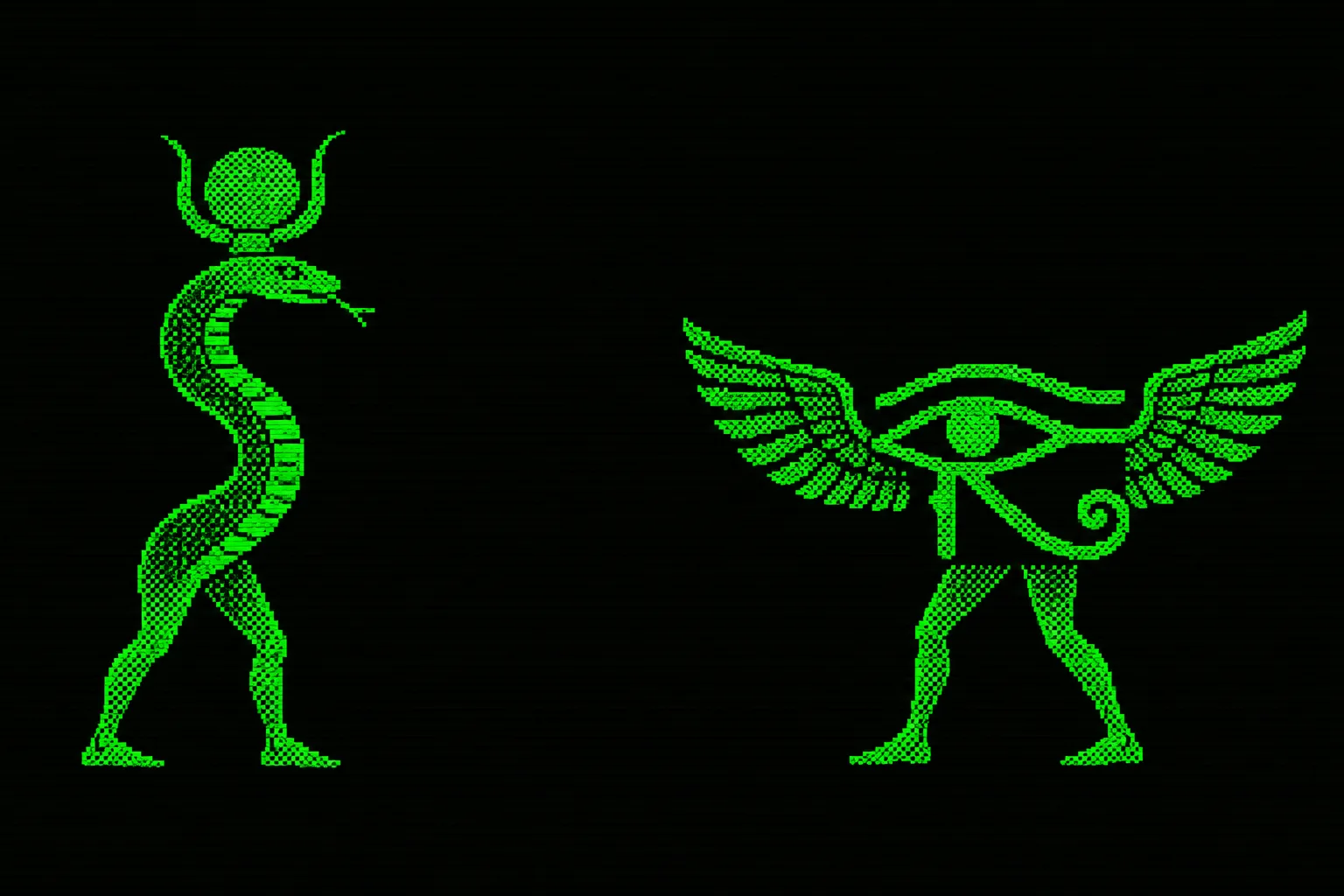
Spell 163 is spoken over a serpent with two legs, bearing a sun disk and a pair of horns, spell 164 over a three-faced Mut with a penis, two wings and a lion’s claw. Both figures are painted on linen and wrapped around the corpse. In spell 162 the speaker, as Ihet, the cow of the sky, calls on a lion god (You are lord of the penis, hard as you rise) to make a flame spring up beneath his head.
Sekhmet is the devouring flame that leaves nothing behind. In spell 165 Amun is summoned by secret names: I know your name. The dead man will eat, drink and urinate with vigor, as if he were on earth.
Spell 162: A Flame Beneath the Head
- 1
rʾ n rḏi̯.t ḫpr bs ẖr tp n ꜣḫ
Spell to make a flame spring up beneath the head of a transfigured spirit
Note · Line 1
This spell was often written on a disk placed beneath the head of the dead person to give the body the warmth of the sun. - 2
ḏd-md,t
Words to be spoken:
- 3
j:nḏ-ḥr =k pꜣ rw pḥ,tj qꜣi̯-šw,tj nb wrr,t ḥn.w m nḫḫ
Hail to you, mighty Lion with your two tall plumes,
lord of the Wereret crown, bearer of the flail!Note · Line 3
The Wereret is a crown of Upper Egypt. Both the crown and the flail are emblems of kingship. - 4
ntk nb mṯꜣ rwḏ m wbn ḥꜣy nn ḏrw,w wbn =f
You are lord of the penis, hard as you rise,
shining one whose rising knows no bounds. - 5
ntk nb ḫpr,w.pl ꜥšꜣ{.t} jnmm.pl ḥꜣp sw m wḏꜣ,t r ms.pl =f
You are the lord of forms, many-hued,
who veils himself in the Wedjat Eye to hide from his children.Note · Line 5
The Wedjat Eye is the eye of Horus, made whole again after it was injured. - 6
ntk nꜥš dn,wyt m-ẖnw psḏ,t pḥrr ꜥꜣ ḫ(ꜣ)ḫ nmt,t
You are the one whose roar resounds among the Nine,
the great runner, swift of stride.Note · Line 6
The Nine are the family of gods headed by Atum at Heliopolis. - 7
ntk nṯr nꜥš jy n ꜥš n =f nhp,w mꜣjr m-ꜥ jꜣd{,tj} sw
You are the mighty god who comes to the one who calls to him,
who shields the sufferer from his tormentor. - 8
mi̯ n ḫrw =j
Come at the sound of my voice!
- 9
jnk ꜣhꜣ,t
I am Ihet, the cow of the sky.
Note · Line 9
The speaker takes the part of the sky cow, mother of the sun god. - 10
rn =k m rʾ =j
Your name is in my mouth.
- 11
jw =j r ḏd.tw =f
I shall speak it:
- 12
P(ꜣ) n-Hꜣqꜣhꜣgꜣ ḥr rn =k
“He of Haqa, Haga-faced” is your name.
Note · Line 12
Knowing the god’s secret names gives the speaker the power to call on him. - 13
⸮jwrw? ⸮jw? ⸮jqrs? ⸮jnq? ⸮rbty? rn =k
“Iuru, Iu, Iqres, Ineq, Rebty” is your name.
- 14
srpt mꜣj srjw rn =k
“Lotus-leaf fan, lion, giraffe” is your name.
- 15
ḫrstj rn =k
“Kheresti” is your name.
- 16
dwꜣ.n =j rn =k
I have worshipped your name.
- 17
jnk ꜣhꜣ,t
I am Ihet, the cow of the sky.
- 18
sḏm ḫrw =j n pꜣ hrw
Hear my voice this day!
- 19
rḏi̯.jn{n} =k bs ẖr tp n Rꜥ,w
Then you set a flame beneath the head of Ra.
- 20
m =k sw m Dꜣ,t nṯr(,j).t m Jwn,w
Look, he is in the divine underworld at Heliopolis.
- 21
ḏi̯ =k ḫpr =f mj n,tj ḥr-tp tꜣ
May you make him like one who lives on earth!
- 22
ntf bꜣ =k
He is your ba.
Note · Line 22
A ba is the living presence of a god or a person, able to move apart from the body. - 23
m ḫmi̯ r =f
Do not ignore him!
- 24
mi̯ n Wsjr [...] mꜣꜥ-ḫrw
Come to Osiris …, vindicated!
Note · Line 24
The dead person bears the name of Osiris in the hope of sharing his renewed life. “Vindicated” means declared just in the judgment of the dead. - 25
ḏi̯ =k ḫpr bs ẖr tp =f
May you make a flame spring up beneath his head!
- 26
yw ntf p(w) bꜣ n tꜣ ẖꜣ,t ꜥꜣ.t n,tj ḥtp.tw m Jwn,w
Yes, he is the ba of the great corpse that rests in Heliopolis.
- 27
⸮Jtm,w? rn =f
Atum is his name.
Note · Line 27
Here the signs spell out the name as a riddle: “Shining One, Khepri, Eldest.” - 28
⸮brktṯw? rn =f
Berektetju is his name.
- 29
mi̯ jr =k
Come, then!
- 30
ḏi̯ =k ḫpr =f mj wꜥ,w m šms,pl =k
May you make him like one of your followers!
- 31
hꜣy ntf ntk
Ho! He is you!
- 32
ḏd-mdw ḥr rpy,t ꜣhꜣ,t jri̯.tw m nb,w nfr ḏi̯(.w) r ḫḫ n ꜣḫ ḥnꜥ jri̯.t =s m zẖꜣ,w ḥr ḏmꜥ n-mꜣwj rḏi̯(.w) ẖr tp =f
Recite over a figure of Ihet made of fine gold and placed at the throat of the transfigured one. Draw her also on a fresh sheet of papyrus and place it beneath his head.
Note · Line 32
Ihet is the sky cow. The “transfigured one” is the dead man in his new state as a spirit. - 33
wnn bs.pl ꜥšꜣ.{t}pl m qd =f nb mj n,tt ḥr-tp tꜣ
Many flames will surround him on every side, as on earth.
Note · Line 33
The spell is meant to restore the warmth the dead man had in life. - 34
mk,t ꜥꜣ.t wr zp-2 jri̯.tn ꜣhꜣ,t n zꜣ =s Rꜥ,w m ḥtp =f wnn s,t =f jnḥw.tw m mšꜥ ⸮mhꜣd,t?
This is the very, very great protection that Ihet made for her son Ra at his setting, when his throne is ringed by an army and by fire.
- 35
wnn =f nṯri̯(.w) m ẖr,t-nṯr
He will be divine in the realm of the dead.
Note · Line 35
The promise is for the dead man: the protection Ihet made for Ra now extends to him. - 36
nn šnꜥ.tw =f ḥr sbꜣ.pl nb n Dꜣ,t m šs-mꜣꜥ
He will not be turned back at any gate of the underworld. Proven effective.
- 37
ḏd.ḫr =k rḏi̯.n =k nṯr,t tn r ḫḫ n ꜣḫ
Once you have placed this goddess at the throat of the transfigured one, say:
- 38
j jmn nꜣ jmn pꜣ n,tj m ḥr,t jmm! ḥr =k n tꜣ ẖꜣ,t n(.t) zꜣ =k
O most hidden of the hidden, you who are in the sky, turn your face toward your son’s corpse!
Note · Line 38
“Hidden” echoes the name of Amun, the Hidden One. The speaker calls the dead man the god’s son. - 39
swḏꜣ =k sw m ẖr,t-nṯr
May you keep him safe in the realm of the dead!
- 40
mḏꜣ,t pw ꜥꜣ.t štꜣ,w
This is a scroll of the utmost secrecy.
- 41
jmi̯ =k rḏi̯ mꜣꜣ s(j) jr,t-nb(,t)
Let no eye see it!
- 42
bw,t pw
That is sacrilege.
- 43
rḫ s(j) ḥꜣp sw ḫpr sw
Whoever knows it and keeps it hidden is one who comes into being.
- 44
mḏꜣ,t tn ḥnw,t ḥw,t jmn(.t) rn =s
The name of this scroll is “Mistress of the Hidden Temple.”
- 45
jwi̯≡f-pw
Here it ends.
Spell 163: The Two-Legged Serpent and the Wedjat Eyes
- 46
rʾ.pl jni̯ r ky šft m-ḥꜣw pri̯(.t) m hrw
Spells brought together for another scroll, in addition to Going Forth by Day:
Note · Line 46
Going Forth by Day is the Egyptian title of the Book of the Dead. It names a freedom the dead hoped to regain: to leave the tomb by daylight. - 47
rʾ n tm ḏi̯(.t) ski̯ ẖꜣ,t n z m ẖr,t-nṯr r nḥm =f m-ꜥ wnm bꜣ.pl n,tj ḏdḥ{,w} m-ḫnt Dꜣ,t ḥnꜥ tm rḏi̯.t ṯzi̯ =tw btꜣ,w =f ḥr-tp tꜣ ḥr =f rḏi̯.t wḏꜣ jwf =f qs.pl =f r dnm ḥnꜥ nṯr nb n,tj thi̯ m ẖr,t-nṯr rḏi̯.t pri̯ =f h(ꜣ)i̯ =f r mr,wt =f jri̯.t p(ꜣ) n,tj nb m jb =f nn jntj.tw =f
Spell to keep a man’s corpse from perishing in the realm of the dead; to save him from the eater of bas who takes captives in the Duat; to keep the wrong he did on earth from being held against him; to keep his flesh and bones safe from the worm and from every god who does harm in the realm of the dead; to let him come forth and go down as he pleases and do all that is in his heart without being turned back.
Note · Line 47
The Duat is the underworld. - 48
ḏd-mdw jn Wsjr [...] mꜣꜥ-ḫrw
Words to be spoken by Osiris …, vindicated:
Note · Line 48
The dead person takes the name of Osiris, the god who died and lived again. “Vindicated” declares that the judgment of the dead has gone in his favor. - 49
jnk pꜣ bꜣ n tꜣ ẖꜣ,t ꜥꜣ.t n,tj ḥtp.tw m Jrhb
I am the ba of the great corpse that rests in Irheb.
- 50
ntf zꜣ n tꜣ ẖꜣ,t n(.t) Ḥrty pꜣ {ḫꜣs,t}〈nb〉 {t}〈r〉mn n,tj ḥtp.tw n pꜣ pḥw,w Snhqrg
He guards the corpse of Herty, lord of the bearers, who rests in the northern reaches of Senehqereg.
- 51
j pꜣ bꜣ n,tj bw ft jb =f r wbn ḥtp ḥtp bꜣ =f m-ẖnw tꜣy =f ẖꜣ,t n,tj ḥtp.tw m Snhprgn mi̯ n Wsjr [...] mꜣꜥ-ḫrw
O ba whose heart never tires of rising and setting,
whose ba rests within his corpse that rests in Senehpergen,
come to Osiris …, vindicated! - 52
n[ḥm] =f sw m-ꜥ bꜣ.pl ḥz(ꜣ) ḥr sḫm ḥꜣ,tj.pl n,tj jṯi̯ ꜥ,t.pl pri̯ hh n rʾ =w r dp bꜣ.pl
May he save him from the bas with fierce faces and mighty hearts,
who snatch away limbs,
from whose mouths a burning breath comes forth to taste the bas.Note · Line 52
The ba just summoned is asked to save the dead man. - 53
j pꜣ n,tj sḏr m-ẖnw ẖꜣ,t =f ḫpr hh =f m sḏ,t rkḥw.tw m-ẖnw pꜣ ywm [ḫ]y [pꜣ] [ywm] [m] [pꜣy] =[f] [rhb,w] [mi̯]
O you who pass the night within your corpse,
whose burning breath turns to fire that blazes in the depths of the sea,
whose heat makes the sea rise—come! - 54
[ḏi̯] =[⸮k?] [sḏ,t]
May you give fire!
- 55
ḫꜣꜥ =k rhb,w r p(ꜣ) n,tj jw =f r sꜥḥꜥ ḏr,t =f r ꜥḥꜥ(,w) Wsjr [...] mꜣꜥ-ḫrw šꜣꜥ (n)ḥḥ ḏ,t
May you hurl searing heat at whoever would raise his hand
against the life of Osiris …, vindicated,
for ever and ever! - 56
ky Wsjr [...] mꜣꜥ-ḫrw pꜣ ꜥḥꜥ(,w) n tꜣ p,t pꜣy =f ꜥḥꜥ(,w) n p(ꜣ) j(w)tn
Hail, Osiris …, vindicated!
The span of life belongs to the sky;
his span of life belongs to the earth. - 57
ḏr,ww p,t ẖr bꜣ =k
The far reaches of the sky lie under your ba.
- 58
tꜣ ẖr sšm =k
The earth is under your command.
- 59
nḥm =k Wsjr [...] mꜣꜥ-ḫrw
May you save Osiris …, vindicated!
- 60
n ḏi̯ =k ⸢ꜣy⸣.tw =f jn kꜣwy ꜥm bꜣ.pl n,tj ṯzi̯ ḏbꜥ
Do not let the foes beset him,
those who swallow bas and bring accusations. - 61
ḫpr bꜣ =f m-ẖnw ẖꜣ,t =f ṯz-pẖr
His ba comes into being within his corpse—and the reverse.
Note · Line 61
The last words direct the reciter to turn the line around: his corpse comes into being within his ba. - 62
ntf jmn m-ẖnw ḏfḏ n wḏꜣ,t Šršr{zp-2}
He is the Hidden One within the pupil of Shersher’s wedjat-eye.
Note · Line 62
The wedjat is the eye of Horus, injured and made whole again. - 63
⸮Šꜣp,w? ⸮nṯr? ⸮jri̯? ⸮kꜣ? r〈n〉 =f
“Shapu of the god, Irka” is his name.
Note · Line 63
Irka can be heard as “maker of the ka,” the vital force of a god or a person. - 64
ntf ḥtp pꜣ mḥ,t(j) jmn,tt n tꜣ dhn,t Njpt n pꜣ tꜣ-zt,t jw bw jri̯ =f ḏꜣi̯ r jꜣb,tt
He is the one who rests northwest of the cliff of Napata in Nubia;
he does not cross to the east. - 65
j Jmn pꜣ kꜣ ḫprr nb wḏꜣ,t.j ḥz(ꜣ) ḏfḏ rn =k Wsjr [...] mꜣꜥ-ḫrw
O Amun, Bull-Scarab, lord of the two wedjat-eyes,
“Fierce of Pupil” is your name and the name of Osiris …, vindicated.Note · Line 65
Amun’s name echoes the Egyptian word for “hidden.” The invocation names the Hidden One of the earlier line. - 66
tj,t.pl n wḏꜣ,t.j =k Šršr{ḫ,t} rn n tꜣ wꜥ.t
As for the fractions of your two wedjat-eyes,
Shersher is the name of one. - 67
⸮Šꜣp,w? ⸮nṯr? ⸮jri̯? ⸮kꜣ? rn n tꜣ k(y).t
“Shapu of the god, Irka” is the name of the other.
- 68
ntf Šk Jmn Šknsrhtw tp Jtm,w
He is Shek-Amun, Shekens-rehtew, the head of Atum.
- 69
sḥḏ n =f Tꜣ,du rn =f m-mꜣꜥ(,t) zp-2
“He who lights the Two Lands for him” is truly, truly his name.
Note · Line 69
The Two Lands are Upper and Lower Egypt. - 70
mi̯ n Wsjr [...] mꜣꜥ-ḫrw jw =f n p(ꜣ) tꜣ n mꜣꜥ,t
Come to Osiris …, vindicated, when he is in the land of Maat!
Note · Line 70
Maat is truth, justice, and right order, personified as a goddess. - 71
m jri̯ ḫꜣꜥ =f wꜥi̯.{wtj}〈tw〉 =f jw =f n p(ꜣ) tꜣ n,tj bw jri̯ =w p(t)r =f ꜥn
Do not leave him alone when he is in the land no one sees a second time.
- 72
rn =k jrm ꜣḫ-jqr ky-ḏd qnw
Your name is with the excellent akh. Another reading: “the many.”
Note · Line 72
An akh is a dead person transformed into a spirit able to act. - 73
ntf pꜣ bꜣ n tꜣ ẖꜣ,t ꜥꜣ.t n,tj m Zꜣw Ni̯,t
He is the ba of the great corpse that is in Sais—Neith.
Note · Line 73
Sais was Neith’s chief place of worship. - 74
ḏd-md,t ḥr ḥfj ẖr(,j) rd.du{tj} ẖr(,j) jtn ꜥb.du
Recite over a serpent with two legs, bearing a sun disk and a pair of horns.
Note · Line 74
The serpent and the eyes that follow are ritual images over which the words are spoken. - 75
jw wḏꜣ,t.j ẖr rd.du{tj} ẖr ḏnḥ.wj n,tj m p(ꜣ) ḏfḏ n tꜣ wꜥ.t twt n fꜣi̯ ꜥ m ḥr n B〈s〉 ẖr(,j) šw,t.j (j)ꜣ,t =f m bjk n,tj n p(ꜣ) ḏfḏ n tꜣ k(y).t twt n fꜣi̯ ꜥ m ḥr n Ni̯,t ẖr(,j) šw,t.j (j)ꜣ{d},t =f m bjk
The two wedjat-eyes have paired legs and paired wings. In the pupil of one is an image of the Arm-Raiser with the face of Bes, wearing two plumes, his back that of a falcon. In the pupil of the other is an image of the Arm-Raiser with the face of Neith, wearing two plumes, his back that of a falcon.
- 76
zẖꜣ m ꜥntj.pl šw ḥr mḥ(,t) wḥm m wꜣḏ šmꜥi̯ ḥnꜥ mw n tꜣ ẖnm(,t) jmn,t(j).t n Km,t ḥr pry n wꜣḏ,t bnd z ḥr ꜥ,t.pl nb(.t) jm =f
On a strip of green cloth, draw the figure with myrrh dried on a dish. Trace it over with Upper Egyptian green pigment and water from the western well of Egypt. Wrap the strip around all the man’s limbs.
Note · Line 76
The cloth bearing the drawing serves as a protective charm for the man wrapped in it. - 77
nn šnꜥ.tw =f ḥr sbꜣ.pl nb n Dꜣ,t
He will not be turned back at any gate of the Duat.
Note · Line 77
Its gates have keepers who can refuse the dead passage. - 78
wnn =f ḥr wnm sjw wzš m pḥ,tj =f mj wnn =f ḥr-tp tꜣ
He will eat, drink and urinate with vigor, as if he were on earth.
- 79
nn sꜥḥꜥ.tw ḫnw nb r =f
No one will stir up trouble against him.
- 80
ꜣḫ ḏr,t n kꜣy jm =f r nḥḥ ḏ,t
The hand of his enemies will help him forever and ever.
Note · Line 80
The promise joins two Egyptian words for eternity: time that renews itself and time that endures. - 81
jr jri̯ mḏꜣ,t tn ḥr-tp tꜣ nn kfꜣ.tw =f jn wpw,tj.pl thꜣ n,tj jri̯ swꜣ,w n tꜣ ḏr =f
Whoever carries out the rites of this scroll on earth will not be stripped bare by the hostile messengers who act as the Passerby throughout the land.
Note · Line 81
The Passerby is the name of a dangerous spirit, not an ordinary traveler. - 82
nn dm =f
He will not be stabbed.
- 83
nn mt =f n šꜥd n nswt
He will not die in the king’s slaughter.
- 84
nn jṯi̯.tw =f r ḏdḥ,w nb
He will not be carried off to any prison.
- 85
ḫr ꜥq =f r qnb,y pri̯ m mꜣꜥ-ḫrw
Then he will go into court and come out vindicated.
- 86
wḏꜣ =f r ḥr(,w) jzf,t n,tj ḫpr(.w) m tꜣ ḏr =f
He will be safe from the terror and injustice that have arisen throughout the land.
Spell 164: Three-Faced Mut, the Devouring Flame
- 87
ky rʾ
Another spell
- 88
ḏd-md,t
Words to be spoken:
- 89
j:nḏ-ḥr =ṯ Sḫm,t Bꜣs,tt 〈⸮jr,t?〉-Rꜥ,w ḥnw,t nṯr.pl ṯꜣi̯ mḥ,t nb(,t) jnsi̯ ḥnw,t ḥḏ,t dšr,t wꜥ,wtj(.t) ḥr tp n jti̯ =s nn ḫpr nṯr.pl ḥr-tp =s wr(,t)-ḥkꜣ m wjꜣ-n-ḥḥ ḏsr(.t) ḫꜥ(,w) m s,t sgr mw,t n Pšks ḥm,t-nsw,t n Prhq ḫpr,w ḥnw,t nb(,t) jz.pl Mw,t m ꜣḫ,t n.t p,t hru̯ Mr,wt tjtj(.t) ḫnnj
Hail to you, Sekhmet, Bastet, Eye of Ra, mistress of the gods,
you who have taken up the wing, lady of scarlet linen,
mistress of the White Crown and the Red,
the only one upon her father’s head.
No gods arise to rule over her.
Great of Magic in the Barque of Millions,
unapproachable in her splendor in the Place of Silence,
mother of Šks, royal wife of Rhq,
form of the sovereign lady, mistress of tombs,
Mut on the horizon of heaven,
contented one, Meret, who tramples down tumult!Note · Line 89
The Eye of Ra is the sun god’s power embodied in a goddess. As a rearing cobra, she takes her place on her father’s brow. - 90
ḥtp m ḫfꜥ =ṯ
In your fist is a food offering.
- 91
wnn =ṯ ꜥḥꜥ.tw m ḥꜣ,t wjꜣ jti̯ =ṯ ḥr sḫr ḏw-qd
You stand at the prow of your father’s barque, striking down the evildoer.
- 92
jw =ṯ ḏi̯ =ṯ mꜣꜥ,t m ḥꜣ,t wjꜣ =f
You set Maat at the prow of his barque.
Note · Line 92
The barque is the vessel in which Ra makes his daily passage. - 93
nt(ṯ) wnm,yt jw,tj zp =s jm,j
You are the devouring flame that leaves nothing behind.
- 94
Spytkhrspsrmkk-rmt rn =ṯ
“Spytkhrspsrmkk-rmt” is your name.
- 95
jw =ṯ m srq,w ꜥꜣ{.t} n.t Sqnq,t m ḥꜣ,t wjꜣ n jti̯ =ṯ Ḥrpgkšršb js m ḏd nḥsi̯(,t) n Jwn,tj.w n.w Tꜣ-ztj
You are the great fiery breath of Sqnqt
at the prow of your father’s barque,
as Ḥrpgkšršb, in the words of the Nubian woman
of the Bow People of Lower Nubia:Note · Line 95
The Bow People are desert nomads; Ta-Seti, here Lower Nubia, means “Land of the Bow.” - 96
j(ꜣ),w n =ṯ nḫt.t r nṯr.pl
Praise to you, mightier than the gods!
- 97
hnw n =ṯ ḫmn,w bꜣ.pl ꜥnḫ.pl n,tj m ḏbꜣ,t =sn m jꜣ,w n šf(y),t =ṯ
The Eight acclaim you,
the living bas in their shrines,
in praise of your majesty.Note · Line 97
The Eight are the primeval gods of Hermopolis. - 98
nt{j}(ṯ) mw,t =w
You are their mother.
- 99
nt(ṯ) šꜣꜥ =sn jri̯ n =sn s,t ḥtp m Dꜣ,t štꜣ.t
You are their beginning.
You made them a place to rest in the hidden Duat. - 100
swḏꜣ qs.pl =(w) wḏꜣ =w r ḥr(,w)
Keep their bones safe, that they may be safe from terror.
- 101
nṯri̯ =ṯ st m s,t nḥḥ
May you make them divine in the place of eternity.
- 102
swḏꜣ sn r ḫꜣ bjn
Keep them safe from the evil hall.
- 103
bꜣ{.pl} ḥzꜣ ḥr m-ẖnw psḏ,t sfj pri̯ m ḥzꜣ ḥr ḥꜣp ḏ,t =f r nkj tꜣr jm ḏr gmi̯ =tw rn =⸮w?
O fierce-faced ba in the midst of the Ennead,
boy who comes forth fierce-faced,
who hid his body there from the Punisher and Hotmouth
when their name was discovered!Note · Line 103
The Ennead is a divine company of nine. The spell now addresses a single ba among them. - 104
pꜣ rw štꜣ rn n p(ꜣ) wꜥ,w zꜣ pꜣ nmmj
“The Hidden Lion” is the name of the one, “Son of the Dwarf” of the other.
- 105
wḏꜣ,t Sḫm,t wr.t ḥnw,t nṯr.pl rn =ṯ
“Wedjat Eye of Sekhmet the Great, Mistress of the Gods” is your name.
Note · Line 105
Its name means “the one that is whole.” - 106
tj,t m rn n Mw,t
“Tyet Knot” is the name of Mut.
Note · Line 106
The tyet is a protective amulet shaped like a knot and associated with the blood of Isis. - 107
nṯri̯ bꜣ.pl =s
Her bas are divine.
- 108
wḏꜣ ẖꜣ(,t).pl =s
Her corpses are whole.
- 109
wḏꜣ ={w}st r tꜣ ḫb,t {n}〈k〉ꜣwjt n,tj m ḫꜣ bjn
They are safe from the execution ground of the adversaries who are in the evil hall.
- 110
nn spḥ.w st
No one snares them.
- 111
ḏd tꜣ nṯr,t m rʾ =s ḏs =s
The goddess speaks with her own mouth:
- 112
jri̯.y =j m ḏd =ṯn
“I will do as you say:
- 113
nꜣ ṯꜣ.w n pꜣ bꜣ jri̯ =w n =f q{r}js
let the fledglings of the ba hold his funeral.”
- 114
ḏd-mdw ḥr ⸮jrw? Mw,t ẖr(,j){.pl} ḥr 3 wꜥ,w m ḥr n Pḫꜣ,t ẖr(,j) šw,t.j ky m ḥr n Pꜥy,t ẖr(,j) ḥḏ,t dšr,t ky m ḥr n Nrjw ẖr(,j) šw,t.j ẖr(,j) mṯꜣ ẖr(,j) ḏnḥ,w.du m ꜥgꜣ,t n mꜣj
Recite over a figure of Mut with three faces: one the face of Pekhat with two plumes, another the face of one of the Pat with the White Crown and the Red Crown, another the face of a vulture with two plumes. The figure has a penis, two wings and a lion’s claw.
Note · Line 114
Pekhat is the cobra goddess; the Pat are the ancestral nobility. The White Crown belongs to Upper Egypt, the Red to Lower Egypt. - 115
zẖꜣ m ꜥnd,pl šw ḥr snṯr wꜣḏ wḥm m ry(,t) ḥr pry n jnsi̯
Paint it with dried myrrh mixed with fresh frankincense and trace it again in ink on a strip of scarlet linen.
- 116
jw wꜥ nmmj ꜥḥꜥ(.w) m-bꜣḥ =s ḥꜣ =s
One dwarf stands before her and one behind her.
- 117
jw ḥr =f r =s ẖr šw,t.j
His face is turned toward her, and he wears the twin plumes.
Note · Line 117
The figure is one of the dwarfs pictured beside the goddess Mut on a funerary bandage. - 118
jw =f m fꜣi̯(.t) ꜥ ẖr ḥr.du wꜥ,w m ḥr n bjk ky m ḥr n pꜥ,t
He raises his arm and has two faces: one a falcon’s, the other the face of one of the primeval people.
- 119
wt{.pl} šnb,t 〈=f〉 jm =f wnn =f nṯri̯(.w) m-ꜥ nṯr.pl m ẖr,t-nṯr
Whoever has his chest wrapped in that bandage will be divine among the gods in the realm of the dead.
- 120
nn šnꜥ.tw =f r-nḥḥ ḏ,t
Never in all eternity will he be turned away.
- 121
wḏꜣ jwf =f qs.pl =f mj-n,tj nn sw mt =f
His flesh and bones are sound, as if he had never died.
- 122
sjw =f mw ḥr ḥbb,t n.t j(t)r,w
He drinks water from the river’s current.
- 123
jw ḏi̯ =tw n =f ꜣḥ(,t) m sḫ,t-jꜣnr
He is given a plot of farmland in the Field of Reeds.
Note · Line 123
The Field of Reeds is a fertile region of the afterlife where the dead sow and reap. - 124
ḏi̯ =tw n =f sbꜣ n p,t
He is given a star of heaven.
- 125
wḏꜣ =f r nkjw r tꜣr n,tj m Dꜣ,t
He is safe from the Punisher and from Hotmouth, who dwell in the Duat.
- 126
nn ḏdḥw =tw bꜣ{.pl} =〈f〉
His ba will not be imprisoned.
- 127
ḏrjw jri̯ =f nḥm =f r n,tj r-gs =f
The kite saves him from the one at his side.
Note · Line 127
A kite is a bird of prey. - 128
nn wnm sw rʾ.pl nb
No rʾ-snake will devour him.
Spell 165: The Secret Names of Amun
- 129
rʾ n mnj tm{m} ḏi̯.t tḫnj =s r srwḏ ẖꜣ,t r sꜥm nwy =sn
Spell for coming to land and not letting it be harmed, for making the corpse firm and swallowing their floodwater.
Note · Line 129
Coming to land is an Egyptian image for dying. What is to be kept from harm may be the sacred eye; the spell does not name it here. - 130
ḏd-md,t
Words to be spoken:
- 131
j pꜣ Bḫn,w zp-2 pꜣ wr zp-2 Jmn zp-2 pꜣ rw Yks pꜣ nṯr wr nṯr.pl jꜣb,tt n.t p,t Jmn Ntkrty Jmn
O Bekhenu, Bekhenu,
Great One, Great One,
Amun, Amun,
you lion, Yks,
you god, Great One among the gods of the eastern sky,
Amun, Ntkrty, Amun!Note · Line 131
The speaker calls on Amun by a series of sacred names. Knowing them is part of the speaker’s claim to be heard. - 132
j pꜣ jmn jwn,w štꜣ ḫpr,w nb ꜥb.du Ḥr,w ⸢ꜥꜣ⸣ ⸮Nw,t? N(jryk) ky-ḏd Kjryk rn =k
O you whose nature is hidden, whose form is secret,
lord of the two horns, Horus, Great One of Nut,
Njryk (another reading: Kjryk) is your name.Note · Line 132
Nut is the goddess of the sky. - 133
Ksyk rn =k
Ksyk is your name.
- 134
ꜣrktkstk rn =k
ꜣrktkstk is your name.
- 135
Jmn Njnkntkšr ky-ḏd (Njnkn)tjkšr Jmn Rw,ty rn =k
Amun-Njnkntkšr (another reading: Amun-Njnkntjkšr), Amun-Ruti is your name.
Note · Line 135
Ruti means “the Two Lions.” Here the pair is invoked as one god. - 136
j Jmn dbḥ,w =j m-ꜥ =k
O Amun, what I need is in your hand!
- 137
jw =j rḫ.kw rn =k
I know your name.
- 138
ḫpr,w =k m rʾ =j
Your form is in my mouth.
- 139
jnmm =k m jr,t.du =j
Your color is in both my eyes.
- 140
mi̯ n jwꜥ{ꜥ}(,w) =k
Come to your heir!
- 141
sšmi̯ =k Wsjr [...] mꜣꜥ-ḫrw
May you guide the Osiris …, justified.
Note · Line 141
The dead person bears the title “Osiris” in identification with the god of the dead. “Justified” declares that the deceased has been found in the right. - 142
ḏi̯ =k sw r Dꜣ,t nḥḥ
May you bring him into the Duat forever.
- 143
ḏi̯ =k ḥtp ꜥ,t.pl =f tm(.w) m ẖr,t-nṯr ky-ḏd jgr,t
May you let all his limbs rest in the realm of the dead (another reading: Igeret).
Note · Line 143
Igeret is a name for the realm of the dead that evokes its silence. - 144
jw =f nṯri̯(.w)
He is divine.
- 145
ẖꜣ,t =f tm.tw
His corpse is whole.
- 146
jw =f wḏꜣ(.w) r ḫꜣ bjn
He is safe from the evil hall.
- 147
nn spḥw(.tj)=f sw
No one will catch him in a noose.
- 148
swꜣš =j n rn =k
I praise your name.
- 149
jri̯ =k n =j ⸮j{m}〈nn〉m?
May you give me color.
Note · Line 149
Color here suggests the visible presence of life. The speaker will offer the god the same gift in return. - 150
ꜥm =k r-ḏd rḫ =(j) ṯw
Take this in: I know you.
Note · Line 150
The Egyptian word for taking something in with the mind also means to swallow. - 151
wr zp-2 jmn rn =k
“Great One, Great One, Hidden One” is your name.
Note · Line 151
“Hidden One” echoes the name Amun itself. - 152
Rtsšk jrj.y =j n =k jnnm
Rtsšk, I will give you color.
- 153
bꜣ Yrqy rn =k
“Ba, Yrqy” is your name.
- 154
Mrqt rn =k
Mrqt is your name.
- 155
Rw,ty rn =k
Ruti is your name.
- 156
Nsqbb rn =k
Nsqbb is your name.
- 157
Tns zp-2 rn =k
“Tns, Tns” is your name.
- 158
Šrštkt rn =k
Šrštkt is your name.
- 159
Jmn zp-2 p(ꜣ) nṯr zp-2 Jmn swꜣš =j n rn =k
Amun, Amun! O god, O god! Amun, I praise your name!
- 160
ḏi̯ =j ꜥm =k
May I give you understanding!
- 161
ḏi̯ =k ḥtp =j m Dꜣ,t ꜥ,t.pl =j tm.tw
May you let me rest in the Duat, with all my limbs whole.
- 162
ḏd.jn bꜣ n,tj m ⸮Nw,t?
Then the ba who is in Nut said:
- 163
jri̯.y =j mk,t =j
“I will extend my protection.
- 164
jri̯.y =j ḏ{t}〈d〉.t =k nb.t
I will do all that you say.”
- 165
ḏd-mdw ḥr twt n fꜣi̯ ꜥ šw,t.du m tp =f rd.du =f wn.tw ḥr-jb =f m ḫprr zẖꜣ(.w) m ḫsbḏ ḥr mw n.w qmy ḥnꜥ wꜥ twt jw ḥr =f m ḥr n r(m){r}ṯ.pl jw ꜥ.du{.pl} =f {sw}〈ws〉tn.w jw ḥr n šf,t ḥr qꜥḥ,w =f wnmi̯ ky ḥr qꜥḥ,w =f jꜣbi̯ zẖꜣ(.w) ḥr wꜥ.t jshꜣ pꜣ twt n fꜣi̯ ꜥ m-ꜥqꜣ ḥꜣ,tj =f zẖꜣ pꜣ twt ḥr pꜣy =f mnḏ.du
Recite over an image of Him Who Raises His Arm, with two plumes on his head, his feet set in a stride and his torso in the form of a scarab. Paint him in lapis lazuli mixed with liquid gum, together with a figure with a human face, both arms hanging free, a ram’s head on his right shoulder and another on his left. Paint them on a strip of linen so that the image of Him Who Raises His Arm lies directly over the dead man’s heart. Paint the image across both his breasts.
Note · Line 165
The spell now gives directions to the reciter. The scarab, a dung beetle, was an emblem of rebirth. - 166
nn rḏi̯ rḫ s(j) ky-ḏd rmn Sgdy n,tj m Dꜣ,t
Do not let Segedy, who is in the Duat, know it (another reading: “shoulder”).
- 167
sjw =f mw m ḥbb,t n.t j(t)r,w
He will drink water from the flowing river.
Note · Line 167
“He” here is the dead man for whom the spell is recited. - 168
psḏ =f mj sbꜣ.pl m ḥr,t
He will shine like the stars in the sky.