~/sacred-texts/book-of-the-dead
Book of the Dead Spells 114 and 116: Secret of the Moon
- Text
- Book of the Dead, 114 and 116
- Date
- Copied in the New Kingdom (c. 1550–1070 BC) on funerary papyri, among them the 18th-Dynasty papyrus of the scribe Nebseni
- Found
- The papyrus of Nebseni is in the British Museum, London (EA 9900)
- Language
- Egyptian (Middle Egyptian) · Hieroglyphic
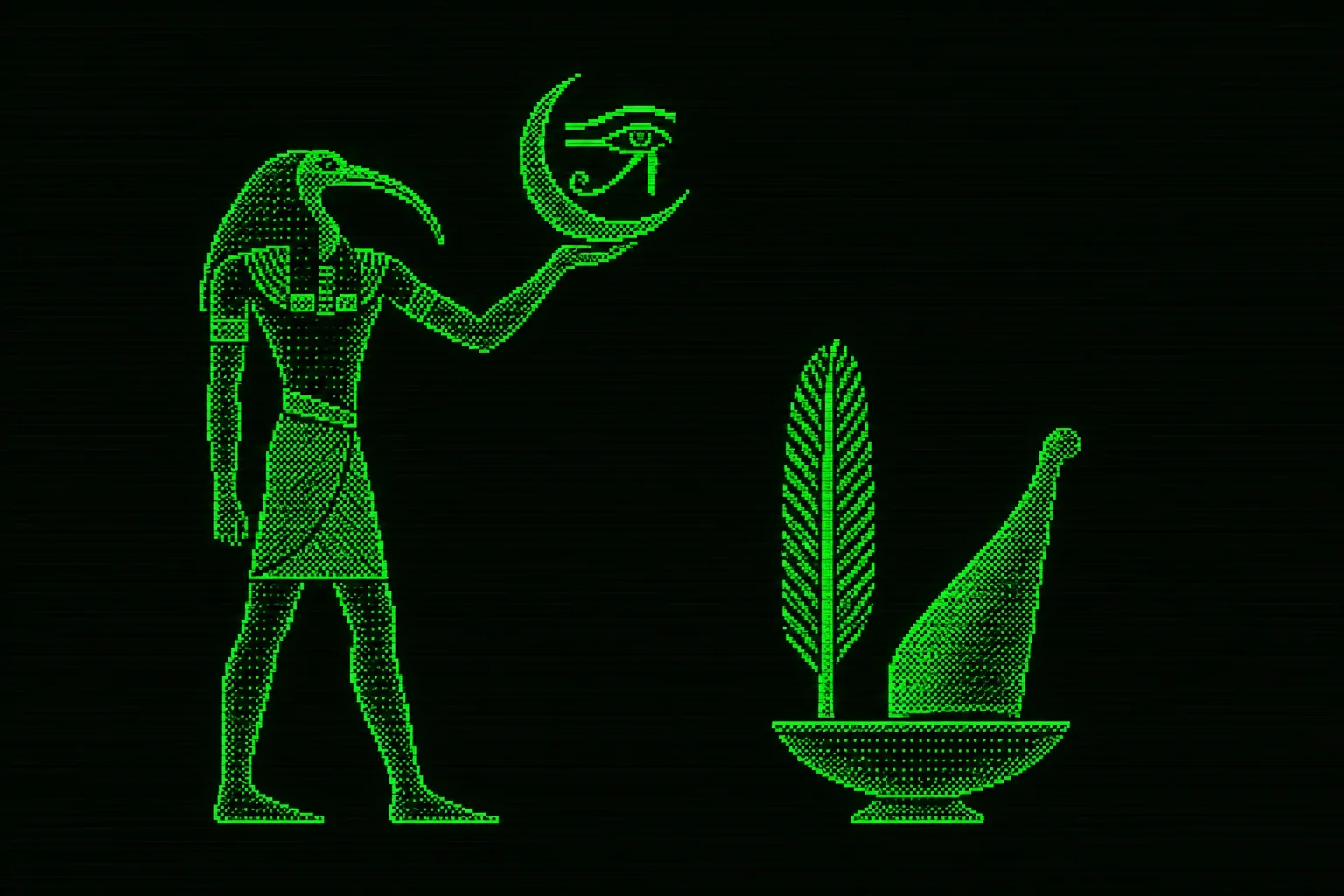
The dead man stands before the bas of Hermopolis, the divine powers of Thoth’s city, and proves he belongs among them by reciting their secret. The secret is the moon, the wounded eye of Horus that grows whole again: I know what is small at the feast of the new moon and great at the feast of the full moon. He swears he kept it hidden: I have not told it to mortals.
The second spell tells of his initiation: I entered knowing nothing. I have seen the mystery. It names the powers as Thoth, Sia and Atum, and ends with the reward for knowing them: To anyone who knows this spell, excrement is an abomination. He does not drink urine.
Spell 114: Knowing the Bas of Hermopolis
- 1
rʾ n rḫ bꜣ,pl-Ḫmn,w Wsjr [...]
Spell for knowing the bas of Hermopolis. The Osiris …:
Note · Line 1
The bas are the divine powers of Hermopolis. Nebseni, for whom the papyrus was made, speaks as Osiris, the god who lives again after death. - 2
jšš šw,t m rmn
The feather is spat from the shoulder.
- 3
wbn n,t m mnṯꜣ,t
Neith’s crown rises from the bowl.
Note · Line 3
Neith’s crown is the Red Crown of Lower Egypt. - 4
sḥḏ.w jr(,t) jn wḏꜥ nj
The eye is made bright by its rightful judge.
- 5
jw =j bzi̯.kw ḥr =s
I have been initiated into this.
- 6
jw =j rḫ.kw jnn! s(t) ⸮m? Qjs
I know who brings it from Cusae.
- 7
n ḏd =j n r(m)ṯ
I have not told it to mortals.
- 8
n wḥm =j n nṯr.pl
I have not repeated it to the gods.
- 9
jy.n =j m wp(w),t n.t Rꜥ,w r smn šw,t m rmn r wbn n,t m mnṯꜣ,t r sjp jr,t n jp sj
I have come on Ra’s errand
to fasten the feather to the shoulder,
that Neith’s crown may rise from the bowl,
and to take account of the eye for him who counts it. - 10
jy.n =j m sḫm ḥr rḫ bꜣ,pl-Ḫmn,w
I have come as one who has power, knowing the bas of Hermopolis.
- 11
mrr!.yw rḫ mri̯ =ṯn
You who love the one who knows, may you love me!
- 12
jw =j rḫ.kw šw,t r(w)ḏ.tj km(m).t jp sj
I know that the feather holds firm and the black one is counted.
Note · Line 12
The “black one” may be the pupil of the eye. - 13
ršy =j ḥr jp jp.t
I rejoice in the counting of what is to be counted.
- 14
j:nḏ-ḥr =ṯn bꜣ,pl-Ḫmn,w
Hail to you, bas of Hermopolis!
- 15
jw =j rḫ.kw šr{t}〈j〉.t m ꜣbd 〈wr.t〉 m smd,t
I know what is small at the feast of the new moon and great at the feast of the full moon.
Note · Line 15
The waxing moon was understood as the wounded eye of Horus growing whole again. - 16
sjꜣ Rꜥ,w štꜣ,w grḥ rḫ.n =ṯn
Ra recognizes the secret of the night that you know.
- 17
sjꜣ.n wj Ḏḥwtj pwy
That very Thoth has recognized me.
Note · Line 17
Thoth, the moon god of Hermopolis, was the divine reckoner who kept count of the days. - 18
j:nḏ-ḥr =ṯn bꜣ,w-Ḫmn,w mj rḫ =j ṯn rꜥ,w-nb
Hail to you, bas of Hermopolis, as I know you day by day!
Spell 116: Another Spell for Knowing the Bas of Hermopolis
- 19
ky rʾ n rḫ bꜣ,pl-Ḫmn,w
Another spell for knowing the bas of Hermopolis
Note · Line 19
The bas of a city are divine powers associated with it. - 20
ḏd-mdw jn [...] mꜣꜥ-ḫrw
Words spoken by …, true of voice:
Note · Line 20
The dead person speaks. “True of voice” means that the speaker has been found in the right before the gods. - 21
wbn Ni̯,t m ⸮Mꜣṯꜣ,t?
Neith rises amid the milkweed.
Note · Line 21
Neith wears the Red Crown of Lower Egypt, and her name echoes one of the names of the crown. - 22
stꜣ Mꜣꜥ,t ḫnti̯.t qꜥḥ
Maat, who is at the front of the shoulder, is drawn along.
Note · Line 22
Maat is the goddess of truth and right order. - 23
wnm jr,t jn jp sj
The Eye was eaten by the one who allots it.
Note · Line 23
The moon was pictured as an eye of Horus, injured and made whole again. - 24
[j]w =⸢j⸣ [b]zi̯.kw ḥr =s jn sm
The sem-priest has initiated me into this.
Note · Line 24
The sem-priest officiated at funerals, notably in the rite of Opening the Mouth to restore the dead person’s powers of speech and nourishment. - 25
n ḏd =j n r(m)ṯ.w n wḥm =j n nṯr.w ṯz-pẖr
I have not told it to human beings, nor repeated it to the gods. (Recite with the terms reversed.)
- 26
ꜥq.n =j m ḫm
I entered knowing nothing.
- 27
mꜣꜣ.n =j ⸢štꜣ,w⸣
I have seen the mystery.
- 28
j⁝nḏ-ḥr.pl =ṯn nṯr.w jm,j.w Ḫmn,w
Hail to you, gods who dwell in Hermopolis!
- 29
rḫ =ṯn wj mj rḫ =j n,t r srwḏ jr,t km.t
May you know me as I know the Red Crown, to give strength to the black Eye.
- 30
rš m jp jp.wt
There is joy in allotting what is allotted.
- 31
jw =j rḫ.kw bꜣ,pl-Jwn,w ꜥꜣ.t m ꜣbd ḫbi̯.t m smd.t
I know the bas of Heliopolis: what is great at the Abed feast, what dwindles at the half-month feast.
Note · Line 31
The Abed feast comes just after the new moon; the half-month feast falls on the fifteenth day of the lunar month. - 32
Ḏḥw,tj pw štꜣ
It is Thoth, the hidden one.
- 33
sjꜣ pw rḫ
It is Sia, the one who knows.
Note · Line 33
Sia is the god who embodies perception. - 34
Jtm pw
It is Atum.
- 35
jr rḫ rʾ pn bw,t =f pw ḥs
To anyone who knows this spell, excrement is an abomination.
Note · Line 35
Funerary spells guard the dead against having to live on human waste in the afterlife. - 36
n zw{r}j.n =f wzš.t
He does not drink urine.