~/sacred-texts/book-of-the-dead
Book of the Dead Spell 82: My Tongue Is Ptah, My Throat Is Hathor
- Text
- Book of the Dead, Spell 82
- Date
- Copied on funerary papyri of the New Kingdom (c. 1550–1070 BC)
- Language
- Middle Egyptian · Hieroglyphic
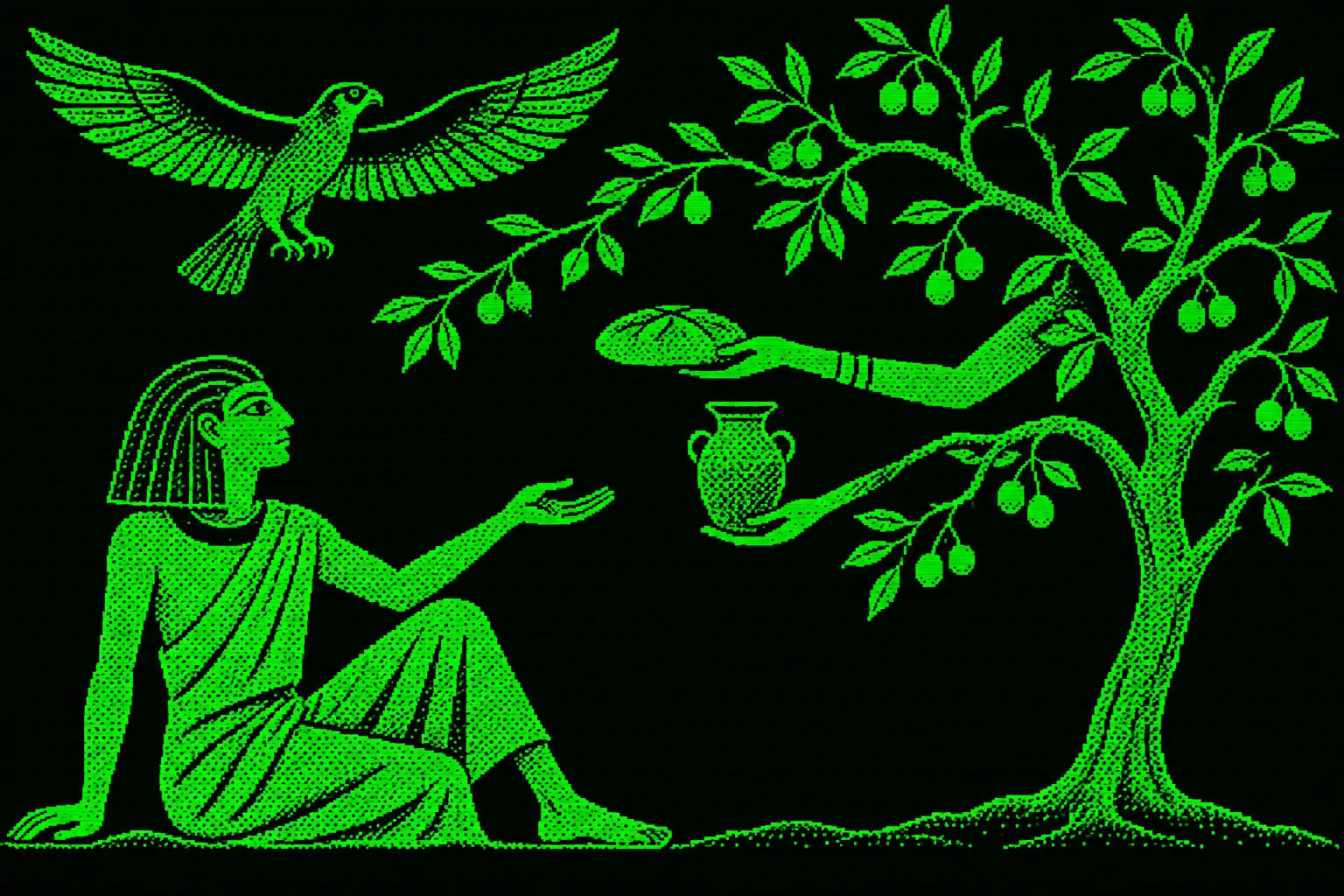
The dead man speaks. He has flown up as a falcon, honked as a goose and landed on the mound. He refuses the food of the damned: Dung is what I loathe. I will not eat it. The gods and spirits question him: “What, then, will you live on?” Bread, he answers, eaten beneath the boughs of the jujube tree of Hathor, who baked it and brewed the beer.
Then he names his body as gods: My head is Ra, united with Atum. My tongue is Ptah. My throat is Hathor. Geb gives him his crowns, Heliopolis bows to him, and he ends as a copulating bull: I am their bull.
- 1
rʾ n jri̯.t ḫpr,w m Ptḥ wnm tʾ zw{r}j ḥ(n)q,t sfḫ.t m pḥ,wj wnn ꜥnḫ(.w) m Jwn,w
Spell for taking the form of Ptah, eating bread, drinking beer, passing stool through one’s backside, and being alive in Heliopolis.
Note · Line 1
Ptah is the creator god of Memphis. Heliopolis was a center of sun worship. - 2
ḏd-mdw jn [...] mꜣꜥ-ḫrw
Words to be spoken by …, the justified:
Note · Line 2
“The justified” is a title for a dead person who has been vindicated before the gods. - 3
pꜣi̯.n =j m bjk
I have taken wing as a falcon.
- 4
ngg.n =j m smn
I have honked as a Nile goose.
- 5
ḫn{n}i̯.n =j m pfꜣ jꜣ,t ḥ(ꜣ)b wr
I have glided down onto that mound at the feast of the Great One.
- 6
bw,t =j zp-2 nn wnm =j sw
What I loathe, what I loathe! I will not eat it.
- 7
bw,t =j pw ḥs
Dung is what I loathe.
Note · Line 7
The dead feared being made to eat excrement instead of the food offered to them. - 8
nn wnm =j sw
I will not eat it.
- 9
bw,t kꜣ =j nn ꜥq =f r ẖ,t =j
What my ka loathes will not enter my belly.
Note · Line 9
The ka is a person’s vital force. Food offerings sustain it after death. - 10
ꜥnḫ =k jrf m jšs,t ḫr(w) =sn nṯr.pl ꜣḫ.pl r =j
“What, then, will you live on?” the gods and the transfigured spirits say to me.
Note · Line 10
The transfigured spirits are the dead who have gained power in the afterlife. - 11
ꜥnḫ =j sḫm =j m tʾ
“I live on bread and have power over it.”
- 12
wnm =k r =k sw ḫru̯ =sn nṯr.pl ꜣḫ.pl r =j
“Then you eat it?” the gods and the transfigured spirits say to me.
- 13
sḫm =j wnm =j sw ẖr zmꜣ,w jmꜣ n Ḥw,t-Ḥr,w ḥnw,t =j jri̯.t ꜥꜣb,t jri̯.t tʾ ḥ(n)q,t wꜣḥ,yt m Jwn,w
“I have power over it and eat it beneath the boughs of the jujube tree of Hathor, my lady, who made the offering, who baked the bread, brewed the beer and prepared the gift of grain in Heliopolis.”
- 14
wnḫ =j dꜣjw m-ꜥ Tꜣy,t
I put on a linen robe from Tayet.
Note · Line 14
Tayet is the goddess of weaving, who provides the linen for the dead. - 15
ꜥḥꜥ =j ḥmsi̯ =j r bw mri̯.y =j
I stand and I sit where I please.
- 16
⸢tp⸣ =j m Rꜥ,w dmḏ(.w) m Jtm,w
My head is Ra, united with Atum.
Note · Line 16
Ra and Atum are both solar gods of Heliopolis. Here the speaker begins to name parts of his body as gods. - 17
jfd,w Rꜥ,w
Ra is the Four.
Note · Line 17
Four can stand for the four quarters of the world; a rite performed four times could take effect in every direction. - 18
ꜣw,t tꜣ zp 4
The earth’s offering is fourfold.
- 19
pri̯.n =j
I have come forth.
- 20
ns =j m Ptḥ
My tongue is Ptah.
- 21
ḥt,yt =j [m] Ḥw,t-Ḥr,w
My throat is Hathor.
- 22
sḫꜣ.n =j mdw Jtm,w n jti̯ =j m rʾ =j
With my own mouth I have spoken Atum’s words from memory to my father.
- 23
ski̯ =f z,t-ḥm,t Gbb swꜣ.t tp ḥr rʾ =f
He destroys Geb’s wife, whose head vanishes at his word.
Note · Line 23
Geb is the earth god. His usual consort is Nut, the sky goddess. - 24
snḏ r =f
Fear him!
- 25
jmi̯ wḥm sw
Do not repeat it.
- 26
jꜥn,w m-ḫtw
Woe follows.
- 27
jp.tw n =(j) jwꜥ,w nb tꜣ
The heir of the lord of the earth is assigned to me.
- 28
Gbb nhp =j jm
Geb is my protection there.
- 29
sqbb wj Gbb
Geb cools me.
- 30
rḏi̯.n =f n =j ḫꜥ,w =f
He has given me his crowns.
- 31
wꜣḥ n =j jm,j.w Jwn,w tp.pl =sn
The people of Heliopolis bow their heads to me.
Note · Line 31
In this spell the dead man speaks as Ptah, the creator god of Memphis. - 32
jnk nb =sn
I am their lord.
- 33
jnk kꜣ =sn
I am their bull.
Note · Line 33
The bull embodied both virility and the strength of a ruler. - 34
wsr =j r nb ꜣ,t
I am stronger than the Lord of Strength.
- 35
nk =j sḫm =j m ḥḥ.pl
I mate; I wield power over millions.