~/sacred-texts/book-of-the-dead
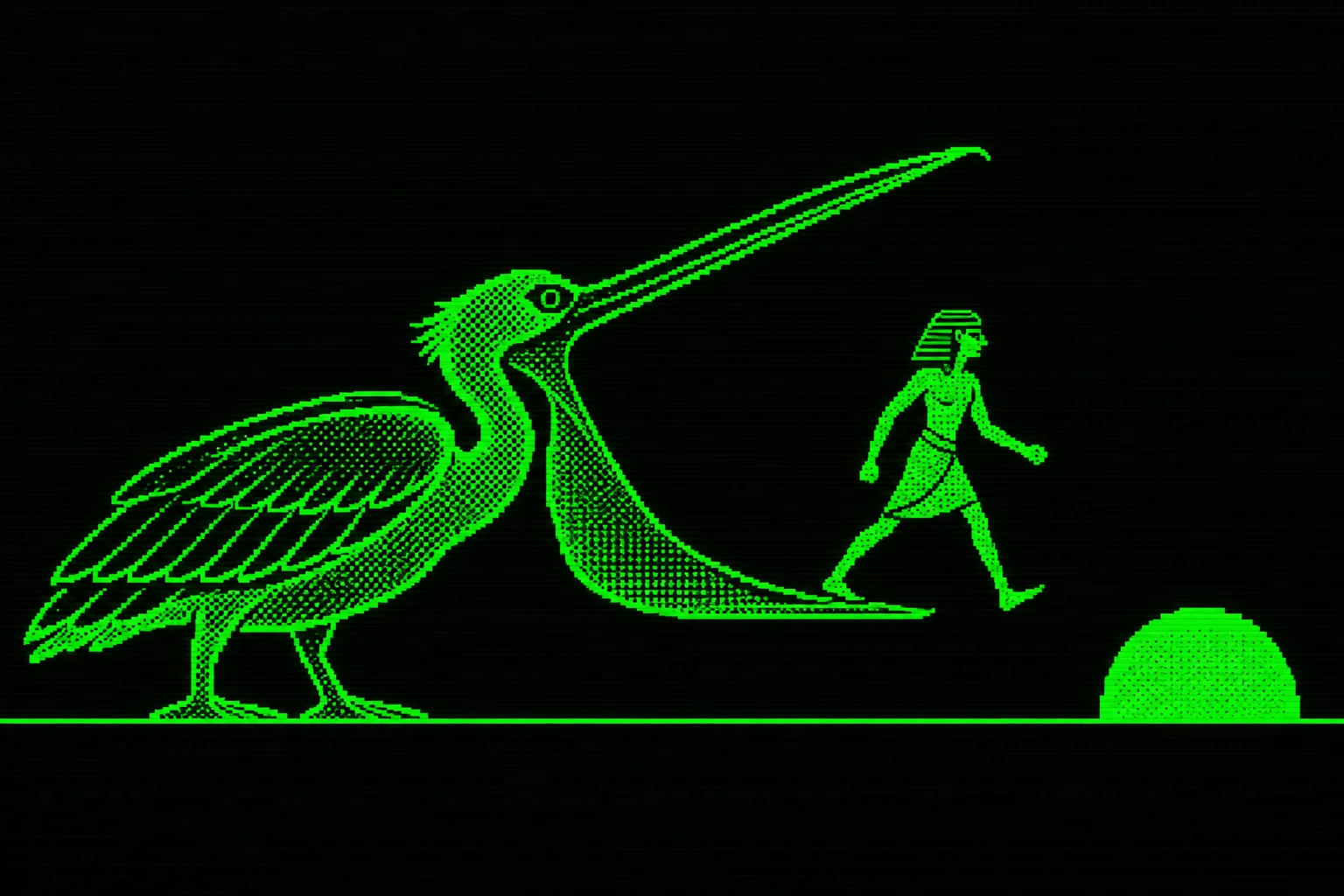
Book of the Dead Spell 68: The Mouth of the Pelican Is Opened
- Text
- Book of the Dead, Spell 68
- Date
- Copied in the 18th Dynasty (about 1400 BC) on the funerary papyrus of the steward Nu at Thebes; the spell descends from Coffin Texts spell 225
- Found
- From a tomb at Thebes; now in the British Museum, London (EA 10477)
- Language
- Middle Egyptian · Hieroglyphic
The dead man, already justified in the judgment, speaks. The doors of sky and earth open, his guard unties him, and The pelican has let me go forth by day to any place I please. He claims his body piece by piece: heart, arms, feet, mouth. Then water, air, the river, and the men and women who act against me in the realm of the dead.
Accused of living on the earth god’s bread, he answers I will not eat it and names his own food: white emmer bread and red barley beer, under Hathor’s tree. Then the corpse gets up: I raise myself on my left side, I stand up, I shake off my dust. The rubric promises: Whoever knows this scroll comes forth by day.
- 1
rʾ n pri̯.t m hrw
Spell for going forth by day.
Note · Line 1
The spell gives the dead person freedom to leave the tomb and come out into daylight. - 2
ḏd-mdw jn [...] mꜣꜥ-ḫrw
Words to be spoken by …, the justified:
Note · Line 2
“The justified” is the title of one vindicated in the judgment of the dead. The voice that follows is that person’s own. - 3
wn [n] =j ꜥꜣ.du p,t
The double doors of the sky stand open for me.
- 4
wn n =j ꜥꜣ.du tꜣ
The double doors of the earth stand open for me.
- 5
wn n =j qꜣr,t.pl Gbb
Geb’s bolts are drawn back for me.
Note · Line 5
Geb is the god of the earth. - 6
zn [n] =[j] ḥw,t [tp(,j).t] [pt]{r}j
The First Palace of the Seer is opened for me.
- 7
jn zꜣu̯ wj [sfḫ] wj
The one who guarded me has unbound me.
- 8
jn mr ꜥ =f jm =j sti̯ ꜥ =f jm =j
The one who bound his arm to me has loosed his arm from me.
- 9
[...] rʾ ⸢ḥn,t⸣
… the mouth of the pelican.
- 10
zn n =j rʾ ḥn,t
The mouth of the pelican is opened for me.
Note · Line 10
Like the opening of the double doors, the opening of the bird’s mouth gives the speaker passage. - 11
rḏi̯.n ḥn,t pri̯ =j m hrw r bw nb mri̯.y =j jm
The pelican has let me go forth by day to any place I please.
- 12
sḫm =j m jb =j
I have power over my heart.
- 13
[sḫ]m =j m ḥꜣ,tj =j
I have power over my heart.
Note · Line 13
The spell names the heart twice, with two different words. The first can embrace thought and feeling; the second names the bodily heart. - 14
sḫm =j m ꜥ.wj =j
I have power over my two arms.
- 15
sḫm =j m rd.du =j
I have power over my two feet.
- 16
sḫm =j m rʾ =j
I have power over my mouth.
- 17
sḫm =j m ꜥ,t.pl =j tm(.w)
I have power over all my limbs.
- 18
sḫm =j m pri̯,t-r-ḫrw
I have power over the offering called forth by voice.
Note · Line 18
By reciting an offering formula, the living could make food and drink available to the dead. - 19
sḫm =j m mw
I have power over water.
- 20
sḫm =j m ṯꜣw
I have power over air.
- 21
sḫm =j m nwy
I have power over the floodwaters.
- 22
sḫm =j m jtr,w
I have power over the river.
- 23
sḫm =j m wḏb.w
I have power over the banks.
- 24
sḫm =j m jrr!.yw r =j
I have power over the men who act against me.
- 25
sḫm [=j] m jrr!.yt r =j m ẖr-nṯr
I have power over the women who act against me in the realm of the dead.
- 26
sḫm =j m wḏ.pl jri̯.t r =j tp tꜣ
I have power over those who order others to act against me on earth.
- 27
jw ms ḏd =ṯn r =j
Yet you say of me:
- 28
ꜥnḫ =f js m tʾ Gbb
“He does live on Geb’s bread.”
- 29
bw,t =j 〈pw〉
That is an abomination to me!
- 30
nn wnm =j sw
I will not eat it.
- 31
ꜥnḫ =j m tʾ n btj ḥḏ.t
I live on bread of white emmer.
Note · Line 31
Nu speaks here as one of the dead. Emmer is a kind of wheat. - 32
ḥ(n)q,t =j m jt dšr n Ḥꜥpj m bw wꜥb
My beer is brewed from the red barley of Hapi of the Pure Place.
Note · Line 32
Hapi is the god of the Nile flood, whose waters nourish the grain. - 33
ḥmsi̯ =j ḥr ẖr,j.w zmꜣ.w jmꜣ n Ḥw,t-Ḥr,w ḫnt,j.t jtn-wsḫ
I take my seat in the places beneath the boughs of the ima-tree of Hathor, who presides over the Itjenu-su shrine.
Note · Line 33
The ima was a fruit tree. The shrine’s name is written here as “the wide sun disk.” - 34
jw =s wḏꜣ =s r Jwn,w ẖr zẖꜣ,w n mdw-nṯr mḏꜣ,t n.t Ḏḥwtj
She goes to Heliopolis bearing the god’s words in writing: the scroll of Thoth.
Note · Line 34
“The god’s words” is an Egyptian name for hieroglyphs. Thoth is the god of writing. - 35
sḫm =j m jb =j
I have power over my heart;
- 36
sḫm =j m ḥꜣ,tj =j
I have power over my heart.
Note · Line 36
The two lines use different words for the heart: the first often names the seat of thought and feeling, the second the bodily organ. - 37
sḫm =j m rʾ =j
I have power over my mouth;
- 38
sḫm =j m ꜥ.wj =j
I have power over my two arms.
- 39
sḫm =j m mw
I have power over water;
- 40
sḫm =j m nwy
I have power over the floodwaters;
- 41
sḫm =j m jtr,w
I have power over the river;
- 42
sḫm =j m wḏb.w
I have power over the banks.
- 43
sḫm =j m jrr!.yw r =j
I have power over the men who act against me;
- 44
sḫm =j m jrr!.yt r =j m ẖr-nṯr
I have power over the women who act against me in the realm of the dead.
- 45
sḫm =j m wḏ.pl jri̯[.t(w)] r =j tp tꜣ m ẖr-nṯr
I have power over those who ordered action against me on earth and in the realm of the dead.
- 46
sṯz (=j) wj ḥr jꜣb,j =j
I raise myself on my left side;
- 47
ḏi̯! (=j) wj ḥr wnm,j =j
I turn onto my right side;
- 48
sṯz (=j) wj ḥr wnm,j =j
I raise myself on my right side.
- 49
ḏi̯! (=j) wj ḥmsi̯.kw
I sit myself up.
- 50
ꜥḥꜥ =j
I stand up.
- 51
wḫꜣ =j ḫmw =j
I shake off my dust.
- 52
jm,j-rʾ =j r =j m sšm,w spd
My tongue is in accord with me, a skillful guide.
Note · Line 52
The tongue is called “the one in the mouth,” a phrase that also serves as the title “overseer.” - 53
jr rḫ mḏꜣ,t tn jw =f pri̯ =f m hrw
Whoever knows this scroll comes forth by day.
Note · Line 53
Here the spell turns from Nu’s own words to a promise: the dead who know the scroll are free to leave the tomb by daylight. - 54
wnn =f ḥr šmi̯.t tp tꜣ m-m ꜥnḫ,w
He will walk the earth among the living.
- 55
n ski̯[.n] =[f] r-nḥḥ
He will never perish.
- 56
šs-mꜣꜥ ḥḥ n zp
Proven effective a million times.