~/sacred-texts/book-of-the-dead
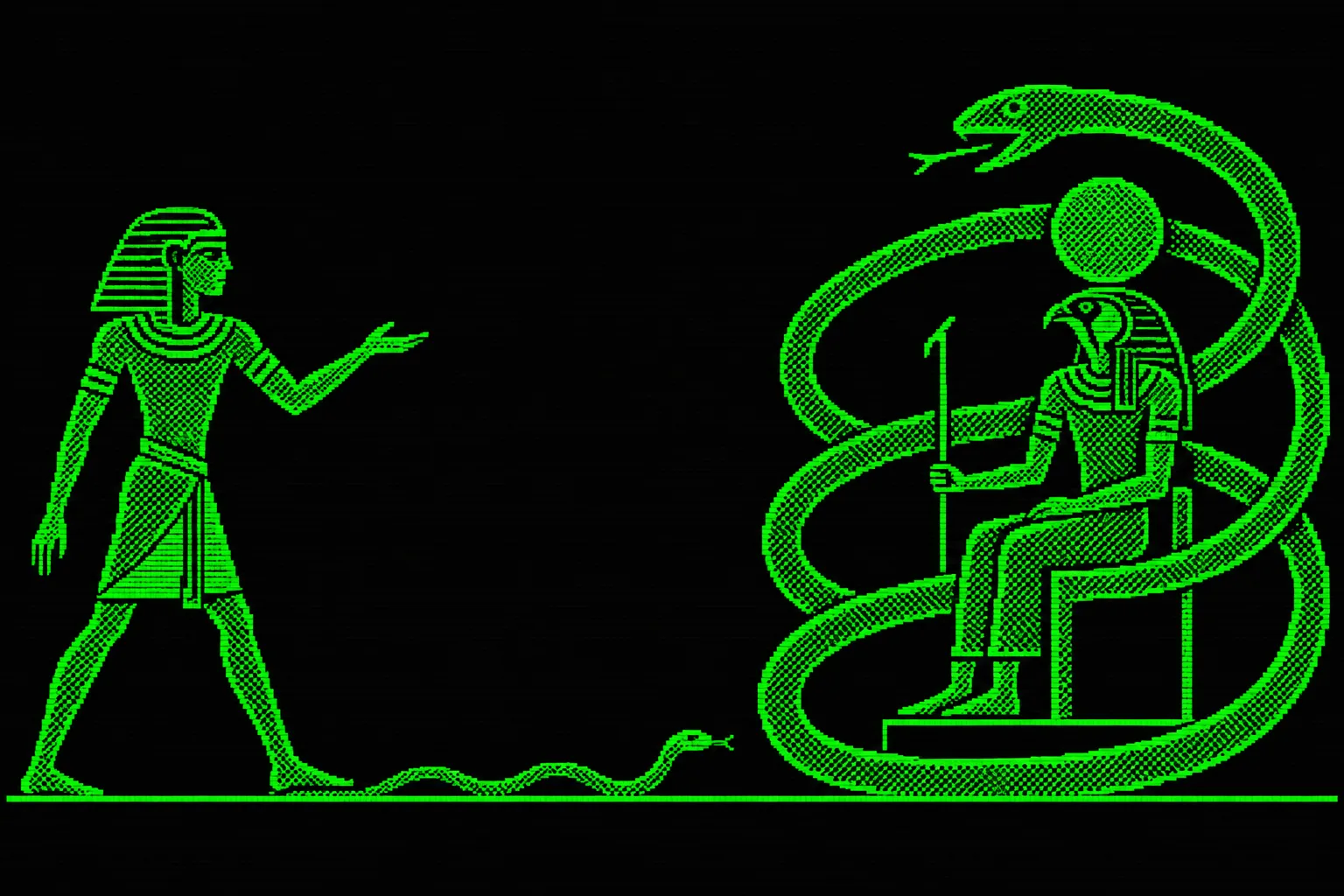
Book of the Dead Spell 64: I Have Come to See Him Who Is in His Coiled Serpent
- Text
- Book of the Dead, Spell 64
- Date
- Copied on funerary papyri from the Third Intermediate Period to Roman times (c. 1070 BC–AD 100); the spell is older, known from about 1600 BC
- Language
- Egyptian · Hieratic
The dead person, named as Osiris, speaks the whole spell. He opens I am Yesterday. I know Tomorrow. The sky is pregnant, and claims the sun’s rebirth as his own: he crosses the Duat and becomes Anubis, the Lion, Atum, the flood. Of the corpse he says I will piece him together, for he belongs to pus.
A postscript says the spell was found at Hermopolis, written in lapis lazuli on a brick of iron ore, under King Menkaure, and given to Prince Hordedef. The reciter must not have had sex with women or eaten sheep, goats or fish. A gold-covered nephrite scarab is laid on the heart and told: do not rise as a witness against me.
- 1
rʾ n pri̯(.t) m hrw m rʾ wꜥ,w
Spell for going forth by day in a single spell.
- 2
ḏd-mdw jn Wsjr [...] mꜣꜥ-ḫrw
Words to be spoken by the Osiris …, true of voice:
Note · Line 2
The deceased takes the name of Osiris, ruler of the dead. To be “true of voice” is to have been vindicated before the divine court. - 3
jnk sf
I am Yesterday.
Note · Line 3
Elsewhere in the Book of the Dead, Yesterday is Osiris and Tomorrow is Ra, the sun god. - 4
jw =j rḫ.kw ⸢dwꜣ,w⸣
I know Tomorrow.
- 5
⸢bkꜣ⸣ ḥr,t
The sky is pregnant.
- 6
msi̯.tw =f m ky zp štꜣ bꜣ jri̯ nṯr.pl jri̯ ḥtp n (j)mn,tj.w jmn,tt p,t ḥm(,w) jꜣb,tt ⸢nb⸣ ⸢ḥr,wj≡fj⸣ mꜣꜣ m stw,t =f nb sṯz pri̯ m jḫḫ(,w)
He will be born once more, he whose ba is secret,
maker of the gods, maker of offerings for those in the West,
West of the sky, steering oar of the East,
lord of his two faces, seen by his own light,
lord of the lifting up, who comes forth from the twilight.Note · Line 6
The ba is the power of a god or a person to take form and move about. The sun’s return at dawn is a new birth. - 7
j bjk.du ḥr,j.w qnb,t =sn sḏm (j)ḫ,t nsb jw ḫpš ṯz(.w) ḥr nḥb,t ḫpd tp ḏꜣḏꜣ jmn,tt
O you two falcons who preside over your court,
who hear the case, you devourers!
The foreleg is bound to the nape,
the rump is on the head of the West! - 8
sšmi̯ jmn,tj.ypl r ⸮štꜣ? ⸮zni̯? ⸮mntj.w?
Those in the West are led to …
Note · Line 8
The West, where the sun sets, is the land of the dead. Its inhabitants are the dead themselves. - 9
sṯꜣ.n =s Rꜥ,w m šms m s,t jwꜣ,y
She has led Ra, escorting him at the site of the house.
- 10
ḥr,j-tp ḥr,t ḥr(,j)-jb krjw ꜥḥꜥ m wmt,t tꜣ ntf pw jnk ṯz-pẖr
The chief of the sky, who dwells in the shrine,
who stands on the rampart of the earth—
he is I, and I am he. - 11
jw jri̯.n =j ṯḥn(,t) nbj.w Ptḥ ḥr bjꜣ =f
I have made the glaze that Ptah fuses onto his metal.
Note · Line 11
Ptah is the patron god of craftsmen. - 12
Rꜥ,w ḥr sbḥ,w ḥr =k nḏm(.w) ḥr mꜣꜥ =k nfr n{.t} hrw pn
Ra cries out for you, rejoicing in your perfect righteousness this day.
- 13
ꜥq m nw,t pri̯ m jꜣb,tt njs{.pl} sms(,w)〈.pl〉
Enter the lower sky, come forth in the east,
you whom the elders call! - 14
sns,pl ḥr jm,j.w-bꜣḥ
Cries of praise ring out among the ancestors.
- 15
snḏm n =j wꜣ,t.pl =k
Make your ways easy for me.
- 16
swsḫ n =j mṯn.w =k r ḏꜣi̯(.t) tꜣ m wsḫ p,t
Widen your paths for me,
that I may cross the earth in the wide expanse of the sky. - 17
šw =k ḥr =j bꜣ ḫmt
May your light be upon me, O ba of the Three!
- 18
ḫrw =j m tkn nṯr.pl ḏd.t
As I draw near the gods, may I say these words:
- 19
sḏm msḏr.du =j m dꜣ,t
May my two ears hear in the Duat!
Note · Line 19
The Duat is the realm of the dead through which the sun travels at night. - 20
nn jw ky-ḏd r ḏw nb mw,t =j r =ṯn
My mother has committed no sin against you (another reading: no evil of any kind).
- 21
nḥm wj mki̯{,t} wj m(-ꜥ) ꜥḫnj jr,t.du m-mšr,w n zni̯ tm m wšꜣ
Save me, guard me from him who closes his two eyes at evening,
so that all things pass into deep night. - 22
(n)nk bꜥḥ =j
My floodwaters are mine.
- 23
sḏm wr rn =k
“Great Hearer” is your name.
- 24
mḥ =j bꜣ ḥbs(.w) m-ẖnw =f
I shall fill the ba so that it is clothed from within.
- 25
m =k ḫpš ṯz(.w) ḥr nḥb,t ḫpd tp ḏꜣḏꜣ jmn,tt jꜣwj pfj jw,tj ⸮štm? =f
Look, the foreleg is bound to the nape,
the rump is on the head of the West,
you old man there who bear no ill will! - 26
ḏi̯! n =j jm,j.w wr wr zꜣ(,t)du
May those who dwell in greatness grant me the greatness of the twins!
Note · Line 26
The twin children are usually Shu and Tefnut, the children of the creator god Atum. - 27
nn gmi̯ =j w⸢di̯⸣ jm [...] ⸮r?
I shall not find what was laid in …
- 28
rmi̯ =(j) n mꜣꜣ(.t) =j m sqd,wt n dnj(,t) Ꜣbḏ,w
I shall weep at what I see on the voyage at the Djenit festival of Abydos.
Note · Line 28
Djenit marked the quarter moon. At Abydos, a center of Osiris’s worship, his festival rites included a procession by boat. - 29
qr(,t).pl sḫni̯.w r-ꜥ.wj qnb,tj.w{ḥ} ḥr,j.w jrw =ṯn m ẖr,t
The bolts have been lowered beside the officials
whose duty is to watch over your forms. - 30
ꜥ.wj =k m-⸢ẖnw⸣ =⸢k⸣
Your two arms are within you.
- 31
ḥr =k m ṯzm{.pl} ḥr ḫnmm =f m krj
Yours is the face of a greyhound, for its power of scent in the shrine.
- 32
⸢s⸣qdi̯ wj rd.du =j m Jnp(,w) m nwd nn ḏr
May my two feet carry me as Anubis, moving without end!
Note · Line 32
The dead speaker takes on the form of Anubis, the jackal god who watches over the dead. - 33
pri̯ sḫnm Tꜣ-twynn r Rw,tj swḏꜣ.kw
The scent of Tatenen goes forth to the Two Lions, and I am made whole.
Note · Line 33
Tatenen is the god of the earth that rose from the waters at creation. The paired lions can stand for the two horizons. - 34
jnk pri̯ m gꜣu̯(,t) ꜥꜣ sšp [...]
I am the one who comes forth from the narrow passage at the door of light …
- 35
jw [...] r mḏwj rn =j jri̯.y =j r ẖr,t ꜣḫ.w
… by the measure of my name, which I shall allot to the transfigured spirits as their share.
Note · Line 35
A transfigured spirit, or akh, is one of the dead who has gained the power to act in the divine world. - 36
ḥḥ.pl 4 pw
They number four million.
- 37
ḥfn.pl 4 pw
They number four hundred thousand.
- 38
ḫꜣ(w) =f m (j)ḫ,t
His measuring bowl holds goods.
- 39
jw =j ḥr m (j)ḫ,t =sn bꜣbꜣ.pl wnw,t.pl m hrw
I am on high among the goods of those who apportion the hours of the day.
- 40
smtr rmn-Sꜣḥ
The Bearer of Orion has been tested.
- 41
24 pw zš(.w) zmꜣ(.w) m ḏḏ!(.t) wꜥ,w-n-wꜥ,w
Spread out, they number twenty-four; they are joined with what each one gives.
Note · Line 41
The Egyptians counted twelve hours of daylight and twelve of darkness. - 42
rʾ-6 pw ḫnt(,j).t dꜣ,t wnw,t n.t sḫr sbj.pl jm m mꜣꜥ-ḫrw
What lies foremost in the Duat is one sixth, at the hour when the rebels there are struck down in triumph.
- 43
nn pw gr n,tj m wbꜣ dꜣ,t
This too is what happens when the Duat is opened.
- 44
nw pw [n],t(j) ḏs =f ⸮ḥtr.y? Šw
This is the one who exists of himself, the one whom Shu binds together.
Note · Line 44
Shu is the god of air who holds the sky apart from the earth. - 45
wbn =⸢j⸣ m nb-ꜥnḫ mꜣꜥ nfr jrr!.j 7 m pri̯(.t) =f
May I rise in truth and beauty as the Lord of Life, who takes seven steps when he comes forth.
- 46
mk,t pw m zꜣ ꜣḫ,pl =f
This is protection, the shelter his magic power gives.
- 47
znf qbḥ(.w)
The blood is cool.
- 48
nzp,w wꜣḏ(.w) zmꜣ-⸢tꜣ⸣
The wounds are fresh at burial.
Note · Line 48
The word for “fresh” also means “green,” as of a growing plant. - 49
wpi̯.n =j ꜥb,du n dmḏ
I have parted the Two Horns so they may be joined.
Note · Line 49
The Two Horns are the horned crown of Osiris. - 50
ḥn =j m štꜣ,w qmꜣ
I am equipped with the creator’s secret.
- 51
m ḫsf wj ḥ{ꜣ,t}r,j.w-ẖ,t =sn
Do not turn me back, you who go on your bellies!
Note · Line 51
The speaker is addressing snakes. - 52
jy.n =j m jpw(,t) n(.t) nb{,t},pl-(j)ḫ,t m nḏ (j)ḫ,t [...] Wsjr
I have come with a message from the Lords of Provisions, guarding the possessions … of Osiris.
- 53
jmi̯ ꜥm jr,t rmi̯(,t).pl =s
Let the Eye not swallow its tears.
- 54
jnk pw nṯr n pr,w n jm,j ꜥḥꜥ{ꜣ},w =f jy.n =f m Ḫm ḫr Jwn,w r ḏi̯!.t rḫ bn,w (j)ḫ,t dꜣ,t
I am the god of the house of him who dwells amid his riches. He has come from Letopolis to Heliopolis to make the affairs of the Duat known to the Bennu.
Note · Line 54
The Bennu is the sacred heron of Heliopolis, a bird of creation and renewal. - 55
j mn ⸮šṯ.pl? {wnm}〈jm,j〉 =s qmꜣ ḫpr,w mj Ḫprj pri̯ m jtn tp ꜥnḏ,w jwr.n =j m jmn,tt n.t p,t ꜣḫ m ḫtm
O enduring one among those who adorn, you who dwell within it,
who fashion forms like Khepri,
who come forth as the sun disk ahead of the glow of dawn,
I was pregnant in the west of the sky, a transfigured spirit in the fortress.Note · Line 55
Khepri is the morning sun in the form of a scarab. His name echoes the Egyptian word for the forms he brings into being. - 56
wbn{Rꜥ,w} 〈=j〉 m ḫꜣ ky-ḏd zꜣꜣ! m qrr,t
I rise bowed low (another reading: keeping watch in the cavern).
- 57
zš.n =j m ḥr,t
I have passed through the sky.
- 58
⸢ḫ⸣n⸢d⸣.n =j ḥr bjꜣ
I have set foot on the iron firmament.
Note · Line 58
The Egyptian term also designates the waters of the sky. - 59
swꜣwꜣ.pl ḥr =s
I pass it by.
- 60
pꜣi̯.y =(j) r mꜣw(,t) ꜣḫ,w
May I fly to the rays of the transfigured spirit!
- 61
ḫpr,w =(j) m Rꜥ,w r rḫ,yt ḫnd =f ḥr sd.pl jm,j.w-tꜣ
My form is that of Ra facing the throng as he treads on the tails of those who dwell in the earth.
Note · Line 61
“Those who dwell in the earth” is a name for snakes. - 62
jhm =j ḥr nwd šw,t.pl ꜣḫ.w
I walk slowly and reach the shadows of the transfigured dead.
Note · Line 62
These are the akhs, the dead who have become powerful spirits. - 63
ḏsr n =j wꜣ,t nfr(.t) ḥr sbꜣ.pl n(.w) dꜣ,t
Clear a fair path for me along the gates of the Duat!
- 64
jri̯.y =j ḥr n,tj-jm gꜣḥ.w =f
May I act for the one who is there, for he is weary.
Note · Line 64
“The one who is there” means the dead man. - 65
s(ꜣ)q (=j) sw ḥr-n,tj r (j)my
I will piece him together, for he belongs to pus.
- 66
nḥm s(w) pw m jmn(,t) n,tj-jm
This is what it means to save the one who is there in his hidden place.
- 67
j gr{,t} j gr(.t) wn (n) =j ḫtm
O silent man, O silent woman, open for me what is sealed!
- 68
ḏi̯! nb nfr zš =j
May the good lord let me pass!
- 69
nm tr m ns{p}〈b〉.w m jmn,t
Who, then, is the devourer in the hidden place?
- 70
jnk ḫnt,j Rʾ-sṯꜣ,w ꜥq m rn =f pri̯ m rn =f pri̯ m ḥz,pl nb ḥḥ.pl tꜣ jri̯ rn =f
I am the one who presides over Rosetau,
who enters in his name, who comes forth in his name,
who comes forth in the favor of the lord of earth’s millions,
who made his own name.Note · Line 70
Rosetau was a name for the necropolis at Giza and also for a region of the dead ruled by Osiris. - 71
jwr(,t) wꜣḥ ꜣ{d}〈ṯ〉p,pl =s msḥ.w tp-ꜥ sḫd
The pregnant woman’s burdens are laid down, for she has passed before the one who is upside down.
- 72
ḫtm ⸮sꜣ(w)? jnb
The niche in the wall is sealed.
- 73
pnꜥ =f nḏm ḏꜣr pw ḫr.tw ḥr psḏ bn,w ḥr zmꜣ,y.pl
Over he turns with ease, this foe, falling on the Bennu’s back and on the confederates.
Note · Line 73
The confederates are the followers of Seth, the enemy of Osiris. - 74
jw Ḥr,w rḏi̯ n =f jr,t =f ḥḏ-tꜣ
At daybreak Horus is given his eye.
Note · Line 74
The eye that Horus lost in his struggle with Seth was made whole again. It is called the Wedjat, “the Sound Eye.” - 75
rn =j pw rn =f
His name is my name.
- 76
nn qꜣi̯ r =j m Rw
As the Lion, I have no one above me.
- 77
ḥn.w Šw {jw}〈r〉 =j
Shu’s sedges are for me.
- 78
jnk {s}〈n〉-mḥ≡f
I am nephrite.
Note · Line 78
Nephrite is a kind of jade used to carve scarab amulets. - 79
nfr mꜣꜣ mnj.w wrḏ(,w)-jb jri̯.t sḫni̯.w gꜣš
How fair to see the Weary of Heart come ashore and settle on the bed of reeds.
Note · Line 79
“The Weary of Heart” is Osiris. - 80
m =k pri̯ =j
Look, I come forth!
- 81
jnk nb-ꜥnḫ
I am the Lord of Life.
- 82
dwꜣ.n =j Nw,w
I have worshiped Nun.
Note · Line 82
Nun is the god of the primeval waters from which the world arose. - 83
jy.n =j m nni̯
I have come out of weariness.
- 84
pri̯ =j m rʾ ⸮nj? ⸮wr? ⸮nʾ,t?
May I come forth through the doorway of the Great One of the City!
- 85
Wsjr mk,t =k r sꜣr
Osiris, your protection guards against want.
- 86
ḥpt =j nh,t
May I embrace the sycamore,
Note · Line 86
The Egyptian sycamore is a fig tree. A goddess in its branches was said to give the dead shade and water. - 87
n{pr}〈h〉i̯.n wj nh,t.pl
for the sycamores have sheltered me.
- 88
jw wpi̯.n =j ⸮sꜣ(w)? dꜣ,t
I have opened the niche of the Duat.
- 89
jy.n =j
I have come.
- 90
ḥpt.n =j wḏꜣ,t
I have embraced the Wedjat eye.
- 91
jw =k tr ṯnw hrw n ḥ(ꜣ)b ẖꜣ(,t) gr.tw
Where, then, are you on the feast day when the corpse lies silent?
Note · Line 91
The dead person is questioned and answers in the next line. - 92
jy.n =j r mꜣꜣ jm,j-mḥn≡f ḥr-m-ḥr jr,t-m-jr,t ṯḥn ṯꜣw m pri̯(.t) =f
I have come to see him who is in his coiled serpent,
face to face, eye to eye,
him who meets the wind as he comes forth.Note · Line 92
The serpent Mehen coils around the sun god to protect him. - 93
⸮g?(ꜣ)gꜣu̯ nn m ḥr =(j)
This wonder shows in my face.
- 94
ꜥf{k}〈n,t〉y jmm! n =j ꜥ.wj =ṯn
You who wear the headcloth, hold out both arms to me!
- 95
ms.pl pri̯ m rʾ ḫꜥi̯ =sn {nw}〈m〉 jr(,t)-Rꜥ,w
The children who came forth from the mouth rise from the Eye of Ra.
Note · Line 95
The Eye of Ra is the sun god’s own power, embodied as a goddess. - 96
ꜥḥꜥ.n =j sꜣq.n =j
I have risen; I have gathered myself together.
- 97
pꜣi̯.y =j r p,t sḫni̯.w =j r tꜣ rꜥ,w-nb
Every day I shall fly up to the sky and settle back to earth.
- 98
ḥpt =j jr,t =j r nmt,t =j
I shall embrace my eye in time with my stride.
- 99
jnk msi̯ m sf{ḫ} nb
I am the one born yesterday, O lord!
- 100
sḫpr.n =j Ꜣkr,pl tꜣ wḥꜥ wj r nw
I brought into being the Akeru of the earth,
who set me free when the time comes.Note · Line 100
The Akeru are earth gods in the form of serpents. - 101
jw sdgꜣ ꜥḥꜣ-ꜥ =f n ḥbs wnḫ
His warrior is hidden away to put on the garment.
- 102
mj m-sꜣ =j ḥkꜣ =j
Come behind me, my magic!
- 103
rwḏ jwf =j
My flesh is firm.
- 104
ꜣḫ,w =j m zꜣ n ꜥ(,t).pl =j r nw pw sḫni̯.w ḥr nḏ-rʾ
My spirit-power guards my limbs at this hour,
now that it has settled down to keep watch over me. - 105
ꜥḥꜥ psḏ,t ḥr ḏd.t =j
The Ennead rises at my words:
Note · Line 105
The Ennead is the company of nine gods. - 106
rw ⸢n⸣ Rꜥ,w fꜣi̯ jm,j tꜣ-ḏsr jw =k jm =j jw =j jm =k jrw =k
Lion of Ra, you who bear him who dwells in the Sacred Land,
you are in me and I am in you; I am your form.Note · Line 106
The Sacred Land is the necropolis, the burial ground of the dead. - 107
jnk bꜥḥ
I am the flood.
- 108
{⸮ḫ?}〈k〉m-wr rn =j
Great Black One is my name.
Note · Line 108
In this watery setting the name evokes a lake; it is also a title of a sacred bull. - 109
ḫpr,w =(j) Jtm,w ky-ḏd Ḫprj
My form is Atum. Another reading: Khepri.
Note · Line 109
Atum is the creator god; Khepri is the sun god at dawn. - 110
šnj-tꜣ n Jtm,w r =j
Atum’s earth-hair is for me.
Note · Line 110
“Earth-hair” is a name for a plant. - 111
ꜥq.n =j m Ḫm
I have entered Letopolis.
- 112
pri̯ =j m (j)ꜣḫ(,w)
May I come forth as the Shining One!
- 113
jnk Wsjr [...] mꜣꜥ-ḫrw mꜣꜣ jrw.pl n r(m)ṯ.pl ḏ,t
I am the Osiris …, vindicated, who sees the forms of humankind forever.
Note · Line 113
The dead person takes the title “Osiris,” identifying with the god who lives on after death. “Vindicated” declares that the dead person has been judged to be in the right. - 114
jr rḫ rʾ pn smꜣꜥ-ḫrw =f pw ḥr-tp tꜣ m ẖr,t-nṯr
Whoever knows this spell is thereby vindicated on earth and in the realm of the dead.
- 115
jw =f jri̯ =f jrr!.w(t) nb n ꜥnḫ,pl
He does all that the living do.
- 116
mk,t pw n.t nṯr-ꜥꜣ
It is the protection of the Great God.
- 117
gmi̯.tw rʾ pn n Ḫmn,w ḥr ḏb(,t) n.t bjꜣ-qs zẖꜣ m ḫsbḏ ẖr rd.du n nṯr pn gmi̯(.w) m hꜣw n nswt-bjt Mn-kꜣ〈,w〉-Rꜥ,w mꜣꜥ-ḫrw rḏi̯(.w) n zꜣ-(n)sw Ḥr-ḏḏ≡f
This spell was found at Hermopolis, written in lapis lazuli on a brick of iron ore beneath the two feet of this god. It was found in the reign of Menkaure, King of Upper and Lower Egypt, vindicated, and given to the king’s son Hordjedef.
Note · Line 117
Hermopolis was the city of Thoth, god of writing. The feet are those of a divine statue. - 118
{j}〈g〉mi̯ =f s(j) m-ḫt mnmn =f r jri̯.t sjp m rʾ.pl-pr.pl
He found the brick after he had set out to inspect the temples.
- 119
jw 〈n〉ḫt ḥnꜥ =f ḥr dbḥ{w} n =f sw m swꜣš
A strong man was with him as he asked the god for the spell with words of praise.
- 120
jni̯.n =f sw m bjꜣ,t n nswt ḫft mꜣꜣ =f n,tj ḥr =s
When he saw what was on the brick, he brought the spell to the king as a marvel.
- 121
sštꜣ pw ꜥꜣ n mꜣꜣ n sḏm
This is a great secret, never seen, never heard.
- 122
{⸮wbꜣ?}〈šdi̯〉 rʾ pn wꜥb(.w) dwr(.w) nn tkn m ḥm,t.pl nn wnm ywj.pl mḥy
Let whoever recites this spell be pure and cleansed, having neither approached women nor eaten sheep, goats, or fish.
Note · Line 122
“Approached women” means had sex with them. - 123
jsk ḫprr n (n-)mḥ(≡f) qd swꜥb m nb(w) rḏi̯(.w) m jb n z jri̯ n =f wp(,t)-rʾ gs m tp(,t)
Meanwhile, let a scarab be shaped from nephrite, overlaid with gold, and laid over the man’s heart. Let the Opening of the Mouth be performed for him, and let him be anointed with the finest oil.
Note · Line 123
The scarab is a beetle-shaped amulet. The Opening of the Mouth was a rite that gave the dead the power to breathe, eat, and speak again. - 124
ḏd.t ḥr =f m ḥkꜣ
Words to be spoken over it as a spell:
- 125
jb =j n mw,t =j zp-2 ḥꜣ,tj =j m ḫpr,w =j m ꜥḥꜥ r =j m mtr(,w) m ḫsf r =j m ḏꜣḏꜣ,t m r⸢q⸣ꜣ r =j m-bꜣḥ jr,j-mḫꜣ(,t)
My heart from my mother, my heart from my mother,
my heart of flesh in my changing forms,
do not rise as a witness against me,
do not oppose me in the tribunal,
do not turn against me before the keeper of the scales.Note · Line 125
The dead man speaks to his own heart. It will be weighed against the feather of truth, and it can bear witness against him. - 126
ntk kꜣ m ẖ,t =j H̱nm,w swḏꜣ ḥꜥ =j
You are the ka within my body,
Khnum, who keeps my flesh sound.Note · Line 126
The ka is the life force. Khnum is the god who shapes the human body on a potter’s wheel. - 127
pri̯ =k r b(w) nfr
May you go forth to the beautiful place.
- 128
ḥn.w =k n jm
May you grant us a place there.
- 129
m s{t}〈ḫ〉nš!! rn šny.pl [...] r(m){r}〈ṯ〉.pl m ꜥḥꜥ.w ky-ḏd m ꜥḥꜥ,w =f m b(w) nfr
Do not make the courtiers’ name stink … people standing. Another reading: in his time in the beautiful place.
- 130
sḏm ꜣw,t-jb n.t wḏꜥ-md,t
To hear is the judge’s delight.
- 131
m ḏd grg r =j r-gs nṯr-ꜥꜣ
Speak no lie against me at the great god’s side.
- 132
m =k tnw =k wnn.tj
See, you are counted, and so you exist.