~/sacred-texts/book-of-the-dead
Book of the Dead Spell 189: Keeping a Man from Walking Upside Down
- Text
- Book of the Dead, Spell 189
- Date
- Copied in the 18th Dynasty (about 1400 BC) on the funerary papyrus of the steward Nu at Thebes
- Found
- Found at Thebes (Qurna); now in the British Museum, London (EA 10477)
- Language
- Middle Egyptian · Hieroglyphic
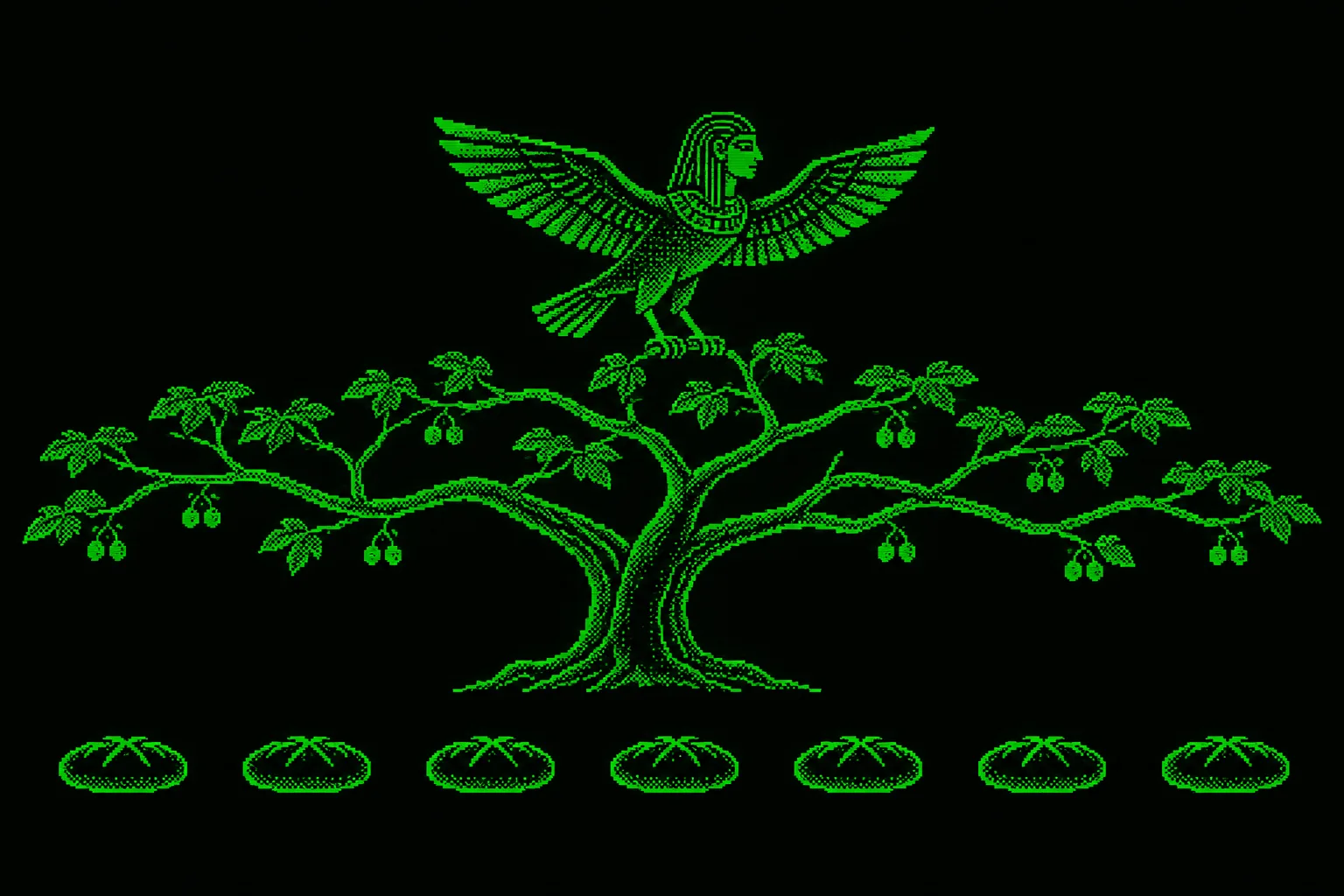
The dead man speaks. He will not eat dung, touch it or tread on it: Dung is what I loathe. The gods and the blessed spirits ask what he will live on, and he answers: I will live on seven loaves brought to me: four loaves from Horus, three loaves from Thoth. He eats beneath Hathor’s sycamore, takes wing as a swallow and honks as a Nile goose.
Then this one who cannot count questions him again: what bread, who brings it, where he eats it. Charged with living on someone else’s goods, he answers: I plow the fields in the Field of Reeds. Gods plow them for him, Apis threshes and Seth reaps.
- 1
rʾ n tm rḏi̯.t jri̯.y z šmi̯.t sḫd.w tm wnm ḥs
Spell for keeping a man from walking upside down and for not eating dung.
Note · Line 1
The spell wards off two reversals of ordinary life in the realm of the dead: walking head down and eating what the body casts out. - 2
ḏd-mdw jn [...]
Words to be spoken by …:
Note · Line 2
This papyrus was made for a man named Nu. He speaks in his own voice. - 3
bw,t =j zp-2 nn wnm =j sw
What I loathe! What I loathe! I will not eat it.
- 4
bw,t =j pw ḥs
Dung is what I loathe.
- 5
nn wnm =j sw
I will not eat it.
- 6
ḥtp-kꜣ nn ḫmi̯.yw jm =f
As for “relief,” there is no touching it.
Note · Line 6
“Relief” is a name for dung that evokes the ka, a person’s vital force, at rest. - 7
nn ḫr =f m ẖ,t =j
It will not fall into my belly.
- 8
nn (j)ꜥr =f m ḏbꜥ.pl =j
It will not reach my fingers.
- 9
nn dmj.n =f m sꜣḥ.pl =j
It does not touch my toes.
- 10
ꜥnḫ =k jrf m m ḫrw-fj =sn nṯr.pl ꜣḫ.pl r =j m b(w) pn jni̯.y =k jm
“What, then, will you live on in this place where you have been brought?” the gods and the blessed spirits ask me.
Note · Line 10
The blessed spirits are the akhu, the dead who have been transfigured and can act among the gods. - 11
ꜥnḫ =j m tʾ 7 jni̯.y n =j tʾ 4 ḫr Ḥr,w tʾ 3 ḫr Ḏḥw,tj
I will live on seven loaves brought to me: four loaves from Horus, three loaves from Thoth.
- 12
rḏi̯ n =k wnm =k ṯnj ḫrw-fj =sn nṯr.pl ꜣḫ.pl r =j
“Where are you permitted to eat?” the gods and the blessed spirits ask me.
- 13
wnm =j ẖr nh,t twy n.t Ḥw,t-Ḥr,w rḏi̯.n =j zp =j jm n ḫn,yt =s
I eat beneath that sycamore of Hathor’s, once I have given her musician what is left of my bread.
Note · Line 13
The tree is a sycamore fig. Hathor could appear from such a tree to give the dead food and water. - 14
jw wḏꜥ n =j ꜣḥ,t.pl =j m Ḏd,w wꜣḏ,t m Jwn,w
My fields in Busiris have been allotted to me, and greens in Heliopolis.
- 15
ꜥnḫ =j m tʾ n bd,t ḥḏ.t m ḥ(n)q,t n jt dšr
I live on bread of white emmer and beer of red barley.
Note · Line 15
Emmer is a kind of wheat. - 16
jw rḏi̯ n =j ꜣb.w,t jti̯ =j mw,t =j
My father’s kin and my mother’s kin have been given to me.
- 17
jr,j-ꜥꜣ n mdw tꜣ =f wn n =j wsḫ n =j jri̯ n =j wꜣ,t
Gatekeeper of the Staff of His Land, open for me, open wide for me, make way for me!
- 18
ḥmsi̯ =j r b(w) mri̯.y =j jm m bꜣ ꜥnḫ
Let me settle where I please as a living ba.
Note · Line 18
The ba is the aspect of a person that can leave the tomb and move about. It is often shown as a bird with a human head. - 19
n ꜣjr =j jn ḫftj.w =j
I am not driven back by my enemies.
- 20
bw,t =j pw ḥs
Dung is what I loathe.
- 21
nn wnm =j sw
I will not eat it.
- 22
nn šmi̯ =k wj bss m Jwn,w ḥri̯.tj r =j
You will not reach me in Heliopolis, you who ooze forth! You are far from me.
Note · Line 22
Nu now speaks to the dung itself. - 23
jnk kꜣ ḥn s,t =f
I am the bull whose place is made ready.
- 24
pꜣi̯.n =j m wr
I have taken wing as a swallow.
- 25
ngg.n =j m smn
I have honked as a Nile goose.
- 26
ḫn{n}i̯.n =j ḥr nh,t nfr.t ḥr,j.t-jb š Ꜣgb(,w)
I have alighted on the beautiful sycamore in the heart of the Flood’s domain.
- 27
prr! ḫnn!{.n} ḥr =s n wfꜣ.n =f
Whoever flies out and alights on it does not lie still.
Note · Line 27
The stillness is that of death. To take wing and alight at will is a sign of life. - 28
jr wnn ẖr =s jw =f m nṯr-ꜥꜣ
Whoever is beneath it is the Great God.
- 29
bw,t =j n wnm.n =j bw,t =j
What I loathe! I do not eat what I loathe.
- 30
bw,t =j pw ḥs
Dung is what I loathe.
- 31
nn wnm.n =j sw
“I do not eat it.
Note · Line 31
Nu, the dead man for whom this papyrus was written, refuses to eat excrement in the life to come. - 32
bw,t kꜣ =j ḥs nn ꜥq =f r ẖ,t =j
Dung is what my ka abhors. It shall not enter my belly.
Note · Line 32
The ka is a person’s vital force. Offerings of food and drink sustain it after death. - 33
nn (j)ꜥr =j n =f m ꜥ.wj =j
I will not reach for it with either hand.
- 34
nn ḫnd =j ḥr =f m ṯb(w),t.du =j
I will not tread on it with the sole of either foot.
- 35
nn sti̯ =j n =ṯn m nš,w
I will not pour from the jar for you.
- 36
n pnq =j n =ṯn m nbꜣ jw,t{j} rḏi̯.y n =ṯn n bnw,t
I will not draw water for you with the shaduf, lest anything be given to you for the millstone.
Note · Line 36
A shaduf is a pole balanced on a pivot, with a bucket at one end and a counterweight at the other. - 37
n ṯꜣi̯.n =j ḥr sp,t šd,w.pl =ṯn
I take nothing from the lip of your mortars.
- 38
n rwj.n =j n =ṯn m-sḫd
I do not walk away on my head for your sake.”
Note · Line 38
Walking upside down and feeding on excrement are paired fears in Egyptian funerary spells. Both turn the order of ordinary life upside down. - 39
ḏd.jn jw:ḫm.w pn ḥsb
Then this one who cannot count said:
Note · Line 39
The questioner who cannot count makes Nu account for his food, down to the number of loaves. - 40
ꜥnḫ =k jrf m-jšs,t m tꜣ pn jy.n =k r =f ꜣḫ =k
“What, then, will you live on in this land where you have come to be transfigured?”
Note · Line 40
To be transfigured is to become an akh, a spirit with the power to act after death. - 41
ꜥnḫ =j m tʾ n jt kmm m ḥ(n)q,t n.t jt sšp
“I live on bread baked from dark barley and beer brewed from bright barley.
- 42
tʾ 4 m sḫ,t-ḥtp ṯn,w pw r nṯr nb
Four loaves from the Field of Offerings: that sets me above every god.
Note · Line 42
The Field of Offerings is a region of the afterlife where the dead receive their provisions. - 43
jw =j gr,t r tʾ 4 m ẖr,t-hrw n.t rꜥ,w-nb
So I shall have four loaves for my daily ration, day after day.
- 44
s{ꜣ}šr,t 4 m Jwn,w ṯn,w pw r nṯr nb
Four toasted loaves from Heliopolis: that sets me above every god.”
- 45
ḏd.jn jw:ḫm.w pn ḥsb
Then this one who cannot count said:
- 46
jni̯ n =k
“To bring to you—
- 47
wnm.n =k ṯnj
where did you eat?”
- 48
ḥr wḏb pwy wꜥb hrw pn šzp.n =j nḥḏ.w,t =j m ꜥntjw
“On that pure riverbank, on this very day, after I received my teeth of myrrh.
Note · Line 48
Myrrh is a fragrant resin used in incense and anointing oils. Here the teeth themselves are made of it. - 49
nn wnm =j sw
I will not eat it.
- 50
nn (j)ꜥr =j n =f m ꜥ.wj =j
I will not reach for it with either hand.
- 51
nn ḫnd =j ḥr =f m ṯbw,t.du =j
I will not tread on it with the sole of either foot.”
- 52
ḏd.jn jw:ḫm.w pn ḥsb
Then this one who cannot count said:
- 53
ꜥnḫ =k jrf m-jšs,t m tꜣ pn jy.n =k r =f ꜣḫ =k
“What, then, will you live on in this land where you have come to be transfigured?”
- 54
ꜥnḫ =j m tʾ 7 pwy
“I will live on those seven loaves.
- 55
jni̯ =tw tʾ 4 m pr Ḥr,w tʾ 3 m pr Ḏḥwtj
Four loaves will be brought from the house of Horus, three from the house of Thoth.”
- 56
ḏd.jn jw:ḫm.w pn ḥsb
Then this one who cannot count said:
- 57
jnm jr =f jni̯ =f n =k sn
“Who, then, will bring them to you?”
- 58
jn ḫnm pr.pl Ḥr,w ḥṯꜣ,tdu Jwn,w
“The keeper of the houses of Horus and the two Hetjat of Heliopolis.”
- 59
wnm =k jr =k sn ṯnj
“Where, then, will you eat them?”
- 60
ẖr zmꜣ,w n.w ḏbꜣ,t nfr.t r-rmn ḥkn.w =s jṯi̯.tw =j jr =f
“Beneath the boughs of the beautiful djebat tree, beside its jubilant ones, when I am taken to him.”
Note · Line 60
The one to whom Nu is taken may be Osiris, ruler of the dead. - 61
〈ḏd〉.jn jw:ḫm.w pn ḥsb
Then this man who cannot count said:
Note · Line 61
The dead man is being questioned about how he will feed himself. The spell is meant to spare him from having to eat dung or drink urine. - 62
ꜥnḫ =k tr m (j)ḫ,t ky rꜥ,w-nb
“So you mean to live on someone else’s goods day after day!”
- 63
ḏd.n =j n =f
I said to him:
- 64
skꜣ =j ꜣḥ,t.pl jm,j(.w) sḫ,t-jꜣr,w
“I plow the fields in the Field of Reeds.”
Note · Line 64
The Field of Reeds is farmland in the world of the dead, with fields and waterways like those of Egypt. - 65
ḏd.jn jw:ḫm.w pn ḥsb
Then this man who cannot count said:
- 66
jnm zꜣꜣ! n =k sn
“Who guards them for you?”
- 67
ḏd.n =j n =f
I said to him:
- 68
jn zꜣ,t.j n bj,tj m-sꜣ jr,j
“The two daughters of the king of Lower Egypt watch over them.”
- 69
jnm skꜣ n =k sn
“Who plows them for you?”
- 70
jn wr.w jm,j.w n.w nṯr.pl p,t n.w nṯr.pl tꜣ
“The great ones among the gods of the sky and the gods of the earth.
- 71
ḥwi̯ =tw n =j m Ḥpw ḫnt,j Zꜣw
They thresh for me as Apis, foremost in Sais.
Note · Line 71
Apis was a sacred bull. Cattle threshed grain by treading the ears underfoot. - 72
ꜣzḫ =tw n =j m Swtj nb p,t mḥ,t(j).t
They reap for me as Seth, lord of the northern sky.”
- 73
j ꜥn.yw jšd.pl ḥr.pl =ṯn fdq.w jzf,t wꜥb ḥr.pl =ṯn
O you who turn about, whose faces are ished trees,
you who cut evil to pieces, cleanse your faces!Note · Line 73
The ished was a sacred fruit tree. - 74
jw js ḥnꜥ zmꜣ,yt Stš r ḏw pwy n bꜣẖ,w
Indeed, I am with Seth’s band at that mountain of Bakhu.
Note · Line 74
Bakhu is a mountain at the edge of the world. - 75
ḥmsi̯ =j ḥnꜥ sꜥḥ.w mnḫ.w r šdi̯(.t) š n Wsjr r zjn jb
I shall sit with the eminent nobles to dig out the pool of Osiris and wipe the heart clean.
- 76
nn srḫ =j n ꜥnḫ r Wsjr [...] mꜣꜥ-ḫrw
No charge concerning my life stands against me, the Osiris …, vindicated.
Note · Line 76
The dead man bears the name of Osiris as a title. “Vindicated” is the verdict in his favor before the divine court.