~/sacred-texts/book-of-the-dead
Book of the Dead Spell 179: Yesterday I Died, Today I Have Come
- Text
- Book of the Dead, Spell 179
- Date
- Copied in the 18th Dynasty (about 1400 BC) in the Book of the Dead papyrus of the steward Nu at Thebes
- Found
- From Thebes; now in the British Museum, London (EA 10477)
- Language
- Middle Egyptian · Hieroglyphic
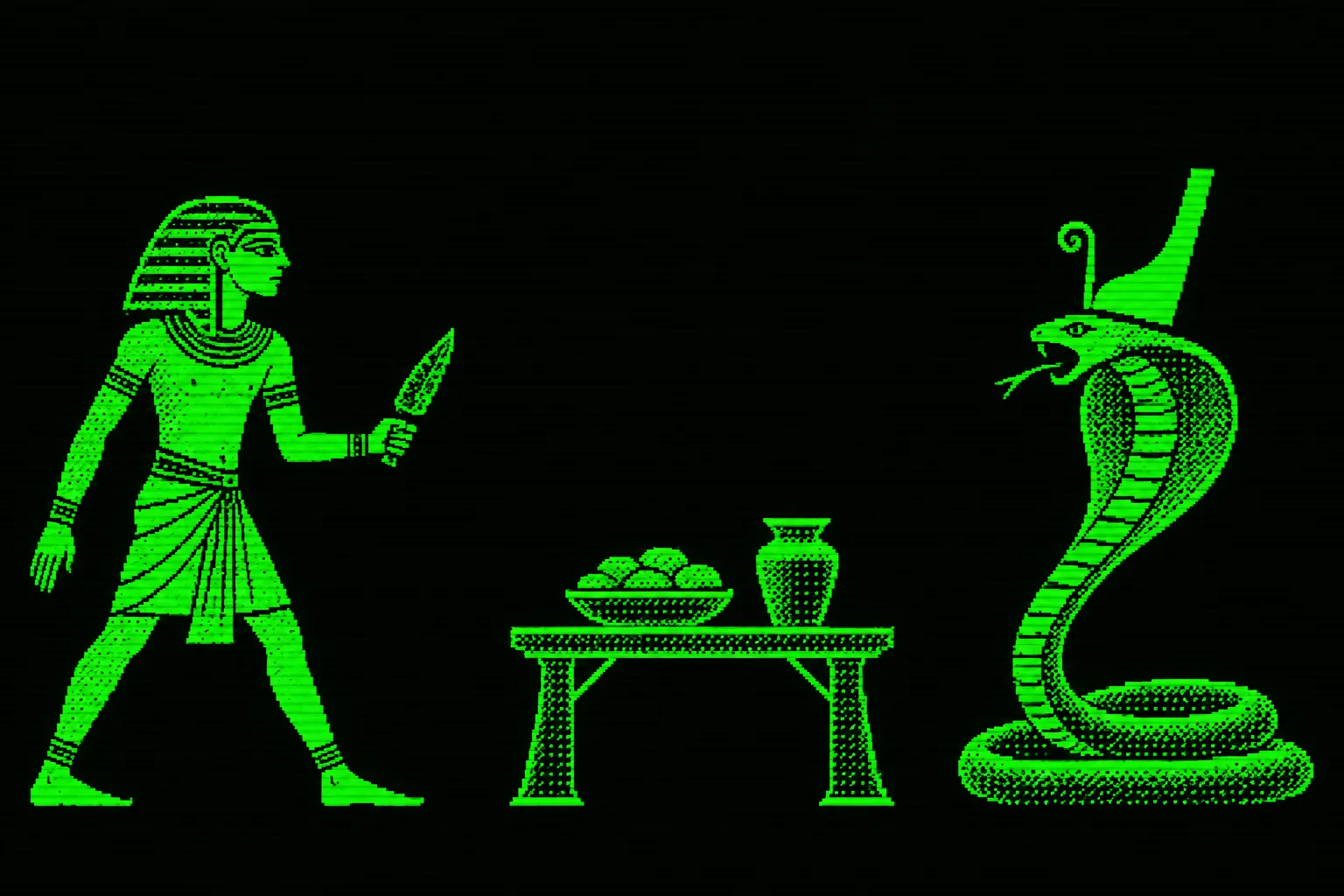
A man buried the day before speaks. Yesterday I died. Today I have come. He names himself: lord of the Wereret crown, the third of Nehebkau, lord of red blood on the day of transformations, lord of knives, even the scribe of the fluid that seeps from the corpse. He orders the gatekeeper of the Great Blow to make way and goes out by day against his enemy.
The enemy is handed to him in the court of Osiris: He is wholly beneath me in the court. Then he eats him: May I eat him in the Great Field, on Wadjet’s offering table. He ends as master of the gods: The form of every god is mine. They pass in procession behind me.
- 1
rʾ n šmi̯.t m sf jy.t m pꜣ-hrw dbḥ =f sw m-ꜥ ꜥ,t.pl =f
Spell for going yesterday and coming today, as he claims himself from his own limbs.
Note · Line 1
The spell is for Nu, the man for whom this papyrus was made. His limbs are the parts from which he is to be made whole again. - 2
ḏd-mdw jn [...]
Words to be spoken by …:
- 3
rḏi̯.w sṯ(ꜣ) m sf
Yesterday the dragging was ordered.
Note · Line 3
The dead were drawn to the tomb on a sledge. The man carried to burial yesterday now speaks for himself. - 4
jy.n =j mjn
Today I have come.
- 5
pri̯ =j m qmꜣ,w
I come forth from the Creator.
- 6
jnk sps pri̯ m jꜣ(ꜣ),t =f
I am the one pulled by the hair, who came forth from his iat-tree.
- 7
jnk nwn pri̯ m sḫm =f
I am the tousled one who came forth from his scepter of power.
Note · Line 7
The scepter’s Egyptian name, sekhem, is also the word the speaker uses when he claims power over his enemy. - 8
jnk nb wrr,t ḫmt-nw n Nḥb(,w)-kꜣ,w
I am lord of the Wereret crown, the third of Nehebkau.
Note · Line 8
Wereret means “the Great One,” a name for the crown of Upper Egypt. Nehebkau is a serpent god. - 9
jnk dšr nḏ.n jr,t =f
I am the Red One whom his own Eye has protected.
Note · Line 9
A god’s Eye can act in its own right as his defender. - 10
mt.n =j m sf
Yesterday I died.
- 11
jy.n =j mjn
Today I have come.
- 12
jri̯ n =j wꜣ,t jr,j-ꜥꜣ n ḥwi̯,t wr.t
Make way for me, gatekeeper of the Great Blow!
- 13
pri̯ =j m hrw r ḫftj{.pl} =j
I go forth by day against my enemy.
- 14
sḫm =j jm =f
I hold him in my power.
- 15
jw =f rḏi̯ n =j
He has been given to me.
- 16
n nḥm.tw =f m-ꜥ =j
He has not been taken from me.
- 17
jw =f km(.w) ẖr =j m ḏꜣḏꜣ,t Wsjr m ḥbs =f
He is wholly beneath me in the court of Osiris at his robing.
- 18
jsṯ ḫnt,j-jmn,tjw m rḏi̯ tp.pl
For the Foremost of the Westerners is the giver of heads.
Note · Line 18
The Westerners are the dead, whose realm lies in the west. Osiris, as their ruler, is called the Foremost of the Westerners. - 19
jnk ⸢nb⸣ dšr,w m hrw ḫpr,w.pl
I am lord of red blood on the day of transformations.
- 20
jnk nb ds.w
I am lord of knives.
- 21
n ꜥwꜣi̯ =j
I shall not be carried off.
- 22
jri̯ n =j wꜣ,t
Make way for me!
- 23
jnk zẖꜣ,w jꜣꜣ,t
I am the scribe of the fluid that seeps from the corpse.
Note · Line 23
The Egyptian word for this fluid echoes the name of the iat-tree earlier in the spell. - 24
jm,j bn{r}j.w,t jni̯ ḫr,t dšr,t ꜥꜣ.t
You in the date palm, bring what the great Red Crown needs!
Note · Line 24
The Red Crown is the crown of Lower Egypt, in the north. Here the crown itself has the power to send the dead man forth. - 25
rḏi̯.n dšr,t ꜥꜣ.t pri̯.y =j m hrw r ḫftj{.pl} =j pf
The great Red Crown has sent me forth by day against that enemy of mine.
- 26
jnt! =j sw
May I fetch him!
- 27
sḫm =j jm =f
May I hold him in my power!
- 28
jw =f rḏi̯(.w) n =j
He has been given to me.
- 29
nn nḥm.tw =f m-ꜥ =j
He shall not be taken from me.
- 30
jw =f km(.w) ẖr =j m ḏꜣḏꜣ,t
He is wholly beneath me in the court.
- 31
wnm =j sw m sḫ,t-ꜥꜣ,t ḥr ḫꜣw,t WꜢḏ,yt
May I eat him in the Great Field, on Wadjet’s offering table.
Note · Line 31
Wadjet is the cobra goddess who guards Lower Egypt. - 32
sḫm =j jm =f m Sḫm,t ꜥꜣ.t
May I wield power over him as Sekhmet the Great.
Note · Line 32
Sekhmet is a lioness goddess. Her name means “the Powerful One.” - 33
jnk nb ḫpr,w
I am lord of forms.
Note · Line 33
The dead could take on other shapes; here the speaker claims that power. - 34
nnk ḫpr,w n nṯr nb
The form of every god is mine.
- 35
pẖr =sn ⸢m-ḫt⸣ =j
They pass in procession behind me.