~/sacred-texts/book-of-the-dead
Book of the Dead Spell 177: You Are the Black Ram
- Text
- Book of the Dead, Spell 177
- Date
- Copied in the 18th Dynasty (about 1400 BC) on the papyrus of the scribe Nebseni; the words go back to Pyramid Texts spells 245–246, first carved for King Unas about 2350 BC
- Found
- Found in the Memphite necropolis at Saqqara; now in the British Museum, London (EA 9900)
- Language
- Egyptian (Middle Egyptian) · Hieroglyphic
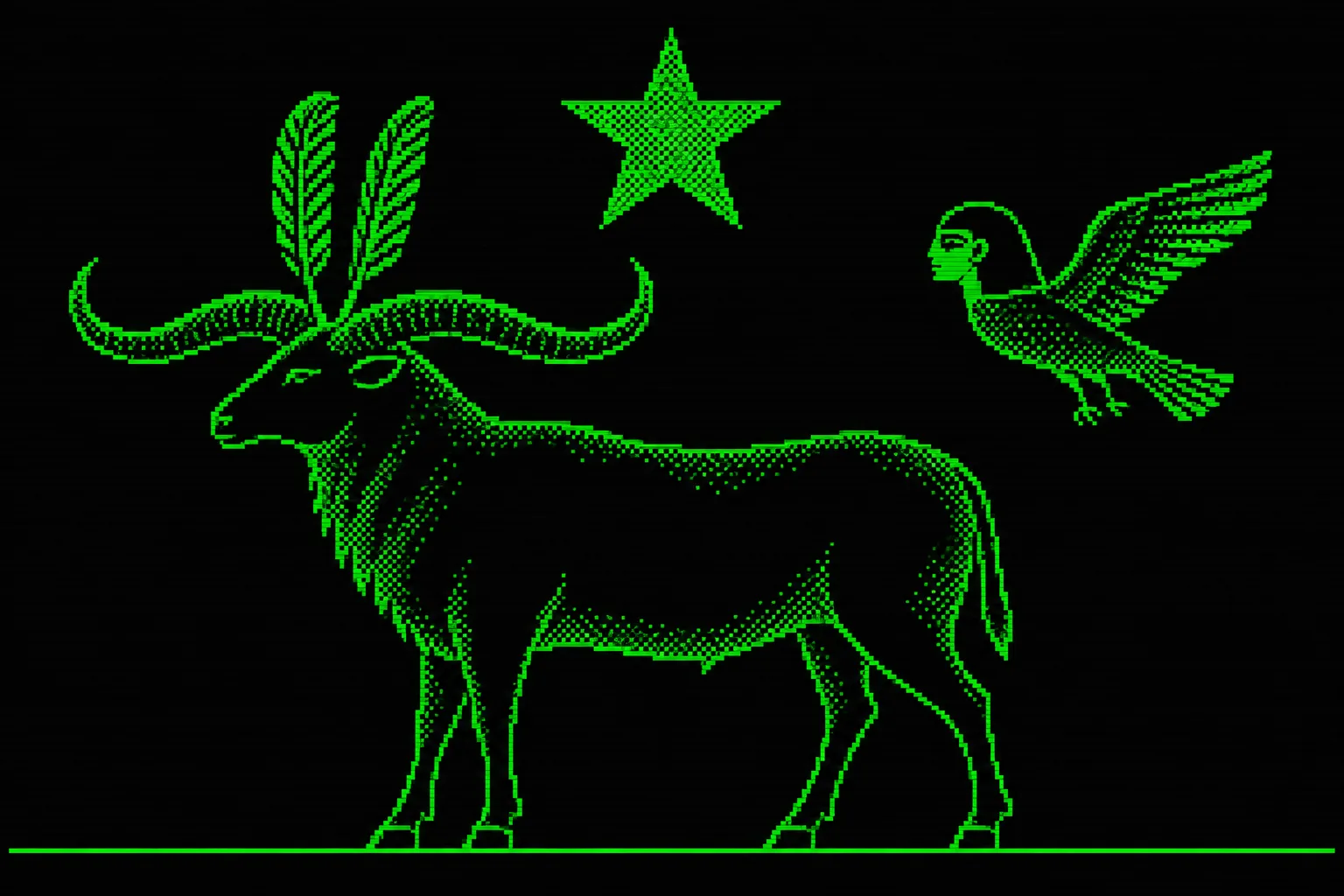
The dead man speaks first and calls on the sky goddess: Nut, Nut! She has cast the father down upon his own ground. He rises as a falcon, and His place lies open to him among the stars of this sky. Then a voice addresses him directly: You are indeed a divine power. You will not go hungry. He is the black ram, suckled by four wap-ewes.
Horus arrives twice, first with his two eyes lapis-blue, then with his two eyes red, his might a torment. Messengers run to the West, the Ennead greets him, and the doors of the horizon-dwellers open. The spell ends on a promise: Your head will not perish. You will not be destroyed.
- 1
rʾ n sṯz ꜣḫ sꜥnḫ bꜣ m ẖr-nṯr
Spell for raising the akh and bringing the ba to life in the realm of the dead.
Note · Line 1
The akh is the transfigured spirit of the dead person. The ba is the aspect of that person that can leave the tomb and return. - 2
[...] [mꜣꜥ-ḫrw] nb-jmꜣḫ m ḥz,wt nṯr =f ḏd =f
…, vindicated, held in honor and in favor with his god, says:
Note · Line 2
“Vindicated” is the verdict of divine judgment: the deceased has been found in the right. - 3
Nw,t zp-2 qmꜣ.n =s jti̯ r tꜣ ⸢=f⸣
Nut, Nut! She has cast the father down upon his own ground.
Note · Line 3
Nut is the sky goddess, mother of Osiris and grandmother of Horus. - 4
Ḥr,w m-ḫt =f
Horus is behind him.
- 5
rd [...] m bjk šw,t.j =fj m gmḥs,w
… grows as a falcon,
his two plumes those of a gemehsu falcon.Note · Line 5
Gemehsu is the Egyptian name of a bird of prey. - 6
jni̯.n sw bꜣ =f
His ba has brought him.
- 7
ḥtm.n sw mdw [...]
The word … has equipped him.
- 8
wpi̯.w n =f s,t =f m-ꜥbw sbꜣ.pl jr(,j).w p,t tn twt js n sbꜣ wꜥ,tj
His place lies open to him among the stars of this sky,
just as it does to the Lone Star. - 9
⸢mꜣ⸣ =k [...] nb-jmꜣḫ
May you see …, the honored one!
- 10
nfr wḏ-md,t =f n ꜣḫ.w
Good is what he decrees for the akhs.
- 11
ṯwt js sḫm
You are indeed a divine power.
- 12
nn ḥqr ⸢=k⸣
You will not go hungry.
- 13
⸢nn⸣ ⸢ṯw⸣ jm =sn
You are not among them.
- 14
nn wnn =k jm =sn
You will not be among them.
- 15
mꜣ =k ḥr tp [...] m bꜣ
May you look upon the head of … as a ba.
- 16
ꜥb.du =f m smꜣ
His two horns are those of a wild bull.
- 17
ṯwt zr km msi̯.w zr,t b(ꜣ)q.t snq{.t} m zr,t 4 wꜣyp.w
You are the black ram,
born of the bright ewe,
suckled by four wap-ewes.Note · Line 17
Wap is the name given here to the sheep that nurse the ram. - 18
jy n =ṯn ⸢Ḥr,w⸣ ḫsbḏ jr,t.du
Horus comes to you, his two eyes lapis-blue.
Note · Line 18
The spell turns here from addressing a single listener to addressing several. - 19
zꜣu̯ n =ṯ〈n〉 Ḥr,w dšr jr,t.du mr ꜣ,t
Beware of Horus, his two eyes red, his might a torment.
- 20
sḥs =f bꜣ =f
He afflicts his ba.
- 21
zbi̯.w jn,w.pl =f
His messengers have been sent out.
- 22
bṯ{t} sjn.pl =f
His couriers run.
- 23
jwi̯ =sn n ⸮rmn? ḥr(,j)-tp jmn,t šm,t wꜥ pn jm =k
They reach the upper shoulder of the West on the errand of this one, who is you.
Note · Line 23
The West, where the sun sets, is the land of the dead. - 24
ḏd =tw md,t-nṯr =k {sḫ,t.j}〈jti̯.pl〉 nṯr.pl
Your divine words are spoken to the fathers of the gods.
- 25
jri̯.w rn =k m mꜣꜥ-ḫrw m-bꜣḥ-ꜥ nṯr.pl
Your name is established in triumph before the gods.
- 26
ḏsr n =k psḏ,t ꜥ.du =sn
The Ennead raise both arms to you.
Note · Line 26
The Ennead is the company of nine gods. - 27
ḏd nṯr {sḫ,t.j}〈jti̯.pl〉 nṯr.pl
The god speaks to the fathers of the gods:
- 28
ꜥḥꜥ jr =k r ꜥꜣ{kꜣ}.pl ꜣḫ,tj.w =sn
Stand, then, at the doors of their horizon-dwellers!
- 29
zn n =k ꜥꜣ.du =sn
Both leaves of their door open for you.
- 30
ḥzi̯ =sn ṯw
They praise you.
- 31
sḫm =k ḫnt =sn
May you be mighty at their head!
- 32
nṯr [...]
The god …
- 33
pri̯ =sn
They come forth.
- 34
fꜣi̯ =sn ḥr.pl =sn
They lift their faces.
- 35
mꜣ =sn sw m-bꜣḥ nṯr-ꜥꜣ Mn,w [...] tp =k zp-2
May they see him before the great god Min. … your head (twice).
Note · Line 35
Min is a god of fertility. “Twice” is a direction to repeat the words in recitation. - 36
ꜥḥꜥ.n =j k [ḥꜣ] =k
I have taken my stand behind you.
- 37
sḫm =k ⸮sk? ⸮tp? =⸮f? ⸮ḥꜣ? =⸮k?
You are mighty. His head perishes behind you.
- 38
⸮n? ⸮sk? ⸮tp? =⸮k?
Your head will not perish.
Note · Line 38
In Egyptian funerary belief, keeping the head joined to the body helped ensure that the dead could live again. - 39
n ḥtm =k
You will not be destroyed.
- 40
jri̯.t =k ḫr r(m)ṯ[.pl] ḫr nṯr.pl
Your deeds are among mortals and among the gods.