~/sacred-texts/book-of-the-dead
Book of the Dead Spell 174: Conceived by Sekhmet, Born a Star
- Text
- Book of the Dead, Spell 174
- Date
- Copied in the 18th Dynasty, in the reign of Thutmose IV (about 1400–1390 BC), in cursive hieroglyphs on the funerary papyrus of Neferubenef. The words are a thousand years older: they come from the Pyramid Texts of King Unas (Utterances 247–250).
- Found
- Now in the Musée du Louvre, Paris (N 3092)
- Language
- Egyptian (Middle Egyptian) · Hieroglyphic
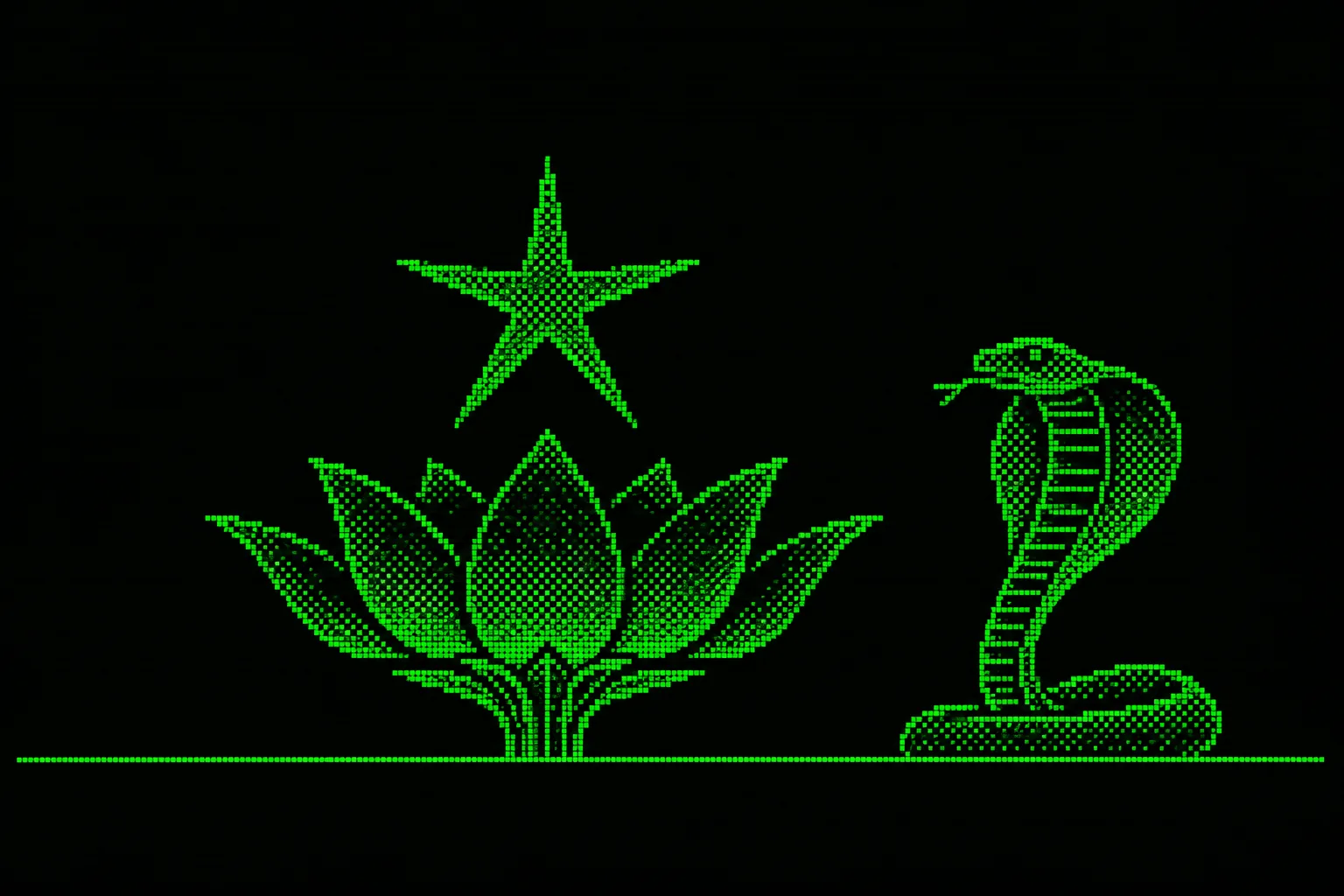
The dead man, named as an Osiris, speaks. He first hails Osiris, who comes out of the Duat armed: The great ones tremble when they see the knife in your hand. Then he claims his own birth as a god: I was conceived by Sekhmet, by Shesmetet. Mine is the birth of a star, sharp of brow and long of stride.
He takes his seat before the vulture and cobra goddesses and tends the cobra on the god’s brow: I am the keeper of the uraeus’s linen on this night of the Great Flood. He becomes the lotus at Ra’s nose, and at last Sia, god of perception: I have become Sia, bearer of the god’s scroll at Ra’s right hand.
- 1
ḏd-mdw jn Wsjr [...] mꜣꜥ-ḫrw
Words to be spoken by the Osiris …, true of voice:
Note · Line 1
The deceased takes the name of Osiris in the hope of sharing his return to life. “True of voice” means vindicated before the divine court. - 2
hꜣ Wsjr zꜣ =k
O Osiris, your son …!
- 3
sd(ꜣ){w} wr.pl
The great ones tremble
- 4
mꜣꜣ =sn šꜥ,t jm,j.t ꜥ =k
when they see the knife in your hand
- 5
pri̯ =k m dwꜣ(,t)
as you come forth from the Duat.
Note · Line 5
The Duat is the realm of the dead, through which the sun passes at night. - 6
j:nḏ-ḥr =k sꜣꜣ
Hail to you, wise one!
- 7
qmꜣ.n ṯ{t}w Gbb
Geb fashioned you.
Note · Line 7
Geb, the earth god, and Nut, the sky goddess, are the parents of Osiris. - 8
msi̯.n ṯw Nw,t
Nut bore you.
- 9
psḏ,t ḥtp.tj
The Ennead is content.
Note · Line 9
The Ennead is the company of nine gods of Heliopolis. - 10
ḥtp Ḥr,w ḥr jr,t =f
Horus is content with his eye.
Note · Line 10
Horus’s eye was injured in his struggle with Seth and made whole again. - 11
ḥtp Jtm,w ḥr rnp,t.pl =f
Atum is content with his years.
- 12
nṯr.pl jꜣb(,t) jmn(,t) ḥr wr(,t) ḫpr.t m-ẖnw-ꜥ ms,wt-nṯr,pl ms,wt-nṯr =j
The gods of east and west are content with the great thing that came to pass amid the births of the gods: my own birth as a god.
- 13
mꜣꜣ =j ptr =j wnn =j jm
May I see, may I behold, may I be there.
- 14
ṯzi̯ =j ḥr gs
May I raise myself onto my side.
- 15
jri̯ =j wḏ msḏḏ! {j}〈qd〉d sbꜣg{r}i̯.y jm,j Nḏd,t
May I do the bidding of him who hates sleep, the one made weary, who dwells in Nedit.
Note · Line 15
Nedit is where Osiris fell. The weary one is Osiris himself, and the sleep he hates is death. - 16
jri̯ tʾ (=j) m Pi̯
My bread is made in Pe.
Note · Line 16
Pe was one of the two settlements that made up Buto in the Nile Delta. It was sacred to Horus. - 17
šzp =j ḫm =j m Jwn,w
May I receive my shrine in Heliopolis.
- 18
Ḥr,w pw
This is Horus.
- 19
wḏ.n =f jri̯.t n jti̯ qr sꜣḥ js
He has given the order to act for the father of the storm cloud, as for Orion.
Note · Line 19
Osiris is identified in the night sky with the constellation Orion. - 20
Stš wṯz ṯw
Seth, raise yourself!
- 21
sṯz Jtm,w
Raise Atum!
- 22
mdw.pl =j ꜥꜣ(.w)
My words are great.
- 23
pri̯ =j r-jm,j-(w)t(j) mn,t.j psḏ,t
May I come forth between the two thighs of the Ennead.
Note · Line 23
Here the Ennead takes the part of Nut, the sky mother: the dead speaker is asking to be born among the stars. - 24
jwr =j jn Sḫm,t jn Šzm,tt
I was conceived by Sekhmet, by Shesmetet.
Note · Line 24
Sekhmet and Shesmetet are both lioness goddesses. - 25
ms,wt =j sbꜣ spd ḥꜣ,t ꜣwi̯ šm,t
Mine is the birth of a star, sharp of brow and long of stride.
- 26
jni̯ =j ḫr,t ḥr,t n Rꜥ,w rꜥ,w-nb
May I bring the provisions of heaven to Ra each day.
- 27
jy.n =j r s,t =j tp Nb,tdu
I have come to my place at the head of the Two Ladies.
Note · Line 27
The Two Ladies are Nekhbet the vulture and Wadjet the cobra, protectors of Upper and Lower Egypt. - 28
ḫꜥi̯ =j m sbꜣ
May I rise as a star.
- 29
mdw.pl =j ⸮jꜣ,w? ḏd my zp =s jm
My words: Iau, who says, “What part has she in this?”
- 30
jnk nw zššn jꜣḫ m tꜣ
I am this lotus that shines from the earth.
Note · Line 30
The lotus opens at daybreak. Its flower is an image of the newborn sun. - 31
wꜥb =j šzp =j jn jri̯ s,t =j r šr,t {s}sḫm-wr
He who made my place has purified me and held me to the nose of the Great Power.
- 32
jy.n =j m jw-nsjsj
I have come from the Isle of Flame.
Note · Line 32
The isle is a place in the underworld. - 33
(w)di̯.n =j mꜣꜥ,t m s,t jzf,t
I have set right in place of wrong.
Note · Line 33
Right here is Maat: truth and justice, the order that keeps the world in being. - 34
jnk jr,j sšr,w jr,j jrꜥ,t grḥ pw n (ꜣ)gbi̯-wr
I am the keeper of the uraeus’s linen on this night of the Great Flood.
Note · Line 34
The uraeus is the rearing cobra worn on the brow of a god or king for protection. - 35
ḫꜥi̯ =j m Nfr-tm zššn r šr,t Rꜥ,w
May I rise as Nefertem, the lotus at Ra’s nose.
Note · Line 35
Nefertem embodies the fragrant lotus that opens in the morning. The dead man asks to become the flower whose scent Ra breathes in. - 36
pri̯ =f m ꜣḫ,t rꜥ,w-nb
May he come forth from the horizon each day.
- 37
{jri̯=f}〈Wsjr〉 [...] mꜣꜥ-ḫrw ḥr,j kꜣ.pl dmḏ m jb.pl ḥr,j sꜣꜣ.t wr ẖr,j mḏꜣ,t nṯr Sjꜣ {jmn}〈jm,j〉-wr,t.j Rꜥ,w
The Osiris …, vindicated, is chief of the kas, one who joins with hearts, great master of wisdom, bearer of the god’s scroll: Sia at Ra’s starboard side.
Note · Line 37
The dead man takes the name of Osiris, god of the dead. The kas are the vital powers of individuals. Ra travels in a boat, hence “starboard.” - 38
jy.n =j ḥr s,t =j ḥr,j kꜣ.pl m dmḏ jb.pl ḥr,j sꜣꜣ.t wr.t
I have come to my place as chief of the kas, gathering hearts, as master of great wisdom.
- 39
ḫpr =j m Sjꜣ ẖr,j mḏꜣ,t nṯr wnm,t(j) Rꜥ,w
I have become Sia, bearer of the god’s scroll at Ra’s right hand.
Note · Line 39
Sia is the god who embodies perception and understanding. - 40
⸮ḏdm? =j
May I pierce!
- 41
ḏd jm,j.t jb wr m ḥꜣb jns,j
Speak what is in the Great One’s heart at the Feast of Red Linen.
- 42
jnk Sjꜣ wnm,t(j) Rꜥ,w snkn jb ḫnt,j ṯpḥ,t Nw,w
I am Sia at Ra’s right hand, the one who wounds the heart and presides over the cavern of Nun.
Note · Line 42
Nun is the god of the primeval waters from which the world arose.