~/sacred-texts/book-of-the-dead
Book of the Dead Spell 17: I Am Yesterday, I Know Tomorrow
- Text
- Book of the Dead, Spell 17
- Date
- Composed by about 2000 BC as Coffin Texts spell 335; this text follows seven funerary papyri copied between the Third Intermediate Period and Roman times (about 1070 BC to AD 100)
- Language
- Egyptian · Hieratic
The dead person speaks as the creator: I am Atum as I was then, alone in the primeval waters. After each claim a voice asks Who, then, is he? and a gloss answers, often with rival readings. I am Yesterday. I know Tomorrow. Yesterday is Osiris; Tomorrow is Ra.
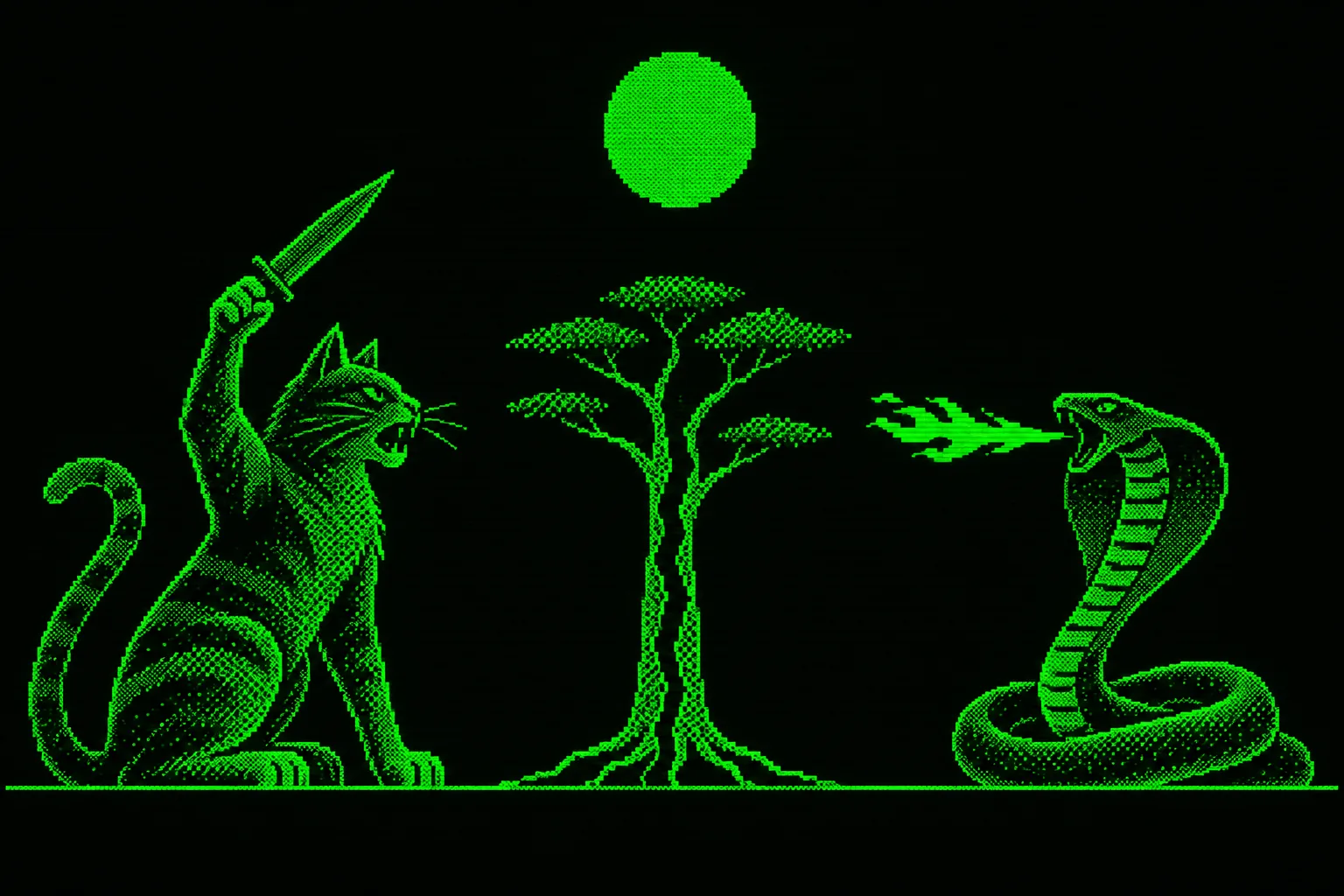
The glosses tell the myths. The gods before Ra are the blood that dripped from Ra’s penis after he began to cut himself. Horus tore off both of Seth’s testicles, and Thoth filled the Wedjat Eye with his own fingers. The speaker is the great tomcat who splits the ished tree, begs rescue from butcher gods, and swears: I shall not fall into their cauldron.
- 1
rʾ.pl n.w sṯz,w.pl sꜣḫ,w.pl pri̯(.t) h(ꜣi̯.t) m ẖr,t-nṯr wn(n) m šms,w n Wsjr ḥtp m šb,w Wnn-nfr(,w) mꜣꜥ-ḫrw pri̯(.t) m hrw jri̯(.t)-ḫpr,w.pl nb n mr,wt =f ḫpr jm =f ḥꜥb.y znj,t wn(n) m zḥ bꜣ ꜥnḫ Wsjr [...] mꜣꜥ-ḫrw jmꜣḫ,w ḫr psḏ,t-ꜥꜣ,t jm,j(.t) jmn,tt m-ḫt mnj.t =f
Spells of raising up and transfiguration for the Osiris …, vindicated, honored before the Great Ennead in the West after he has come to moor: to go out from the realm of the dead and descend into it, to be in the retinue of Osiris, to have his fill of the meal of Wennefer, vindicated, to go forth by day, to take whatever form he wishes to take, to play senet and to be in the tent as a living ba.
Note · Line 1
Coming to moor is an image of dying. - 2
jw ꜣḫ{,w} n jri̯ s(j) tp tꜣ
It avails the one who has performed it on earth.
- 3
ḫpr md,t tmm
What humankind says comes to pass.
- 4
ḏd-mdw jn Wsjr [...] mꜣꜥ-ḫrw
Words to be spoken by the Osiris …, vindicated:
Note · Line 4
The dead person bears the name of Osiris. “Vindicated” means that the speaker has been found in the right before the divine tribunal. - 5
jnk Jtm,w m wnn =j wꜥi̯.〈k〉w m nw,w
I am Atum as I was then, alone in the primeval waters.
- 6
jnk Rꜥ,w m ḫꜥi̯(.t) =f šꜣꜥ ḥqꜣ =f jri̯.n =f
I am Ra at his rising, when he began to rule what he had made.
- 7
ptr rf sw
Who, then, is he?
Note · Line 7
The spell unfolds in questions and answers that name the gods behind the speaker’s declarations. - 8
Rꜥ,w pw m ḫꜥi̯ =f m šꜣꜥ ḥqꜣ =f jri̯.n =f
It is Ra as he rose, when he began to rule what he had made.
- 9
šꜣꜥ Rꜥ,w pw ḫꜥi̯ m Ḥw,t-Nn-nsw,t m wnn
This was Ra’s beginning, when he rose in Heracleopolis as one who exists.
- 10
ḫpr sṯz Nw,w
Then came the raising of Nun.
Note · Line 10
Nun is the primeval water in the person of a god. - 11
jw =f ḥr qꜣꜣ jm,j-Ḫmn,w
He was on the mound in Hermopolis.
Note · Line 11
Ra stands on the first dry ground to emerge from the waters. - 12
ḥtm.n =f ms.pl-bdš.pl ḥr qꜣꜣ jm,j-Ḫmn,w
He destroyed the children of the weary ones on the mound in Hermopolis.
Note · Line 12
These enemies of the sun god often take the form of snakes. - 13
jnk nṯr-ꜥꜣ ḫpr ḏs =f
I am the great god who came into being of himself.
- 14
mw pw
It is the water.
- 15
Nw,w pw jti̯ nṯr.pl
It is Nun, father of the gods.
- 16
ptr rf sw
Who, then, is he?
- 17
Rꜥ,w pw qmꜣ ḥꜥ =f
It is Ra, who fashioned his own body.
- 18
ḫpr nn n nṯr.pl jm,j.w-ḫt Rꜥ,w
These gods who follow Ra came into being.
- 19
jnk jw,tj ḫsf =f m nṯr.pl
I am the one who is not turned back among the gods.
- 20
ptr rf sw
Who, then, is he?
- 21
Jtm,w m jtn =f
Atum in his sun disk.
- 22
ky-ḏd Rꜥ,w pw jm,j-jtn≡f wbn =f m ꜣḫ,t jꜣb,t(j).t n.t p,t
Another reading: It is Ra in his sun disk as he rises on the eastern horizon of the sky.
- 23
jnk sf
I am Yesterday.
- 24
jw =j rḫ.kw dwꜣ,w
I know Tomorrow.
- 25
ptr rf sw
Who, then, is he?
- 26
jr sf Wsjr pw
As for Yesterday, it is Osiris.
- 27
jr dwꜣ,w Rꜥ,w pw hrw pfy n ḥtm{.t} sbj(.pl) n.w nb-(r-)ḏr jm =f ḥnꜥ sjp{.t}.ntw =f zꜣ =f Ḥr,w
As for Tomorrow, it is Ra, on that day when the rebels against the Lord of All are destroyed and his son Horus has been judged.
Note · Line 27
Horus, the son of Osiris, claimed his father’s throne. The gods judged his claim against that of Seth. - 28
ky-ḏd hrw p(w) n jw≡n-mn
Another reading: It is the day of the feast of “We Endure.”
- 29
dhn =f q{r}js(,t) pw n.t Wsjr jn jti̯ =f Rꜥ,w
It was his father Ra who ordained the burial of Osiris.
- 30
jri̯ n =f ꜥḥꜣ-ꜥ nṯr.pl ḫft wḏ,t =f Wsjr nb ḏw jmn,tt
The gods’ battleground was made for him at his command, the command of Osiris, lord of the mountain of the West.
- 31
ptr rf sw
Who, then, is this?
Note · Line 31
The spell sets questions and answers alongside the words the deceased speaks. Sometimes it preserves more than one answer. - 32
jmn,tt pw jri̯.tn{tw} =sn bꜣ.pl nṯr.pl ḫft wḏ,t =f Wsjr nb ḏw jmn,tt
It is the West, which the bas of the gods made at the command of Osiris, lord of the western mountain.
Note · Line 32
The West, where the sun sets, is the realm of the dead. A ba is the power of a god or a person to take form and act. - 33
ky-ḏd jmn,tt pw
Another reading: It is the West.
- 34
nw pw rḏi̯.n Rꜥ,w hꜣi̯ nṯr nb r =s
It was there that Ra made every god descend.
- 35
ꜥḥꜥ,n ꜥḥꜣ.n =f ḥr =s
Then he fought over it.
- 36
jw =j rḫ.kw nṯr pwy ꜥꜣ n,tj jm =s
I know that great god who is there.
- 37
ptr rf sw
Who, then, is this?
- 38
Wsjr pw
It is Osiris.
- 39
ky-ḏd ḥkn,w pw n Rꜥ,w rn =f
Another reading: His name is “He Who Rejoices for Ra.”
- 40
bꜣ pw n Rꜥ,w rn =f
His name is “Ba of Ra.”
- 41
nk =f jm =f ḏs =f
He mates with himself.
Note · Line 41
The image is of a god who can beget life without a partner. - 42
jnk bn,w pwy ꜥꜣ n,tj m Jwn,w
I am that great Bennu bird in Heliopolis.
Note · Line 42
The Bennu was a sacred heron associated with the rising sun at Heliopolis, a center of Ra’s worship. - 43
jnk sjp n n,tj wnn{.tj}
I am the examiner of him who is.
- 44
ptr rf sw
Who, then, is this?
- 45
jr bn,w Wsjr pw n,tj m Jwn,w
As for the Bennu, he is Osiris in Heliopolis.
- 46
jr sjp n n,tj wnn{,t} ẖꜣ,t =f pw
As for the examiner of him who is, that is his corpse.
- 47
ky-ḏd nḥḥ pw ḥnꜥ ḏ,t
Another reading: They are eternity ever renewed and eternity ever abiding.
Note · Line 47
Egyptian distinguishes time that renews itself, as the sun does each morning, from time that endures without change. - 48
jr nḥḥ hrw pw
Eternity ever renewed is day;
- 49
jr ḏ,t grḥ
eternity ever abiding is night.
- 50
jnk Mn,w m pr,t{j} =f
I am Min as he goes forth in procession.
Note · Line 50
Min is a god of fertility, shown wearing two tall plumes. - 51
jw rḏi̯ n =f šw,t.du =f m tp =f
His two plumes are set upon his head for him.
- 52
ptr rf sw
Who, then, is this?
- 53
jr Mn,w Ḥr,w pw nḏ-ḥr-jti̯≡f Wsjr
As for Min, he is Horus, protector of his father Osiris.
- 54
jr pr,w =f ms,wt =f pw
His going forth is his birth.
- 55
jr šw,t.du =f m tp =f šmi̯ ꜣs,t ḥnꜥ Nb,t-ḥw,t
As for the two plumes on his head, Isis went with Nephthys.
- 56
rḏi̯.n =sn ḥꜣ =f m wnn =sn m ḏr,t.du
They took their places around him in the form of the two kites.
Note · Line 56
Kites are birds of prey. In mourning for Osiris, the sisters Isis and Nephthys take their form. - 57
js s{w}〈n〉 ḥr mn m tp =f
And there they remain, on his head.
- 58
ky-ḏd ꜥrꜥ,t.du pw wr.pl ꜥꜣ.pl jm,j(.t) ḥꜣ,t jti̯ =f Jtm,w
Another reading: They are the two great and mighty uraei on the brow of his father Atum.
Note · Line 58
A uraeus is a rearing cobra worn on the brow of a god or king for protection. - 59
ky-ḏd jr,t.du =f pw šw,t.du =f m tp =f
Another reading: His two plumes on his head are his two eyes.
- 60
wnn =j m tꜣ
I am in the earth.
- 61
jy.n =j m nʾ,t
I have come from the city.
- 62
ptr rf sw
What is this, then?
Note · Line 62
The spell carries its own commentary: this question introduces an explanation of the words just spoken. - 63
ꜣḫ,t pw n(.t) jti̯ =f Jtm,w
It is the horizon of his father Atum.
Note · Line 63
Atum is the creator god of Heliopolis. - 64
jw ḫsr ḏw
Evil has been driven out.
- 65
ptr rf sw
What is this, then?
- 66
šꜥd =tw šptj pw Wsjr [...] mꜣꜥ-ḫrw
It means that the umbilical cord of Osiris …, the vindicated one, is cut.
Note · Line 66
The title “Osiris” identifies the dead person with the god. “Vindicated” declares that the judgment of the dead has gone in his favor. - 67
sḥrj.w ḏw nb jr,j =(j)
All the evil in me has been cleared away.
- 68
ptr rf sw
What is this, then?
- 69
wꜥb Wsjr [...] mꜣꜥ-ḫrw hrw ms,wt =f m zš wr{.t} ꜥꜣ{.t} n,tj m Nn-nsw,t hrw ꜥb,w rḫ,yt n nṯr pwy ꜥꜣ n,tj jm =s
On the day of his birth, Osiris …, the vindicated one, is purified in the vast pool at Heracleopolis, on the day the people are purified for that great god who is there.
Note · Line 69
The cutting of the cord and the washing of the newborn give bodily form to the dead person’s rebirth. - 70
ptr rf sw
What is this, then?
- 71
sšmi̯ ḥḥ.pl rn n wꜥ,w
“Guide of Millions” is the name of one.
Note · Line 71
The explanation names two bodies of water, though the spell has spoken of only one pool. - 72
wꜣḏ-wr rn n ky
“Great Green” is the name of the other.
Note · Line 72
The Great Green is an Egyptian name for the sea. - 73
š pw n ḥzmn ḥnꜥ š pw n mꜥꜣ
One is the Lake of Natron, the other the Lake of mꜥꜣ.
Note · Line 73
Natron is a mineral salt used in ritual cleansing. The substance called mꜥꜣ has not been identified. - 74
ky-ḏd wtṯ ḥḥ.pl rn n wꜥ,w
Another reading: “Semen of Millions” is the name of one.
- 75
wꜣḏ-wr rn n ky
“Great Green” is the name of the other.
- 76
jr gr nṯr pfy ꜥꜣ n,tj jm =s Rꜥ,w pw ḏs =f
As for that great god who is there, he is Ra himself.
- 77
šmi̯ =(j) ḥr wꜣ,t rḫ.(t)n =j tp-n š mꜣꜥ(,t)du
I walk the road I know toward Lake Maati.
Note · Line 77
Maati is a dual form: the name evokes the two Maats, personifications of truth and right order. - 78
ptr rf sw
What is this, then?
- 79
jr Rʾ-sṯꜣ,w sbꜣ pw rsj n N-jr≡f
Rosetau is the southern gate of Naref.
Note · Line 79
Rosetau is a name for the necropolis and for a region of the underworld. Naref was a sanctuary of Osiris near Heracleopolis. - 80
sbꜣ pw mḥ,t(j) jꜣ,t Wsjr
It is the northern gate of the mound of Osiris.
- 81
jr gꜣ š mꜣꜥ(,t)du ꜣbḏ,w pw
Lake Maati, in turn, is Abydos.
Note · Line 81
Abydos was revered as the burial place of Osiris. - 82
ky-ḏd wꜣ,t pw šmi̯ jti̯ =f Jtm,w ḥr =s ḫft wḏꜣ =f r sḫ,t-jꜣl
Another reading: It is the road his father Atum takes when he sets out for the Field of Reeds.
- 83
spr =(j) r tꜣ ꜣḫ,t
I reach the land of the horizon.
- 84
ꜥq =j m sbꜣ{,t} ḏsr,t
I enter through the gate of the Sacred Land.
Note · Line 84
The Sacred Land is the desert burial ground. - 85
ptr rf sw
What is this, then?
- 86
sḫ,t-jꜣl pw msi̯ ḏf(ꜣ) nṯr.pl ḥꜣ(,j.w) kꜣ{r}jw
It is the Field of Reeds, which brings forth food for the gods who surround the shrine.
- 87
jr sbꜣ{,t} ḏsr,t sbꜣ{,t} p{ft}w n sṯz(,w)-Šw
The gate of the Sacred Land is the gate of what Shu holds aloft.
Note · Line 87
Shu, god of the air, holds the sky goddess Nut above the earth. - 88
jr sbꜣ mḥ,t(j) sbꜣ pw n dꜣ,t
The northern gate is the gate of the Duat.
Note · Line 88
The Duat is the Egyptian underworld, through which the sun travels at night. - 89
ky-ḏd ꜥꜣ.du rʾ pw{y} n,t(j) wḏꜣ jti̯ =f Jtm,w ḥr =f ḫft wḏꜣ =f r ꜣḫ,t jꜣb,t(j).t n.t p,t
Another reading: These are the two leaves of the doorway through which his father Atum passes on his way to the eastern horizon of the sky.
- 90
jm,j.w-bꜣḥ jmi̯ n =j ꜥ.wj =ṯn
You who have gone before, stretch out both arms to me!
- 91
jnk pw ḫpr jm =ṯn
I am the one who came into being among you.
- 92
ptr rf sw
Who is that, then?
Note · Line 92
This recurring question introduces an explanation of the words just spoken. - 93
znf pw hꜣi̯ m ḥnn n Rꜥ,w m-ḫt wꜣi̯ =f r šꜥd =f ḏs =f
It is the blood that dripped from Ra’s penis after he began to cut himself.
- 94
ꜥḥꜥ〈,n〉 =w ḫpr(.w) m nṯr.pl jm,j.w-bꜣḥ Rꜥ,w pw
The drops, then, became the gods who stand before Ra.
- 95
Ḥw Sjꜣ pw wnn.w m-ḫt jti̯ =w Jtm,w m-ẖr(,t)-hrw n.t rꜥ,w-nb
They are Hu and Sia, who stand behind their father Atum, day after day, every day.
Note · Line 95
Hu is the spoken word and Sia is understanding: the creator’s powers of speech and perception take the form of gods. - 96
jw mḥ.n Wsjr [...] mꜣꜥ-ḫrw pn wḏꜣ,t m-ḫt hbi̯ =s hrw pwy n ꜥḥꜣ rḥ,wj
This Osiris …, vindicated, has filled the Wedjat Eye after it was trampled on that day of battle between the Two Companions.
Note · Line 96
The dead man is called Osiris to identify him with the god who rose from death. “Vindicated” declares that judgment has gone in his favor. - 97
ptr rf sw
Who is that, then?
- 98
hrw pfj n ꜥḥꜣ⸮{-r}〈ꜥ〉? Ḥr,w ḥnꜥ Stš m wdi̯ =f sṯꜣ,t n Ḥr,w m jṯi̯.n Ḥr,w ẖr,wdu n Stš
That was the day Horus and Seth fought, when Seth wounded Horus and Horus tore off both of Seth’s testicles.
- 99
jr gr Ḏḥwtj jri̯ nn m ḏbꜥ.pl =f ḏs =f
It was Thoth who did this with his own fingers.
Note · Line 99
Thoth’s deed was to fill the injured eye of Horus, making it whole again. Wedjat means “the whole one.” - 100
jw ṯzi̯.n Wsjr [...] mꜣꜥ-ḫrw šn(j) =f m wḏꜣ,t m tr n nš(n)j
Osiris …, vindicated, has lifted his hair out of the Wedjat Eye in the time of rage.
- 101
ptr rf sw
Who is that, then?
- 102
jr,t twy wnmi̯(.t) n.t Rꜥ,w m nšnj =s r =f m-ḫt h(ꜣ)b =f s{w}〈j〉
It is that right eye of Ra, raging against him after he had sent her forth.
Note · Line 102
Ra’s eye is also a goddess: he can send her out, and she can turn against him. - 103
jn gr Ḏḥwtj ṯzi̯ šn(j).pl =f jni̯ n =f s(j) ꜥnḫ-(w)ḏꜣ-s(nb)(.tj) nn b(ꜣ)gi̯ =s r nb =s
It was Thoth who lifted his locks and brought her back to Ra alive, whole and healthy, without her flagging in her service to her lord.
- 104
k(y)-ḏd wn(n).jn jr,t =f pw mr =s m wnn =s ḥr rmi̯(.t) sn,nw =s
Another reading: This means that his eye was aching then, as she wept for her fellow eye.
- 105
ꜥḥꜥ,n Ḏḥwtj ḥr pg{ꜣ}s =s
Then Thoth spat on her.
Note · Line 105
In Egyptian healing rites, spittle could be a remedy. - 106
jw mꜣꜣ.n Wsjr [...] mꜣꜥ-ḫrw pn Rꜥ,w pw msi̯ m sf r ḫpd.w n Mḥ(,t)-wr(,t)
This Osiris …, vindicated, has seen this Ra, born yesterday at the haunches of Mehet-Weret.
Note · Line 106
Mehet-Weret, whose name means “Great Flood,” is the cow goddess who gives birth to the sun. - 107
wḏꜣ Wsjr [...] mꜣꜥ-ḫrw wḏꜣ =f ṯz-pẖr
If Osiris …, vindicated, is whole, so is Ra. Recite also in reverse.
- 108
ptr rf sw
Who is that, then?
- 109
nw pw nwy n{.t} p,t
This is the flood of heaven.
- 110
ky-ḏd twt pw n jr,t-Rꜥ,w dꜣ,t msi̯.tw =f rꜥ,w-nb
Another reading: It is an image of the Eye of Ra of the underworld as he is born each day.
- 111
jr gr(,t) Mḥ(,t)-wr(,t) wḏꜣ,t pw n(.t) Rꜥ,w
As for Mehet-Weret, she is the Wedjat Eye of Ra.
- 112
ḥr-n,tj wꜥ,w m nn n nṯr.pl jm,j.w-ḫt Ḥr,w md{,t}wi̯ =f ḥr-tp mri̯,y nb =f
For one of these gods who stand behind Horus speaks for the one his lord loves.
- 113
ptr rf sw
Who is that, then?
- 114
Jms,tj Ḥpy Dwꜣ-mw,t≡f Qbḥ-sn,pl≡f
Imsety, Hapy, Duamutef and Qebehsenuef.
Note · Line 114
These are the four sons of Horus, protectors of the dead. - 115
j:nḏ-ḥr =ṯn nb.w-mꜣꜥ〈,t〉 ḏꜣḏꜣ,t ḥꜣ(,j.t) Wsjr ḏḏ! šꜥ{d}〈,t〉 m jzf,t(j).pl jm,j.w-ḫt Ḥtp≡s-ḫwi̯≡s
Hail to you, lords of Maat, tribunal gathered around Osiris, you who slaughter evildoers, you who stand behind Hetepeskhus!
Note · Line 115
Maat is truth and right order, the standard by which the dead are judged. - 116
m =ṯn wj jy.kw ḫr =ṯn
Look at me: I have come to you.
- 117
nn ḏw nb jr,j =j mj nn n jri̯ =ṯn n {j}ꜣḫ.w 7 jpw jm,j.w-šms nb =sn S{j}p{j}〈ꜣ〉 jri̯.{t}n Jnp(,w) s,t =sn hrw pfj n mi̯ r =k n =n
No evil clings to me, in keeping with what you did for these seven akhs who follow their lord Sepa. Anubis prepared their place on that day of “Come to us, then!”
Note · Line 117
An akh is a dead person transformed into a spirit with power to act. - 118
ptr rf sw
Who is that, then?
- 119
jr nn n nṯr.pl nb.w-mꜣꜥ〈,t〉 Ḏḥwtj pw ḥnꜥ Jsdz nb{,t}-jmn,tt
These gods, the lords of Maat, are Thoth and Isdes, lord of the West.
Note · Line 119
The West, where the sun sets, is the land of the dead. - 120
jr ḏꜣḏꜣ,t ḥꜣ(,j.t) Wsjr Jms,tj Ḥpy Dwꜣ-mw,t≡f Qbḥ-sn,pl≡f
As for the tribunal gathered around Osiris: Imsety, Hapy, Duamutef and Qebehsenuef.
- 121
nn pw n,tj(.w) m-sꜣ pꜣ ḫpš n p,t mḥ,t(j.t)
These are the ones who follow the Foreleg in the northern sky.
Note · Line 121
The Foreleg is the constellation we know as the Big Dipper, part of the Great Bear. The Egyptians saw in it the foreleg of a bull. - 122
jr ḏḏ! šꜥ{d}〈,t〉 m jzf,t(j).pl jm,j.w-ḫt Ḥtp≡s-ḫwi̯≡s Sbk.pl pw jm,j.w mw
Those who bring slaughter on the evildoers who follow Hetepes-Khues are the Sobek gods who dwell in the water.
Note · Line 122
Sobek is the crocodile god. Here his name is plural: the waters hold many such gods. - 123
jr Ḥtp≡s-ḫwi̯≡s jr,t twy n.t Rꜥ,w
As for Hetepes-Khues, she is that Eye of Ra.
Note · Line 123
The Eye is a goddess in her own right, the sun god’s power to strike his enemies. - 124
ky-ḏd nsr,t pw jm,j{.w}〈.t〉-ḫt Wsjr ḥr sꜣ(m) bꜣ.pl n.w ḫfti̯.pl =f
Another reading: she is the Flaming One who stands behind Osiris, burning the bas of his enemies.
- 125
jr g{ꜣ}〈r,t〉 ḏw nb jr,j =j jri̯.t =f m-m nb.w-nḥḥ ḏr hꜣi̯ =f m ẖ,t n(.t) mw,t =f
Now as for “every evil that clings to me,” it is what he has done among the lords of eternity since he came forth from his mother’s womb.
Note · Line 125
The spell quotes the dead person’s words, then speaks of him in the third person. - 126
jr g{ꜣ}〈r,t〉 ꜣḫ.w 7 jpw Jms,tj Ḥpy Dwꜣ-mw,t≡f Qbḥ-sn,pl≡f Mꜣꜣ-jti̯≡f H̱r(,j)-b(ꜣ)q≡f Ḥr,w ḫnti̯-n-jr,tdu
Now these seven akhs are Imsety, Hapy, Duamutef, Qebehsenuef, Maaitef, Kheribaqef and Horus Khenty-en-irty.
Note · Line 126
The first four named here are the sons of Horus, guardians of the dead. - 127
rḏi̯{.t} sn Jnp,w m-ḥr.pl-n q{r}js(,t) n.t Wsjr ky-ḏd m-sꜣ wꜥb,t n.t Wsjr
Anubis stationed them before the burial of Osiris; another reading says, behind the embalming hall of Osiris.
- 128
ky-ḏd jr {j}ꜣḫ.w 7 jpw Ḥḏḥḏ Qdqd Kꜣ-n-rḏi̯-n≡f-nbj,t-ḫnt,j{t}-hh≡f ꜥq-ḥr-jm,j-wnw,t≡f Dšr-jr,tdu-jm,j{.w}-ḫt-ḥw,t-jns,j ꜣsb-ḥr-prr!-m-ḫtḫt Mꜣꜣ-m-grḥ-jnn!≡f-m-hrw
Another reading gives these seven akhs: Hedjhedj; Qedqed; the Bull whom no flame can touch, who rules over his blaze; Piercing Face, who is in his hour; Red of Both Eyes, who stands behind the House of Red Linen; Burning Face, who comes out backward; and He Who Sees by Night the One He Fetches by Day.
- 129
jr ḏꜣḏꜣ,t n.t N-jr≡f wr =f n jti̯ =f Rꜥ,w
As for the tribunal of Naref: “His greatness belongs to his father Ra.”
- 130
jr hrw pfj n mi̯ r =k n =n ḏd jn Wsjr pw n Rꜥ,w
As for that day of “Come, then, to us!”—this is what Osiris said to Ra:
- 131
mi̯ r =k
“Come, then!
- 132
mꜣꜣ wj
Look at me!”
- 133
⸢ḫrw-fj⸣ sw Rꜥ,w m jmn,tt
Ra spoke those words in the West.
- 134
jnk bꜣ ḥr(,j)-jb zꜣ,du =f
I am the ba who dwells in his two children.
- 135
ptr rf sw
Who, then, is he?
- 136
Wsjr ꜥq =f r Ḏd,w
Osiris, when he entered Mendes.
Note · Line 136
The meeting takes place at Mendes in the Nile Delta. Here and below, the name is written Djedu, the Egyptian name for Busiris. - 137
gmi̯.n =f bꜣ n Rꜥ,w jm
There he found the ba of Ra.
- 138
ꜥḥꜥ,n ḥpt ky ky jm
Then and there the two embraced.
- 139
ꜥḥꜥ,n ḫpr(.w) m bꜣ =f m zꜣ,du =f
Thus they became his ba in the form of his two children.
- 140
Ḥr,w pw nḏ-ḥr-jti̯≡f ḥnꜥ Ḥr,w ḫnt,j-n-jr,tdu
They are Horus who protects his father and Horus Khenty-en-irty.
- 141
ky-ḏd jr bꜣ ḥr(,j)-jb zꜣ,du =f bꜣ pw n Rꜥ,w ḥnꜥ bꜣ pw n Wsjr
Another reading: the ba who dwells in his two children is the ba of Ra and the ba of Osiris.
- 142
bꜣ pw n Šw ḥnꜥ bꜣ pw n Tfn,t
It is the ba of Shu and it is the ba of Tefnut.
Note · Line 142
Shu, god of air, and Tefnut, goddess of moisture, are the creator’s two children. - 143
bꜣ.pl pw jm,j.w Ḏd,w
These are the bas who dwell in Mendes.
- 144
jnk mjw pfy ꜥꜣ n,tj ḥr pš.t jšd r-gs =f m Jwn,w grḥ pfy n ꜥḥꜣ-ꜥ jri̯.t zꜣw(,t) sbj.w hrw pfy n ḥtm.t ḫfti̯.pl n.w nb-(r-)ḏr jm =f
I am that great tomcat who splits the ished tree beside him in Heliopolis, on that night of battle when watch was kept over the rebels, on that day when the enemies of the Lord of All were destroyed.
Note · Line 144
The ished was a sacred fruit tree of Heliopolis, the city of the sun god. - 145
ptr rf sw
Who, then, is he?
- 146
jr mjw pfj ꜥꜣ n,tj ḥr pš.t jšd r-gs =f m Jwn,w Rꜥ,w pw ḏs =f ḏd =tw mjw r =f m ḏd Sjꜣ mj sw m nn jri̯.n =f
That great tomcat who splits the ished tree beside him in Heliopolis is Ra himself. He is called “Tomcat” because Sia said, “How like he is to what he has done!”
Note · Line 146
Sia is perception personified. His word for “like,” mi, echoes miu, “tomcat.” - 147
ḫpr rn =f pw n mjw
That is how his name “Tomcat” came to be.
- 148
ky-ḏd wn.jn Šw pw ḥr jri̯(.t) jm,j-pr,w n Gbb Wsjr
Another reading: then Shu drew up Geb’s will in favor of Osiris.
Note · Line 148
Geb is the earth god and the father of Osiris; Osiris inherits his kingship. - 149
jr gr(,t) n,tj ḥr pš.t jšd r-gs =f m Jwn,w wnn ms,pl-bdš(,t).pl pw ḥr mꜣꜥ jri̯(.t) =sn
Now as for “who splits the ished tree beside him in Heliopolis,” the children of the Weary One were setting right what they had done.
- 150
jr grḥ pfj n ꜥḥꜣ-ꜥ ꜥq =sn pw m jꜣb,tt n.t p,t
That night of battle was the night they entered the eastern sky.
- 151
ꜥḥꜥ,n ꜥḥꜣ-ꜥ ḫpr(.w) m p,t m tꜣ (r-)ḏr =f
Then battle broke out in heaven and over all the earth.
- 152
j Rꜥ,w m-swḥ,t≡f psḏ =f m jtn =f wbn =f m ꜣḫ,t =f nbj.w ḥr bjꜣ =f bw,t =f jzf,t sqdi̯⸢{,wt}⸣ ⸢ḥr⸣ ⸢sṯz(,w)⸣-Šw jw,tj sn,nw =f m nṯr.pl ḏi̯! ṯꜣw n hh n rʾ =f sḥḏ Tꜣ,du m (j)ꜣḫ,pl =f nḥm =k Wsjr [...] mꜣꜥ-ḫrw m-ꜥ nṯr pfj štꜣ-jr,w =f wnn jnḥ.wdu =f m rmn.du mḫꜣ,y grḥ{.w} n ḥsb ꜥwꜣ,yt
O Ra in his egg,
as he shines in his sun disk,
as he rises from his horizon,
he who swims upon his waters of iron,
who abhors wrong,
who sails the sky that Shu holds high,
who has no equal among the gods,
who gives wind with the hot breath of his mouth
and lights the Two Lands with his radiance:
may you save Osiris …, vindicated, from that god whose form is secret,
whose brows are the two arms of the balance
on the night of reckoning with the Robber Woman.Note · Line 152
Shu is the god of air who holds up the sky. - 153
ptr rf sw
Who, then, is he?
Note · Line 153
The spell asks questions about its own words and sometimes preserves several answers side by side. - 154
jni̯-ꜥ≡f pw
He is the one who brings his arm.
- 155
jr grḥ pfy n ḥsb ꜥwꜣ,yt grḥ p{fj}〈w〉 n nsr,t m ḫry.pl
As for that night of reckoning with the Robber Woman, it is the night of flame against those marked for slaughter.
- 156
ḏi̯! spḥ,w n jzf,t(j).pl r nm,t =f dr bꜣ.pl
He who casts the noose over wrongdoers to draw them to his slaughter block, who drives off the bas!
- 157
ptr rf sw
Who, then, is he?
- 158
Šzm,w pw
He is Shesmu.
- 159
s(j)ꜣṯ,j pw n Wsjr
He is the butcher of Osiris.
- 160
ky-ḏd Zp pw
Another reading: He is Sep.
- 161
wnn =f m-tp wꜥ,w ẖr(,j) mꜣꜥ,t
He stands before the One who bears Maat.
- 162
ky-ḏd bjk pw
Another reading: He is the falcon.
- 163
wnn =f m tp.pl
He has more than one head:
- 164
wnn wꜥ,w ẖr mꜣꜥ,t ky ẖr jzf,t
one bears Maat, the other wrong.
- 165
rḏi̯.n =f jzf,t n jri̯.t =s mꜣꜥ,t n jy ẖr =s
He has given wrong to the one who would do it, and Maat to the one who comes bearing her.
- 166
ky-ḏd Ḥr,w pw ḫnt,j-{z}Ḫm
Another reading: He is Horus, foremost in Letopolis.
- 167
ky-ḏd Ḏḥwtj pw
Another reading: He is Thoth.
- 168
Nfr-tm pw zꜣ Bꜣs,tt
He is Nefertem, son of Bastet.
- 169
ḏꜣḏꜣ,t pw ḫsf (j)ḫ,t r ḫfti̯.pl n.w nb-r-ḏr
It is the tribunal that turns plots back against the enemies of the Lord of All.
- 170
nḥm =ṯn Wsjr [...] mꜣꜥ-ḫrw m-ꜥ nw jr,j.pl sṯꜣ(,w).pl mnḥ,y.pl spd.ypl mr ḥsq jw,tj(.w) pri̯(.t) m zꜣw(,t) =sn jm,j.w-ḫt Wsjr
May you all save Osiris …, vindicated, from these dealers of wounds,
these deft butchers whose cuts bring pain,
from whose guard there is no escape,
who stand behind Osiris. - 171
nn sḫm =sn jm =j
They shall have no power over me.
- 172
nn hꜣi̯ =j r kt{ꜣ}w,t =sn
I shall not fall into their cooking fires.
- 173
ḥr-n,tj twy rḫ.k(w) sw rḫ.kw rn n Mḏd pfj jm,j =sn m pr,w Wsjr sti̯ m ḏr,t =f n mꜣꜣ.tw =f pẖr m tꜣ m nsr,t {m}〈n.t〉 rʾ =f
For I know him. I know the name of that Smiter among them in the house of Osiris,
who shoots with his hand yet is not seen,
who ranges over the earth with the flame of his mouth.Note · Line 173
The Smiter is Medjed. To know his name is to have a means of protection against him. - 174
smj.n =f Ḥꜥpi̯ nn mꜣꜣ.tw =f
He has announced the Nile flood without being seen.
- 175
Wsjr [...] mꜣꜥ-ḫrw wḏꜣ(.w) tp tꜣ ḫr Rꜥ,w mnj nfr,t ḫr Wsjr
Osiris …, vindicated, is safe on earth with Ra and has made a fair landing with Osiris.
Note · Line 175
Coming safely to the mooring is an Egyptian image for dying well. - 176
nn ḫpr ꜥb(w) n =j jm n ḥr,j.pl ꜥḫ.w =sn
No purification offering shall be made of me there for those who stand over their braziers,
- 177
ḥr-n,tj sw šms(,w) n nb-r-ḏr m zẖꜣ,w Ḫprj
for he is a follower of the Lord of All in the record of Khepri.
Note · Line 177
Khepri is the sun god in his form as the rising sun. - 178
ꜥḫi̯.w Wsjr [...] mꜣꜥ-ḫrw m bjk
May Osiris …, vindicated, soar as a falcon.
- 179
ng{ꜣ}g{ꜣ} =f m smn
May he honk as a Nile goose.
- 180
nn ski̯ =f r-nḥḥ mj Nḥb,w-kꜣ
Like Nehebkau, he shall never perish.
- 181
ptr rf sw
Who is he, then?
Note · Line 181
The spell pauses again and again to ask whom it means. Sometimes it preserves several answers side by side. - 182
Jnp,w pw
It is Anubis.
- 183
Ḥr,w pw ḫnt,j-n-jr,tdu ky-ḏd Ḥr,w n šny,t
It is Horus Khenty-en-irty. Another reading: Horus of Shenyt.
Note · Line 183
Shenyt is a place in the realm of the dead. - 184
ky-ḏd ḏꜣḏꜣ,t n,tj ḫsf ḫfti̯.pl n.w nb-(r-)ḏr jm =f
Another reading: the tribunal that keeps the enemies of the Lord of All away from him.
- 185
ky-ḏd wr-z(w)n,w pw n šny,t
Another reading: it is the chief physician of Shenyt.
- 186
nn dnd(n) =sn jm =(j)
They shall not rage at me.
- 187
nn hꜣi̯ =j r k{ꜣ}t{j}〈w,t〉 =sn
I shall not fall into their cauldron.
- 188
ptr rf sw
Who is he, then?
- 189
nw pw ḥr,j.w ꜥḫ.w =sn
These are the ones who stand over their braziers.
- 190
twt pw n Rꜥ,w ḥnꜥ twt pw n jr,t-Ḥr,w
It is an image of Ra and an image of the Eye of Horus.
- 191
j nb ḥw,t-ꜥꜣ,t jty nṯr.pl nḥm =k Wsjr [...] mꜣꜥ-ḫrw m-ꜥ nṯr pfj n,tj ḥr =f m ṯzm jnḥ.wdu =f m r(m)ṯ.pl ꜥnḫ =f m ḫr,y(t) jr(,j) qꜣb pw n š nsr,t ꜥm ẖꜣ,t m ḫnp ḥꜣ,tj.pl wdi̯ ẖꜣ,t.pl nn mꜣꜣ.ntw =f
O lord of the Great House, ruler of the gods,
may you save the Osiris …, vindicated, from that god
whose face is a hound’s and whose two brows are human,
who lives on slaughtered cattle and guards this bend in the Lake of Flame,
who swallows a corpse as he snatches hearts
and casts down corpses though no one sees him!Note · Line 191
The dead person bears the title “Osiris” in the hope of sharing that god’s renewed life. - 192
ptr rf sw
Who is he, then?
- 193
ꜥm ḥḥ.pl rn =f
“Swallower of Millions” is his name.
- 194
wnn =f m š n Pwn,t
He is in the Lake of Punt.
- 195
jr gr(,t) š n sḏ,t p(ꜣ) n,tj m 〈N-ꜣ〉r≡f r šny,t
Now the Lake of Fire is the one in Naref, near Shenyt.
Note · Line 195
Here its name also marks a place in the world of the dead. - 196
ḫnd nb ḥr =f sꜣ{w}〈t〉.(w) ḫr =f n šꜥ{d}〈,t〉
Whoever sets foot on it while unclean will fall to slaughter.
- 197
ky-ḏd Mds rn =f
Another reading: “The Violent One” is his name.
- 198
jr,j-ꜥꜣ pw{y} n jmn,tt
He is the gatekeeper of the West.
- 199
ky-ḏd Bꜣbꜣ rn =f
Another reading: Baba is his name.
- 200
ntf zꜣw qꜣb pwy n jmn,tt
It is he who guards that bend in the West.
- 201
ky-ḏd ḥr,j zp =f rn =f
Another reading: “Master of His Own Affair” is his name.
- 202
j nb-n{r}jw ḥr(,j)-tp Tꜣ,du nb dšr wḏ nm{mj},t ꜥnḫ m bsk.pl
O lord of dread, chief of the Two Lands,
lord of redness, you who command the slaughter block,
you who live on entrails!Note · Line 202
The Two Lands are Upper and Lower Egypt. - 203
ptr rf sw
Who is he, then?
- 204
ḥꜣ,tj pw{y} n Wsjr
It is the heart of Osiris.
- 205
ntf pw jm,j šꜥd nb
It is this heart that is present at every slaughter.
- 206
rḏi̯.y n =f wrr(,t) ꜣw,t-jb m ḫnt,j Nn-nsw,t
As chief of Heracleopolis, he is given the Wereret crown and gladness.
Note · Line 206
Wereret means “the Great One,” a name for the crown of Upper Egypt. - 207
ptr rf sw
Who is he, then?
- 208
jr rḏi̯.y n =f wrr(,t) ꜣw(,t)-jb m ḫnt,j Nn-nsw,t Wsjr pw wḏ n =f ḥqꜣ〈,t〉 m nṯr.pl hrw pfy n smn Tꜣ,du m-bꜣḥ-ꜥ nb-(r-)ḏr
The one given the Wereret crown and gladness as chief of Heracleopolis is Osiris. Rule over the gods was decreed for him on that day when the Two Lands were made fast in the presence of the Lord of All.
- 209
ptr rf sw
Who is he, then?
- 210
wḏ ={j} rn =f ḥqꜣ m nṯr.pl
“Commander, Ruler over the Gods” is his name.
- 211
Ḥr,w pw zꜣ Wsjr sḥqꜣ.n =f m s,t n(.t) jti̯ =f Wsjr
It is Horus, son of Osiris, whom he set to rule on the throne of his father Osiris.
- 212
jr hrw pwy n smn Tꜣ,du dmḏ Tꜣ,du pw q{r}js Wsjr
That day when the Two Lands were made fast was the joining of the Two Lands at the burial of Osiris.
- 213
bꜣ mnḫ m Nn-nsw,t ḏi̯! kꜣ.pl dr jzf,t sšmi̯ n =f wꜣ,t nḥḥ
O noble ba in Heracleopolis,
giver of food, banisher of wrong,
to whom the way of eternity is shown!Note · Line 213
It is often pictured as a bird with a human head. - 214
ptr rf sw
Who, then, is he?
Note · Line 214
The spell pauses to ask and answer questions about its own words. Some questions have more than one answer. - 215
Rꜥ,w pw ḏs =f
It is Ra himself.
- 216
nḥm =k Wsjr [...] mꜣꜥ-ḫrw m-ꜥ nṯr pfj ṯꜣi̯ bꜣ.pl nsb.w ḥꜣ,tj.pl ꜥnḫ m ḥwꜣ(ꜣ,t) jr(,j) kk,w jm,j Zkr snḏ n =f jm,j-bꜣgi̯
May you save Osiris …, vindicated,
from that god who snatches away bas and devours hearts,
who lives on rot and belongs to the darkness within Sokar,
whom the One Who Languishes fears!Note · Line 216
The dead person bears the title Osiris and shares in the god’s return to life. - 217
ptr rf sw
Who, then, is he?
- 218
Stš pw
It is Seth.
- 219
ky-ḏd jr smꜣ Ḥr,w pw zꜣ n Gbb
Another reading: The wild bull is Horus, son of Geb.
Note · Line 219
Egyptian tradition knows Horus both as the son of Osiris and as Horus the Elder, of Osiris’s own generation. - 220
j Ḫprj ḥr(,j)-jb wjꜣ =f pꜣw,tj.w ḏ,t =f ḏs =f ky-ḏd ḏ,t nḥm =k Wsjr [...] mꜣꜥ-ḫrw m-ꜥ nw jr,j.pl-sjp rḏi̯ n =sn nb ꜣḫ,pl n-mr,y r zꜣw(.t) ḫfti̯.pl =f ḏi̯! =f šꜥd m jꜣṯ(,w) jw,tj pri̯(.t) m zꜣu̯(.t) =w
O Khepri in the heart of his barque,
whose very body the primeval gods form (another reading: “whose body they form forever”),
may you save Osiris …, vindicated, from these Reckoners,
to whom the lord gave magical power to keep his enemies under guard
when he ordered slaughter at the place of execution.
There is no escaping their watch!Note · Line 220
The barque is the boat in which the sun makes its passage. - 221
nn hꜣi̯ =j m-ꜥ ds =sn
I shall not fall by their knife.
- 222
nn ꜥq =j r nm,t =sn
I shall not step onto their slaughter block.
- 223
nn wrḏ =j m-ẖnw smꜣ,t =sn
I shall not grow weary in their semat.
Note · Line 223
The semat is a place whose precise nature is unknown. The spell later names Tjenenet as the semat of Osiris. - 224
nn hꜣi̯ =j m-ẖnw nm,t =sn
I shall not fall upon their slaughter block.
- 225
nn ḥmsi̯ =j m-ẖnw ḥꜣd.pl =sn
I shall not sit inside their basket traps.
- 226
nn jri̯ =tw n =j (j)ḫ,t m nw bw,t nṯr.pl
Nothing the gods abhor shall be done to me.
- 227
ḥr-n,tj jnk (j)r(,j)-pꜥ,t m wsḫ,t ꜥꜣ.t
For I am a hereditary prince in the Great Hall.
Note · Line 227
“Hereditary prince” was a court rank. Its bearer need not have been a son of the king. - 228
Wsjr [...] mꜣꜥ-ḫrw pn swꜣ wꜥb(.w) ḥr-jb ms〈q〉,t rḏi̯ n =f ms,y(t) n ṯḥn(,t) jm,j.t Ṯnn,t
This Osiris …, vindicated, is the one who passes pure through the heart of Mesqet, the one who is given a supper of the faience that is in Tjenenet.
Note · Line 228
Mesqet is a region of the sky. Faience is a glazed material, often bright blue or green. - 229
ptr rf sw
Who, then, is he?
- 230
jr Ḫprj ḥr(,j)-jb wjꜣ =f Rꜥ,w-Ḥr,w-ꜣḫ,tj pw ḏs =f
Khepri in the heart of his barque is Ra-Horakhty himself.
Note · Line 230
Ra-Horakhty is Ra as Horus of the Two Horizons. - 231
jr nw jr,j.pl-sjp bn,tj pw ꜣs,t pw Nb,t-ḥw,t pw
These Reckoners are Benti the baboon, Isis and Nephthys.
- 232
jr nw bw,t nṯr.pl ḥsb pw grg =f pw
As for what the gods abhor: it is the reckoning; it is his lie.
- 233
jr swꜣ wꜥb(.w) ḥr-jb msq,t Jnp,w pw
The one who passes pure through the heart of Mesqet is Anubis.
- 234
jw =f m-sꜣ ꜥfḏ,t n,tj ẖr jm,j-ẖ,t Wsjr
He is behind the chest that holds the entrails of Osiris.
- 235
jr rḏi̯.y n =f ms,y n ṯḥn(,t) m Ṯnn,t Wsjr pw
The one who is given a supper of faience in Tjenenet is Osiris.
- 236
ky-ḏd jr ms,y n ṯḥn(,t) m Ṯnn,t p,t pw tꜣ pw
Another reading: The supper of faience in Tjenenet is the sky; it is the earth.
- 237
ky-ḏd qnqn Šw Tꜣ,du pw m Nn-nsw,t
Another reading: It is the beating Shu gave the Two Lands in Heracleopolis.
- 238
jr ṯḥn(,t) jr,t-Ḥr,w pw
The faience is the Eye of Horus.
Note · Line 238
The injured eye of Horus was made whole again. To offer it to the dead was to offer wholeness. - 239
jr Ṯnn,t smꜣ,t pw n.t Wsjr
Tjenenet is the semat of Osiris.
Note · Line 239
Tjenenet is the name of a sanctuary at Memphis and of a region of the underworld. - 240
qd =tw pr,w =k Jtm,w
Your house is being built, Atum.
- 241
snṯj =tw ḥw,t =k Rw,tj
Your court is founded, Ruti.
Note · Line 241
Ruti is the Double Lion: two lions who together form one god. - 242
p{t}ḥrr ṯw nw
Run round it!
- 243
twr Ḥr,w nṯri̯ Stš ṯz-pẖr
Horus is pure; Seth is divine. Recite also in reverse.
Note · Line 243
On the second recitation the gods change places: Seth is pure; Horus is divine. - 244
jy.n Wsjr [...] mꜣꜥ-ḫrw m tꜣ pn
The Osiris …, vindicated, has come to this land.
- 245
jṯi̯.n =f m rd.du =f
With his two feet he has taken possession of it.
- 246
ntf Jtm,w
He is Atum.
- 247
jw =f m nʾ,t =f
He is in his city.
Note · Line 247
Atum’s city is Heliopolis. - 248
ḥꜣ =k rw ḥḏ rʾ pds tp
Back, white-mouthed, flat-headed lion!
- 249
ḥmi̯ n pḥ(,tj) n Wsjr [...] mꜣꜥ-ḫrw
Give way before the might of the Osiris …, vindicated!
- 250
ky-ḏd ḥmi̯ n pḥ(,tj) =k Wsjr jri̯ zꜣw(,t) nn mꜣꜣ.ntw =f m ⸮zꜣ,w(t)? j.n Wsjr [...] mꜣꜥ-ḫrw
Another reading: “Give way before your might, Osiris, who keeps watch, unseen at his watch,” says the Osiris …, vindicated.
- 251
ntf ꜣs,t
He is Isis.
Note · Line 251
The dead man now takes the identity of the goddess Isis; the spell still calls him “he.” - 252
gmi̯.n =k sw pḫd.n =f šnj =f ḥr =f tḫtḫ.n =f r rʾ n wꜣ,t =f ky-ḏd wp,t =f
You found him with his hair flung over him, tangled at the mouth of his path. Another reading: at the crown of his head.
- 253
jwr =〈f〉 m ꜣs,t
He was conceived in Isis.
- 254
bnn =f m Nb,t-ḥw,t
He was begotten in Nephthys.
- 255
ꜣs,t dr =s ḏw =f
May Isis drive out his evil.
- 256
Nb,t-ḥw,t bḥn.n =s {ḫ}〈ẖ〉nnj =f
Nephthys has cut away his strife.
- 257
n{r}jw m-ḫt =(j)
Dread is behind me.
- 258
šf,t tp-ꜥ,wj =j
Awe is before me.
- 259
qꜥḥ.w n =j ḥḥ.pl rmn =sn
Millions bend their arms for me.
Note · Line 259
The bent arm is a gesture of homage. - 260
spr n =j rḫ,y(t)
The people plead with me.
- 261
sḫbḫ{b} n =j wnḏw.w ḫfti̯.pl =k
The kinsfolk trample your enemies underfoot for me.
- 262
kfꜣ n =j skm,ypl ꜥ.du =sn
The Grey Ones bare both arms for me.
Note · Line 262
The Grey Ones are beings of the realm of the dead. - 263
rḏi̯ =k snsn b{j}nr
You give sweet breath.
- 264
qmꜣ n =j jm,j.w H̱r,j-ꜥḥꜣ jm,j.w Jwn,w
Those in Kheraha and those in Heliopolis make it for me.
Note · Line 264
Kheraha was near what is now Old Cairo. - 265
nṯr nb ẖr snḏ n wr n{r}jw =(j) n ꜥꜣ n šf,t =(j)
Every god is afraid, so great is the dread I inspire, so great the awe.
- 266
nḏ.n =j nṯr nb m-ꜥ sḥwr sw
I have shielded every god from whoever reviles him.
- 267
stj.n =j r pr(,w) =f
I have shot as he went forth.
- 268
ꜥnḫ =j r mri̯.y =j
I live as I please.
- 269
jnk Wꜣḏ,t nb(,t) wnm,(yt)
I am Wadjet, lady of the devouring fire.
Note · Line 269
Wadjet is the cobra goddess of Lower Egypt. The rearing cobra on the king’s brow spits fire at his enemies. - 270
jꜥr =sn n =j ꜥnḏ jm =sn
When they draw near me, want overtakes them.
- 271
ptr rf sw
Who is he, then?
Note · Line 271
The spell asks questions about its own words and answers by naming the gods and things behind its images. - 272
štꜣ.pl-jr,w.pl m ḏḏ! Jmn rn ḥꜣd
“Secret of Forms” is the name of the fish trap Amun sets.
- 273
mꜣꜣ jni̯.t =f ḥr-ꜥ rn k{r}jw ky-ḏd rn n ḫn{w}〈r〉,t
“He Who Sees What He Will Fetch at Once” is the name of the shrine; in another reading, it is the name of the prison.
- 274
jr rw ḥḏ r(ʾ) pds tp ḥnn pw n Wsjr
The lion with the white mouth and the flat head is the penis of Osiris.
- 275
ky-ḏd ḥnn pw n Rꜥ,w
Another reading: it is the penis of Ra.
- 276
jr pḫt =f šnj =f ḥr =f tḫtḫ(.w) r rʾ n wꜣ,t =f wnn ꜣs,t pw ḥr štꜣ =s
“He let his hair hang over him in tangles at the mouth of his path”—that is Isis hiding herself.
- 277
ꜥḥꜥ,n zjn =s šnj =s ḥr =s
At that she rubbed her hair.
- 278
jr Wꜣḏ,t 〈nb,t〉 wnm,(yt) jr,t-Rꜥ,w pw
Wadjet, Lady of the Devouring Flame, is the Eye of Ra.
Note · Line 278
As his Eye, she turns her fire on his enemies. - 279
jr jꜥr =sn n =j ꜥnḏ jm =sn wnn zmꜣ,ypl Swtj pw ḥr tkn jm =sn
“When they come within reach of me, want overtakes them”—that is Seth’s band drawing near the flames.
- 280
ḏr-n,tj tkn pw ꜣm
For to draw near is to burn.
- 281
rḏi̯.tw n =f m sjp n jm,j.w Ḏd,t sẖ{ꜣ} bꜣ.pl n.w ḫfti̯.pl =f
He is granted a share in the reckoning of the people of Mendes, who strike the bas of his enemies.