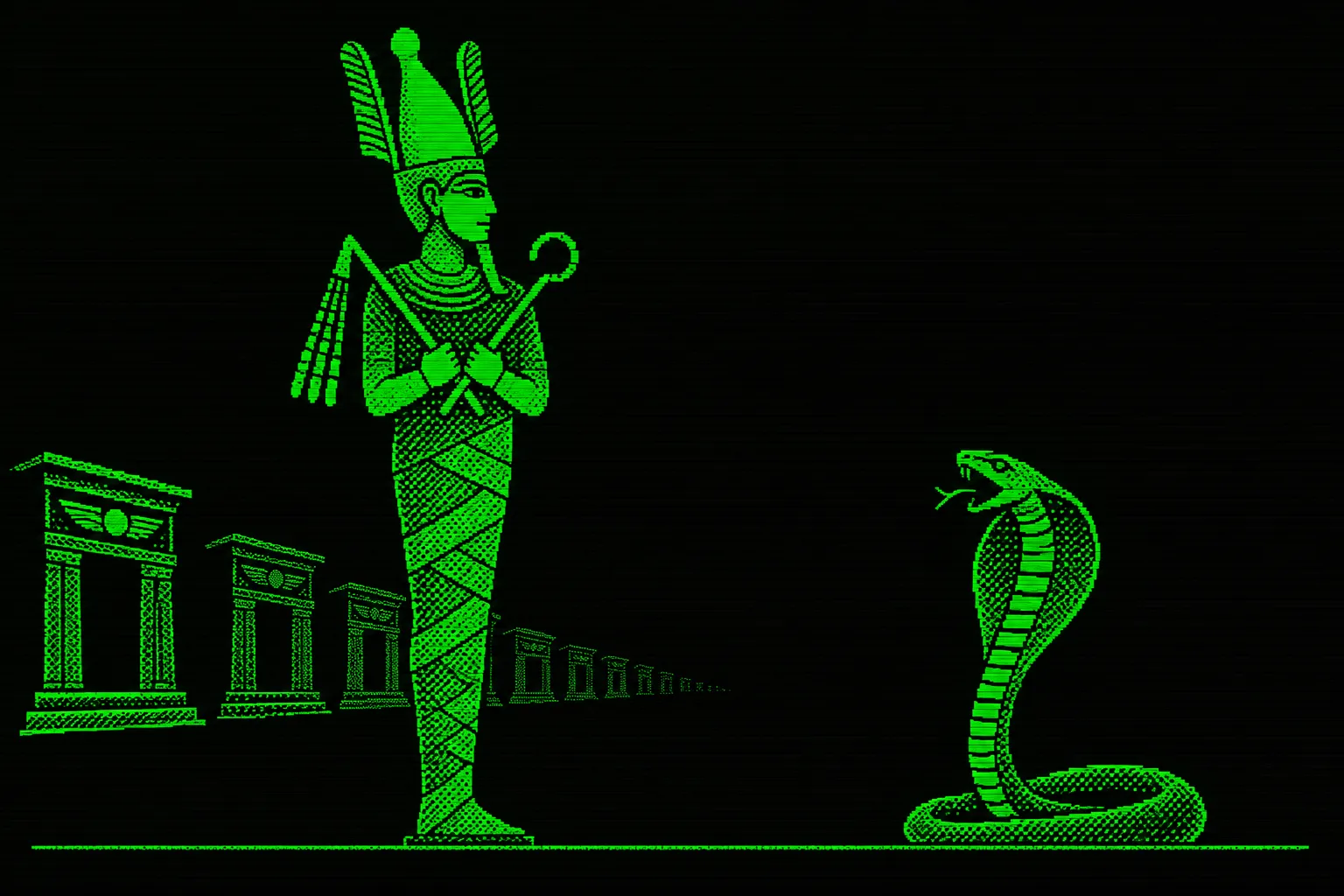
~/sacred-texts/book-of-the-dead
Book of the Dead Spell 142: Osiris in All His Names
- Text
- Book of the Dead, Spell 142
- Date
- Copied on funerary papyri from the Third Intermediate Period to Roman times (about 1070 BC to the 1st century AD); the litany itself goes back to the 18th Dynasty
- Language
- Middle Egyptian · Hieratic
The dead man, himself named an Osiris, recites a scroll for knowing the names of Osiris in every dwelling of his where he wishes to be. A hundred names follow: Osiris-Orion, Osiris the begetter, Osiris, the Throat, Osiris, bull in the heart of the Black Land, Osiris, lord of might, who tramples rebels underfoot. He is named in Sais, Busiris, Abydos and Memphis, in the sky, in the earth, in the night barque.
Then come the gods around him: Atum, Geb, Horus, Anubis, Isis the Divine, in all her names, the four Meskhenets of Abydos, the uraeus at the heart of the temple. The list closes on Osiris in all his forms, Osiris in all his names, Osiris in all his tombs.
- 1
mḏꜣ,t n.t sjqr ꜣḫ.w rḏi̯.t šmi̯ =f swsḫ nmt,t =f pri̯(.t) m hrw m ḫpr,w nb mri̯.w =f rḫ rn.pl n.w Wsjr m s,t =f nb.t mrr! =f wnn =f jm
A scroll for ennobling the transfigured dead, for enabling him to walk and lengthening his stride, for going forth by day in whatever form he desires, and for knowing the names of Osiris in every dwelling of his where he wishes to be.
Note · Line 1
“Going forth by day” is the dead person’s power to leave the tomb and move freely in daylight. - 2
ḏd-mdw jn Wsjr [...] mꜣꜥ-ḫrw
Words to be spoken by the Osiris …, vindicated:
Note · Line 2
The dead person bears the name of Osiris. “Vindicated” declares that the judgment of the dead has gone in his favor. - 3
Wsjr-Wnn-nfr,w
Osiris-Wennefer
Note · Line 3
Wennefer means “he who endures in perfection.” - 4
Wsjr ꜥnḫ,y
Osiris, the Living One
- 5
Wsjr nb-ꜥnḫ
Osiris, lord of life
- 6
Wsjr nb-(r-)ḏr
Osiris, lord of all
- 7
Wsjr wpi̯ šꜥ,t Tꜣ,du
Osiris, who decides the battle of the Two Lands
Note · Line 7
The Two Lands are Upper and Lower Egypt. - 8
Wsjr ḫnt,j Wn(,t)
Osiris, who presides over the Wenet sanctuary
- 9
Wsjr ḫnt,j np(r)
Osiris, who presides over the grain
- 10
Wsjr s(ꜣ)ḥ
Osiris-Orion
Note · Line 10
Here Osiris is named as the constellation Orion. - 11
Wsjr Zpꜣ šps bꜣ,pl-Jwn,w
Osiris-Sepa, noble among the bas of Heliopolis
Note · Line 11
Sepa was a god worshipped in the form of a centipede. A ba is a power through which a god or a dead person can be present and act. - 12
Wsjr ḫnt,j Ṯnn,t
Osiris, who presides over Tjenenet
Note · Line 12
Tjenenet was the name of a sanctuary at Memphis and of a region of the underworld. - 13
Wsjr m {sw}〈Rs〉-n,t
Osiris in Resenet
Note · Line 13
Resenet and Mehenet are the southern and northern chapels of Osiris in the temple of Neith at Sais. - 14
Wsjr m Mḥn,t
Osiris in Mehenet
- 15
Wsjr nb ḥḥ.pl
Osiris, lord of millions
- 16
Wsjr zꜣ rp(w),t.j
Osiris, son of the Two Ladies
- 17
Wsjr Ptḥ nb-ꜥnḫ
Osiris-Ptah, lord of life
- 18
Wsjr ḫnt(,j) Rʾ-sṯꜣ,w
Osiris, who presides over Rosetau
Note · Line 18
Rosetau was a name for the burial ground at Giza and also for a region of the underworld. - 19
Wsjr ḥqꜣ jdb.pl ḥr(,j)-jb Ḏd,w
Osiris, ruler of the riverbanks, who dwells in Busiris
Note · Line 19
Busiris was a center of Osiris’s worship in the Nile Delta. - 20
Wsjr ḥr(,j)-jb ḫꜣs,t.pl
Osiris amid the foreign lands
- 21
Wsjr bꜣ špsi̯ m Ḏd,w
Osiris, the exalted ba in Busiris
- 22
Wsjr m Ḥqꜣ-ꜥnḏ
Osiris in the province of Heliopolis
- 23
Wsjr m Ḥs(r),t ky-ḏd zḥ-nṯr
Osiris in Heseret (another reading: the god’s hall)
Note · Line 23
Heseret was a sacred precinct at Hermopolis. - 24
Wsjr nb tꜣ-ꜥnḫ
Osiris, lord of the Land of Life
Note · Line 24
The Land of Life is a name for the necropolis. - 25
Wsjr m Zꜣw
Osiris in Sais
- 26
Wsjr m Nḏ〈f〉,t
Osiris in Nedjefet
- 27
Wsjr m rsj ky-ḏd m ḏꜣḏꜣ,t
Osiris in the south (another reading: in the council of the gods)
- 28
Wsjr m Pi̯
Osiris in Pe
Note · Line 28
Pe and Dep were the twin towns that made up Buto in the Nile Delta. - 29
Wsjr m Dp
Osiris in Dep
- 30
Wsjr m ⸮Nṯri̯?
Osiris in the chapel
- 31
Wsjr m Zꜣw ẖr(,j).t
Osiris in Lower Sais
Note · Line 31
This litany names many local forms of Osiris. Sais was a city in the western Nile Delta. - 32
Wsjr m Zꜣw ḥr,j(.t)
Osiris in Upper Sais
- 33
Wsjr m N-(ꜣ)r≡f
Osiris in Naref
- 34
Wsjr m bjk,du!!
Osiris in the Place of the Two Falcons
- 35
Wsjr Swn,w
Osiris of Syene
Note · Line 35
Syene is modern Aswan, at the first cataract of the Nile. - 36
Wsjr m Rʾ-nn
Osiris in Lahun
- 37
Wsjr m ꜥpr
Osiris in Aper
- 38
Wsjr m Qfn,w
Osiris in Qefenu
- 39
Wsjr m Zkr,y
Osiris in the place of Sokar
- 40
Wsjr m Pḏ
Osiris in Pedj
- 41
Wsjr m ḥw,t =f m Rʾ-sṯꜣ,w
Osiris in his domain at Rosetau
- 42
Wsjr m Tꜣ-wr
Osiris in Ta-wer
Note · Line 42
Ta-wer was the province that included Abydos, a principal center of Osiris’s worship. - 43
Wsjr m Ndy,t
Osiris in Nedit
Note · Line 43
Nedit was the place where Osiris was said to have fallen at the hands of his brother Seth. - 44
Wsjr ḫnt(,j) nʾ,t =f
Osiris, who presides over his city
- 45
Wsjr jty
Osiris the sovereign
- 46
Wsjr m Psg〈-rʾ〉
Osiris in Peseg-ra
- 47
Wsjr m ḥw,t =f jm,j(.t) Tꜣ-šmꜥ,w
Osiris in his domain in Upper Egypt
- 48
Wsjr m ḥw,t =f jm,j(.t) Tꜣ-mḥw
Osiris in his domain in Lower Egypt
- 49
Wsjr m p,t
Osiris in the sky
- 50
Wsjr m tꜣ
Osiris in the earth
- 51
Wsjr m ns,t
Osiris on the throne
- 52
Wsjr m tꜣf-wr
Osiris in Itfa-wer
- 53
Wsjr Zkr m štꜣ,t
Osiris-Sokar in the Shetyt
Note · Line 53
Sokar was a god of the Memphite burial grounds. Here he and Osiris are named as one god. The Shetyt was Sokar’s sacred crypt. - 54
Wsjr ḥqꜣ-ḏ,t m Jwn,w
Osiris, ruler of everlasting time, in Heliopolis
- 55
Wsjr wtṯ
Osiris the begetter
- 56
Wsjr m Sk,tt
Osiris in the night barque
Note · Line 56
The night barque carried the sun through the underworld between sunset and sunrise. - 57
Wsjr m-{r}rw,t ṯꜣw
Osiris beyond the wind
- 58
Wsjr nb-ḏ,t
Osiris, lord of everlasting time
- 59
Wsjr nb-nḥḥ
Osiris, lord of ever-renewing time
Note · Line 59
The paired titles name two kinds of eternity: one endures without change; the other renews itself, as the sun does each morning. - 60
Wsjr m dšr(,t)
Osiris in the desert
- 61
Wsjr m zš
Osiris in the marshland
- 62
Wsjr Wḥꜣ,t rsj(.t)
Osiris of the Southern Oasis
Note · Line 62
The Southern Oasis is Kharga, in Egypt’s Western Desert. - 63
Wsjr Wḥꜣ,t mḥ,t(j.t)
Osiris of the Northern Oasis
Note · Line 63
The Northern Oasis is Bahariya. - 64
Wsjr m jꜣ,t wr.t
Osiris in the Great Place
- 65
Wsjr m ꜥpr,t
Osiris in Aperet
- 66
Wsjr m šnw
Osiris in Shenu
- 67
Wsjr m Ḥkn,w ky-ḏd Ḥsr,t
Osiris in Hekenu; another reading: Heseret
- 68
Wsjr m Zkr
Osiris as Sokar
- 69
Wsjr m Šꜣw
Osiris in Shau
- 70
Wsjr fꜣi̯ Ḥr,w
Osiris, who bears Horus
Note · Line 70
Horus is Osiris’s son. - 71
Wsjr m w Pgꜣ
Osiris in the district of the Battleground
- 72
Wsjr m Mꜣꜥ,tj
Osiris in Maati
Note · Line 72
Maati was the name of a canal near the Giza plateau. - 73
Wsjr m Mnj
Osiris in Meni
- 74
Wsjr bꜣ,pl jti̯ =f
Osiris, his father’s might
- 75
Wsjr nb jdb.pl nsw,t-nṯr.pl
Osiris, lord of the riverbanks, king of the gods
- 76
Wsjr m Bn
Osiris in Ben
- 77
Wsjr Tꜣy(,t)
Osiris of Tait
Note · Line 77
Tait was a town in Lower Egypt known for weaving. - 78
Wsjr ḥr,j šꜥy =f
Osiris upon his sand
- 79
Wsjr ḫnt(,j) zḥ{,t} ḥm,t.pl =f
Osiris, who presides over the hall of his cows
- 80
Wsjr m ⸮sjꜣṯ?
Osiris as Sia
- 81
Wsjr m ⸮Sj,tjw?
Osiris in Sitiu
- 82
Wsjr m ꜣšr,w
Osiris in Isheru
Note · Line 82
Isheru was the name of a sacred lake, notably the one at the temple of Mut at Karnak. - 83
Wsjr m Tꜣ,du!! nb.w
Osiris throughout the Two Lands
- 84
Wsjr ḫnt,j-š-pr-ꜥꜣ
Osiris, overseer of the royal palace lake
- 85
Wsjr m ḥw,t-bnbn
Osiris in the Temple of the Benben
Note · Line 85
The Benben was a sacred stone at Heliopolis, an image of the first mound to rise from the waters at creation. - 86
Wsjr m Jwn,w
Osiris in Heliopolis
- 87
Wsjr sr wr jm,j Jwn,w
Osiris, the great noble in Heliopolis
- 88
Wsjr m Ḥmꜣg
Osiris in Hemag
- 89
Wsjr mks
Osiris-Mekes
Note · Line 89
A mekes was a royal scepter. - 90
Wsjr m Pi̯ Nw,w
Osiris in Pe of the primeval waters
Note · Line 90
Pe was one of the two towns that made up Buto in the Nile Delta. The primeval waters were called Nun. - 91
Wsjr m ḥw,t-ꜥꜣ,t
Osiris in the Great Temple
Note · Line 91
This spell names Osiris in his many forms and seats of worship, then names other gods alongside him. - 92
Wsjr nb-ꜥnḫ m Ꜣbḏ,w
Osiris, lord of life in Abydos
Note · Line 92
Abydos was a chief sanctuary of Osiris, where his tomb was venerated. - 93
Wsjr nb-Ḏd,w
Osiris, lord of Busiris
- 94
Wsjr ḫnt,j gꜣu̯ s,t.pl
Osiris, foremost among those whose seats are narrow
- 95
Wsjr jty ḥr(,j)-jb jꜣb,tt
Osiris, ruler in the heart of the East
- 96
Wsjr jty ḥr(,j)-jb ⸮štꜣ,t?
Osiris, ruler in the heart of Shetat
- 97
Wsjr m ꜥnḫ m Ḥw,t-kꜣ-Ptḥ
Osiris, alive in Memphis
- 98
Wsjr nb-pḥ,tj ptpt sbj.pl
Osiris, lord of might, who tramples rebels underfoot
- 99
Wsjr kꜣ ḥr(,j)-jb Km,t
Osiris, bull in the heart of the Black Land
Note · Line 99
The Black Land was Egypt, named for the dark soil of the Nile floodplain. - 100
Wsjr jḥ,tj
Osiris, the Throat
Note · Line 100
The spell names the throat itself as a form of Osiris. - 101
Wsjr zḥ
Osiris of the Hall
- 102
Wsjr Rꜥ,w-Ḥr,w-ꜣḫ,tj
Osiris-Ra-Horakhty
Note · Line 102
Ra-Horakhty is the sun god Ra in the form of Horus of the Two Horizons. - 103
Jtm,w kꜣ ẖ(,t) psḏ,t-ꜥꜣ,t
Atum, bull of the lineage of the Great Ennead
Note · Line 103
The Great Ennead is the family of nine gods of Heliopolis. Atum stands at its head as the ancestor of the other eight. - 104
Wp-wꜣ,tpl šmꜥi̯ sḫm Tꜣ,du
Wepwawet of Upper Egypt, power of the Two Lands
Note · Line 104
Wepwawet means “Opener of the Ways.” - 105
Wp-wꜣ,tpl mḥw sḫm p,t
Wepwawet of Lower Egypt, power of the sky
- 106
Ptḥ ḏd špsj s,t Rꜥ,w
Ptah, exalted djed-pillar, seat of Ra
Note · Line 106
The djed-pillar is a sign of enduring stability. It was also identified with the backbone of Osiris. - 107
wꜥ,w sbq m ḥw,t-bnbn
The sole wise one in the Temple of the Benben
- 108
Gbb rpꜥ nṯr.pl
Geb, hereditary prince of the gods
- 109
Ḥr,w-wr
Horus the Elder
- 110
Ḥr,w ḫntj-n-jr,tdu
Horus-Khenty-en-irty
Note · Line 110
This is Horus in his sightless form; the name refers to the absence of his two eyes. - 111
Ḥr,w zꜣ ꜣs,t
Horus, son of Isis
- 112
Mn,w nswt Ḥr,w nḫt
Min the king, Horus the Strong
- 113
Jwn-mw,t≡f wꜥb pr-wr
Pillar of His Mother, who purifies the Per-wer
Note · Line 113
The title names Horus as his mother Isis’s support. The Per-wer, or “Great House,” is the traditional shrine of Upper Egypt. - 114
H̱nm,w Ḥr,w ḥtp
Khnum, Horus at peace
- 115
Sḫꜣy(,t)-Ḥr,w
Sekhat-Hor
- 116
Ḥr,w Ḫntj-ẖty
Horus-Khentykhety
- 117
Ḥr,w Ḏḥwtj
Horus-Thoth
- 118
Jni̯-ḥr,t
Onuris
- 119
Jnp,w ḫnt,j-zḥ-nṯr
Anubis, who presides over the god’s hall
Note · Line 119
The hall is the place of embalming, where the dead are in Anubis’s care. - 120
Nw,t
Nut
- 121
ꜣs,t nṯri̯.t m rn(.pl) =s nb.w
Isis the Divine, in all her names
Note · Line 121
A single deity can appear under many names. - 122
⸮rʾ? ⸮sḫꜣy?
Mouth of the Deaf
- 123
Šnty,t
Shentayt
Note · Line 123
Shentayt is Isis as the widow who mourns Osiris. - 124
Ḥqꜣ,yt
The Sovereign
- 125
Nšm,t nb(,t)-ḏ,t
The Neshemet barque, Lady of Eternity
Note · Line 125
This sacred boat carried the image of Osiris in procession at Abydos. Here the boat itself is addressed as a goddess. - 126
Ni̯,t Srq,t
Neith and Selqet
- 127
Mꜣꜥ,t
Maat
Note · Line 127
Maat is the goddess of truth, justice, and the order of the world. - 128
ꜣhy,t
The Sky Cow
Note · Line 128
Ihet is the goddess who embodies the sky as a cow. - 129
tꜣ 4 Msḫn,t jm,j.w(t) ꜣbḏ,w
The four Meskhenets who dwell in Abydos:
Note · Line 129
Meskhenet is the goddess of childbirth, who declares a child’s fate at birth. Here she appears in four forms. - 130
Msḫn,t ꜥꜣ.t
Meskhenet the Great
- 131
Msḫn,t sbq.t
Meskhenet the Wise
- 132
Msḫn,t mnḫ.t
Meskhenet the Excellent
- 133
Msḫn,t nfr.t
Meskhenet the Good
- 134
Jms,tj
Imsety
Note · Line 134
Imsety and the next three gods are the four sons of Horus. They guard the internal organs of the dead. - 135
Ḥpy
Hapy
- 136
Dwꜣ-mw,t≡f
Duamutef
- 137
Qbḥ-sn,pl≡f
Qebehsenuef
- 138
Jꜥrꜥ,t ḥr(,j.t)-jb ḥw,t-nṯr
The uraeus at the heart of the temple
Note · Line 138
The uraeus is a cobra reared up to strike, a sign of divine protection. - 139
nṯr.pl sšmi̯ dꜣ,t
The gods who guide the underworld
- 140
nṯr.pl qr,tj
The gods of the two caverns from which the Nile springs
- 141
nṯr.pl nṯr,t〈.pl〉 jm,j.w ꜣbḏ,w
The gods and goddesses who dwell in Abydos
- 142
jtr,t-šmꜥ(,t) jtr,t-mḥ(,t)
The shrine row of Upper Egypt and the shrine row of Lower Egypt
Note · Line 142
Each row of shrines represents one of Egypt’s two traditional kingdoms. - 143
jmꜣḫ,w.pl n.w Wsjr
The honored dead of Osiris
Note · Line 143
Their honored standing entitles them to offerings that sustain them after death. - 144
Wsjr-ḫnt,j-jmn,tt
Osiris, Foremost of the West
Note · Line 144
The west, where the sun sets, is the realm of the dead. - 145
Wsjr m s,t(.pl) =f nb.w
Osiris in all his places
- 146
Wsjr m s,t =f m Tꜣ-šmꜥ,w
Osiris in his place in Upper Egypt
- 147
Wsjr m ꜥḥꜥ,t =f m Tꜣ-mḥw
Osiris in his tomb in Lower Egypt
- 148
Wsjr m s,t nb(.t) mri̯.y(t) kꜣ =f jm
Osiris in every place his ka wishes to be
Note · Line 148
The ka is the living power of a god or a person; offerings nourish it. - 149
Wsjr m zḥ(.pl) =f nb.w
Osiris in all his halls
- 150
Wsjr m qmꜣ(.pl) =f nb.w
Osiris in all his forms
- 151
Wsjr m rn(.pl) =f nb.w
Osiris in all his names
- 152
Wsjr m grg(,t) =f nb
Osiris in every one of his settlements
- 153
Wsjr m ḫꜥ,w.pl =f nb.w
Osiris in all his crowns
- 154
Wsjr m ẖkr.pl =f nb.w
Osiris in all his ornaments
- 155
Wsjr m ꜥḥꜥ,t(.pl) =f nb.w
Osiris in all his tombs
Note · Line 155
Several places in Egypt claimed to hold the tomb of Osiris or a part of his body. - 156
Ḥr,w-nḏ-ḥr-jti̯≡f m rn =f nb
Harendotes in each of his names
Note · Line 156
Harendotes is Horus as the avenger of his father, Osiris. - 157
Jnp,w ḫnt(,j)-zḥ-nṯr m rn =f nb
Anubis, who presides over the divine hall, in each of his names
Note · Line 157
The divine hall is the place where the dead are embalmed. - 158
Jnp,w jm,j-wt
Anubis-Imiut
Note · Line 158
Imiut is a title of Anubis associated with a funerary emblem: an animal skin hung from a pole. - 159
nṯr.pl nṯr[.w,t] ⸢nb⸣ jm,j[.w] [...]
All the gods and goddesses who are in …
- 160
m ḏḏ! n Wsjr [...] mꜣꜥ-ḫrw
as a gift from the Osiris …, justified
Note · Line 160
The dead person bears the title “Osiris” in the hope of sharing the god’s life after death. “Justified” means that the gods have judged the deceased to be in the right.