~/sacred-texts/book-of-the-dead
Book of the Dead Spell 140: Eye of Horus Filled, Apophis Cast Down
- Text
- Book of the Dead, Spell 140
- Date
- Copied on Book of the Dead papyri from the Third Intermediate Period to Roman times (about 1070 BC to the 1st century AD)
- Language
- Egyptian · Hieratic
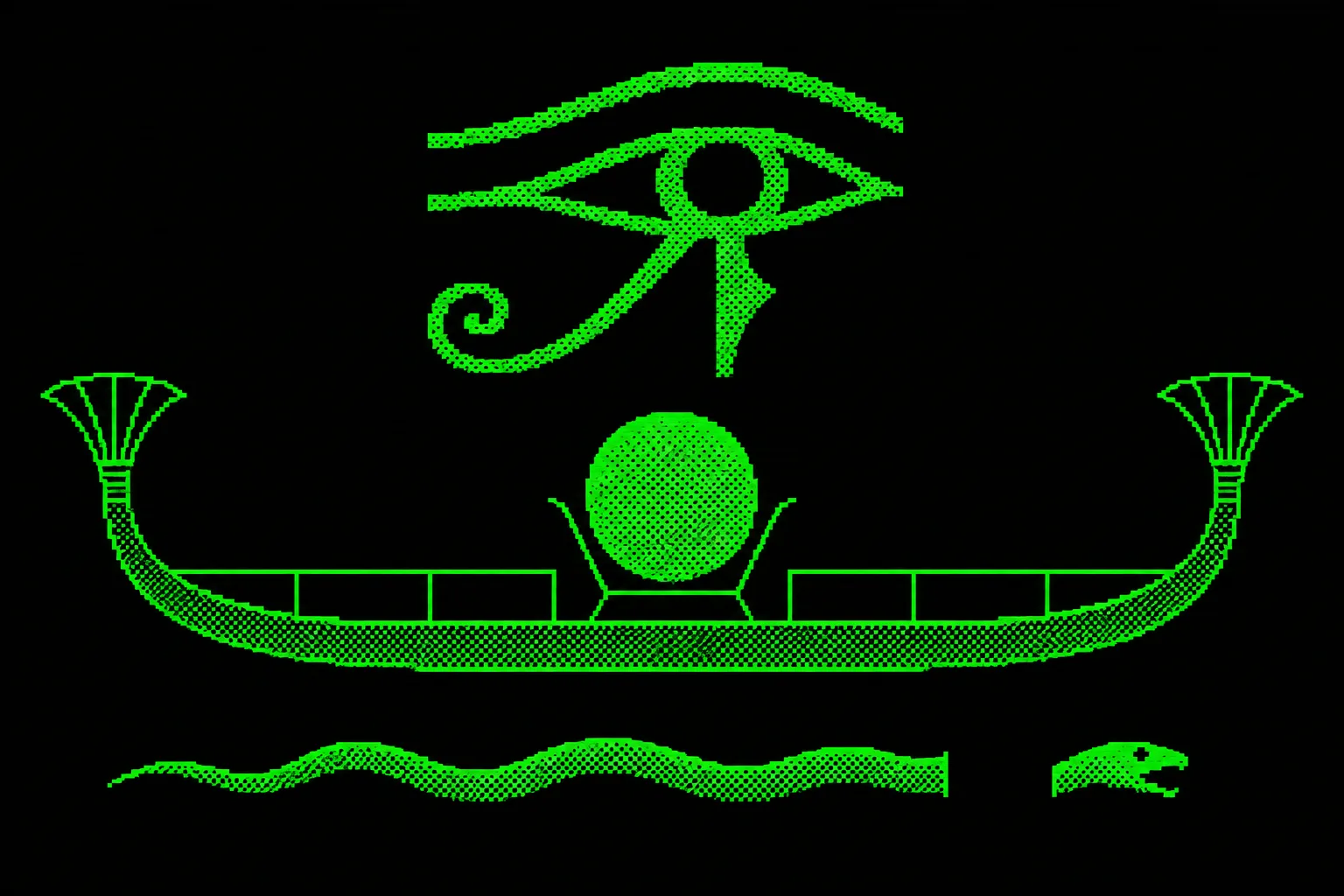
The dead person, named as Osiris, speaks on the last night of the second month of Peret, when the Eye of Horus is made whole. Atum rises, the Ennead is summoned, and the sun god copulates with the Eye. It is counted before the gods: Then it was full and at peace. The gods feast and shout: Apophis is cast down. The heads of the Weary One’s children are struck off.
The instructions follow. Recite these words over a wedjat eye of genuine lapis lazuli or amethyst, adorned with gold, lay a jasper eye on the limbs, and load twelve offering tables with bread, cakes, incense and roast meat. The reward: He will be like one of them.
- 1
mḏꜣ,t jri̯.t m ꜣbd 2 pr(,t) ꜥrq,y ḫft mḥ wḏꜣ,t m ꜣbd 2 pr(,t) ꜥrq,y
Scroll for use on the last day of the second month of Peret, at the filling of the Wedjat Eye on the last day of the second month of Peret.
Note · Line 1
Peret was the season when the fields emerged from the flood. The Wedjat is the restored Eye of Horus; its filling evokes the moon growing full. - 2
ḏd-mdw jn Wsjr [...] mꜣꜥ-ḫrw
Words to be spoken by the Osiris …, justified:
Note · Line 2
The deceased takes the name of Osiris. “Justified” means that the dead person has been vindicated in judgment. - 3
ḫꜥi̯ Sḫm wbn(.w) 〈m〉 ꜣḫ,t
The Mighty One appears, rising on the horizon.
- 4
ḫꜥi̯ Jtm,w ḥr sṯj jꜣd,t =f ꜣḫ,w wbn(.w) m p,t
Atum appears above the fragrance of his dew,
a transfigured spirit rising in the sky. - 5
ḥw,t-bnbn m ḥꜥꜥ(w,t)
The Benben temple rejoices.
Note · Line 5
The Benben was the sacred stone at Heliopolis that represented the first land to rise from the primeval waters. - 6
jm,j-tw =sn twt(.w) mj-qd =sn
Those in their midst are gathered, every one.
- 7
ḫrw nhm m-ẖnw kꜣ{r}jw
A shout of joy rings out within the shrine.
- 8
hnw pẖr(.w) m dꜣ,t
Acclaim goes round the underworld.
- 9
sn-tꜣ m rʾ n Jtm,w Ḥr,w-ꜣḫ,tj
At the word of Atum-Horakhty, the ground is kissed.
Note · Line 9
Kissing the ground is an act of homage. Horakhty is Horus of the Two Horizons. - 10
wḏ,t ḥm =f n psḏ,t šms,w n.w ḥm =f
His Majesty’s command goes out to the Ennead, His Majesty’s retinue.
Note · Line 10
The Ennead is the company of nine gods. - 11
wꜣḏ ḥm =f ḥr ⸮nk? ky-ḏd jri̯(.t) kꜣ(,t) wḏꜣ,t
His Majesty flourishes as he couples with the Wedjat Eye; another reading: as he acts on the thought of the Wedjat Eye.
Note · Line 11
The Eye can appear as a goddess in her own right. - 12
m =ṯn ḥꜥ =j rḏi̯ n =f nrjw ꜥ.w,t =j nb(.t) swꜣḏ.(t)n =sn
Look at my body! It is endowed with the terror of all my limbs, which they have made to flourish.
- 13
pri̯ =f rʾ =f
It goes forth, his utterance.
- 14
ḥm =f jw ꜣḫ,t =f ḥtp =s ḥr s,t =s ḥr ḥm =f wnw,t twy n.t grḥ,w mḥ(.t) wnw,t 4.t tꜣ nfr(.w) m ꜣbd 2 pr,t ꜥrq,y
As for His Majesty, his radiant Eye rests in its place upon him at that hour of the night which brings the fourth hour to its close, when the land is perfect, on the last day of the second month of Peret.
- 15
jw ḥm n wḏꜣ,t m-bꜣḥ-ꜥ-n psḏ,t
The Majesty of the Wedjat Eye is before the Ennead.
- 16
wbn ḥm =f mj zp-tp(,j)
His Majesty rises as at the First Time.
Note · Line 16
The First Time is the moment of creation; the sun rises as it did then. - 17
jw wḏꜣ〈,t〉 m tp =f
The Wedjat Eye is on his head.
- 18
Rꜥ,w Jtm,w wḏꜣ,t Šw Gbb Wsjr Swtj Ḥr,w Mntj Bꜥḥ Rꜥ,w r-nḥḥ Ḏḥwtj nꜥjw ḏ,t Nw,t ꜣs,t Nb,t-ḥw,t Ḥw,t-Ḥr,w Nḫt Mr,t Mꜣꜥ,t Jnp(,w) tꜣ msi̯ ḏ,t bꜣ Ḥꜣ,t-mḥy,t Rꜥ,w
Ra, Atum, the Wedjat Eye, Shu, Geb, Osiris, Seth, Horus, Montu, Flood, Ra forever, Thoth who sails without end, Nut, Isis, Nephthys, Hathor, Strength, Meret, Maat, Anubis, the earth born of Eternity, the ba of the province of Mendes, Ra.
Note · Line 18
A ba is a power through which a being can manifest itself. At Mendes this power was worshipped as a ram. - 19
ḥsb.ntw wḏꜣ,t m-bꜣḥ nb tꜣ pn
The Wedjat Eye was reckoned up before the lord of this land.
- 20
ꜥḥꜥ,n =s mḥ.tw ḥtp.tw
Then it was full and at peace.
- 21
wn.jn nn n nṯr.pl m ḥꜥꜥ(w,t) ={ṯn} m hrw pn
Then these gods rejoiced on this day,
- 22
ḏr,t =sn ẖr =sn!!
their hands beneath them.
- 23
ꜥḥꜥ,n jri̯ ḥ(ꜣ)b n nṯr nb ḏd =sn
Then a feast was held for every god, and they said:
- 24
hꜣy n =ṯ
Hail to you!
Note · Line 24
The gods are addressing the Eye. - 25
ḥkn,w m Rꜥ,w
Praise rings out over Ra!
- 26
sqdi̯ jz,t.y wjꜣ
The two crews sail the barque.
- 27
sḫr ꜥꜣpp
Apophis is cast down.
Note · Line 27
Apophis is the serpent who threatens the sun on its nightly voyage. - 28
hꜣy n =ṯ
Hail to you!
- 29
ḥkn,w n{.t} Rꜥ,w sḫpr.jw Ḫprj
Praise to Ra, who brings Khepri into being!
Note · Line 29
Khepri is the rising sun. His name echoes the words “come into being.” - 30
hꜣy n =ṯ
Hail to you!
- 31
ḥkn,w m Rꜥ,w
Praise to Ra!
- 32
ḥꜥꜥ(w,t) jm =f
Joy in the barque!
Note · Line 32
The barque is the sacred boat in which Ra, the sun god, makes his daily journey. - 33
dr ḫfti̯.pl =f
His enemies are driven off.
- 34
hꜣy n =ṯ
A shout of joy for you!
Note · Line 34
The speaker addresses the wedjat, the eye of Horus restored to wholeness after it was injured. - 35
ḥkn,w m Rꜥ,w
Praise to Ra!
- 36
dr tp.pl n ms,pl-bdš(,t)
The heads of the Weary One’s children are struck off.
Note · Line 36
The “children of the Weary One” are enemies of Ra, usually pictured as snakes. - 37
jꜣ,wj n =ṯ
Homage to you!
- 38
ḥkn,w n Wsjr [...] mꜣꜥ-ḫrw
Praise to the Osiris …, vindicated!
Note · Line 38
The dead person is called Osiris after the god who rose from the dead. “Vindicated” means that the deceased has been judged to be in the right. - 39
ḏd-mdw ḥr wḏꜣ,t n.t ḫsbḏ mꜣꜥ.t 〈ḥ〉mꜣg(,t) rʾ-pw swꜥb.tw m nbw
Recite these words over a wedjat eye of genuine lapis lazuli or amethyst, adorned with gold.
- 40
wdnw n =s (j)ḫ,t-nb,t nfr(.t) wꜥb(.t) m-bꜣḥ =s ḫft Rꜥ,w ḏi̯ =f sw m ꜣbd 2 pr(,t) ꜥrq,y ḥnꜥ jri̯.t k.t wḏꜣ,t n.t ḫnm(,t) rḏi̯(.tj) n z r ꜥ,t.pl nb(.t) mri̯.wt ={j}f wnn(⸮.tj?)
Set every good and pure thing before the eye as an offering to it, facing Ra when he shows himself on the last day of the second month of Peret. Make another wedjat eye of jasper and lay it on the man, on every limb he wishes to endure.
- 41
ḏd rʾ pn m wjꜣ-n-Rꜥ,w jw sṯꜣ.tw =f ḥnꜥ nn n nṯr.pl
Whoever recites this spell in the barque of Ra will be towed along with these gods.
- 42
wnn =f mj wꜥ,w jm =sn
He will be like one of them.
- 43
jw sṯz.tw =f m ẖr,t-nṯr
He will be raised up in the realm of the dead.
- 44
jr ḏd rʾ pn mj,tt pꜣ wdnw m mḥ wḏꜣ,t wḏꜣ,t
For whoever recites this spell in the same way, the offering at the filling of the wedjat eye, the wedjat eye, is this:
Note · Line 44
The filling of the eye evokes the waxing moon, which grows whole again month by month. - 45
ḫꜣw,t 4 n Rꜥ,w Jtm,w ḫꜣw,t 4 n wḏꜣ,t ḫꜣw,t 4 n nn n nṯr.pl
four offering tables for Ra-Atum, four offering tables for the wedjat eye, four offering tables for these gods.
- 46
n,tj ḥr wꜥ,w nb jm =sn
On each of them:
- 47
tʾ nfr tʾ-ḥḏ 5 dgꜣ.pl tʾ-ḥḏ 5 šꜥy-bjꜣ 5 snṯr dnj(,t) dq(r).pl dnj(,t) jwf ꜣšr
fresh bread, five white loaves, fruit, five white loaves, five cakes, incense, a basket of fruit and a basket of roast meat.