~/sacred-texts/book-of-the-dead
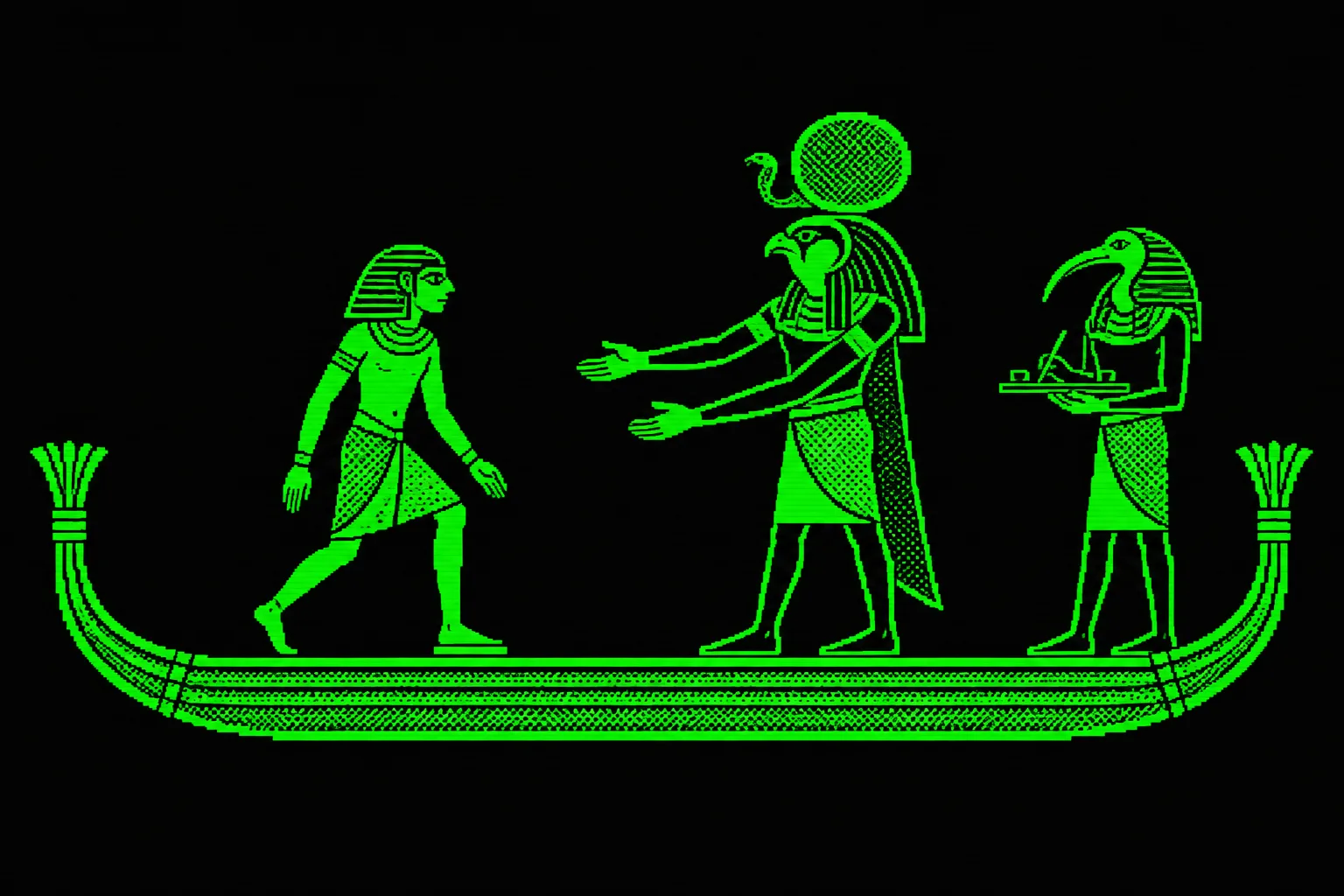
Book of the Dead Spell 129: Ra Holds Out Both Hands to Him
- Text
- Book of the Dead, Spell 129
- Date
- Copied on funerary papyri from the Third Intermediate Period to Roman times (c. 1070 BC – 1st century AD); the same text as spell 100, known from the New Kingdom
- Language
- Egyptian · Hieratic
The title states the purpose: A scroll to confer honor on a man and bring him aboard the barque of Ra with Ra’s followers. A reciter then lists what the dead man, named as Osiris, has done. He ferries the Bennu bird east, opens Hapi’s cavern, hauls Sokar on his sledge, strengthens the cobra on the god’s brow, knots the ship’s rope and drives back the foes. Ra holds out both hands to him.
The instructions follow: the boat is drawn in green frit and myrrh on new papyrus and laid against the man’s breast. Thoth has the last word: “I have counted his ba as it leaves and boards the barque of Ra.” The spell ends: The corpse will remain in its place.
- 1
mḏꜣ,t n.t sjqr z rḏi̯.t h(ꜣi̯) =f r wj{t}〈ꜣ〉-n-Rꜥ,w ḥnꜥ jm,j.w-ḫt =f
A scroll to confer honor on a man and bring him aboard the barque of Ra with Ra’s followers.
Note · Line 1
Ra is the sun god. To board his boat is to share in his daily passage through the sky and his nightly passage through the underworld. - 2
ḏd-md,t
Words to be spoken:
- 3
ḏꜣi̯ Wsjr [...] mꜣꜥ-ḫrw bn,w r jꜣb,tt Wsjr r Ḏd,w
Osiris …, justified, will ferry the Bennu bird east and Osiris to Busiris.
Note · Line 3
The first “Osiris” is a title given to the dead man; “justified” means he has been declared in the right. - 4
zš.n =f ṯpḥ,t Ḥꜥpi̯
He has opened Hapi’s cavern.
Note · Line 4
Hapi is the god of the Nile flood. The cavern is the hidden source from which its waters rise. - 5
ḫsr.n =f wꜣ,t jtn
He has cleared the way for the sun disk.
- 6
sṯꜣ.{pl}〈n〉 =f Zkr ḥr tmm =f
He has drawn Sokar on his sledge.
Note · Line 6
Sokar is a funerary god whose sacred boat was hauled on a sledge in procession. - 7
swsr.n =f wr,t m ꜣ,t =s
He has strengthened the Great One with her own might.
Note · Line 7
The Great One is the uraeus, the cobra that rears on the brow of a god or king to protect him. - 8
šms Wsjr [...] mꜣꜥ-ḫrw
Osiris …, justified, follows in the procession.
- 9
dwꜣ =f jtn
He praises the sun disk.
- 10
zmꜣ.n =f jm,jw-hṯ,t
He has joined those who shout for joy.
- 11
ntf wꜥ,w jm =sn
He is one of them.
- 12
jri̯.n =f sn,nw n ꜣs,t ḫmt,nw n Nb,t-ḥw,t
He has made himself a second to Isis, a third to Nephthys.
Note · Line 12
A “second” is a companion and a “third” a helper. The dead man takes his place beside the two sisters who mourned and protected Osiris. - 13
swsr.n =f ꜣḫ,w =sn
He has strengthened their magic.
- 14
ṯz.n =f ꜥqꜣ
He has knotted the ship’s rope.
- 15
ḫsf.n =f ḫfti̯.pl
He has driven back the foes.
- 16
sḥm.n =f nmt,t =f
He has turned back his steps.
- 17
rḏi̯ n =f Rꜥ,w ꜥ.wj =f
Ra holds out both hands to him.
- 18
nn ḫsf sw jz,t.y =f
His two crews will not drive him back.
Note · Line 18
The crews serve on the sun god’s day boat and night boat. - 19
wsr Wsjr [...] mꜣꜥ-ḫrw wsr wḏꜣ,t ṯz-pẖr
If Osiris …, justified, is strong, the Wedjat Eye is strong. Recite also in reverse.
Note · Line 19
The Wedjat is the injured eye of Horus made whole again. On the second recitation the two change places: the Eye’s strength assures the dead man’s strength. - 20
ḏd-md,t ḥr sšm pn n,tj m zẖꜣ,w zẖꜣ,w ḥr šw mꜣwj wꜥb(.w) m dq,pl n.w ḥmw,t wꜣḏ(.t) ḥr mw n ꜥntjw rḏi̯(.w) n z r šnb,t =f nn tk(n).tw =f
Recite over this image in pigment, drawn on a clean new sheet of blank papyrus with powdered green frit mixed with liquid myrrh. The image is to be laid against the man’s breast; no one is to approach him.
Note · Line 20
Frit is a glassy material that can be ground for use as a pigment. - 21
jw =f hꜣi̯ =f r wjꜣ-n-Rꜥ,w m-ẖr(,t)-hrw n.t rꜥ,w-nb
He will board the barque of Ra day in, day out.
- 22
jw ḥsb sw Ḏḥwtj m pri̯(.t) hꜣi̯(.t) m šs-mꜣꜥ{,t}
Thoth counts him as he steps ashore and as he steps aboard. Truly effective.
Note · Line 22
Thoth is the divine scribe. His count includes the dead man among those who travel with Ra. The last words vouch for the spell. - 23
zẖꜣ =k sw m qd(w),t nfr(.t) m wjꜣ-n-Rꜥ,w (m-)mj,tt
You shall likewise draw him in fine outline aboard the barque of Ra.
- 24
jr dq,pl n ḥmw,t wꜣḏ(.t) ḏd.w =f r ḥbs(,t) wꜣḏ pꜣ jri̯ =tw šꜥ,t jm =f
“Powdered green frit” means green heseb, the substance used to write the document.
- 25
jw Wsjr [...] mꜣꜥ-ḫrw (ḥr) sꜥḥꜥ ḏd smn tj,t
Osiris …, justified, raises the djed pillar and sets the tyet amulet firmly in place.
Note · Line 25
The djed pillar is a sign of stability associated with Osiris. The tyet, a knotted emblem of Isis, gives protection. - 26
sqdd! =f r b(w) mri̯.n =f
He sails to the place he has wished for.
- 27
jw ḥtp rʾ ḏd.{j}n Ḏḥwtj n Rꜥ,w
Gracious is the spell Thoth spoke to Ra.
- 28
Ṯnn,t ḥtp.tw ḥr nb =s Rꜥ,w
Tjenenet is content with its lord, Ra.
Note · Line 28
Tjenenet is the name of a sanctuary at Memphis and also of a region of the underworld. - 29
ḏd.n Ḏḥwtj
Thoth said:
- 30
ḥsb.n =(j) bꜣ =f m pri̯(.t) hꜣi̯(.t) r wjꜣ-n-Rꜥ,w
“I have counted his ba as it leaves and boards the barque of Ra.”
Note · Line 30
The ba is the aspect of a person that can move freely after death, often pictured as a bird with a human head. - 31
jw ẖꜣ,t r mn m s,t =s
The corpse will remain in its place.