~/sacred-texts/book-of-the-dead
The Negative Confession (Book of the Dead 125): I Have Not Killed
- Text
- Book of the Dead, Spell 125
- Date
- Copied in the 18th Dynasty (about 1400 BC) on the papyrus of Nu, steward of the treasurer, at Thebes
- Found
- Found at Qurna, Thebes; now in the British Museum, London (EA 10477)
- Language
- Middle Egyptian · Hieroglyphic
A dead man reaches the Hall of the Two Truths and greets Osiris and the forty-two judges who live on those who belong to evil and gulp down their blood. He denies wrong after wrong: I have not killed. I have not taken milk from a baby’s mouth. Then he calls each judge by name and denies one sin to each: I have not had sex with a married woman.
The gods question him, and the gate itself refuses him: “We will not let you pass us,” say the posts of this gate, “unless you speak our name.” He names posts, lintel, floor and doorkeeper. Thoth announces him to Osiris. The spell ends with orders for reciting it.
- 1
ḏd.t ḫft spr r wsḫ,t tn n.t Mꜣꜥ,tj pḫꜣ [...] mꜣꜥ-ḫrw m ḫw,w nb jri̯.n =f mꜣꜣ ḥr.pl nṯr.pl
Words to say on reaching this Hall of the Two Truths, to separate …, the vindicated one, from every wrong he has done, and to see the faces of the gods.
Note · Line 1
The hall is where the dead are judged. - 2
ḏd-mdw jn [...]
Words to be spoken by …:
- 3
j⁝nḏ-ḥr =k nṯr-ꜥꜣ nb mꜣꜥ,tj
Hail to you, great god, lord of the Two Truths!
- 4
jy.n =j ḫr =k nb =j jnt!.kw
I have come to you, my lord; I have been brought.
- 5
mꜣn! =j nfr,w =k
May I see your beauty!
- 6
jw =j rḫ.kw ṯw rḫ.kw rn =k rḫ.kw rn n pꜣ nṯr 42 n wnn.yw ḥnꜥ =k m wsḫ,t tn n.t Mꜣꜥ,tj ꜥnḫ.yw m {zꜣw,t}〈jr,j.w〉 ḏw,t sꜥm.ypl m znf =sn hrw pwy n ḥsb qdw,w m-bꜣḥ Wnn-nfr,w
I know you. I know your name.
I know the name of the forty-two gods who are with you in this Hall of the Two Truths,
who live on those who belong to evil and gulp down their blood
on that day when character is judged before Wennefer.Note · Line 6
The forty-two gods are judges of the dead. Wennefer is a name of Osiris, who presides over the judgment. - 7
m =k zꜣ,t.j Mr,tj nb Mꜣꜥ,tj rn =k
Behold the two daughters, the two Merets! “Lord of the Two Truths” is your name.
Note · Line 7
The Merets are twin goddesses associated with ritual song. - 8
m =k wj jy.kw ḫr =k
Look, I have come to you.
- 9
jni̯.n =j n =k Mꜣꜥ,t
I have brought you Maat.
- 10
dr.n =j n =k jzf,t r(m)ṯ.pl
For you I have driven out the wrong that people do.
- 11
n smꜣ{j}r =j wnḏw,t
I have not brought misery on my kin.
- 12
n jri̯ =j jw,yt m s,t mꜣꜥ,t
I have not done evil in place of what is right.
- 13
n rḫ =j jw,tt
I do not know what does not exist.
- 14
n jri̯ =j b(w) ḏw
I have done no evil.
- 15
n jri̯ =j tp rꜥ,w-nb bꜣk.w m-ḥr.pl jri̯.tn =j
I have not set a day’s work beyond what I could do myself.
- 16
n spr rn =j r jꜣ,t n.t ḫrp.pl
My name has not reached the seat of the overseers.
Note · Line 16
The implication is that no accusation against the speaker has come before the authorities. - 17
n nmḥ =j nmḥ,w m (j)ḫ,t =f
I have not made a poor man poorer by taking his goods.
- 18
n jri̯ =j bw,t nṯr.pl
I have done nothing the gods abhor.
- 19
n sḏw{j} =j ḥm n ḥr,j-tp =f
I have not discredited a servant in his master’s eyes.
- 20
n smr =j
I have caused no pain.
- 21
n sḥqr =j
I have made no one go hungry.
- 22
n srm =j
I have made no one weep.
- 23
n smꜣ =j
I have not killed.
- 24
n wḏ =j smꜣ
I have given no order to kill.
- 25
n jri̯ =j mn,t ḥr-nb
I have made no one suffer.
- 26
n ḫbi̯ =j šb,w m rʾ.pl-pr,w.pl
I have not reduced the portions offered in the temples.
- 27
n ḥḏi̯ =j pꜣ.w,t.pl nṯr.pl
I have not damaged the gods’ offering loaves.
- 28
n nḥm =j ḫnf,w ꜣḫ.pl
I have not taken away the offering cakes of the transfigured dead.
Note · Line 28
These dead are called akhs: through the funeral rites they have become spirits with power to act. - 29
n nk =j nkk{nkk}
I have not had sex with a boy.
- 30
n dꜣdꜣ =j
I have not had illicit sex.
- 31
n ḫbi̯ =j dbḥ
I have not diminished the measure.
Note · Line 31
The dead man, Nu, declares before the gods that he has done no wrong. The measure here is a vessel of standard capacity. - 32
n ḫbi̯ =j sṯꜣ,t
I have not diminished the aroura.
Note · Line 32
An aroura was a measure of land: a square one hundred royal cubits on each side, a little over half an acre. - 33
n sjꜣṯ =j ꜣḥ,t.pl
I have not cut away land from the fields.
- 34
n wꜣḥ =j ḥr mw,t.pl n.t jwsw
I have not added anything to the weights of the hand balance.
- 35
n nmḥ =j m tḫ n mḫꜣ,t
I have not taken anything from the plummet of the standing balance.
Note · Line 35
The plummet hung straight down and showed whether the beam was level. - 36
n nḥm =j jrṯ,t m rʾ nḫn.w
I have not taken milk from a baby's mouth.
- 37
n kfꜣ =j ꜥw,t ḥr sm,w =sn
I have not deprived sheep and goats of their grass.
- 38
n sḫt =j ꜣpd.w n qs.pl nṯr.pl
I have not netted birds from the gods’ Harpoon Points.
Note · Line 38
The name may refer to hunting grounds reserved for the gods. - 39
n ḥꜣm =j rmi̯(,w).w n ẖꜣ.w,t =sn
I have not caught fish from their lagoons.
- 40
n ḫsf =j mw m tr =f
I have not held back water in its season.
- 41
n dnj =j dnj,t ḥr mw ꜣs.w
I have not dammed the running water with a dike.
- 42
n ꜥḫm =j ḫ,t m ꜣ,t =s
I have not quenched a fire at its appointed hour.
- 43
n thi̯ =j sw.w ḥr stp,t.pl
I have not missed the appointed days for offering the choice cuts of meat.
- 44
n šnꜥ =j mnmn,t ḥr (j)ḫ,t-nṯr
I have not kept cattle from the god’s offering rite.
- 45
n ḫsf =j nṯr m pri̯,w =f
I have not held back a god in procession.
Note · Line 45
In a procession the god’s image was carried out of the sanctuary. - 46
jw =j wꜥb.kw zp-4
I am pure! (Four times.)
- 47
ꜥbw =j ꜥbw bn,w pwy ꜥꜣ n,tj m Nn-nsw,t
My purity is the purity of that great Bennu bird in Heracleopolis.
Note · Line 47
The Bennu was a sacred heron associated with the sun and with renewed life. - 48
ḥr-n,tt jnk js fnḏ pwy n nb ṯꜣw.pl sꜥnḫ rḫ,yt nb.t hrw pwy n mḥ wḏꜣ,t m Jwn,w m ꜣbd 2 pr,t ꜥrq,y
For I am indeed that nose of the Lord of Winds, who gives life to all the people on that day when the Wedjat Eye is filled in Heliopolis, on the last day of the second month of Peret.
Note · Line 48
The winds are the breath that keeps people alive. The Wedjat is the injured eye of Horus made whole again; filling it ritually renews its wholeness. Peret was the growing season after the Nile flood. - 49
jnk mꜣꜣ mḥ wḏꜣ,t m Jwn,w
I am one who has seen the filling of the Wedjat Eye in Heliopolis.
- 50
nn ḫpr bw ḏw r =j m tꜣ pn m wsḫ,t tn n.t Mꜣꜥ,tj
No evil will befall me in this land, in this Hall of the Two Truths,
Note · Line 50
The Two Truths are twin forms of Maat, the goddess of truth and right order. This is the hall of judgment. - 51
ḥr-n,tt {t}wj rḫ.kw rn n nn n nṯr.pl wnn.yw jm =s
for I know the name of these gods who are in it.
- 52
j wsḫ-nmt,t pri̯ m Jwn,w n jri̯ =j jzf,t
O Wide-Strider, you who come forth from Heliopolis, I have done no wrong.
Note · Line 52
Nu now addresses his divine judges one by one, naming each and denying a particular offense. - 53
j ḥpt sḏ,t pri̯ m H̱r,j-ꜥḥꜣ n ꜥwꜣi̯ =j
O Embracer of Flame, you who come forth from Kheraha, I have not robbed.
- 54
j fnḏ,y pri̯ m Ḫmn,w n jri̯ =j ꜥwn-jb
O Beaked One, you who come forth from Hermopolis, I have not been greedy.
- 55
j ꜥm šw,t.pl pri̯ m qrr,t n ṯꜣw =j
O Swallower of Shadows, you who come forth from the cavern, I have not stolen.
- 56
j nḥꜣ-ḥr pri̯ m Rʾ-sṯꜣ,w n smꜣ =j rmṯ
O Fierce Face, you who come forth from Rosetau, I have not killed a human being.
Note · Line 56
Rosetau was a name for the burial ground at Giza and also for a region of the underworld. - 57
j Rw,tj pri̯ m p,t n ḥḏi̯ =j dbḥ
O Ruty, you who come forth from the sky, I have not damaged the measure.
Note · Line 57
Ruty means “the Two Lions,” a divine pair addressed by a single name. - 58
j jr,t.j =f m sḏ,t pri̯ m Ḫm n jri̯ =j ẖꜣb,t
O you whose two eyes are fire, you who come forth from Letopolis, I have done no injustice.
- 59
j nbj pri̯ m ḫtḫt n ṯꜣu̯ =j (j)ḫ,t-nṯr
O Burning One, you who come forth backwards, I have not stolen what belongs to a god.
- 60
j sḏ qs.pl pri̯ m Nn-nsw,t n ḏd =j grg
O Breaker of Bones, you who come forth from Heracleopolis, I have not told a lie.
- 61
j ḫmi̯.y pri̯ m štꜣ,yt n nḥm =j
O Overthrower, who came forth from the secret underworld, I have taken nothing away.
Note · Line 61
Nu, the dead man for whom this papyrus was made, addresses the divine judges one by one. Before each he denies a particular wrong. - 62
j wꜣḏ ns pri̯ m ḥw,t-kꜣ-Ptḥ n knj =j
O Flourishing Flame, who came forth from Memphis, I have not grumbled.
Note · Line 62
The Egyptian name for Memphis here means “House of the Ka of Ptah.” The ka is the god’s vital presence. - 63
j Ḥr≡f-ḥꜣ≡f pri̯ m ṯpḥ,t ⸮ḏꜣi̯.t? n nḥm =j wnm,t
O He Whose Face Is Behind Him, who came forth from the Cavern of the Crossing, I have taken no food away.
- 64
j qr,t.j pri̯ m jmn,t n jri̯ =j ḥnw,yt
O Cave-Dweller, who came forth from the West, I have not profiteered from grain.
Note · Line 64
The West, where the sun sets, is the land of the dead. - 65
j tꜣ rd pri̯ m j{w}ḫḫ,w n ꜥm-jb =j
O Burning Foot, who came forth from the twilight, I have not been heedless.
- 66
j ḥḏ jbḥ.pl pri̯ m tꜣ-š n thi̯ =j
O White Teeth, who came forth from the Faiyum, I have not transgressed.
- 67
j wnm znf pri̯ m nm,t n smꜣ =j jḥ nṯr,j
O Blood-Eater, who came forth from the place of slaughter, I have not slaughtered a sacred ox.
- 68
j wnm bsk.w pri̯ m mꜥbꜣ,(y)t n ꜥwn =j ḥnb
O Eater of Entrails, who came forth from the Court of the Thirty, I have not cheated in measuring fields.
Note · Line 68
The Thirty are a body of judges. - 69
j nb-mꜣꜥ,t pri̯ m Mꜣꜥ,tj n smtmt =j
O Lord of Truth, who came forth from the Two Truths, I have not eavesdropped.
Note · Line 69
Maat is both truth and the right order of things. Here she appears in a double form; the hall of judgment, too, is called the Hall of the Two Truths. - 70
j tnm.y pri̯ m Bꜣs,t n šmi̯ =j
O Wanderer, who came forth from Bubastis, I have not been a chatterer.
- 71
j ꜥnḏ(,w).y pri̯ m Jwn,w n sḫwn =j n js ḥr (j)ḫ,t =j
O Shining One, who came forth from Heliopolis, I have not quarreled except over what was mine.
- 72
j ḏw ḏw,t =f pri̯ m ꜥnḏ,tj n nk =j nkk
O He Whose Evil Is Evil, who came forth from the province of Busiris, I have not had sex with a boy.
Note · Line 72
The term for the male partner names him by his role as the one penetrated. - 73
j Wꜣmm,tj pri̯ m ḫb,t n dꜣdꜣ =j
O Wamemti, who came forth from the place of execution, I have not had illicit sex.
- 74
j mꜣꜣ jni̯.t =f pri̯ m pr,w Mn,w n nk =j ḥm,t-ṯꜣy
O He Who Sees What He Will Fetch, who came forth from the temple of Min, I have not had sex with a married woman.
- 75
j ḥr,j wr.w pri̯ m šnḏ,t n jri̯ =j ḥrw
O Chief of the Great Ones, who came forth from the Acacia Shrine, I have not spread terror.
- 76
j nb Ḫm pri̯ m Ḫꜣsw,w n tꜣ rʾ =j
O Lord of Letopolis, who came forth from the province of Xois, my words have not been hot.
- 77
j šd-ḫrw pri̯ m wr,yt n zẖi̯ =j ḥr =j ḥr md,t n.t mꜣꜥ,t
O Mighty Voice, who came forth from the Great Sanctuary, I have not turned a deaf ear to words of justice.
- 78
j nḫn pri̯ m Ḥqꜣ-ꜥnḏ n ṯrm =j ky
O Child, who came forth from the province of Heliopolis, I have not winked at another.
- 79
j knm,tj pri̯ m knm,t n šnṯ =j
O Dark One, who came forth from the dark, I have reviled no one.
- 80
j jni̯-ḥtp≡f pri̯ m Zꜣw n pri̯-ꜥ =j
O Bringer of His Offering, who came forth from Sais, I have not raised a hand in violence.
- 81
j sr ḫrw pri̯ m Wnsj n ꜣs jb =j
O Herald Voice, who came forth from Lake Wenes, my heart has not been hasty.
- 82
j nb ḥr.pl pri̯ m Nḏf,t n thi̯ =j jwn =j n jꜥi̯ =j nṯr
O Lord of Faces, who came forth from Nedjefet, I have not gone against my nature; I have not washed a god.
- 83
j srḫ,y pri̯ m wṯn,t n ꜥšꜣ-ḫrw =j ḥr md,t
O Accuser, who came forth from Wetjenet, I have not talked on and on about a matter.
- 84
j nb ꜥb.wj pri̯ m Zꜣw,tj n jri̯ =j jw,yt mꜣꜣ =j bjn
O Lord of the Two Horns, who came forth from Asyut, I have done no wrong, though I saw evil.
- 85
j Nfr-tm pri̯ m Ḥw,t-kꜣ-Ptḥ n jri̯ =j šnṯ r nsw,t
O Nefertem, who came forth from Memphis, I have not reviled the king.
- 86
j Tm-zp pri̯ m Ḏd,w n rhn =j ḥr mw
O Destroyer of What Remains, who came forth from Busiris, I have not leaned on water.
- 87
j jri̯ m jb =f pri̯ m Ṯbw n qꜣi̯ ḫrw =j
O He Who Acts as His Heart Bids Him, who came forth from Tjebu, my voice has not been loud.
- 88
j Jḥy pri̯ m Nw,w n šnṯ =j nṯr
O Ihy, who came forth from the primeval waters, I have not reviled a god.
Note · Line 88
The waters are Nun, the boundless deep that existed before creation. - 89
j wꜣḏ rḫ,yt n jri̯ =j šfw,t
O you who make the people flourish, I have not puffed myself up.
- 90
j nḥb nfr,t pri̯ m ḥw,t =f n jri̯ =j sṯni̯{t}.yt
O Giver of Good Things, who came forth from his temple, I have not been remiss.
- 91
j Nḥb-kꜣ,pl pri̯ m ṯpḥ,t =f n wr ẖr,t =j n-js ḥr (j)ḫ,t
O Nehebkau, who comes forth from his cave, I made no great demands except on what was mine.
Note · Line 91
The dead speaker addresses the divine judges one by one, calling each by name and denying a particular wrong. - 92
j ḏsr-tp pri̯ m kꜣr{j} =f n šnṯ(,t) n.t nṯr jm =j
O Djeser-tep, who comes forth from his shrine, no god’s quarrel is in me.
- 93
j jni̯ ꜥ =f n sꜣt =j nṯr-nʾ,tj
O you whose arm fetches, I have not reviled the city god.
- 94
ḏd-mdw jn [...] mꜣꜥ-ḫrw
Words to be spoken by …, the vindicated:
Note · Line 94
“Vindicated” is the title of one who has been judged and found in the right. - 95
j:nḏ-ḥr =ṯn nṯr.pl jpw jm,j.w wsḫ,t tn n.t Mꜣꜥ,tj
Hail to you, you gods in this Hall of the Two Truths!
- 96
jw =j rḫ.kw ṯn rḫ.kw rn.w =ṯn
I know you; I know your names.
- 97
nn ḫr =j n šꜥ,t =ṯn
I shall not fall victim to your slaughter.
- 98
n sjꜥr =ṯn bjn =j n nṯr pn n,tj =ṯn m-ḫt =f
You will bring no word of evil I have done to this god in whose train you stand.
- 99
nn jwt! zp =j ḥr =ṯn
My case will not come before you.
- 100
ḏd =ṯn mꜣꜥ,t r =j m-bꜣḥ nb-r-ḏr
May you speak what is right about me before the Lord of All,
- 101
ḥr-n,tt jri̯.n =j mꜣꜥ,t m Tꜣ-mrj
for I have done what is right in the Beloved Land.
Note · Line 101
The Beloved Land is Egypt. - 102
n šnṯ =j nṯr
I have reviled no god.
- 103
n jwi̯ zp =j ḥr nsw,t jm,j-hrw≡f
My case did not come before the reigning king.
- 104
j:nḏ-ḥr =ṯn jm,j.w wsḫ,t tn n.t Mꜣꜥ,tj jw,tj.w grg m ẖ,t =sn ꜥnḫ.yw m mꜣꜥ,t sꜥm.yw m mꜣꜥ,t m-bꜣḥ Ḥr,w jm,j-jtn≡f
Hail to you who are in this Hall of the Two Truths,
in whose bellies there is no lie,
who live on truth, who swallow truth
before Horus in his sun disk! - 105
nḥm =ṯn wj m-ꜥ Bꜣby ꜥnḫ m bsk.w wr.w hrw pwy n jp,t ꜥꜣ.t
On that day of the great reckoning, may you save me from Babi, who lives on the entrails of the great ones!
Note · Line 105
Babi is a fierce baboon god. - 106
m =ṯn wj jy.kw ḫr =ṯn
Look, I have come to you.
- 107
nn jzf,t =j
I am free of wrongdoing.
- 108
nn ḫbn,t =j
I am free of guilt.
- 109
nn ḏw,t =j
I am free of evil.
- 110
nn mtr,w =j
There is no witness against me.
- 111
nn jri̯.{t}n =j (j)ḫ,t r =f
There is no one I have wronged.
- 112
ꜥnḫ =j m mꜣꜥ,t
I live on truth.
- 113
sꜥm =j m mꜣꜥ,t
I swallow truth.
- 114
jri̯.n =j ḏd.t r(m)ṯ hrr!.t nṯr.pl ḥr =s
I have done what people say and what pleases the gods.
- 115
jw =j sḥtp.n =j nṯr m mrr!.t =f
I have satisfied the god with what he loves.
- 116
jw rḏi̯.n =j tʾ n ḥqr,w mw n jbi̯.w mnḫ,t n ḥꜣw{j} mẖn,t n jwi̯,w
I have given bread to the hungry,
water to the thirsty,
clothing to the naked,
a ferryboat to one who had no boat. - 117
jw jri̯.n =j ḥtp-nṯr n nṯr.pl pri̯,t-r-ḫrw n ꜣḫ.w
I have made divine offerings to the gods
and invocation offerings to the transfigured dead.Note · Line 117
An invocation offering is a gift of sustenance called forth for the dead by speaking its name. - 118
nḥm wj jrf =ṯn
Save me, then!
- 119
ḫwi̯.pl wj jrf =ṯn
Shield me, then!
- 120
nn smj =ṯn r =j m-bꜣḥ
You will bring no charge against me in the divine presence.
- 121
jnk wꜥb rʾ wꜥb ꜥ.wj ḏd.w n =f jy zp-2 m-ḥtp jn mꜣꜣ.w sw
I am one whose mouth is pure, whose two hands are pure, to whom those who see him say, “Come, come in peace!”
Note · Line 121
Nu, the dead man for whom this papyrus was written, speaks here on his own behalf before the gods who judge the dead. - 122
ḥr-n,tt sḏm.n =j mdw pwy ꜥꜣ ḏd.w sꜥḥ.w ḥnꜥ mjw m pr,w ḥꜣ pḏ rʾ
For I have heard that great speech the dignitaries and the tomcat gave in the house, gathered round the one who opens his mouth wide.
Note · Line 122
Elsewhere in the Book of the Dead, Ra takes the form of a tomcat and cuts down his serpent enemy beside the sacred ished tree. - 123
mtr,w m ḥr≡f-ḥꜣ≡f
He Whose Face Is Behind Him was the witness,
- 124
ḏi̯ =f dnj,wt
and he let out a roar.
- 125
jw mꜣꜣ.n =j psš jšd m-ẖnw Rʾ-sṯꜣ,w
I have seen the splitting of the ished tree within Rosetau.
- 126
jnk smj n nṯr.pl rḫ (j)ḫ,t ẖ,t =sn
I am one who reports to the gods, who knows the things of their bodies.
- 127
jy.n =j ꜥꜣ r smtr mꜣꜥ,t r rḏi̯.t jwsw r ꜥḥꜥ,w =f m-ẖnw j{w}gr,t
I have come here to bear witness to Maat, to set the balance upright in its place in the Silent Land.
Note · Line 127
In the judgment of the dead, the heart is weighed against her feather. - 128
j qꜣi̯ ḥr jꜣ,t =f nb ꜣtf,w jri̯.y rn =f m nb ṯꜣw nḥm wj m-ꜥ nꜣy≡k n wpw,tj.w wdd!.yw ṯms.w sḫpr.yw jdr,yt jw,tj.w ṯꜣm,t n.t ḥr =sn
O High One on his standard, lord of the Atef crown, whose name was made Lord of the Wind, save me from those messengers of yours who inflict harm, who bring punishment, whose faces show no mercy!
Note · Line 128
The standard is a pole bearing a divine image. The Atef is the tall crown flanked by feathers that Osiris wears. - 129
ḥr-n,tt jri̯.n =j mꜣꜥ,t n nb-mꜣꜥ,t
For I have done Maat for the Lord of Maat.
- 130
jw =j wꜥb.kw
I am pure.
- 131
ḥꜣ,t =j m ꜥb,w
My front is pure.
- 132
pḥ,wy =j twr{j}(.w)
My backside is cleansed.
- 133
ḥr,j-jb =j m šd,yt mꜣꜥ,t
My middle is a pool of Maat.
- 134
nn ꜥ,t jm =j šwi̯.t m mꜣꜥ,t
Not a limb of mine is empty of Maat.
- 135
wꜥb.n =j m šd,yt rsj.t
I have purified myself in the southern pool.
- 136
ḥtp.n =j m nʾ,t mḥ,tj.t m sḫ,t z{ꜣ}nḥm.pl wꜥb.t jz,t Rꜥ,w jm =s m wnw,t twy sn,nw.t n.t grḥ 3,nw.t n.t hrw snꜥꜥ.t jb.pl nṯr.pl m-ḫt swꜣ =sn ḥr =s m grḥ m hrw
I have come to rest in the northern town, in the Field of Locusts, where Ra’s crew purify themselves at this second hour of the night and at the third hour of the day. The field soothes the hearts of the gods after they pass it, by night and by day.
Note · Line 136
Ra’s crew sail with the sun god in his boat across the sky by day and through the underworld by night. - 137
ḏi̯ =k jwt! =f j.n =sn r =j
“May you let him come!” they say of me.
Note · Line 137
The exchange that follows tests Nu’s knowledge: he must name himself and tell what he encountered on his way. - 138
ptr ṯw j.n =sn r =j
“Who are you?” they say to me.
- 139
ptr rn =k j.n =sn r =j
“What is your name?” they say to me.
- 140
jnk rd ẖr,j n mḥ,yt
I am the shoot at the base of the papyrus.
- 141
jm,j bq =f rn =j
“He Who Is in His Moringa Tree” is my name.
- 142
swꜣ.n =k ḥr m j.n =sn r =j
“What did you pass on your way?” they say to me.
- 143
swꜣ.n =j ḥr nʾ,t mḥ,tj.t bq
I passed the town north of the moringa tree.
- 144
ptr mꜣꜣ.tn =k jm
“What did you see there?”
- 145
ḫnd pw ḥnꜥ msd,t
A leg and a hip.
- 146
ptr j.n =k n =sn
“What did you say to them?”
- 147
jw mꜣꜣ.n =j jhh,y m nw n tꜣ,pl-fnḫ,w
“I saw rejoicing in these lands of the Fenkhu.”
Note · Line 147
The Fenkhu were a people of the eastern Mediterranean coast, associated with what is now Lebanon. - 148
ptr rḏi̯.n =sn n =k
“What did they give you?”
- 149
bsw pw n sḏ,t ḥnꜥ wꜣḏ n ṯḥn,t
A torch of fire and a papyrus-shaped amulet of faience.
Note · Line 149
Faience is a glazed material made chiefly from ground quartz. Amulets shaped like a fresh papyrus stalk stood for renewed life. - 150
ptr jrf jri̯.tn =k r =s
“What, then, did you do with it?”
- 151
jw qrs.n =j st ḥr wḏb n mꜥꜣ,t m (j)ḫ,t-ḫꜣwj
“I buried it on the bank of Maaat, with the evening offering.”
Note · Line 151
Maaat is a region of the afterlife. Nu, the dead man, is being questioned before he can enter the hall of judgment. - 152
ptr gmi̯.tn =k ḥr =f wḏb n mꜥꜣ,t
“What did you find there, on the bank of Maaat?”
- 153
wꜣs pw n ds
“It is a was-scepter of flint.
Note · Line 153
A was-scepter is a staff with an animal head and a forked foot, an emblem of divine power. - 154
rḏi̯-ṯꜣw rn =f
Its name is ‘Giver of Breath.’”
- 155
ptr jrf jri̯.tn =k r pꜣ bs n sḏ,t ḥnꜥ pꜣ wꜣḏ n ṯḥn,t
“What, then, did you do with the flaming torch and the papyrus amulet of faience
Note · Line 155
The amulet is shaped like a papyrus stalk. - 156
m-ḫt qrs =k st
after you buried it?”
- 157
jw h(w)t.n =j ḥr =s
“I mourned over it.
- 158
jw ꜥḫm.n =j sḏ,t
I quenched the fire.
- 159
jw sḏ.n =j wꜣḏ qmꜣ.w n mr
I broke the papyrus amulet. They were cast into the canal.”
- 160
mj jr =k
“Come, then!
- 161
ꜥq ḥr sbꜣ pn n wsḫ,t tn n.t Mꜣꜥ,tj
Enter through this gate of this Hall of the Two Truths.
- 162
jw =k rḫ.tj n
You know us.”
- 163
nn ḏi̯! =n ꜥq =k ḥr =n j.n bnš.w n sbꜣ pn
“We will not let you pass us,” say the posts of this gate,
Note · Line 163
The parts of the gate now speak in turn. To pass, Nu must name each one. - 164
n-js ḏd.n =k rn =n
“unless you speak our name.”
- 165
tḫ pw n b(w) mꜣꜥ rn.w =ṯn
“Your names are ‘The Plummet in Its True Place.’”
Note · Line 165
The plummet is a hanging weight that shows when the beam of a balance is level. - 166
nn ḏi̯! =j ꜥq =k ḥr =j j.n ꜥr,yt n.t sbꜣ pn
“I will not let you pass me,” says the lintel of this gate,
- 167
n-js ḏd.n =k rn =j
“unless you speak my name.”
- 168
ḥnk,w n fꜣi̯.t mꜣꜥ,t rn =ṯ
“Your name is ‘The Scale Pan That Bears Truth.’”
Note · Line 168
In the judgment of the dead, the heart is weighed against Maat, often shown as a feather. - 169
nn ḏi̯! =j ꜥq =k ḥr =j j.n {ḏ}ꜥr,yt n.t sbꜣ pn
“I will not let you pass me,” says the lintel of this gate,
- 170
n-js ḏd.n =k rn =j
“unless you speak my name.”
- 171
ꜥnḫ,t pw n.t Sbk nb bꜣẖ,w rn =ṯ
“Your name is ‘The Living Eye of Sobek, Lord of Bakhu.’”
Note · Line 171
Sobek is the crocodile god. Bakhu is the mountain of the eastern horizon. - 172
nn wn =j n =k j.n sbꜣ pn
“I will not open for you,” says this gate,
- 173
n-js ḏd.n =k rn =j
“unless you speak my name.”
- 174
qꜣb,t n.t Šw rḏi̯.〈t〉n =f m-ḥr Wsjr rn =k
“Your name is ‘The Breast of Shu, Which He Laid Before Osiris.’”
- 175
nn ḏi̯! =n ꜥq =k ḥr =n j.n ḥpt.w
“We will not let you pass us,” say the crossbars,
- 176
n-js ḏd.n =k rn =n
“unless you speak our name.”
- 177
nḫn.w pw n jꜥr.w,t rn.w =ṯn
“Your names are ‘The Children of the Uraeus Cobras.’”
Note · Line 177
A uraeus is the rearing cobra worn on the brow of a god or ruler for protection. - 178
nn wn =j n =k
“I will not open for you.
- 179
nn ḏi̯! =j ꜥq =k ḥr =j j.n jr,j-ꜥꜣ n sbꜣ pn
I will not let you pass me,” says the keeper of this gate,
- 180
n-js ḏd.n =k rn =j
“unless you speak my name.”
- 181
jwꜣ n Gbb rn =k
“‘Longhorn of Geb’ is your name.”
Note · Line 181
Nu, the dead man, must name the parts of the doorway before they will let him pass. Geb is the earth god. - 182
jw =k rḫ.tj n
“You know us.
- 183
swꜣ jr =k ḥr =n
Pass by us, then.”
- 184
nn ḏi̯! =j ḫnd =k ḥr =j j.n zꜣt,w n ⸢wsḫ,t⸣ ⸢tn⸣ ⸢n.t⸣ ⸢Mꜣꜥ⸣,tj
“I will not let you tread on me,” says the floor of this Hall of the Two Truths.
- 185
ḥr-m jrf gr
“But why?
- 186
jw =j wꜥb.kw
I am pure.”
- 187
ḥr-n,tt n rḫ =k rn n rd.du =kj ḫnd =k ḥr =j jm =sn
“Because you do not know the name of your two feet, with which you tread on me.
- 188
ḏd jr =k n =j st
Tell it to me, then.”
- 189
bz.w Mn,w rn n rd =j wnm,j
“‘Secrets of Min’ is the name of my right foot.
Note · Line 189
Min is a god of fertility. - 190
wnpp!.t n.t Ḥw,t-Ḥr,w rn n rd =j jꜣb,j
‘Root of Hathor’ is the name of my left foot.”
- 191
jw =k rḫ.tj n
“You know us.
- 192
ꜥq jr =k ḥr =n
Come in among us, then.”
- 193
nn smj =j ṯw j.n jr,j-ꜥꜣ n wsḫ,t tn n.t Mꜣꜥ,tj
“I will not announce you,” says the doorkeeper of this Hall of the Two Truths,
- 194
n-js ḏd =k rn =j
“unless you say my name.”
- 195
sjꜣ jb.pl ḏꜥr ẖ,t.pl rn =k
“‘He Who Reads Hearts and Searches Bodies’ is your name.”
- 196
smj =j ṯw jrf n m m nṯr jm,j wnw,t =f
“To which god on duty, then, shall I announce you?”
- 197
ḏd =k st n ꜥ,w Tꜣ,du
“Tell it to the Interpreter of the Two Lands.”
Note · Line 197
The Two Lands are Upper and Lower Egypt. - 198
ptr rf sw
“Who is he, then?”
- 199
ꜥ,w Tꜣ,du Ḏḥwtj pw
“The Interpreter of the Two Lands is Thoth.”
Note · Line 199
Thoth is the gods’ scribe. He records the judgment of the dead. - 200
mj j.n Ḏḥwtj
“Come,” says Thoth.
- 201
jy.n =k r-m
“What have you come for?”
- 202
jy.n =j ꜥꜣ r smj.t
“I have come here to be announced.”
- 203
ptr ḫr,t =k
“How do you stand?”
- 204
jw =j wꜥb.kw m ḫw,w
“I am pure of wrongdoing.
- 205
ḫwi̯.n =(j) wj m šnṯ,t n.t jm,j.w-hrw≡sn
I have guarded myself against the strife of those on duty for the day.
- 206
nn wj m-m =sn
I am not among them.”
- 207
smj =j ṯw jrf n m m nṯr jm,j wnw,t =f
“To which god on duty, then, shall I announce you?”
Note · Line 207
The exchange about the Interpreter is repeated here, after Thoth himself has spoken. - 208
ḏd =k st n ꜥ,w Tꜣ,du
“Tell it to the Interpreter of the Two Lands.”
- 209
pw tr rf sw
“Who is he, then?”
- 210
ꜥ,w Tꜣ,du Ḏḥwtj pw
“The Interpreter of the Two Lands is Thoth.”
- 211
mj j.n Ḏḥwtj
“Come,” says Thoth.
Note · Line 211
Thoth, scribe of the gods, questions the dead man before announcing him to Osiris. - 212
jy.n =k r-m
“What have you come for?”
- 213
jy.n =j ꜥꜣ r smj.t
“I have come here to be announced.”
- 214
ptr ḫr,t =k
“How do you stand?”
- 215
jw =j wꜥb.kw m ḫw,w
“I am free of wrongdoing.
- 216
jw ḫwi̯.n =(j) wj m šnṯ,t n.t jm,j.w-hrw≡sn
I have kept myself clear of the quarrel of those on duty for the day.
- 217
nn wj m-m =sn
I am not among them.”
- 218
smj =j jrf ṯw n m
“To whom, then, shall I announce you?”
- 219
smj =k wj n hꜣ,yt m sḏ,t jnb.pl m jꜥr.w,t ꜥnḫ.w(t) wnn zꜣt,w =f m nwy
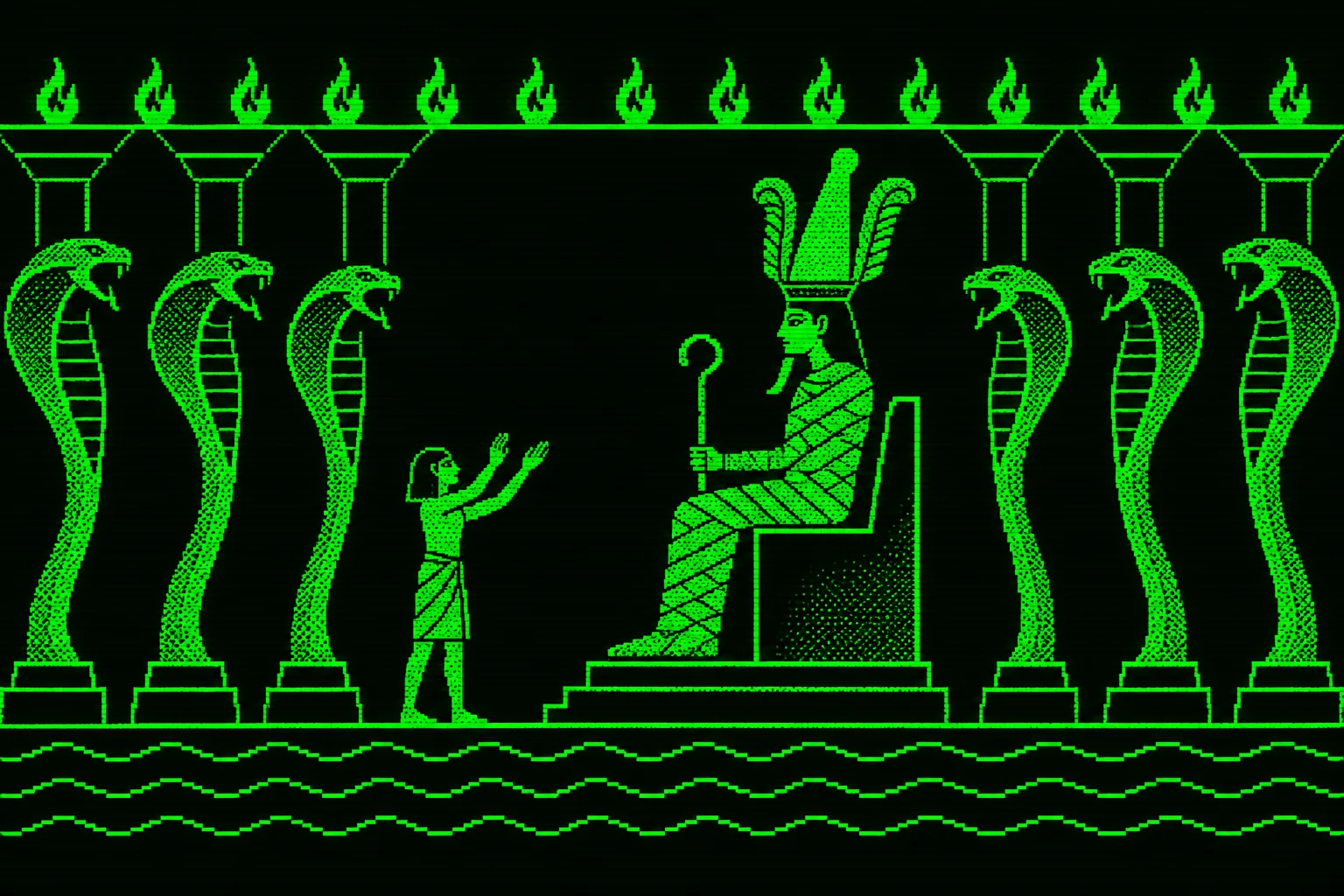
“Announce me to him whose hall is fire, whose walls are living cobras, whose floor is floodwater.”
Note · Line 219
The cobras are uraei, the rearing serpents that guard gods and kings. - 220
zy pw
“Who is that?”
- 221
Wsjr pw
“It is Osiris.”
- 222
wḏꜣ jr =k
“Go, then!
- 223
m =k ṯw smj.tj
See, you have been announced.
- 224
jw tʾ =k m wḏꜣ,t
Your bread is the Wedjat Eye.
Note · Line 224
The Wedjat Eye is the injured eye of Horus made whole again. An offering identified with it carries its power to restore. - 225
jw ḥ(n)q,t =k m wḏꜣ,t
Your beer is the Wedjat Eye.
- 226
jw pri̯ =tw n =k r ḫrw tp tꜣ m wḏꜣ,t ḫrw-fj sw Wsjr [...] mꜣꜥ-ḫrw
What is called forth for you on earth is the Wedjat Eye,” he says to the Osiris …, true of voice.
Note · Line 226
Offerings could be made by speaking their names aloud. The dead man himself bears the title “Osiris”; “true of voice” means he has been vindicated in judgment. - 227
jri̯.t mj ḫpr m wsḫ,t tn n Mꜣꜥ,tj
Do as is done in this Hall of the Two Truths:
Note · Line 227
The dialogue gives way to directions for the rite. The hall of judgment takes its name from a double form of Maat, goddess of truth and right order. - 228
ḏd =tw rʾ pn wꜥb(.w) twr{j}(.w) wnḫ.w m ḥbs,w ṯb.w m ḥḏ,t.j sdm.w m msdm,t wrḥ.w m ꜥntj,w
Recite this spell pure and clean, wrapped in a robe and shod in white sandals, your eyes lined with black kohl, your body anointed with myrrh.
- 229
wdn n =f jḥ.pl ꜣpd.pl snṯr tʾ ḥnq,t sm,w
Offer him cattle, fowl, incense, bread, beer and greens,
- 230
jsk jri̯.n =k sšm,w pn n,tj m zẖꜣ ḥr zꜣt,w wꜥb(.w) m ztj sẖr.w m ꜣḥ,t n,tj n ḫnd šꜣj ꜥw,t ḥr =f
once you have made this sacred image, drawn in ochre on clean ground spread with field earth, where no pig, sheep or goat has set foot.
- 231
jr jrr! mḏꜣ,t tn ḥr =f wnn =f wꜣḏ(.w)
Whoever performs the rite of this scroll over the image will flourish.
- 232
ms.pl =f wꜣḏ(.w)
His children will flourish
- 233
n ḥntꜣ
without fail,
- 234
n wnn =f m mḥ-jb n nsw,t ḥnꜥ šn,yt =f
for he will have the confidence of the king and his court.
- 235
jw ḏi̯! =tw n =f šns dsj pzn wr n jwf ḥr ḫꜣw,t n.t nṯr-ꜥꜣ
A cake, a jug, a loaf and a great cut of meat will be set out for him on the altar of the Great God.
- 236
n šnꜥ.ntw =f ḥr sbꜣ nb n jmn,t
He will not be turned away at any gate of the West.
Note · Line 236
The West, where the sun sets, is the realm of the dead. - 237
jw sṯꜣ.tw =f ḥnꜥ nsw,t.yw-bj,tj.w
He will be led in with the kings of Upper and Lower Egypt.
- 238
wnn =f m šms,w n Wsjr
He will be in the train of Osiris.
- 239
šs-mꜣꜥ ḥḥ n zp
Truly effective, a million times over.