~/sacred-texts/book-of-the-dead
Book of the Dead Spell 124: I Raise the Sacred Cobras
- Text
- Book of the Dead, Spell 124
- Date
- First attested in the New Kingdom (from c. 1550 BC); the three papyrus copies read here date from the Third Intermediate Period to the Ptolemaic era (c. 1070–30 BC)
- Language
- Egyptian · Hieratic
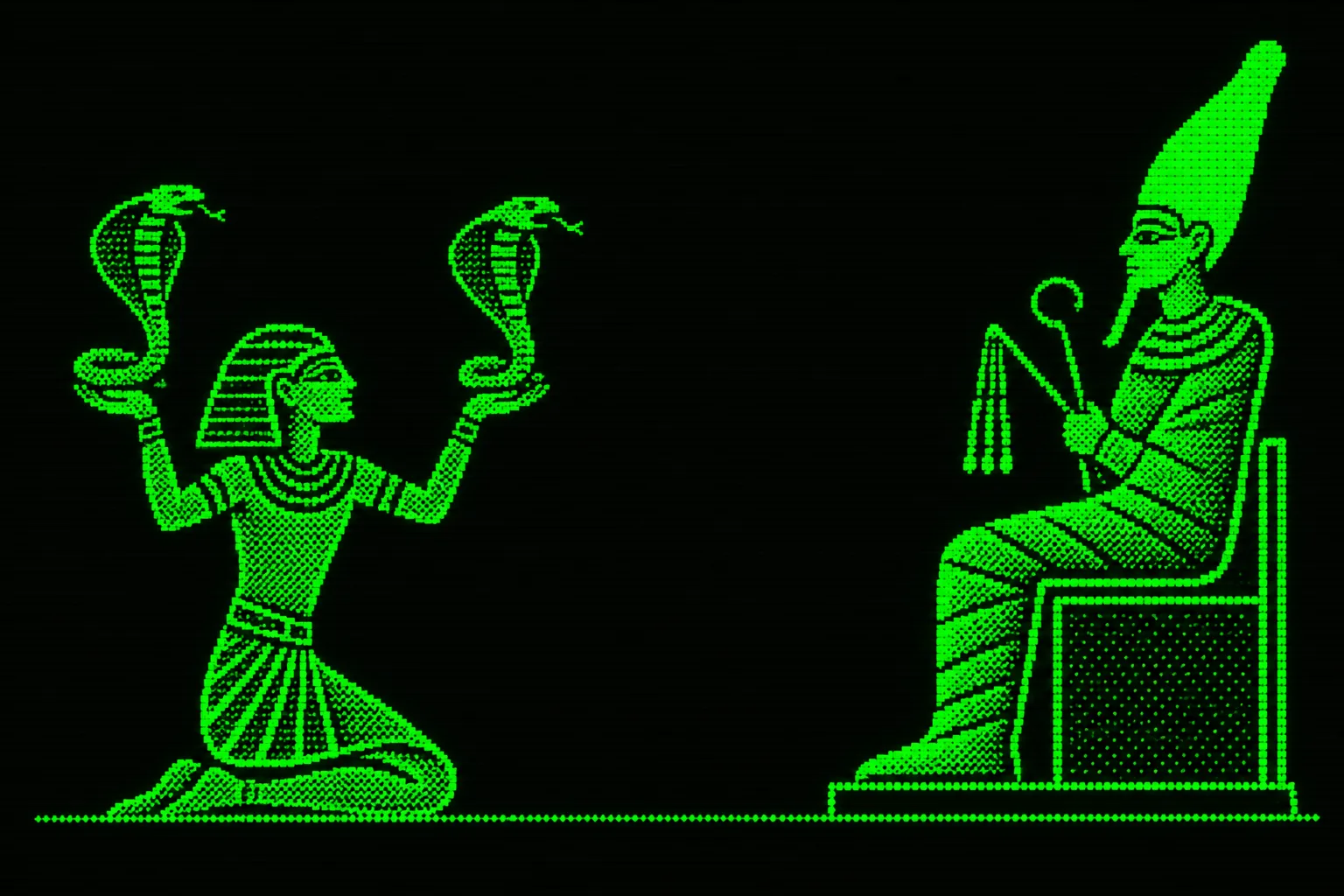
The dead person, named as an Osiris, speaks on the way into the god’s tribunal. The speaker takes up the royal serpents: I raise the sacred cobras. The speaker has built in Busiris and plowed fields there, and refuses the food of the damned: Dung is what I loathe. I will not eat it. The bread is white emmer, the beer comes from the red barley of Hapi, and the sun’s two boats deliver both.
Then comes the claim to rank. Any god who blocks the way is hauled before Ra, and Those who dwell in darkness tremble before me. Seated with Osiris, the speaker reports to him: I tell him of the affairs of mortals. A voice answers: Come, worthy spirit!
- 1
rʾ n ꜥq r ḏꜣḏꜣ,t Wsjr
Spell for entering the tribunal of Osiris.
- 2
ḏd-mdw jn Wsjr [...] mꜣꜥ-ḫrw
Words to be spoken by the Osiris …, vindicated:
Note · Line 2
The deceased takes the name of Osiris. “Vindicated” means that the speaker has been found to be in the right before the divine tribunal. - 3
qd bꜣ =j ḫnt Ḏd,w
My ba has built at the head of Busiris.
Note · Line 3
The ba is the aspect of a person that can go abroad after death. Busiris was a center of the worship of Osiris in the Nile Delta. - 4
wꜣḏ.pl =j m Pi̯
My green plants are in Pe.
Note · Line 4
Pe was one of the towns that made up Buto in the Delta. - 5
skꜣ.n =j ꜣḥ,t.pl =j m jrw =(j)
I have plowed my fields in my own form.
- 6
jw mꜣmꜣ =j m Mn,w ḥr =s
There my doum palm stands as Min.
Note · Line 6
Min is a god of fertility; the palm is a form he takes here. - 7
bw,t =j zp-2 nn wnm =j sw
What I loathe! What I loathe! I will not eat it.
- 8
bw,t =j pw ḥs
Dung is what I loathe.
Note · Line 8
The dead feared being made to eat excrement. The speaker claims bread and beer instead. - 9
nn wnm =j sw
I will not eat it.
- 10
ḥtp-kꜣ j:ḫm.pl jm =f nn (j)ꜥr =j r =f m ꜥ.wj =j
The dung of those who knew nothing of him—I will not reach for it with my two hands.
- 11
nn ḫnd.n =j ḥr =f m ṯbw,t.j =j
I have not stepped on it with either of my sandals.
- 12
ḥr-n,tj tʾ.pl =j m btj ḥḏ.t ḥ(n)q,t =j m jt dšr.t n.t Ḥꜥpi̯
For my loaves are made from white emmer,
my beer from the red barley of Hapi.Note · Line 12
Hapi is the Nile flood personified. Its waters sustained the grain crops. - 13
jn (m)sk,tt (m)ꜥnḏ,t jni̯ n =j st
It is the night bark and the day bark that bring it to me.
Note · Line 13
These are the boats in which the sun god travels through the underworld by night and across the sky by day. - 14
wnm =j ẖr zmꜣ,w jsr.w
I eat beneath the branches of the tamarisks.
- 15
jw =j rḫ.kw rmni̯ nfr,pl
I know the bearer of beautiful things.
- 16
jḫ jri̯ n =j sꜣḫ,t ḥḏ,t
May the spells of the White Crown be recited for me!
Note · Line 16
The White Crown is the royal crown of Upper Egypt. - 17
sṯz =j jꜥr,t.pl
I raise the sacred cobras.
- 18
j jr,j-ꜥꜣ n sḥtp-Tꜣ,du.pl nw jri̯ ḥtp ḏi̯! =k fꜣi̯ =j zꜣt,t
O gatekeeper of the peacemakers of the Two Lands, those makers of offerings,
let me lift the earth!Note · Line 18
The Two Lands are Upper and Lower Egypt. - 19
wn n =j ꜣḫḫ,w rmn.du =f
Twilight opens both his arms to me.
- 20
gr psḏ,t m md,t ḥnmm,t ḥnꜥ Wsjr [...] mꜣꜥ-ḫrw
The Ennead falls silent as the sun folk speak together with the Osiris …, vindicated.
Note · Line 20
The Ennead is the company of nine gods; the sun folk are the people of the sun god. - 21
sšmi̯ ḥꜣ,tj.pl nṯr.pl ḫwj =k wj
You who guide the hearts of the gods, may you guard me!
- 22
wsr =(j) m p,t m ꜥḫm.pl
May I be mighty in the sky among the images of the gods!
- 23
j qd.ypl jr nṯr nb nṯr,t nb(.t) ḏꜣi̯ =f sw jm =j sjp.tw =f r-tp-ꜥ Rꜥ,w
O builders, any god or goddess who stands in my way shall be brought before Ra.
- 24
sjp.tw =f n tp(,j)-ꜥ.pl sšp
That deity shall be handed over to the ancestors of light.
- 25
jw ꜣḫ,w ḥbs p,t m nṯr.pl
The radiant spirit who veils the sky is one of the gods.
Note · Line 25
A radiant spirit, or akh, is one of the dead transfigured into a being of divine power. - 26
jw ẖr,t =j jm =j m tʾ r =sn nṯr.pl
I have my share of bread, more than they have, the gods.
- 27
ꜥq.n =j ḥr Jtn
I have gone in upon the Aten.
Note · Line 27
The Aten is the disk of the sun. Atum, named in the next line, is the creator god associated with the setting sun. - 28
pri̯.n =j ḥr Jtm,w ky-ḏd ḥr j(ꜥ)ḥ,w
I have come forth upon Atum. Another reading: upon the moon god.
- 29
md,t n =j šms,w =f nṯr.pl
His followers, the gods, speak to me.
- 30
md,t n =j ḥnmm,t
The sun folk speak to me.
- 31
nrjw n =j jm,j.w kk,w
Those who dwell in darkness tremble before me.
- 32
zmꜣ.n =j m-ẖnw Mḥ,t-wr,t r-gs jm,j-hrw≡f
I have joined the others within the Great Flood, beside the one whose day it is to serve.
Note · Line 32
The Great Flood is Mehet-Weret, the cow goddess who embodies the waters of creation. - 33
jsk wj jm ḥnꜥ Wsjr tmꜣ(,t) =j
Now I am there with Osiris—my mat.
Note · Line 33
A mat was a place to sit. Here the speaker names it but says no more about it. - 34
ḏd =j n =f md,t r(m){r}〈ṯ〉.pl
I tell him of the affairs of mortals.
- 35
wḥm =j n =f md,t nṯr.pl
I recount to him the affairs of the gods.
- 36
jy ꜣḫ,w-(j)qr
Come, worthy spirit!
Note · Line 36
The dead speaker is now addressed as an akh, a spirit transfigured after death and able to act among the gods. - 37
s(j)ꜥr mꜣꜥ,t n mri̯.tw sw
Offer up Maat to the one who is loved.
Note · Line 37
Maat is truth, justice and right order, personified as a goddess. She could be offered to a god in the form of a small figure. - 38
jnk ꜣḫ,w ꜥpr r ꜣḫ.w nb twt sꜥḥ.w Jwn,w Ḏd,w Nn-nsw,t Ꜣbḏ,w Jp,w ⸮Sn,pl?
I am a spirit better equipped than any other spirit, the equal of the mummified dead of Heliopolis, Busiris, Heracleopolis, Abydos, Panopolis and the Senu shrine.
- 39
jw mꜣꜥ-ḫrw Wsjr [...] mꜣꜥ-ḫrw m-ꜥ nṯr nb nṯr,t nb(.t) n,tj jmn(.w) m ẖr,t-nṯr
The Osiris …, vindicated, stands vindicated before every god and every goddess hidden in the realm of the dead.
Note · Line 39
Here “the Osiris” is the dead person, identified with the god who was himself vindicated after death.