~/sacred-texts/book-of-the-dead
Book of the Dead Spell 153: You Have Not Caught Me in That Net
- Text
- Book of the Dead, Spell 153
- Date
- Copied in the 18th Dynasty under Amenhotep III (c. 1390–1352 BC) on the funerary papyrus of Yuya, and recopied on papyri down to the Ptolemaic period
- Found
- Yuya's papyrus was found in 1905 in his tomb, KV46, in the Valley of the Kings at Thebes; now in the Egyptian Museum, Cairo (CG 51189)
- Language
- Egyptian (Middle Egyptian) · Hieroglyphic
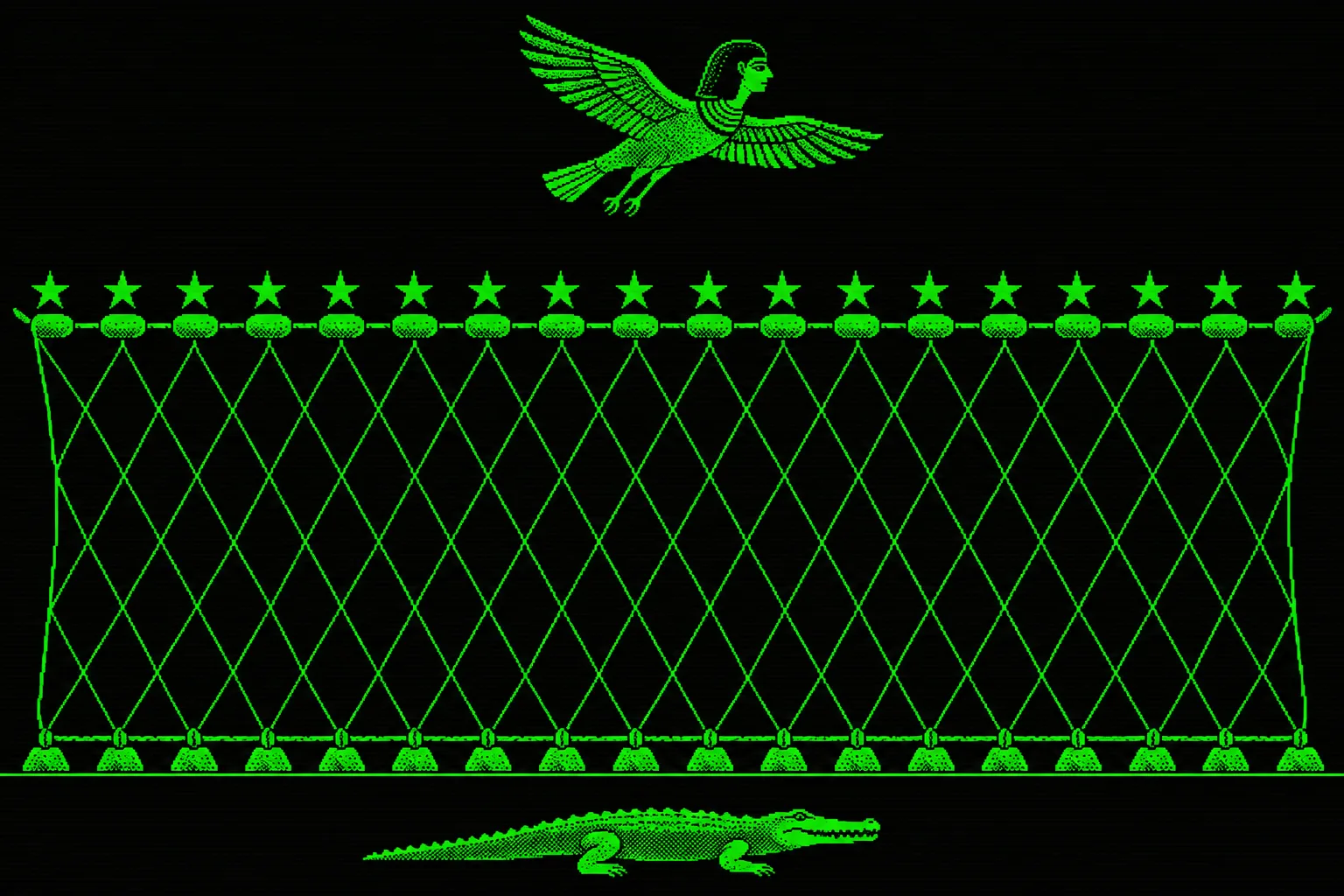
The dead man faces the fishermen of the next world. Their net, whose floats reach the sky and whose weights reach the earth, catches the Weary Ones, the dead. He tells them: you have not caught me in that net of yours. His proof is knowledge. He names each part of the net as the body of a god: the fork is Sokar’s thumb, the rope is the sinews of Atum, the stake is the leg of Shesmu, god of slaughter. The fishermen are the Akeru, serpent gods of the earth.
Then he becomes the fisher, knife in hand: For I am the net, down to its sinkers below and up to its floats above. He asks to cross to the northern sky and live on what they live on.
- 1
rʾ n pri̯.t m jꜣd,t m-ẖnw jn,t
Spell for escaping the net in the heart of the valley.
- 2
ḏd-mdw jn [...] mꜣꜥ-ḫrw nb-jmꜣḫ
Words to be spoken by …, vindicated and revered:
Note · Line 2
The papyrus belonged to Yuya. “Vindicated” declares that the dead man has been judged to be in the right. - 3
Mꜣꜣ-ḥꜣ≡f sḫm m jb =f wḥꜥ ḏsf,w n wbꜣ,t-tꜣ jbꜣ,t-tꜣ j wḥꜥ.pl jpw ms.w jti̯.pl =sn ḥꜣm.pl pẖr.yw m-ẖnw nwi̯,t n ḥꜣm =ṯn wj m jꜣd,t =ṯn twy ḥꜣm =ṯn nn,yw jm =s
He Who Looks Behind Him, master of his own heart,
who takes the prey of the trap—the trap!
O you netters, children of their fathers,
who fish as you range through the floodwaters,
you have not caught me in that net of yours
with which you catch the Weary Ones.Note · Line 3
He Who Looks Behind Him is a divine ferryman. The Weary Ones are the dead. - 4
n jss{.t} =ṯn wj m jss,t =ṯn twy jss.t =ṯn ḫtj.w-tꜣ jm =s n,t(j).t ḏbꜣ,w r p,t dns.w =s r tꜣ
You have not snared me in that snare of yours
with which you snare the Wanderers,
whose floats reach the sky and whose weights reach the earth. - 5
pri̯.n =j m jbj =s
I have come free of its cover.
- 6
ḫꜥi̯.n =j m Ḥnw
I have risen as the Henu barque.
Note · Line 6
The Henu was the sacred boat of Sokar, a god of the dead. - 7
pri̯.n =j m ḏr,t.pl =s
I have come free of its hands.
- 8
ḫꜥi̯.n =j m Sbk
I have risen as Sobek.
Note · Line 8
Sobek is the crocodile god. - 9
jri̯.n =j ꜥpꜣ,w r =ṯn m wḥꜥ ḏsf,w jmn ḏbꜥ.pl
I have flown to you as a catcher of prey, my fingers hidden.
- 10
jw =j rḫ.kw rn n ꜥḏ jm =s
I know the name of the fork in the net.
Note · Line 10
By naming the parts of the net, the speaker claims power over it. What looks like fishing gear is also the very flesh of the gods. - 11
ḏbꜥ pw wr n Zk{r}j
It is Sokar’s thumb.
Note · Line 11
The Egyptian name for the thumb is “great finger.” - 12
jw =j rḫ.kw mḏꜣ,t =j jm =s
I know my wooden peg in the net.
- 13
ḏr,t pw n.t ꜣs,t
It is the hand of Isis.
- 14
jw =j rḫ.kw {jw}šꜥ,t =j jm =s
I know my knife in the net.
- 15
ḥsb,t twy pw n.t ꜣs,t šꜥd.t npꜣ.w n Ḥr,w jm =s
It is that blade of Isis with which she cut Horus’s umbilical cord.
- 16
jw =j rḫ.kw rn n ḏbꜣ.w =s dns.pl =s
I know the name of its floats and its weights.
- 17
pꜣd-mꜣs,t tw〈y〉 pw{y} n.t Rw,tj
It is this kneecap of the Two Lions.
Note · Line 17
The Two Lions form a single deity called Ruti. - 18
jw =j rḫ.kw rn n nwḥ =s ḥꜣm.w sj ḥr =s
I know the name of its rope, which draws the net shut upon itself.
- 19
〈r〉wḏ.w pw n Jtm,w
They are the sinews of Atum.
- 20
jw =j rḫ.kw rn n wḥꜥ.w ḥꜣm sj
I know the name of the fishermen who fish with it.
- 21
ꜣkr,w pw tp(,j).w-ꜥ ẖb.yw
They are the Aker gods, the ancestors who were subdued.
Note · Line 21
The Aker gods are earth gods in the form of snakes. - 22
jw =j rḫ.kw rn n mḫsf =j jm =s
I know the name of my stake in the net.
- 23
sbq pw n Šzm,w
It is the leg of Shesmu.
- 24
jw =j rḫ.kw rn n ꜥ.wj jꜥꜥ!.w s(j) ḥr =f
I know the name of the two arms that wash the net on the stake.
- 25
ꜥ.wj pw n nṯr-ꜥꜣ nb sḏm-md,t m Jwn,w grḥ pwy n smd,t m ḥw,t-Jꜥḥ zꜣb ms
They are the two arms of the great god,
lord of the hearing in Heliopolis
on that night of the full-moon feast in the House of the Moon,
the judge of the child. - 26
jw =j rḫ.kw rn n wꜥr,t gwꜣ.t.tw =s ḥr =s
I know the name of the reach where the net is drawn tight.
- 27
wꜥr,t tw pw bjꜣ,y ꜥḥꜥ.t nṯr.pl ḥr =s
It is this reach of metal on which the gods stand.
- 28
jw =j rḫ.kw rn n wdp,w šzp rmi̯.w jm =s
I know the name of the attendant who takes the fish from it.
- 29
j{ꜣ}bṯ m sd pw wdp,w n nṯr.pl
He is Catcher-with-His-Tail, attendant of the gods.
- 30
jw =j rḫ.kw rn n ḥtp wꜣḥ.y =f sw ḥr =f
I know the name of the offering table on which he lays the fish.
- 31
ḥtp Ḥr,w pw sḥtp nṯr nb ḥmsi̯ nṯr nb ḥꜣ =f
This is the offering table of Horus. It satisfies every god, and every god takes his seat around it.
Note · Line 31
The dead man speaks. To escape the net set for the dead, he must show that he knows its parts and their divine names. - 32
jw =j rḫ.kw rn n wꜣḥ.y =f n =f sw
I know the name of the one for whom he sets it down.
- 33
Ḥr,w pw ḥmsi̯(.w) wꜥi̯.yw m kk,w jw,tj mꜣꜣ =f snḏ n =f n,tjw ḏḏ!.w n =f jw,t(j){t}w
It is Horus, who sits alone in the dark, whom no one can see.
Those who are fear him;
those who are not are given to him.Note · Line 33
“Those who are” are the living; “those who are not” are the dead. - 34
jw =j rḫ.kw mḫsf =j jm =s
I know my stake in it.
- 35
sbq pw n Šzm,w
It is the leg of Shesmu.
Note · Line 35
Shesmu is a god of the winepress and of slaughter. - 36
jy.n =j ḫꜥi̯ =j m wr sšmi̯-tꜣ hꜣi̯ tꜣ {j}m wjꜣ.du ꜥꜣ.wj
I have come, appearing as the Great One, the Guide of the Land,
who came down to earth in the two great barques. - 37
jn wr rḏi̯ n =j ḥr,j-jb ḥw,t wr
It was the Great One who gave it to me in the heart of the prince’s mansion.
- 38
jy.n =j ḫr =k wḥꜥ ꜥrr,yt =f
I have come to you, fisherman of his gate.
- 39
ꜥḏ =j m-ꜥ =j
My holding fork is in my hand.
- 40
jw šꜥ,t =j m-ꜥ =j
My cutting knife is in my hand.
- 41
zfṯ =j m-ꜥ =j
My slaughtering knife is in my hand.
- 42
pri̯ =j pẖr.y =j
I go out and make my rounds.
- 43
ḏsf.n =j m jꜣd,t =j
I have made my catch with my net.
- 44
jw =j rḫ.kw rn n ꜥḏ tmm rʾ.pl wbn,w pwy
I know the name of the fork that closes the mouths of that wound.
- 45
ḏbꜥ.du pw{y} wr n Wsjr
They are the two great fingers of Osiris.
- 46
jw =j rḫ.kw rn n ḏbꜥ.du nḏri̯.yw sw
I know the name of the two fingers that grip it.
- 47
ḏbꜥ.du pwy tp(,j) ꜥ Rꜥ,w ꜥn,t.pl tp(,j).t ꜥ Ḥw,t-Ḥr,w
They are the two fingers on the hand of Ra, the nails on the hand of Hathor.
- 48
jw =j rḫ.kw rn n mḫsf
I know the name of the stake.
- 49
sbq pw n Šzm,w
It is the leg of Shesmu.
- 50
jw =j rḫ.kw rn n nw,t n,tj(.t) ḥr ꜥḏ pn
I know the name of the rope on this fork.
- 51
rwḏ.pl nb-rḫ,yt pw
It is the sinews of the Lord of the People.
- 52
jw =j rḫ.kw rn n mḏꜣ,t =s
I know the name of its wooden peg.
- 53
ḏr,t pw n.t ꜣs,t
It is the hand of Isis.
- 54
jw =j rḫ.kw rn n wꜣ,t.pl =s
I know the name of its cords.
- 55
wꜣ,t.pl nṯr sms,w pw
They are the cords of the eldest god.
- 56
⸢jw⸣ =j rḫ.kw rn n jḥ.pl =s
I know the name of its strands of twine.
- 57
nw,t hrw pw
They are the rays of daylight.
- 58
jw =j rḫ.kw rn n wḥꜥ.pl =s ḥꜣm.pl s(j)
I know the name of its fishermen, who fish with it.
- 59
ꜣkr,w pw tp(,j).w-ꜥ Rꜥ,w [...] tmm.w tp(,j).w-ꜥ Gbb
They are the Akeru, the ancestors of Ra,
… the destroyers, the ancestors of Geb.Note · Line 59
The Akeru are serpent gods of the earth. Geb is the earth god. - 60
j jni̯ n =k wnm.n =k jni̯.n =j wnm.n =j
O you who hauled in for yourself the one you ate,
I have hauled in the one I ate. - 61
ꜥm.n =j ꜥm.n =j j:mnḥ n Wsjr
I have swallowed whom I have swallowed, O Butcher of Osiris!
Note · Line 61
Yuya, the dead man for whom this papyrus was made, speaks this spell to escape the nets of the next world. The Egyptian word for “swallow” can also mean “know.” - 62
j Ḥr≡f-ḥꜣ≡f sḫm m jb =f wḥꜥ ḏsf,w n 〈w〉bꜣ{ꜣ},t-tꜣ wbꜣ{ꜣ},t-tꜣ j wḥꜥ.pl ḥꜣm.yw ms.w jti̯.w =sn gr(g).yw sḫt.yw m-ẖnw Jwn =s 〈n〉 ḥꜣm =ṯn wj m jꜣd,t =ṯn tw
O He Whose Face Is Behind Him, master of his own heart,
fisher of Earth-Opener’s catch—Earth-Opener!—
O fishers and netters, children of their fathers,
who set traps within Her Pillar,
you cannot catch me in this net of yours!Note · Line 62
Earth-Opener is the name of a trap. - 63
n sḫt =ṯn wj m šnw.pl =ṯn ḥꜣm =ṯn nni̯,yw jm =s sḫt{.t} =ṯn ḫtj,w-tꜣ jm =s
You cannot snare me with your cords.
In that net you catch the Weary Ones;
in it you snare the wandering tribes. - 64
ḥ{nꜥ}〈r〉-n,tt wj sj r ḏbꜣ.w =s ḥr,j.w r d(n)s.w =s ẖrj
For I am the net, down to its sinkers below and up to its floats above.
- 65
m =k wj m =k jrf wj jy.kw
Look at me! Look now, I have come.
- 66
mḫsf =j m-ꜥ =j
My stake is in my hand.
- 67
ꜥḏ =j m-ꜥ =j
My fork is in my hand.
- 68
mḏꜣ,t =j m-ꜥ =j
My wooden peg is in my hand.
- 69
jw šꜥ,t =j m-ꜥ =j
My knife is in my hand.
- 70
jy.n =j
I have come
- 71
ꜥq =j
to enter,
- 72
ḥwi̯ =j
to strike.
- 73
jy.n =j ḏs =j
I myself have come
- 74
ḏsf =j ṯꜣ.pl
to catch chicks,
- 75
ḏsf =j sw
to catch him,
- 76
ḏi̯! =j sw m s,t =f
to set him in his place,
- 77
sḏ =j pḏ
to break the bow of the net,
- 78
ḥwi̯ =j sw
to strike him,
- 79
ḏi̯! =j sw m s,t =f
to set him in his place.
- 80
jr mḫsf pn n,tj m-ꜥ =j sbq p(w) n Šzm,w
This stake in my hand is the leg of Shesmu.
Note · Line 80
Yuya names the tools in his hand as parts of the gods’ bodies or as tools the gods themselves wield. - 81
jr ꜥḏ pn n,tj m-ꜥ =j ḏbꜥ.du pw n Zk{r}j
This fork in my hand is the two fingers of Sokar.
- 82
jr mḏꜣ,t n,tj m-ꜥ =j ḏr,t pw n(.t) ꜣs,t
The wooden peg in my hand is the hand of Isis.
- 83
j〈r〉 šꜥ,t n,tj(.t) m-ꜥ =j ḥsb,t pw n.t Šzm,w
The knife in my hand is Shesmu’s slaughtering knife.
- 84
m =k wj jy.kw
Look, I have come.
- 85
m =k jrf wj jy.kw
Look now, I have come!
- 86
ḥmsi̯ =j m wjꜣ
May I take my seat in the barque.
- 87
ḏꜣi̯.y =j mr-nḫꜣ,du r p,t mḥ,t(j).t
May I cross the Canal of the Two Knives to the northern sky.
- 88
sḏm =j mdw nṯr.pl
May I hear the words of the gods.
- 89
jri̯.y =j jrr!.t =sn
May I do what they always do.
- 90
hn,w m hn,w n kꜣ =j
Joy upon joy for my ka!
Note · Line 90
The ka is the life force of a person. It endures after death and receives offerings. - 91
ꜥnḫ =j m ꜥnḫ =sn jm
May I live on what they live on!
Note · Line 91
The dead man speaks in a spell for escaping a fishing net in the afterlife. - 92
pri̯ [...] mꜣꜥ-ḫrw ḥr mꜣq,t tn jri̯.tn n =f jti̯ =f Rꜥ,w
May …, the vindicated one, climb out on this ladder his father Ra made for him!
Note · Line 92
“Vindicated” is a title for the dead who have been judged in the right before the gods. - 93
nḏri̯ Ḥr,w Stš m ꜥ ={j}f
May Horus and Seth take him by the hand!
Note · Line 93
Horus and Seth are rivals, but here they help the dead man together.