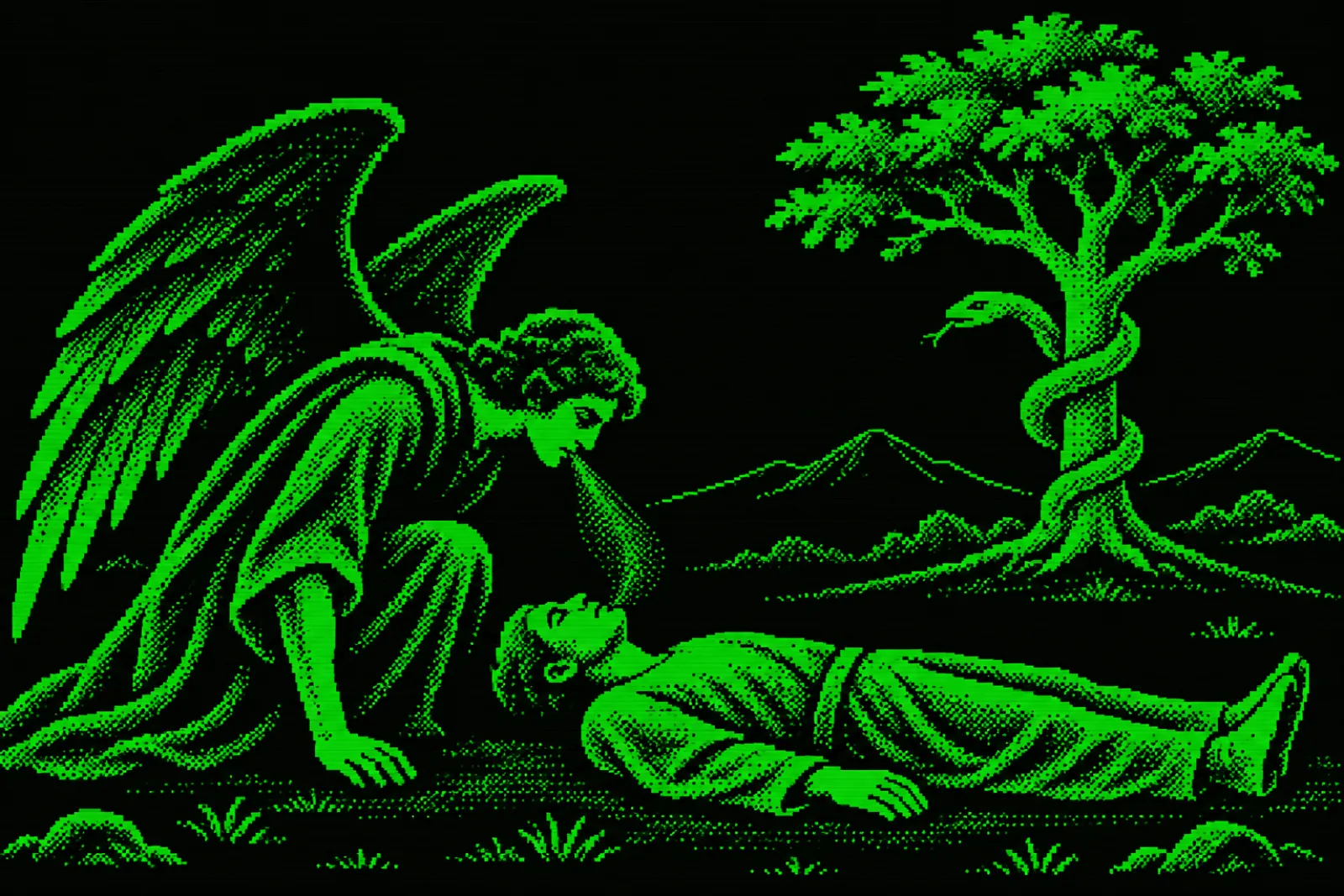
~/sacred-texts/bogomil-books-and-legends
Bogomil Legends of Adam: Satan Makes the Body
Translated by AI straight from the Latin and Church Slavonic, not from a modern translation, then checked against the editions and studies listed below. How we translate
- Text
- Bogomil books and legends, Interrogatio Iohannis chs. V–VII (Carcassonne and Vienna); Slavonic Baruch ch. V; On the Tiberias Sea (two Russian versions); Tale of the Cross-tree
- Date
- Bogomil originals of the 11th–12th centuries; the Latin copies from the late 12th century, the Slavonic from the 13th (Cross-tree) to the 18th century (Tiberias Sea, second version)
- Found
- Bulgaria and the Balkans; the Latin carried to the Cathars of Lombardy and Languedoc, the Tiberias Sea to Russia
- Language
- Latin and Church Slavonic · Latin and Cyrillic alphabets
The Bogomils, dualist heretics of tenth-century Bulgaria, taught that the visible world and the human body were made by Satanael, the Father’s fallen son, and that only the spirit came from above. Their books spread west to the Cathars of Italy and southern France and north into Russia. Jordan Ivanov gathered them in Bogomilski knigi i legendi (Sofia, 1925), printing every text in its original language. This page takes from his edition what the books say about the making of Adam, the serpent and the Fall.
The Secret Book, the Interrogatio Iohannis, survives only in Latin. In it John asks Christ at the Last Supper how the world was made, and Christ answers that Satan made it. Two copies exist: one from the Inquisition archive at Carcassonne, which says it was brought from Bulgaria by Nazarius, the Cathar bishop of Concorezzo, and one in Vienna, with glosses in its margin. Each beat of the creation and the Fall is given here twice, Carcassonne (C) first and then Vienna (V). The margin glosses follow the lines they explain.
The Slavonic texts follow. In the Revelation of Baruch, an angel tells Baruch that the tree of the Fall was a vine Satanael planted. On the Tiberias Sea survives in Russian copies of a Bulgarian original. In it Satanael dives for the earth, pierces the clay Adam while God is away fetching the soul, and goes into paradise inside the serpent’s belly. Adam’s three trees then pass into the wood of the cross. A second Russian copy tells the piercing again and adds that Satan refused to bow to Adam. Last comes the scene of Moses and the three trees from the oldest Bulgarian copy of the Tale of the Cross-tree, which the Latin margin of the Secret Book repeats.
Every line is translated from the Latin or Slavonic. The reference under each line names the copy and chapter. Other episodes of the same books are left out, among them Satan’s fall, Enoch’s books, Adam’s bond with Satan and the Tiberias Sea’s chapter on Cain and Abel. On the Gnostic background, see Gnosticism and the Eve Theory of Consciousness.
Each numbered line gives the Latin and Church Slavonic first. Our English is underneath. Tap a dotted word for its meaning, and Note for our comment on the line; our comments are in the right margin.
The Secret Book (Interrogatio Iohannis): Satan makes Adam and Eve
- i0V, margin to IV
Volucres et pisces non habent spiritum nec bestiae, neque habent spiritum hominis, sed volucres et pisces ab aquis et aëre et bestiae a terra et aëre recipiunt, quod habent.
Birds and fish have no spiritus: breath, spirit, soul, nor do beasts; nor do they have the spirit of a man: birds and fish receive what they have from the waters and the air, and beasts from the earth and the air.
Note on line i0
A gloss in the margin of the Vienna manuscript, beside Satan’s command that the earth and sea bring forth living things. It sets up what follows: animals are made of the elements alone, but man will get a spirit, an angel shut in the clay. The print has haben, a misprint for habent. - c1C, ch. V
Et praeterea excogitavit et fecit hominem ad similitudinem ejus vel sui, et praecepit angelo tertii coeli intrare in corpus luteum.
And after that he excogito: to think out, to devise and made man in his likeness, or his own, and ordered the angel of the third heaven to go into the corpus luteum: a body of mud, of clay.
Note on line c1
C is the Carcassonne text, V the Vienna. The maker is Satan throughout: the chapters before tell how he fell, raised the dry land and made sun, moon, stars and his own angels. ejus vel sui (“his, or his own”) is the copyist’s hedge over whose likeness is meant; both point back to Satan. - v1V, ch. V
Et cogitavit facere hominem in servitio sibi, et tulit de limum terra et fecit hominem similem sibi. Et praecepit angelo secundi coeli interoire in corpus luti,
And he thought to make man to in servitio sibi: in service to himself, and he took limus: mud, slime of the earth and made man like himself. And he ordered the angel of the second heaven to go into the body of mud,
Note on line v1
The Vienna text gives the motive plainly: Satan makes man to be his servant. The two copies differ on the heavens: the angel in Adam is from the third heaven in C, the second in V; the angel in Eve from the second in C, the first in V. - c2C, ch. V
Et tulit de eo et fecit aliud corpus in formam mulieris, et praecepit angelo secundi coeli introire in corpus mulieris.
And he took from it and made another body in the form of a woman, and ordered the angel of the second heaven to go into the woman's body.
- v2V, ch. V
et tulit de eo et fecit aliud corpus in forma mulieris praecepitque angelo primi coeli introire in illum.
and he took from it and made another body in the form of a woman, and ordered the angel of the first heaven to go into it.
- c3C, ch. V
Angeli vero ploraverunt videntes in se formam mortalem et esse dissimilis forma.
But the angels ploro: to wail, to weep aloud when they saw a mortal form on them, and that they were unlike in form.
- v3V, ch. V
Angeli ploraverunt multum videntes super se formam mortalem esse in divisis formis.
The angels wept greatly when they saw a mortal form upon them, being in divisae formae: forms split apart.
Note on line v3
The “divided forms” are the two sexes: one clay body has been cut into a man’s and a woman’s, and the angels inside them weep at it. - c4C, ch. V
Et praecepit opus carnale facere in corporibus luteis, et non intellexerunt facere peccatum.
And he ordered them to do the opus carnale: the fleshly act, intercourse in the bodies of clay, and they did not understand how to do the sin.
- v4V, ch. V
Praecipiebatque eis carnalis opera facere in corporibus luti, et illi nesciebant facere peccatum.
And he kept ordering them to do the works of the flesh in the bodies of mud, and they did not know how to do the sin.
Note on line v4
Satan’s first command to the pair is to have sex. They cannot: the angels in the clay do not know how, and the next lines are his plan to teach them. - c5C, ch. V
Sententiator malorum ita cogitavit cum ingenio suo ut faceret paradisum, et introduxit homines, et praecepit adducere.
The sententiator malorum: one who pronounces sentence, an arbiter (DMLBS) thought it out with his cunning, to make a paradise, and he brought the people in, and ordered them led there.
Note on line c5
praecepit adducere has no object in the print; the sense is “ordered them brought in”. M. R. James (1924) reads it with the next sentence, “commanded to bring a reed”. - v5V, ch. V
Initiator autem peccati cum sua seductione ita fecit: plantavit paradisum et misit homines intra et praecepit eis ne comederent ex eo.
And the initiator peccati: the one who starts sin did this, with his seductio: a leading astray: he planted a paradise and put the people in it and ordered them not to eat from it.
Note on line v5
Paradise too is Satan’s planting, not God’s, and the prohibition is his. The margin gloss that follows says what paradise is. - v5nV, margin to ch. V
Plantavit paradisum id est ortum fructiferum XX arboribus, scilicet nucibus et malis, perimicis et cotanis et aliis pomis et inte et circumdedit omnia paradisino igne et misit intus Adam et Evam
plantavit paradisum: the words of the text the gloss explains: that is, a fruit-bearing garden with twenty trees, namely nuts and apples, peaches and cottana: small Syrian figs and other fruits, and … and he surrounded everything with the fire of paradise and put Adam and Eve inside,
Note on line v5n
Ivanov’s print of the gloss has several broken words: perimicis is persicis, peaches; cotanis as cottanis, small figs; inte is unreadable; paradisino igne is “paradise fire”, the flaming sword of Genesis 3:24 set round Satan’s garden. - v5n2V, margin to ch. V
et adhuc manet ad deceptionem hominum, qui credunt ea esse bonum locum, sed malus est. In vetita non fuit mors, sed Diabolus latenter misit saporem suum in —, ut posset decipere eos; non tamen esset liberatus a morte, si non comedisset, sed Diabolus fecit hoc totum, ut decipiat homines.
and it still remains, to deceive men, who believe it a good place; but it is evil. There was no death in the forbidden [fruit], but the Devil secretly put his own sapor: taste, flavour, savour into [it], so that he could deceive them; yet [man] would not have been free of death if he had not eaten: the Devil did all this to deceive men.
Note on line v5n2
Ivanov prints intis vetita with a dash where a word is lost; the text is in vetita, with “fruit” and “it” restored in brackets. The point of the gloss is that the clay body was mortal from the start: eating did not bring death, the Devil only flavoured the fruit with his own taste. - c6C, ch. V
Et plantavit Diabolus arundinem in medio paradisi, et ita celavit ingenium suum Diabolus nequam, ut ipsi non cognoscerent deceptionem ejus.
And the Devil planted a arundo: reed, cane in the middle of paradise, and the wicked Devil so hid his cunning that they did not recognize his deceit.
Note on line c6
The tree of the knowledge of good and evil is a reed. Ivanov (p. 70) sets beside it the Slavonic Baruch, where Satanael plants the vine in paradise (below). - v6V, ch. V
Diabolus introivit in paradisum et plantavit arundinem in medio paradisi, et de sputo suo fecit serpentem et praecepit ei in arundine manere. Et sic Diabolus asscondebat sapientiam suae fraudis, ut non viderent deceptionem suam.
The Devil went into paradise and planted a reed in the middle of paradise, and from his sputum: spit, spittle he made the serpens: snake, serpent and ordered it to stay in the reed. And so the Devil hid the sapientia suae fraudis: the cleverness of his trick, so that they would not see his deceit.
Note on line v6
Only Vienna has the serpent made from the Devil’s spittle. Its margin gloss below gives a second version: the serpent was made from the Devil’s slaver, which fell from him while he slept. Either way the serpent is a thing of the Devil’s own body. Wakefield and Evans (1969) give “a bed of reeds”; the Latin is a single reed. - c7C, ch. V
Et intrabat et loquebatur ad eos, dicens: de omni fructu, qui est in paradiso, comedite, de fructu vero scientiae boni et mali nolite comedere.
And he used to go in and speak to them, saying: “Eat of every fruit that is in paradise, but do not eat of the fruit of the knowledge of good and evil.”
- v7V, ch. V
Et introibat ad eos, dicens: de omni fructu comedite, qui est in paradiso, de fructu iniquitatis ne comedatis.
And he used to go in to them, saying: “Eat of every fruit that is in paradise; do not eat of the fruit of iniquitas: injustice, wickedness.”
- c8C, ch. V
Verumtamen introivit Diabolus in serpentem nequam et seduxit angelum, qui erat in forma mulieris, et effudit frater ejus concupiscentiam peccatorum, et fecit concupiscentiam suam cum Aeva in cantu serpentis.
But the Devil went into the wicked serpent and seduced the angel that was in the woman's form, and effudit frater ejus: so printed, “her brother poured out”, a corruption of effudit super eam the concupiscentia: desire, lust of sins, and he worked his lust with Eve in cantu serpentis: so printed; Vienna has cum cauda serpentis, with the serpent's tail.
Note on line c8
Two corruptions in the Carcassonne print (Benoist 1691, as Ivanov gives it). frater ejus “her brother” makes no sense where Vienna has super caput ejus “on her head”, and is a misread abbreviation; M. R. James (1924) leaves the clause out. in cantu serpentis “in the serpent’s song” stands where Vienna has cum cauda serpentis; James translates “in the Song of the serpent”, but cantu is a copying error for cauda, the serpent’s tail. - v8V, ch. V
Postea malignus Diabolus, intrans in serpentem malum, et decepit angelum, qui erat in forma mulieris, et effundit super caput ejus concupiscentiam peccati, et fuit concupiscentia Evae sicut fornax ardens.
Then the malign Devil went into the evil serpent and deceived the angel that was in the woman's form, and poured the desire of sin out over her head, and Eve's concupiscentia: desire, lust was like a burning fornax: furnace, oven.
Note on line v8
Wakefield and Evans (1969) have “a longing for sin” and “a glowing oven”. The Latin is the standard word for carnal desire, and a fornax ardens is a blazing furnace. - v9V, ch. V
Statimque Diabolus, exiens de arundine in forma serpentis, fecit concupiscentiam suam cum Eva cum cauda serpentis.
And at once the Devil came out of the reed in the form of the serpent and worked his lust on Eve with the serpent's cauda: tail; also, in Latin slang, the penis.
Note on line v9
The Fall is sex: the Devil, inside the serpent, has Eve with the snake’s tail. cauda is also Latin slang for the penis (Horace, Satires 1.2.45, so Lewis & Short), and the double sense is intended. Wakefield and Evans: “sated his lust on her with the serpent’s tail”. - v9nV, margin to ch. V
Serpens non fuit ut serpens, sed sicut homo; fecit enim se sicut pulcrem adolescentem et per praeceptum Diaboli introivit in paradisum per — canam et decepit mulierem et fornicatus est cum ea cum cauda, quod Diabolus cum dormiret, cecidit de bava ejus, ex illa creatus est ille serpens.
The serpent was not like a serpent but like a man: he made himself like a pulcher adulescens: a beautiful young man, and at the Devil's order went into paradise through … and deceived the woman and fornicor: to have sex outside marriage, to whore with her with his tail; for while the Devil slept, it fell from his bava: saliva, slobber (DMLBS; Old French bave), and from that the serpent was created.
Note on line v9n
A gloss in the Vienna margin. Ivanov prints nos fuit (for non fuit) and a lost word before canam. Ivanov (p. 70) compares a Bosnian apocryphon in which the serpent becomes a beautiful maiden instead. Wakefield and Evans, as reproduced online, do not carry the Vienna margin glosses. - c9C, ch. V
Et ideo dicuntur filii Diaboli et filii serpentis facientes concupiscentiam Diaboli patris eorum usque ad consummationem hujus saeculi.
And that is why they are called sons of the Devil and filii serpentis: children of the snake, doing the lust of the Devil their father until the end of this age.
Note on line c9
An echo of John 8:44, “You are of your father the devil, and the lusts of your father you will do”, read literally: the human race is the serpent’s offspring. - v10V, ch. V
Ideo non vocantur filii Dei, sed filii Diaboli et filii serpentis voluntates patris facientes diabolicas usque ad saeculi finem.
That is why they are not called sons of God but sons of the Devil and sons of the serpent, doing the devilish wishes of their father until the end of the age.
Note on line v10
Wakefield and Evans supply “[the offspring]” as subject. The Latin has none: “they” are Eve’s children by the serpent, and through them all who are born. - c10C, ch. V
Et iterum effudit Diabolus in angelo, qui erat in Adam, venenum suum et concupiscentiam quae generat filios serpentis et filios Diaboli usque ad consummationem hujus saeculi.
And again the Devil poured into the angel that was in Adam his venenum: poison, venom; also a drug or potion and the desire that begets sons of the serpent and sons of the Devil until the end of this age.
Note on line c10
Only Carcassonne has venenum suum, “his venom”: the serpent-Devil pours his venom into Adam together with desire, and the two beget the serpent’s children. M. R. James (1924) merges the pair into “the poison of his lust”; the Latin keeps them as two things poured. - v11V, ch. V
Postea Diabolus effudit suam concupiscentiam super caput angeli, qui erat in Adam, et ambo inventi sunt in concupiscentia luxuriae simul generando filios Diaboli et serpentis usque ad consummationem saeculi.
Then the Devil poured his desire out over the head of the angel that was in Adam, and both were found in the lust of luxuria: lust, lechery, excess, begetting together sons of the Devil and of the serpent until the end of the age.
Note on line v11
Wakefield and Evans: “a lust for debauchery”. luxuria in medieval Latin is the sin of lechery. The Secret Book: who made the bodies of clay
- c11C, ch. VI
Et postea ego Joannes interrogavi Dominum, dicens: quomodo dicunt homines, Adam et Aevam a Deo creatos esse et in paradiso positos servare praecepta Patris, et morti traditi sunt?
And after that I, John, asked the Lord, saying: “How is it that men say that Adam and Eve were created by God and placed in paradise to keep the Father's commandments, and were handed over to death?”
- v12V, ch. VI
Et postea ego Johannes interrogavi Dominum, dicens: quare dicunt homines, Adam et Eva a Deo sunt formati et in paradiso positi fuerunt custodire mandata ejus, et ipsi propter transgressionem praecepti Patris morti traditi sunt?
And after that I, John, asked the Lord, saying: “Why do men say that Adam and Eve were formed by God and placed in paradise to keep his commands, and that for transgressing the Father's commandment they were handed over to death?”
- c12C, ch. VI
Et dixit mihi Dominus: audi Joannes, dilecte Patris mei, insipientes homines ita dicunt in praevaricatione Patrem meum corpora lutea fabricare, sed spiritus sancti propter praevaricationem inventi sunt habentes corpora lutea mortalia, et ideo morti traditi sunt.
And the Lord said to me: “Listen, John, beloved of my Father: foolish men say that my Father fabrico: to build, to forge, to fashion bodies of clay in the transgression; but holy spirits, through praevaricatio: a stepping aside, a breach of duty, were found to have mortal bodies of clay, and that is why they were handed over to death.”
Note on line c12
Ivanov prints sed Spiritu sancti, which does not construe; it is a misprint for spiritus sancti, “holy spirits”, the fallen angels, which fits Vienna’s sense. - v13V, ch. VI
Et Dominus dixit mihi: audi, Johannes carissime, insipientes homines sic dicunt quod in praevaricatione Pater meus lutea corpora fecit, sed de Spiritu sancto omnes virtutes coelorum fecit, ipsi autem propter causam eorum inventi sunt habentes lutea corpora et morti traditi sunt.
And the Lord said to me: “Listen, dearest John: foolish men say that in the transgression my Father made bodies of clay; but he made all the virtutes coelorum: the heavenly hosts, the angels from the Holy Spirit, and it is propter causam eorum: because of their case, their doing that they were found to have bodies of clay and were handed over to death.”
Note on line v13
The Father made only spirits; the clay body is the adversary’s work. Wakefield and Evans add “of His own law” after “transgression” and “[only]” before “all the virtues”. - c13C, ch. VI
Et iterum ego Joannes interrogavi Dominum: qualiter homo incipit esse in spiritum in corpore carnali?
And again I, John, asked the Lord: “How does a man begin to be in spirit, in a body of flesh?”
- c14C, ch. VI
Et dixit Dominus ad me: de caducis angelis de coelo ingrediuntur in corporibus mulierum et accipiunt carnem de concupiscentia carnis, et nascitur — spiritus de spiritu et caro de carne, et ita consummatur regnum Sathanae in hoc mundo et in omnibus gentibus.
And the Lord said to me: “Some of the angels who fell from heaven go into the bodies of women and take flesh from the concupiscentia carnis: carnal lust, and spirit is born of spirit and flesh of flesh; and so the reign of Satan is accomplished in this world and in all nations.”
Note on line c14
Ivanov prints caro de cane, a misprint for carne. Every birth is a fallen angel entering a woman’s body through lust: the spirit is an angel, the flesh comes from desire. - v14V, ch. VI
Et adhuc ego Johannes interrogavi Dominum, dicens: Domine, quomodo incipitur homo de spiritu in corpore carnali?
And still I, John, asked the Lord, saying: “Lord, how is a man begun from spirit in a body of flesh?”
- v15V, ch. VI
Dixitque mihi Dominus: de lapsis spiritibus coelorum ingrediuntur in corpora feminea lutosa et carnem accipiunt de concupiscentia carnis, et nascitur spiritus de spiritu et caro de carne, et ita finitur regnum Sathanae in hoc mundo.
And the Lord said to me: “Some of the fallen spirits of the heavens go into the corpora feminea lutosa: female bodies made of mud and take flesh from the desire of the flesh, and spirit is born of spirit and flesh of flesh; and so the reign of Satan is finio: to bound, to bring to an end, to complete in this world.”
Note on line v15
Wakefield and Evans: “the reign of Satan ceases not in this world”. finitur here is “is completed”, as the Carcassonne consummatur shows: each birth fills out Satan’s reign. The Secret Book: the three trees of the cross
- c15C, ch. VII
Et tunc cum cognovisset, quod descendi de coelo in mundum, misit angelum, et accepit de tribus lignis, et dedit ea ad crucifigendum me Moisi, quae nunc mihi servantur.
“And then, when he knew that I had come down from heaven into the world, he sent an angel, and he took from tria ligna: three pieces of wood, and gave them to Moses for crucifying me; and they are kept for me now.”
Note on line c15
Christ is speaking, and “he” is Satan. The manuscript has qui, and linguis, “tongues”; Ivanov prints quae and lignis, rightly, since quae goes with the wood. - v16V, ch. VII
Cum autem cognovisset Sathanas, quod descenderem in hunc mundum, misit angelum suum et accepit de tribus arboribus et dedit Moysi prophetae ad crucifigendum me, quae ligna mihi custodiuntur usque nunc.
“But when Satan knew that I was to come down into this world, he sent his angel and took from three trees and gave them to the prophet Moses for crucifying me; and that wood is kept for me until now.”
- v16nV, margin to ch. VII
Etiam fuerunt ligna illa, cum quibus divisit mare Moyses, cum autem venerunt filii Israel ad aquas amaras quas qui gustabant moriebantur. Erat tunc angelus Moysi dicens: tolle ligna et junge insimul et planta ea juxta aquam dicens: ista ligna erunt salus mundi et defensio mundi, remissio peccatorum mundi …
Those were also the pieces of wood with which Moses divided the sea; and when the children of Israel came to the aquae amarae: the waters of Marah, Exodus 15:23, whoever tasted them died. Then the angel was with Moses, saying: “Take the wood and join it together and plant it beside the water,” saying: “This wood will be the salvation of the world and the defence of the world, the forgiveness of the world's sins …”
Note on line v16n
The gloss goes on, with gaps, to make the joined wood a sign of the Trinity, and those who drank the healed water a type of those saved by faith in it. The 13th-century Bulgarian Tale of the Cross-tree has the same scene in Slavonic (below), which is Ivanov’s argument (pp. 70–71) that the Secret Book was composed in Bulgaria. Slavonic Baruch: the tree was Satanael’s vine
- b1Baruch, ch. V
И пакы рѣхъ азъ Варохъ къ ангелоу: Господи, покажи ми дрѣво иже прѣльсти змиꙗ Ѥоугоу и Адама.
And again I, Baruch, said to the angel: “Lord, show me the tree by which the змиꙗ: serpent, dragon deceived Eve and Adam.”
Note on line b1
The Slavonic Revelation of Baruch, in Ivanov’s edition of the South Slavonic version (pp. 193–200). A few lines before, the angels each plant a tree in paradise, Michael the olive, Gabriel the apple, and “Satanael planted the vine”. - b2Baruch, ch. V
И рече ми ангелъ: слыши, Варохъ, прьвое дрѣво ѥсть лоза, второе же дрѣво похоть грѣхов'на, иже излиꙗ Сатанаилъ на Ѥоугоу и Адама;
And the angel said to me: “Hear, Baruch: the first tree is the лоза: grapevine, and the second tree is похоть грѣхов'на: sinful desire, carnal lust, which Satanael poured out on Eve and Adam;
Note on line b2
The same image as the Secret Book: desire poured out on the first pair by the adversary. Ivanov (p. 70) prints this line beside the Latin. A few lines before, the Slavonic says that this was the planter’s first name and that after his fall he was still called Satanael; Ivanov’s note says the Greek text calls him Samael. - b3Baruch, ch. V
и сего ради проклелъ бѣ Богъ лозоу, зане бѣ ю Сатанаилъ оусади и тою прѣльсти прьвозданьнаго Адама и Ѥоугоу.
and for this God cursed the vine, because Satanael had planted it, and by it he deceived the прьвозданьнъ: first-created Adam and Eve.”
The Tiberias Sea: Satanael dives up the earth
- t1Tiberias I
Егда не бысть неба ни земли, и тогда бысть одно море Тивириадское, а береговъ у него не было.
When there was neither heaven nor earth, there was only the Tiberias Sea, and it had no shores.
Note on line t1
On the Tiberias Sea, first Russian version, from a 16th-century miscellany published by E. V. Barsov (1886), as Ivanov prints it (pp. 290–294). The Bulgarian original survives only in excerpts Grigorovich copied from a Slepče manuscript, which Ivanov gives in modern Bulgarian; the Russian copies follow it almost word for word. - t2Tiberias I
И сниде Господь по воздуху на море Тивириадское и видѣ Господь на мори гоголя пловуща, а тотъ гоголь Сотонаилъ, заросъ во пѣніи морской.
And the Lord came down through the air to the Tiberias Sea, and the Lord saw a гоголь: the goldeneye, a diving duck swimming on the sea, and that goldeneye was Satanael, overgrown with sea foam.
Note on line t2
Ivanov prints (п)ѣніи, restoring the п of пѣна, foam. - t3Tiberias I
И рече Господь Сотонаилу, аки не вѣдая его: кто еси? И рече Сотонаилъ: азъ есми Богъ. — А мене како наречеши? И отвѣща Сотонаилъ: а ты Богъ богомъ и Господь господемъ.
And the Lord said to Satanael, as if he did not know him: “Who are you?” And Satanael said: “I am God.” “And what will you call me?” And Satanael answered: “You are God of gods and Lord of lords.”
- t4Tiberias I
Аще бы Сотонаилъ не то слово рекъ Господу, и Господь бы его тутъ же искоренилъ на мори Тивириадскомъ.
Had Satanael not said that word to the Lord, the Lord would have rooted him out then and there on the Tiberias Sea.
- t5Tiberias I
И рече Господь: Сотонаиле, поныри ся въ море и вынеси мнѣ земли и кремень! Сотонаилъ же послуша Господа и поныри ся въ море и вынеси земли и кремень.
And the Lord said: “Satanael, поныряти: to plunge, to dive under into the sea and bring me up earth and кремень: flint, firestone!” And Satanael obeyed the Lord and dived into the sea and brought up earth and flint.
Note on line t5
The earth-diver: God sends the adversary down for the ground under the sea: the earth-diver story, which is also told in Siberia and North America. - t6Tiberias I
И взя Господь землю и песокъ, разсѣя по морю Тивириадскому и рече: буди на море земля толъста и пространна!
And the Lord took the earth and sand, scattered it over the Tiberias Sea and said: “Let there be on the sea an earth, thick and wide!”
- t7Tiberias I
И възя Господь у Сотонаила кремень и преломи его на полы, и въ правой руцѣ остави Господь у себя, а въ лѣвой отдалъ Господь Сотонаилу.
And the Lord took the flint from Satanael and broke it in half; the half in his right hand the Lord kept for himself, and the half in his left he gave to Satanael.
- t8Tiberias I
И взя Господь посохъ и нача бити кремень и рече: вылѣти из него кремени аггели и архангели по образу моему и по подобію и безплотніи! И почали отъ того кремени вылѣтати силы огненныя, и сотвори Господь аггелы и архангелы и вся девять чиновъ.
And the Lord took a staff and began to strike the flint, and said: “Fly out of this flint, angels and archangels, in my image and likeness, and bodiless!” And fiery powers began to fly out of that flint, and the Lord made the angels and archangels and all nine ranks.
- t9Tiberias I
И видѣ Сотонаилъ что сотворилъ Господь, и почалъ тотъ кремень бити, что далъ ему Господь изъ лѣвыя руки. И почали у Сотонаилу вылѣтати аггелы его Сотонаиловы, себе сотвори силу великую.
And Satanael saw what the Lord had made, and began to strike the flint the Lord had given him from his left hand. And Satanael's own angels began to fly out from Satanael: he made himself a great host.
Note on line t9
The chapter ends: “And the Lord made [Satanael] chief over all the angelic ranks.” Chapter II, omitted here, tells how Satanael wanted to set his throne above the clouds, and how Michael cast him and his host down to earth, where they fell for three days and nights like drops of rain. The Tiberias Sea: Satanael riddles the clay Adam
- t10Tiberias III
И потомъ сотвори Господь раи на востоцѣ, и помысли Господь сотворити первозданнаго человѣка Адама.
And then the Lord made paradise in the east, and the Lord thought to make the first-created man, Adam.
- t11Tiberias III
И сотвори тѣло его отъ седми частеи: отъ земли тѣло, отъ камени кости, отъ моря кровь, отъ солнца очи, отъ облака мысли, отъ вѣтра дыханіе, отъ огня теплота.
And he made his body from seven parts: the body from earth, the bones from stone, the blood from the sea, the eyes from the sun, the thoughts from the cloud, the дыханіе: breathing, breath from the wind, the warmth from fire.
Note on line t11
Adam made of the parts of the world is an old apocryphal theme; the Slavonic 2 Enoch (30:8) has a list that partly overlaps this one. - t12Tiberias III
И поиде Господь на небеса ко Отцу своему по душу Адама. Сотона невѣдая что сотворити ему: истыка тѣло Адамово персты.
And the Lord went up to heaven to his Father for Adam's душа: soul, breath of life. Satan, not knowing what to do to him, истыкати: to stab all over, to prick full of holes Adam's body with his fingers.
Note on line t12
While God is away fetching the soul, the body lies empty and the adversary gets at it. In the Bulgarian folk versions Ivanov prints (Part II, nos. 5 and 19), the devil pricks the clay man all over with an awl or a stick, and God stops the holes. - t13Tiberias III
И пріиде Господь к своему созданію, к тѣлу Адамову, и видѣ тѣло истыкано все, и рече Господь: о діаволе! како еси смѣлъ надъ моимъ созданіемъ тако сотвори(ти)?
And the Lord came to his creation, to Adam's body, and saw the body pricked full of holes, and the Lord said: “O Devil! How did you dare do this to my creation?”
- t14Tiberias III
И отвѣща діаволъ: Господи, аще тя кой человѣкъ чьгънетъ что заболилъ и тотъ да тебя помянетъ.
And the Devil answered: “Lord, if any man чьгънетъ: a garbled word for the second version's забудетъ, “will forget” you, when something aches in him, let him remember you.”
Note on line t14
The verb is garbled in the print. The second Russian version (below) has забудет тя, “he will forget you”, and that is the sense: the holes are pain, and pain makes man call on God. - t15Tiberias III
И Господь повороти Адама внутръ ранами, и ѿтоле зачатся болѣзнь. Сотона сотворилъ, аще у кого заболитъ и тотъ да воздохнетъ: охъ, охъ, Господи помилуй!
And the Lord turned Adam внутръ ранами: with the wounds to the inside, and from then sickness began. Satan made it so that if anything aches in anyone, he sighs: “Oh, oh, Lord have mercy!”
Note on line t15
God does not unmake the adversary’s work but turns it inward, and the wounds stay inside as sickness. The second version (below) speaks of the torn skin turned inward before the spirit is put in. - t16Tiberias III
Ожи Господь Адама и дастъ ему область въ раю надъ всѣми пътицами и ѕвѣрьми и скоты.
The Lord ожити: to make alive and gave him rule in paradise over all the birds and beasts and cattle.
- t17Tiberias III
И видѣ Господь, ꙗко неудобно Адаму единому въ раю быти, и восхотѣ сотворити ему супругу. И вложи во Адама сонъ и выня изъ него ребро и сотвори ему супругу,
And the Lord saw that it was not fitting for Adam to be alone in paradise, and wanted to make him a wife. And he put sleep into Adam, and took a rib out of him and made him a wife,
- t18Tiberias III
и вопроси Господь Адама: Адаме! что еси во снѣ видялъ? И рече Адамъ: Господи, видѣхъ апостола Петра въ Римѣ внизъ главою распята, апостола Павла въ Дамасъце, Іоанна во Едѣсе, а тебя, Господи, во Іерусалимѣ Гогоде на крестѣ распята и копіемъ въ ребра прободаема.
and the Lord asked Adam: “Adam! What did you see in your sleep?” And Adam said: “Lord, I saw the apostle Peter crucified head down in Rome, the apostle Paul in Damascus, Іоанна во Едѣсе: so printed, a slip for Ephesus, and you, Lord, in Jerusalem at Гогоде: printed under a title mark, an abbreviation of Golgotha, crucified on the cross and pierced in the ribs with a spear.”
Note on line t18
Ivanov prints Гогоде under a title mark, an abbreviation of Golgotha; Едѣсе is Edessa, but John’s city is Ephesus, so this is a slip. Adam’s sleep while his rib is taken shows him the spear in Christ’s side. - t19Tiberias III
И насади Адамъ три древа: единово древо часть свою, а другою древо часть Еввину, а посреди Господне древо.
And Adam planted three trees: one tree his own part, the second tree Eve's part, and in the middle the Lord's tree.
Note on line t19
The first planting of the Cross-tree: the three trees of Adam, Eve and the Lord will grow from Adam’s grave into the wood of the crucifixion (below). - t20Tiberias III
И повелѣ Господь Адаму отъ всѣхъ древъ ꙗсти, а отъ единаго древа не повелѣ Господь ꙗсти. Заповѣда ему: Адаме, отъ сего древа вкусишъ, смертію умрешъ.
And the Lord commanded Adam to eat from all the trees, but from one tree the Lord did not command him to eat. He commanded him: “Adam, if you taste of this tree, you will die the death.”
The Tiberias Sea: Satan inside the serpent
- t21Tiberias IV
И в то время была въ раю змия паче всѣхъ ѕвѣрей почтена, преукрашенна. Изыде змия изъ раю гуляти.
And at that time there was in paradise a змия: snake, serpent, honoured above all beasts, most beautifully adorned. The serpent went out of paradise to stroll.
- t22Tiberias IV
Искони бѣ сотона ненавидя добра роду человѣчьскаго, и сотона обернулся червемъ и приползи ко зміе и рече змія: пожри мя! Пожре червя и несе в раи.
From the beginning Satan hated the good of the human race, and Satan turned himself into a червь: worm, grub, maggot and crawled up to the serpent and said to the serpent: “пожрети: to devour, to swallow!” It swallowed the worm and carried it into paradise.
Note on line t22
The serpent is the vessel Satan rides into paradise inside its belly. In the second Russian version the worm says “swallow me into yourself and carry me into paradise”, where the worm, as printed, goes “to Eve”, and the serpent later pleads: “Satan ordered me to swallow him and carry him into paradise.” - t23Tiberias IV
Змия же обернула ся около запрещенного древа, и нача сотона вопити змиевыми устами: о Евва! что твой Богъ повелѣ ꙗсти?
And the serpent coiled itself round the forbidden tree, and Satan began to cry out with the змиевы уста: the snake's lips: “O Eve! What did your God command you to eat?”
- t24Tiberias IV
И рече Евва: отъ всѣхъ древъ ꙗсти повелѣлъ Господь, а отъ того древа не повелѣлъ намъ Богъ ꙗсти, да смертію умрешъ. И рече сотона: не смертію умрешъ, но будете аки бози, станете вѣдать добро и ѕло.
And Eve said: “The Lord commanded us to eat from all the trees, but from that tree God did not command us to eat, lest you die the death.” And Satan said: “You will not die the death, but you will be like gods; you will come to know good and evil.”
- t25Tiberias IV
И видѣ Евва а негодъ но се древо что видѣ, и взя отъ плода Евва и снѣде и дастъ Адаму съꙗсти.
And Eve saw that the tree was а негодъ но: so printed, a corruption of ꙗко годно, “that it was pleasing”, and Eve took of the fruit and ate, and gave it to Adam to eat.
Note on line t25
The phrase is garbled in the print; it follows Genesis 3:6, “the woman saw that the tree was good”. - t26Tiberias IV
И Адамъ обнажи ся отъ Бога слова божія, и видѣша срамоту свою и взяша три листие смоковные и сотвориша на себѣ ризы смоковные, да бы не видя срамоту свою, и скрыша ся.
And Adam was stripped bare of God's word, and they saw their срамота: shame; the private parts and took three fig leaves and made themselves garments of fig, so as not to see their shame, and hid.
- t27Tiberias IV
И вниде Господь и зва: Адаме, Адаме, гдѣ вы? И отвѣщавъ Адамъ: Господи, согрѣшихъ, преступихъ. И отвѣщавъ Адамъ: Господи, жена мя прельстила.
And the Lord came in and called: “Adam, Adam, where are you?” And Adam answered: “Lord, I have sinned, I have transgressed.” And Adam answered: “Lord, the woman led me astray.”
- t28Tiberias IV
И рече (Господь) Еввѣ: ты окаянная, что сотворила? И отвѣщавъ Евва: Господи, змия мя прельстила. И рече Господь: ты, прелукавая, что сотворила? И отвѣщавъ змия: Господи, сотона мя прельстилъ.
And the Lord said to Eve: “You wretch, what have you done?” And Eve answered: “Lord, the serpent led me astray.” And the Lord said: “You, most cunning one, what have you done?” And the serpent answered: “Lord, Satan led me astray.”
Note on line t28
Ivanov prints (Господь) in brackets as his addition. - t29Tiberias IV
И рече Господь Адаму: отселѣ ты снѣси хлѣбъ свои въ поте лица твоего; а ты, окаянная Евва, в печали родиши дѣти; а ты, прелукавая (змия), отселѣ на чревѣ своемъ полъзаеши до скончанія вѣка своего по земли.
And the Lord said to Adam: “From now on you will eat your bread in the sweat of your face; and you, wretched Eve, will bear children in sorrow; and you, most cunning serpent, from now on will crawl on your belly upon the earth until the end of your age.”
- t30Tiberias IV
И повелѣ Господь Адама и Евву изъ рая изгнати вонъ. И тогда паде ся изъ раю двѣ части его: Адамова часть паде во Едру реку, а Еввина въ Тигръ реку, а Господне древо остало ся въ раю.
And the Lord ordered Adam and Eve driven out of paradise. And then two of its parts fell out of paradise: Adam's part fell into the river Edra, and Eve's into the river Tigris, and the Lord's tree stayed in paradise.
Note on line t30
The “parts” are the trees Adam planted: Adam’s tree and Eve’s tree fall into the rivers, and the Lord’s stays. The Tiberias Sea: the Cross-tree
- t31Tiberias VII
И слыша сотона и хотя Сифа и Адама погубити. И рече сотона: Сифе, поиди на Едръ реку и Мигръ реку, и тамо есть древа часть отца твоего и часть матери твоея; и ты возми отъ тѣхъ древъ, да исцелѣетъ отецъ твои.
And Satan heard, and wanting to destroy Seth and Adam, Satan said: “Seth, go to the river Edra and the river Migr: there are the trees, your father's part and your mother's part; take from those trees, so that your father may be healed.”
Note on line t31
The dying Adam has sent Seth to paradise for a branch; an angel gives him one, and Satan meets him on the road home. Мигръ is the Tigris. - t32Tiberias VII
Сифъ же, не знаꙗ сотоны и послуша его, поиде на Ефранъ реку, ажно близъ реки лежатъ много ветьвеи, и Сифъ же взя отъ всѣхъ частеи и пріиде ко отцу своему, принесе вѣтвы отъ всѣхъ частеи.
And Seth, not knowing Satan, obeyed him and went to the river Efran, and there by the river lay many branches; and Seth took from all the parts and came to his father and brought him branches from all the parts.
- t33Tiberias VII
И взя у него, сплете венецъ Адамъ и тогда Адамъ умре и погребенъ бысть въ томъ венцѣ. И взя сотона душу Адамову, отнесе ю, по его рукописанію, во адъ.
And Adam took them from him and wove a вѣнецъ: crown, wreath, and then Adam died and was buried in that wreath. And Satan took Adam's soul and carried it off to hell, by his рукописаніе: handwriting; a signed bond.
Note on line t33
The bond is the contract of chapter V: to be let plough Satan’s earth, Adam signed himself and all his descendants over to Satan. - t34Tiberias VIII
И отъ его вѣнца возрастоша три древа, и отъ тѣхъ древъ возрастоша одно древо,
And from his wreath three trees grew, and from those trees one tree grew,
Note on line t34
The rest of the sentence (“and in those graves …”) is garbled in the print. A just man, Iasson, later settles at the place. - t35Tiberias VIII
Умираꙗ, приказа древо то что распети ся Христу, Сыну Божію, и рече Спутнику сыну своему: чадо мое, стереги древа сего, на семъ древѣ хощетъ распяти ся избавитель нашъ;
Dying, [Iasson] entrusted that tree on which Christ, the Son of God, was to be crucified, and said to Sputnik his son: “My child, guard this tree: on this tree our deliverer will be crucified;”
Note on line t35
Iasson’s son is named Sputnik, “fellow-traveller”, because he was born on the road. His father goes on to tell him to suffer and die with Christ, so that through him they may be delivered from eternal torment; the copy breaks off as Sputnik becomes “the wicked robber”, one of the two thieves crucified with Christ. The Tiberias Sea, second version: the holes and the refusal
- m1Tiberias 2, V
И поиде Господь по духъ святый свой на небеса Отцу, и прииде Господь ко Адаму на землю, узрѣ Адама ранами обложена, отъ сатаны перстомъ истыкана,
And the Lord went up to heaven to the Father for his Holy Spirit, and the Lord came back to Adam on earth, and saw Adam covered with wounds, riddled by Satan's finger,
Note on line m1
The second Russian version, from an 18th-century miscellany in the Grigorovich collection at Odessa, published by V. Mochulsky (1887); Ivanov pp. 294–298. It has just made Adam from the earth, stone, the Red Sea, the clouds, the sun and the wind, in Satan’s very place: man is made to fill the ranks of the fallen. - m2Tiberias 2, V
и рече Господь сатанѣ: почто, окаянне дияволе, тако сотворил еси? Азъ сотворилъ человѣка чиста и непорочна и безболѣзненна. И рече сатана ко Господу: забудетъ тя; аще кое мѣсто поболитъ, и онъ помолится: Господи помилуй!
and the Lord said to Satan: “Why have you done this, cursed Devil? I made man clean and blameless and безболѣзненъ: free from sickness and pain.” And Satan said to the Lord: “He will forget you; if some place aches, he will pray: Lord, have mercy!”
- m3Tiberias 2, V
И Господь поворотивъ его внутрь подерши кожею и вложи в него духъ святый и оживи Адама.
And the Lord turned him inward by the подерши кожею: подерши is “torn”, from подрати, to tear, and put the Holy Spirit into him and brought Adam to life.
Note on line m3
The first version turns Adam “wounds inward”; this one speaks of the torn skin. In both the turning comes before the spirit is put in, so the body the soul enters already carries the adversary’s wounds. - m4Tiberias 2, V
И рече Господь сатанѣ: поклонися ты Адаму! И рече сатана: я твоему созданию не поклонюся.
And the Lord said to Satan: “Bow down to Adam!” And Satan said: “I will not bow down to your creation.”
Note on line m4
The refusal to bow to Adam is the Satan of the Life of Adam and Eve (12–16) and of the Qur’an’s Iblis. The Tale of the Cross-tree: Moses plants the three trees
- p1Cross-tree
И приде аггель кь немоу и показа емоу .г. дрѣва: певьгыи, кеньдри и кипарись.
And an angel came to him [Moses] and showed him three trees: певьгыи: pine, from Greek peukē, cedar and cypress.
Note on line p1
From the oldest Bulgarian copy (13th century) of the Tale of the Cross-tree attributed to the priest Jeremiah, as Ivanov quotes it (p. 71) from Starine 5, p. 83. Ivanov’s bracket names Moses. In the Secret Book it is Satan who sends this angel. - p2Cross-tree
И створи Моиси, ꙗкоже повелѣ емоу аггель, и вьзѧ .г. дрѣва и сплетѧ ꙗко плѣницѫ и вьсади прї исходищи водь.
And Moses did as the angel ordered him: he took the three trees and wove them together like a плѣница: a braid, a woven band and planted them by the исходища водъ: outflows of water.
- p3Cross-tree
И рече аггель господьнь: се ѡбразь свѧтыѫ троицѫ, се дрѣво бѫде спасению, се дрѣво жизнь мироу, на сѣмь дрѣве оубо хотеть жидове распѧтин Господа.
And the angel of the Lord said: “This is the image of the Holy Trinity; this tree will be for salvation; this tree is life to the world; and on this tree the Jews will crucify the Lord.”
Note on line p3
The Latin margin gloss to the Secret Book (above) has the same words: the joined wood planted by the water, the salvation of the world, the sign of the Trinity.