~/sacred-texts/late-egyptian-miscellanies
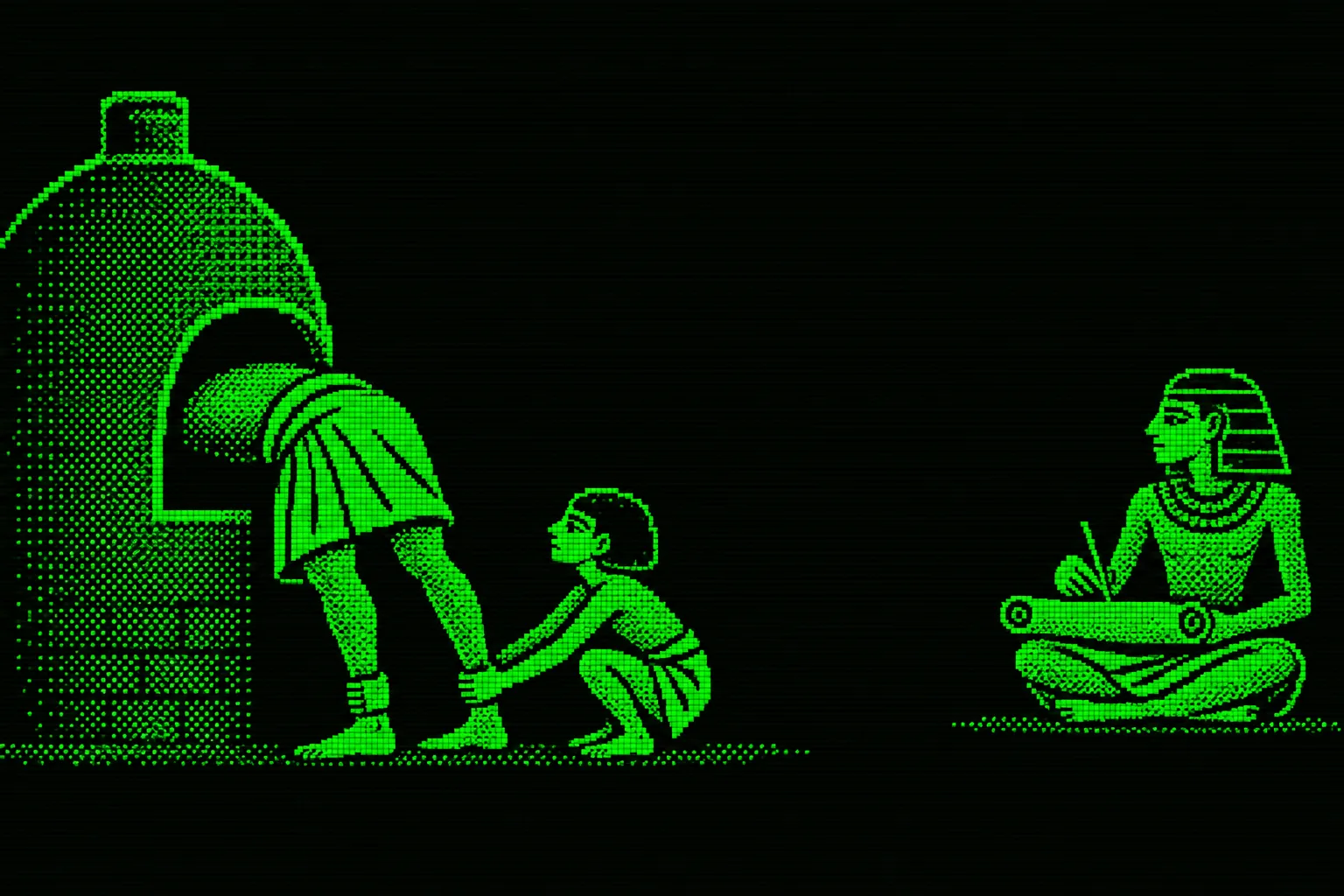
Be a Scribe: His Head Inside the Oven, His Son Holding His Feet
- Date
- Copied in the 19th and 20th Dynasties (about 1210–1100 BC) by apprentice scribes on school papyri at Memphis and Thebes
- Found
- Papyrus Anastasi II and Papyrus Sallier I come from Memphis, Papyrus Lansing from Thebes; all three are now in the British Museum, London (EA 10243, EA 10185, EA 9994)
- Language
- Late Egyptian · Hieratic
A teacher lists the trades for his pupil. Everyone is born to a master: A man comes out of his mother’s womb already running to his overseer. The priest dips himself in the river in wind and rain; the baker works with his head inside the oven, his son holding him by both feet. Only the scribe directs all the work in this land.
In two letters from Papyrus Lansing the scribe Nebmaatre-nakht scolds his pupil Wenemdiamun, a weakling who drinks: You’ve pitched your tent at the brewers’ place like a man thirsting for beer. Then he praises writing: It is sweeter than bread and beer, than clothes, than anointing oil.
Be a Scribe: Every Other Trade Is Toil
- 1
[...] jri̯ zẖꜣ,w
… Become a scribe!
Note · Line 1
A teacher urges his pupil to take up the scribe’s calling. - 2
nḥm.w =f 〈tw〉 m bꜣk.w
It will save you from forced labor,
- 3
mki̯{.tw} =f 〈tw〉 ḥr kꜣ,t nb(.t)
shield you from every kind of toil.
- 4
rwj{.tw} =f 〈tw〉 ẖrj jkn ḫꜣ~nꜣ~ḫj tm =k fꜣi̯.y mstj
It will get you out from under the hoe and the broad hoe,
so you need not carry the basket.Note · Line 4
Earth loosened with hoes was carried away in baskets. - 5
jri̯.y =f {r-}jwd =kwj r ẖni̯ wsr,w
It will spare you from pulling an oar.
- 6
rwj{.tw} =f 〈tw〉 ḥr ḏꜣ~nꜣ~nꜣ tm =〈k〉 ḫpr ẖrj nb.w.pl qnw ẖrj ḥr,jw.pl ꜥšꜣ
It will keep you clear of drudgery,
so you do not end up under many masters, under a host of overseers. - 7
pri̯ pꜣ r(m)ṯ.pl m ẖ,t n(.t) mw,t =f jw =f m pd n ḥr,j =f
A man comes out of his mother’s womb already running to his overseer.
- 8
pꜣ šrj.w 〈m〉 šms n(,j) wꜥw
The child is a soldier’s attendant;
- 9
pꜣ mnḥ{.t} m mꜥ~gꜣ
the youth is a recruit.
- 10
pꜣ ⸮wr? ḏḏ r ꜥḥw,tj
The older man is set to work as a field hand;
- 11
pꜣ z jw =f r wꜥw
the grown man will be a soldier.
- 12
pꜣ ṯhꜣ ḏḏ r jr,j-ꜥꜣ p[ꜣ] [kꜣmn] r wšꜣ jḥ.pl
The lame man is set to guard the door,
the blind man to fatten cattle. - 13
pꜣ [wḥꜥ],w-ꜣpd,w šm ḥr 〈ḫti̯〉 〈tꜣ〉
The fowler has gone roaming through the land;
- 14
pꜣ wḥꜥ,w-rm,w ḥr hꜣrpw
the fisherman is sinking.
- 15
pꜣ ḥm-〈nṯr〉 ꜥḥꜥ m ꜥḥw,tj
The priest stands ready as a field hand;
- 16
pꜣ wꜥb ḥr jri̯(.t) ḥn(,t)
the wab-priest performs the service.
Note · Line 16
Wab means “pure.” This priest had to bathe before he could serve in the temple. - 17
j:jri̯ =f nw [j]w wn.w 3.t r tḫb.w =f m 〈pꜣ〉 jtwr
He spends his time dipping himself in the river, for there are three services.
- 18
bn sw ḥr stni̯ pr,t r šmw tꜣ p,t m ṯꜣw ḥr mw
He makes no distinction between winter and summer,
even when the sky is all wind and rain. - 19
pꜣ ḥr,j-jḥ ꜥḥꜥ m pꜣ bꜣk,w
The stablemaster stands at his work.
- 20
pꜣy =f ḥtrj ḫꜣꜥ [m] [sḫ,t] [jw] ḫꜣꜥ ⸮jt? n tꜣy =f ḥm,t
His team of horses is left in the field once barley has been left for his wife.
- 21
tꜣy =f šrjw,t m pꜣ dnj{,t} jw tꜣy =f bꜣk,t m tꜣ bꜣ~jrʾ~y,t 〈jw〉 pꜣy =f šms m Nrꜣw
His daughter is at work on the dike, his maidservant is bound to labor,
and his attendant is at Tura.Note · Line 21
Tura was a limestone quarrying site across the Nile from Memphis. - 22
pꜣ rtḥ,tj ꜥḥꜥ ḥr qnf ḥr ḫꜣꜥ ꜥq,w.pl r tꜣ ḫ,t jw ḏꜣḏꜣ =f m-ẖnw tꜣ tj~rw~rw mḥ zꜣ =f m rd.du =f
The baker stands baking, tossing loaves onto the fire,
his head inside the oven, his son holding him by both feet. - 23
sp n(,j) wh[ꜣ] m ḏr,t zꜣ =f hꜣi̯.y =f jm m mꜥ~gꜣ
One slip from his son’s grasp and down he goes, onto the oven floor.
- 24
wp,w zẖꜣ,w mntwf ḫrp kꜣ,t nb(.t) n,tj m tꜣ pn
The scribe is the exception:
it is he who directs all the work in this land. - 25
[...] 〈grḥ〉 [...]
… The end. …
Rebuke of the Beer-Drinking Pupil
- 26
[...] ḥ(nꜥ)-ḏd
… Now to the point:
- 27
zẖꜣ,w-mšꜥ ṯs(,w)-mnmn(,t) 〈Nb-mꜣꜥ,t-Rꜥ-nḫt,ṱ〉 n pr-Jmn 〈ḏd〉 〈n〉 zẖꜣ,w Wn-m-ḏi̯≡Jmn
The army scribe Nebmaatre-nakht, chief of the herd of the temple of Amun, speaks to the scribe Wenemdiamun:
Note · Line 27
This is a model letter for scribes in training. The senior scribe addresses his pupil as a scribe already. - 28
ḥnꜥ-ḏd
Now to the point:
- 29
jri̯ zẖꜣ,w nꜥ(ꜥ) ḥꜥ,t =k ḫpr ḏr,t =k gꜣḥj tm =k rʾ~ḥw~ḥ mj pꜣ ḫꜣ~bw~sꜣ mj gꜣnnj (⸮n?) ḥꜥ,t =f
Be a scribe, so your body may be smooth and your hand grow supple,
so you do not gutter like a lamp, like a man grown weak in body. - 30
pꜣ-wn mn qs n r(m)ṯ.pl jm =k
For there’s not a grown man’s bone in you.
- 31
[t]w≡k qꜣi̯.ṱ šmꜥ.ṱ
You’re tall and thin.
- 32
jr ṯꜣy =kwj ꜣtp(,t) r fꜣy =sw wnn =k wꜣ~tj~mtj~m jw rd.du =k (ḥr) ꜥšꜣ{.t} m s{ḫ}ḫjḫj jw =k ꜣd,t.ṱ m pḥ,tj jw =k nmḥ.ṱ m ꜥ,t =k nb.t jw =k ḥwrw.ṱ m ḥꜥ =k
If you take up a load to carry it, you’ll stagger,
both your legs wobbling at every step.
You lack strength, you’re weak in every limb, you’re feeble in body. - 33
jmm ḥr =k r jrj zẖꜣ,w jꜣw,t nfr.t n šꜣjw =k ꜥš =k n wꜥ wšb{.t} n =k ḫꜣ šmi̯{.t} =k wstn.ṱ ḥr wꜣ,t tm =k ḫpr mj jḥ n swḏ
Set your sights on being a scribe, a fine office for which you were destined.
Then you can call to one and a thousand will answer you;
you can walk freely down the road
and not end up like an ox on loan. - 34
jw =k r ḥꜣ,t ktḫ.pl
You’ll be at the head of the others.
- 35
wršu̯ ={k}〈j〉 ḥr mtr =kwj
I spend the day instructing you.
- 36
bw jri̯ =k sḏm
You don’t listen.
- 37
ḥꜣ,tj =k m-mj 〈ḫn〉
Your heart is like a fool.
- 38
sbꜣ =j n =k
I teach you,
- 39
bn swst m jb{j} =k
but none of it is in your heart.
- 40
jṯt nꜣy =sn r ḥꜥ,t =k
Take what is theirs into your body!
Note · Line 40
“Theirs” may refer to the lessons: the pupil is to take in what they have to give him. - 41
tꜣ bw~wꜣ~,w(t) m ḥr =k rꜥ-nb mj ṯꜣ m-sꜣ mw,t =f
The hill is before your eyes every day, as it is for a chick following its mother.
- 42
j:ḏi̯ =k wꜣ,t r pꜣ ꜣbw
It’s pleasure you steer for.
- 43
ḫnms =kwj m ḫnm.pl
You keep company with boon companions.
- 44
jry =k n =k rwr,yt m tꜣ s,t n nꜣ ꜥtḫ.w.pl mj {ḥꜣ}〈ꜣ〉bw swrj ḥ(n)q,t
You’ve pitched your tent at the brewers’ place like a man thirsting for beer.
- 45
ḥmsi̯ =kwj m tꜣ s,t ḥnk{r},t ḥnꜥ sꜣi̯≡f-n-jꜣw,t,ṱ≡f
You sit in the sitting room with Had-Enough-of-His-Job.
Note · Line 45
The companion’s name is a joke: he is the very man to help a pupil neglect his work. - 46
jry =k n =k nꜣ zẖꜣ,w.pl m bw,t
You’ve made the writings a thing you loathe.
- 47
snsnj =kwj tꜣ kꜣ~sꜣ(,t)
You keep company with the Kassite woman.
Note · Line 47
The Kassites were a people who ruled Babylonia for several centuries. - 48
m-jri̯ jri̯.t =w
Don’t do these things!
- 49
jw =w 〈r-〉jḫ
What good are they?
- 50
bn ḫꜣ~m~jꜣ jm =sn
There’s no bowing in any of them.
- 51
jḫ rḫ =k swsn [...]
Please take note of this …
In Praise of the Scribe’s Profession
- 52
[...] [zẖꜣ,w-nsw] ⸢(j)m(,j)⸣-r(ʾ)-jḥ,pl-〈wr-〉n-Jmn-[Rꜥ-nsw-nṯr,pl] [Nb-mꜣꜥ,t-Rꜥ-nḫt,ṱ] [ḏd] [n] [zẖꜣ,w] [Wn-m-ḏi̯≡j-Jmn]
… Nebmaatre-nakht, royal scribe and chief overseer of the cattle of Amun-Ra, king of the gods, says to the scribe Wenemdiamun:
- 53
[ḥnꜥ-ḏd]
Now to the point:
- 54
[jri̯] [tꜣj] [jꜣw,t] [šp]sj(.t) jm,j-ḫt-Ḏḥw,tj
Take up this noble office, follower of Thoth!
Note · Line 54
Thoth, the god of writing, was the patron of scribes. - 55
rn ⸢nfr⸣ n j:jri̯ sw
A good name belongs to the one who holds it.
- 56
[...] [___] =⸢f⸣ [__] wr.w.pl
… him … the great.
- 57
j:jri̯ =f snsnj _ ꜥꜣy.pl r =f
He keeps company with men greater than himself.
- 58
ršw,t [...]
Joy …
- 59
[zẖꜣ] m ḏr,t =k
Write with your hand,
- 60
šdi̯ =k m ⸢rʾ⸣ =[k]
read with your mouth.
- 61
jri̯ mj j:ḏd.t.pl =j
Do as I say.
- 62
[...] [___] =k
… you …
- 63
bw ft.n jb =j
My heart did not grow weary.
- 64
⸮[ꜥ]š? ⸮s[__]? =⸮k?
Calling … you.
- 65
mri̯{.tw} =j 〈tw〉 r [...]
I love you more than …
- 66
[...] n pꜣy =j mtj =k
… because I teach you.
- 67
gmi̯ =k st m ꜣḫ,w
You will find it useful.
- 68
[...] [ẖrj] [ꜥq,w] ḥ(n)q,t
… with bread and beer.
- 69
sꜥꜣi̯ tw m-[ḏi̯] [⸮ḥr,j?].w.pl =k
Make yourself great in the eyes of your superiors.
- 70
hꜣb.tw =k m wpw,t [...] [⸮tkn?] [wsfꜣ.t]
You will be sent on a mission …
Do not go near idleness. - 71
mry zẖꜣ ms⸢d⸣i̯ ꜣbw jry =k sr j{ꜣ}qr
Love writing, hate pleasure,
and you will make a fine official. - 72
m rḏi̯.t jb =k n tꜣ bwꜣ,t
Do not set your heart on the high ground.
- 73
mqꜣḥꜣ qmꜣmw šꜣ~pw
Give up romping and roaming.
- 74
wršu̯ 〈ḥr〉 zẖꜣ m ḏbꜥ.pl =k jw =k (ḥr) šdi̯ m grḥ
Spend the day writing with your fingers;
read by night. - 75
snsnj n =k tꜣ ꜥw,tj pꜣ gstj
Make the scroll and the palette your companions.
Note · Line 75
A scribe’s palette held his writing reeds and cakes of black and red ink. - 76
nḏm sw r šdḥ
It is sweeter than shedeh wine.
Note · Line 76
Shedeh was a prized Egyptian grape wine. - 77
jr zẖꜣ n pꜣ n,tj rḫ sw ꜣḫ sw r jꜣw,t nb.t
For the one who knows how to write,
writing is of more use than any office. - 78
nḏm sw r ꜥq,w ḥ(n)q,t r ḥbs.w.pl r sgnn
It is sweeter than bread and beer,
than clothes, than anointing oil. - 79
sbq sw r jwꜥꜥ ={j} 〈ḥr〉 Km,t r mꜥḥꜥ ḥr jmn,tt{t} grḥ [...]
It is worth more than an inheritance in Egypt,
more than a tomb in the West. …Note · Line 79
The West, where the sun sets, was the land of the dead.