~/sacred-texts/battle-of-kadesh-relief-inscriptions
Battle of Kadesh Reliefs: Ramesses II Fights 2,500 Chariots
- Date
- Carved in the 19th Dynasty during the reign of Ramesses II (c. 1274–1213 BC) on temple walls at the Ramesseum in Thebes and the Great Temple of Abu Simbel
- Found
- In situ at the Ramesseum (Luxor, West Bank) and the Great Temple of Abu Simbel, Egypt
- Language
- Late Egyptian · Hieroglyphic
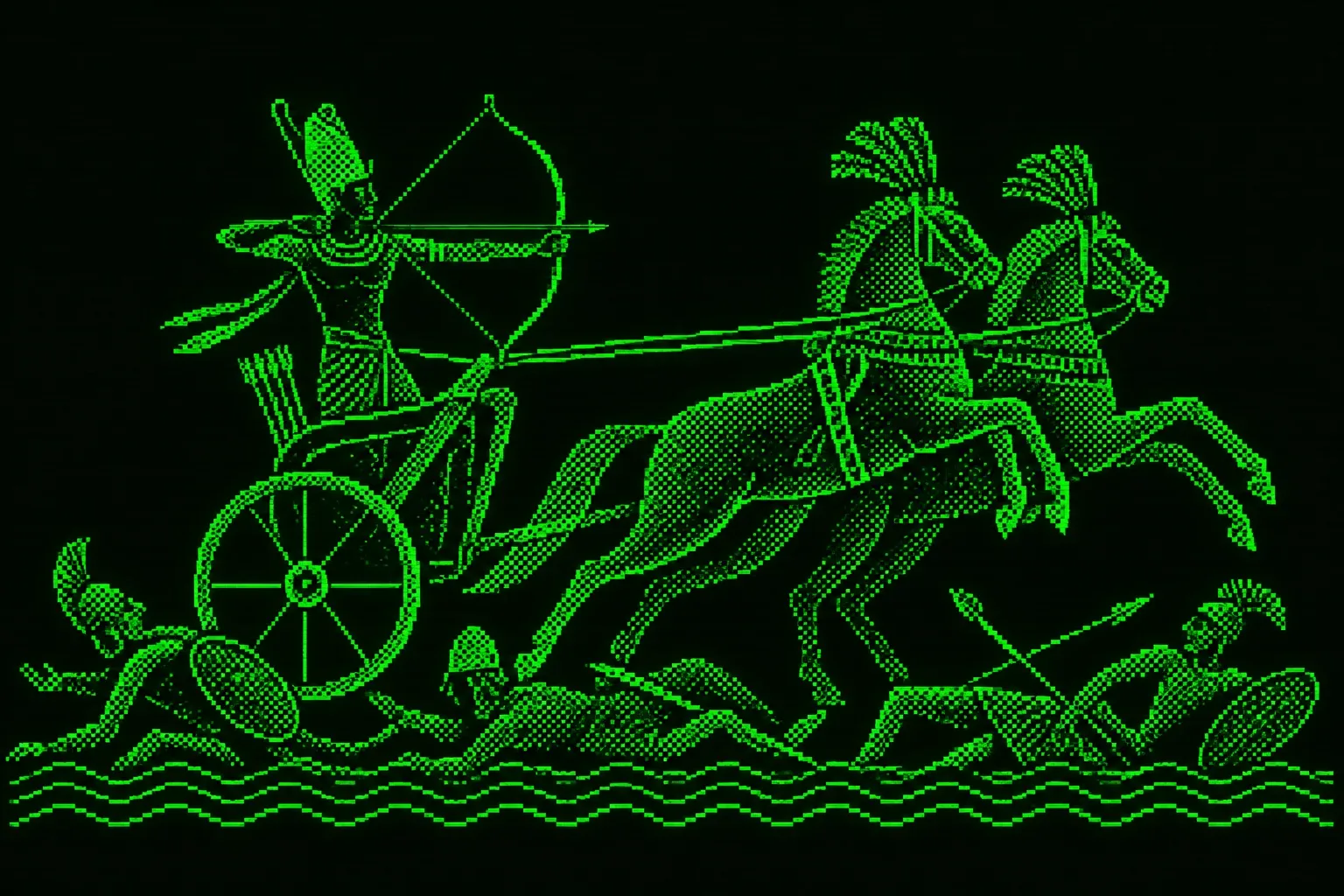
These captions accompany three Kadesh battle reliefs—two at the Ramesseum, one at Abu Simbel. The narrator tells how Ramesses II, ringed by 2,500 teams of horses, cuts them into a heap of corpses before his horses and hurls them one on top of another, into the waters of the Orontes. Short labels name dead Hittite officers and note the prince of Aleppo: His soldiers draining him after His Majesty threw him into the water.
At Abu Simbel, the cupbearer and scout urge the division of Ptah forward: Your lord stands all alone among the enemy ranks! The Hittite ruler hangs back, praising Ramesses: “He is like Seth, great in strength—Baal in the flesh.”
Ramesseum, First Pylon (West Face): The Battle
- 1
nṯr-nfr nb-jr,t-jḫ,t nb-tꜣ,wj Wsr-Mꜣꜥ,t-Rꜥw-stp.n-Rꜥw nb-ḫꜥ,w Rꜥw-msi̯-s(w)-mri̯.y-Jmn mri̯.y Mnṯ,w
The perfect god, lord of ritual, lord of the Two Lands, Usermaatre-setepenre, lord of crowns, Ramesses-Meriamun, beloved of Montu.
Note · Line 1
The king is Ramesses II, shown shooting arrows from his chariot. The Two Lands are Upper and Lower Egypt. Usermaatre-setepenre is his throne name; Meriamun means “beloved of Amun.” Montu is a god of war. - 2
nṯr-nfr sḫm pḥ,tj ꜥꜣ nḫt,w.pl hd ḫꜣs,t.pl nb.t nswt-bj,tj Wsr-Mꜣꜥ,t-Rꜥw-stp.n-Rꜥw sꜣ-Rꜥw Rꜥw-msi̯-s(w)-mri̯.y-Jmn
The perfect god, mighty in strength, great in victories, who strikes all foreign lands; the King of Upper and Lower Egypt, Usermaatre-setepenre, the Son of Ra, Ramesses-Meriamun.
- 3
pꜣ ꜥḥꜥ jri̯.n ḥm =f jw =f ḥmsi̯ ḥr mḥ,tj-jmn,tj.t Qdš
The stand His Majesty made when he sat in camp northwest of Kadesh.
- 4
jw =f ḥr ꜥq m pꜣ ḫrw n nꜣ-n ḫr.pl n Ḫt jw =f wꜥi̯ ḥr tp =f n ky ḥnꜥ =f
He drove into the ranks of the foes from Hatti all alone, with no one else beside him.
Note · Line 4
Hatti was the kingdom of the Hittites. - 5
gmi̯.n =f jnḥ sw 2.500 n ꜥ-n-ḥtr.pl m wꜣ,t =f nb.t
He found that 2,500 teams of horses had ringed him on every side.
Note · Line 5
These are the horse teams of the enemy chariots. - 6
jw =f ḥr wꜥwꜥ =st jri̯.w m jwn,w ẖr-ḥꜣ,t ssm,t.pl =f
He cut them down; they lay in a heap of corpses before his horses.
- 7
jw =f ḥr ẖdb wr.pl nb n ḫꜣs,t.pl nb nꜣ.w sn.pl n pn Ḫt ḥnꜥ nꜣ.w =f wr.pl-ꜥꜣ.pl nꜣ.w =f mšꜥ tꜣ(y) =f n,ṯ-ḥtr.pl
He killed all the princes of all the foreign lands, the brothers of the ruler of Hatti, together with his great princes, his infantry and his chariotry.
- 8
jw =f ḥr gbgb =st m wꜥ ḥr wꜥ r pꜣ mw n.w J~r~n~ṯ
He hurled them down, one on top of another, into the waters of the Orontes.
- 9
jst pꜣ ḫr,w n Ḫt ꜥḥꜥ ꜥnw ꜥ.du =f m jꜣ,w n nṯr-nfr
Meanwhile the foe of Hatti stood turned away, both arms raised in praise of the perfect god.
Note · Line 9
“The foe of Hatti” here means the Hittite ruler himself. - 10
[...] {{ḥfn,w}} {{[⸮ꜥq?]}} {{m}} {{ꜥšꜣ,t}} [...] {{n}} {{ḫꜣs,t}} {{nb.t}} [...] {{nb}} {{n}} [...] {{ḥm}} ={{f}} {{wꜥi̯.w}} {{n}} {{ky}} {{ḥnꜥ}} ={{f}} {{[nswt-bj,tj]}} {{Wsr-Mꜣꜥ,t-Rꜥw-stp.n-Rꜥw}} {{di}} {{ꜥnḫ}}
… hundreds of thousands, who enters the throng … of every foreign land … every … of … His Majesty alone, with no one else beside him, the King of Upper and Lower Egypt, Usermaatre-setepenre, given life.
Note · Line 10
This caption and the next two survive from an earlier version of the battle scene, carved over when the relief was revised. - 11
{{pꜣ}} {{pri̯}} {{[jri̯.n]}} {{[ḥm]}} ={{f}} {{m}} {{pꜣ}} {{ḫrw.pl}} {{n}} {{pꜣ}} {{ḫr,w}} {{[n]}} {{Ḫt}} [...] {{s[⸮_?]}} {{ḫꜣꜥ}} {{n[⸮_?]}} {{ḥm}} ={{f}} {{〈m〉}} {{rs,j}} {{Qdš}} {{m-sꜣ}} ={{sn}} {{ḥr}} {{jri̯.t}} {{šꜥ{f},t}} {{j:m}} ={{sn}}
The sortie His Majesty made through the ranks of the foe of Hatti … cast … His Majesty was south of Kadesh, pursuing them and slaughtering them.
- 12
{{nṯr-nfr}} {{nḫt}} {{ḫpš}} {{nb-[Tꜣ,wj]}} {{Wsr-Mꜣꜥ,t-Rꜥw-stp.n-Rꜥw}} {{nb-ḫꜥ,w}} {{Rꜥw-msi̯-s(w)-mri̯.y-Jmn}} {{mri̯.y}} {{Jmn-Rꜥw}} {{nb-ns,t.pl-Tꜣ.du}}
The perfect god, strong of arm, lord of the Two Lands, Usermaatre-setepenre, lord of crowns, Ramesses-Meriamun, beloved of Amun-Ra, lord of the thrones of the Two Lands.
- 13
ḥtr ꜥꜣ tp,j n ḥm =f Mri̯.y-Jmn n jḥ,w-ꜥꜣ-〈n〉-Wsr-Mꜣꜥ,t-Rꜥw-stp.n-Rꜥw-mri̯.y-Jmn
His Majesty’s first great team of horses, “Beloved of Amun,” from the Great Stable of Usermaatre-setepenre, Beloved of Amun.
- 14
Gr~bꜣ~tw~sꜣ {ḫ}〈q〉rꜥ,w-n-pꜣ-ḫr,w-n-Ḫt
Gerbetes, shield-bearer to the foe of Hatti.
Note · Line 14
This and the next four captions name the enemy dead shown beneath and around the king’s horses and chariot. - 15
Tj~r~gꜣ~tj~ṯꜣ~sꜣ ḥr,j-pḏ,t-n-nꜣ-Qbsw
Tarhuntazzis, commander of the troops of Qabassu.
- 16
ꜥ~g~m ḥr,j-pḏ,t-n-pꜣ-[ḫr,w-n]-Ḫt
Agem, commander of the troops of the foe of Hatti.
- 17
K~m~y~ṯ ꜥꜣ-n-tw~hr
Kummayazzi, chief of the Tuher warriors.
- 18
Ḫ~r~p~s~r sẖꜣ,w-šꜥ,t-n-pꜣ-ḫr,w-n-Ḫt
Kharapsili, secretary to the foe of Hatti.
- 19
pꜣ wr ẖs n Ḫ~r~b
The wretched prince of Aleppo.
- 20
ẖꜥ =f jn mšꜥ =f m-ḫt ḫꜣꜥ sw ḥm =f r mw
His soldiers draining him after His Majesty threw him into the water.
Note · Line 20
On the riverbank, three men hold the prince upside down to drain the water out of him. - 21
pꜣ wr ḫr ẖs n Ḫt ꜥḥꜥ m-ḥr,j-jb mšꜥ =f ḥnꜥ n,ṯ-ḥtr.pl =f ḥr =f ꜥnw tnbẖ jb =[f] b[dš]
The fallen, wretched prince of Hatti, standing amid his infantry and his chariotry, his face turned back in dismay, his heart gone faint.
- 22
nn pri̯.n =f r ꜥḥꜣ n snḏ [n] ḥm =f ḏr mꜣꜣ.n =f ḥm =f sḫm m 〈nꜣ〉-n Ḫt ḥnꜥ wr [n] ḫꜣs,t nb jy ḥnꜥ =f jw ḥm =f [...] ḥr sḫr n =f st n wnw,t wꜥ.t
He did not come out to fight for fear of His Majesty, for he had seen His Majesty overpower the men of Hatti and the prince of every foreign land that had come with him, while His Majesty … struck them down for himself in a single hour.
- 23
di.jn =f j[ꜣ,w] [n] nṯr-nfr ḥr-ḏd
Then he gave praise to the perfect god, saying:
- 24
sw mj Swtḫ-ꜥꜣ-pḥ,tj Bꜥr m-ḥꜥ,w =f
“He is like Seth, great in strength—Baal in the flesh.”
Note · Line 24
Baal, the storm god, was identified with Seth in Egypt. Ramesseum, Second Court (East Wall): The Battle
- 25
nb-Tꜣ,wj Wsr-Mꜣꜥ,t-Rꜥw-stp.n-Rꜥw nb-ḫꜥ,w Rꜥw-msi̯-s(w)-mri̯.y-Jmn
Lord of the Two Lands, Usermaatre-setepenre; Lord of Crowns, Ramesses-Meryamun.
Note · Line 25
The two names are those of Ramesses II: the first is his throne name, the second his birth name with the epithet “beloved of Amun.” - 26
nṯr-nfr sḫm pḥ,tj ꜥꜣ nḫt,w.pl hd ḫꜣs,t.pl nb.t nswt-bj,tj Wsr-Mꜣꜥ,t-Rꜥw-stp.n-Rꜥw sꜣ-Rꜥw Rꜥw-msi̯-s(w)-mri̯.y-Jmn
The perfect god, mighty in strength, great in victories, who strikes at every foreign land; King of Upper and Lower Egypt, Usermaatre-setepenre; Son of Ra, Ramesses-Meryamun.
Note · Line 26
This caption stands above the king as he shoots arrows from his chariot. - 27
pꜣ ꜥḥꜥ jri̯.n ḥm =f jw =f ḥmsi̯ ḥr mḥ,tj-jmn,tj.t Qdš
The stand His Majesty made as he sat northwest of Kadesh.
Note · Line 27
This was the site of the Egyptian camp. - 28
jw =f ḥr ꜥq m-ẖnw pꜣ ḫry,w ꜥꜣ n nꜣ ḫr.pl n Ḫt jw =f wꜥi̯.w ḥr tp =f n ky ḥnꜥ =f
He drove into the midst of the great host of Hittite foes, alone, with no one else beside him.
- 29
gmi̯.n =f jnḥ sw 2.500 n ꜥ-〈n〉-ḥtr.pl m 4.t ẖ,t.pl m wꜣ,t =f nb.t
He found that 2,500 teams of horses, in four divisions, had him surrounded on every side.
- 30
jw =f ḥr wꜥwꜥ =st jri̯.w m jwn,w ẖr-ḥꜣ,t ssm,t.[pl] =[f]
He cut them down till they were a heap of corpses before his horses.
- 31
jw =f ḥr ẖdb wr.pl nb [n] ḫꜣs,t.pl nb nꜣ sn.[pl] [n] ⸢pꜣ⸣ ḫr n Ḫt ḥnꜥ nꜣ.w =f wr.pl-ꜥꜣ.pl pꜣ(y) =f mšꜥ tꜣ(y) =f n,ṯ-ḥtr.pl
He killed all the princes of all the foreign lands, the brothers of the foe of Hatti, together with his great princes, his army and his chariotry.
Note · Line 31
“The foe of Hatti” is the inscription’s name for the Hittite king himself. - 32
jw =f ḥr gbgb =st ḫr ḥr ḥr =sn
He threw them down, and they fell on their faces.
- 33
jw =f ḥr di.t hꜣi̯ =sn m wꜥ ḥr wꜥ r pꜣ mw n.w J~[r~n~ṯ] jw ḥm =f m-sꜣ =sn mj mꜣj ḥsꜣ ḥr smꜣ =st m s,t.pl =sn
He sent them tumbling one on top of another into the waters of the Orontes. His Majesty was at their heels like a fierce lion, slaughtering them where they stood.
- 34
jst pꜣ ḫr,w n Ḫt [...] ⸢nṯr-nfr⸣
The foe of Hatti, meanwhile, … the perfect god …
- 35
ḥtr ꜥꜣ n ḥm =f Nḫt,w-m-Wꜣs,t n jḥ,w-ꜥꜣ-〈n〉-Wsr-Mꜣꜥ,t-Rꜥw-stp.n-Rꜥw-mri̯.y-Jmn
His Majesty’s great team of horses, “Victory in Thebes,” from the Great Stable of Usermaatre-setepenre, beloved of Amun.
- 36
{{ḥtr}} {{ꜥꜣ}} {{n}} {{ḥm}} ={{f}} {{Nḫt,w-m-Wꜣs,t}} {{n}} {{jḥ,w-ꜥꜣ-〈n〉-Wsr-Mꜣꜥ,t-Rꜥw-stp.n-Rꜥw-mri̯.y-Jmn}}
His Majesty’s great team of horses, “Victory in Thebes,” from the Great Stable of Usermaatre-setepenre, beloved of Amun.
Note · Line 36
This second label and the next three fragments belong to an earlier version of the scene, later erased and carved over. - 37
[...] {{mj}} {{n}} ={{j}} {{n[⸮_?].kw}} [...] {{Pr-ꜥꜣ}} {{ꜥnḫ-(w)ḏꜣ-s(nb)}} [...]
… Come to me! I … Pharaoh, may he live, prosper and be well …
- 38
{{jnk}} {{Nḫt-Jmn}} {{pꜣ}} {{wꜥ,w}} [...] {{ẖny,t}} [...] {{Tꜣ,wj}}
I am Nakhtamun, the soldier … rowing crew … the Two Lands.
- 39
{{ꜥḥꜥ.n}} {{di.n}} {{ḥm}} ={{f}} [...] {{ꜥḥꜣ}} [...] {{[⸮_?]ṯ}} {{ḥr}} {{mkḥꜣ}} {{n}} [...] {{ḫꜣs,t.pl}} {{nb}} [...]
Then His Majesty caused … to fight … neglecting … all foreign lands …
- 40
S~p~ṯ~r sn n pꜣ ḫr n Ḫt
Sipitaili, brother of the foe of Hatti.
Note · Line 40
Two soldiers are shown pulling him from the river. This and the labels that follow identify individual Hittites and their allies in the battle scene. - 41
[T~r]~g~n~n~s kḏn-n-pꜣ-ḫr,w-n-Ḫt
Tarchunnias, charioteer of the foe of Hatti.
- 42
T~r~g~n~n~y~s [...]
Tarchunnias …
- 43
T~r~g~n~n~s kḏn-n-pꜣ-ḫr,w-n-Ḫt
Tarchunnias, charioteer of the foe of Hatti.
- 44
Gr~b~t~s qrꜥ,w-n-pꜣ-ḫr,w-n-Ḫt
Gerbetes, shield-bearer of the foe of Hatti.
- 45
T~r~g~t~[⸮s?] ḥr,j-pḏ,t-n-nꜣ-Qbsw
Tarchuntazzis, commander of the troops of Qabassu.
- 46
ꜥ~g~m ḥr,j-pḏ,t-n-P~n~s
Agem, commander of the troops of Panasa.
- 47
Kꜣ~m~y~ṯꜣ ꜥꜣ-n-tw~hr
Kummayazzi, chief of the Tuher warriors.
- 48
Ḫ~r~p~s~r sẖꜣ,w-šꜥ,t-n-pꜣ-ḫr-n-Ḫt
Charapsili, secretary to the foe of Hatti.
- 49
T~y~d~r ḥr,j-šms,w-n-pꜣ-ḫr,w-n-Ḫt
Tatili, chief of the retainers of the foe of Hatti.
- 50
Pꜣ~y~sꜣ kḏn-n-pꜣ-ḫr,w-n-Ḫt
Pijas, charioteer of the foe of Hatti.
- 51
Sꜣ~m~r~tw~sꜣ kḏn-[n-pꜣ-ḫr,w-n-Ḫt]
Sumitilis, charioteer of the foe of Hatti.
- 52
R~b~s~n~n ḥr,j-pḏ,t-n-Jn~n~n~s
Labasalni, commander of the troops of Alzi.
- 53
⸢Ḫ⸣~m~ṯ~r~m sn n pꜣ ḫr,w n Ḫt
Himmu-zalma, brother of the foe of Hatti.
- 54
T~d~r ꜥꜣ-n-tw~hr.pl
Tatili, chief of the Tuher warriors.
- 55
Ṯ~⸮n?~m qrꜥ-n-pꜣ-ḫr,w-n-Ḫt
Zalma, shield-bearer to the foe of Hatti.
Note · Line 55
Zalma lies dead, face down in the river, with only his feet still on the bank. - 56
Ṯꜣ~wꜣ~ṯꜣ~sꜣ ḥr,j-{ḫꜣs,t}〈pḏ,t〉-n-Jw~n~sꜣ
Zuwanzas, commander of the troops of Alzi.
Note · Line 56
Another Hittite has hold of Zuwanzas in the river and may be trying to save him. - 57
pꜣ wr ẖs n Ḫ~r~b
The wretched prince of Aleppo.
- 58
ẖꜥ =f jn mšꜥ =f m-ḫt ḫꜣ[ꜥ] sw ḥm =f r mw
His troops drain him after His Majesty has hurled him into the water.
Note · Line 58
Two soldiers hold the prince upside down to drain the water he has taken in. His Majesty is Ramesses II. - 59
[...] ⸢jw⸣ ⸢ḥm⸣ =[f] [m] ⸢bjk-n⸣ṯr
… while His Majesty was a divine falcon.
- 60
di.jn =f jꜣ,w n nṯr-nfr ḥr-ḏd
Then he gave praise to the perfect god, saying:
Note · Line 60
The Hittite ruler, shown in his chariot, is the speaker. “The perfect god” is a royal title of Ramesses. - 61
sw mj Stẖ [m] [w]nw,t =〈f〉
“He is like Seth in his hour.”
Note · Line 61
Seth was the god of storms, famed for his ferocity in battle. - 62
tw~hr n,tj r-ḥꜣ,t =〈f〉 s 8.000
The Tuher warriors in front of him: 8,000 men.
Note · Line 62
Tuher is an Egyptian term for warriors from western Asia. The count is for those in front of the Hittite ruler. - 63
tw~hr [n,tj] [m]-sꜣ =f s ⸢9.000⸣
The Tuher warriors behind him: 9,000 men.
- 64
dmj n Qdš
The city of Kadesh.
Great Temple of Abu Simbel, Great Pillared Hall (North Wall): The Battle
- 65
[...] ⸢ꜣ⸣s pꜣ mšꜥ
… to urge the division on.
Note · Line 65
The surviving words accompany a figure of the vizier in his chariot. - 66
pꜣ wbꜣ-n-Pr-ꜥꜣ-ꜥnḫ-(w)ḏꜣ-s(nb) jy r ꜣs pꜣ mšꜥ n Ptḥ ḏd n =〈sn〉
The cupbearer of Pharaoh (life, prosperity, and health to him!) has come to urge the division of Ptah on and say to them:
Note · Line 66
Ptah was the god for whom this Egyptian army division was named. - 67
šm.t n-ḥr =tn
“March forward!
- 68
pꜣy =tn nb ꜥḥꜥ 〈m〉 〈pꜣ〉 〈ḫr〉w.pl wꜥi̯ sp-[2]
Your lord stands all alone among the enemy ranks!”
- 69
pꜣ ḥꜣ~p,wt n Pr-ꜥꜣ ꜥnḫ-(w)ḏꜣ-s(nb) jy r ꜣs pꜣ mšꜥ n Ptḥ ḏd n =〈s〉n
The scout of Pharaoh (life, prosperity, and health to him!) has come to urge the division of Ptah on and say to them:
Note · Line 69
The scout delivers his summons on horseback. - 70
šms
“Follow!
- 71
š(mi̯) n-ḥr =tn
March forward!
- 72
Pr-ꜥꜣ ꜥnḫ-(w)ḏꜣ-s(nb) pꜣy =tn nb ꜥḥꜥ 〈m〉 pꜣ 〈ḫr〉w{jt}.pl wꜥi̯ sp-2
Pharaoh (life, prosperity, and health to him!), your lord, stands all alone among the enemy ranks!”
- 73
pꜣ jy jri̯.n ḥꜣ~p,wt 〈r〉 ꜣs pꜣ mšꜥ
The arrival of the scout to urge the army on.
- 74
Wsr-Mꜣꜥ,t-Rꜥw-stp.n-Rꜥw Rꜥw-msi̯-s(w)-mri̯.y-Jmn
Usermaatre Setepenre, Ramesses Meryamun.
Note · Line 74
The king shooting arrows from his chariot is Ramesses II. The first name is his throne name; the second is his birth name with the epithet “beloved of Amun.” - 75
nṯr-nfr sḫm pḥ,tj ꜥꜣ nḫt,w.pl hd ḫꜣs,t[.pl] [nb.t] nswt-nḫt smꜣ ḫr,w =f ḥwi̯ Pḏ,t.pl-[9] [m] ḫpš =f wꜥi̯ wmt ḥꜣ,tj =f [...] jri̯ s{t}n m gb[gb].y nb ⸮m? [...]
The good god, mighty in strength, great in victories, who assails every foreign land; the strong king who slaughters his foe, who strikes the Nine Bows with his sickle-sword, he alone; whose heart is steadfast … who makes of them a heap of corpses, lord in …
Note · Line 75
The Nine Bows stand for all the foreign peoples the king claims to subdue. - 76
jri̯.n ḥm =f [...] n nꜣ-n [...] šms,w.pl [n] ḥm =f jw =f ḥmsi̯ ḥr mḥ,tj Qdš
His Majesty did … of the … followers of His Majesty, while he sat north of Kadesh.
- 77
wn.jn =f ḥr ꜥḥꜥ ꜣs ḥr ṯsi̯.t r Nḫt,w.pl-m-Wꜣs,t pꜣ{t}〈y〉 =f ḥtr ꜥꜣ jw =f ḥr ꜥq m ḫr.w.pl ḫr,w n Ḫt jw =f mj ḏꜥ prr =f m p,t wsr,t =f mj ḫ,t m kꜣkꜣ.pl jw =f mj jtj =f Mnṯ,w
Then he sprang up and mounted his chariot behind Victory-in-Thebes, his great team of horses. He drove into the ranks of the foe of Hatti like a storm wind breaking from the sky. His might was like fire among the kaka plants. He was like his father Montu.
- 78
S~p~ṯ~r sn 〈n〉 pꜣ 〈ḫr,w〉 〈n〉 Ḫt
Sipitaili, brother of the foe of Hatti.
- 79
Q~r~b~t~s qrꜥ,w-n-〈pꜣ-ḫr,w-n〉-Ḫt
Gerbetes, shield-bearer of the foe of Hatti.
Note · Line 79
He lies dead behind the wheel of the Egyptian king’s chariot. - 80
R~b~swr
Labasalni.
Note · Line 80
In the river beside the fortress, another man holds him by the hair and under the chin. - 81
B~n~q kḏ〈n〉-n-pꜣ-〈ḫr,w-n〉-Ḫt
Banaga, charioteer of the foe of Hatti.
Note · Line 81
He is shown falling backward out of his chariot. - 82
pꜣ wr ḫr n Ḫt ꜥḥꜥ m-ḥr-jb mšꜥ =f ḥnꜥ n,〈t〉-ḥtr.pl =f ḥr =f ꜥnw tnbẖ jb =f bdš
The fallen prince of Hatti stands amid his army and his chariot warriors, his face turned back in dismay, his heart faint.
Note · Line 82
“Fallen” treats the enemy ruler as already defeated, though he is shown alive in his chariot. - 83
n pri̯.n =f r ꜥḥꜣ n snḏ n ḥm =f ḏr mꜣꜣ ḥm =f sḫm.w m nꜣ-n Ḫt ḥnꜥ wr.pl
He did not come out to fight for fear of His Majesty, once he had seen His Majesty prevail over the men of Hatti and the princes.
- 84
nꜣ-n tw~hr n ꜥḥꜣ n ḫr,w n Ḫt [nꜣ] [tw]~hr ⸮n-mj-nḫt? n,tj 〈r〉-ḥꜣ,t =⸢f⸣ [s] 8.000
The Tuher fighting troops of the foe of Hatti and the Tuher troops of Minakht, stationed in front of him: 8,000 men.
Note · Line 84
The relief shows these men on foot in front of the Hittite king. - 85
ky tw~hr n ꜥḥꜣ n,tj m-sꜣ =f s 9.000
Another Tuher fighting force behind him: 9,000 men.
- 86
pꜣ 〈tw〉~hr n pꜣ ḫr,w 〈n〉 Ḫt
The Tuher force of the foe of Hatti.
- 87
dmj n Qdš
The city of Kadesh.