~/sacred-texts/amduat
Amduat, Twelfth Hour: Reborn Through the Serpent
Translated by AI straight from the Middle Egyptian (New Kingdom), not from a modern translation, then checked against the editions and studies listed below. How we translate
- Text
- Amduat, Twelfth Hour (Hornung §§ 793–849, figures 822–908)
- Date
- Early New Kingdom; first complete copy c. 1450 BC (Thutmose III)
- Found
- Burial chambers of the Valley of the Kings, first complete in the tomb of Thutmose III (KV 34)
- Language
- Middle Egyptian (New Kingdom) · Hieroglyphic (cursive)
The Amduat, “What Is in the Duat”, follows the sun through the twelve hours of the night. The god sails the river of the underworld in his barque, called “Flesh” in the crew lists, with the serpent Mehen, the Coiled One, wrapped around his shrine from the seventh hour on. Each hour is drawn in three bands of pictures, with a running text and a caption naming every figure. Its first complete copy is in the tomb of Thutmose III (about 1450 BC), and the text says this hour is to be drawn on the east side of the burial chamber.
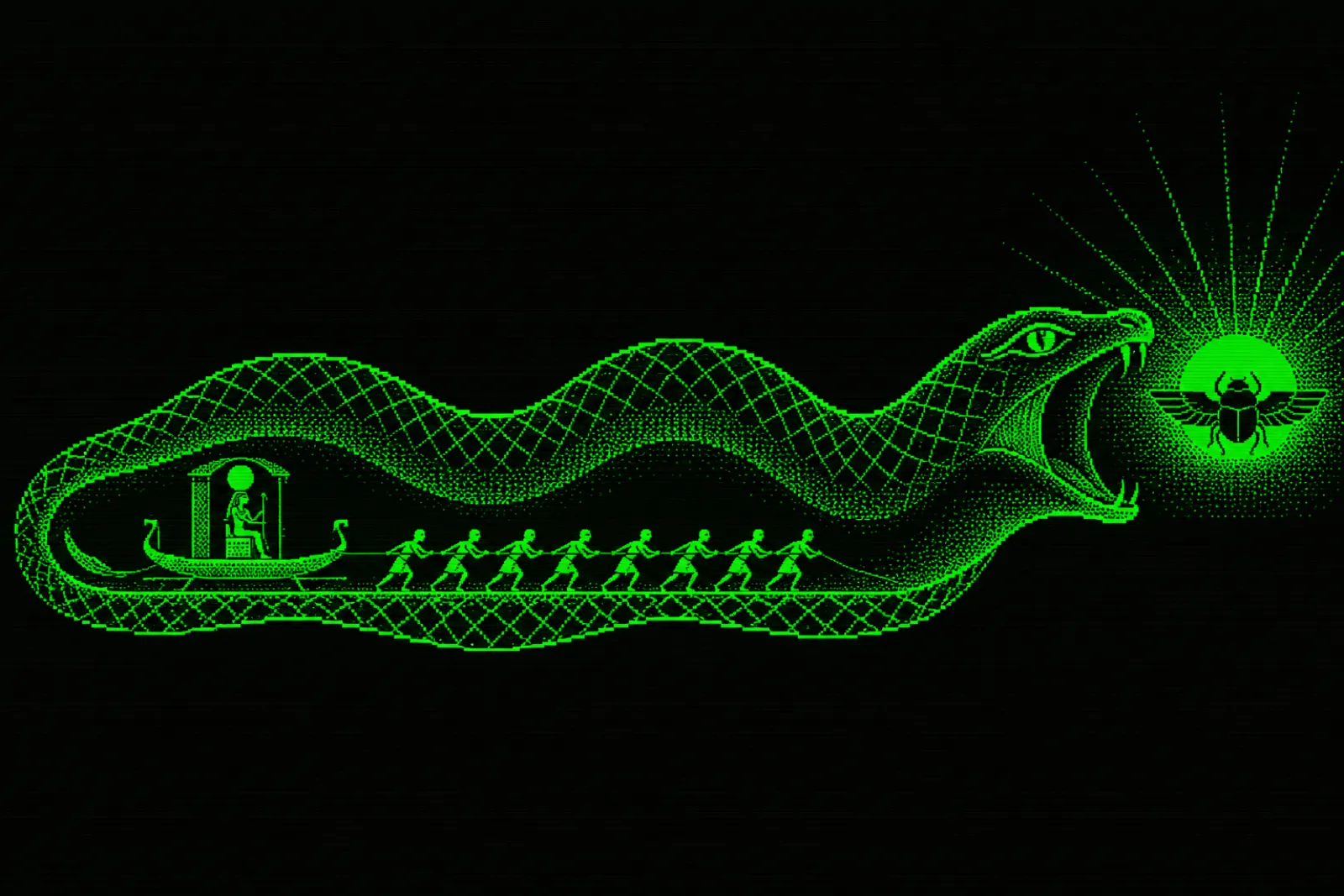
The twelfth hour is the birth. In the middle band twelve gods haul the barque into the tail of a giant serpent, “Life of the Gods”, and thirteen goddesses haul it out of the serpent’s mouth. The god comes out as Khepri, the scarab, and Shu, whose head and arms close the band, receives him on the eastern bank. The dead who travel with him go in as “revered ones” and come out as youths. In the upper band twelve cobra goddesses drive off Apophis with the flames on their mouths and twelve gods sing to the newborn sun. In the lower band are the primeval gods, the oarsmen who drive off Apophis, and the gods who praise Osiris, whose mummy is left lying at the very end of the book.
This is every sentence of the open edition, which gives Hornung’s text from the New Kingdom copies: the opening text, the captions of all three bands and the name labels, 92 lines in all. The hour has no separate closing text; it ends with the mummy’s caption. Line numbers are the edition’s sentence numbers; Hornung’s section numbers are shown under them. Scene headings are left out. The open edition has no hieroglyphs for this text. For the hour in which Mehen first wraps the god, see the Seventh Hour; for the coiled serpent around the god, see Within the Coiled One.
Each numbered line gives the Middle Egyptian (New Kingdom) first, in Latin letters. Our English is underneath. Tap a dotted word for its meaning, and Note for our comment on the line; our comments are in the right margin.
- 3Amd. 793
ḥtp jn ḥm n nṯr pn ꜥꜣ m qrrt cavern · TLA tn nt Pḥ.wj-kk.w-zmꜣ.w “End of the Primeval Darkness”, the name of the cavern · TLA
The resting of the majesty of this great god in this qrrt: cavern of Pḥ.wj-kk.w-zmꜣ.w: “End of the Primeval Darkness”, the name of the cavern.
Note on line 3
kk.w-zmꜣ.w is literally “united darkness”, the utter dark that was before creation. The last cavern of the night is named as its end. - 4Amd. 794
msi̯ to give birth; to be born · TLA nṯr pn ꜥꜣ m ḫpr.w form, becoming, transformation · TLA =f n Ḫpr.j Khepri, the scarab, “He Who Becomes” · TLA r qrrt cavern · TLA tn
This great god is msi̯: to give birth; to be born in his ḫpr.w: form, becoming, transformation of Ḫpr.j: Khepri, the scarab, “He Who Becomes” at this cavern.
Note on line 4
Form (ḫpr.w), become (ḫpr) and Khepri, the scarab god of the rising sun, are one root: the god is born in his “becoming” as “He Who Becomes”. - 5Amd. 795
ḫpr to come into being, to become, to change · TLA Nw.w Nun, the primeval water as a god · TLA Nw.wt Naunet, Nun's female pair · TLA Ḥḥ.w Heh, the god of endlessness · TLA Ḥḥ.wt Hauhet, Heh's female pair · TLA r qrrt cavern · TLA tn r msw.t birth · TLA nṯr pn ꜥꜣ
Nw.w: Nun, the primeval water as a god, Nw.wt: Naunet, Nun's female pair, Ḥḥ.w: Heh, the god of endlessness and Ḥḥ.wt: Hauhet, Heh's female pair come into being at this cavern at the msw.t: birth of this great god.
Note on line 5
Two of the four couples of the Ogdoad, the eight primeval gods of Hermopolis (Schweizer 2010, p. 189). They stand in the lower register (line 82), and the god comes out of them (line 80). - 6
pr =f m dwꜣ.t the Duat, the underworld · TLA
He goes forth from the dwꜣ.t: the Duat, the underworld,
- 7
ḥtp =f m mꜥnḏ.t the morning (day) barque of the sun · TLA
he settles in the mꜥnḏ.t: the morning (day) barque of the sun,
- 8
and he appears at the jḥ.tj: the two thighs of Nw.t: Nut, the sky goddess.
Note on line 8
The word is a dual, “the two thighs”; the TLA German has “the inner faces of the thighs”. The sun is born from between the sky goddess’s legs. Schweizer (2010, p. 191) puts it as the barque coming out of Nut’s vulva each morning. - 9Amd. 796
rn n sbꜣ n nʾt tn Ṯnn-nṯr.w “Raiser of the Gods”, the name of the gate · TLA
The name of the gate of this place: Ṯnn-nṯr.w: “Raiser of the Gods”, the name of the gate.
- 10
rn n nʾt tn Ḫpr.t-kk.w-ḫꜥ.t-msw.t “(She) whose darkness becomes and whose births appear”, the name of the place · TLA
The name of this place: Ḫpr.t-kk.w-ḫꜥ.t-msw.t: “(She) whose darkness becomes and whose births appear”, the name of the place.
Note on line 10
The TLA German has “with changing darkness and shining births”. ḫpr, “become”, is the Khepri verb again; ḫꜥ is the word for the sun’s appearing (line 8). - 11Amd. 797
rn n wnwt nt grḥ ḫpr to come into being, to become, to change · TLA nṯr pn ꜥꜣ r =s Mꜣꜣ.t-nfr.w-Rꜥw “She who sees the perfection of Re”, the name of the hour · TLA
The name of the hour of the night in which this great god ḫpr: to come into being, to become, to change: Mꜣꜣ.t-nfr.w-Rꜥw: “She who sees the perfection of Re”, the name of the hour.
- 12
qrrt cavern · TLA štꜣt nt dwꜣ.t the Duat, the underworld · TLA msi̯ to give birth; to be born · TLA nṯr pn ꜥꜣ r =s
The secret cavern of the Duat in which this great god is born.
Note on line 12
The verb is msi̯, “give birth, be born”, as in line 4; the TLA German has “formed” (gebildet) here. - 13Amd. 798
pr =f m nw.w the primeval water, Nun · TLA ḥtp =f m ẖ.t belly, body, womb · TLA Nw.t Nut, the sky goddess · TLA
He comes out of the nw.w: the primeval water, Nun and settles in the ẖ.t: belly, body, womb of Nut.
- 14
jw jr.t nn mj sšm image, form, figure · TLA pn ntï m zẖꜣ ḥr jꜣbtw ꜥt jmn hidden; the hidden chamber, the burial room · TLA m dwꜣ.t the Duat, the underworld · TLA
This is made like this image, which is drawn on the east side of the jmn: hidden; the hidden chamber, the burial room in the Duat.
Note on line 14
A painter’s instruction, as in the seventh hour: this hour belongs on the east wall of the burial chamber, the side where the sun rises. - 15Amd. 799
jw ꜣḫ useful, effective; the power of an akh spirit · TLA n rḫ st tp tꜣ m pt m tꜣ
Knowing it is ꜣḫ: useful, effective; the power of an akh spirit on earth, in the sky and in the earth.
- 16Amd. 800
jw nswt pn Ḥr.w Horus · TLA kꜣ-nḫt ḫꜥ-m-wꜣst nbtï wꜣḥ-nswyt-mj-rꜥw-m-pt ḥrw-nbw ḏsr-ḫꜥw-sḫm-pḥtï nzw-bjtj mn-ḫpr-rꜥw zꜣ-rꜥw ḏḥwtj-ms-nfr-ḫprw mꜣꜥ-ḫrw rḫ st
This king, the Horus Strong Bull Appearing in Thebes, the Two Ladies’ name Enduring of Kingship like Re in the Sky, the Golden Horus Holy of Appearances, Mighty of Strength, the King of Upper and Lower Egypt Menkheperre, the Son of Re Thutmose Beautiful of Forms, justified, knows it.
Note on line 16
The full titulary of Thutmose III, in whose tomb (KV 34) this copy is painted. “Beautiful of forms” (nfr-ḫpr.w) uses the Khepri word again. - 18Amd. 801
wnn =sn m sḫr pn m ḏ.t body, self · TLA =sn ḏs =sn
They are like this, in their own ḏ.t: body, self:
Note on line 18
The upper register: twelve goddesses, each with a cobra rising from her shoulders. - 19
Their jꜥr.t: uraeus, the rearing cobra come out on their rmn: shoulder, once this great god has arrived at this place.
- 20Amd. 802
wnn =sn m-ḫt nṯr pn
They are behind this god.
- 21Amd. 803
jn nsr.t flame, fire · TLA tpt!! rʾ mouth · TLA n jꜥr.t uraeus, the rearing cobra · TLA =sn ḫsf!! Ꜥꜣpp Apophis, the serpent enemy of the sun · TLA ḥr rꜥw r ꜥrryt jꜣbtt nt ꜣḫ.t horizon, the place of sunrise · TLA
It is the nsr.t: flame, fire on the mouths of their uraei that drive Ꜥꜣpp: Apophis, the serpent enemy of the sun back from Re at the eastern gate of the ꜣḫ.t: horizon, the place of sunrise.
Note on line 21
Apophis was stuck with knives and fettered in the seventh hour, and he is still there at the door of morning. One serpent fights another here: the cobras have flames on their mouths. - 22
ḫnz =sn ḥrt m-ḫt =f m swt =sn nt mꜥnḏ.t the morning (day) barque of the sun · TLA
They cross the sky behind him in their places in the morning barque.
- 23Amd. 804
ꜥn st nn-n nṯrw!! m-ḫt znn nṯr pn ꜥꜣ ṯz sandbank · TLA štꜣ n pt
These gods turn back once this great god has passed the secret ṯz: sandbank of the sky.
Note on line 23
The text has “gods” (marked as an error by the edition) for the goddesses. The sandbank is the word used for Apophis’s sandbank in the seventh hour. - 24
ḥtp.ḫr =sn m nswt =sn
Then they rest on their seats.
- 25Amd. 805
ntsn snḏm!! jb n nṯrw jmnt m Rꜥw-Ḥr.w-ꜣḫ.tj Re-Horakhty, “Re, Horus of the Horizon”, the morning sun · TLA
It is they who make sweet the heart of the gods of the West by Rꜥw-Ḥr.w-ꜣḫ.tj: Re-Horakhty, “Re, Horus of the Horizon”, the morning sun.
- 26Amd. 806
jrt =sn pw m tꜣ rḏt sḥḏ to light up, to make bright · TLA n ntw m kkw m tkꜣ.w flame, torch · TLA n jꜥr.t uraeus, the rearing cobra · TLA =sn m-ḫtw =sn
Their task in the earth is to give sḥḏ: to light up, to make bright to those who are in the darkness, with the tkꜣ.w: flame, torch of their uraei behind them.
- 27
They escort Re, and they njk: to punish Apophis for him in the sky.
- 28Amd. 807
nfrt-ḫꜥw jrt-wꜣt-n-rꜥw nbt-sḫm-tꜣ!! ḥrt-tp-wꜣḏwt swꜣḏt-jdbwï-ḥrt ḥꜥt-m-tꜣwï=s qꜣt-m-jrw=s Sḫm.t-m-ꜣḫ.w=s “Mighty in her akh-powers”, a goddess · TLA ḥꜥꜥt-rꜥw-m-jrw=f!! Mꜣ.t-ẖꜣ.t-ꜥḥꜥ-wjꜣ=f “She who sees the corpse when his barque stands still”, a goddess · TLA prt-m-wpt-rꜥw nb〈t〉-ꜥrwt-m-wjꜣ-n-ḥḥw
Beautiful of Appearances. She Who Prepares the Way for Re. Mistress of the Powers of the Earth. Chief of the Uraei. She Who Makes the Banks of the Sky Green. She Who Rejoices in Her Two Lands. High in Her Form. Mighty in Her Sḫm.t-m-ꜣḫ.w=s: “Mighty in her akh-powers”, a goddess. She Who Acclaims Re in His Forms. She Who Sees the Mꜣ.t-ẖꜣ.t-ꜥḥꜥ-wjꜣ=f: “She who sees the corpse when his barque stands still”, a goddess When His Barque Stands. She Who Comes Forth from Re’s Brow. Mistress of the Uraei in the Barque of Millions.
Note on line 28
Labels on the twelve cobra goddesses (Hornung’s nos. 822–833). - 30Amd. 809
wnn =sn m sḫr pn
They are like this:
Note on line 30
The upper register goes on with twelve gods, their arms raised in praise. - 31Amd. 810
dwꜣ =sn dwꜣ =sn nṯr pn ꜥꜣ m nhp.w early morning, dawn · TLA ḥtp =f m ꜥrryt jꜣbtt nt pt
They praise, they praise this great god at nhp.w: early morning, dawn, when he rests at the eastern gate of the sky.
- 32
j.n 〈=sn〉 n {=sn} rꜥw
They say to Re:
- 33
msi̯ to give birth; to be born · TLA msi̯ to give birth; to be born · TLA ḫpr to come into being, to become, to change · TLA ḫpr to come into being, to become, to change · TLA jmꜣḫ.y revered one, the honoured dead · TLA tꜣ bꜣ ba, the soul as a power that can move and be seen · TLA nb ḥrt
Born is the born one, become is the one who became, revered one of the earth, bꜣ: ba, the soul as a power that can move and be seen of the lord of the sky!
Note on line 33
Born (ms) and become (ḫpr) are each said twice, the birth word and the Khepri word side by side. - 34
pt n bꜣ ba, the soul as a power that can move and be seen · TLA =k ḥtp =f jm!! =f
The sky belongs to your ba; it rests in it.
- 35Amd. 811
tꜣ n ẖꜣ.t corpse · TLA =k nb jmꜣḫ spine, backbone; the same sound as “reverence” and “revered one” · TLA
The earth belongs to your ẖꜣ.t: corpse, lord of reverence.
Note on line 35
The ba goes up to the sky and the corpse stays in the earth: the corpse is the mummy at the end of the lower register (lines 102–104). - 36
jṯt =k ꜣḫ.t horizon, the place of sunrise · TLA ḥtp =k kꜣr =k twꜣ ṯw Nṯr.tj the Two Goddesses, the double uraeus · TLA m ḏ.t body, self · TLA =sn
You take possession of the horizon, you settle in your shrine, and the Nṯr.tj: the Two Goddesses, the double uraeus lift you up with their bodies.
Note on line 36
The TLA dictionary glosses the Two Goddesses (lemma 90330) as the double uraeus, the pair of cobras on the king’s and the sun’s brow. So the newborn sun is lifted by serpents. - 37Amd. 812
hy n =k bꜣ ba, the soul as a power that can move and be seen · TLA jm ḥrt
Jubilation to you, ba who is in the sky!
- 38
Your two zꜣ.t: daughter receive you in your form.
Note on line 38
The two daughters are the Two Goddesses of line 36. - 39
jrt =sn pw m dwꜣ.t the Duat, the underworld · TLA dwꜣ nṯr pn ꜥꜣ
Their task in the Duat is to praise this great god.
- 40Amd. 813
ꜥḥꜥ =sn r nʾt tn
They stand at this place.
- 41
sjp =sn n nṯrw mfkꜣ.tjw the Turquoise Ones · TLA
They are assigned to the gods, the mfkꜣ.tjw: the Turquoise Ones.
- 42Amd. 814
ḏḏ mfkꜣ.tjw the Turquoise Ones · TLA hnw n rꜥw m-ḫt ḥtp =f m pt
The Turquoise Ones give jubilation to Re again and again, after he has settled in the sky.
- 43
ḫꜥ =f m jrtï ḥnmm.t humankind, the sun-folk · TLA
He appears in the two eyes of ḥnmm.t: humankind, the sun-folk.
Note on line 43
The rising sun is seen by the living; the TLA German has “before the two eyes”. - 44
ḥtp.ḫr nn-n nṯrw m qrrt cavern · TLA =sn
Then these gods settle in their cavern.
- 45Amd. 815
nb-ꜥnḫ hy nb-jꜣ nb-dꜣt nḏm-jb ḥꜥ-m-rꜥw wꜣš-jb wn tꜣw-jꜣbt!! mꜣ-tpw-nṯrw ṯꜣz-tpw-nṯrw Ḥkn.w-Ḫpr.j “Praiser of Khepri”, a god · TLA
Lord of Life. Shouter for Joy. Lord of Jubilation. Lord of the Duat. Glad of Heart. He Who Rejoices in Re. Joyful of Heart. The Child. He Who Praises the East. He Who Renews the Heads of the Gods. He Who Joins On the Heads of the Gods. Ḥkn.w-Ḫpr.j: “Praiser of Khepri”, a god.
Note on line 45
Labels on the twelve gods (Hornung’s nos. 834–845). “The Child” is the TLA’s gloss for a name written wn. “He Who Praises the East” follows the TLA’s lemma; the transliteration has tꜣw-jꜣbt. - 47Amd. 817
sqdd nṯr pn m sḫr pn m nʾt tn m jmꜣḫ spine, backbone; the same sound as “reverence” and “revered one” · TLA n sšm image, form, figure · TLA pn štꜣ n Ꜥnḫ-nṯr.w “Life of the Gods”, the great serpent of the twelfth hour · TLA
This god sails like this, in this place, in the jmꜣḫ: spine, backbone; the same sound as “reverence” and “revered one” of this secret sšm: image, form, figure of Ꜥnḫ-nṯr.w: “Life of the Gods”, the great serpent of the twelfth hour.
Note on line 47
The middle register. The barque is towed through the body of a huge serpent, Ꜥnḫ-nṯr.w, “Life of the Gods”. The boat goes along his spine, inside him. - 48
nṯrw =f sṯꜣ to tow, to drag · TLA sw
His gods sṯꜣ: to tow, to drag him.
- 49Amd. 818
ꜥq to go in, to enter · TLA =f m sd tail · TLA =f prr =f m rʾ mouth · TLA =f msi̯ to give birth; to be born · TLA m ḫpr.w form, becoming, transformation · TLA =f n Ḫpr.j Khepri, the scarab, “He Who Becomes” · TLA nṯrw jmw wjꜣ barque, the sacred boat · TLA =f mj!!
He ꜥq: to go in, to enter at its sd: tail and comes out of its rʾ: mouth, born in his form of Khepri; and the gods who are in his wjꜣ: barque, the sacred boat likewise.
Note on line 49
The heart of the hour. The Egyptian says “he enters at his tail and comes out of his mouth”: the same pronoun covers the god and the serpent, and nothing in the grammar keeps them apart. The god passes through the serpent backwards, tail to mouth, against the way it swallows, and comes out young. His crew is reborn with him. - 50
ḥtp =f ḥr-tp sšm image, form, figure · TLA štꜣ n Šw Shu, the god of air, who holds the sky apart from the earth · TLA wpi̯ to part, to separate; to open · TLA p!! r tꜣ kk.w-zmꜣ.w the primeval darkness, literally “united darkness” · TLA
He rests on top of the secret image of Šw: Shu, the god of air, who holds the sky apart from the earth, who wpi̯: to part, to separate; to open the sky from the earth and the kk.w-zmꜣ.w: the primeval darkness, literally “united darkness”.
- 51Amd. 819
jn ꜥwï =f ḫtm dwꜣ.t the Duat, the underworld · TLA
It is his arms that seal the Duat.
Note on line 51
Shu’s arms. At the end of the middle register are the scarab and Shu’s head with outstretched arms (labels, line 76; Schweizer 2010, p. 189): the arms that receive the newborn sun are the arms that seal the underworld. - 52
ḥtp.ḫr nṯr pn m ꜣḫ.t horizon, the place of sunrise · TLA jꜣbtt nt pt
Then this god settles in the eastern horizon of the sky.
- 53
šzp to receive, to take · TLA sw Šw Shu, the god of air, who holds the sky apart from the earth · TLA ḫpr.w form, becoming, transformation · TLA =f r jdb jꜣbtï
Shu šzp: to receive, to take him and his form on the eastern bank.
- 54Amd. 820
wp-wꜣ〈w〉t Sjꜣ Sia, Perception · TLA Nb.t-wjꜣ “Mistress of the Barque”, a goddess · TLA Mḥn Mehen, “the Coiled One”, the serpent who encircles · TLA jwf “Flesh”, the sun god's body in the night · TLA ḥr-ḥknw kꜣ-mꜣꜥt nhz Ḥw Hu, Utterance · TLA ḫrp-wjꜣ!! Ḫpr.j Khepri, the scarab, “He Who Becomes” · TLA
Opener of the Ways. Sjꜣ: Sia, Perception. Nb.t-wjꜣ: “Mistress of the Barque”, a goddess. Mḥn: Mehen, “the Coiled One”, the serpent who encircles. jwf: “Flesh”, the sun god's body in the night. Horus-Who-Praises. Bull of Maat. Nehes. Ḥw: Hu, Utterance. The Steerer of the Barque. Khepri.
Note on line 54
The crew of the barque (Hornung’s nos. 846–856). The list still names Mehen, who has wrapped the god’s shrine since the seventh hour, and Flesh, the god’s night form; it now ends with Khepri, the form he is born in. - 56Amd. 821
wnn =sn m sḫr pn sṯꜣ to tow, to drag · TLA =sn nṯr pn ꜥꜣ m bqs.w backbone, vertebrae · TLA Ꜥnḫ-nṯr.w “Life of the Gods”, the great serpent of the twelfth hour · TLA
They are like this: they sṯꜣ: to tow, to drag this great god in the bqs.w: backbone, vertebrae of Life of the Gods.
Note on line 56
Twelve gods haul the towrope into the serpent. The TLA German has “spinal cord” (Rückenmark); bqs.w is the backbone, the word used of the crocodile’s back in the seventh hour. - 57Amd. 822
jmꜣḫ.y revered one, the honoured dead · TLA n rꜥw jmw-ḫt =f tpw-ꜥwï =fï msi̯ to give birth; to be born · TLA =sn m tꜣ rꜥw-nb m-ḫt msw.t birth · TLA nṯr pn ꜥꜣ m jꜣbt pt
The jmꜣḫ.y: revered one, the honoured dead of Re, who are behind him and before him: they are born in the earth every day, after the birth of this great god in the east of the sky.
- 58Amd. 823
ꜥq to go in, to enter · TLA =sn m sšm image, form, figure · TLA štꜣ n Ꜥnḫ-nṯr.w “Life of the Gods”, the great serpent of the twelfth hour · TLA m jmꜣḫ.y revered one, the honoured dead · TLA
They enter the secret image of Life of the Gods as revered ones,
- 59
pr =sn {pr} {=sn} m ḥwn.w youth, young man · TLA rꜥw rꜥw-nb
and they come out as ḥwn.w: youth, young man of Re, every day.
Note on line 59
The dead go in as revered ones and come out as youths. They are jmꜣḫ.yw, “revered ones”, and they ride in the serpent’s jmꜣḫ, “spine”. Line 68 puts the two words side by side (jmꜣḫyw jmw jmꜣḫ=f, “the revered ones who are in his spine”). The pun is deliberate. Schweizer (2010, p. 191) calls it “the miracle of rejuvenation” inside the serpent, and reads the old-age names of the gods who tow the barque in (line 62) against the young names of the goddesses who tow it out (line 76). - 60Amd. 824
What they bw.t: abomination, what is taboo is to mourn on earth, and to speak the name of the nṯr-ꜥꜣ: the Great God.
- 61Amd. 825
They are in their own bodies, coming forth behind the Great God into the sky.
- 62Amd. 826
wr Jꜣw “the Old One” · TLA ṯnj sbq ḥw-ꜥnḫw=f zb-rnpwt=f sḫm-rr jmꜣḫwj nb-jmꜣḫ skm.w “Grey-Haired” · TLA n-skmw Ꜥnḫ.y “the Living One” · TLA
Great One. Jꜣw: “the Old One”. Venerable. Wise One. Shepherd of His Living Ones. He Who Lives Through His Years. Mighty of Time. Revered-Revered. Lord of Reverence. skm.w: “Grey-Haired”. He of the Grey Hairs. Ꜥnḫ.y: “the Living One”.
Note on line 62
Labels on the towing gods (Hornung’s nos. 857–868). They are named for old age, and the last of them is “the Living One”. Schweizer (2010, p. 191) contrasts their names with the youthful names of the goddesses who tow the barque out of the serpent (line 76). - 64Amd. 827
wnn sšm image, form, figure · TLA pn štꜣ n Ꜥnḫ-nṯr.w “Life of the Gods”, the great serpent of the twelfth hour · TLA r nst 〈=f〉 dwꜣ.t the Duat, the underworld · TLA jwt zbj.n =f r st nbt rꜥw-nb
This secret image of Life of the Gods is at its place in the Duat, and never goes to any other place, every day.
Note on line 64
The serpent does not move. The barque goes through him. - 65
mdw nṯr pn ꜥꜣ r =f m rn =f n Nꜥw Nau, “the Smooth One”, a name of the serpent; it is also *nꜥw*, the common word for snake · TLA
This great god speaks to it by its name of Nꜥw: Nau, “the Smooth One”, a name of the serpent; it is also nꜥw, the common word for snake.
- 66
It is nꜥꜥ: to be smooth for the birth of the god.
Note on line 66
The name is explained by a pun the text makes: Nau (nꜥw) is nꜥꜥ, “smooth”, for the god’s birth. Nꜥw is also the ordinary word for a snake (Pyramid Text 230). The smoothness lets the god slip through him. - 67Amd. 828
ns sw jmꜣḫ spine, backbone; the same sound as “reverence” and “revered one” · TLA 1300 m ꜣw =f m mḥ cubit · TLA dsr n nṯr
Its spine is 1,300 holy mḥ: cubit of the god in length.
Note on line 67
Almost three times the 443 cubits of Apophis’s sandbank in the seventh hour. - 68Amd. 829
ꜥnḫ =f m ḫrw hmhm.t roar, shriek, outcry · TLA jmꜣḫ.y revered one, the honoured dead · TLA jmw jmꜣḫ spine, backbone; the same sound as “reverence” and “revered one” · TLA =f prr m rʾ mouth · TLA =f rꜥw-nb
It lives on the sound of the hmhm.t: roar, shriek, outcry of the revered ones who are in its spine, who come out of its mouth every day.
Note on line 68
The serpent feeds on the cries of the dead passing through his body. The TLA German has “Geschrei”, shrieking. - 69
Kꜣ-n-ḏ-ꜥnḫ-nṯr.w “Ka of him who makes the gods live”, the label on the serpent · TLA
Kꜣ-n-ḏ-ꜥnḫ-nṯr.w: “Ka of him who makes the gods live”, the label on the serpent.
Note on line 69
The label on the serpent (Hornung’s no. 869). Schweizer (2010, p. 192) gives it as his full name. - 71
wnn =sn m sḫr pn
They are like this:
Note on line 71
Thirteen goddesses take over the towrope where the barque comes out of the serpent’s mouth. - 72Amd. 830
ntsn šzp to receive, to take · TLA nfr.t towrope of a boat · TLA nt wjꜣ barque, the sacred boat · TLA n rꜥw pr =f m jmꜣḫ spine, backbone; the same sound as “reverence” and “revered one” · TLA n Ꜥnḫ-nṯr.w “Life of the Gods”, the great serpent of the twelfth hour · TLA
It is they who receive the nfr.t: towrope of a boat of the barque of Re when he comes out of the spine of Life of the Gods.
- 73
ntsn sṯꜣ to tow, to drag · TLA nṯr pn ꜥꜣ m pt sšmw sw r wꜣwt ḥrt
It is they who tow this great god in the sky and lead him to the ways of the sky.
- 74Amd. 831
ntsn jr!! ḫpr to come into being, to become, to change · TLA m pt m ṯꜣw m ḥtpw m ḏꜥ m ḥt
It is they who make what happens in the sky: wind, calm, storm and rain.
- 75Amd. 832
wḏt =sn pw m ꜥnḫw jrt wjꜣ barque, the sacred boat · TLA ꜥꜣ m pt
It is their command, as living ones, that the great barque in the sky carries out.
- 76Amd. 833
sṯꜣt Mꜣꜣ.t-nfr.w-Rꜥw “She who sees the perfection of Re”, the name of the hour · TLA Mꜣꜣ.t-Ḫpr.j “She who sees Khepri”, a goddess · TLA mꜣꜣt-ẖꜣt-nṯr=s nbt-jwnw nbt-ḏt nḥyt ꜥnḫt-rmn mdt-tp-wjꜣ ḥꜥt-m-ꜣḫt=s ḥtpt-m-ꜣḫt=s jnt-nṯr=s ḏsrt-jꜣbt Ḫpr.j Khepri, the scarab, “He Who Becomes” · TLA Sšm.w-Šw “Image of Shu” · TLA
She Who Tows. She Who Sees the Perfection of Re. Mꜣꜣ.t-Ḫpr.j: “She who sees Khepri”, a goddess. She Who Sees the Corpse of Her God. Mistress of Heliopolis. Mistress of Eternity. Nehehyt. She Who Is Alive of Shoulder. She Who Speaks on the Barque. She Who Rejoices in Her Horizon. She Who Rests in Her Horizon. She Who Fetches Her God. She Who Makes the East Holy. Ḫpr.j: Khepri, the scarab, “He Who Becomes”. Sšm.w-Šw: “Image of Shu”.
Note on line 76
Labels on the thirteen goddesses (Hornung’s nos. 870–882), then on the scarab and on Shu’s head with outstretched arms that close the register (nos. 883–884). The second goddess has the name of the hour (line 11). - 78
wnn =sn m sḫr pn m ḏ.t body, self · TLA =sn ḏs =sn
They are like this, in their own bodies:
Note on line 78
The lower register begins with four gods, the two couples of the Ogdoad named in line 5. - 79Amd. 835
ḥtp 〈=sn〉 ḫr rꜥw m pt
They stay with Re in the sky.
- 80
ntsn šzp to receive, to take · TLA nṯr pn ꜥꜣ m prt =f jm =sn m jꜣbt pt rꜥw-nb
It is they who receive this great god when he comes out of them in the east of the sky, every day.
Note on line 80
“Out of them”: the primeval gods are another body the sun is born from. - 81Amd. 836
wnn =sn r ꜥrryt =sn nt ꜣḫ.t horizon, the place of sunrise · TLA sšm image, form, figure · TLA =sn n dwꜣ.t the Duat, the underworld · TLA r qrrt cavern · TLA tn
They are at their gate of the horizon; their image of the Duat is at this cavern.
- 82
Nw.w Nun, the primeval water as a god · TLA Nw.wt Naunet, Nun's female pair · TLA Ḥḥ.w Heh, the god of endlessness · TLA Ḥḥ.wt Hauhet, Heh's female pair · TLA
Nun. Naunet. Heh. Hauhet.
Note on line 82
Labels (Hornung’s nos. 885–888). - 84Amd. 837
wnn =sn m sḫr pn ẖr!! mꜥwḥ.w oar · TLA =sn
They are like this, holding their mꜥwḥ.w: oar.
Note on line 84
Eight gods with oars, and a serpent. ẖr, literally “under”, means here that they carry the oars. - 85Amd. 838
It is they who drive Apophis back in the east of the sky after the birth of the god.
- 86
jrt =sn pw jrt sṯz.w raising up; praise · TLA n Jtn-ꜥꜣ “the Great Disc”, the sun disc · TLA m ꜣḫ.t horizon, the place of sunrise · TLA jꜣbtt nt pt rꜥw-nb
Their task is to sṯz.w: raising up; praise the Jtn-ꜥꜣ: “the Great Disc”, the sun disc in the eastern horizon of the sky every day.
- 87Amd. 839
jn Nsr-m-jr.t=f “Burning-with-his-eye”, a god · TLA psi̯ to cook · TLA ḫftw rꜥw m nhp.w early morning, dawn · TLA
It is Nsr-m-jr.t=f: “Burning-with-his-eye”, a god who psi̯: to cook the enemies of Re at dawn.
Note on line 87
The verb is psi̯, “cook”, in a form for repeated action. The enemies are cooked every morning. - 88
ḫnz nn-n nṯrw ḥrt m-ḫt nṯr pn ꜥꜣ rꜥw-nb
These gods cross the sky behind this great god every day.
- 89Amd. 840
They receive their forms at this cavern every day.
- 90Amd. 841
dbꜣ qꜣ-šfšft nhꜣy nḥj Nsr-m-jr.t=f “Burning-with-his-eye”, a god · TLA nbj-ꜣḫw ḫntï-hṯṯ=f sḫm-jb dꜣtï
Clothed One. High of Majesty. Nehay. Nehi. Burning-with-His-Eye. Burner of Akhs. He Who Is Before His Chetjetj. Bold of Heart. He of the Duat.
Note on line 90
Labels (Hornung’s nos. 889–897). The TLA files nhꜣy and nḥj under the same name, Nehi; hṯṯ in the seventh name is not understood. - 92Amd. 842
wnn =sn m sḫr pn ḥꜣ zp-2 sšm image, form, figure · TLA n Wsjr Osiris · TLA ḫnt.j foremost, who is in front of · TLA kk.w-zmꜣ.w the primeval darkness, literally “united darkness” · TLA
They are like this, behind the image of Wsjr: Osiris, ḫnt.j: foremost, who is in front of of the Primeval Darkness.
Note on line 92
The word “behind” carries the scribe’s mark for “twice”, which tells the reader to repeat it; it is not repeated in the English. The same mark doubles “live” in lines 94 and 96. - 93Amd. 843
mdww ḏdw.{n} =sn 〈n〉 nṯr pn ꜥꜣ m-ḫt ꜥpp nṯr pn ꜥꜣ ḥr =f
Words that they speak to this great god after this great god has passed by him:
Note on line 93
The first “great god” is Osiris, the second Re, as the TLA German marks. - 94
ꜥnḫ zp-2 ḫnt.j foremost, who is in front of · TLA kkw =f
Live, live, Foremost of His Darkness!
- 95Amd. 844
ꜥnḫ ꜥꜣ ḫnt.j foremost, who is in front of · TLA kkw =f nb-ꜥnḫ ḥqꜣ jmnt Wsjr-Ḫnt.j-jmn.tjw Osiris Khentamentiu, “Foremost of the Westerners” · TLA
Live, Great One, Foremost of His Darkness, Lord of Life, Ruler of the West, Wsjr-Ḫnt.j-jmn.tjw: Osiris Khentamentiu, “Foremost of the Westerners”!
- 96Amd. 845
ꜥnḫ zp-2 ḫnt.j foremost, who is in front of · TLA dwꜣ.t the Duat, the underworld · TLA ṯꜥw rꜥw n fnd =k srq.w breathing · TLA Ḫpr.j Khepri, the scarab, “He Who Becomes” · TLA ḫr =k ꜥnḫ =k ꜥnḫ.tw!!
Live, live, Foremost of the Duat! The breath of Re is for your nose, the srq.w: breathing of Khepri is with you: you live, and live on!
Note on line 96
The last clause, ꜥnḫ=k ꜥnḫ.tw (marked as an error by the edition), is not in the TLA German; Schweizer (2010, p. 186) has “so that you live and remain alive”. - 97
jhy Wsjr Osiris · TLA nb-ꜥnḫ nṯrw pw jmw-ḫt Wsjr Osiris · TLA ḫpr to come into being, to become, to change · TLA ḫr =f zp-tp.j the first time, the time of creation · TLA
Hail, Osiris, Lord of Life! The gods in the following of Osiris are those who came into being with him at the zp-tp.j: the first time, the time of creation.
- 98Amd. 846
They are behind this secret image at this cavern.
- 99Amd. 847
ꜥnḫ =sn m ꜥnḫt =f jm srq =sn m mdww nṯr pn m dwꜣ.t the Duat, the underworld · TLA =sn ḏs =sn
They live on what he lives on there; they breathe by the words of this god and by their own praises.
- 100Amd. 848
ꜥb-ꜣḫ ṯmꜣ-rʾ jꜥbw zḫnw rmnw ḫnw bw-n-ꜥ ꜣḫ-rʾ jṯp jm-nṯr
United with the Akh. Strong of Mouth. He Who Unites. The Embracer. Bearer. Musician. Place of the Arm. Effective of Mouth. Itjep. He Who Is in God.
Note on line 100
Labels on the ten gods (Hornung’s nos. 898–907). - 102Amd. 849
wnn =f m sḫr pn m sšm image, form, figure · TLA jmn hidden; the hidden chamber, the burial room · TLA Ḥr.w Horus · TLA m kk.w-zmꜣ.w the primeval darkness, literally “united darkness” · TLA
He is like this, as the image that Ḥr.w: Horus hid in the primeval darkness.
Note on line 102
The last figure of the book, at the end of the lower register, is the mummy of Osiris. - 103
jn sšm image, form, figure · TLA pn štꜣ twꜣ Šw Shu, the god of air, who holds the sky apart from the earth · TLA ẖr Nw.t Nut, the sky goddess · TLA prr ꜣgb.w flood, the high water · TLA wr m tꜣ m sšm image, form, figure · TLA pn
It is this secret image that Shu lifts up beneath Nut, so that the great ꜣgb.w: flood, the high water comes out of the earth, out of this image.
Note on line 103
The flood is the Nile’s high water, and it comes out of the mummy. - 104
Sšm.w-jwf “Image of Flesh”, the label on the mummy · TLA
Sšm.w-jwf: “Image of Flesh”, the label on the mummy.
Note on line 104
The label on the mummy (Hornung’s no. 908). Flesh is the name the sun god carried through the night in the barque (line 54). The mummy is that night body, left behind in the dark while the god goes out of the serpent’s mouth as Khepri.