~/sacred-texts/amduat
Amduat, Seventh Hour: Apophis Cut Down, Re in Mehen's Coils
Translated by AI straight from the Middle Egyptian (New Kingdom), not from a modern translation, then checked against the editions and studies listed below. How we translate
- Text
- Amduat, Seventh Hour (Hornung §§ 523–580, figures 487–555)
- Date
- Early New Kingdom; first complete copy c. 1450 BC (Thutmose III)
- Found
- Burial chambers of the Valley of the Kings, first complete in the tomb of Thutmose III (KV 34)
- Language
- Middle Egyptian (New Kingdom) · Hieroglyphic (cursive)
The Amduat, “What Is in the Duat”, is the oldest of the books of the underworld that New Kingdom kings had painted on the walls of their burial chambers. Its first complete copy is in the tomb of Thutmose III (about 1450 BC). It follows the sun through the twelve hours of the night: the god, ram-headed and called “Flesh”, sails the river of the underworld in his barque, and each hour is drawn in three bands of pictures, with a running text and a caption naming every figure.
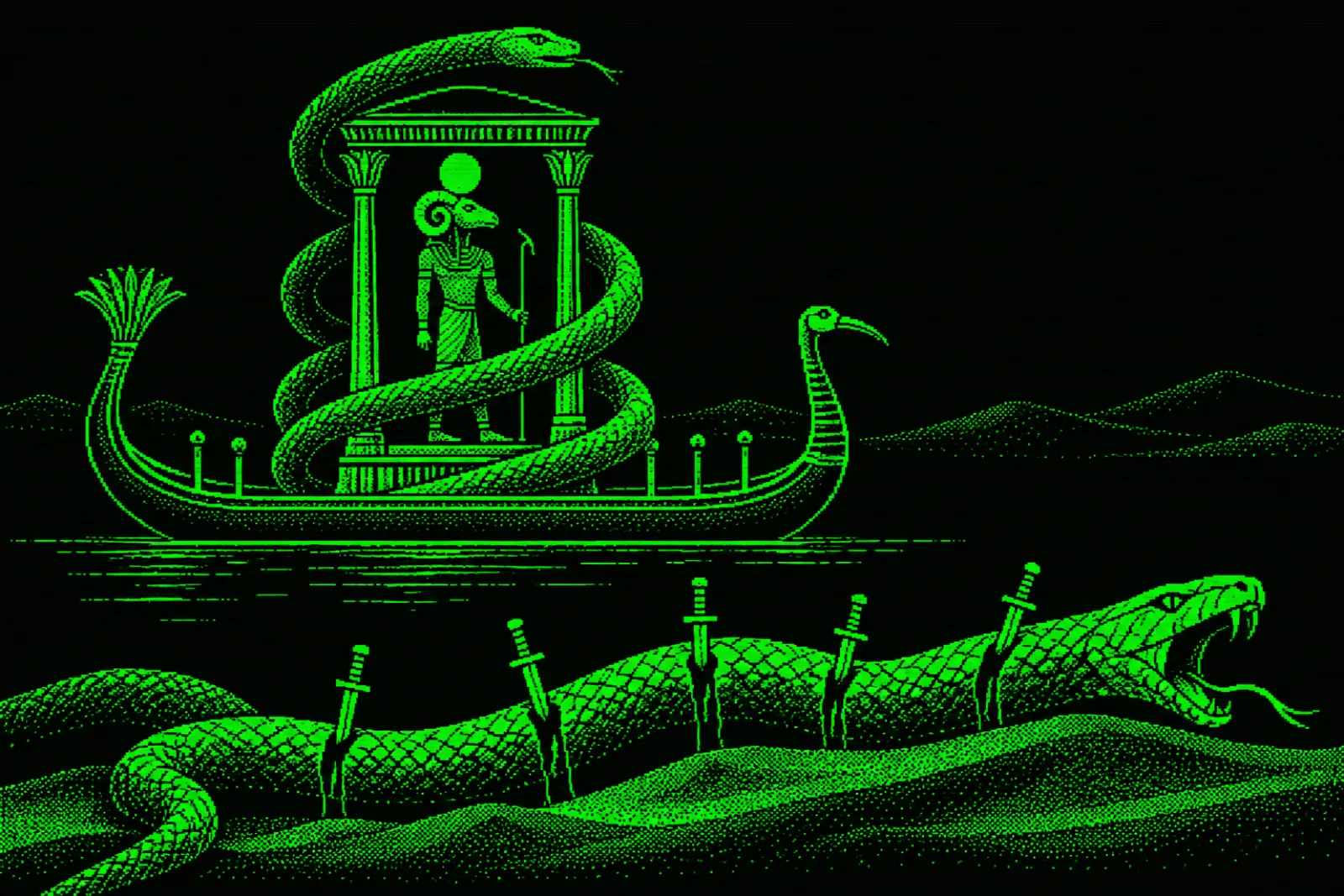
The seventh hour is the hour of Apophis. In the upper band Osiris sits enthroned inside the coils of Mehen, the Coiled One, while his enemies are beheaded, tied, burned and roasted on the spit before him. In the middle band the barque crosses a riverbed with no water, drawn by the spells of Isis and the Eldest Magician; Mehen now arches over the sun god’s shrine. Ahead lies Apophis, his coils filling a sandbank and stuck with knives, a noose over his head and a fetter at his tail, with four goddesses holding knives beyond him. In the lower band Horus sits enthroned before the star gods and the goddesses of the hours, and a crocodile on a sandbank holds the Eye of Osiris in its back while Osiris’s head rises from the sand.
This is every sentence of the open edition, which gives Hornung’s text from the New Kingdom copies: the narrative, the speeches and the name captions, 125 lines in all. Line numbers are the edition’s sentence numbers; Hornung’s section numbers are shown under them. Scene headings are left out, names written twice (in plain and in secret signs) are given once, and one word the edition marks as meaningless is shown as [ … ]. The open edition has no hieroglyphs for this text. For the coiled serpent around the god, see Within the Coiled One.
Each numbered line gives the Middle Egyptian (New Kingdom) first, in Latin letters. Our English is underneath. Tap a dotted word for its meaning, and Note for our comment on the line; our comments are in the right margin.
- 3Amd. 523
The ḥtp: to rest, to settle of this great god in the ṯpḥ.t: cavern of Wsjr: Osiris.
- 4Amd. 524
wḏ-mdw jn ḥm n nṯr pn r ṯpḥ.t cavern · TLA tn n nṯrw jmw =s
Orders given by the majesty of this god at this cavern, to the gods who are in it.
Note on line 4
The TLA German adds “great”, which the transliteration here lacks. - 5
This god takes ky jr.w: another form, shape at this cavern.
Note on line 5
Schweizer (2010, p. 138) takes the “other form” to be the serpent Mehen, who from this hour to the twelfth coils around the sun god’s shrine in the barque instead of the chest that covered it before. The text names Mehen as the god’s cover at line 77. - 6Amd. 525
stnm to turn aside, to divert · TLA =f wꜣt r Ꜥꜣpp Apophis, the serpent enemy of the sun · TLA m ḥkꜣ.w magic; the act of spellbinding · TLA Ꜣs.t Isis · TLA ḥkꜣw-smsw the Eldest Magician · TLA
He stnm: to turn aside, to divert from Ꜥꜣpp: Apophis, the serpent enemy of the sun by the ḥkꜣ.w: magic; (plural) spells of Ꜣs.t: Isis and of the ḥkꜣw-smsw: the Eldest Magician.
Note on line 6
Hornung identified the Eldest Magician, who stands with Isis at the prow of the barque, as a form of Seth (Hornung 1963, vol. II, p. 131, via Schweizer 2010, p. 141): the murderer of Osiris is here Re’s chief defender against the serpent. ḥkꜣ.w is plural, the spoken spells, the same word as Heka, magic as a power. - 7
The name of the gate of this place, past which this god travels: rwtï-wsjr: the Double Gate of Osiris.
- 8Amd. 526
rn n nʾt ṯn ṯpḥt-štꜣt the Secret Cavern · TLA
The name of this place: ṯpḥt-štꜣt: the Secret Cavern.
- 9
rn n wnwt nt grḥ sšmt nṯr pn ꜥꜣ ḫsft-hjw-ḥsqt-nḥꜣ-ḥr “She who repels Hiu and beheads Fierce-Face”, the name of the hour · TLA
The name of the hour of the night who guides this great god: ḫsft-hjw-ḥsqt-nḥꜣ-ḥr: “She who repels Hiu and beheads Fierce-Face”, the name of the hour.
Note on line 9
The hour herself is named for a beheading: ḥsq is “to cut off the head”. Fierce-Face (Nḥꜣ-ḥr) is a name of Apophis; the hour’s own text uses it and “Apophis” for the same enemy (lines 61 and 63). - 10Amd. 527
wꜣt štꜣt nt jmn.t the hidden place · TLA ꜥppt nṯr-ꜥꜣ ḥr =s m wjꜣ barque, the sacred boat · TLA =f dsr
The secret way of the West, along which the great god passes in his holy wjꜣ: barque, the sacred boat,
- 11Amd. 528
ꜥpp to pass by, to travel through · TLA =f ḥr wꜣt tn jwt mw water · TLA =s jwt sṯꜣw towing, hauling · TLA =s
He passes along this way: it has no water, it has no sṯꜣw: towing, hauling.
Note on line 11
The river is dry here, and the boat moves by magic instead (lines 12 and 60). Schweizer (2010, pp. 139–40) links the dry way to Apophis drinking the water (line 87). - 12
sqdi̯ to sail, to travel by boat · TLA =f m ḥkꜣ.w magic; the act of spellbinding · TLA Ꜣs.t Isis · TLA ḥkꜣw-smsw the Eldest Magician · TLA m ꜣḫ.w spell-power, effective power · TLA tpï rʾ mouth · TLA n nṯr pn ḏs =f
He sails by the spells of Isis and the Eldest Magician, by the ꜣḫ.w: spell-power, effective power on the rʾ: mouth of this god himself.
Note on line 12
The magic is spoken: it sits “on the mouth” of the god. - 13Amd. 529
jrt šꜥ.t slaughter, cutting down (TLA: wounding) · TLA Ꜥꜣpp Apophis, the serpent enemy of the sun · TLA m dwꜣ.t the Duat, the underworld · TLA r qrrt cavern · TLA tn n hꜣw =f pj m pt
Making the šꜥ.t: slaughter, cutting down (TLA: wounding) of Apophis in the dwꜣ.t: the Duat, the underworld at this cavern [ … ]; his place is in the sky.
Note on line 13
The TLA German has “wounding” (Verwundung) for šꜥ.t; we write “slaughter”, the sense the same noun has in the Book of the Heavenly Cow for the massacre of mankind (see that page). One word after “this cavern” is marked in the edition as meaningless and is left out. Whose place is in the sky the line does not say. - 14Amd. 530
jw jr.tw nn mj-qd ḥr mḥt ꜥt jmnt m dwꜣ.t the Duat, the underworld · TLA
This is made in the same way on the north side of the ꜥ.t jmn.t: the hidden chamber, the burial room in the Duat.
Note on line 14
This is a painter’s instruction: the hour is to be drawn on the north wall of the burial chamber, the room the book is named for. - 15
It is ꜣḫ: to be effective, useful in the sky, in the earth and on the earth.
- 16
jw rḫ to know · TLA st m bꜣ to be a ba, to be ensouled · TLA bꜣ to be a ba, to be ensouled · TLA ḫr Rꜥw Re, the sun god · TLA
Whoever rḫ: to know it is a bꜣ: ba, the manifest power of a being among the bas with Rꜥw: Re, the sun god.
- 18Amd. 531
ḏ-mdw jn nṯr pn ꜥꜣ
Words spoken by this great god:
Note on line 18
The upper register begins with three beings greeted by the sun god as he passes. - 19
šps the Noble One · TLA ḏ.n ꜥ =k
šps: the Noble One, your hand has given.
Note on line 19
The Noble One’s hand reaches out to help the god. - 20
Horus has come out of your head.
Note on line 20
The word for head is written in the cryptographic spelling dp. - 21
ḥknyṯ: the Praiser, your voice sounds, your throat is true.
- 22Amd. 532
ꜥnḫyt: the Living One, your qꜣb: coil, fold (of a snake) opens.
Note on line 22
qꜣb is the fold or coil of a snake’s body; the edition corrects the suffix to the feminine. The Living One is a serpent, and her coil opens for the god. - 23
jjj.n =j sḥḏ =j ḫntï kkwt
I have come to light up the one who is before the darkness.
- 24
I give a sḫn: resting place to the one who is in the Mḥn: Mehen, “the Coiled One”, the serpent who encircles.
Note on line 24
The first naming of Mehen in this hour. The one “in the Coiled One” is Osiris, enthroned in the scene that follows inside a canopy of serpent coils (line 27). - 25
The Noble One. The Praiser. Akhuit-ankh.
Note on line 25
Labels on the three figures (Hornung’s nos. 487–489). The TLA gives no German for the third name, and we leave it untranslated. - 27Amd. 533
Then this god said to Osiris, who is jm Mḥn: who is in Mehen:
Note on line 27
Osiris sits enthroned inside the coils of Mehen. Schweizer (2010, pp. 134–35) notes that this is the first time Osiris is shown encircled by the serpent, in the same hour in which Mehen takes over the sun god’s shrine. - 28
O this Osiris, ḫntï-dꜣt: Foremost of the Duat, Lord of Life, Ruler of the West!
- 29
ꜥnḫ n =k ꜥnḫ =k ꜥnḫ.t
Life is yours: you live, you are alive.
- 30Amd. 534
bꜣ to be a ba, to be ensouled · TLA n =k bꜣ to be a ba, to be ensouled · TLA =k bꜣ to be a ba, to be ensouled · TLA m tꜣ
Ba-power is yours: you are a ba, you are bꜣ: to be a ba, to be ensouled in the earth.
- 31
bwꜣ.n =k r jmw-ḫt =k
You are high above your followers.
- 32
Your ḫft.j: enemy fall to you, under your two feet.
- 33
sḫm.n =k m jrw r =k
You have power over those who act against you.
- 34Amd. 535
The nsr: flame of ꜥnḫ-jrw: Living-of-Forms are against them: he ꜣm: to burn them.
- 35
mdn-ḥr r =sn mds to cut up, to butcher · TLA =f sn
mdn-ḥr: Violent-Face is against them: he mds: to cut up, to butcher them.
Note on line 35
In the picture three of Osiris’s enemies kneel with their heads cut off; Schweizer (2010, pp. 134–35) has two punishing demons standing over the condemned. - 36
He mꜥq: to roast on a spit as a mꜥq: spit-roast for him.
Note on line 36
The enemies are cooked as meat for Osiris. The TLA German says the same, “am Spieß grillen … als Spießbraten”. - 37
Osiris is jp: to count, to reckon, to assess every day.
Note on line 37
jp is to count or assess: Osiris is reckoned every day as lord of the dead. - 38Amd. 536
jw =j ꜥp =j ḥr =ṯn m ḥtp
I pass by you in peace.
- 39
jwf-wsjr ꜥnḫ-jrww Living-of-Forms · TLA ḫft.j enemy · TLA Wsjr Osiris · TLA mds-ḥr Violent-Face · TLA
Flesh-of-Osiris. Living-of-Forms. The enemies of Osiris. Violent-Face.
Note on line 39
Labels on the figures (Hornung’s nos. 490–495). The first two are given twice in the TLA, in plain and cryptographic writing; one writing is kept here. - 41
j.n ḥm n nṯr pn
The majesty of this god said:
Note on line 41
Three bound enemies lie on their backs before the Punisher. - 42Amd. 538
You who make wt: binding, bandage, constriction against Osiris, who are ẖꜣk: to be hostile to the Foremost of the Duat:
Note on line 42
wt is the word for binding, as with mummy bandages. They made binding against Osiris; now they are bound themselves. - 43
your two arms are nṯṯ: to be bound, tied, your qꜣs: bond, cord are knotted fast.
- 44
ḥtm to destroy, to annihilate · TLA bꜣ to be a ba, to be ensouled · TLA =ṯn jsq.n šw.t shadow · TLA =ṯn
Your bas are ḥtm: to destroy, to annihilate, your šw.t: shadow are held back.
- 45Amd. 539
The njkw: the Punisher njk: to punish you with his njkwt: punishing-knife; fetter.
Note on line 45
A three-fold pun on njk, “punish”, which the TLA German marks (“Wortspiel mit njk”). The punishing is done with knives. - 46
You will not get out of his zꜣw.t: guard, custody, ever.
- 47
Those who make bonds against Osiris.
Note on line 47
The same caption written in cryptographic signs; the edition restores the ordinary words. - 48Amd. 540
Those who make bonds against Osiris.
- 49
wtï: the Bound One. Bound One. Bound One. The Punisher.
Note on line 49
Labels on the three bound enemies and the Punisher (Hornung’s nos. 496–499). - 51
j.n nṯr pn ꜥꜣ
This great god said:
Note on line 51
Three human-headed ba-birds stand before a god seated on the coils of a serpent (Schweizer 2010, pp. 134–35, who takes him as the sun god in his form of Atum). - 52Amd. 541
O living bas, living, with the štꜣ.w: secret things upon you,
- 53
nw tp head · TLA ḫprw m ḫpr jm =j
who belong to the heads, who come into being as ones created from me,
- 54Amd. 542
who are behind jwf-jṯ: Flesh-of-Atum, guarding his ḏ.t: body in the Duat.
- 55
Your ba lives. The sꜣq: the Gatherer, who is in the earth, makes you firm.
- 56
He puts his nḥ: fire into those who are hostile to you.
- 57
Matj. Kheperwy. Ba-of-Tatenen. Flesh-of-Atum. The Gatherer.
Note on line 57
Labels on the figures (Hornung’s nos. 500–504). The first two names have no German in the TLA and are left as names. - 59Amd. 544
sqdi̯ to sail, to travel by boat · TLA nṯr pn ꜥꜣ m nʾt tn m wꜣt nt qrrt cavern · TLA Wsjr Osiris · TLA
This great god sails in this place on the way of the qrr.t: cavern of Osiris,
Note on line 59
The middle register: the barque of Re, and before it Apophis. - 60Amd. 545
ḥr sṯꜣ to tow, to drag · TLA m ḥkꜣ.w magic; the act of spellbinding · TLA Ꜣs.t Isis · TLA ḥkꜣw-smsw the Eldest Magician · TLA
sṯꜣ: to tow, to drag by the spells of Isis and the Eldest Magician,
- 61
to turn the way aside from Nḥꜣ-ḥr: Fierce-Face, Nehaher, a name of Apophis.
- 62
jw jr.t nn-n ḥkꜣ.w magic; the act of spellbinding · TLA Ꜣs.t Isis · TLA ḥkꜣw-smsw the Eldest Magician · TLA
These spells of Isis and the Eldest Magician are performed
- 63
n ḫsf to repel, to drive back · TLA Ꜥꜣpp Apophis, the serpent enemy of the sun · TLA ḥr Rꜥw Re, the sun god · TLA m jmn.t the hidden place · TLA nt dwꜣ.t the Duat, the underworld · TLA
because Apophis is to be ḫsf: to repel, to drive back from Re in the jmn.t: the hidden place of the Duat.
Note on line 63
ḥr here means “from”, not “by” (the agent would be marked with jn): the serpent is pushed back from the sun. - 64Amd. 546
jw jr.t tp head · TLA tꜣ m-mjtt
It is done on earth in the same way.
Note on line 64
The spells are not only a myth: the line says they are performed on earth as well. - 65
Whoever does it is one who is in the barque of Re, in the sky and in the earth.
- 66
Few know this sšm: image, form, figure.
- 67
jwt rḫ to know · TLA =f n ḫsf to repel, to drive back · TLA 〈=f〉 Nḥꜣ-ḥr Fierce-Face, Nehaher, a name of Apophis · TLA
One who does not know it does not drive back Fierce-Face.
- 68Amd. 547
The barque of Re, and the gods who are in it.
Note on line 68
A caption over the barque, restored by the edition. - 69
Ꜣs.t Isis · TLA Sjꜣ Sia, Perception · TLA ḥkꜣw-smsw the Eldest Magician · TLA Mḥn Mehen, “the Coiled One”, the serpent who encircles · TLA jwf flesh · TLA
Isis. Sjꜣ: Sia, Perception. The Eldest Magician. Mḥn: Mehen, “the Coiled One”, the serpent who encircles. jwf: “Flesh”, the sun god's body in the night.
Note on line 69
The crew of the barque (Hornung’s nos. 505–509). The Coiled One is Mehen, painted as a serpent arched over the shrine in which the ram-headed sun god, called “Flesh”, stands. Isis and the Eldest Magician stand at the prow. - 70
Horus-Who-Praises. Bull of Maat. Nehes. Ḥw: Hu, Utterance. The ḫrp-wjꜣ: Steerer of the barque.
Note on line 70
The rest of the crew (Hornung’s nos. 510–514). Nhz is left as a name. - 72
ṯz sandbank · TLA Nḥꜣ-ḥr Fierce-Face, Nehaher, a name of Apophis · TLA m dwꜣ.t the Duat, the underworld · TLA
The ṯz: sandbank of Fierce-Face in the Duat:
- 73
mḥ to fill · TLA 443 m ꜣw =f
443 cubits in its length.
- 74Amd. 549
He fills it with his qꜣb: coil, fold (of a snake).
Note on line 74
Apophis’s body fills the whole sandbank, about 230 metres long. In the picture his coils are pierced with knives. - 75
jr.t ꜥḏ.t slaughter, massacre · TLA =f r =f jwt ꜥpp to pass by, to travel through · TLA nṯr pn ꜥꜣ ḥr =f
His ꜥḏ.t: slaughter, massacre is done against him, he past whom this great god does not go,
Note on line 75
The scribe’s spelling is odd; the TLA reads the word as ꜥḏ.t, slaughter, and the German has “Gemetzel”. - 76
when he turns the way aside from him, toward the Cavern of Osiris.
- 77Amd. 550
sqdi̯ to sail, to travel by boat · TLA nṯr pn m nʾt tn m sšm image, form, figure · TLA n Mḥn Mehen, “the Coiled One”, the serpent who encircles · TLA
This god sails in this place in the sšm: image, form, figure of the Mḥn: Mehen, “the Coiled One”, the serpent who encircles.
Note on line 77
“In the image of Mehen” belongs to the god, as line 5 (“he takes another form”) and the painting, where Mehen is coiled around the god’s shrine, show: he goes past Apophis wrapped in another serpent. - 78Amd. 551
He is like this at his sandbank in the Duat.
Note on line 78
From here the subject is Apophis. - 79
sḏꜣw-mw: the sandbank's name, “Water-Carrier” is the name of this sandbank,
Note on line 79
The TLA has “Wasserbringender”, water-bringer; sḏꜣ is to make go, to convey, so “carrier” keeps both directions open. - 80
440 cubits in its length, 440 in its breadth.
- 81
jn ḫrw voice · TLA =f sšm nṯrw r =f
It is his ḫrw: voice that leads the gods to him.
- 82Amd. 552
jw =f njm =f m-ḫt ꜥq nṯr pn ꜥꜣ nʾt tn
He moves after this great god has entered this place.
Note on line 82
The verb (njm) is rare; the TLA gives Hornung’s “sich bewegen” as a proposal. - 83
ꜥm to swallow; also to learn, to know · TLA jwf flesh · TLA jr.t eye; the Eye of the sun · TLA =f m tꜣ r ꜥpp to pass by, to travel through · TLA =f ḥr =f
Then jwf: “Flesh”, the sun god's body in the night ꜥm: to swallow; also to learn, to know his jr.t: eye; the Eye of the sun in the earth, so that he may pass by him.
Note on line 83
Flesh is the sun god. The scribe wrote Rꜥw, Re, where the edition reads jr.t, eye. Schweizer (2010, p. 140) reads the Eye as the sun god’s own light, which he takes into himself to get past Apophis. The same verb is used of the heads (line 98) and the crocodile (line 135), who swallow their own images: the god takes his own Eye back into his body. - 84Amd. 553
Then srqt-ḥtt: Selket, “She who lets the throat breathe”, the scorpion goddess throws the spḥ: lasso, noose over the head.
Note on line 84
Srq.t-ḥt.t, “she who lets the throat breathe”, is the full name of Selket, the scorpion goddess; here she throws the noose over Apophis’s head. In the TLA the word for lasso stands later in the line. - 85
ḥr-dsw=f: He-Who-Is-over-His-Knives: he puts the njk.t: punishing-knife; fetter (“the punisher”) on his two feet,
Note on line 85
The fetter is njk.t, “the punisher”, the word used for the knives at line 45. A serpent has no feet; the text gives Apophis “two feet” anyway. In the picture one deity holds him at the neck and one at the tail (Schweizer 2010, p. 137), so the feet are the tail end. - 86Amd. 554
m-ḫt nḥm Ꜣs.t Isis · TLA ḥkꜣw-smsw the Eldest Magician · TLA pḥ.tj physical strength · TLA =f m ḥkꜣ.w magic; the act of spellbinding · TLA =sn
after Isis and the Eldest Magician have taken away his pḥ.tj: physical strength by their spells.
- 87
jw rḫ to know · TLA st tp head · TLA tꜣ m jwtï zwr to drink · TLA Nḥꜣ-ḥr Fierce-Face, Nehaher, a name of Apophis · TLA mw water · TLA =f
Whoever knows it on earth is one whose mw: water Fierce-Face does not zwr: to drink.
Note on line 87
Fierce-Face drinks the water of those who do not know the image. Schweizer (2010, pp. 139–40) reads the hour’s dry riverbed as water Apophis has gulped down. - 88
Ꜥꜣpp Apophis, the serpent enemy of the sun · TLA srqt-ḥt Selket, “She who lets the throat breathe”, the scorpion goddess · TLA ḥr-dsw=f He-Who-Is-over-His-Knives · TLA
Apophis. Selket. He-Who-Is-over-His-Knives.
Note on line 88
Labels (Hornung’s nos. 515–517). - 89
nṯrwt p nkywt Ꜥꜣpp Apophis, the serpent enemy of the sun · TLA m dwꜣ.t the Duat, the underworld · TLA ḫsf to repel, to drive back · TLA ḫwt n ḫft.j enemy · TLA nw Rꜥw Re, the sun god · TLA
They are goddesses who punish Apophis in the Duat, who drive back the things of the enemies of Re.
Note on line 89
Four goddesses stand beyond the serpent, knives in hand. - 90Amd. 556
wnn =sn m sḫr pn ẖr njkwwt punishing-knife; fetter (“the punisher”) · TLA =sn
They are like this, holding their njkwt: punishing-knife; fetter.
Note on line 90
Literally “under their knives”: ẖr, “under”, is used for what one carries. - 91
They punish Apophis every day.
- 92
dmdyt dnyt njkyt ḥtmyt
She Who Unites. She Who Cuts. She Who Punishes. She Who Destroys.
Note on line 92
Labels on the four knife goddesses (Hornung’s nos. 518–521). - 94Amd. 558
They are the secret forms of the Duat,
Note on line 94
Four tomb-mounds with a god’s head on each, and two deities. - 95
the hnw: chest, box of the earth, the heads of the secret things.
- 96
wnn =sn m pḥ ṯz sandbank · TLA pn
They are at the end of this sandbank.
- 97Amd. 559
pr tp head · TLA ds knife · TLA jmw =sn sḏm =sn ḥkꜣ.w magic; the act of spellbinding · TLA Nḥꜣ-ḥr Fierce-Face, Nehaher, a name of Apophis · TLA
The tp: head and the ds: knife that are in them come out when they hear the ḥkꜣ.w: magic; the act of spellbinding of Fierce-Face.
Note on line 97
The edition reads ḥkꜣ here as an act, the spellbinding of Apophis (Hornung’s “Bezaubern”). - 98
ꜥm to swallow; also to learn, to know · TLA =sn sšmw =sn m-ḫt ꜥpp to pass by, to travel through · TLA nṯr pn nʾt tn
Then they ꜥm: to swallow; also to learn, to know their images, after this god has passed this place.
- 99Amd. 560
wnn nb-wꜣs ḥtmt-jb m rrr sšm image, form, figure · TLA pn štꜣ
Lord of the Was-Scepter and She Who Is Furnished with a Heart exist as those who belong to this secret image.
- 100
n zbi̯ to go, to pass away · TLA bꜣ to be a ba, to be ensouled · TLA n rḫ to know · TLA st n qnt nt zfw knife · TLA =sn
The ba of one who knows it does not zbi̯: to go, to pass away through the power of their zf: knife.
- 101
ẖr-sšm-tm ẖr-sšm-ḫprj ẖr-sšm-rꜥw ẖr-sšm-wsjr
Containing the Image of Atum. Containing the Image of Khepri. Containing the Image of Re. Containing the Image of Osiris.
Note on line 101
Names of the four tomb-mounds (Hornung’s nos. 522–525), each given in plain and cryptographic writing in the TLA. Schweizer (2010, pp. 145–46) reads the four chests as holding four forms of the sun god. - 102
nb-wꜣs ḥtmt-jb
Lord of the Was-Scepter. She Who Is Furnished with a Heart.
Note on line 102
Labels (Hornung’s nos. 526–527). - 104Amd. 563
This image is Ḥr.w: Horus on his throne.
Note on line 104
The lower register: Horus enthroned before twelve star gods and twelve hour goddesses. - 105Amd. 564
wnn sšm image, form, figure · TLA pn m sḫr pn jrt =f p m dwꜣ.t the Duat, the underworld · TLA snhp to set moving, to rouse · TLA sbꜣyw the Star-Gods · TLA
This image is like this: his work in the Duat is to snhp: to set moving, to rouse the sbꜣyw: the Star-Gods,
- 106
jrt ꜥḥw wnwwt m dwꜣ.t the Duat, the underworld · TLA
to make the stations of the hours in the Duat.
- 107
ḥrw-ḥr-ḫndw=f
Horus-on-His-Throne.
Note on line 107
Label (Hornung’s no. 528). - 108Amd. 565
The majesty of Ḥr.w-dwꜣ.tj: Horus of the Duat said to the gods, the Star-Gods:
- 109
mꜣꜥ.n jwf flesh · TLA =ṯn ḫpr.n ꜣḫ akh, a transfigured spirit · TLA =ṯn ḥtp to rest, to settle; to be content · TLA =ṯn m sbꜣ star · TLA =ṯn
May your jwf: flesh be in order, may your ꜣḫ: akh, a transfigured spirit come into being, so that you rest in your sbꜣ: star.
- 110Amd. 566
You stand up at your places for this Re of the Horizon, who is in the Duat every day.
Note on line 110
r=ṯn is literally “to you”: each stands at their own place. - 111Amd. 567
You are behind him, your stars are before him, until I pass through the beautiful West in peace.
- 112
ntṯn ꜥḥꜥw jmw tꜣ ṯn-r-ṯn n =j sbꜣ star · TLA =ṯn 〈n〉 jm-pt
You are the Helpers who are in the earth; you are mine, and your stars belong to the One in the Sky.
- 113Amd. 568
swt js ḥtp to rest, to settle; to be content · TLA nb-ꜣḫt
He is content, the Lord of the Horizon.
- 114
wr-ẖrt nb-ẖr.t nb-ḫrt-tꜣ dꜣtï
Great One of Provision. Lord of Provision. Lord of What the Earth Yields. The One of the Duat.
Note on line 114
Labels (Hornung’s nos. 529–532). - 115
ḥy-sbꜣw ḥy-ꜣḫw ṯn-ꜥ
Driver of the Stars. Driver of the Akh-Spirits. Raised-Arm.
Note on line 115
Labels (Hornung’s nos. 533–535). - 116
dsr-ꜥ ṯmꜣ-ꜥ ds-m-ns=f He Who Cuts with His Tongue · TLA ds-m-jrt=f He Who Cuts with His Eye · TLA sqr-tpw He Who Strikes Off Heads · TLA
Holy-Arm. Strong-Arm. ds-m-ns=f: He Who Cuts with His Tongue. ds-m-jrt=f: He Who Cuts with His Eye. sqr-tpw: He Who Strikes Off Heads.
Note on line 116
Labels (Hornung’s nos. 536–540). The star gods who drive the hours carry names of cutting and beheading. - 118
j.n ḥm n Ḥr.w-dwꜣ.tj Horus of the Duat · TLA n wnwwt the Hours, goddesses of the night's hours · TLA jmwt nʾt tn
The majesty of Horus of the Duat said to the wnw.wt: the Hours, goddesses of the night's hours who are in this place:
- 119Amd. 572
j wnwwt the Hours, goddesses of the night's hours · TLA ḫpryt j wnwwt the Hours, goddesses of the night's hours · TLA sbꜣywt
O Hours who have come into being! O Hours, star goddesses!
- 120
j wnwwt the Hours, goddesses of the night's hours · TLA nḏtwt Rꜥw Re, the sun god · TLA ꜥḥꜣwt ḥr jm-ꜣḫt
O Hours who protect Re and fight for the One in the Horizon!
- 121Amd. 573
šzpw n =ṯn jr.w form, shape · TLA =ṯn rmnw n =ṯn sšmw =ṯn
Take your forms for yourselves, carry your images for yourselves,
- 122
fꜥw n =ṯn tp head · TLA =ṯn
lift up your heads!
- 123Amd. 574
Guide this Re, the One in the Horizon, to the beautiful West in peace.
- 124Amd. 575
jn nn-n nṯrw nṯrywt sšm nṯr pn ꜥꜣ r wꜣt štꜣt nt nʾt tn
It is these gods and goddesses who guide this great god to the secret way of this place.
- 125
ḥknwṯṯ nbt-tꜣ nbt-nbwt
The Praiser. Lady of the Earth. Lady of Ladies.
Note on line 125
Labels on the hour goddesses (Hornung’s nos. 541–543). - 126
dꜣṯṯ wnmtt
She of the Duat. She of the Right Eye.
Note on line 126
Labels (Hornung’s nos. 544–545). - 127
ḥrt-tp-kꜣw jnyṯ jwnyṯ
Chief of the Powers. Inyt. The Colored One.
Note on line 127
Labels (Hornung’s nos. 546–548). The TLA identifies Inyt as a demoness of sickness. - 128
tꜣjṯṯ jrt-ꜣḫw jrt-jrww wḥꜥt-sdb
She of Tait. She Who Makes Light. She Who Makes Forms. She Who Loosens Evil.
Note on line 128
Labels (Hornung’s nos. 549–552). - 130Amd. 578
wnn =f m sḫr pn ḥr jdb bank, shore · TLA n šꜥ
He is like this on the jdb: bank, shore of sand:
Note on line 130
A crocodile lies on a bank at the end of the lower register, and a man’s head rises from it. - 131
ntf zꜣ sšmw n nʾt ṯn
It is he who guards the images of this place.
- 132
He hears the voice of the crew of the barque of Re.
- 133
The Eye comes out of his bqs.w: backbone, vertebrae,
- 134Amd. 579
then the head that is in his bank comes out,
- 135
ꜥm to swallow; also to learn, to know · TLA =f sšm image, form, figure · TLA =f m-ḫt ꜥpp to pass by, to travel through · TLA nṯr pn ꜥꜣ ḥr =f
then he ꜥm: to swallow; also to learn, to know his image again, after this great god has passed by him.
- 136Amd. 580
jw rḫ to know · TLA st m tmw ꜥbš Abesh, a crocodile · TLA ꜥm to swallow; also to learn, to know · TLA bꜣ to be a ba, to be ensouled · TLA =f
Whoever knows it is one whose ba ꜥbš: Abesh, a crocodile does not swallow.
- 137
Abesh-in-the-Duat. jrt-wsjr: Eye of Osiris. tp-wsjr: Head of Osiris.
Note on line 137
Labels (Hornung’s nos. 553–555). The eye that comes out of the crocodile’s back and the head that rises from his bank are the Eye and the Head of Osiris: the dead god’s body is kept inside the beast and shown only while the sun passes.