~/sacred-texts/amduat
Amduat, Eleventh Hour: Mehen Carried, the Damned Burned
Translated by AI straight from the Middle Egyptian (New Kingdom), not from a modern translation, then checked against the editions and studies listed below. How we translate
- Text
- Amduat, Eleventh Hour (Hornung §§ 743–792, figures 754–821)
- Date
- Early New Kingdom; first complete copy c. 1450 BC (Thutmose III)
- Found
- Burial chambers of the Valley of the Kings, first complete in the tomb of Thutmose III (KV 34)
- Language
- Middle Egyptian (New Kingdom) · Hieroglyphic (cursive)
The Amduat, “What Is in the Duat”, follows the sun through the twelve hours of the night. The god, ram-headed and called “Flesh”, sails the river of the underworld in his barque, with the serpent Mehen, the Coiled One, wrapped around his shrine from the seventh hour on. Each hour is drawn in three bands of pictures, with a running text and a caption naming every figure. Its first complete copy is in the tomb of Thutmose III (about 1450 BC), and the text says this hour, like the last, is to be drawn on the east side of the burial chamber.
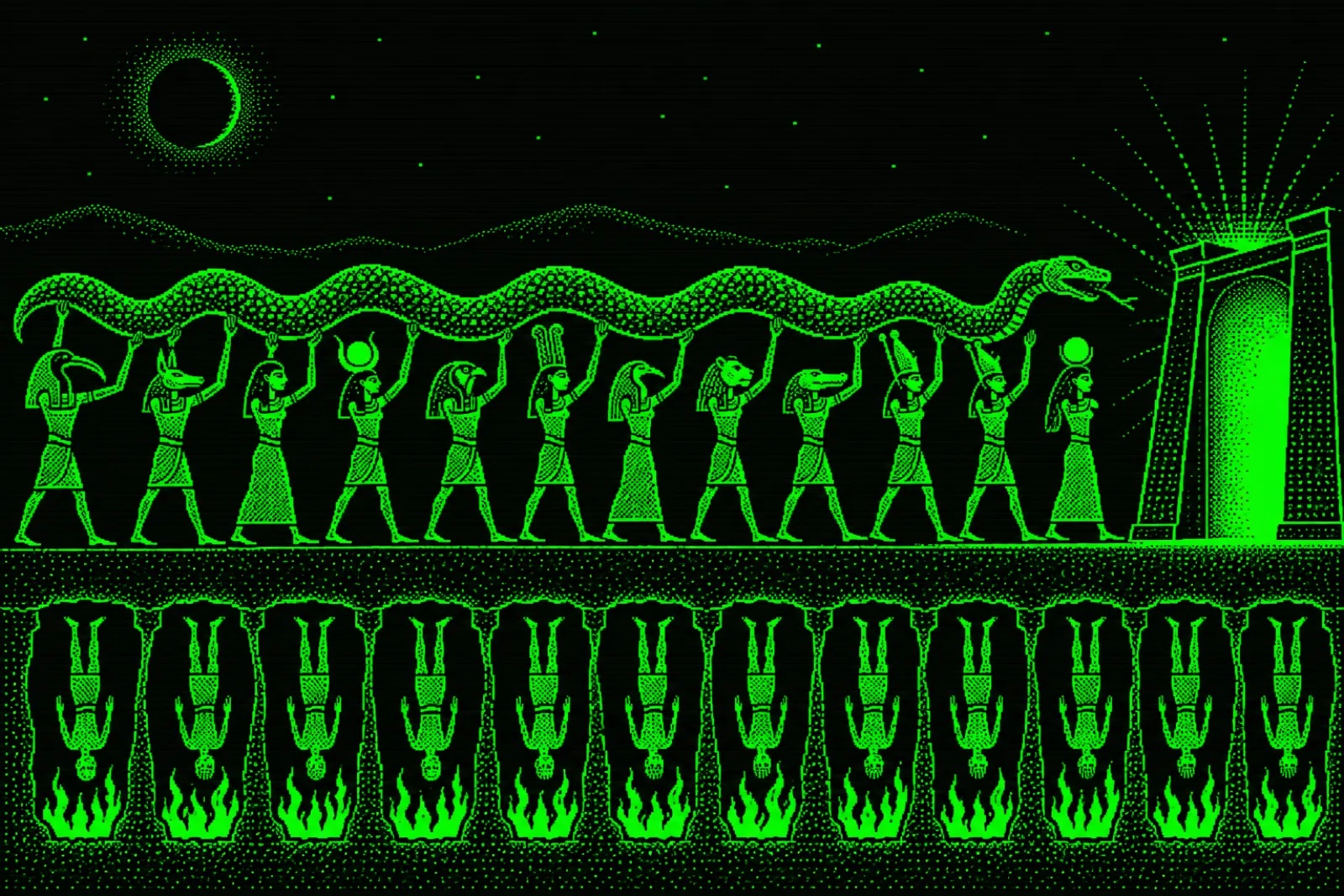
The eleventh hour is the last before the birth. In the upper band a two-headed god stands for Re, a winged serpent swallows back the image of Atum that came out of its back, and the goddess Eternity sits on a serpent called “He Who Takes the Hours”; twelve gods are told their bas will alight on their shadows, and the winds of the underworld come out through the faces of four goddesses seated on serpents. In the middle band the barque is guided by a goddess who lights the darkness, and in front of it twelve gods carry a great coiled serpent, Mehen of the Earth, on their heads toward the eastern horizon. Two crowned cobras stand at the second gate of the primeval darkness, and four forms of Neith guard the hidden gate of Sais. In the lower band Horus orders the slaughter of his father’s enemies: the damned, stood on their heads, are burned in pits of fire by a serpent demon and by goddesses with knives, and demons over cauldrons live on their screams.
This is every sentence of the open edition, which gives Hornung’s text from the New Kingdom copies: the opening text, the captions of all three bands and the name labels, 85 lines in all. Line numbers are the edition’s sentence numbers; Hornung’s section numbers are shown under them. Scene headings are left out, and words the edition restores from other copies are shown in angle brackets. The open edition has no hieroglyphs for this text. For the hour in which Mehen first wraps the god, see the Seventh Hour; for the birth through the serpent that follows, see the Twelfth Hour.
Each numbered line gives the Middle Egyptian (New Kingdom) first, in Latin letters. Our English is underneath. Tap a dotted word for its meaning, and Note for our comment on the line; our comments are in the right margin.
- 3Amd. 743
ḥtp jn ḥm n nṯr pn ꜥꜣ m qrrt cavern · TLA tn
The resting of the majesty of this great god in this qrrt: cavern.
- 4Amd. 744
wḏ=f-mdw n nṯrw jmw =s
He gives orders to the gods who are in it.
- 5
rn n sbꜣ n nʾt tn ꜥqw nṯr pn ꜥꜣ ḥr =f Sḫn-dwꜣ.tjw “Resting place of those in the Duat”, the name of the gate · TLA
The name of the gate of this place through which this great god enters: Sḫn-dwꜣ.tjw: “Resting place of those in the Duat”, the name of the gate.
- 6Amd. 745
rn n nʾt tn Rʾ-n-qrr.t-jp.t-ẖꜣ.wt “Mouth of the cavern that counts the corpses”, the name of the place · TLA
The name of this place: Rʾ-n-qrr.t-jp.t-ẖꜣ.wt: “Mouth of the cavern that counts the corpses”, the name of the place.
Note on line 6
jp is “to count, to reckon”: the cavern takes a tally of the dead. The corpses come back in the lower band, where the damned are slaughtered. - 7Amd. 746
rn n wnwt nt grḥ sšmt nṯr pn ꜥꜣ Sbꜣ.yt-nb.t-wjꜣ-ḫsf.t-sbj-m-pr.t=f “The starry one, mistress of the barque, who repels the rebel at his coming forth”, the name of the hour · TLA
The name of the hour of the night that guides this great god: Sbꜣ.yt-nb.t-wjꜣ-ḫsf.t-sbj-m-pr.t=f: “The starry one, mistress of the barque, who repels the rebel at his coming forth”, the name of the hour.
Note on line 7
The hour goddess is sbꜣ.yt, “starry”, and the gate of line 5 is a sbꜣ; the two words sound alike. The rebel (sbj) is the sun’s enemy. - 8Amd. 747
qrrt cavern · TLA štꜣt nt dwꜣ.t the Duat, the underworld · TLA ꜥppt nṯr pn ꜥꜣ ḥr =s r prt m ḏw jꜣb n pt
The secret cavern of the dwꜣ.t: the Duat, the underworld over which this great god passes, to come out of the eastern mountain of the sky.
- 9
ꜥm ḏ.t cobra (TLA: “the one who rears up”); also body, self: two words of one sound · TLA sšm image, form, figure · TLA =s m-bꜣḥ Ptr “the Seer”, a god · TLA jm nʾt tn
The ḏ.t: cobra, “she who rears up” swallows her images before the Ptr: “the Seer”, a god who is in this place,
Note on line 9
The edition tags the subject as ḏ.t, “cobra”. The goddess of the upper band, seated on a serpent, is labelled Ḏ.t, “Eternity” (line 26), and her caption opens “her body (ḏ.t) itself” (line 22). The three words sound the same, and the hour plays on them. Schweizer (2010, p. 176) makes the goddess djet-time, eternity as duration. The subject is the cobra, and the other two words sound in it. - 10Amd. 748
ḏ ={n}〈s〉 sn m-ḫt r mswt Ḫpr.j Khepri, the scarab, “He Who Becomes” · TLA m tꜣ
and gives them back afterwards, at the birth of Ḫpr.j: Khepri, the scarab, “He Who Becomes” in the earth.
Note on line 10
The TLA corrects the copy’s =n to =s, “she”. The serpent swallows the images and gives them out again as the sun’s birth. The same swallowing comes back in lines 19, 24 and 71. - 11Amd. 749
jw jr.t nn mj-qd mj sšm image, form, figure · TLA pn ntï m zẖꜣ ḥr jꜣb!! ꜥt jmn hidden; the Hidden One; the hidden chamber, the burial room · TLA nt dwꜣ.t the Duat, the underworld · TLA
This is made in this way, like this image, which is drawn on the east side of the jmn: hidden; the hidden chamber, the burial room of the Duat.
Note on line 11
A painter’s instruction, as in the seventh and twelfth hours. The eleventh hour, like the twelfth, belongs on the east wall of the burial chamber, the side of sunrise. The copy writes “east” with a slip (jꜣb), which the TLA marks as sic. - 12Amd. 750
jw nst nb-tꜣwï mn-ḫpr-rꜥw zꜣ-rꜥw n ẖt =f ꜥꜣ!! =f ḏḥwtj-ms-nfr-ḫprw mꜣꜥ-ḫrw rḫ st m psš =f m ꜣḫ akh, the dead as an effective spirit · TLA ꜥpr to equip; to be equipped · TLA m pt tꜣ šs mꜣꜥ
The king, the Lord of the Two Lands, Menkheperre, son of Re of his body, whom he loves, Thutmose Neferkheperu, true of voice, knows it, when he shares out (the offerings) as an ꜥpr: to equip; to be equipped ꜣḫ: akh, the dead as an effective spirit in the sky and the earth. A true remedy.
Note on line 12
The king’s names are those of Thutmose III. The copy writes ꜥꜣ for mrj, “love”, which the TLA marks as sic. psš is “to divide, to share”; the TLA German adds “(offerings)”. The closing šs mꜣꜥ (TLA lemma sšr, “thing, procedure”) is the stamp of a proven formula, as in the Amduat’s short version (“a true remedy”, Schweizer 2010, p. 182); the TLA German has “truly valuable”. - 14
wnn =f m sḫr pn
He is like this:
Note on line 14
The first figure of the upper band: a god with two heads, a sun disc between them (Schweizer 2010, p. 173). - 15Amd. 751
he stands up for Rꜥw: Re, the sun god without going away to his place in the Duat.
- 16
Ꜥpr-ḥr-nb-ḏ.t “Whose face is equipped, lord of eternity”, the two-headed god · TLA
Ꜥpr-ḥr-nb-ḏ.t: “Whose face is equipped, lord of eternity”, the two-headed god.
Note on line 16
The god’s label (Hornung’s no. 754). Schweizer (2010, p. 173) calls him “Lord of (djet-)time”. - 18
wnn =f m sḫr pn
He is like this:
Note on line 18
Atum stands before a winged serpent. - 19Amd. 752
ḏwj nṯr pn r =f pr sšm image, form, figure · TLA n Jtm.w Atum, the creator god · TLA m jꜣ.t spine, back · TLA =f ꜥm.ḫr =f sšm image, form, figure · TLA m-ḫt =f
This god calls to him, and the sšm: image, form, figure of Jtm.w: Atum, the creator god comes out of his jꜣ.t: spine, back; then he swallows his image again.
Note on line 19
Him is the winged serpent: Atum’s image comes out of the serpent’s back, and the serpent takes it back in. The Egyptian has only “he” and “his” for both. - 20
ꜥnḫ =f m šw.t shadow, the shade of a person · TLA mwt the dead, as a harmful power · TLA ẖꜣ.t corpse · TLA =f tp =f
He lives on the šw.t: shadow, the shade of a person of the mwt: the dead, as a harmful power, on his corpse and on his head.
Note on line 20
The serpent feeds on the dead. The text has “his corpse, his head”, in the singular, as if the dead man were one; the TLA German keeps it so. - 22Amd. 753
ḏ.t cobra (TLA: “the one who rears up”); also body, self: two words of one sound · TLA =s ḏs =s wnn =s m-ḥrt Šd-wnw.wt “He who takes away the hours”, the serpent of the scene · TLA
Her ḏ.t: body; bodily form; self itself: she is above Šd-wnw.wt: “He who takes away the hours”, the serpent of the scene.
Note on line 22
A goddess sits on a rearing serpent in front of a row of stars. Her caption opens with ḏ.t, “body”, the sound of her own name, Ḏ.t, Eternity (line 26). The text writes the serpent’s name short, šdw; the TLA ties it to Šd-wnw.wt, “He who takes away the hours” (Schweizer 2010, p. 176), and its German has “the Shedu stars”. Schweizer reads the stars as the hours the sun has already passed. - 23
jrt =s p〈w〉 ꜥnḫ wḏ Rꜥw Re, the sun god · TLA rꜥw-nb
Her task is to live on the command of Re every day.
- 24
ꜥm =s sšm image, form, figure · TLA =s r nʾt tn
She swallows her image at this place.
- 25Amd. 754
wnwt 11 p〈w〉 wꜥt m-ḫtw nṯr
It is the eleventh hour, the Only One, behind the god.
Note on line 25
wꜥ.t, “the only one”, is the hour herself; behind the god is her place in the sun’s train. - 26
Ḏ.t Djet, Eternity, as a goddess · TLA Šd-wnw.wt “He who takes away the hours”, the serpent of the scene · TLA
Ḏ.t: Djet, Eternity, as a goddess. Šd-wnw.wt: “He who takes away the hours”, the serpent of the scene.
Note on line 26
The labels on the goddess (Hornung’s no. 757) and on the stars (no. 758). The second label is written šdw; the English follows the TLA’s lemma, Šd-wnw.wt, while the TLA German reads it as a name of the stars, “Shedu”. - 28
wnn =sn m sḫr pn
They are like this:
Note on line 28
Twelve gods stand in the upper band. - 29
jw nṯr pn ꜥꜣ ḏw =f r =sn m rnw =sn
This great god calls to them by their names:
- 30
prw n =j jmn hidden; the Hidden One; the hidden chamber, the burial room · TLA ḥꜣy n =j Štꜣ-ꜥ “Secret of arm” · TLA
“Come out to me, jmn: hidden one! Light up for me, Štꜣ-ꜥ: “Secret of arm”!
- 31
ꜥnḫ.n bꜣ ba, the soul as a power that can move and be seen · TLA =ṯn sḫn =sn ḥr šw.t shadow, the shade of a person · TLA =ṯn
May your bꜣ: ba, the soul as a power that can move and be seen live, may they alight on your šw.t: shadow, the shade of a person!
Note on line 31
The ba flies down to settle on its shadow: the dead are put back together before the sunrise. - 32Amd. 756
You are the ones who open the jmn.t: the West, the land of the dead, who put the image in its holy place.
- 33
ṯꜣw =ṯn tp rʾ =j srqw fnḏw =ṯn jm =f
Your air is on my mouth: your noses breathe it.
- 34Amd. 757
ḥtpw n =ṯn tp wjꜣ barque, the sacred boat · TLA =j ꜥnḫw bꜣ ba, the soul as a power that can move and be seen · TLA =ṯn jm =f
Your offerings are on my wjꜣ: barque, the sacred boat: your bas live on them.
- 35
mw n =ṯn n ꜥḥꜥt nw.w the primeval water, Nun · TLA ḏḏwt!! mw n Dwꜣ.tj one who belongs to the Duat · TLA r =s
Water for you is from the high water of nw.w: the primeval water, Nun, which gives water to the Dwꜣ.tj: one who belongs to the Duat beside it.
Note on line 35
The TLA tags the word for “high water” as ꜥḥꜥ.yt, its lemma for noon, the sun’s high point; its German has “high stand”. Two other words are marked sic by the TLA. - 36
jhy mꜣꜥ jrw =ṯn
Oho! Right is your doing.”
- 37Amd. 758
bꜣ ba, the soul as a power that can move and be seen · TLA =ṯn n m-ḫt ḫpr.w form, becoming, transformation · TLA =j
Your bas are among those who follow my ḫpr.w: form, becoming, transformation.
Note on line 37
ḫpr.w, “forms”, is the root of Khepri, the form in which the god will be born in the next hour. - 38
jrt =sn p m dwꜣ.t the Duat, the underworld · TLA sꜥrt sštꜣ secret, mystery · TLA n nṯr pn ꜥꜣ r 〈ꜥt〉 jmn hidden; the Hidden One; the hidden chamber, the burial room · TLA 〈rꜥw-nb〉
Their task in the Duat is to bring the sštꜣ: secret, mystery of this great god up to the Hidden Chamber every day.
Note on line 38
The last three words are restored in the edition from other copies. - 39Amd. 759
〈prr〉 〈=sn〉 〈ḫr〉 〈nṯr〉 〈pn〉 〈ꜥꜣ〉 〈r〉 ḥrt
They come out with this great god to the sky.
Note on line 39
All but the last word are restored in the edition from other copies. - 40Amd. 760
tpwï ẖnm-rnyt nr-tꜣ ꜥwï-m-ẖn=f wpt-tꜣwï!! mr.n-ꜥwï=f jmn-ꜥwï=f swt-jwf dwꜣ-ḥrw mꜣꜥ msḫtj ḥp-ꜥ
Two-Headed. Khnum-renyt. Protector of the Earth. Both His Arms Are in Him. Who Parts the Two Lands. Whose Arms Are Bound. Whose Arms Are Hidden. Who Makes Flesh Great. Adorer of Horus. The True One. Meskhetiu. Who Holds Back the Arm.
Note on line 40
Labels on the twelve gods (Hornung’s nos. 759–770); the meanings follow the TLA’s lemma entries. Flesh is the sun god’s name in the night barque (line 53). - 42Amd. 761
wnn =sn m sḫr pn
They are like this:
Note on line 42
Four goddesses sit on serpents. - 43
mn.t thigh · TLA =sn m tꜣ rd foot, leg · TLA =sn m kk.w-zmꜣ.w the primeval darkness, literally “united darkness” · TLA
Their mn.t: thigh are in the earth, their feet in the kk.w-zmꜣ.w: the primeval darkness, literally “united darkness”.
- 44Amd. 762
jw nṯr pn ꜥꜣ ḏw =f r =sn m ḏ.t cobra (TLA: “the one who rears up”); also body, self: two words of one sound · TLA =sn ḏs{s} =sn
This great god calls to them in their own bodies.
- 45
hwt.ḫr =sn jwt zbj.n =sn m swt =sn
Then they wail, without going away from their places.
- 46Amd. 763
ꜥnḫ bꜣ ba, the soul as a power that can move and be seen · TLA =sn m ḫrw sšm image, form, figure · TLA prr m rd foot, leg · TLA =sn rꜥw-nb
Their bas live on the voice of the image that comes out of their rd: foot, leg every day.
Note on line 46
rd.wj are the two legs or feet. The image coming out from between the goddesses’ legs is the serpent each one sits on. - 47
prr sbyt shꜣ ṯꜣw ḫpr m dwꜣ.t the Duat, the underworld · TLA m ḥrw nn-n nṯryt
Head wind and the storm of the wind come out, coming into being in the Duat through the faces of these goddesses.
- 48Amd. 764
nbt-ꜥnḫ nbt-ꜣḫw nrt-jdbwï ḥnt-nṯrw
Mistress of Life. Mistress of the Akhs. She Who Protects the Two Banks. She Who Protects the Gods.
Note on line 48
Labels on the four goddesses (Hornung’s nos. 771–774); the meanings follow the TLA’s lemma entries. - 50Amd. 765
sqdd nṯr pn ꜥꜣ m nʾt tn m sḫr pn
This great god sails in this place like this:
Note on line 50
The middle band begins with the sun’s barque. - 51
jzt =f nt nṯrw ẖn =sn sw r ꜣḫ.t horizon, the place of sunrise · TLA jꜣbtt nt pt
his crew of gods row him to the eastern ꜣḫ.t: horizon, the place of sunrise of the sky.
- 52Amd. 766
Psḏ.t “the Shining One”, a goddess · TLA tpt wjꜣ barque, the sacred boat · TLA sšm =s nṯr pn ꜥꜣ r wꜣwt kkw m jmw ={n}〈s〉 sḥḏ jm.j-tꜣ one who is in the earth · TLA
Psḏ.t: “the Shining One”, a goddess who is on the barque guides this great god to the paths of darkness, lighting up jm.j-tꜣ: one who is in the earth with what is in her.
Note on line 52
The TLA guesses that what is in her means her light. The copy has =n for =s, “her”, corrected by the TLA. Her label in the barque is She Who Lights Up the Duat (line 53). - 53Amd. 767
wp-wꜣwt Sjꜣ Sia, Perception · TLA nb-wjꜣ!! Mḥn Mehen, “the Coiled One”, the serpent around the god's shrine · TLA jwf “Flesh”, the sun god's body in the night · TLA ḥr-ḥknw kꜣ-mꜣꜥt nhz Ḥw Hu, Utterance · TLA ḫrp-wjꜣ!! psdt-dꜣt
Opener of the Ways. Sjꜣ: Sia, Perception. Mistress of the Barque. Mḥn: Mehen, “the Coiled One”, the serpent around the god's shrine. jwf: “Flesh”, the sun god's body in the night. Horus Who Praises. Bull of Maat. The Wakeful One. Ḥw: Hu, Utterance. Pilot of the Barque. She Who Lights Up the Duat.
Note on line 53
Labels on the eleven in the barque (Hornung’s nos. 775–785). Mehen is the serpent arched over the shrine, around Flesh, the ram-headed sun god inside it. Two labels have slips marked sic by the TLA. - 55
wnn =sn m sḫr pn m-ḥꜥt nṯr pn ꜥꜣ
They are like this, in front of this great god:
Note on line 55
Twelve gods walk ahead of the barque with a great coiled serpent on their heads. - 56Amd. 769
fꜣꜣ =sn Mḥn-tꜣ “Mehen of the earth”, the Coiled One as the serpent around the world · TLA n tpw =sn r nʾt tn
they carry Mḥn-tꜣ: “Mehen of the earth”, the Coiled One as the serpent around the world on their heads at this place.
Note on line 56
The edition restores -tꜣ, “of the earth”, from other copies. The TLA German has “(Earth-)encircler”; Schweizer (2010, p. 175) calls the serpent “the ouroboric world-encircler”. - 57
They stride behind Re to the eastern horizon of the sky.
- 58Amd. 770
jw nṯr pn ꜥꜣ ḏwj =f r =sn m rnw =sn wḏ =f n =sn jrw =sn
This great god calls to them by their names and assigns them their task.
- 59
j.n n =sn Rꜥw Re, the sun god · TLA
Re says to them:
- 60
zꜣw n =ṯn sšm image, form, figure · TLA =ṯn fꜣw n =ṯn tpw =ṯn
“Guard your image! Carry what is on you!
Note on line 60
The image is the serpent on their heads; tp.j is “what is on, on top of”. The TLA German has “carry (it), on you”. - 61Amd. 771
rd.n ꜥwï =ṯn mn rd foot, leg · TLA =ṯn mꜣꜥ.n šmwt =ṯn pd.n nmtt =ṯn
Firm be your arms, lasting your feet, true your steps, wide your stride!
- 62Amd. 772
May you be content with your offerings at the ꜥrr.wt: gate, portal of the eastern horizon.”
- 63
jrt =sn p m dwꜣ.t the Duat, the underworld · TLA rḏt Mḥn Mehen, “the Coiled One”, the serpent around the god's shrine · TLA r šmwt =f r ꜥrr.wt gate, portal · TLA nt ꜣḫ.t horizon, the place of sunrise · TLA jꜣbtt
Their task in the Duat is to set Mḥn: Mehen, “the Coiled One”, the serpent around the god's shrine on his way to the gate of the eastern horizon.
Note on line 63
The carriers’ work is to bring Mehen to the gate of sunrise. In the twelfth hour the god will pass through a serpent’s body there, from its tail to its mouth. - 64Amd. 773
ḥtp.ḫr =sn nswt =sn m-ḫt zbb nṯr pn ꜥꜣ kkw ḥtp =f ꜣḫ.t horizon, the place of sunrise · TLA
Then they take their seats, after this great god has gone out of the darkness and settled at the horizon.
Note on line 64
ḥtp is “to rest, be at peace, be content”: the god settles at the horizon at sunrise. - 65Amd. 774
fꜣ rmnw ꜣṯpy ndrw šzpw rd-ꜥ ꜣmw jmtw!! šdw zḫnw sšm-sšm Mḥn.j “He of the Coil”, from *mḥn*, “to coil” · TLA
Bearer. Carrier. Laden One. Seizer. Receiver. Firm of Arm. Grasper. Pleasant One. Taker. Embracer. Leader of the Image. Mḥn.j: “He of the Coil”, from mḥn, “to coil”.
Note on line 65
Labels on the twelve carriers (Hornung’s nos. 786–797). Each name is their work, carrying and holding; the last is named after the serpent he carries. One label has a slip marked sic by the TLA. - 67
It is the image that Ḥr.w: Horus made secret:
Note on line 67
Two cobras, one with the white crown and one with the red. - 68Amd. 776
wnn =sn r sbꜣ 2.nw n kk.w-zmꜣ.w the primeval darkness, literally “united darkness” · TLA wꜣt dsrt Zꜣw Sais, the city of Neith · TLA
they are at the second gate of the primeval darkness, the holy road of Zꜣw: Sais, the city of Neith.
Note on line 68
The TLA marks the reading Sais with a question mark. - 69
jw nṯr pn ḏwj =f r =sn
This god calls to them.
- 70
pr.ḫr tpw =sn štꜣw
Then their secret heads come out.
- 71
ꜥm.ḫr =sn sšm image, form, figure · TLA =sn m-ḫt
Then they swallow their image again.
Note on line 71
The cobras put out their secret heads when the god calls, then swallow their image, as the serpents of lines 9, 19 and 24 swallow their images. - 72Amd. 777
sšm-ꜣst sšm-nbt-ḥwt
Image of Isis. Image of Nephthys.
Note on line 72
Labels on the two cobras (Hornung’s nos. 798–799). - 74
They are like this at this gate, as the image that Horus made.
Note on line 74
Four goddesses, forms of Neith. - 75Amd. 778
jw nṯr pn ḏwj =f r =sn m rnw =sn
This god calls to them by their names.
- 76
srq =sn m sḏm ḫrw =f
They breathe by hearing his voice.
- 77Amd. 779
ntsn zꜣꜣ sbꜣ dsr Zꜣw Sais, the city of Neith · TLA jwt rḫ =f n mꜣꜣ n ptr
They are the ones who guard the holy gate of Sais, which is not known, not seen, not beheld.
- 78
Nj.t-ṯꜣ.yt “the male Neith” · TLA nt-dšr nt-ḥḏ nt-šr
Nj.t-ṯꜣ.yt: “the male Neith”. Neith of the Red Crown. Neith of the White Crown. Neith-Osiris.
Note on line 78
Labels on the four Neiths (Hornung’s nos. 800–803). The first is a male Neith, the goddess as a man. The TLA tags the last label as Neith-Osiris, though the copy reads nt-šr. - 80Amd. 780
wḏ-mdw jn ḥm n nṯr pn jrt šꜥ.t slaughter · TLA ḥww jt Wsjr Osiris · TLA ẖꜣ.t corpse · TLA ḫftw ḥꜥ.w flesh, body · TLA mwt the dead, as a harmful power · TLA Sḫd.w those stood on their heads, the damned · TLA jntw šmwt jrww Ḥtm.yw the destroyed ones, the damned · TLA
Command by the majesty of this god to make a šꜥ.t: slaughter of those who struck the father Wsjr: Osiris: the ẖꜣ.t: corpse of the enemies, the ḥꜥ.w: flesh, body of the dead, the Sḫd.w: those stood on their heads, the damned, those held back from their steps, the forms of the Ḥtm.yw: the destroyed ones, the damned.
Note on line 80
The lower band is the slaughter of the damned. Sḫd.w are the dead stood on their heads, as they are drawn in the pits. - 81
pr.n =j jm =f ḥ jt m-ḫt bꜣg =f
“I came out of him. The father strikes, after he was weary.
Note on line 81
The speaker is Horus, born of Osiris. The father who was weary is Osiris, striking back through his son. - 82Amd. 782
njk to punish · TLA n ẖꜣ.t corpse · TLA =ṯn m njk.t “the Punisher”, a knife · TLA ḥtm n bꜣ ba, the soul as a power that can move and be seen · TLA =ṯn hbt n šw.t shadow, the shade of a person · TLA =ṯn ḥsq to cut off (the head); to cut out (the heart) · TLA n tpw =ṯn
njk: to punish for your corpses with the njk.t: “the Punisher”, a knife! Destruction for your bas! Trampling for your shadows! ḥsq: to cut off (the head); to cut out (the heart) for your heads!
Note on line 82
The copy writes the last verb jqs; the TLA reads it as ḥsq, “cut off the head”. - 83Amd. 783
n ḫpr =ṯn sḫd =ṯn
You do not come into being: you stand on your heads.
- 84
n ṯz =ṯn ḫr =ṯn m ḥꜣd pit; the same word as “fish-trap” · TLA =ṯn
You do not rise: you fall into your ḥꜣd: pit; the same word as “fish-trap”.
Note on line 84
The TLA tags ḥꜣd as the word for a fish-trap or basket trap; the pits of the damned are drawn as pits of fire. - 85
n bn =ṯn n dꜣ =ṯn
You do not escape: you do not get away.
- 86Amd. 784
ꜣm.wt burning · TLA St.t-ḥḥ “Who sets millions on fire”, a serpent demon · TLA r =ṯn wꜣwꜣ.t fire, glow · TLA Ḥr.jt-ktw.wt=s “She who is over her cauldrons”, a goddess of the pits · TLA r nsr.t flame · TLA Ḥr.jt-ḥꜣd.w=s “She who is over her pits” · TLA r =ṯn bḫḫ.w fiery breath · TLA jm rʾ n Ḥr.jt-nm.wt=s “She who is over her butcher's blocks” · TLA r =ṯn ds knife · TLA jm =ṯn n Ḥr.jt-zf.w=s “She who is over her knives” · TLA =ṯn
The ꜣm.wt: burning of St.t-ḥḥ: “Who sets millions on fire”, a serpent demon is against you; the wꜣwꜣ.t: fire, glow of Ḥr.jt-ktw.wt=s: “She who is over her cauldrons”, a goddess of the pits is against you; the nsr.t: flame of Ḥr.jt-ḥꜣd.w=s: “She who is over her pits” is against you; the bḫḫ.w: fiery breath in the mouth of Ḥr.jt-nm.wt=s: “She who is over her butcher's blocks” is against you; the ds: knife of Ḥr.jt-zf.w=s: “She who is over her knives” is in you.
Note on line 86
Schweizer (2010, p. 181) makes Who Burns Millions a rearing snake demon in front of Horus. The nm.t is the slaughtering block on which cattle are butchered. The second clause lacks its “you” in the copy. - 87
She makes your ꜥḏ.t: slaughter, massacre; she deals out your šꜥ.t: slaughter; also terror.
Note on line 87
The TLA tags šꜥ.t with the same lemma as the “slaughter” of line 80; its German here reads the word as “terror” (“she puts you into your terror”). - 88Amd. 786
n mꜣꜣ =ṯn ꜥnḫw tpw tꜣ ḏ.t cobra (TLA: “the one who rears up”); also body, self: two words of one sound · TLA
You will not see the living who are on earth, ever.”
- 89
wnn =sn m sḫr pn m dwꜣ.t the Duat, the underworld · TLA
They are like this in the Duat:
Note on line 89
The damned in their pits. - 90
jw wḏd.t!! ṯz.t destruction; the image of an enemy to be destroyed · TLA =sn rꜥw-nb jn ḥm n Ḥr.w-dwꜣ.tj “Horus of the Duat” · TLA
their ṯz.t: destruction; the image of an enemy to be destroyed is ordered every day by the majesty of Ḥr.w-dwꜣ.tj: “Horus of the Duat”.
- 91Amd. 787
Ḥr.w Horus · TLA St.t-ḥḥ “Who sets millions on fire”, a serpent demon · TLA ḥꜣd pit; the same word as “fish-trap” · TLA ḥꜣd pit; the same word as “fish-trap” · TLA ḥꜣd pit; the same word as “fish-trap” · TLA ḥꜣd pit; the same word as “fish-trap” · TLA ḥꜣd pit; the same word as “fish-trap” · TLA 〈ḫftw〉
Horus. St.t-ḥḥ: “Who sets millions on fire”, a serpent demon. Pit. Pit. Pit. Pit. Pit. Enemies.
Note on line 91
Labels on Horus, the serpent and the pits of the lower band (Hornung’s nos. 804–806). Each pit is labelled ḥꜣd; the label on the enemies is restored from other copies. - 92Amd. 788
Ḥr.jt-ktw.wt=s “She who is over her cauldrons”, a goddess of the pits · TLA ḥꜥ.w flesh, body · TLA Ḥr.jt-ḥꜣd.w=s “She who is over her pits” · TLA bꜣ ba, the soul as a power that can move and be seen · TLA nk〈n〉yt Ḥr.jt-nm.wt=s “She who is over her butcher's blocks” · TLA 〈tpw〉 Ḥr.jt-zf.w=s “She who is over her knives” · TLA Jn.t-sḫd.w “Valley of the upside-down” · TLA Sḫd.w those stood on their heads, the damned · TLA
She Who Is over Her Cauldrons. Bodies. She Who Is over Her Pits. Bas. Nekenyt. She Who Is over Her Butcher's Blocks. Heads. She Who Is over Her Knives. Jn.t-sḫd.w: “Valley of the upside-down”. The Upside-Down.
Note on line 92
Labels on the goddesses and on the damned in their pits (Hornung’s nos. 807–816): bodies, bas, heads, the upside-down. One group of enemies (no. 812) has no label. Nekenyt is otherwise unknown; nkn means “to hurt, to injure”. - 94
wnn =sn m sḫr pn
They are like this:
Note on line 94
Five deities stand at the end of the lower band. - 95Amd. 790
nsn jr ṯms.w harm, injury, wrong · TLA m ḫftw Wsjr Osiris · TLA m dwꜣ.t the Duat, the underworld · TLA
They are the ones who do ṯms.w: harm, injury, wrong among the enemies of Osiris in the Duat.
Note on line 95
“Bloody” follows the TLA German, “bloody punishment”; the dictionary gloss of ṯms.w is harm or wrong. - 96
It is Ḥr.j-wḥꜣ.wt=f: “He who is over his cauldrons” who guards this cavern.
- 97Amd. 791
ꜥnḫ =sn m ḫrw ḫftw m sbḥ to cry out, shriek · TLA n bꜣ ba, the soul as a power that can move and be seen · TLA šw.t shadow, the shade of a person · TLA ḏḏw.n =sn r ḥꜣd pit; the same word as “fish-trap” · TLA =sn
They live on the voice of the enemies, on the sbḥ: to cry out, shriek of the bas and shadows they throw into their pits.
Note on line 97
The demons feed on the screams of the damned, as the serpent of the twelfth hour lives on the shrieks of the dead inside it. - 98Amd. 792
Ps.t “the Cook”, from *psi̯*, “to cook” · TLA rkḥyt ḥrt-šꜥ=s ḥtmyt Ḥr.j-wḥꜣ.wt=f “He who is over his cauldrons” · TLA
Ps.t: “the Cook”, from psi̯, “to cook”. The Burning One. She Who Is over Her Sand. The Destroyer. He Who Is over His Cauldrons.
Note on line 98
Labels on the five (Hornung’s nos. 817–821). The fourth label is šꜥy, “sand”; the same letters spell šꜥ.t, “slaughter” (lines 80, 87). The Cook names what is done to the damned in the cauldrons.