~/sacred-texts/akkadian-myths
Adapa: The Sage Who Refused the Bread of Life
Translated by AI straight from the Akkadian, not from a modern translation, then checked against the editions and studies listed below. How we translate
- Text
- Akkadian myths, Fragments A (MLC 1296), B (EA 356, the Amarna tablet), C (K 8743) and D (K 8214)
- Date
- Fragment B written c. 1400–1350 BC; fragments A, C and D are later Assyrian copies, C and D from Ashurbanipal's library (7th century BC)
- Found
- B: Tell el-Amarna, Egypt (Berlin, VAT 348). C and D: Nineveh (British Museum, K 8743 and K 8214). A: Morgan Library, New York (MLC 1296)
- Language
- Akkadian · Cuneiform
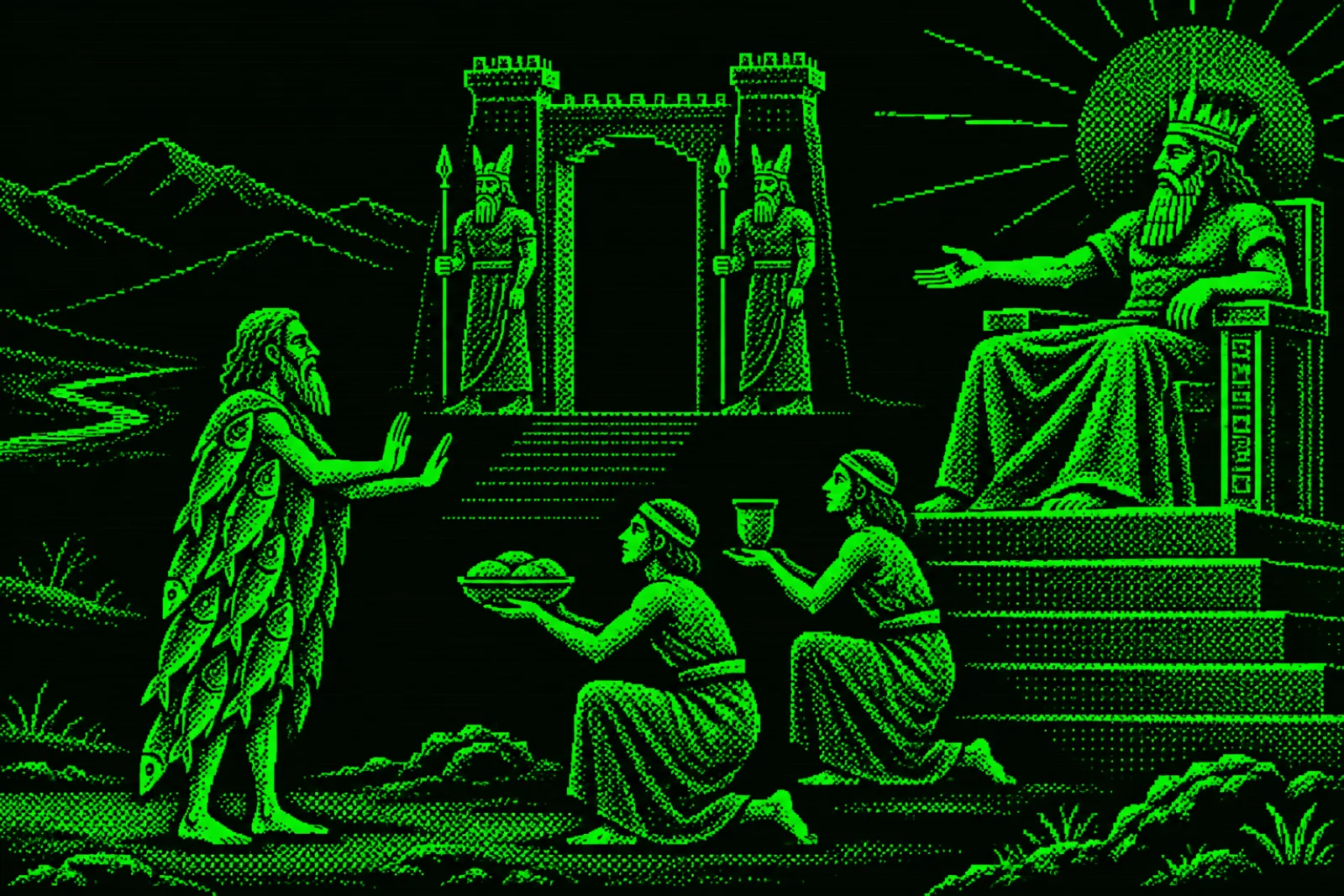
Adapa is the sage of Eridu, the oldest city of Sumer in the tradition, and the priest of its god Ea. Ea gave him “a wide ear”, wisdom, “but lasting life he did not give him”. Out fishing for Ea’s temple, Adapa is sunk by the South Wind and curses her, and her wing breaks. Anu, king of the gods, summons him to heaven. Ea dresses him in mourning, so that the two gods who keep Anu’s gate, Dumuzi and Ningišzida, will speak for him, and warns him that he will be offered the bread and water of death and must refuse them. Anu offers him the bread and water of life. Adapa refuses, Anu laughs, “Why did you not eat, not drink? You will not live”, and Adapa is sent back to his earth.
Four pieces of the myth survive. The longest is a tablet from the archive of the pharaohs at Tell el-Amarna in Egypt (EA 356, about 1400–1350 BC), a school text with red ink points that divide the phrases for a foreign reader. Three later Assyrian pieces add the opening and another ending: fragment A, which describes Adapa and his duties; C, a Nineveh copy of the summons to heaven; and D, from the same Nineveh tablet as C, where Anu laughs at Ea’s deed and the myth turns into a spell against disease.
The Amarna tablet is translated from the Cuneiform Digital Library’s open transliteration. For the three Assyrian fragments no modern transliteration is open, so they are translated from Dhorme’s 1907 edition, checked against Jensen (1900) and Langdon (1915). Shlomo Izre’el’s 2001 edition, the standard one, was not available; where Foster’s translation adopts its readings, the notes say so. A short Sumerian version from Tell Haddad and a small Nineveh piece (K 15072) are not included, because neither is open.
Each numbered line gives the Akkadian first: the original script, then the same words in Latin letters. Our English is underneath. Tap a dotted word for its meaning, and Note for our comment on the line; our comments are in the right margin.
- a1Fragment A, 1
tašīmtu tašīmtu: discernment, good sense eršu eršu: wise ù […]
tašīmtu: discernment, good sense, eršu: wise … […]
Note on line a1
The opening lines of the tablet are lost. Scheil restored tašīmtu, ‘discernment’. Jensen (KB VI/1 p. 93) took irša as the adjective ‘wise’; Dhorme (Choix p. 148 n. 1) and Rogers (p. 69) as a verb, ‘he possessed (intelligence)’. - a2A 2
qibītu qibītu: word, command, utterance ki-ma qibītu qibītu: word, command, utterance Anu Anu: the sky god, king of the gods, whose house is in heaven lu-ú-ma?-ti?
His qibītu: word, command like the word of [Anu: the sky god] …
Note on line a2
Dhorme (p. 148 n. 2) restores Anu from D 6, where Anu asks who could make a word greater than his; Speiser (ANET p. 101) restores Ea. The signs at the end of the line are damaged. - a3A 3
uznu uznu: ear; understanding. 'A wide ear' is a wide mind: the ear is the organ of intelligence (Jensen, KB VI/1, p. 460) rapšu rapšu: wide, broad šuklulu šuklulu: to perfect, complete, equip fully uṣurtu uṣurtu: drawing, design, plan; the designs of the land, what the gods have drawn for it (Jensen p. 405; Langdon p. 39) mātu mātu: land, country kullumu kullumu: to show, reveal (CAD K 524–525). CAD reads EA 356:58 'why did Ea show (all the) malformed things in heaven and earth to the people?'
A rapšu: wide uznu: ear; understanding he šuklulu: to perfect, equip fully for him, to kullumu: to show, reveal the uṣurtu: drawing, design, plan of the mātu: land.
Note on line a3
We keep the ear: the translators give ‘understanding’ (Speiser) or ‘wisdom’ (Foster). Jensen argued that Assyrian has no free-standing mind, only a belly and an ear that are ’the places of thoughts, that is, of inner speech’ (KB VI/1, pp. xix–xx). kullumu is Jensen’s reading of the last word (Dhorme p. 148 n. 3); the same verb returns when Anu complains of what Ea ‘showed’ mankind (B rev. 22). - a4A 4
a-na šu-a-tu nēmequ nēmequ: wisdom nadānu nadānu: to give (written with a logogram; Dhorme calls it SE) napištu napištu: life, breath, throat. Jensen (p. 406): not balāṭu 'being alive' but napištu, 'the breath of life' dārû dārû: lasting, everlasting ul nadānu nadānu: to give (written with a logogram; Dhorme calls it SE)
To him he nadānu: to give nēmequ: wisdom; dārû: lasting, everlasting napištu: life, breath he did not give him.
Note on line a4
The verb is written with a logogram (Dhorme p. 148 n. 4 calls it SE; we write SUM, the sign for ‘give’). The line the whole story turns on. Jensen (p. 406) notes that the word is napištu, the breath of life, not balāṭu, ‘being alive’, the word of the ‘bread of life’ Anu will offer, and adds: ‘For wisdom and life compare the two trees in the biblical paradise’ (Gen. 2:9, 3:22). The pairing is strikingly close: in both, the god’s gift of knowing comes without the gift of living. - a5A 5
i-na u₄-me-šu-ma i-na ša-na-a-ti ši-na-a-ti apkallu apkallu: sage, one of the wise men of the first days; also a priestly title mār Eridu Eridu: the oldest city of Sumer in the tradition, Ea's city on the lagoon at the head of the Gulf
In those days, in those years, the apkallu: sage, one of the wise men of the first days, son of Eridu: Ea's city,
Note on line a5
apkallu is the sage of the first days. Dalley (p. 182) identifies Adapa with Uan, the first sage, whom Berossus calls Oannes; Dhorme (p. 150 n. 16) instead with Berossus’ second king Alaparos, read as Adaparos. - a6A 6
Ea Ea (Sumerian Enki): god of the Abzu, the sweet waters under the earth, of wisdom and incantation; Adapa's lord and maker ki-ma riddu riddu: conduct, rule; pattern. Speiser 'model of men'; Dalley 'protecting spirit (?)'; Foster 'vicegerent'; Dhorme 'chief (?)' i-na amēlūtu amēlūtu: mankind, humanity; a human being banû-create banû: to build, create, make
Ea: god of the Abzu banû-create: to create him as a riddu: conduct, rule; pattern among amēlūtu: mankind.
Note on line a6
riddu is a pattern, a model: Speiser ’the model of men’, Foster ‘vicegerent’, Dalley ‘a protecting spirit (?)’, Dhorme ‘a chief (?)’. Langdon (p. 40 n. 3) notes that the line makes Adapa one of mankind, made by Ea, not a god. - a7A 7
apkallu apkallu: sage, one of the wise men of the first days; also a priestly title qibītu qibītu: word, command, utterance ma-am-man ul ú-sam-sak
The apkallu: sage: no one sets aside his qibītu: word, command.
- a8A 8
le’û le'û: able, capable atraḫasīsu atra-ḫasīsu: 'exceedingly wise', the epithet that is also the name of the flood hero Atrahasis ša Anunnaku Anunnakū: the great gods as a body šu-ma
The le’û: able, capable, the atraḫasīsu: 'exceedingly wise', also the flood hero's name of the Anunnaku: the great gods, is he;
Note on line a8
atra-ḫasīsa, ’exceedingly wise’, is the name of the flood hero Atrahasis, here an epithet. Dhorme (p. 149 n. 8), after Scheil, joins šuma to the next line as ’name’, ‘whose name the Anunnaki proclaimed’; Jensen, Speiser and Foster read ‘he’. - a9A 9
ebbu ebbu: pure, shining, holy ellu ellu: clean, pure, holy qātu qātu: hand pašīšu pašīšu: anointed one, a class of priest še’û še'û: to seek, look after; mušte'û parṣī, 'who tends the rites' parṣu parṣu: rite, cultic ordinance
ebbu: pure, shining, ellu: clean, holy of qātu: hand, the pašīšu: anointed one, a priest, who še’û: to seek, look after the parṣu: rite.
Note on line a9
Dhorme (p. 149 n. 9) sets pašīšu, ‘anointed’, beside the Hebrew māšîaḥ, ‘messiah’. Adapa will anoint himself with Anu’s oil (B rev. 29). - a10A 10
it-ti nuḫatimmu nuḫatimmu: cook, baker; nuḫatimmūtu, the baker's craft nuḫatimmu nuḫatimmu: cook, baker; nuḫatimmūtu, the baker's craft epēšu epēšu: to do, make, act
With the nuḫatimmu: cook, baker he does the baking;
Note on line a10
Foster (p. 526 n. 1) reports Talon’s reading that Ea, not Adapa, does the baking here, and rejects it. - a11A 11
it-ti nuḫatimmu nuḫatimmu: cook, baker; nuḫatimmūtu, the baker's craft ša Eridu Eridu: the oldest city of Sumer in the tradition, Ea's city on the lagoon at the head of the Gulf kimin KI.MIN: ditto, 'the same as above'
with the bakers of Eridu he does kimin: ditto.
Note on line a11
KI.MIN is the scribe’s ditto mark (Dhorme p. 149 n. 11). - a12A 12
akalu akalu: bread, food ù mû mû: water ša Eridu Eridu: the oldest city of Sumer in the tradition, Ea's city on the lagoon at the head of the Gulf ūmišam ūmišam(ma): every day epēšu epēšu: to do, make, act
The akalu: bread, food and mû: water of Eridu he makes ūmišam: every day.
Note on line a12
The same pair, akalu and mû, that Anu will offer him in heaven (B rev. 24–26): the man who makes the gods’ bread and water every day will refuse the bread and water of life. Jensen reads ù, ‘and’; Dhorme’s text has a-ka-la me-e. - a13A 13
i-na qātu qātu: hand ellu ellu: clean, pure, holy paššūru paššūru: table, offering table; paššūra rakāsu 'to set the table', paṭāru 'to clear it' rakāsu rakāsu: to tie, bind; to set up (a table)
With his ellu: clean, holy qātu: hand he rakāsu: to tie; to set up a table the paššūru: offering table,
Note on line a13
The paššūru is the gods’ offering table; it is ’tied’ when set and ‘untied’ when cleared (Dhorme p. 150 n. 13, after Zimmern). - a14A 14
ù ba-lu-uš-šu paššūru paššūru: table, offering table; paššūra rakāsu 'to set the table', paṭāru 'to clear it' ul paṭāru paṭāru: to loosen, untie; to clear away
and without him the paššūru: offering table is not paṭāru: to untie, clear away.
- a15A 15
elippu elippu: boat, ship muḫḫuru muḫḫuru: to steer, guide (a boat) bāʾirūtu bā'irūtu: fishing, the fisherman's work dākūtu dākūtu: hunting; Dhorme (p. 150) from dâku 'to kill'; Langdon (p. 41 n. 2) 'a summoning' ša Eridu Eridu: the oldest city of Sumer in the tradition, Ea's city on the lagoon at the head of the Gulf epēšu epēšu: to do, make, act
He muḫḫuru: to steer the elippu: boat; he does the bāʾirūtu: fishing and dākūtu: hunting for Eridu.
Note on line a15
dākūtu is hunting: Dhorme (p. 150 n. 15) derives it from dâku, ’to kill’; Langdon (p. 41 n. 2) has ‘a summoning’; Speiser ’the prescribed fishing’. - a16A 16
e-nu-mi-šu Adapa Adapa (written a-da-pa, with the male-name sign in B): the sage of Eridu. Fragment D calls him 'seed of mankind' (zēr amēlūti) mār Eridu Eridu: the oldest city of Sumer in the tradition, Ea's city on the lagoon at the head of the Gulf
At that time Adapa, son of Eridu,
- a17A 17
[…] Ea Ea (Sumerian Enki): god of the Abzu, the sweet waters under the earth, of wisdom and incantation; Adapa's lord and maker i-na mayyālu mayyālu: bed, couch, bedroom i-na ša-da-di
[…] Ea … on the mayyālu: bed, bedroom, in the drawing …
Note on line a17
The sense is lost with the first word. Jensen (p. 93): ‘in the bedroom, as he draws’; Dhorme: ‘as he withdrew to bed’; Speiser: ‘While […] Ea … upon the couch’; Dalley (p. 184): ‘When he had got the [leader (?)] Ea out of bed’; Foster (p. 526): ‘At the drawing of the [bo]lt of Ea from its socket(?)’. - a18A 18
ūmišam ūmišam(ma): every day sigaru sigaru: bolt, lock, locked door Eridu Eridu: the oldest city of Sumer in the tradition, Ea's city on the lagoon at the head of the Gulf iš-šar
every day he sees to the sigaru: bolt, lock of Eridu.
Note on line a18
Jensen derives iššar from ’to take care’; Dhorme (p. 150 n. 18) from šâru, ’to pass beyond’. Dalley (p. 188 n. 4) suggests the bolt stood for the cosmic bolt of the sea, which let the fish through. - a19A 19
i-na kāru kāru: quay, harbour ellu ellu: clean, pure, holy kar-u₄-sakar elippu elippu: boat, ship rakābu rakābu: to ride, board (a boat)
At the ellu: holy kāru: quay, the Quay of the New Moon, he rakābu: to board the elippu: boat,
Note on line a19
The quay’s name is written with the sign for the crescent moon: Speiser ‘Quay of the New Moon’, Jensen ‘Neulicht-Ufermauer’, Dalley ‘Kar-usakar’. - a20A 20
[ša-a-ru i]-zi-qa-an-ni-ma elippu elippu: boat, ship qelēpu qelēpu: to drift, float
[a wind] zâqu: to blow, and his elippu: boat qelēpu: to drift;
Note on line a20
The restoration ‘a wind blew’ is Scheil’s (Dhorme p. 151 n. 20). Foster (p. 526), adopting Izre’el’s readings, has instead ‘[Without? a st]eering oar his boat could drift on course’ and the next line likewise, taking both as signs of Adapa’s magic power. - a21A 21
[i-na gimuššu gimuššu: punting pole, oar elippu elippu: boat, ship muḫḫuru muḫḫuru: to steer, guide (a boat)
[with the pun]ting pole he muḫḫuru: to steer his boat
Note on line a21
gimuššu is Jensen’s restoration (Dhorme p. 151 n. 21). - a22A 22
[…] i-na tâmtu tâmtu: sea rapšu rapšu: wide, broad
[…] on the rapšu: wide tâmtu: sea.
Note on line a22
Fragment A breaks off. The Amarna tablet takes up the story at sea, after a gap of unknown length. - b1Fragment B (Amarna), obv. 1′ (EA 356:1)
𒂊𒁍𒍑 □
epēšu epēšu: to do, make, act ...]
epēšu: to do, make […]
Note on line b1
The top of the Amarna tablet is lost. Foster (p. 527) restores the opening as Adapa getting ready to speak to the South Wind. - b2obv. 2′ (EA 356:2)
𒋗𒌑𒌅 □
šūtu šūtu: the South Wind. In B it is addressed as feminine (kappa-ki 'your wing', aḫḫē-ki 'your brothers') x [...]
The šūtu: the South Wind … […]
Note on line b2
Jensen (p. 94) and Dhorme (p. 151) restored ’the South Wind blew and sank him’ from rev. 16; Dhorme notes that Knudtzon’s collation does not allow the sign i after ‘South Wind’. CDLI reads only the word and a trace. - b3obv. 3′ (EA 356:3)
𒀀𒈾 𒁉𒄿 𒌅 □ 𒄿𒀀 𒌑𒊭□𒍢 𒄿 □
a-na pi₂-i tu#? [x] ia# u₂#-ša#-am-ṣi i x [...]
[…] … I have done enough … […]
Note on line b3
CDLI reads a-na pi₂-i tu? [x] ia u₂-ša-am-ṣi; Foster (p. 527), following Izre’el, ‘I have done enough(?), let me […]’. Jensen and Dhorme, seeing fewer signs, read ’to the house of the fish he made him go down’, after rev. 17. The rest of the line is damaged. - b4obv. 4′ (EA 356:4)
𒋗𒌑𒌅 𒊭𒀀𒊏𒉌 □□𒂊𒆠 𒈠𒆷 𒄿
šūtu šūtu: the South Wind. In B it is addressed as feminine (kappa-ki 'your wing', aḫḫē-ki 'your brothers') [ša?-a?]-ra-ni aḫ-ḫe-e-ki ma-la i-[...]
'šūtu: the South Wind, [the winds], aḫḫēki: your (feminine) brothers, as many as [there are] …
Note on line b4
-ki, ‘your’, is feminine: Adapa speaks to the South Wind as a woman (Dalley p. 188 n. 5). Jensen and Dhorme read the word as uḫḫû, ‘spittle, venom’: Jensen ‘deinen Geifer’, Speiser ‘all thy venom’. CDLI’s aḫ-ḫe-e-ki, ‘your brothers’, the other winds, is followed by Dalley and Foster. - b5obv. 5′ (EA 356:5)
𒅗𒀀𒀊𒉺𒆠 𒇻𒌑𒊺𒁉𒅕 𒆠𒈠 𒄿𒈾 𒁉𒄿𒋗 𒅅𒁍𒌑
kappu kappu: wing (CAD K 186, citing EA 356:5 'I will break your wing') šebēru šebēru: to break, shatter (a bone, a wing) ki-ma i-na pi₂-i-šu# qabû qabû: to say, speak, order
I will šebēru: to break your kappu: wing!' As soon as he had said it with his mouth,
Note on line b5
CAD K 186 cites the line: ‘I will break your (the south wind’s) wing’. The wing breaks because Adapa says so: his word acts. - b6obv. 6′ (EA 356:6)
𒊭 𒋗𒌑𒋾 𒅗𒀊𒉺𒊭 𒀉𒋼𒌍𒁉𒅕 𒐌 𒌑𒈪
ša šūtu šūtu: the South Wind. In B it is addressed as feminine (kappa-ki 'your wing', aḫḫē-ki 'your brothers') kappu kappu: wing (CAD K 186, citing EA 356:5 'I will break your wing') šebēru šebēru: to break, shatter (a bone, a wing) 7 ūmu ūmu: day
the šūtu: the South Wind kappu: wing was šebēru: to break. For seven ūmu: day
- b7obv. 7′ (EA 356:7)
𒋗𒌑𒌅 𒀀𒈾 𒈠𒀀𒋾 𒌑𒌋𒄞 𒄿𒍣𒅅𒂵 𒀭𒀀𒉡
šūtu šūtu: the South Wind. In B it is addressed as feminine (kappa-ki 'your wing', aḫḫē-ki 'your brothers') a-na mātu mātu: land, country u₂-ul zâqu zâqu: to blow (of wind) Anu Anu: the sky god, king of the gods, whose house is in heaven
the South Wind did not zâqu: to blow toward the mātu: land. Anu: the sky god
- b8obv. 8′ (EA 356:8)
𒀀𒈾 𒋗□𒅗𒇷𒋗 𒀭𒄿𒆷𒀊𒊏𒀜 𒄿𒊭□𒋛
[a-na] sukkallu sukkallu: vizier, minister, the god's messenger Ilabrat Ilabrat: Anu's vizier and messenger šasû šasû: to cry out, call, shout
šasû: to cry out, call to his sukkallu: vizier, messenger Ilabrat: Anu's vizier:
- b9obv. 9′ (EA 356:9)
□𒈪𒉌 𒋗𒌑𒌅 𒅖𒌅 𒐌 𒌑𒈪 𒀀𒈾 𒈠𒀀𒋾 𒆷 𒄿𒍣𒂵
ammīni ammīni: why? šūtu šūtu: the South Wind. In B it is addressed as feminine (kappa-ki 'your wing', aḫḫē-ki 'your brothers') iš-tu 7 ūmu ūmu: day a-na mātu mātu: land, country la zâqu zâqu: to blow (of wind)
'[ammīni: why? has the South Wind not blown toward the land for seven days?]'
Note on line b9
CDLI brackets the whole line; Jensen (p. 94) and Dhorme (p. 152) read it with only the first sign lost. - b10obv. 10′ (EA 356:10)
𒋗□𒅗𒆷𒋗 𒄿𒆷𒀊𒊏𒀜 𒄿𒉺𒀠𒋗 𒁉𒂊𒇷
sukkallu sukkallu: vizier, minister, the god's messenger Ilabrat Ilabrat: Anu's vizier and messenger apālu apālu: to answer bēlu bēlu: lord, master
His sukkallu: vizier Ilabrat apālu: to answer him: 'My bēlu: lord,
- b11obv. 11′ (EA 356:11)
𒁹𒀀𒁕𒉺 𒈠𒅆𒊑 𒀭𒂍𒀀 𒊭 𒋗𒌑𒋾 𒅗𒀊𒉺𒊭
Adapa Adapa (written a-da-pa, with the male-name sign in B): the sage of Eridu. Fragment D calls him 'seed of mankind' (zēr amēlūti) ma-ar Ea Ea (Sumerian Enki): god of the Abzu, the sweet waters under the earth, of wisdom and incantation; Adapa's lord and maker ša šūtu šūtu: the South Wind. In B it is addressed as feminine (kappa-ki 'your wing', aḫḫē-ki 'your brothers') kappu kappu: wing (CAD K 186, citing EA 356:5 'I will break your wing')
Adapa, the son of Ea: Adapa's god, the South Wind's kappu: wing
- b12obv. 12′ (EA 356:12)
𒅖𒋼𒁉𒅕 𒀭𒀀𒉡 𒀀𒈠𒋫 𒀭𒉌𒋫 𒄿𒈾 𒊺𒂊𒈪𒋗
šebēru šebēru: to break, shatter (a bone, a wing) Anu Anu: the sky god, king of the gods, whose house is in heaven amātu amātu: word, speech; matter, affair an-ni-ta i-na šemû šemû: to hear
has šebēru: to break.' When Anu šemû: to hear this amātu: word,
- b13obv. 13′ (EA 356:13)
𒅋𒋛 𒈾𒊏𒊒 𒀉𒋾𒁉 𒄿𒈾 𒆪𒊺𒄷𒋛𒋗 𒋗𒁍𒌨𒈠 𒇷𒅋□𒉌𒋗
šasû šasû: to cry out, call, shout narāru narāru: help, aid; as a cry, 'Help!' tebû tebû: to rise, get up (also of a wind or an illness) i-na kussû kussû: chair, throne šu-pu#?-[ur?-ma? leqû leqû: to take, fetch, bring
he šasû: to cry out, 'narāru: help; the cry 'Help!'' He tebû: to rise from his kussû: throne: '[Send, and let them] leqû: to take, fetch him here!'
Note on line b13
narāru is ‘help’: Speiser ‘Mercy!’, Foster ‘(Heaven) help (us)!’, Dalley ‘(Heaven) help (him)!’. šupur-ma, ‘send’, is CDLI’s restoration, with question marks. - b14obv. 14′ (EA 356:14)
𒀭𒉌𒅗𒀀 𒀭𒂍𒀀 𒊭 𒊭𒈨𒂊 𒄿𒁲 𒅋𒁍𒊺𒄷𒍪𒈠
an-ni?-ka-a Ea Ea (Sumerian Enki): god of the Abzu, the sweet waters under the earth, of wisdom and incantation; Adapa's lord and maker ša šamû šamû: heaven, sky idû idû: to know lapātu lapātu: to touch; to take hold of
At this Ea, who idû: to know the ways of šamû: heaven, lapātu: to touch, take hold of him,
Note on line b14
ša šamê īde, ‘who knows what is of heaven’. Dhorme (pp. 152–153) read ‘at the bolt of Ea that locks heaven’; CDLI’s an-ni-ka-a follows Knudtzon (Langdon p. 41 n. 6). Speiser: ’took hold of him’. The god who knows the ways of heaven is the one who will tell Adapa what heaven’s food is. - b15obv. 15′ (EA 356:15)
𒀀𒁕𒉺 𒈠𒆷𒀀 𒍑𒋼𒌍𒅆𒋗 𒅗𒀀𒅆𒊑𒊏
Adapa Adapa (written a-da-pa, with the male-name sign in B): the sage of Eridu. Fragment D calls him 'seed of mankind' (zēr amēlūti) malû malû: unkempt hair in mourning (Speiser, Foster, Dalley); Dhorme and Jensen, a soiled garment našû našû: to lift, carry; Š 'to make someone carry or wear' karru karru: a mourning garment (CAD K 222, citing EA 356:42, 'for whom are you wearing mourning?')
[Adapa]; he našû: Š to make someone wear his malû: unkempt hair (Speiser, Foster); a soiled garment (Dhorme), a karru: mourning garment
Note on line b15
malû: Speiser, Foster and Dalley ‘unkempt hair’, the mourner’s hair; Dhorme (p. 152 n. 15) and Jensen (p. 400 f.) a soiled garment, Dhorme ‘un vêtement sale’. Langdon (p. 41) ‘caused him to have boils’. The Ninevite copy has the same words (C 12, cited as a parallel in CAD K 222). - b16obv. 16′ (EA 356:16)
𒌋𒄞𒋫𒀠𒁉𒄑𒍪 □𒂊𒈠 𒄿𒊭𒀝𒅗𒀭𒋗
labāšu labāšu: to put on (a garment), be clothed; D and Š 'to clothe' ṭēmu ṭēmu: instruction, order; plan, understanding šakānu šakānu: to put, place, set; ṭēma šakānu 'to give instructions'
[he had him put on], and šakānu: to put; ṭēma šakānu, to give instructions him ṭēmu: instruction:
- b17obv. 17′ (EA 356:17)
□𒁹𒀀𒁕𒉺 𒀀𒈾 𒉺𒉌 𒀭𒀀𒉌 𒊬𒊑 𒀜𒋫 𒋫𒆷𒀝
Adapa Adapa (written a-da-pa, with the male-name sign in B): the sage of Eridu. Fragment D calls him 'seed of mankind' (zēr amēlūti) a-na pānu pānu: face, front; ana pāni, 'before' Anu Anu: the sky god, king of the gods, whose house is in heaven šarru šarru: king at-ta alāku alāku: to go
'[Adapa, before Anu] the šarru: king you will alāku: to go.
- b18obv. 18′ (EA 356:18)
𒀀𒈾 𒊭𒈨𒂊 𒋼𒂖𒇷𒈠 𒀀𒈾 𒊭𒈨𒂊
[a-na šamû šamû: heaven, sky te-el-li]-ma#? a-na šamû šamû: heaven, sky
[To heaven you will go up], and to heaven
- b19obv. 19′ (EA 356:19)
𒄿𒈾 𒂊𒇷𒅗 𒀀𒈾 𒁀𒀊 𒀭𒀀𒉌 𒄿𒈾 □□𒅗
[i-na] elû elû: to go up, ascend [a-na bābu bābu: gate, door Anu Anu: the sky god, king of the gods, whose house is in heaven i-na ṭeḫû ṭeḫû: to approach, draw near
when you elû: to go up, [when you ṭeḫû: to approach Anu's bābu: gate],
- b20obv. 20′ (EA 356:20)
𒄿𒈾 𒁀𒀀𒁍 𒀭𒀀𒉌 □𒀭𒌉𒍣 𒅆𒁳 𒀭𒄑𒍣𒁕
[i]-na# bābu bābu: gate, door Anu Anu: the sky god, king of the gods, whose house is in heaven Dumuzi Dumuzi (Tammuz): the shepherd god who dies and goes down to the netherworld each year, and is mourned u₃ Gizzida Gizzida, here {d}geš-zi-da: presumably Ningišzida, 'Lord of the good tree' (Jensen p. 95 n. 10), a serpent god of the netherworld, shown on a Gudea relief with snakes rising from his shoulders; Dumuzi's companion
at the bābu: gate of Anu [Dumuzi: the shepherd god who dies and is mourned and Gizzida: Ningišzida, Lord of the Good Tree, a serpent god]
Note on line b20
Gizzida, written {d}geš-zi-da, is Ningišzida, ‘Lord of the Good Tree’. Jensen (p. 95 n. 10) took Giš-zi-da to be ‘presumably’ Nin-giš-zi-da, who like Tammuz dwells at times in the netherworld. Ningišzida is a serpent god: on a relief of Gudea of Lagash snakes rise from his shoulders, and Gudea’s libation vase shows his entwined serpents. Both gods vanish from the land and are mourned, and in heaven they keep Anu’s gate. See the companion Sacred Texts page on Ningišzida’s own hymns, Ningišzida, Serpent Lord of the Tree. - b21obv. 21′ (EA 356:21)
𒄑𒍝□𒍪 𒅎𒈠𒊒𒅗 𒅋𒋫𒈾𒀀𒇻𒅗 □𒇻
izuzzu izuzzu: to stand amāru amāru: to see šâlu šâlu: to ask; Gtn 'keep asking' eṭlu eṭlu: young man, man in his prime
will be izuzzu: to stand. They will amāru: to see you, they will šâlu: Gtn, to keep asking you: "eṭlu: young man,
- b22obv. 22′ (EA 356:22)
𒀀𒈾 𒈠𒀀𒉌 𒅗𒀀 𒂊𒈠𒋫 𒁹𒀀𒁕𒉺 𒀀𒈾 𒈠𒀭𒉌
a-na ma-a-ni ka-a emû emû: to become like, look like; ana manni kâ emâta, 'for whom do you look like this?' Adapa Adapa (written a-da-pa, with the male-name sign in B): the sage of Eridu. Fragment D calls him 'seed of mankind' (zēr amēlūti) a-na ma-an-ni
for whom do you emû: to become like, look like? Adapa, for whom
- b23obv. 23′ (EA 356:23)
𒅗𒅆𒊑𒊏 𒆷𒀊𒊭𒋫 𒄿𒈾 𒈠𒀀𒋾𒉌 𒄿𒇻 𒅆𒈾 □𒀠□𒈠
karru karru: a mourning garment (CAD K 222, citing EA 356:42, 'for whom are you wearing mourning?') labāšu labāšu: to put on (a garment), be clothed; D and Š 'to clothe' i-na mātu mātu: land, country ilu ilu: god ši-na ḫalāqu ḫalāqu: to vanish, disappear, be lost; also to perish
are you labāšu: to put on, wear karru: mourning garment?" "Two ilu: god have ḫalāqu: to vanish, be lost from our mātu: land,
- b24obv. 24′ (EA 356:24)
𒀀𒈾𒆪 𒀀𒅗𒈾 𒅁𒊺𒂊𒆪 𒈠𒀭𒉡 𒄿𒇻 𒊺𒈾 𒊭 𒄿𒈾 𒈠𒀀𒋾
a-na-ku a-ka-na epēšu epēšu: to do, make, act mannu mannu: who? ilu ilu: god še-na ša i-na mātu mātu: land, country
so I am epēšu: to do, make like this." "mannu: who? are the two gods who from the land
- b25obv. 25′ (EA 356:25)
□𒀠□ 𒀭𒌉𒍣 𒅆𒁳 𒀭𒄑𒍣𒁕 𒋗𒉡 𒀀□𒈪𒅖 𒅁𒉺𒆷𒍪𒈠
ḫalāqu ḫalāqu: to vanish, disappear, be lost; also to perish Dumuzi Dumuzi (Tammuz): the shepherd god who dies and goes down to the netherworld each year, and is mourned u₃ Gizzida Gizzida, here {d}geš-zi-da: presumably Ningišzida, 'Lord of the good tree' (Jensen p. 95 n. 10), a serpent god of the netherworld, shown on a Gudea relief with snakes rising from his shoulders; Dumuzi's companion šu-nu a-ḫa-mi-iš naplusu naplusu: to look at; aḫāmiš ippalsū, 'they looked at one another'
have ḫalāqu: to vanish?" "Dumuzi and Gizzida: Ningišzida." They will naplusu: to look at one another
- b26obv. 26′ (EA 356:26)
𒄑𒍢𒉌□□ 𒋗𒉡 𒀀𒈠𒋫 𒁕𒈪𒅅𒋫
ṣiāḫu ṣiāḫu: to laugh, smile; Gtn 'laugh and laugh'. CAD Ṣ 65: Dumuzi and Ningišzida 'exchanged amused glances' (EA 356:46); 'Anu … smiled to himself on account of him' (EA 356:66) šu-nu amātu amātu: word, speech; matter, affair damqu damqu: good, favourable
and ṣiāḫu: to laugh; Gtn, to laugh and laugh. A damqu: good amātu: word
Note on line b26
iṣṣenehhû is the repeated form of ṣiāḫu, ’to laugh’: Foster ’laugh and laugh’, Dalley ’laugh a lot’, Speiser ‘smile’; CAD Ṣ 65 gives ’exchanged amused glances’ for the same words at rev. 10. Jensen and Dhorme read issiniḫḫu, ’they will be astonished’, and Dhorme (p. 153 n. 26) found the sense hard to fix. The verb is laughter: the two vanished gods laugh to find a man in heaven mourning them, and the gods laugh again at rev. 10 and Anu at rev. 30. - b27obv. 27′ (EA 356:27)
𒀀𒈾 𒀭𒀀𒉌 𒄿𒂵𒀊𒁍𒌑 𒉺𒉌 𒁀𒉡𒋾 𒊭 𒀭𒀀𒉌
a-na Anu Anu: the sky god, king of the gods, whose house is in heaven qabû qabû: to say, speak, order pānu pānu: face, front; ana pāni, 'before' banû-good banû: good, fine, kindly (adjective); lā banû 'not good, worthless' ša Anu Anu: the sky god, king of the gods, whose house is in heaven
they will qabû: to speak to Anu; the banû-good: good, kindly pānu: face of Anu
- b28obv. 28′ (EA 356:28)
𒋗𒉡 𒌑𒅗𒆷𒈬𒅗 𒀀𒈾 𒉺𒉌 𒀭𒀀𒉌 𒄿𒈾 𒌑𒍪𒍣𒅗
šu-nu kullumu kullumu: to show, reveal (CAD K 524–525). CAD reads EA 356:58 'why did Ea show (all the) malformed things in heaven and earth to the people?' a-na pānu pānu: face, front; ana pāni, 'before' Anu Anu: the sky god, king of the gods, whose house is in heaven i-na izuzzu izuzzu: to stand
they will kullumu: to show you. When you izuzzu: to stand before Anu,
- b29obv. 29′ (EA 356:29)
𒀀𒅗𒆷 𒊭 𒈬𒋾 𒌑𒅗𒇻𒉌𒅅𒆪𒈠
akalu akalu: bread, food ša mūtu mūtu: death kullu kullu: to hold; ukallūnikkuma, 'they will hold out to you, offer you' (CAD K 515, EA 356:29, 'bread of death')
they will kullu: to hold out, offer to you akalu: bread, food of mūtu: death:
Note on line b29
CAD K 515 cites the line: ‘when they offer you the bread of death, do not eat it’. When the bread comes it is called bread of life (rev. 24–26). On whether Ea lied, see the note at rev. 33. - b30obv. 30′ (EA 356:30)
𒆷𒀀 𒋫𒅗𒀠 𒈨𒂊 𒈬𒌑𒋾 𒌑𒅗𒇻𒉌𒅅𒆪𒈠
la-a akālu akālu: to eat mû mû: water mūtu mūtu: death kullu kullu: to hold; ukallūnikkuma, 'they will hold out to you, offer you' (CAD K 515, EA 356:29, 'bread of death')
do not akālu: to eat. They will kullu: to offer to you mû: water of mūtu: death:
- b31obv. 31′ (EA 356:31)
𒆷 𒋫𒊭𒀜𒋾 𒇻𒌑𒁀𒊏 𒌑𒅗𒇻𒉌𒅅𒆪𒈠
la šatû šatû: to drink lubāru lubāru: garment, robe kullu kullu: to hold; ukallūnikkuma, 'they will hold out to you, offer you' (CAD K 515, EA 356:29, 'bread of death')
do not šatû: to drink. They will hold out to you a lubāru: garment:
- b32obv. 32′ (EA 356:32)
𒇷𒀉𒁀𒀸 𒊭□𒈾 𒌑𒅗𒇻𒉌𒆪𒈠 𒁉𒅖𒊭𒀸
labāšu labāšu: to put on (a garment), be clothed; D and Š 'to clothe' šamnu šamnu: oil kullu kullu: to hold; ukallūnikkuma, 'they will hold out to you, offer you' (CAD K 515, EA 356:29, 'bread of death') pašāšu pašāšu: to anoint, rub with oil
labāšu: to put on. They will hold out to you šamnu: oil: pašāšu: to anoint.
Note on line b32
Garment and oil are what a host gives a guest; Liverani’s reading of the story as hospitality refused, ‘Adapa ospite degli dei’ (1982, listed by Foster p. 530), builds on this. We have not read it. - b33obv. 33′ (EA 356:33)
□𒂊𒈠 𒊭 𒀾𒆪𒉡𒅗 𒆷 𒋼𒈪𒅅𒆠 𒀀𒈠𒋫
ṭēmu ṭēmu: instruction, order; plan, understanding ša šakānu šakānu: to put, place, set; ṭēma šakānu 'to give instructions' la mekû mekû: to neglect, be careless of amātu amātu: word, speech; matter, affair
The ṭēmu: instruction I have šakānu: to give you, do not mekû: to neglect; the amātu: word
- b34obv. 34′ (EA 356:34)
𒊭 𒀝𒁀𒆪 𒇻 𒍝𒀊𒋫𒋫 𒈠𒅆𒊑 𒅆𒅁𒊑
ša qabû qabû: to say, speak, order lu ṣabātu ṣabātu: to seize, hold fast; Š ḫarrāna šuṣbutu 'to make (someone) take the road' ma-ar šipru mār šipri: messenger (literally 'son of the errand')
I have qabû: to speak to you, ṣabātu: to seize, hold fast.' The šipru: mār šipri, messenger
- b35obv. 35′ (EA 356:35)
𒊭 𒀭𒀀𒉌 𒅅𒋫𒀠𒁕 𒁹𒀀𒁕𒉺 𒊭 𒋗𒌑𒋾
ša Anu Anu: the sky god, king of the gods, whose house is in heaven kašādu kašādu: to reach, arrive Adapa Adapa (written a-da-pa, with the male-name sign in B): the sage of Eridu. Fragment D calls him 'seed of mankind' (zēr amēlūti) ša šūtu šūtu: the South Wind. In B it is addressed as feminine (kappa-ki 'your wing', aḫḫē-ki 'your brothers')
of Anu kašādu: to reach, arrive: 'Adapa, who the South Wind's
- b36obv. 36′ (EA 356:36)
𒅗𒀊𒉺𒊭 𒅖𒁉𒅕 𒀀𒈾 𒈬□𒄿𒀀 𒋗𒁉𒆷𒀾𒋗
kappu kappu: wing (CAD K 186, citing EA 356:5 'I will break your wing') šebēru šebēru: to break, shatter (a bone, a wing) a-na mu-ḫi-ia wabālu wabālu: to carry, bring; Š 'send, have brought'
kappu: wing šebēru: to break: wabālu: Š to send to me!'
- b37rev. 1 (EA 356:37)
□𒊏𒀭 𒊭𒈨𒂊 𒌑𒊺□𒁉𒄑𒍪𒈠 𒀀𒈾 𒊭𒈨𒂊 𒄿𒋼𒇷𒈠
ḫarrānu ḫarrānu: road, way šamû šamû: heaven, sky ṣabātu ṣabātu: to seize, hold fast; Š ḫarrāna šuṣbutu 'to make (someone) take the road' a#-na# šamû šamû: heaven, sky elû elû: to go up, ascend
He ṣabātu: Š to make take (a road) the ḫarrānu: road of šamû: heaven, and he elû: to go up to heaven.
Note on line b37
‘He’: Anu’s messenger, or Ea; the text does not say. - b38rev. 2 (EA 356:38)
𒀀𒈾 𒊭𒈨𒂊 𒄿𒈾 𒂊𒇷𒋗 𒀀𒈾 𒁀𒀊 𒀭𒀀𒉌 𒄿𒈾 □□𒋗
a-na šamû šamû: heaven, sky i-na elû elû: to go up, ascend a-na bābu bābu: gate, door Anu Anu: the sky god, king of the gods, whose house is in heaven i-na ṭeḫû ṭeḫû: to approach, draw near
When he elû: to go up to heaven, when he ṭeḫû: to approach the bābu: gate of Anu,
- b39rev. 3 (EA 356:39)
𒄿𒈾 𒁀𒀀𒁍 𒀭𒀀𒉌 𒀭𒌉𒍣 𒀭𒄑𒍣𒁕 𒄑𒍝□𒍪
i-na bābu bābu: gate, door Anu Anu: the sky god, king of the gods, whose house is in heaven Dumuzi Dumuzi (Tammuz): the shepherd god who dies and goes down to the netherworld each year, and is mourned Gizzida Gizzida, here {d}geš-zi-da: presumably Ningišzida, 'Lord of the good tree' (Jensen p. 95 n. 10), a serpent god of the netherworld, shown on a Gudea relief with snakes rising from his shoulders; Dumuzi's companion izuzzu izuzzu: to stand
at Anu's gate Dumuzi and Gizzida: Ningišzida, a serpent god were izuzzu: to stand.
Note on line b39
In Genesis 3:24 cherubim keep the way to the tree of life; here a dying shepherd god and a serpent god keep the gate of the god who offers the food of life, and it is their word that brings the offer. - b40rev. 4 (EA 356:40)
𒄿𒈬𒊒𒋗𒈠 𒁹𒀀𒁕𒉺 𒅋𒋢𒌑 𒈾𒊏𒊒
amāru amāru: to see Adapa Adapa (written a-da-pa, with the male-name sign in B): the sage of Eridu. Fragment D calls him 'seed of mankind' (zēr amēlūti) šasû šasû: to cry out, call, shout narāru narāru: help, aid; as a cry, 'Help!'
They amāru: to see him, Adapa, and šasû: to cry out, 'narāru: the cry 'Help!'
- b41rev. 5 (EA 356:41)
□𒇻 𒀀𒈾 𒈠𒀭𒉌 𒅗𒀀 𒂊𒈠𒀀𒋫 𒀀𒁕𒉺
eṭlu eṭlu: young man, man in his prime a-na ma-an-ni ka-a emû emû: to become like, look like; ana manni kâ emâta, 'for whom do you look like this?' Adapa Adapa (written a-da-pa, with the male-name sign in B): the sage of Eridu. Fragment D calls him 'seed of mankind' (zēr amēlūti)
eṭlu: young man, for whom do you emû: to look like? Adapa,
- b42rev. 6 (EA 356:42)
𒀀𒈾 𒈠𒀭𒉌 𒅗𒅆𒊑𒊏 𒆷𒀊𒊭𒀀𒋫
a-na ma-an-ni karru karru: a mourning garment (CAD K 222, citing EA 356:42, 'for whom are you wearing mourning?') labāšu labāšu: to put on (a garment), be clothed; D and Š 'to clothe'
for whom are you labāšu: to wear karru: mourning garment?'
Note on line b42
CAD K 222 cites this line: ‘for whom are you wearing mourning?’ - b43rev. 7 (EA 356:43)
𒄿𒈾 𒈠𒋾 𒄿𒇻 𒊺𒂊𒈾 □𒀠□𒈠 𒀀𒈾𒆪 𒅗𒅆𒊑𒊏
i-na mātu mātu: land, country ilu ilu: god še-e-na ḫalāqu ḫalāqu: to vanish, disappear, be lost; also to perish a-na-ku karru karru: a mourning garment (CAD K 222, citing EA 356:42, 'for whom are you wearing mourning?')
'Two ilu: god have ḫalāqu: to vanish from the land, so I karru: mourning garment
- b44rev. 8 (EA 356:44)
𒆷𒀊𒊭𒆪 𒈠𒀭𒉡 𒄿𒇻 𒅆𒈾 𒊭 𒄿𒈾 𒈠𒀀𒋾 □𒀠□
labāšu labāšu: to put on (a garment), be clothed; D and Š 'to clothe' mannu mannu: who? ilu ilu: god ši#-na ša i-na mātu mātu: land, country ḫalāqu ḫalāqu: to vanish, disappear, be lost; also to perish
am labāšu: to wear.' 'mannu: who? are the two gods who have ḫalāqu: to vanish from the land?'
- b45rev. 9 (EA 356:45)
𒀭𒌉𒍣 □𒄑𒍣𒁕 𒀀□𒈪𒅖 𒅁𒉺𒀠𒋢𒈠
Dumuzi Dumuzi (Tammuz): the shepherd god who dies and goes down to the netherworld each year, and is mourned Gizzida Gizzida, here {d}geš-zi-da: presumably Ningišzida, 'Lord of the good tree' (Jensen p. 95 n. 10), a serpent god of the netherworld, shown on a Gudea relief with snakes rising from his shoulders; Dumuzi's companion a-ḫa-mi-iš# naplusu naplusu: to look at; aḫāmiš ippalsū, 'they looked at one another'
'Dumuzi and Gizzida: Ningišzida.' They naplusu: to look at one another
- b46rev. 10 (EA 356:46)
𒄑𒍢𒉌□□ 𒁹𒀀𒁕𒉺 𒀀𒈾 𒉺𒉌 𒀭𒀀𒉌 𒊬𒊑
ṣiāḫu ṣiāḫu: to laugh, smile; Gtn 'laugh and laugh'. CAD Ṣ 65: Dumuzi and Ningišzida 'exchanged amused glances' (EA 356:46); 'Anu … smiled to himself on account of him' (EA 356:66) Adapa Adapa (written a-da-pa, with the male-name sign in B): the sage of Eridu. Fragment D calls him 'seed of mankind' (zēr amēlūti) a-na pānu pānu: face, front; ana pāni, 'before' Anu Anu: the sky god, king of the gods, whose house is in heaven šarru šarru: king
and ṣiāḫu: Gtn, to laugh and laugh. Adapa, before Anu the šarru: king,
Note on line b46
CAD Ṣ 65 cites this line: ‘(Dumuzi and Ningizzida) exchanged amused glances’. - b47rev. 11 (EA 356:47)
𒄿𒈾 𒆠𒊑𒁉𒋗 𒄿𒈬𒌨𒋗𒈠 𒀭𒀀𒉡 𒅋𒋛𒈠
i-na qe₂-re-bi-šu amāru amāru: to see Anu Anu: the sky god, king of the gods, whose house is in heaven šasû šasû: to cry out, call, shout
as he drew near, Anu amāru: to see him and šasû: to call:
- b48rev. 12 (EA 356:48)
𒀠𒅗 𒁹𒀀𒁕𒉺 □𒈪𒉌 𒊭 𒋗𒌑𒋾 𒅗𒀊𒉺𒊭
al-ka Adapa Adapa (written a-da-pa, with the male-name sign in B): the sage of Eridu. Fragment D calls him 'seed of mankind' (zēr amēlūti) ammīni ammīni: why? ša šūtu šūtu: the South Wind. In B it is addressed as feminine (kappa-ki 'your wing', aḫḫē-ki 'your brothers') kappu kappu: wing (CAD K 186, citing EA 356:5 'I will break your wing')
'Come, Adapa! ammīni: why? the šūtu: the South Wind kappu: wing
- b49rev. 13 (EA 356:49)
𒋼𒂊𒌍𒁉𒅕 𒁹𒀀𒁕𒉺 𒀭𒀀𒈾 𒅁𒉺𒀠 𒁁𒉌
šebēru šebēru: to break, shatter (a bone, a wing) Adapa Adapa (written a-da-pa, with the male-name sign in B): the sage of Eridu. Fragment D calls him 'seed of mankind' (zēr amēlūti) Anu Anu: the sky god, king of the gods, whose house is in heaven apālu apālu: to answer bēlu bēlu: lord, master
did you šebēru: to break?' Adapa apālu: to answer Anu: 'My bēlu: lord,
- b50rev. 14 (EA 356:50)
𒀀𒈾 𒁉𒀉 𒁁𒉌𒄿𒀀 𒄿𒈾 𒂵𒀀𒀊𒆷𒀜 𒋫□𒋾
a-na bītu bītu: house; temple bēlu bēlu: lord, master i-na qa₂-a-ab-la-at tâmtu tâmtu: sea
for the bītu: house, temple of my bēlu: lord, in the middle of the tâmtu: sea,
- b51rev. 15 (EA 356:51)
𒉡𒉌 𒀀𒁀𒅆𒊑 𒋫□𒋫 𒄿𒈾 𒈪𒊺𒇷 𒅔𒅆𒅋𒈠
nūnu nūnu: fish bâru bâru: to catch (fish, birds) tâmtu tâmtu: sea i-na mešēlu mešēlu: mirror (Jensen p. 97, and the translators after him) in-ši-il-ma
I was bâru: to catch nūnu: fish. The tâmtu: sea lay like a mešēlu: mirror,
Note on line b51
‘Mirror’ is Jensen’s reading of mešēlu (p. 97), followed by Speiser and Foster; Dalley has ‘he inflated (?) the sea into a storm (?)’. The calm sea, then the sudden wind, is the reading most translators give. - b52rev. 16 (EA 356:52)
𒋗𒌑𒌅 𒄿𒍣𒂵□𒈠 𒄿𒀀𒀀𒅆 □□𒅁𒁀𒀭𒉌
šūtu šūtu: the South Wind. In B it is addressed as feminine (kappa-ki 'your wing', aḫḫē-ki 'your brothers') zâqu zâqu: to blow (of wind) ia-a-ši ṭebû ṭebû: to sink, go under; D 'to sink, submerge (someone)'
and the šūtu: the South Wind zâqu: to blow and ṭebû: D to sink, submerge me.
- b53rev. 17 (EA 356:53)
𒀀𒈾 𒁉𒀉 𒁁𒉌 𒌋𒄞𒋫□𒍢𒅋 𒄿𒈾 □𒂵𒀜 𒇷𒅁𒁉𒄿𒀀
[a]-na# bītu bītu: house; temple bēlu bēlu: lord, master šumṣulu ultamṣil: from šumṣulu, 'to spend the day'. Foster 'I spent the rest of the day'; Dalley 'I was forced to take up residence'; Dhorme (p. 151) from našālu 'to make go down' i-na uggatu uggatu: anger, fury libbu libbu: heart, belly, inside; the seat of thought and feeling
In the bītu: house of my bēlu: lord I šumṣulu: to spend the day. In the uggatu: fury of my libbu: heart, inside
Note on line b53
Dhorme (p. 154 n. 17): Adapa’s lord is Ea, ‘whose dwelling is the ocean’; Foster’s note, ’the depths, the abode of Ea’. To be sunk is to be sent down to him. Jensen and Harper read bīt nūnī, ’the house of the fish’ (so Speiser and Dalley); Knudtzon’s collation, which CDLI follows, gives bīt bēli, ‘my lord’s house’. Foster: ‘I spent the rest of the day in (my) lord’s house’. - b54rev. 18 (EA 356:54)
□□𒊭 𒀜𒋫𒍝𒅆𒊑 𒅁𒉺𒇻 𒄿𒁕𒋗 □𒀭𒌉𒍣
[x-(x)]-ša#? nazāru nazāru: to curse (Dhorme p. 155, reading attazar) apālu apālu: to answer idu idu: side; idāšu, 'at his side' Dumuzi Dumuzi (Tammuz): the shepherd god who dies and goes down to the netherworld each year, and is mourned
[…] her I nazāru: to curse.' They spoke up at his idu: side, [Dumuzi]
Note on line b54
attazar, ‘I cursed’, is Dhorme’s reading (p. 155 n. 18), from nazāru; Harper had lā tāru, ’no mercy’ (Jensen p. 97). The ‘-ša’, ‘her’, before it is the South Wind. Adapa breaks the wing with a curse, a word of his mouth (obv. 5). - b55rev. 19 (EA 356:55)
𒅆𒁳 𒀭𒄑𒍣𒁕 𒀀𒈠𒍪 𒁀𒉌𒋫 𒀀𒈾 𒀭𒀀𒉌
[u₃] Gizzida Gizzida, here {d}geš-zi-da: presumably Ningišzida, 'Lord of the good tree' (Jensen p. 95 n. 10), a serpent god of the netherworld, shown on a Gudea relief with snakes rising from his shoulders; Dumuzi's companion amātu amātu: word, speech; matter, affair banû-good banû: good, fine, kindly (adjective); lā banû 'not good, worthless' a#-na# Anu Anu: the sky god, king of the gods, whose house is in heaven
[and] Gizzida: Ningišzida; a banû-good: good amātu: word about him to Anu
- b56rev. 20 (EA 356:56)
𒄿𒂵𒀊𒁍𒌑 𒀉𒌅□ 𒇷𒅁𒁀𒋗 𒄑𒍝𒆪𒀜
qabû qabû: to say, speak, order nâḫu nâḫu: to rest, calm down libbu libbu: heart, belly, inside; the seat of thought and feeling sakātu sakātu: to be silent, fall still
they qabû: to speak. His libbu: heart nâḫu: to calm down; he sakātu: to be silent.
Note on line b56
Jensen and Dhorme read is-sa-ba-at, ‘he was seized’ (Dhorme p. 156 n. 20); CDLI reads is-sa₃-ku-at, from sakātu, ’to be silent’: Foster ‘he became quiet’, Dalley ‘he grew quiet’. - b57rev. 21 (EA 356:57)
□𒈪𒉌 𒀭𒂍𒀀 𒀀𒈪𒇻𒋫 𒆷 𒁀𒉌𒋫 𒊭 𒊭𒈨𒂊
ammīni ammīni: why? Ea Ea (Sumerian Enki): god of the Abzu, the sweet waters under the earth, of wisdom and incantation; Adapa's lord and maker amēlūtu amēlūtu: mankind, humanity; a human being la banû-good banû: good, fine, kindly (adjective); lā banû 'not good, worthless' ša šamû šamû: heaven, sky
'ammīni: why? did Ea, to amēlūtu: mankind, the banû-good: lā banû, not good, worthless, the things of šamû: heaven
Note on line b57
amēlūta lā bānīta is ‘worthless mankind’, as in Speiser (‘a worthless human’) and Dalley (‘wretched mankind’). CAD K 525 and Foster take lā bānīta as the thing shown: ‘why did Ea show (all the) malformed things in heaven and earth to the people?’ (CAD), ‘something bad of heaven and earth’ (Foster). Langdon (p. 44): ‘mankind impure’. - b58rev. 22 (EA 356:58)
𒅆𒁳 𒅕𒍢𒂊𒋾 𒌑𒆠𒅋𒇷𒅔𒅆 𒇷𒅁𒁀
u₃ erṣetu erṣetu: earth; the netherworld kullumu kullumu: to show, reveal (CAD K 524–525). CAD reads EA 356:58 'why did Ea show (all the) malformed things in heaven and earth to the people?' libbu libbu: heart, belly, inside; the seat of thought and feeling
and erṣetu: earth kullumu: to show, reveal, and a libbu: heart, inside
Note on line b58
ukillinši is ukallim-ši, ‘he showed her’, ‘her’ being mankind (Dhorme p. 156 n. 22). Ea’s gift to Adapa in A 3 was a wide ear ’to reveal the designs of the land’ with the same verb: what was Ea’s gift there is Anu’s complaint here. - b59rev. 23 (EA 356:59)
𒅗𒀊𒊏 𒅖𒆪𒌦𒋗 𒋗𒌑𒈠 𒄿𒋼𒁍𒊺𒄷𒋢
kabru kabru: thick, fat, heavy, stout. CAD K 23 reads libba kabra 'probably for gamra', 'a devout heart'; Langdon (1915, p. 44 n. 2) reads ka-ap-ra, 'a covered heart' šakānu šakānu: to put, place, set; ṭēma šakānu 'to give instructions' šu-u₂#-ma epēšu epēšu: to do, make, act
kabru: thick, fat, heavy šakānu: to put, set in him? It is he who has epēšu: to do it to him.
Note on line b59
libba kabra, literally ‘a thick (fat, heavy) heart’, where the heart (libbu) is the inside, the seat of thought. CAD K 23: ‘probably for gamra’, ‘he gave him a devout heart’; Foster ‘such a stout heart’; Dalley ‘a heavy heart’; Speiser takes it as ‘rendering him distinguished’; Dhorme ‘magnanime’. Langdon (p. 44 n. 2) reads ka-ap-ra, ‘a covered heart’, ‘a heart ashamed of indecency’, and sets it beside Gen. 3:7, where the eyes of both are opened and they know that they are naked. libba (end of rev. 22) belongs with kabra iškunšu, ‘set a thick heart in him’; Jensen (p. 99) and Speiser make it the object of ‘show’, ’the inside (heart) of heaven and earth’. Dhorme (p. 156 n. 22) allows both. - b60rev. 24 (EA 356:60)
𒉌𒉡 𒈪𒈾𒀀 𒉌𒅁𒁍𒊺𒄷𒋢 𒀀𒅗𒀠 𒁀𒆷□
ni-nu mi-na-a epēšu epēšu: to do, make, act akalu akalu: bread, food balāṭu balāṭu: life; to live, be alive
We, what shall we epēšu: to do for him? akalu: bread of balāṭu: life
- b61rev. 25 (EA 356:61)
𒇷𒂵𒉌𒋗𒌝𒈠 𒇷𒆰 𒀀𒅗𒀠 𒁀𒆷□
leqû leqû: to take, fetch, bring akālu akālu: to eat akalu akalu: bread, food balāṭu balāṭu: life; to live, be alive
leqû: to fetch for him, and let him akālu: to eat.' Bread of balāṭu: life
Note on line b61
Dhorme (p. 156 n. 24): Anu will not be less generous than Ea, and fills the gap Ea left in A 4, eternal life. - b62rev. 26 (EA 356:62)
𒅋□𒉌𒋗𒌝𒈠 𒌑𒌋𒄞 𒄿𒆪𒌋𒄞 𒈨𒂊 𒁀𒆷□
leqû leqû: to take, fetch, bring u₂-ul akālu akālu: to eat mû mû: water balāṭu balāṭu: life; to live, be alive
they leqû: to fetch him, and he did not akālu: to eat. mû: water of balāṭu: life
Note on line b62
Strikingly close to Genesis 2–3: a man made wise by a god, a food of life, a god’s word that the food means death (obv. 29–30; Gen. 2:17), and in the end the man still mortal and sent back to the earth (rev. 34; Gen. 3:19, 23). The turn is reversed: Adam eats against the warning and is barred from the tree of life (Gen. 3:22–24); Adapa keeps the warning and refuses the food of life when it is offered. Rogers (p. 69): ’the “food of life” belongs to the same category as the “tree of life” in Genesis'. - b63rev. 27 (EA 356:63)
𒅋□𒉌𒋗𒌝𒈠 𒌑𒌋𒄞 𒅋𒋾 𒇻𒁀𒊏
leqû leqû: to take, fetch, bring u₂-ul šatû šatû: to drink lubāru lubāru: garment, robe
they fetched him, and he did not šatû: to drink. A lubāru: garment
- b64rev. 28 (EA 356:64)
𒅋□𒉌𒋗𒌝𒈠 𒀉𒋫𒀠𒁀𒀸 𒊭□𒈾
leqû leqû: to take, fetch, bring labāšu labāšu: to put on (a garment), be clothed; D and Š 'to clothe' šamnu šamnu: oil
they fetched him, and he labāšu: to put on. šamnu: oil
- b65rev. 29 (EA 356:65)
𒅋□𒉌𒋗𒌝𒈠 𒀉𒋫𒀊𒅆𒅖
leqû leqû: to take, fetch, bring pašāšu pašāšu: to anoint, rub with oil
they fetched him, and he pašāšu: to anoint.
Note on line b65
He takes what Ea allowed and refuses what Ea forbade. A fainter echo: in Genesis the man leaves the garden in a garment the god has made him (Gen. 3:21). - b66rev. 30 (EA 356:66)
𒀉𒄖𒌋𒄞𒋗𒈠 𒀭𒀀𒉡 𒄑𒍢□ 𒄿𒈾 𒈬□𒋗
dagālu dagālu: to look at, gaze upon Anu Anu: the sky god, king of the gods, whose house is in heaven ṣiāḫu ṣiāḫu: to laugh, smile; Gtn 'laugh and laugh'. CAD Ṣ 65: Dumuzi and Ningišzida 'exchanged amused glances' (EA 356:46); 'Anu … smiled to himself on account of him' (EA 356:66) i-na mu-ḫi-šu
Anu dagālu: to look at him and ṣiāḫu: to laugh at him.
Note on line b66
CAD Ṣ 65 cites the line: ‘when Anu saw him (Adapa), he smiled to himself on account of him’. Jensen (p. 99) ‘staunte über ihn’, ‘wondered at him’; Speiser and Dalley ’laughed at him’. - b67rev. 31 (EA 356:67)
𒀠𒅗 𒁹𒀀𒁕𒉺 □𒈪𒉌 𒆷 𒋫𒆪𒌋𒄞 𒆷 𒋫𒀠𒋾𒈠
al-ka Adapa Adapa (written a-da-pa, with the male-name sign in B): the sage of Eridu. Fragment D calls him 'seed of mankind' (zēr amēlūti) ammīni ammīni: why? la akālu akālu: to eat la šatû šatû: to drink
'Come, Adapa! ammīni: why? did you not akālu: to eat, not šatû: to drink?
- b68rev. 32 (EA 356:68)
𒆷 𒁀𒀠𒁕𒋫 𒀀𒀀 𒉌𒅆 𒁕𒀀𒆷𒋾 𒀭𒂍𒀀 𒁁𒉌
la balāṭu balāṭu: life; to live, be alive a#-a nišū nišū: people, mankind dalāti da-a-la-ti: wretched, said of the people (nišū). Speiser (ANET p. 103 n. 9) 'perverse'; Foster 'wretched'; Dalley 'downtrodden' Ea Ea (Sumerian Enki): god of the Abzu, the sweet waters under the earth, of wisdom and incantation; Adapa's lord and maker bēlu bēlu: lord, master
You will not balāṭu: to live, be alive. Alas for the dalāti: wretched nišū: people, mankind!' 'Ea, my bēlu: lord,
Note on line b68
lā balṭāta is ‘you are not alive’, ‘you will not live’. Speiser: ‘Thou shalt not have (eternal) life!’; Dhorme ‘Tu ne vivras pas’; Foster and Dalley read a question: ‘Won’t you live?’, ‘Didn’t you want to be immortal?’. Then Anu’s cry over mankind, calling them wretched: Speiser (ANET, n. 9) ‘perverse’, Foster ‘wretched’, Dalley ‘downtrodden’. One man’s refusal is mankind’s mortality. - b69rev. 33 (EA 356:69)
𒅅𒁀𒀀 𒆷 𒋫𒅗𒀠 𒆷 𒋫𒊭𒀜𒋾
qabû qabû: to say, speak, order la akālu akālu: to eat la šatû šatû: to drink
qabû: to say, order me: "Do not akālu: to eat, do not šatû: to drink."'
Note on line b69
Did Ea deceive him? Rogers (1912, pp. 68–69): Ea feared bread of death would be offered, ’the counsel was ill advised’, and Adapa lost life ’through his literal obedience to Ea’. Dhorme (1907, p. 157 n. 26): Ea sincerely expected Anu to punish with deadly food, Anu was calmed by Dumuzi and Gizzida and offered life instead, and Adapa, with his god’s warning in his ear, refused: ‘a finesse of the narrative’. Langdon (1915, p. 42 n. 2) speaks of ‘Ea’s intrigue to cause mankind to lose immortality’. Foster (p. 525): the food ‘would have made him a god and released him from Ea’s service’, and Anu was ‘vastly amused by Ea’s cleverness and his sage’s stupidity’. Dalley (pp. 182–183) leaves trick, sincere failure and broken hospitality open. It is a deliberate deception: the same Ea gave wisdom and withheld lasting life (A 4), he is the god ‘who knows the ways of heaven’ (obv. 14), and in D 4 Anu laughs at ‘what Ea had done’, not at an accident. - b70rev. 34 (EA 356:70)
𒇷𒄿𒂵𒋗𒈠 𒋼𒅕𒊏𒋗 𒀀𒈾 𒂵𒂵𒊑𒋗
leqû leqû: to take, fetch, bring târu târu: to return; D 'to send back' a-na# qaqqaru qaqqaru: ground, earth
'leqû: to take him and târu: D to send back to his qaqqaru: ground, earth.'
Note on line b70
‘To his earth’: Adapa goes back down to the ground, mortal, as Adam is sent ’to till the ground from whence he was taken’ (Gen. 3:23). - b71Fragment B, rev. 35 (EA 356:71)
This line is missing from the open Akkadian text we translate from.
Paraphrase A broken line with a few signs. Jensen and Dhorme read [*id-g*]*u-ul-*[*šu*], '[he] looked [at him]', as in rev. 30; CDLI reads only traces. The Amarna tablet ends here.
Taken from the published translations until we can translate the Akkadian ourselves.
- c1Fragment C (K 8743), 1
Anu Anu: the sky god, king of the gods, whose house is in heaven an-ni-ta] i-na šemû šemû: to hear
[When Anu] šemû: to hear [this],
Note on line c1
K 8743, from Ashurbanipal’s library at Nineveh, tells the scene of B obv. 12–20 in other words; Rogers (p. 68) calls it a duplicate, Langdon (p. 38 n. 2) says it differs considerably. Only the line ends survive. The restorations here are Dhorme’s (pp. 157–158); Langdon calls his own fuller ones ‘conjectural’ (p. 42 n. 2). - c2C 2
[… i-na uggatu uggatu: anger, fury libbu libbu: heart, belly, inside; the seat of thought and feeling
[… in the uggatu: fury] of his libbu: heart
- c3C 3
[…] mār šipru mār šipri: messenger (literally 'son of the errand') šapāru šapāru: to send
[…] he šapāru: to send a šipru: mār šipri, messenger
- c4C 4
[… mūdû mūdû: one who knows; mūdû libbi ilāni rabûti, 'who knows the heart of the great gods' libbu libbu: heart, belly, inside; the seat of thought and feeling ilu ilu: god rabû rabû: great
[…], who mūdû: one who knows the libbu: heart of the rabû: great ilu: god,
Note on line c4
The start is restored: Langdon (p. 42) makes the knower of the gods’ heart Ea; Dhorme (p. 157) attaches the epithet to the messenger. - c5C 5
This line is missing from the open Akkadian text we translate from.
Paraphrase A broken line: only a plural marker and a verb, *i-bar-rum*, 'they look into', survive (Dhorme p. 157; Langdon p. 42, 'who investigates the …').
Taken from the published translations until we can translate the Akkadian ourselves.
- c6C 6
[…] a-na Ea Ea (Sumerian Enki): god of the Abzu, the sweet waters under the earth, of wisdom and incantation; Adapa's lord and maker šarru šarru: king kašādu kašādu: to reach, arrive
[…] to kašādu: to reach Ea the šarru: king.
- c7C 7
[…]-šu amātu amātu: word, speech; matter, affair wabālu wabālu: to carry, bring; Š 'send, have brought'
[…] he wabālu: Št, amāta šutābulu, to ponder, discuss the amātu: word, matter.
Note on line c7
Speiser (ANET, n. 10) gives šutābulu amāti as ’to discuss the matter’; Langdon ‘he was much concerned about the affair’. - c8C 8
[…]-šu a-na šarru šarru: king Ea Ea (Sumerian Enki): god of the Abzu, the sweet waters under the earth, of wisdom and incantation; Adapa's lord and maker
[…] him to the šarru: king Ea.
- c9C 9
[…]-ri šapāru šapāru: to send
[…] he has šapāru: to send […].
Note on line c9
Dhorme restores [mār šip-r]i il-tap-ra, ‘he has sent a messenger’; Langdon reads il-tap-pa-a[s-su], ‘he touched him’, as Ea touches Adapa in B obv. 14. - c10C 10
[…] uznu uznu: ear; understanding. 'A wide ear' is a wide mind: the ear is the organ of intelligence (Jensen, KB VI/1, p. 460) mūdû mūdû: one who knows; mūdû libbi ilāni rabûti, 'who knows the heart of the great gods' libbu libbu: heart, belly, inside; the seat of thought and feeling ilu ilu: god rabû rabû: great
[… wide of] uznu: ear; understanding, who mūdû: one who knows the libbu: heart of the rabû: great ilu: god,
Note on line c10
‘Wide’ is restored: Dhorme [rap-ša] (p. 157 n. 10, ’literally, wide of ear’), Langdon [ḫasīsu rapša] (p. 42), who takes the line as Ea. If so, Ea is ‘wide of ear’, the gift he gave Adapa in A 3. - c11C 11
[…] šamû šamû: heaven, sky kânu kânu: to be firm; D 'to establish, make firm'
[…] of šamû: heaven … he kânu: D to make firm.
- c12C 12
[…] malû malû: unkempt hair in mourning (Speiser, Foster, Dalley); Dhorme and Jensen, a soiled garment našû našû: to lift, carry; Š 'to make someone carry or wear'
[…] he našû: Š to make someone wear his malû: matted, unkempt hair,
Note on line c12
CAD K 222 cites malâ ultaššīšu here as the parallel to B obv. 15. - c13C 13
balālu balālu: to mix, smear, besprinkle karru karru: a mourning garment (CAD K 222, citing EA 356:42, 'for whom are you wearing mourning?') labāšu labāšu: to put on (a garment), be clothed; D and Š 'to clothe'
he balālu: to smear, besprinkle him, and labāšu: D to clothe him in karru: mourning garment.
Note on line c13
Each editor reads the verbs differently: Dhorme [u]-ba-lik(?)-ma … ul-lab-bi-[is-su]; Langdon u-ba-lil-ma … ul-tap-pi-lis-su, ‘made foul and clothed him with a mourner’s garment’; CAD K 222 cites kar-ra ul-tap-pi. The mourning garment is secure. - c14C 14
ṭēmu ṭēmu: instruction, order; plan, understanding iš-kun-šu amātu amātu: word, speech; matter, affair qabû qabû: to say, speak, order
[He gave him instructions,] a amātu: word he qabû: to speak to him:
Note on line c14
The restored start is Langdon’s (p. 42). - c15C 15
Adapa Adapa (written a-da-pa, with the male-name sign in B): the sage of Eridu. Fragment D calls him 'seed of mankind' (zēr amēlūti) a-na pān Anu Anu: the sky god, king of the gods, whose house is in heaven šarru šarru: king at-ta alāku alāku: to go
'[Adapa, before Anu] the šarru: king you will alāku: to go.
- c16C 16
[la te-me-ek-ki] ṭēmu ṭēmu: instruction, order; plan, understanding amātu amātu: word, speech; matter, affair ṣabātu ṣabātu: to seize, hold fast; Š ḫarrāna šuṣbutu 'to make (someone) take the road'
[Do not neglect] the ṭēmu: instruction; ṣabātu: to hold fast the amātu: word.
Note on line c16
Dhorme’s and Langdon’s printed texts end sa-bal; the word is ṣa-bat, ‘hold fast’, as Dhorme’s ‘retiens’ and Speiser’s ‘my words hold fast’ require. - c17C 17
[a-na šamû šamû: heaven, sky i-na elû elû: to go up, ascend a-na bābu bābu: gate, door Anu Anu: the sky god, king of the gods, whose house is in heaven i-na ṭeḫû ṭeḫû: to approach, draw near
[When you go up to heaven], when you ṭeḫû: to approach the bābu: gate of Anu,
- c18C 18
Dumuzi Dumuzi (Tammuz): the shepherd god who dies and goes down to the netherworld each year, and is mourned u Gizzida Gizzida, here {d}geš-zi-da: presumably Ningišzida, 'Lord of the good tree' (Jensen p. 95 n. 10), a serpent god of the netherworld, shown on a Gudea relief with snakes rising from his shoulders; Dumuzi's companion i-na bābu bābu: gate, door Anu Anu: the sky god, king of the gods, whose house is in heaven izuzzu izuzzu: to stand
[Dumuzi and Gizzida, at the gate of] Anu, will be izuzzu: to stand.'
Note on line c18
The Ninevite copy keeps the two gods at Anu’s gate; their names are restored from B. - c19C 19
This line is missing from the open Akkadian text we translate from.
Paraphrase Only the end of a word, *-ka*, 'you' or 'your', survives; the fragment breaks off.
Taken from the published translations until we can translate the Akkadian ourselves.
- d1Fragment D (K 8214), 1
šu-ú […]
he […]
Note on line d1
K 8214, from Ashurbanipal’s library, is from the same tablet as C, in the same hand and clay (Langdon p. 38 n. 2). It tells the offer and Anu’s laughter in another version, then turns into an incantation. Foster (p. 529) restores this line as ‘[He ordered bread of life for him, he did not eat]’. - d2D 2
[…] qabû qabû: to say, speak, order šu-ú ip-[…]
[…] he qabû: to say, order for him, and he […].
Note on line d2
Speiser and Foster (p. 529) restore oil and anointing here, after the Amarna sequence; that is their restoration, not in the signs. The sign after šū, ‘he’, is ip or ib: Jensen (p. 98) ip-p[a-la-as], Dhorme (p. 160) ib-[bat], ‘he is destroyed’. Foster’s numbering of D is one line longer than Strong’s. - d3D 3
šubātu šubātu: garment qabû qabû: to say, speak, order šu-ú labāšu labāšu: to put on (a garment), be clothed; D and Š 'to clothe'
A šubātu: garment he qabû: to order for him, and he labāšu: to put on.
Note on line d3
Dhorme (p. 160) restores [tu-ur] before šubāta; the line stands without it. Jensen (p. 99) read the line differently: ‘May you stay seated, he said to him, but he goes up’. - d4D 4
[…] Anu Anu: the sky god, king of the gods, whose house is in heaven a-na ipšetu ipšetu: deed, what someone has done Ea Ea (Sumerian Enki): god of the Abzu, the sweet waters under the earth, of wisdom and incantation; Adapa's lord and maker šaqîš šaqîš: loudly, on high ṣiāḫu ṣiāḫu: to laugh, smile; Gtn 'laugh and laugh'. CAD Ṣ 65: Dumuzi and Ningišzida 'exchanged amused glances' (EA 356:46); 'Anu … smiled to himself on account of him' (EA 356:66)
[…] Anu ṣiāḫu: to laugh šaqîš: loudly at ipšetu: deed:
Note on line d4
Dhorme and Jensen print i-si-iḫ-ma, for iṣ-ṣi-iḫ-ma, as Dhorme glosses it (p. 158 n. 4, isiḫ for issiḫ). The verb of B rev. 30. Jensen (p. 99) ‘staunte “hoch”’, Dhorme ‘fut hautement émerveillé (?)’; Speiser ’laughed aloud’, Foster ’laughed uproariously’. Here Anu laughs at Ea’s deed, not at Adapa. - d5D 5
ilu ilu: god ša šamû šamû: heaven, sky u erṣetu erṣetu: earth; the netherworld ma-la bašû bašû: to be, exist mannu mannu: who? ki-a-am lu-[…]
'Of the ilu: god of šamû: heaven and erṣetu: earth, as many as bašû: to exist, mannu: who? [has ever done] thus?
- d6D 6
qibītu qibītu: word, command, utterance […] ki-ma qibītu qibītu: word, command, utterance Anu Anu: the sky god, king of the gods, whose house is in heaven mannu mannu: who? watāru watāru: to exceed; D 'to make greater, surpass'
His qibītu: word, command … like the word of Anu: mannu: who? could make it watāru: D to make greater?'
Note on line d6
Langdon (p. 38 n. 2) reads a sign el(?) before kīma: ‘Who has made his command to exceed the command of Anu?’ Foster: ‘Who else could make his command outweigh Anu’s?’ A 2 said Adapa’s word was ’like the word of [Anu]’. - d7D 7
Adapa Adapa (written a-da-pa, with the male-name sign in B): the sage of Eridu. Fragment D calls him 'seed of mankind' (zēr amēlūti) iš-tu išdu išdu: base, foundation; išid šamê, the horizon šamû šamû: heaven, sky a-na elâtu elâtu: the upper part; elât šamê, the zenith šamû šamû: heaven, sky
Adapa, from the išdu: base; išid šamê, the horizon of heaven to the elâtu: upper part; the zenith of heaven,
- d8D 8
[… naplusu naplusu: to look at; aḫāmiš ippalsū, 'they looked at one another' puluḫtu puluḫtu: fear, awe, awesomeness amāru amāru: to see
[…] naplusu: to look, and amāru: to see its puluḫtu: fear, awe.
Note on line d8
Strong read ip-[pa-lis], Jensen ip-p[a-la-as] (Dhorme p. 158). The awesomeness, puluḫtašu, is heaven’s; Dhorme ‘sa terreur’. - d9D 9
[…]-šu Anu Anu: the sky god, king of the gods, whose house is in heaven ša Adapa Adapa (written a-da-pa, with the male-name sign in B): the sage of Eridu. Fragment D calls him 'seed of mankind' (zēr amēlūti) e-li-šu-[ma …]-ta šakānu šakānu: to put, place, set; ṭēma šakānu 'to give instructions'
[…] Anu šakānu: to put, set on Adapa […].
Note on line d9
The line has ša a-da-pa e-li-šu, ‘which Adapa … upon him’. Foster (p. 530) and Speiser make Anu the one who imposes something on Adapa (‘an observance’, Foster); Jensen (p. 101, ‘dass Adapa gegen ihn … machte’) and Dhorme (p. 159, ‘ce qu’Adapa sur lui … a placé’) make Adapa the subject. Anu is the subject, as Foster and Speiser have it. - d10D 10
[…]-ki ša Ea Ea (Sumerian Enki): god of the Abzu, the sweet waters under the earth, of wisdom and incantation; Adapa's lord and maker šubarrû šubarrû: freedom, release from obligations (Speiser, ANET p. 103 n. 12: release from feudal duties) šakānu šakānu: to put, place, set; ṭēma šakānu 'to give instructions'
[…] of Ea, he šakānu: to set, decree his šubarrû: freedom, release.
Note on line d10
Speiser: ‘For [the city] of Ea he decreed release’, a release from feudal duties (ANET, n. 12); Foster: ‘Ea released him’; Dhorme (p. 159) took šubarû as ‘cult’, ‘because he had served Ea’. Whose release, Adapa’s or Eridu’s, is lost with the start of the line. - d11D 11
Anu Anu: the sky god, king of the gods, whose house is in heaven bēlūtu bēlūtu: lordship, rule a-na ar-kat ūmu ūmu: day a-na šu-pi-i šīmtu šīmtu: fate, destiny; šīmta šiāmu, 'to decree a destiny' i-ši-[im]
Anu x: šiāmu, to decree as šīmtu: fate, destiny that his bēlūtu: lordship be made glorious for the ūmu: day to come.
Note on line d11
Jensen and Dhorme read bēlūssu, ‘his lordship’; Speiser renders ‘[pri]esthood’. - d12D 12
šemû šemû: to hear Adapa Adapa (written a-da-pa, with the male-name sign in B): the sage of Eridu. Fragment D calls him 'seed of mankind' (zēr amēlūti) zēru zēru: seed; offspring a-mi-lu-ti
[Let] Adapa šemû: to hear, the zēru: seed, offspring of amēlūtu: mankind,
Note on line d12
zēr amēlūti, ‘seed of mankind’. Langdon (p. 40 n. 3) takes it as ‘ancestor of the human race’; Jensen (commentary p. 362): Adapa means ‘man’, perhaps as against his divine lord, ‘but not the first man’. Speiser (ANET, note to the title) reports Ebeling’s unpublished syllabary equating a-da-ap with ‘man’ (‘hence “Adam”?’). From here the tablet is an incantation that calls on Adapa. - d13D 13
[ša …]-ni-šu šalṭiš šalṭiš: triumphantly, in lordly fashion kappu kappu: wing (CAD K 186, citing EA 356:5 'I will break your wing') šūtu šūtu: the South Wind. In B it is addressed as feminine (kappa-ki 'your wing', aḫḫē-ki 'your brothers') šebēru šebēru: to break, shatter (a bone, a wing)
[who with] his […] šalṭiš: triumphantly šebēru: to break the kappu: wing of the šūtu: the South Wind,
- d14D 14
[…] a-na šamû šamû: heaven, sky elû elû: to go up, ascend ši-i lu-ú ki-a-am
[…] who elû: to go up to heaven: 'So be it!'
Note on line d14
šī lū kīam, ‘so be it’: CAD K 327 lists this line under šī lū kīam, and Jensen (p. 101, ‘Das sei so’) and Dhorme (p. 159, ‘Que cela soit ainsi!’) read it as speech. Speiser takes it as a scribe’s ‘and so forth’. - d15D 15
[…]-ša-kan ù ša lemniš lemniš: evilly, badly a-na nišū nišū: people, mankind šakānu šakānu: to put, place, set; ṭēma šakānu 'to give instructions'
[…] and what he has šakānu: to put, set lemniš: evilly upon the nišū: people,
- d16D 16
[…] murṣu murṣu: illness, disease ša i-na zumru zumru: body nišū nišū: people, mankind šakānu šakānu: to put, place, set; ṭēma šakānu 'to give instructions'
[and] the murṣu: illness, disease that he has šakānu: to put in the zumru: body of the nišū: people,
Note on line d16
Dhorme reads ’they’ for the bringers here and in line 15; we keep the singular. The bringer of the disease is lost; Foster (p. 530) calls the passage an incantation against diseases caused by the South Wind. - d17D 17
[…]-a-tum Ninkarrak Ninkarrak: a healing goddess, a name of Gula nuḫḫu nuḫḫu: to calm, soothe, allay
[…] Ninkarrak: a healing goddess will nuḫḫu: to calm, allay.
- d18D 18
tebû tebû: to rise, get up (also of a wind or an illness) simmu simmu: wound, sore, skin disease murṣu murṣu: illness, disease saḫāru saḫāru: to turn; to turn away
Let it tebû: to rise, depart, and let the simmu: wound, sore and the murṣu: disease saḫāru: to turn, turn away.
Note on line d18
Jensen reads ’let illness rise and disease turn (to him)’; Dhorme ’let her come, and the infirmity, the disease, depart’. The disease rises out of the body and turns away. - d19D 19
[…] šu-a-tum ḫurbāšu ḫurbāšu: chills, shivering; terror maqātu maqātu: to fall
[On] that one may ḫurbāšu: chills, shivering maqātu: to fall,
- d20D 20
[…] šittu šittu: sleep ṭābu ṭābu: good, sweet la ṣalālu ṣalālu: to lie down, sleep
[…] may he not ṣalālu: to lie down, sleep ṭābu: good, sweet šittu: sleep,
Note on line d20
The curse falls on ’that one’, the bringer of the disease, not on the patient. - d21D 21
[…]-lal pu-u-du nūgu nūgu: joy libbu libbu: heart, belly, inside; the seat of thought and feeling nišū nišū: people, mankind
[…] … the nūgu: joy of the people's libbu: heart.
Note on line d21
Jensen reads pūdu, ‘shoulder’ (Dhorme p. 161 n. 21). Two more line ends follow, and the tablet breaks off.