~/sacred-texts/abusir-papyri
Abusir Papyri: Temple Duty Roster and Broken Gold Cobras
- Date
- Written in hieratic in the late 5th Dynasty (about 2400–2300 BC) for the pyramid temple of King Neferirkare Kakai at Abusir
- Found
- From the archive of Neferirkare's pyramid temple at Abusir, which reached the antiquities market from 1893. Now in the Louvre, Paris
- Language
- Old Egyptian · Hieratic
Duty roster of the pyramid temple (pLouvre E 25279)
- 1
⸢tp⸣ ḥw,t tp rs,j ⸢N,j-ḫ⸣ꜣs,wt-Kꜣkꜣj Mri̯-Rꜥw-〈〈Kꜣkꜣj〉〉 Nfr-kꜣ-[Kꜣkꜣj] Nfr-[⸮_?]
Temple roof; southern roof: Nikhasut-Kakai, Meryre-Kakai; Neferka-Kakai; Nefer…
Note · Line 1
This is a duty roster from the mortuary temple of King Neferirkare Kakai at Abusir. - 2
n,t(w) m rs,w m pr n,j rʾ pr-šnꜥ.pl mḥ,tj(.w) n wꜣ,t ḥm-nṯr pẖr =f ḥꜣ ḥr,j
He who keeps watch at the gatehouse of the northern storerooms, on the side of the priests' path, and makes his round behind the Upper Temple:
Note · Line 2
The “Upper” is the king’s pyramid together with the temple at its foot. The “priests’ path” was evidently a route used by the clergy within the complex. - 3
Mri̯-Rꜥw-Kꜣkꜣj sms,w Mri̯-Rꜥw-Kꜣkꜣj sms,w Mri̯-Rꜥw-[Kꜣkꜣj] sms,w [Mri̯-Rꜥw-Kꜣkꜣj] sms,w [Mri̯-Rꜥw-Kꜣkꜣj] sms,w [Mri̯-Rꜥw-Kꜣkꜣj] sms,w [...]
Meryre-Kakai the Elder; Meryre-Kakai the Elder; Meryre-Kakai the Elder; Meryre-Kakai the Elder; Meryre-Kakai the Elder; Meryre-Kakai the Elder; …
- 4
n,tjw r jni̯.t ḥtp-nṯr m S,t-jb-Rꜥw m ẖnw ꜥḥ
Those who are to fetch the god's offerings from Setibre, from inside the Palace:
Note · Line 4
Setibre, “Ra’s Favourite Place,” was Neferirkare’s sun temple nearby. The pyramid temple drew its daily offerings from there and from the royal Residence. The “god’s offerings” are the temple’s food and goods for the cult. - 5
ḫnt,j-š Mri̯-Mꜣꜥ,t-Kꜣkꜣj nḏs N,j-ḫꜣs,wt-Kꜣkꜣj Mri̯-Mꜣꜥ,t-〈〈Kꜣkꜣj〉〉 nḏs N,j-ḫꜣs,wt-Kꜣkꜣj Mri̯-Mꜣꜥ,t-〈〈Kꜣkꜣj〉〉 nḏs N,j-ḫꜣs,wt-Kꜣkꜣj Mri̯-Mꜣꜥ,t-〈〈Kꜣkꜣj〉〉 nḏs N,j-ḫꜣs,wt-Kꜣkꜣj Mri̯-Mꜣꜥ,t-〈〈Kꜣkꜣj〉〉 nḏs N,j-ḫꜣs,wt-Kꜣkꜣj Mri̯-Mꜣꜥ,t-〈〈Kꜣkꜣj〉〉 nḏs N,j-ḫꜣs,wt-[Kꜣkꜣ]j Mri̯-Mꜣꜥ,t-〈〈[Kꜣkꜣj]〉〉 nḏs [N,j-ḫꜣs,wt-Kꜣkꜣj] Mri̯-Mꜣꜥ,t-〈〈[Kꜣkꜣj]〉〉 nḏs [...]
Khentiu-she: Merymaat-Kakai the Younger; Nikhasut-Kakai, Merymaat-Kakai the Younger; Nikhasut-Kakai, Merymaat-Kakai the Younger; Nikhasut-Kakai, Merymaat-Kakai the Younger; Nikhasut-Kakai, Merymaat-Kakai the Younger; Nikhasut-Kakai, Merymaat-Kakai the Younger; Nikhasut-Kakai, Merymaat-Kakai the Younger; Nikhasut-Kakai, Merymaat-Kakai the Younger; …
- 6
ḫrp-jm,jw-zꜣ Jr,w-kꜣ-Ptḥ ḏ,t Sꜥnḫ-wj-Ptḥ Sꜥnḫ-wj-Ptḥ Sꜥnḫ-wj-Ptḥ Sꜥnḫ-wj-Ptḥ Sꜥnḫ-wj-Ptḥ Sꜥnḫ-wj-Ptḥ Sꜥnḫ-wj-Ptḥ Sꜥnḫ-wj-Ptḥ Sꜥnḫ-wj-Ptḥ Sꜥnḫ-wj-Ptḥ Sꜥnḫ-wj-Ptḥ Sꜥnḫ-wj-Ptḥ Sꜥnḫ-wj-Ptḥ Sꜥnḫ-wj-Ptḥ Sꜥnḫ-wj-Ptḥ Sꜥnḫ-wj-Ptḥ Sꜥnḫ-wj-Ptḥ [...]
The director of the phyle-members, Iruka-Ptah; his dependant: Seankhuiptah, Seankhuiptah, Seankhuiptah, Seankhuiptah, Seankhuiptah, Seankhuiptah, Seankhuiptah, Seankhuiptah, Seankhuiptah, Seankhuiptah, Seankhuiptah, Seankhuiptah, Seankhuiptah, Seankhuiptah, Seankhuiptah, Seankhuiptah, Seankhuiptah; …
Note · Line 6
Temple staff served in rotating crews called phyles. Seankhuiptah, a dependant of a funerary estate, does the fetching day after day for the official in charge of them. - 7
n,tjw r jni̯.t jwf.pl ḥnꜥ rnp(,wt) n ꜥnḫ.w m S,t-jb-Rꜥw
Those who are to fetch meat and fresh produce for the living from Setibre:
- 8
ḫnt,j-š.pl Mri̯-Rꜥw-Kꜣkꜣj nḏs Mri̯-Rꜥw-Kꜣkꜣj nḏs Mri̯-Rꜥw-Kꜣkꜣj nḏs Mri̯-Rꜥw-Kꜣkꜣj nḏs Mri̯-Rꜥw-Kꜣkꜣj nḏs Mr-Kꜣkꜣj Mr-Kꜣkꜣj Mr-Kꜣkꜣj Mr-Kꜣkꜣj Mr-Kꜣkꜣj Mr-Kꜣkꜣj Mri̯-Rꜥw-Kꜣkꜣj nḏs Mri̯-Rꜥw-Kꜣkꜣj nḏs Mri̯-Rꜥw-Kꜣkꜣj nḏs Mri̯-Rꜥw-Kꜣkꜣj nḏs Mri̯-Rꜥw-Kꜣkꜣj nḏs Mri̯-Rꜥw-Kꜣkꜣj nḏs Mri̯-Rꜥw-Kꜣkꜣj nḏs ⸢Mri̯-Rꜥw-⸣[Kꜣkꜣj]
Khentiu-she: Meryre-Kakai the Younger; Meryre-Kakai the Younger; Meryre-Kakai the Younger; Meryre-Kakai the Younger; Meryre-Kakai the Younger; Merkakai; Merkakai; Merkakai; Merkakai; Merkakai; Merkakai; Meryre-Kakai the Younger; Meryre-Kakai the Younger; Meryre-Kakai the Younger; Meryre-Kakai the Younger; Meryre-Kakai the Younger; Meryre-Kakai the Younger; Meryre-Kakai the Younger; Meryre-Kakai
- 9
ḥr,j-ns,t J-kꜣ,w-Ḥr,w-ꜥnḫ,w Nfr-rnp,t Jmm Nfr-rnp,t Nfr-rnp,t Jmm Jꜣm Nfr-rnp,t Jmm Jmm Jꜣm Šš Ṯtw Šš Nfr-rnp,t Šš{j} Jmmj Jꜣm Ṯtw Kꜣkꜣj-wsr,w Ṯtw Jmm Nfr-rnp,t Jꜣm Ṯtw Ṯtw Ḏꜣ,tj Ṯtw Ṯtw
The successor Ikau-Horankhu: Neferrenpet; Imem; Neferrenpet; Neferrenpet; Imem; Iam; Neferrenpet; Imem; Imem; Iam; Shesh; Tjetu; Shesh; Neferrenpet; Shesh; Imemi; Iam; Tjetu; Kakai-useru; Tjetu; Imem; Neferrenpet; Iam; Tjetu; Tjetu; Djati; Tjetu; Tjetu
Note · Line 9
“Successor” renders a title meaning roughly “the one in line for the seat,” an heir to an office. The men listed after him are the ones who actually did the daily carrying. - 10
n,tjw r swꜥ m ḥw,t-nṯr mj-qd =s
Those who are to be left on their own throughout the whole temple:
Note · Line 10
Apparently the men posted alone to mind the temple, a skeleton watch kept in its halls. - 11
ḥm.pl-nṯr Ꜣḫ,t-ḥtp,w Ftk-tʾ ꜥnḫ-m-ꜥ-nṯr Ftk-tʾ Ftk-tʾ Ꜣḫ,t-ḥtp,w Ꜣḫ,t-ḥtp,w ꜥnḫ-m-ꜥ-nṯr Ftk-tʾ Ftk-tʾ ꜥnḫ-m-ꜥ-nṯr Ftk-tʾ ꜥnḫ-m-ꜥ-nṯr Ḫwi̯-wj-nfr Ꜣḫ,t-ḥtp,w ꜥnḫ-m-ꜥ-nṯr ꜥnḫ-m-ꜥ-nṯr ꜥnḫ-m-ꜥ-nṯr
Priests: Akhethotep; Fetekta; Ankhemanetjer; Fetekta; Fetekta; Akhethotep; Akhethotep; Ankhemanetjer; Fetekta; Fetekta; Ankhemanetjer; Fetekta; Ankhemanetjer; Khuiwinefer; Akhethotep; Ankhemanetjer; Ankhemanetjer; Ankhemanetjer
- 12
ḫntj-š.〈〈pl〉〉 Mr-Kꜣkꜣj Nfr-kꜣ-Kꜣkꜣj Mꜣj Mr-nb-Mꜣꜥ,t Mr-Kꜣkꜣj Nfr-kꜣ-Kꜣkꜣj Nfr-kꜣ-Kꜣkꜣj Nfr-kꜣ-Kꜣkꜣj Nfr-kꜣ-Kꜣkꜣj Nfr-kꜣ-Kꜣkꜣj Nfr-kꜣ-Kꜣkꜣj Nfr-kꜣ-Kꜣkꜣj Nfr-kꜣ-Kꜣkꜣj Nfr-kꜣ-Kꜣkꜣj Nfr-kꜣ-Kꜣkꜣj Mr-Kꜣkꜣj Mr-nb-Mꜣꜥ,t Mr-nb-Mꜣꜥ,t
Khentiu-she: Merkakai; Neferka-Kakai; May; Merneb-Maat; Merkakai; Neferka-Kakai; Neferka-Kakai; Neferka-Kakai; Neferka-Kakai; Neferka-Kakai; Neferka-Kakai; Neferka-Kakai; Neferka-Kakai; Neferka-Kakai; Neferka-Kakai; Merkakai; Merneb-Maat; Merneb-Maat
- 13
n,tjw r jri̯.t (j)ḫ,t n twt⸢.pl⸣ [...] hrw n ḥꜣb
Those who are to perform the offering rites for the statues … on feast days:
Note · Line 13
The temple held statues of the king, which received offerings and rituals of their own on festivals. - 14
ẖr,j-ḥ(ꜣ)b(,t).pl Ḥꜥ-kꜣ Ḥꜥ-kꜣ
Lector priests: Haka; Haka
Note · Line 14
Lector priests read the sacred texts aloud during the rites. Haka serves on two successive days. - 15
sḥḏ-ḥm-nṯr〈〈.pl〉〉 Psḏn,tjw ꜣbd,w
Inspectors of the priests: New Moon Festival; Monthly Festival
Note · Line 15
Here festival names stand in the day columns instead of personal names. - 16
jm,j-ḫt-ḥm,w-nṯr.〈〈pl〉〉 〈〈Psḏn,tjw〉〉 〈〈ꜣbd,w〉〉
Under-supervisors of the priests: New Moon Festival; Monthly Festival
- 17
sḥꜣ ⸮_?-Kꜣkꜣj
Unveiling: …-Kakai
Note · Line 17
The verb means “to uncover, reveal.” - 18
jrr ꜥb,w [...]
Those who perform the purification: …
Note · Line 18
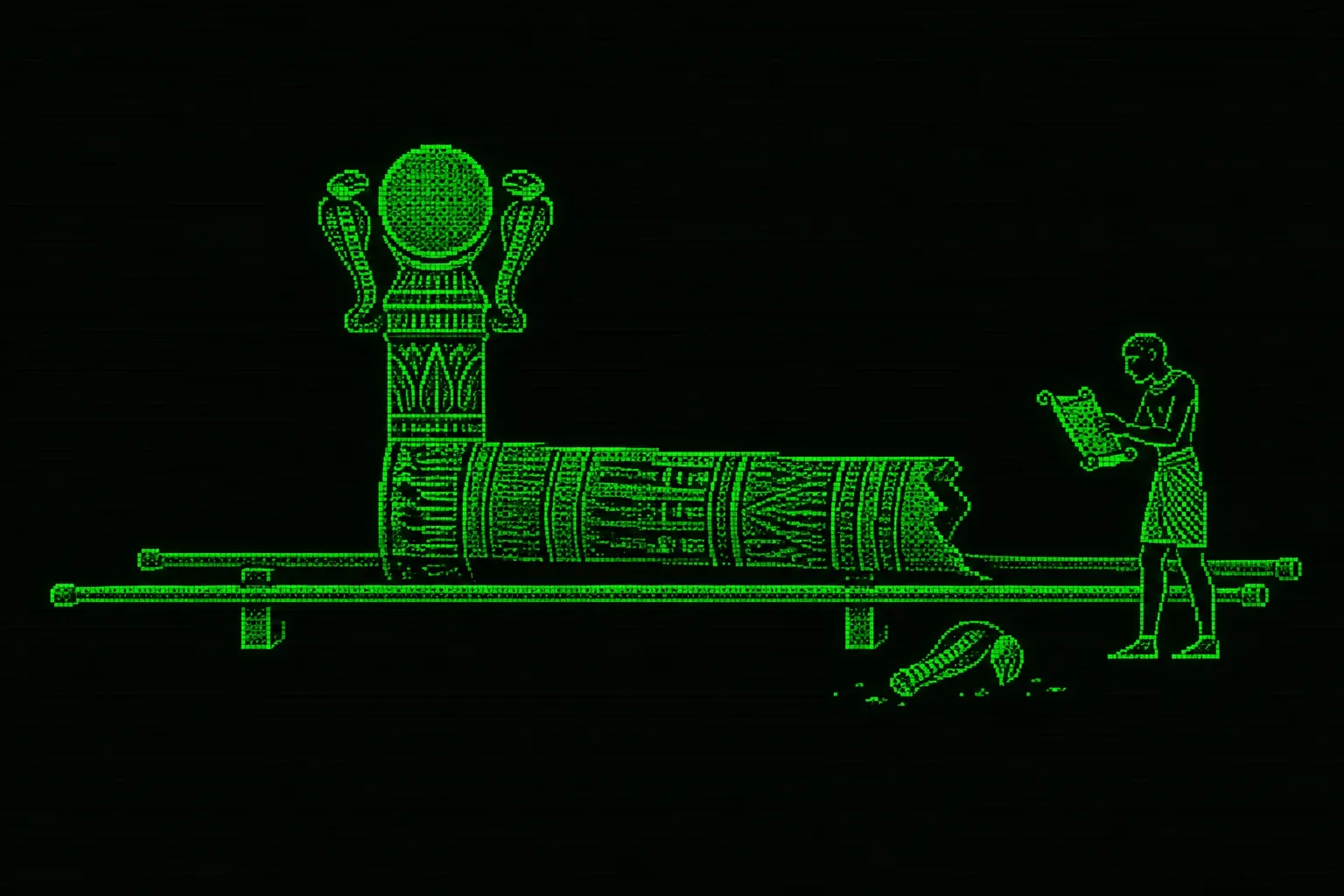
A duty roster: the purification rite is assigned to staff whose names stood in the lost part of the papyrus. Inspection of a gold festival column (pLouvre E 25416 c)
- 19
rnp,t-ḫt-zp 10 ꜣbd 4 šm,w [sw] 21
Year after the tenth count, fourth month of Shemu, day 21.
Note · Line 19
Kings counted their reign by the nationwide cattle count, which was held at intervals, often every second year. - 20
sḫsf n wḫ 1 šdi̯.y n Wdn,t+ +Jhy r-gs ẖr,j-ḥ(ꜣ)b,t Kꜣ≡j-ḥtp,w
Inspection of the one column that was taken out for the Wedjenet-Ihy offering festival, in the presence of the lector priest Kai-hetepu.
- 21
nbw
Gold.
Note · Line 21
The material of the column and its fittings. - 22
ḏs =f n⸢ḥ⸣[ꜥ] [...] [⸮_?] =f ⸢ꜥšꜣ⸣ ⸢ḥꜣ⸣ =⸢f⸣
The column itself: damaged … its …; much damage to its back.
Note · Line 22
“Damage” stands for a technical word in these inventories (nḥꜥ). It is used for wear on an object, such as chipping, scratching or dents. - 23
jtn nḥ⸢ꜥ⸣ ⸢jm⸣ =[f] [...] 4
The sun disk: damage on it … 4.
- 24
jꜥr,t.du jw,tjt [...]
The two uraei: missing …
Note · Line 24
A uraeus is the rearing cobra worn on royal and divine crowns. - 25
〈〈jꜥr,t.du〉〉 ⸢nḥꜥ⸣ [...]
The two uraei: damaged …
- 26
wṯz.du jꜣ,t ⸢jw,⸣tjt [...]
The two carrying poles and the standard: missing …
Note · Line 26
The poles were for carrying the object in procession, and the standard was the stand it was set on.