TL;DR
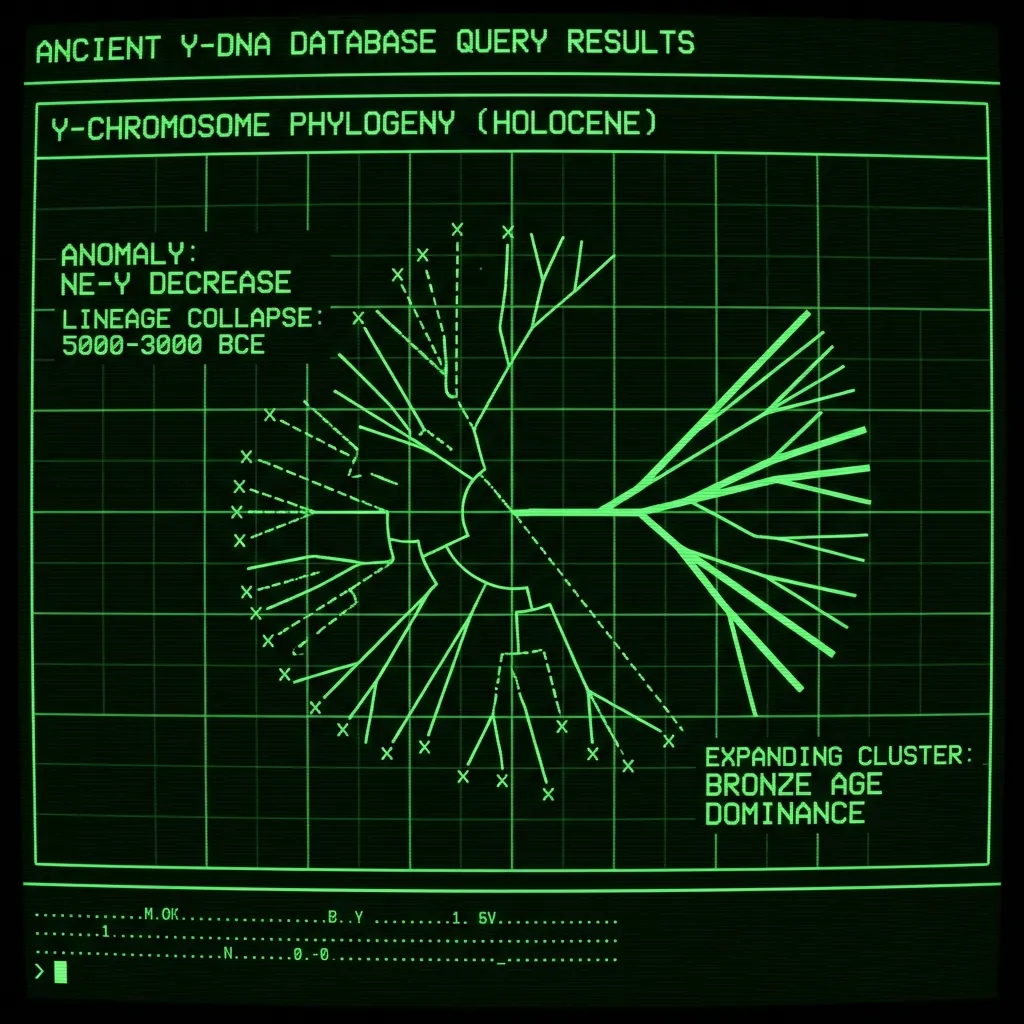
- Around 3000–5000 BC, male effective population size (Ne) on the Y-chromosome crashed by ~5–20×, while female Ne kept growing, producing the famous “Y-chromosome bottleneck.” 1
- The best-supported explanations involve patrilineal clans, extreme male reproductive skew, and inter-clan competition—i.e., systematic selection on male lineages, not a random demographic accident. 2
- Standard demographic methods often assume neutrality; pervasive selection and structure can make selection look like a simple size crash, and can misdate when it started. 3
- From a gene’s-eye view, the Bronze Age mind was sculpted in a world where most men left no patrilineal descendants, and a minority of clan-aligned, violent, status-obsessed males dominated the Y-tree. 4
- This male-line purge doesn’t mean “men disappeared” biologically—autosomal ancestry is preserved—but it marks a sharp turning point in how male psychology, kinship, and power were wired into human history.
“Crosses with crosses, shields with shields they clash… and the earth runs black with blood.”
— The Iliad, trans. (pick your favorite), retelling a Bronze Age argument over paternity
1. The strange case of the missing men#
If you trace only the paternal line—father to son, son to son—the human species does something very weird between the Neolithic and the Bronze Age.
Genome-wide, effective population sizes grow through the Holocene as farming, villages, and eventually cities spread. But on the Y-chromosome, diversity collapses: multiple studies converge on a male Ne drop of an order of magnitude or more between roughly 3000 and 5000 BC, followed by explosive re-expansion. 1
Mitochondrial DNA (mtDNA) and autosomes don’t show a matching crash. Female Ne keeps climbing, and autosomal diversity mostly tracks overall population growth. The simplest reading:
- Women: lots of lineages surviving and expanding.
- Men: most patrilines get wiped out; a minority expand massively.
This is the so-called Y-chromosome bottleneck. Its magnitude is extreme: estimated ratios of female to male Ne in this window can reach ~10–20:1. 2
The crucial point: this isn’t a story about biological sex ratios—there weren’t suddenly 15 women for every man. It’s about who, among men, got to be a patrilineal ancestor.
From the point of view of the Y-chromosome, the Bronze Age looks like a cull.
2. What the data actually say#
Let’s anchor the narrative in the usual suspects: Karmin et al. (2015), Poznik et al. (2016), and later modeling work.
Karmin et al. sequenced Y-chromosomes from 456 men across diverse populations and reconstructed effective population size through time. They found:
- A sharp downturn in Y-Ne across many Old World populations between ~4–8 kya.
- No comparable downturn in mtDNA, which instead shows ongoing expansion. 1
Poznik et al. then used 1244 Y-chromosomes from the 1000 Genomes Project and similar skyline plots, confirming punctuated bursts and crashes in male demography, including the post-Neolithic bottleneck. 4
Meanwhile, sex-biased demography studies show that uniparental markers (Y vs mtDNA) often diverge in diversity and coalescent times, consistent with culturally structured mating and migration. 2
A compact overview#
| Study / Source | Main Signal on Y | Contrast with mtDNA / Autosomes | Takeaway for the bottleneck |
|---|---|---|---|
| Karmin et al. 2015 (Genome Res.) 1 | Global Y-Ne collapse ~4–8 kya, ~>5× drop | mtDNA shows growth; autosomes consistent with expansion | Strong male-specific bottleneck, culturally timed. |
| Poznik et al. 2016 (Nat. Genet.) 4 | “Punctuated bursts” in Y demography; sharp Holocene downturn | Autosomes lack matching crash | Recurrent male-biased bottlenecks and expansions. |
| Zeng et al. 2018 (Nat. Commun.) 5 | Simulations reproduce Y bottleneck via patrilineal clans + warfare | mtDNA grows; female Ne stable/increasing | Cultural hitchhiking: competition between patrilineal groups. |
| Guyon et al. 2024 (Nat. Commun.) | Y bottleneck reproduced by peaceful patrilineal segmentary systems | Female lineages expand | Social structure alone, even without explicit war, yields collapse. |
| Neolithic/Bronze summaries (encyclopedic) | Female:male Ne ratio up to ~17:1 in mid-Holocene | — | Extreme sex-skewed effective size implies huge variance in male reproductive success. |
Even the Wikipedia-level summaries now explicitly connect the bottleneck to the spread of agriculture, patrilineal inheritance, and highly skewed male reproductive success.
The puzzle isn’t whether something dramatic happened to male lineages. It’s what kind of evolutionary force did it.
3. Drift, demography, or selection?#
Three broad explanations get floated:
- Neutral demography: a global male population crash (plague, climate, whatever).
- Cultural structure with neutral genetics: patrilineal clans, but no systematic fitness differences between Y lineages; drift in a structured population.
- Gene–culture selection: patrilineal clans plus persistent differences in reproductive success between male lineages; survival of particular Y haplogroups is not random.
The empirical picture rules out the simplest version of (1). A true global crash big enough to slash Y-Ne by 10–20× should leave fingerprints in autosomes and mtDNA; they’re not there. 1
That pushes us toward (2) and (3), which are not cleanly separable. Once you look at the world through the gene’s eyes, “neutral cultural structure” that repeatedly kills some clans and rewards others is selection, even if the immediate causes are social.
Cultural hitchhiking: the violent version#
Zeng, Aw & Feldman (2018) model “cultural hitchhiking” in patrilineal kin groups. Imagine:
- Villages composed of patrilineal clans (men who share a Y haplogroup).
- Violent competition between clans for territory and mates.
- Victorious clans expand, fission, and propagate their Y; defeated clans lose males and sometimes go extinct.
Their forward simulations show that this structure alone can reproduce a strong male-specific bottleneck, with Y-Ne dropping by an order of magnitude while mtDNA continues to expand. 5
The genetic pattern follows the fortunes of culturally defined war-bands.
Patrilineal segmentary systems: the “peaceful” model#
Guyon et al. (2024) run a different kind of model. They build segmentary patrilineal systems—lineages that split and form new segments as they grow—based on ethnographic data, and let them evolve without requiring massive violence.
Key ingredients:
- Patrilocal residence and patrilineal descent.
- Lineages fission when they grow.
- Reproductive success varies between descent groups (some lineages thrive, others stagnate).
Under these conditions, Y-Ne still plummets, even when female Ne increases and violence is minimal. Lineage-level variance and fission are enough.
In both models, though, the gene’s-eye story is the same:
Certain Y-bearing patrilines systematically founded more successful descent groups, and their male descendants came to dominate the Y-tree.
That’s selection. You can choose to call it “cultural.” The Y doesn’t care.
4. Why this basically has to be selection#
You don’t get a 10–20× gap between male and female Ne from polite monogamy and random fluctuations.
Sex-specific demography reviews lay out the math: to reduce Y-Ne that far while mtDNA expands, you need extreme variance in male reproductive success, far beyond what you’d see in simple drift models. 2
Natural selection on the Y itself is a bit weird—it’s mostly non-recombining and gene-poor—but there’s mounting evidence for selection shaping Y haplogroup distributions, including signals of positive and purifying selection on Y lineages in different regions. 6
Couple that with:
- The global timing around post-Neolithic transitions. 1
- Widespread archaeological evidence for increasing social stratification, hereditary elites, and large-scale warfare in the Late Neolithic and Bronze Age.
And the most parsimonious picture is:
Cultural institutions created a fitness landscape where some kinds of men—and their clans—reproduced vastly more than others.
That is selection, even if the causal chain runs through chariots, brideprice, and “who controls the herds” rather than through a single protein-coding mutation.
5. How standard demography hides selection (and misdates it)#
Here’s the twist: most classic demographic inference assumes neutrality.
Coalescent-based methods typically reconstruct population size history assuming that genome-wide patterns of variation reflect drift in a panmictic population. Selection, background selection, and structure are treated as noise to be masked, not as core drivers. 7
A decade of work has shown how badly this can go:
- Background selection and linked selection can make stable populations look like they experienced bottlenecks or expansions. 3
- Purifying selection can bias inferred growth patterns even when functional sites are masked. 5
- Population structure itself can mimic population size changes if you force a homogeneous model onto heterogeneous reality. 8
For our purposes, the key point is conceptual:
If you fit a neutral demographic model to a world where male fitness is violently skewed by culture and selection, your “bottleneck” will be a distorted summary of a much messier process.
The Y-chromosome bottleneck we reconstruct around 4–5 kya may be the culmination of a longer selection regime that started earlier—perhaps as early as the first Neolithic chiefdoms and segmentary lineages forming 8–10 kya—but collapses into a sharp downturn in skyline plots.
The Bronze Age male mind, in other words, may be the late-stage expression of evolutionary pressures that began when we first tied land, herds, and women to patrilines.
6. What disappears in a Y-bottleneck (and what doesn’t)#
Before we start fantasizing about armies of vanished Neolithic warlords, a clarification.
When a Y lineage “goes extinct,” it doesn’t mean all the men in that clan vanished from the autosomal genome. Their daughters can still pass on autosomal variants; their grandsons via daughters carry their autosomes, but not their Y.
The bottleneck is specifically about patrilineal continuity.
So the story is not that “most men died childless.” Rather:
- Many men had only daughters or short male lines that fizzled out.
- A subset of men sat at the center of expanding patrilineal trees that came to dominate the Y landscape.
If your Bronze Age ancestor is “missing” from the Y tree, he probably lives on in you—but not as part of the patrilineal brand architecture.
For understanding the evolution of male psychology, though, patrilineal success matters. Culture and genes conspired to reward particular male strategies—those that kept your Y on the board.
7. The Bronze Age mind as a product of patrilineal selection#
So what kind of male psychology thrives in this environment?
There’s an emerging literature in evolutionary psychology and cultural evolution that explicitly connects sexual selection, status-seeking, and institutions like patrilineal segmentary systems. Some of it now references the Y-chromosome bottleneck directly. 9
Abstracting across that and the genetic models, you get a surprisingly coherent picture:
- Extreme male–male competition. Whether via war, raiding, or peaceful accumulation, male reproductive success is tightly coupled to rank within the patrilineal hierarchy.
- Coalitional obsession. Your main evolutionary project is not “be a good human” but “advance our patriline.” That means loyalty to male kin, suspicion of outsiders, and willingness to sacrifice for the clan.
- Inheritance fixation. Land, livestock, and women are funneled along male lines; disputes over paternity and succession are existential events for lineages.
- Status as survival. Falling a rung down the ladder risks turning your descendants into genetic background noise—daughters marrying into other clans, sons squeezed out.
From the Y’s point of view, the winners are men who:
- Are effective at coalitionary violence or intimidation.
- Navigate intra-clan politics well enough not to be culled by their own side.
- Produce sons who inherit both resources and clan position.
This is exactly the psychological ecology implied by the late Neolithic and Bronze Age archaeological record: fortified settlements, weapon-rich burials, hereditary warrior elites, and long-range raiding networks.
The Y-chromosome bottleneck is genetics’ way of saying: yes, this left a mark.
8. Was the bottleneck purely “peaceful”?#
Guyon et al.’s segmentary-system model is often framed in the press as “a peaceful explanation of the bottleneck.”
And in a narrow sense, they’re right: you can get a big drop in Y-Ne without assuming constant massacres. Lineage fission and differential reproduction do a lot of work.
But “peaceful” here means “no explicit genocide parameter in the simulation.” In ethnographic reality, segmentary systems are not pacifist utopias; they organize feud, raiding, and collective punishment along lines of male descent.
So I’d translate their result more neutrally:
Once patrilineal segmentary systems exist, you don’t need additional assumptions of global, apocalyptic violence to get a Y bottleneck. The baseline operation of the system is already harsh enough.
That’s compatible with Zeng et al.’s violence-heavy model; they emphasize different aspects of the same underlying dynamics. 5
Either way, the world that birthed the Bronze Age mind was one where being born into the wrong patriline was a slow genetic death sentence.
9. How early did this start?#
Genetic skyline plots place the nadir of the Y-bottleneck around 4–5 kya, but if we stop there, we’re mistaking the crash for the whole accident.
Given:
- The well-documented spread of agriculture and early chiefdoms from ~10 kya onward.
- Archaeological transitions toward property, hierarchy, and long-range exchange in the 8th–5th millennia BC.
- The known tendency of selection and structure to bias neutral demographic inference. 3
It’s plausible that:
- Initial selection on male lineages began with early Neolithic patrilines, as land and herds started to be inherited in male lines.
- This process intensified as populations densified, elites emerged, and inter-group conflict scaled up.
- By the time we hit the Bronze Age full-on—chariots, fortified hillforts, caravan routes—the underlying Y-tree was already pruned; what we see as a “bottleneck” is the point where the pruning reaches a coalescent tipping point.
In other words, the Y-bottleneck is not a single event but the genetic shadow of a multi-millennial transition to a patrilineal, war-structured world.
10. Where this leaves the modern male mind#
We are not Bronze Age chiefs. But we are, to a first approximation, running hardware tuned in that world.
The genes carried on the Y are a tiny part of the story—most behaviorally relevant variation is autosomal or X-linked—but the process that produced the Y-bottleneck implies widespread selection on male behavior, cultural and genetic:
- Men who failed to navigate patrilineal politics had fewer patrilineal descendants.
- Clans that failed at war, alliance, or herding strategy disappeared from the Y-tree.
- Institutions that rewarded particular male norms (honor, vengeance, martial prowess) structured who reproduced.
Modern societies try to channel these impulses into startups and sports leagues. But the deep-time fact remains: for several thousand years, being the wrong kind of man was equivalent, in the long run, to never having existed in the male genealogical record.
That’s the Bronze Age mind: not a romantic warrior-soul, but a population-level filter that made some patterns of male cognition and culture very common, and others essentially impossible.
FAQ#
Q1. Does the Y-chromosome bottleneck mean most men had no children?
A. No. It means most male lines eventually ended—often through having daughters or short-lived male lines—while a minority of patrilines expanded dramatically, dominating the modern Y tree.
Q2. Could the bottleneck be just an artifact of methods?
A. Method choices matter, and selection and structure can bias demographic inference, but multiple independent datasets and modeling approaches converge on a real, substantial male-specific Ne decline. 1
Q3. Why doesn’t mtDNA show the same bottleneck?
A. Because female reproductive success is less tightly tied to patrilineal hierarchy; women can move between groups, and matrilines don’t suffer the same group-level extinctions as male descent groups. 2
Q4. Does this prove selection on specific “warrior genes” on the Y?
A. Not specifically; the Y has few genes. The bottleneck mostly reflects selection on culturally defined patrilines and autosomal backgrounds; the Y is a convenient tracer of how those clans rose and fell. 6
Q5. How does this connect to broader human evolution?
A. It shows that relatively recent cultural institutions—patrilineal clans, war, inheritance—can drastically reshape genealogies in a few thousand years, and likely had strong feedbacks on male psychology, social norms, and the kinds of minds that felt “normal” in the Bronze Age.
Sources#
- Karmin, M. et al. “A recent bottleneck of Y chromosome diversity coincides with a global change in culture.” Genome Research 25(4) (2015): 459–466. 1
- Poznik, G. D. et al. “Punctuated bursts in human male demography inferred from 1,244 worldwide Y-chromosome sequences.” Nature Genetics 48(6) (2016): 593–599. 4
- Zeng, T. C., Aw, A. J., & Feldman, M. W. “Cultural hitchhiking and competition between patrilineal kin groups explain the post-Neolithic Y-chromosome bottleneck.” Nature Communications 9 (2018): 2077. 5
- Guyon, L. et al. “Patrilineal segmentary systems provide a peaceful explanation for the post-Neolithic Y-chromosome bottleneck.” Nature Communications 15 (2024): 3243.
- Heyer, E. et al. “Sex‐specific demographic behaviours that shape human genomic variation.” Molecular Ecology 21(3) (2012): 597–612. 2
- Jobling, M. A. “Human Y-chromosome variation in the genome-sequencing era.” (Review).
- Ewing, G. B. & Jensen, J. D. “The consequences of not accounting for background selection in demographic inference.” Molecular Ecology 25(1) (2016): 135–141. 3
- Pouyet, F. et al. “Background selection and biased gene conversion affect more than 95% of the human genome and bias demographic inferences.” eLife 7 (2018): e36317. 10
- Johri, P. et al. “The impact of purifying and background selection on the inference of population history: problems and prospects.” Molecular Biology and Evolution 38(7) (2021): 2986–3003. 5
- Marchi, N. & Excoffier, L. “Demographic inference.” Current Biology 31(12) (2021): R726–R732. 11
- Wang, C. C. et al. “Natural selection on human Y chromosomes.” preprint (2013). 6
- Snyder, B. “Sexual Selection Creates Status-Seeking Males and Unsustainable Economic Growth.” Evolutionary Psychological Science (2025). 9
- “Neolithic.” Overview article with genetic and cultural summary.