TL;DR
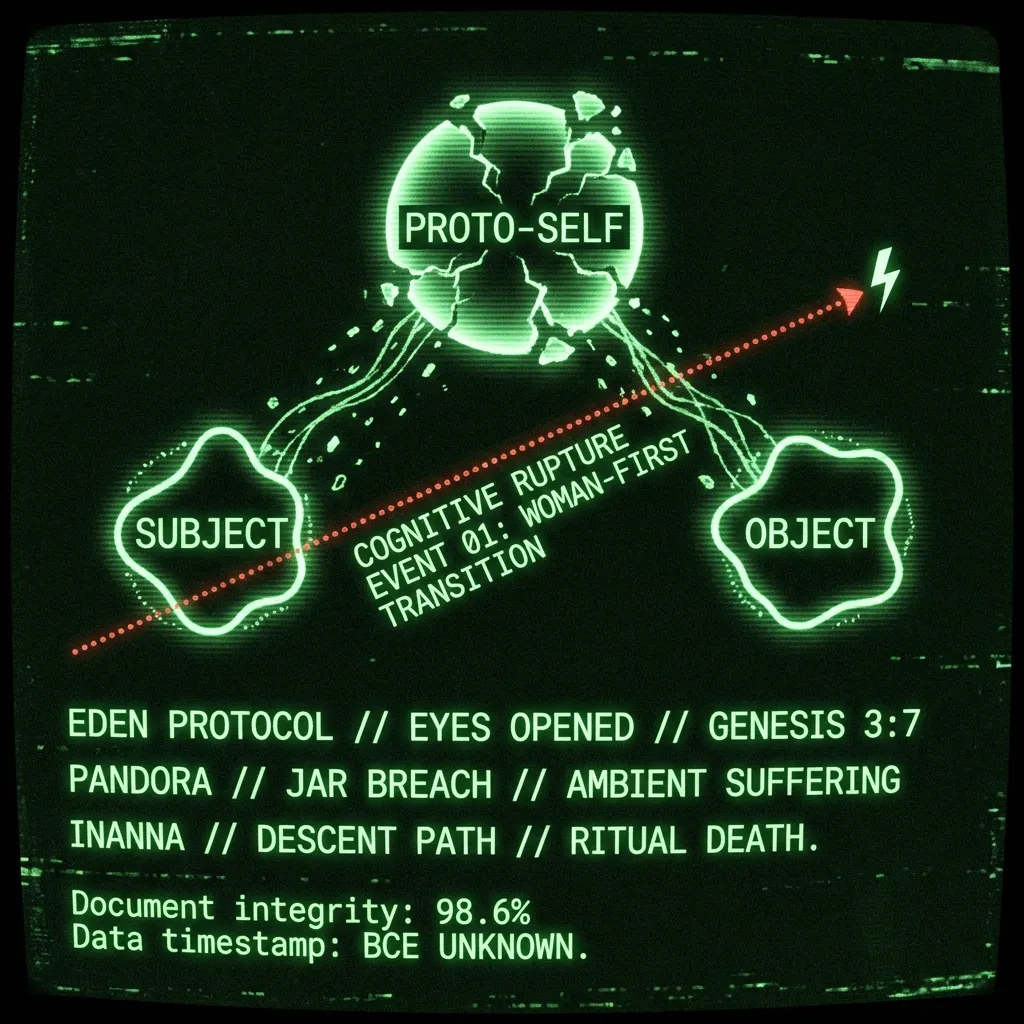
- This essay develops the EToC universe by treating “woman does it first” as a cross-cultural memory: the first irreversible cognitive rupture—the world becomes an object, and the self becomes a thing inside it.
- Across Eden, the jar, the underworld, the broken sky, the first islands, and the seasonal return, the shared mechanism is the same: a boundary is crossed; a taboo look/act happens; vision changes; the cost is mortality/labor/sex-strife; culture crystallizes.
- Eve’s “eyes opened” and shame-tech (clothing) is the prototype: perception turns reflexive, and social life reorganizes around that new inner theater. 1
- Persephone and Inanna stage the same event as underworld contact: the “knowledge” is death’s inevitability and the social technologies that metabolize it (ritual, seasonality, initiation). 2
- Nüwa and the Djanggawul make the rupture cosmic and geographic: repairing a torn world is what it feels like when cognition “splits” reality into categories, kinship, territory, and law. 3
- Izanami is the nightmare mirror: the first taboo look isn’t at fruit but at decay—and it detonates the permanent separation of life and death, with birth as the counter-spell. 4
“And the eyes of both were opened…” 5
— Genesis 3 (Hebrew Bible)
The shared core: an irreversible “opening”#
EToC’s claim is not that these myths are allegories of philosophy. It’s sharper: they are compressed reports of a species-level transition, retold until it looks like gods and brides and monsters.
Here’s the core, abstracted:
- A boundary exists (a garden rule, a sealed container, a closed palace, a sky that “holds,” a land not-yet-partitioned).
- A woman crosses first (or is the axis around which the crossing occurs).
- A look/act becomes irreversible (“do not eat,” “do not open,” “do not look at me,” “do not return,” “do not let the sky fall”).
- Vision changes: not just “seeing more,” but seeing differently—the birth of reflexivity, shame, and narrative self-modeling.
- A cost arrives: death becomes explicit; labor becomes obligatory; sex becomes conflicted; hierarchy hardens; time becomes seasonal.
- Culture is the scar tissue: clothing, ritual, marriage rules, agriculture, childbirth institutions, cosmic repair.
The repetition is the point: independent cultures converge on the same felt structure because they’re describing the same kind of rupture.
Comparative table: the “woman-first rupture” motif#
| Figure | Threshold crossed | The “forbidden” act | What becomes newly visible | Cost (the bite) | Cultural aftereffect |
|---|---|---|---|---|---|
| Eve | Garden / command | Eats + gives; then “eyes opened” | Self-as-object; nakedness; moralized interiority | Mortality + labor + painful birth | Clothing, law, exile, lineage 1 |
| Pandora | Sealed jar / gift | Opens what must stay closed | Suffering as a permanent atmosphere | Inescapable evils; ambivalent “hope” | Gendered suspicion; marriage as risk; toil |
| Persephone | Meadow → underworld | Abduction + pomegranate binding | Time as cycle; death as residence | Seasonal loss; hunger; bargaining | Initiation structures; Eleusinian patterning 2 |
| Inanna | “Great Below” | Descent; stripped at gates | Death seen directly; power unmasked | Execution/hanging; substitution demanded | Ritual death/rebirth logic; sovereignty reframed |
| Nüwa | Sky/earth integrity | Repairs cosmic breach | World becomes fixable—structured | Monsters, floods, disorder precede repair | Category-making; cosmological engineering 3 |
| Djanggawul Sisters | Featureless land → named country | Arrival/creation; instituting law | Territory, kinship, “who is who” | Social obligation; taboo regimes | Moieties/clans; sacred geography 6 |
| Izanami | Life → Yomi (gloom) | “Look not at me” is violated | Decay; the corpse as fact | Enmity of death; daily killing vs births | Birth as counter-magic; separation rites 4 |
This table is the skeleton; now we put flesh on it by reading each story as a memory-format for the same cognitive event.
Eve: the prototype of reflexive sight#
The Eden narrative is brutally specific about the phenomenology.
The act isn’t merely “disobedience.” It is a perception switch:
- Hebrew: vattippāqaḥnā ʿênê šenêhem — וַתִּפָּקַחְנָה עֵינֵי שְׁנֵיהֶם — “the eyes of both were opened.” 5
- Immediately: they “know” (not merely see) nakedness, and they manufacture concealment—fig leaves, sewing, hiding. 1
In EToC terms: the first self-model arrives like a curse. The body is no longer just lived; it is represented. Once represented, it can be judged, compared, managed, concealed.
And Eve “does it first” in the precise technical sense: she performs the initiating transition and then propagates it (“and she gave also to her husband with her…”). 1
The serpent is not window dressing. It is the narrative device that marks the new cognitive niche: symbolic mediation. Something speaks inside the scene, proposes a counterfactual, offers a theory of mind (“God knows that…”). That’s the software update: reality becomes negotiable in language.
The consequence list (mortality, labor, pain-in-birth, relational struggle) is not random moralism; it’s what it feels like when a creature becomes trapped in reflective cognition and social comparison: you inherit time, dread, and status.
Pandora: the cognition of “inescapable atmosphere”#
Pandora is often taught as “misogyny.” In the EToC universe, she’s something colder: the first opening of an interior that should have stayed sealed.
The Greek tradition’s obsession is not “a jar” per se; it’s a container whose opening changes the global state. That’s exactly how consciousness rupture feels in hindsight:
- before: local harms, local fears
- after: suffering becomes ambient, a background condition of mind, not merely events in the world
The EToC read: Pandora encodes the moment when the tribe discovers that pain is not only external injury but internal anticipation—an imaginative engine that can generate suffering in advance.
The famous remainder—“hope” (ἐλπίς)—is often debated (comfort? delusion?). The EToC stance is crisp: once reflexive mind appears, you get both plague and medicine in the same organ. Hope is not an angel; it’s the counterfactual simulator that also produces dread.
Pandora is thus Eve’s sister myth: the same mechanism framed as affective climate instead of shame-tech.
Persephone: underworld as the new address of death#
Persephone’s story is an Eden story with different scenery. The meadow is a garden. The narcissus is a lure. The underworld is exile.
The Homeric Hymn insists on two things:
- the taking is authorized “by Zeus” (cosmic law), not merely violence 2
- the return is partial and conditional (pomegranate binding): the new state cannot be fully reversed 2
That irreversibility is the point. Once a culture metabolizes death into a structured concept—a place, a rule, a bargain—the old seamlessness is gone. Persephone becomes a dual citizen: innocence above, necessity below.
EToC translation move: “the underworld” is the mind’s new basement level: the domain of inevitability, constraint, and the costs of being a self.
The seasonal bargain is a public calendarization of private trauma. A people that has crossed into reflective consciousness now needs ritual time to hold it: periods of loss, periods of return. That’s the civilizational invention hidden inside the romance.
Inanna: the goddess who dies on purpose#
Inanna is Persephone turned inside out: not abducted, but choosing descent.
The Descent of Inana is almost clinically initiation-shaped:
- She goes below.
- At each gate she is stripped (status removed).
- She is killed and displayed.
- She is returned, but only through substitution—someone must take her place.
That substitution demand is the most revealing “memory fragment.” It encodes the social truth that the new consciousness is not free: it is paid for. Someone must bear the cost of the new regime—often symbolically, sometimes literally.
In EToC terms, Inanna represents the moment a culture realizes that “selfhood” is a thing you can enter and exit only through structured death: you cannot become a reflective being without losing an older, animal immediacy.
And she is female because the myth is tracking an axis of transformation historically managed by women: birth, blood, thresholds, kinship continuity—domains where the cost-accounting of life and death is unavoidable.
Nüwa: repairing the torn sky is category-making#
Where Eden and the underworld are intimate, Nüwa is cosmic engineering. The Huainanzi frames the world as literally broken:
- “四極廢,九州裂,天不兼覆,地不周載” — “the four poles collapsed, the nine regions split; heaven no longer fully covered; earth no longer fully bore.” 3
- Then: “于是女媧煉五色石以補蒼天,斷鰲足以立四極” — “So Nüwa smelted five-colored stones to patch the blue sky, and cut the great turtle’s legs to set the four poles.” 3
This is the most literal mythic image of what a consciousness rupture feels like: the world stops “holding,” things spill, categories fail, predators surge, floods won’t end—and then someone stabilizes the frame.
Nüwa is not merely a creator; she is a repairer, and repair implies a prior unity that has been broken. That is EToC’s exact claim: a former cognitive continuity fractures into subject/object; the sky no longer “covers” in the old way; the mind becomes exposed to infinity, and must patch itself with structure.
Five-colored stones are a mythic compression of differentiation: the world becomes an array of properties, and only by recombining them can you make a stable canopy again.
Nüwa is Eve with a hard hat.
The Djanggawul Sisters: world-making as kinship, territory, and law#
Here the “opening” becomes geographic and social: the land is not merely created; it is made legible—named, partitioned, obligated.
Across Yolŋu traditions, the Djanggawul (often rendered Djang’kawu) are described as ancestral beings—frequently in forms that include powerful female figures—who travel, bring forth features, establish sacred sites, and institute social order. Museums and archives describe this as foundational to country and ceremony in north-east Arnhem Land. 6
The EToC reading: the “first rupture” is remembered here as the creation of map-like cognition:
- place becomes owned (not economically first, but spiritually—“this site is this story”)
- people become typed (moiety, clan, relation)
- behavior becomes governed (taboos, marriage rules, ritual obligations)
If Eve gives us shame and interiority, the Djanggawul give us something equally consciousness-y: the social world as a structured graph. You can’t have a self without a lattice of relations to locate it inside.
This is why the women-first signature matters here: the myth is preserving the sense that the first stable social ontologies—who belongs to whom, what lines can be crossed, what unions are permitted—arrive through a feminine ancestral vector.
In EToC terms: the self is born inside kinship.
Izanami: “Look not at me” and the invention of death-as-separation#
The Kojiki passage is the nightmare version of Eden: not fruit, but corpse; not shame, but decay.
Izanagi follows Izanami to Yomi. She agrees to attempt return and gives a taboo:
- “Look not at me!” 4
He looks anyway. What he sees is not metaphor—it is the cognitive shock of mortality:
- “Maggots were swarming… and [she was] rotting…” 4
Then the chase. Then the sealing of the pass with a boulder. Then the duel of arithmetic:
- she vows to kill a thousand daily; he vows to set up fifteen hundred “parturition-houses.” 4
That exchange is the most EToC-dense line in the whole corpus: the world becomes a ledger of deaths and births. Once the taboo look has happened, death is no longer an accident; it is an institution. And birth becomes the counter-institution.
Eve invents clothing. Izanami invents demography.
Also note the peaches: “Great-Divine-Fruit” used as apotropaic weapons. 4 The Eden fruit is knowledge; the Kojiki fruit is defense. Same object-class, different phase: once the rupture happens, fruit becomes technology.
Persephone again: why the underworld keeps recurring#
At this point you can see why Persephone sits in the list twice—once as herself, once as a template.
Underworld narratives are the best mythic container for what the EToC rupture is: contact with death as a conceptual reality, and the consequent reorganization of life into rules, bargains, and cyclical ritual time.
That’s why Inanna and Persephone rhyme; why Izanami and Eve rhyme; why Nüwa and Pandora rhyme. They’re not “the same story.” They’re the same event-shape told through different local metaphysics.
What the “woman-first” signature is doing#
In the EToC universe, “woman first” is not a political slogan. It’s a diagnostic marker. It points to a class of transformations historically managed, mediated, or symbolically concentrated around women:
- birth (threshold between non-being and being)
- blood (cyclical time made flesh)
- kinship (the relational graph that defines social identity)
- food (gathering, preparation, taboo)
- initiation (the controlled death of a prior self)
Myth stores memory where the culture has reliable handles. If the handle is “woman,” it doesn’t mean women are to blame. It means women are the register on which the rupture was recorded.
FAQ#
Q1. What is the single shared core across these myths in the EToC reading? A. A taboo boundary is crossed and perception becomes reflexive—“eyes open,” decay is seen, the sky no longer “covers”—and the world reorganizes around irreversible costs (mortality, labor, sex-strife) plus compensatory cultural tech (ritual, law, kinship, time).
Q2. Why does the “do not look / do not open / do not eat” motif matter so much? A. Because it encodes irreversibility: once a representational mind performs the act (opening, looking, tasting), the prior seamless worldview cannot be restored; myth marks that point with a prohibition that fails on purpose.
Q3. How does Nüwa “repairing the sky” fit a theory about consciousness instead of geology? A. The Huainanzi describes a world whose frame collapses and must be patched with differentiated materials; that’s an exact symbolic analogue for a cognitive rupture that forces reality into categories and requires structural “repair” to be livable. 3
Q4. What does Izanami contribute that Eve doesn’t? A. Izanami makes the rupture explicitly necrological: the forbidden knowledge is not moralized desire but witnessed decomposition, and the aftermath becomes a numerical institution—death-rate versus birth-rate—turning mortality into a permanent administrative fact. 4
Footnotes#
Sources#
- Hebrew Bible. “Genesis 3 (Hebrew/English on Sefaria).” Sefaria. 1
- The Homeric Hymn to Demeter (trans. Hugh G. Evelyn-White). “Homeric Hymn to Demeter (PDF).” 2
- ToposText. “Homeric Hymn to Demeter (text).” 7
- The Descent of Inana (Sumerian). Electronic Text Corpus of Sumerian Literature (ETCSL). “Inana’s Descent to the Nether World (translation).”
- Liu An et al. Huainanzi (Western Han). Chinese Text Project. “Lanming xun (覽冥訓) — Chinese Text Project.” 3
- Huainanzi (Wikisource mirror). “淮南子/覽冥訓 — Wikisource (Chinese).” 8
- Lie Yukou (attrib.). Liezi. Chinese Text Project. “Tang Wen (湯問) — Chinese Text Project.” 9
- Kojiki (trans. Basil Hall Chamberlain). Sacred Texts Archive. “Section IX — The Land of Hades.” 4
- Sacred Texts Archive. “Kojiki Index (navigation to creation + Izanami/Yomi sections).” 10
- National Museum of Australia. “Yalangbara / Djang’kawu material (collection context).” 6
- AIATSIS Catalogue. “Djanggawul / Djang’kawu related collection records (archival context).” 11
- Art Gallery of New South Wales. “Djang’kawu / Yolŋu foundational narratives (art-historical context).” 12