~/atlas/greek-mythology
Why Is a Book of Maps Called an Atlas?
Mercator named his 1595 map collection Atlas after the astronomer-king of Mauretania, not the punished Titan; how the name spread to every book of maps.
TL;DR
- A book of maps is called an atlas because of one book: Gerardus Mercator’s Atlas, which his son Rumold published at Duisburg in 1595, a year after Mercator’s death.
- Mercator’s preface names the namesake: Atlas, king of Mauretania in North Africa, “a most skilled astrologer” and “the first among men to discourse on the sphere,” not the Titan condemned to hold up the sky.
- That Atlas comes from Diodorus of Sicily, who read the sky-bearing giant as a memory of a king who taught the sphere of the heavens.
- The Titan got onto map books anyway. Rome’s Lafreri collections (c. 1570–72) put a Titan bearing the globe on their title pages; Mercator’s own title page shows a seated king studying a globe.
- Ortelius made the first modern atlas (1570) but called it a Theatrum, a theatre.
- The word spread through Mercator–Hondius reprints; English has it from 1635–36.
- The top vertebra is called the atlas for the same image: it holds up the globe of the head.
Hunc Atlantem tam insignem eruditione, humanitate ac sapientia virum mihi imitandum proposui. (“This Atlas, a man so outstanding in learning, humanity and wisdom, I have set before myself to imitate.”) — Gerardus Mercator, Praefatio in Atlantem (1595)
Mercator’s Atlas of 1595 #
Gerardus Mercator (1512–1594), the Flemish cartographer best known for the 1569 projection that carries his name, named the atlas. He issued his modern maps in parts: France, the Low Countries and Germany in 1585, Italy and the Balkans in 1589. Neither part was yet called an atlas. After his death on 2 December 1594 his son Rumold completed the work and published it whole in 1595, under the title his father had chosen: Atlas sive cosmographicae meditationes de fabrica mundi et fabricati figura, “Atlas, or cosmographical meditations on the making of the world and the shape of what was made” (Utrecht University Special Collections; Koeman, quoted by the David Rumsey Map Collection).1
Mercator meant more than a map book. The Atlas was to be a whole cosmography: the creation of the world, the heavens, astrology, the elements, and only then geography. The maps were the part he lived to finish, and the name stuck to them.
The Preface to the Atlas #
The Atlas opens with a one-page Praefatio in Atlantem, “Preface to the Atlas,” followed by a family tree headed Stemma Atlantis. It is a genealogy and a mission statement, and it does not mention Zeus, the war of the Titans, or any punishment. The key sentences, read from the page reprinted unchanged in the 1607 Mercator–Hondius edition (David Rumsey Map Collection scan), translated literally:
Atlas Rex Mauritaniae & regio stemmate natus, patrem habuit terrenum sive indigenam … qui fuit Caelus cognominatus, & Matrem Titeam, cognomine Terram.
Atlas, king of Mauretania and born of royal stock, had for father an earth-born or native man … who was surnamed Caelus [Sky], and for mother Titea, surnamed Terra [Earth].
Et quidem Atlas, ut citant Veteres, Diodorus lib. 4. cap. 5. Astrologus fuit peritissimus, deque sphaera primus inter homines disputavit.
And indeed Atlas, as the ancients report (Diodorus, book 4, chapter 5), was a most skilled astrologer, and was the first among men to discourse on the sphere.
Hunc Atlantem tam insignem eruditione, humanitate ac sapientia virum mihi imitandum proposui, quoad ingenium & vires suppetunt, Cosmographiam veluti ex alta animi specula contemplaturus, si forte aliquid veritatis in rebus nondum percognitis rimari possim.
This Atlas, a man so outstanding in learning, humanity and wisdom, I have set before myself to imitate, as far as my wit and strength hold out, and to contemplate cosmography as from a high watchtower of the mind, in case I can dig out some truth in things not yet thoroughly known.
He closes by promising to set out “the whole world as in a mirror” (totum Mundum tanquam in speculo). The title is a dedication to a patron saint of astronomers.2
The rest of the preface is not mild. Mercator retells, from Diodorus, how Atlas’s sister Basilia married their brother Hyperion, and how the other brothers, afraid his children would inherit, ipsum obtruncarunt, “butchered him,” and drowned the boy Sol (the Sun) in the river Eridanus. Atlas’s pious son Hesperus climbed the summit of Mount Atlas to watch the courses of the stars and was snatched away by the winds; Mercator adds that he has found him, blown safely to Spain, as king of Iberia. After Hyperion’s murder Atlas and Saturn divided their father’s kingdom, Atlas taking the coast of the Ocean from Libya to the Strait of Gibraltar, “where the mountain Atlas and the Atlantes people of Mauretania were named from him.”3
Mercator’s genealogy cites Eusebius’s Preparation for the Gospel, which preserves Philo of Byblos’s Phoenician history. Philo’s version of the family is harsher than the one Mercator chose to repeat. There Kronos, Atlas’s brother, “became suspicious of his own brother Atlas, and, with the advice of Hermes, threw him into a deep pit and buried him”; he killed his own son and “cut off the head of a daughter of his own”; and he ambushed their father Ouranos and “emasculates him near some fountains and rivers,” the blood dripping into the water (Eusebius, Praeparatio Evangelica 1.10, tr. Gifford).
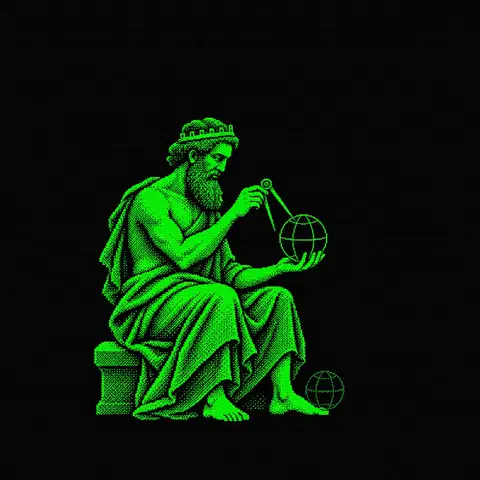
The 1595 title page matches the preface. Atlas sits in a niche, bearded and half-robed, with a globe in his hands and a second at his feet, an armillary sphere on the roof above him. He is studying the world, not straining under it.
Atlas, King of Mauretania and First Astronomer #
He is the Titan read as history. Greek and Roman writers who explained myths as memories of real people (euhemerism) made Atlas a North African king and the first astronomer, and explained the sky on his shoulders as a figure of speech for his knowledge of the heavens. Mercator took his Atlas straight from them.
Diodorus of Sicily (1st century BC) gives the fullest account. Among the Atlantians on the shore of Ocean, the first king was Uranus, a careful observer of the stars; he had 45 sons, 18 of them by Titaea, who were called Titans after her (3.56–57). After Hyperion’s murder the kingdom was divided, and Atlas, who got the coast, “was the first to publish to mankind the doctrine of the sphere,” and so “the entire heavens were supported upon the shoulders of Atlas, the myth darkly hinting” at his discovery (3.60.2). In book 4 Diodorus repeats it: Atlas “had ingeniously discovered the spherical nature of the stars, and for that reason was generally believed to be bearing the entire firmament upon his shoulders” (4.27.5; Diodorus 3.56–61 and 4.27, tr. Oldfather). Atlas’s seven daughters, the Atlantides, became the stars of the Pleiades.
The same reading runs through Latin literature:
| Source | Date | What it says about Atlas |
|---|---|---|
| Vitruvius, De architectura 6.7.6 | c. 25 BC | Statues of men holding up beams are called atlantes by the Greeks, because Atlas “first took care to hand down to men the course of the sun and moon and the rules of the turnings of all the stars,” and for that benefit painters and sculptors show him “holding up the world” (Latin text) |
| Virgil, Aeneid 1.740–742 | 19 BC | At Dido’s banquet the bard Iopas, “whom great Atlas taught,” sings “the wandering moon and the labours of the sun” |
| Pliny, Natural History 7.203 | AD 77 | In his list of inventors: astrologiam Atlans Libyae filius, “astronomy, Atlas son of Libya” (Latin text) |
| Augustine, City of God 18.8 | c. 420 | Prometheus’s brother Atlas “is said to have been a great astrologer, which gave the fable its chance to invent that he carries the sky” |
So Mercator was not inventing a second Atlas. He was choosing the learned reading of the one Atlas over the poetic one, the reading every educated man of 1595 knew from Diodorus and Augustine.
The Titan Who Holds Up the Sky #
The Titan is the older Atlas, and the one the map trade adopted.4 In Hesiod he is the son of Iapetus and brother of Prometheus, and his punishment is a place at the end of the world:
Ἄτλας δ᾽ οὐρανὸν εὐρὺν ἔχει κρατερῆς ὑπ᾽ ἀνάγκης, πείρασιν ἐν γαίης πρόπαρ᾽ Ἑσπερίδων λιγυφώνων ἑστηκώς, κεφαλῇ τε καὶ ἀκαμάτῃσι χέρεσσι.
And Atlas holds the broad sky under hard necessity, at the ends of the earth, in front of the clear-voiced Hesperides, standing, with his head and unwearying hands. — Hesiod, Theogony 517–519 (Greek and English)
Hesiod adds that “wise Zeus assigned him this lot” (520). The Hesperides he stands beside keep the golden apples with “the terrible snake” that guards them in the hidden places of the dark earth (Theogony 334–335). In the Odyssey he is “baneful-minded” Atlas, “who knows the depths of every sea, and himself holds the tall pillars that keep earth and sky apart” (1.52–54). Herodotus says the people of the Atlas mountains called their peak “the pillar of heaven” (4.184), and Ovid has Perseus turn Atlas into that mountain with the Gorgon’s head when the giant refuses him hospitality (Metamorphoses 4.631–662). Plato gives the name to a son of Poseidon, first king of Atlantis, after whom the Atlantic Ocean is named (Critias 114a).
The Farnese Atlas and Lafreri’s Title Pages #
The image everyone pictures comes from sculpture. The Farnese Atlas in Naples, a Roman marble of the 2nd century AD after a Hellenistic original, shows the kneeling Titan bearing a celestial globe carved with the constellations, the oldest surviving picture of the Greek star figures. Bradley Schaefer dated the star positions on it to about 125 BC and traced them to Hipparchus’s lost star catalogue (Schaefer 2005, doi:10.1177/002182860503600202). The Titan carries an astronomer’s sky chart, not the Earth.
The Earth globe came with the map trade. Roman map sellers, led by Antonio Lafreri, bound assorted printed maps into volumes to order around 1570–72, and their engraved title pages, Geografia: tavole moderne di geografia, usually show Atlas carrying the terrestrial globe on his shoulders. Lafreri was the first to put Atlas on a set of maps, though he never called it an atlas (Lapaine et al. 2008).5 After Mercator gave the book the name, publishers gave it the Titan, and the crouching giant under the globe became the stock frontispiece. Mercator named the book for the astronomer king; everyone after him pictured the Titan.
From Theatrum to Atlas: How the Name Spread #
The first modern atlas was not called one. Abraham Ortelius’s Theatrum Orbis Terrarum (Antwerp, 1570) was a uniform, bound, edited set of maps of the whole world, the format every later atlas follows. Its title called the world a stage, a theatre, and that was the usual word for such books until Mercator’s Atlas displaced it (Lapaine et al. 2008). Earlier bound sets of maps exist, manuscript sea charts and the printed maps in editions of Ptolemy’s Geography from 1477 on, but nobody called them atlases until historians did so after the fact.
The name travelled with the copper plates. Jodocus Hondius bought Mercator’s plates in 1604 and reissued the Atlas from Amsterdam in 1606, enlarged, and the Mercator–Hondius Atlas went through edition after edition in Latin, French, German, Dutch and English until 1641 (David Rumsey Map Collection). Its rivals took the word too: Blaeu’s Atlas Novus (1635) and his Atlas Maior (1662).
In English the word arrives as a title. Wye Saltonstall’s Historia Mundi: or Mercator’s Atlas was printed in London in 1635 (Folger Shakespeare Library record), and Henry Hexham’s Atlas or A Geographicke Description of the Regions, Countries and Kingdomes of the World followed from Amsterdam in 1636 (Short-Title Catalogue Netherlands). From there “atlas” became a common noun for any volume of maps, and later for any systematic set of plates, from star atlases to anatomical ones.
The Atlas Vertebra #
The top vertebra is called the atlas because it holds up the head the way Atlas holds up the sky. The ancient name sat lower down. The 2nd-century lexicographer Julius Pollux calls the first neck vertebra the epistropheus (“the one that turns”) and the second the axon, and says that of the four after them “the last, as the burden-bearer, is called atlas,” the vertebra at the base of the neck where loads rest on the shoulders (Onomasticon 2.131–132; Bethe 1900, p. 124). Renaissance anatomists moved the name to the top vertebra, which carries the globe of the skull, and the second vertebra became the axis (Jackowe and Biener 2022, doi:10.1111/joa.13613).6
Timeline: How Atlas Became a Book of Maps #
| Date | Event |
|---|---|
| c. 700 BC | Hesiod, Theogony 517–520: Atlas holds up the sky at the ends of the earth by Zeus’s decree |
| 1st century BC | Diodorus 3.60, 4.27: Atlas, king on the Ocean coast, first taught the sphere; hence the myth of the sky on his shoulders |
| c. 25 BC | Vitruvius 6.7.6: sculptors show Atlas holding up the world for teaching the courses of sun, moon and stars |
| 2nd century AD | Farnese Atlas: kneeling Titan with a celestial globe of the constellations |
| 2nd century AD | Pollux, Onomasticon 2.132: the burden-bearing vertebra at the base of the neck is called atlas |
| 1570 | Ortelius, Theatrum Orbis Terrarum, Antwerp: first modern atlas, called a theatre |
| c. 1570–72 | Lafreri’s Roman map collections: title page of Atlas bearing the Earth |
| 1585, 1589 | Mercator publishes the first parts of his modern maps |
| 2 Dec 1594 | Mercator dies at Duisburg |
| 1595 | Rumold Mercator publishes Atlas sive cosmographicae meditationes, with the preface naming Atlas of Mauretania |
| 1606 | Hondius’s Amsterdam edition begins the Mercator–Hondius series |
| 1635–36 | English editions: Historia Mundi: or Mercator’s Atlas (London), Hexham’s Atlas (Amsterdam) |
| 1662 | Blaeu’s Atlas Maior, the largest atlas of the century |
FAQ #
Q1. Why is a book of maps called an atlas?
A. Because Gerardus Mercator titled his collected maps Atlas in 1595, and later map books
copied the title until it became the ordinary word. His preface says he named the book after
Atlas, king of Mauretania, “a most skilled astrologer” who first taught the sphere.3
Q2. Who named the atlas?
A. Gerardus Mercator, the Flemish cartographer of the Mercator projection. He chose the title
before his death in December 1594; his son Rumold published the complete Atlas sive
cosmographicae meditationes de fabrica mundi et fabricati figura in 1595.1
Q3. Is the atlas named after the Titan who holds up the sky?
A. Indirectly, and against Mercator’s stated intention. His preface never mentions Zeus, the
war of the Titans or the punishment; he took Atlas from Diodorus, who made him a king and
astronomer. Publishers then put the Titan bearing the globe on map title pages, and that image stuck.
Q4. What was the first atlas?
A. Abraham Ortelius’s Theatrum Orbis Terrarum (Antwerp, 1570) was the first modern atlas, a
uniform bound set of world maps, but it was called a theatre. Mercator’s 1595 book was the first
to be called an Atlas.
Q5. When did “atlas” start meaning a book of maps in English?
A. In the 1630s, through the English editions of Mercator’s book: Historia Mundi: or
Mercator’s Atlas (London, 1635) and Henry Hexham’s Atlas or A Geographicke Description
(Amsterdam, 1636).
Q6. Does the Farnese Atlas hold up the Earth?
A. No. The Roman marble in Naples shows the kneeling Titan bearing a celestial globe carved
with the constellations, which Bradley Schaefer traced to Hipparchus’s star catalogue of about
125 BC. The Earth globe on Atlas’s shoulders came later, with the Roman map trade.
Q7. Why is the first neck vertebra called the atlas?
A. Because it holds up the globe of the skull as Atlas holds up the sky. Pollux in the 2nd
century gave the name to the burden-bearing vertebra at the base of the neck; Renaissance
anatomists moved it to the top one.6
Sources #
- Mercator, Gerardus. Atlas sive cosmographicae meditationes de fabrica mundi et fabricati figura. Duisburg: heirs of Mercator, 1595 (Bibliothèque nationale de France copy). See also the Library of Congress record.
- Mercator, Gerardus. “Praefatio in Atlantem,” text page of Atlas sive cosmographicae meditationes, 2nd Mercator–Hondius edition, Amsterdam, 1607. David Rumsey Map Collection, image 10501.012.
- Lapaine, Miljenko, Olga Perić and Ivo Dubravčić. “The Origin of the Term ‘Atlas’.” Kartografija i geoinformacije 7, no. 9 (2008): 42–53.
- Keuning, Johannes. “The History of an Atlas: Mercator–Hondius.” Imago Mundi 4 (1947): 37–62.
- Utrecht University Special Collections. “The ‘Atlas’ by Mercator and Hondius.”
- Diodorus Siculus. Library of History, tr. C. H. Oldfather, Loeb Classical Library, book 3 and book 4. LacusCurtius.
- Eusebius. Praeparatio Evangelica, book 1, tr. E. H. Gifford (1903).
- Hesiod. Theogony, ed. and tr. H. G. Evelyn-White. Perseus Digital Library.
- Vitruvius. De architectura, book 6. LacusCurtius.
- Pliny the Elder. Naturalis historia, book 7. LacusCurtius.
- Augustine. De civitate Dei 18.8. Latin text, The Latin Library.
- Schaefer, Bradley E. “The Epoch of the Constellations on the Farnese Atlas and Their Origin in Hipparchus’s Lost Catalogue.” Journal for the History of Astronomy 36, no. 2 (2005): 167–196.
- Pollux, Julius. Onomasticon, vol. 1, ed. Erich Bethe. Leipzig: Teubner, 1900.
- Jackowe, David J., and Michael G. Biener. “Atlas and Talus.” Journal of Anatomy 240, no. 6 (2022): 1174–1178.
- Folger Shakespeare Library. Historia Mundi: or Mercator’s Atlas, London: T. Cotes for M. Sparke and S. Cartwright, 1635.
- Short-Title Catalogue Netherlands. Atlas or A Geographicke Description, tr. Henry Hexham, Amsterdam: H. Hondius and J. Iohnson, 1636.
Utrecht University counts 51 maps in the 1585 parts, 22 in 1589, and 107 in the complete 1595 Atlas. The book was printed at Düsseldorf by Albertus Busius for Mercator’s heirs at Duisburg; library records give either town. ↩︎ ↩︎
Specula here is “watchtower, lookout,” not speculum “mirror”; the mirror comes in the last sentence. Lapaine, Perić and Dubravčić render both as mirrors. Their full translation of the preface was made from the 1595 edition (the Library of Congress Rosenwald copy in the Octavo facsimile); its content matches the 1607 reprint read here line for line. ↩︎
Mercator’s reference “Diodorus lib. 4 cap. 5” follows the chapter division of his edition; the passages are Diodorus 3.56–61 and 4.27 in modern numbering. His Eusebius reference, De evangelica praeparatione book 1 chapter 7, is chapter 10 in modern editions. Keuning’s summary, often repeated online, says the king “made the first celestial globe”; Mercator’s words are that he first “discoursed on the sphere,” de sphaera disputavit, which could mean the celestial globe or the theory of a spherical heaven. ↩︎ ↩︎
Mercator’s preface names only the king. See Johannes Keuning, “The History of an Atlas: Mercator-Hondius,” Imago Mundi 4 (1947), doi:10.1080/03085694708591880; Miljenko Lapaine, Ivka Perić and Tomislav Dubravčić, who translated the preface in full (2008), hrcak.srce.hr/file/42750. ↩︎
The Lafreri volumes were assembled to order from maps sold singly, so no two copies match and the title pages vary; the Library of Congress holds a set of such sheets catalogued under the title-page wording, with one dated “in Roma 1572.” ↩︎
Counting Pollux’s names (first, second, then four more) puts his atlas at the sixth neck vertebra unless he counted from the skull differently; Jackowe and Biener place it at the seventh. Either way it is the vertebra where the neck meets the shoulders. ↩︎ ↩︎