Why China Will Not Open Qin Shi Huang’s Tomb
TL;DR
- Qin Shi Huang’s burial chamber is sealed, but it is not uninvestigated: mercury surveys, geophysics, remote sensing, soil chemistry, and atmospheric lidar have all probed it indirectly.
- China learned at the Ming Dingling tomb that a successful entrance can become a conservation catastrophe—and that politics can destroy whatever science manages to save.
- Qin’s own painted warriors supply a stopwatch: their lacquer and pigments can begin separating within minutes of exposure to a drier atmosphere.
- A public 1997 State Council notice says large imperial mausoleums will not be proactively excavated until conservation science is adequate. It is a moratorium without a deadline.
- The caution is real. So is the opacity: access, foreign participation, original records, and publication all sit inside a state-controlled archaeological and security regime.
Something appears to be leaking from the First Emperor’s tomb.
Not treasure hunters. Not a secret passage. Mercury.
In the summer of 2016, researchers parked a laser-radar system around the great earthen mound at Lintong and fired ultraviolet pulses through the air. The instrument was tuned to elemental mercury. Ordinary local readings hovered around 5–10 nanograms per cubic metre. Near parts of the mound, the signal rose to roughly 25.
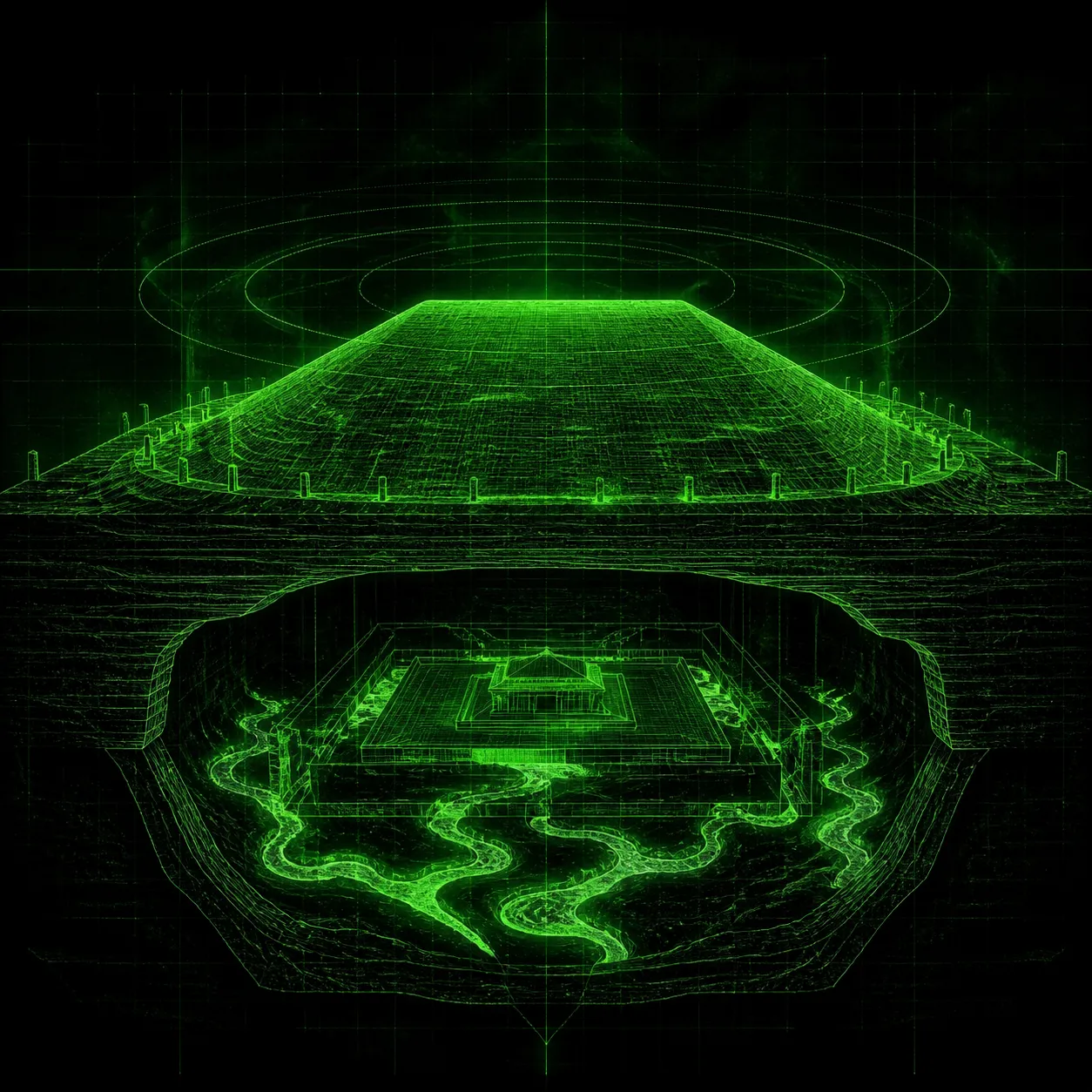
That did not photograph a silver ocean. It did something stranger: it caught what the researchers read as mercury escaping through cracks in the buried structure, a chemical breath from a world described more than two thousand years ago. Sima Qian wrote that the First Emperor’s chamber contained mercury made into the Hundred Rivers, the Yangtze, the Yellow River, and the seas, mechanically kept in circulation; above were celestial patterns, below the features of the earth. The modern lidar study cannot show that the rivers still flow—or even that literal channels survive—but it joins earlier soil and soil-gas surveys in pointing to an unusual mercury source beneath the mound.
The chamber is therefore neither a blank nor an archaeological room waiting for somebody to find the key. China has been interrogating it for decades. What it will not do is cross the final few metres.
The official reason is conservation. The deeper answer is that the tomb sits inside a preservation-security regime with two parts: a conservation case for restraint shaped by one of archaeology’s most instructive disasters, and separate legal controls over access, records, and publication. That regime protects the First Emperor’s underground empire. It also ensures that the Chinese state controls who may investigate it, which records leave the country, and when the rest of the world learns what has been found.
What is actually known beneath the mound? #
The popular story divides too neatly into belief and mystery: an ancient historian told us about crossbows, palaces, stars, and mercury rivers; modern archaeologists refuse to look. The real record is more provocative because it occupies the territory between text and excavation.
| Layer of evidence | What it supports | What it does not support |
|---|---|---|
| Shiji, written roughly a century after the burial | A chamber conceived as a palace and cosmos, with mercury waters, celestial patterns, mechanisms, treasure, and lethal defenses | Direct eyewitness knowledge of the completed interior |
| Soil, soil-gas, and atmospheric surveys | A persistent, spatially concentrated mercury anomaly associated with the mound | A measured mercury tonnage, a surviving map, or moving rivers |
| Remote sensing and geophysics | A coherent underground target, walls/passages, a deep chamber zone, and a mound that appears comparatively intact | A photographic inventory of the chamber or its objects |
| Archaeology outside the centre | The scale of the necropolis, its pits and workshops, painted figures, bronze machines, worker burials, and complex construction | The present atmosphere, organics, structure, or contents of the sealed central room |
The largest survey was a national high-technology (“863”) project conducted in 2002–03 with the stated aim of non-destructive investigation. Its remote-sensing team flew hyperspectral and thermal sensors over the site; its geophysical team used what Chinese accounts describe as eight families and twenty-two methods, including gravity, magnetics, electrical resistance, radioactivity and radon, elastic waves, nuclear magnetic resonance, ground temperature, and mercury measurement. Archaeologists’ traditional hand coring later checked some of the conclusions. The published remote-sensing paper is not a treasure map. It is an argument that complementary instruments can constrain a vast buried structure without destroying it.
Public summaries infer an underground enclosure and central chamber roughly thirty metres below the surface, protected by substantial rammed earth, without obvious evidence of catastrophic water penetration. Measurements vary because reports sometimes refer to different things—the chamber, the surrounding palace walls, or the larger excavation boundary. What matters is the convergence: there is a large, planned, probably still coherent architectural target beneath the mound.
The Shiji passage is no longer floating alone in legend. But the instruments have not turned it into an open room.
The tomb China did open #
To understand why Qin remains sealed, go to Beijing and enter another emperor’s tomb.
In 1955, Guo Moruo and other prominent scholars wanted to excavate the Ming Changling, burial place of the Yongle emperor. The entrance proved difficult to locate, so the team shifted to the nearby Dingling, tomb of the Wanli emperor and his two empresses. Work began in May 1956. In September 1957, excavators passed through the stone gate of an underground palace sealed for nearly four centuries. This sequence, including the political drive to continue opening royal tombs, is reconstructed in a Chinese participant and policy history.
It was the triumph everyone had wanted. More than three thousand objects emerged, according to official Chinese retrospectives, including lacquered wood, court clothing, bolts and fragments of silk, the imperial coffins, and the remains of the dead.
Then the victory started to rot.
The conservators were not indifferent. Chinese retrospectives describe chemists being consulted and treatments being attempted. The problem was that the necessary field, staff, storage, and tested methods did not yet exist. Textiles darkened, hardened, or became brittle under inadequate climate control and irreversible consolidation. The original coffins deteriorated and were discarded. A Beijing expert discussion later called the result for the silks devastating.
Dingling then demonstrated that conservation has a political half-life as well as a chemical one. During the Cultural Revolution in 1966, Red Guards dragged the bones of the Wanli emperor and his empresses into a public spectacle and burned them. A Chinese official retrospective places the two failures in the same institutional memory: inadequate technology failed to save large quantities of material, especially silk; political violence destroyed the imperial dead.
The first retreat from opening more imperial tombs actually began before 1966. Chinese retrospective accounts say senior cultural-relics official Zheng Zhenduo and archaeologist Xia Nai appealed to Zhou Enlai as other provinces proposed their own spectacular excavations. Later participant accounts describe that appeal; the public 1997 notice documents the subsequent national policy. The Cultural Revolution did not create the first retreat; it supplied an even darker reason never to trust that an opened tomb is safe merely because the excavation team means well.
This is Dingling’s real lesson: archaeologists entered the chamber. They did not finish the larger task of preserving the chamber’s world.
“Temporary”—with no clock #
China’s restraint is sometimes described as an unwritten taboo. It is not.
On 30 March 1997, the State Council issued a public notice on archaeological and cultural-relics work. One sentence is the policy in its most exact form:
目前,由于文物保护方面的科学技术、手段等条件尚不具备,对大型帝王陵寝暂不进行主动发掘。
At present, because the scientific technology, methods, and other conditions for conserving cultural relics are not yet adequate, large imperial mausoleums will temporarily not undergo proactive excavation.
The officially reproduced notice
does not forbid scholarship, photography, rescue archaeology, or every non-invasive technique.
It says 主动发掘: proactive excavation. Nor is it a secret statute. Its power lies in the word
暂—for now. There is no expiry date and no numerical threshold for declaring the technology
ready. The state decides when “temporary” ends.
Modern law adds the approval stack. Under China’s revised Cultural Relics Protection Law, effective in 2025, archaeological excavation requires approval and qualified institutions. A research excavation at a nationally protected site proceeds through the national cultural-relics authority and, at this level, the State Council. The governing language begins with protection, rescue, rational use, and strengthened management; another provision specifies minimal intervention. The separate Archaeological Excavation Management Measures, Articles 5–10, also require applicants to identify site-protection measures and technical preparations for conserving excavated objects.
Qin Shi Huang’s chamber is thus not “closed because archaeologists are cautious” in the informal sense. Opening it would be an irreversible national act, requiring the highest administrative authority to declare that the scientific premise behind the moratorium has finally changed.
The four-minute warning #
The strongest case for keeping the chamber shut is not buried in the chamber. It was excavated in the surrounding pits.
The terracotta warriors were not created grey. Their clay bodies carried a lacquer ground and brilliant layers of red, purple, green, blue, white, and black. After two millennia in damp soil, the lacquer was waterlogged and chemically altered. Excavation exposed it to a new atmosphere. As the ground layer dried, it shrank, curled, and pulled the paint away from the ceramic.
The Qin mausoleum museum explains that the lacquer’s sensitivity caused the entire painted layer to detach soon after excavation. Its conservators measured how soon. In one experiment, a painted fragment was moved from a box at 100 per cent relative humidity into an ordinary room at 60 per cent: after one minute both ends of the lacquer layer had visibly lifted, and after four minutes most of it had (museum retrospective). The long-running German-Chinese conservation project likewise reports paint-bearing lacquer separating from the terracotta within minutes after excavation. Laboratory and field work developed polyethylene-glycol and polymer/electron-beam methods to stabilize some surfaces, but those techniques treat known materials under managed conditions. They are not a universal pause button for an imperial palace.
Now scale that problem to a chamber no living person has sampled.
Its humidity, oxygen, carbon dioxide, microorganisms, salts, organics, wood, lacquer, textiles, paint, bronze corrosion, water table, and structural weaknesses are unknown. Mercury adds a worker safety and contamination problem whose concentration inside is also unknown. A small opening changes air flow. A tunnel changes load. Light and visitors change biology. Removing one object changes the support and microclimate of the objects beside it.
“Dig slowly” is not a conservation plan. The painted warriors show that the emergency can begin at the first exposed edge.
The invisible excavation #
The choice is not between opening the chamber and learning nothing. China chose a third strategy: investigate the chamber without entering it.
The first systematic mercury work began in 1981–82 and was published in Chinese in 1983. It found a strong anomalous zone centred over the tomb area, often summarized as about 12,000 square metres. A 2005 mercury and radon study reproduced the broad result. The 863 project added a much wider instrument suite. The 2016 lidar experiment then searched the air itself for vapor escaping through soil and fissures.
This history changes the meaning of “unopened.” The central palace has been sampled chemically from above, modeled geophysically, flown over with hyperspectral sensors, mapped thermally, and tested from multiple positions. China has accepted considerable investigation so long as it does not collapse the chamber’s environmental boundary.
It also creates the central information gap. Published conclusions, selected profiles, technical papers, maps, and monographs exist. The complete original measurement corpus does not appear in an open repository where an outside team can rerun the inversions. A contemporary magazine account of the 863 survey says a single hyperspectral flight in March 2003 produced roughly seven gigabytes of data. That is small by modern standards, but it is enough to distinguish a public scientific conclusion from public raw evidence.
The closed measurement corpus creates a controlled evidence regime: the institutions that approve and conduct the investigation possess a denser view than outside researchers can independently reconstruct.
Where preservation becomes security #
China’s published rules make archaeology a security matter without requiring any secret order about mercury rivers.
Under Articles 6, 9, 11, and 13 of the regulations on foreign archaeological work, a foreign partnership must work with a Chinese institution and be led by a Chinese expert. The Chinese side has priority publication rights. Original archaeological records belong to China. For a proposed foreign project, the national heritage authority may send the application for review by national defense, foreign affairs, public security, and state security departments before seeking special State Council permission. Foreign visits to unopened sites or active digs require approval; visitors to an excavation may be barred from making their own archaeological records.
| Control point | Public rationale | Informational consequence |
|---|---|---|
| National approval of research excavation | Protect a uniquely important site | No institution can open the core on its own authority |
| Conservation plan in the application | Prevent an irreversible Dingling-scale loss | Entry depends on state acceptance of a technical threshold |
| Chinese leadership of foreign partnerships | Sovereignty and accountability | Foreign teams cannot independently control the work |
| Chinese custody of original records | Protection of national archaeological data | Outside replication depends on what is shared |
| Chinese priority publication | Ordered release of joint-project results | Chinese institutions can speak first |
| Defense, foreign-affairs, police, and state-security review | National and site security | Archaeology can become a literal security decision |
Domestic archaeology has its own release gate. The Archaeological Excavation Management Measures require an important discovery to reach the national heritage authority before it reaches the general public, and require the excavation report to be completed within three years. The state therefore receives the news first, holds the original field archive, and sets a formal publication clock. Access control is built into ordinary procedure; it does not begin when a foreign team arrives.
Foreign collaboration at Qin operates inside this structure. German conservators helped rescue painted surfaces; the 2016 mercury project joined researchers at South China Normal University with laser-spectroscopy expertise associated with Lund University in Sweden; international scientists study materials and climate. Every collaboration nevertheless depends on Chinese leadership, approval, custody, and publication priority. Conservation and state control operate through the same machinery.
The stakes are also larger than archaeology. By the mausoleum museum’s fiftieth anniversary in
2024, more than 160 million people had visited and more than 200 foreign heads of state or
government had been received. Museum officials call the warriors a 金名片—a “golden calling
card” of Chinese civilization
(National Cultural Heritage Administration).
Opening the emperor’s chamber would be watched as a test of Chinese science, custody, and national
power. No government would treat that spectacle as an ordinary field season.
What would it take to open the chamber? #
A future excavation would require more than a better robot or a brave archaeologist. It would need an entire replacement environment ready before the first breach.
At minimum, the operation would have to establish the chamber’s gases and mercury hazards without venting them; map structural loads and voids at excavation resolution; isolate sections from air, light, microbes, and humidity shock; stabilize paint, lacquer, wood, textiles, metals, and human remains in place; document objects faster than they change; provide redundant power and emergency systems; store and conserve an unknown volume of material for generations; and publish a data record adequate for independent scientific scrutiny.
That is not impossible forever. It is also not what present non-invasive findings prove China can do today.
The First Emperor designed his necropolis as a total world: court, army, rivers, heavens, animals, workers, entertainers, officials, and roads continuing underground. The great irony is that the state protecting it has had to build another total system aboveground—laws, laboratories, ministries, permits, lasers, police reviews, archives, and international partnerships.
China will not open Qin Shi Huang’s chamber because Dingling proved that finding a world and saving it are different achievements. The mercury signal tells us that the chamber can already leak information without being opened. Until archaeology can preserve the underground empire faster than exposure destroys it, that is the most intelligent form of excavation available.
Sources #
- State Council of the People’s Republic of China. “Notice on Strengthening and Improving Cultural-Relics Work”, 30 March 1997.
- National People’s Congress. Cultural Relics Protection Law of the People’s Republic of China, 2024 revision, effective 1 March 2025.
- State Council. Regulations on Archaeological Work Involving Foreign Parties, amended text.
- Sima Qian. Records of the Grand Historian, “Basic Annals of the First Emperor of Qin”.
- Zhao, Guangyu, et al. “Mercury as a Geophysical Tracer Gas—Emissions from the Emperor Qin Tomb in Xi’an Studied by Laser Radar”, Scientific Reports 10 (2020).
- Tan, Kunshan, et al. “The Application of Remote-Sensing Technology in the Archaeological Study of the Mausoleum of Emperor Qin Shihuang”, International Journal of Remote Sensing 27 (2006).
- Emperor Qinshihuang’s Mausoleum Site Museum. “A Breakthrough in the Conservation of the Polychromy of the Terracotta Army”; and “Forty Years of Excavation and Scientific Conservation of the Terracotta Army”, 2014.
- Technical University of Munich. “Farbfassung: Grabanlage des ersten Kaisers”.
- People’s Daily Zhou Enlai Memorial. “Zhou Enlai and the Protection of Cultural Relics”, 2017.
- Beijing Municipal Government. Expert discussion on Dingling and Chinese textile archaeology, 2021.
- Chang Yong and Li Tong. “Preliminary Study of Mercury Buried in the Mausoleum of Qin Shihuang”, Kaogu 1983(7).
- Liu Chongmin, Shi Changyi, Hu Shuqi, and Yan Weidong. “Application of Mercury and Alpha-Cup Radon Measurements to the Exploration of the Qin Shihuang Mausoleum”, Geophysical and Geochemical Exploration 29(4), 2005.
- China Science and Technology Pictorial. “Complete Technical Manual for the Survey of the Qin Shihuang Mausoleum”, magazine account of the 863 survey reprinted by Sina, 13 January 2004.
- National Cultural Heritage Administration. Archaeological Excavation Management Measures.
- Shaanxi Province. Regulations for the Protection of the Mausoleum of Qin Shihuang, 2005.
- CCTV / Southern Weekly. Participant history of Dingling and the imperial-tomb excavation policy, 2006.
- National Cultural Heritage Administration. “The Fiftieth Anniversary of the Archaeological Discovery of the Terracotta Warriors.”, 15 October 2024.
Continue exploring #
Read other posts