~/dragons/comparative-mythology
Where Did Dragons Come From? Fifteen Theories Put to the Test
Fifteen dragon-origin theories—from giant snakes and ritual dances to rainbows, fossils, and predator fear—tested against their sources.
TL;DR
- The appendix lists fifteen very different things: observations, local folklore mechanisms, and universal theories should not be scored as if they were equivalent.
- Aristotle and Pliny described unusually large snakes; they did not propose a theory of dragon origins.
- Crocodiles, fossils, burial mounds, rivers, rainbows, and ritual dances can each explain local features, but none explains every dragon.
- Humans do detect snakes unusually quickly, yet that is not evidence for a genetically inherited picture of a winged, fire-breathing monster.
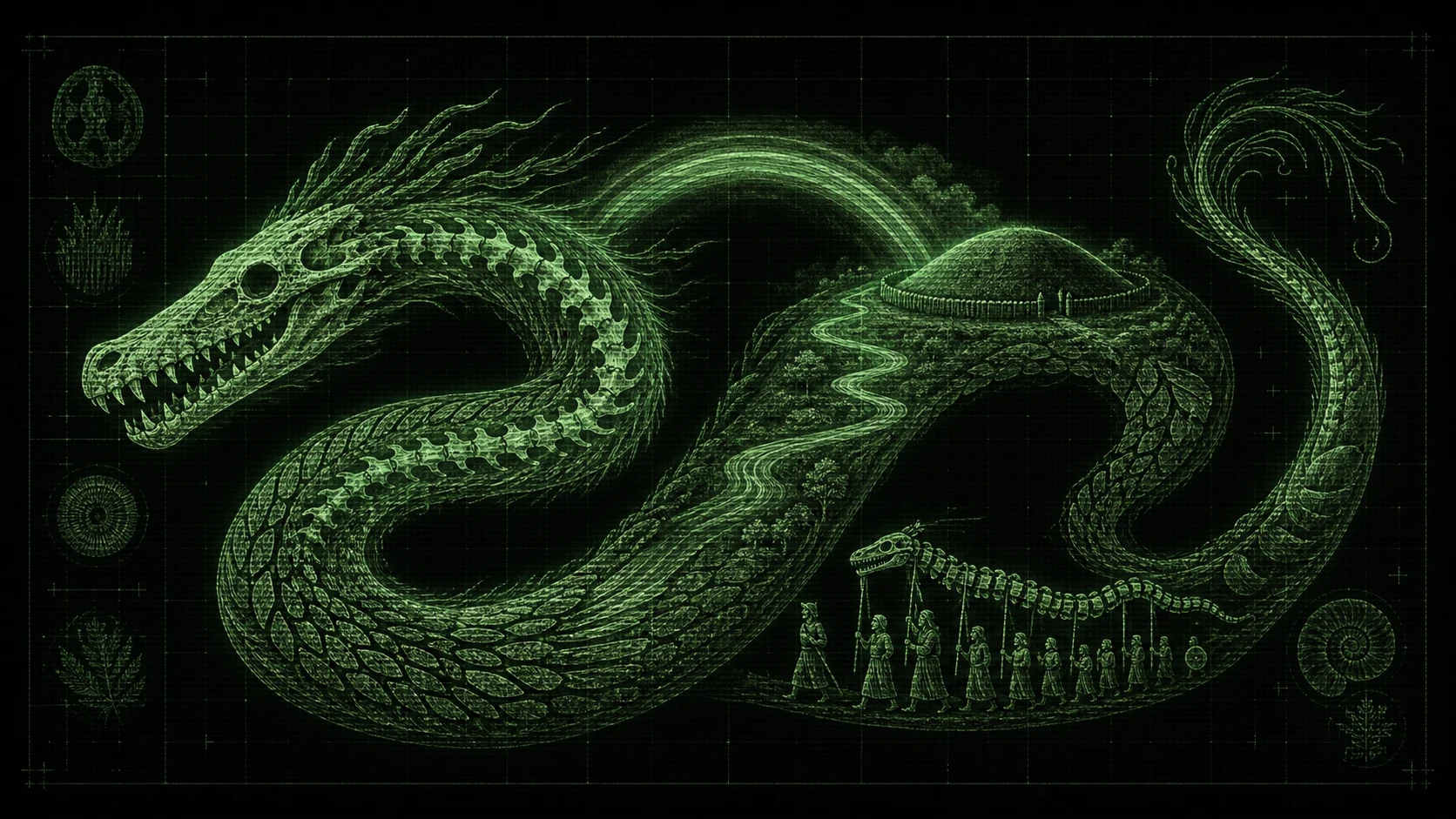
- The best model is layered: perceptual triggers become environmental symbols, ritual forms, and finally standardized literary creatures.
What does the dragon-origins appendix actually say? #
The starting document is a two-page supplement to DorothyBelle Poli and Lisa Stoneman’s 2020 paper, “Drawing New Boundaries: Finding the Origins of Dragons in Carboniferous Plant Fossils”. Its table compresses fifteen writers, from Aristotle to Adrienne Mayor, into one-line “dragon origin hypotheses.” The supplement itself is useful as a map of the debate. It is not a neutral verdict on it.
The compression creates three problems. First, several entries never claimed to explain the origin of dragons. Aristotle and Pliny wrote natural history; T. H. White translated a medieval bestiary. Second, “dragon” joins creatures that their own communities did not treat as one species: Greek drakontes, European worms and wyverns, Chinese lóng, Māori taniwha, and Aboriginal Australian Rainbow Serpents. Third, a mechanism that works in one landscape—a crocodile sighting, a coal-seam fossil, a treasure mound—need not explain a worldwide pattern.
That category problem is not pedantry. Daniel Ogden’s history of the Western dragon follows a long transformation from a mostly serpentine classical drakōn into a composite animal with wings, clawed legs, fiery breath, a cave, and treasure (Ogden 2021). If the target changed through time, its “origin” cannot be a single moment.
Fifteen claims, sorted by what they can actually explain #
| Writer | Date in the appendix | Core proposal | What it best explains | Assessment |
|---|---|---|---|---|
| Aristotle | c. 200 BCE | Large serpents supplied dragon lore | Greek drakōn as snake | Observation, not an origin theory; date is too late |
| Pliny the Elder | c. 70 CE | Giant snakes and reptiles became dragons | Roman and exotic serpent reports | Strong lexical evidence; weak as universal cause |
| Edward Topsell | 1658 | A serpent becomes a dragon by devouring serpents; giant bones confirm it | Early-modern natural history | Records belief, but mixes hearsay, scripture, and zoology |
| Charles Gould | 1886 | Dragon traditions remember real giant reptiles | Cryptozoological survival | Testable in principle; no confirming animal evidence |
| Grafton Elliot Smith | 1919 | A water-and-mother-goddess complex diffused and became the evil dragon | Shared Old World motifs | Historically ambitious, methodologically hyperdiffusionist |
| Elsdon Best | 1924 | Māori saurian water-beings may preserve crocodile memory | Some Pacific monster imagery | Possible local stimulus; reductive account of taniwha |
| Ernest Ingersoll | 1928 | Fear, peril, ignorance, and moral symbolism generated dragons | Why monsters feel dangerous | Useful psychology; too elastic to identify an origin |
| Hilda Ellis Davidson | 1950 | Burial mounds, treasure, and landscape generated mound-dragons | Northern European grave guardians | Excellent local mechanism; not a world theory |
| T. H. White | 1954 | Medieval “dragons” were often what we would call large snakes | Bestiary vocabulary | Essential warning about words, not a causal theory |
| Joseph Fontenrose | 1959 | Dragon combat clusters around springs, rivers, and released waters | Water-serpent combat myths | Explains a recurring function better than a creature’s birth |
| Mary Barnard | 1964 | Snake dances projected an animated collective body into myth | Long, articulated dragon bodies | Clever social mechanism; chronology remains difficult |
| Carl Sagan | 1977 | Predator fear made reptilian monsters cognitively compelling | Snake salience and rapid attention | Supported at the level of attention, not inherited dragon images |
| Simon Best | 1988 | Rare crocodile encounters fed Pacific dragon or taniwha stories | Some saurian descriptions | Biogeographically possible; direct folklore chain unproven |
| Robert Blust | 2000 | The dragon is a transformed Rainbow Serpent | Rain, drought, water, color, flight | Powerful trait cluster; risks circularly defining “dragon” |
| Adrienne Mayor | 2000/2011 | Fossils generated or reinforced monster traditions | Geographically specific monsters | Strong when fossil, place, and ancient testimony coincide |
The date corrections matter. Aristotle died in 322 BCE, so an attribution around 200 BCE cannot describe his own writing date. Ingersoll’s Dragons and Dragon Lore was published in 1928, not 1927, according to the Folger catalog. Mayor’s The First Fossil Hunters first appeared in 2000; 2011 is the revised Princeton edition. A table about origins should itself preserve provenance.
Did ancient writers think dragons were giant snakes? #
1. Aristotle: the drakōn was already an animal word #
Aristotle’s History of Animals, written around the mid-fourth century BCE, mentions the drakōn among observable or reported animals. Eagles fight them; a water-serpent attacks the fish called the glanis; Libyan serpents are said to grow large enough to trouble ships. In the complete public-domain translation, the translated “dragon” behaves overwhelmingly like a formidable snake.
This is valuable evidence, but it points in the opposite direction from the appendix’s wording. Aristotle did not say that people saw snakes and then invented a supernatural dragon. He used an existing serpent term while trying to describe the animal world. His testimony establishes a serpentine lexical base, not a causal event.
2. Pliny the Elder: imperial distance enlarged the serpent #
In Book 8 of Natural History, Pliny reports Indian dragons coiling around elephants and Ethiopian dragons reaching twenty cubits. The relevant elephant-and-dragon chapters combine eyewitness claims, travelers’ tales, and marvel literature. The farther the animal is from Rome, the more elastic its dimensions become.
Pliny therefore shows one real engine of monster-making: distance magnifies zoology. Retold reports of pythons and crocodilians could acquire impossible size and behavior. Yet he, too, starts with draco as a great serpent. This is transmission and exaggeration, not the first birth of the dragon idea.
Did early modern writers believe dragons were real animals? #
3. Edward Topsell: a serpent that eats its way into dragonhood #
Topsell’s History of Serpents was first printed in 1608 and incorporated into the better-known 1658 edition of The History of Four-footed Beasts and Serpents. His dragon chapter preserves a proverb that one serpent must devour another before it becomes a dragon. It also repeats a story from Chios: a forest fire exposed a dragon’s head and bones of “unusual greatnesse.” The entire dragon chapter is available in Michigan’s EEBO transcription.
This is not a clean zoological hypothesis. On adjacent pages, Topsell accepts winged dragons, classical marvels, providence, and the dragon as an image of the Devil. He reveals how the early modern category was assembled: old authorities, ambiguous bones, living snakes, emblems, and theology all certified one another.
4. Charles Gould: extinct reptile, surviving cryptid #
Charles Gould’s Mythical Monsters (1886) argued that globally persistent traditions deserved more than automatic dismissal. His dragon could be an extraordinary serpent, lizard, or saurian that coexisted with early humans and perhaps survived into historical times. Gould did not simply say “Iguanodon.” In his dragon chapter, he keeps the candidate broad enough to include an unknown winged reptile.
Gould deserves credit for asking a falsifiable question: did a large animal leave bodies, tracks, or securely dated human depictions? More than a century of paleontology has produced abundant giant reptiles but no non-avian dinosaur contemporary with humans and no flying, fire-breathing vertebrate. The theory survives only in the modest form that encounters with real large snakes and crocodilians influenced some stories.
5. Grafton Elliot Smith: the dragon diffused with civilization #
Smith’s The Evolution of the Dragon (1919) is much richer than the appendix’s line about mother goddesses becoming the Christian Devil. He begins with a beneficent water-being associated with the Great Mother, fertility, resurrection, and the “elixir of life.” He then traces how Egyptian and Near Eastern divine animals fused into a composite dragon and how the opponent of a god became the evil monster. The full book is online at Project Gutenberg.
The cost of this coherence is Smith’s hyperdiffusionism. He treats Egypt and the ancient Near East as the engine from which dragon beliefs traveled astonishing distances—even across the Pacific to the Americas. Contact certainly moves stories, but similarity alone does not reveal direction, date, or route. Smith is strongest on historical recombination and weakest on a single global family tree.
Can local landscapes manufacture dragons? #
6. Elsdon Best: crocodile memory and the danger of translating taniwha #
In Maori Religion and Mythology (1924), Elsdon Best called some taniwha “water dwelling creatures of saurian form” and wondered whether they preserved knowledge of crocodiles. The National Library of New Zealand record confirms the book and date. The idea is plausible at a very general level: travelers’ reports and inherited memories can long outlive the animal that started them.
But taniwha is not simply the Māori word for a European dragon. Taniwha may be dangerous beings, guardians, ancestors, or signs tied to particular rivers, coasts, caves, and communities; the Te Ara overview makes that range clear. Best’s colonial-era translation extracts “saurian form” from a category whose force is genealogical and local. It may explain one image while distorting the institution around it.
7. Hilda Ellis Davidson: the dragon under the mound #
Davidson’s “The Hill of the Dragon” does not claim that burial mounds created all dragons. It asks why Anglo-Saxon and related northern traditions repeatedly put a dragon in a mound with treasure, then compares literature—including Beowulf—with archaeology. A grave mound already joins the dead, dangerous wealth, ancestral power, and a visibly altered landscape. A guardian monster makes those relationships narratable.
This is one of the strongest proposals in the list because its scale matches its evidence. It explains the mound-and-hoard dragon complex, not Chinese rain dragons or Australian Rainbow Serpents. Local theories become more convincing when they stop claiming the world.
8. T. H. White: sometimes “dragon” is a translator’s decision #
White’s The Book of Beasts (1954) translates a twelfth-century Latin bestiary and observes that many reptiles labeled draco are closer to a huge serpent or python than a modern fantasy dragon. The bibliographic record and preview show what kind of source this is: a translation with commentary, not a comparative origin study.
White contributes a methodological veto. Before explaining why two cultures invented the same animal, one must prove that they did. A serpent, sea monster, demon, crocodile, and storm-being can all become “dragon” in English. Translation can create the universality that a theory then claims to explain.
9. Joseph Fontenrose: the serpent at the spring #
Fontenrose’s Python (1959) begins with Apollo’s killing of Python at Delphi and expands into a comparative study of divine combat against serpentine opponents. Springs, rivers, rain, drought, and the release or control of water recur throughout the dossier. The book includes an appendix on dragons and springs; the University of California Press description shows its geographic breadth.
The supplement reduces this to “dragon as metaphor for spring or river.” Fontenrose’s actual argument concerns a traveling combat-myth complex and its variants, not a simple visual metaphor. Water explains what many dragons do: block, guard, release, flood. It does not by itself explain wings, treasure, fire, or why a river must have a reptilian body. For the larger water-control pattern, see Dragon-Slayers and Flood-Stoppers.
10. Simon Best: could a crocodile reach the Pacific story-world? #
Simon Best’s “Here Be Dragons” (1988) compared Polynesian, East Asian, and New Zealand traditions and collected early European reports of enormous lizard-like animals. He proposed that rare crocodile sightings or memories helped form some dragon and taniwha stories.
Saltwater crocodiles can disperse over long distances at sea, so the biological premise is not absurd; a modern review documents extra-limital Pacific voyages of 2,000 kilometers or more (Spennemann 2021). But possibility is not provenance. To demonstrate origin, one would need a securely dated sighting, an independently recorded local description, and a traceable change in tradition. Best offers an intriguing regional catalyst, not a license to replace Indigenous accounts with a misidentified reptile.
Can fear or ritual create a dragon? #
11. Ernest Ingersoll: fear given a composite body #
The supplement’s 1927 date is likely a pre-publication or bibliographic slip; library records date Dragons and Dragon Lore to 1928. Ingersoll, a naturalist, treated the dragon as a creature engendered between inward fear and outward peril, then elaborated through ignorance, superstition, and moral conflict. Dangerous animals supplied pieces; stories joined them into a body that could represent good or evil.
This works well as a theory of emotional selection: frightening stories are memorable, and a composite monster can absorb the worst features of several predators. It works poorly as a unique origin because almost any monster can be explained after the fact as “fear.” A useful theory must predict which fears become serpentine and which do not.
12. Mary Barnard: perhaps the dance came before the beast #
Mary Barnard’s short essay “A Dragon Hunt”, published in The American Scholar in 1964, rejects extinct reptiles, universal archetypes, and extreme diffusion. Her alternative is social: a line of dancers makes a large, flexible snake-body; the performed creature is then projected into story. Chinese dragon dances and the Tarasque of southern France make the reversal imaginable. Robert Blust’s open-access The Dragon and the Rainbow preserves the fullest accessible summary of Barnard’s proposal.
Barnard explains something most nature theories ignore: why a dragon often looks articulated, as if many forces animate one long body. Her weakness is chronology. Evidence that people danced dragons does not, by itself, show that dancing preceded the relevant dragon image. The hypothesis needs early performance evidence independent of already established myth.
13. Carl Sagan: a monster assembled by primate attention #
In The Dragons of Eden (1977), Sagan speculated that dragon imagery drew power from ancestral encounters with predators. The book is a history of brain and intelligence, not a dedicated folklore monograph; it won the 1978 Pulitzer Prize for General Nonfiction (Pulitzer record). Its enduring insight is that culture does not start with a blank attentional field.
Experiments do find that adults and young children locate snakes faster than flowers, frogs, or caterpillars (LoBue and DeLoache 2008). But the leap from rapid detection to an inherited dragon representation is unsupported. Guns can capture attention as efficiently as snakes (Fox, Griggs, and Mouchlianitis 2007), and a review of laboratory versus ecological evidence warns against equating attention, fear, and genetic preparedness (Coelho et al. 2019). Biology may weight the input; culture still constructs the monster.
14. Robert Blust: the rainbow becomes a serpent, then a dragon #
Blust’s “The Origin of Dragons” (2000) begins from a real explanatory challenge: dragon-like beings across wide regions share water, rain, drought, flight, luminosity, and serpentine form. He argues that the rainbow was interpreted as an enormous serpent controlling water; as animist systems changed, the Rainbow Serpent survived as the dragon. He therefore proposes both repeated rational inference and a very ancient cultural inheritance.
The theory’s great strength is trait economy. A rainbow is arched like a serpent, appears in the sky, accompanies rain, gleams with color, and seems to touch water or land. Its weakness is classification. If every luminous, watery, serpentine being counts as a dragon, the evidence is partly built into the definition. Blust’s recent open-access book develops the case at length, but the Pleistocene chronology still depends more on distribution than on a datable transmission chain. Compare the broader problem of how long myths can survive.
Did fossils inspire dragon legends? #
15. Adrienne Mayor: monsters reconstructed from bones #
Mayor’s The First Fossil Hunters argues that Greeks and Romans encountered large fossil bones, tracks, and skulls and interpreted them through giants, heroes, griffins, and monsters. The revised Princeton edition appeared in 2011, but the original book dates to 2000. Mayor’s best cases align an ancient report, a fossil-bearing landscape, and a locally meaningful creature.
That standard is crucial. A fossil can specify or confirm a monster already imaginable without creating the entire category. “People found dinosaur bones, therefore dragons” is not a theory; it is a resemblance. Geomythology becomes persuasive only when the find, interpretation, place, and textual or oral history can be joined without skipping centuries.
What Poli and Stoneman add: the fossil may look like skin, not bone #
Poli and Stoneman shift attention from animal fossils to Carboniferous plants. Lepidodendron, a tree-sized lycopsid of coal-swamp forests roughly 300 million years ago, left trunks patterned by diamond-shaped leaf scars. Its Stigmaria rooting system can resemble a clawed limb; large branch scars historically called Ulodendron can look eye-like; fern impressions can suggest feathers. Their paper asks whether people in coal-bearing landscapes assembled these fragments into reptilian bodies.
This is a genuinely fresh proposal because a fossilized trunk looks less like a skeleton than like dragon skin. The authors compare fossil geography with dragon lore, discuss British coal regions and the Lambton Worm, and report a 115-person object-recognition exercise in which “scales,” “snake/serpent,” “reptile,” and “dragon” were common responses. The visual trigger is real. Roanoke College’s project account summarizes the Lepidodendron work and its British focus.
The causal chain remains incomplete. Modern participants already know what dragon scales are supposed to look like; a correlation between coal measures and dragon stories could also reflect population density, mining history, or the later naming of fossils through existing lore. The decisive evidence would be a premodern find context, a contemporary description of the fossil as a creature, and a dated local narrative that changes after the encounter. Until then, Lepidodendron is a compelling local enhancer, not the root of dragons everywhere.
Which dragon-origin theory is most convincing? #
No theory wins because the list hides several different questions. What made serpentine forms cognitively available? Why do monsters gather at rivers or graves? How did one image travel? Why did medieval artists add wings and legs? Those questions require different evidence.
Dragons are not distorted memories of one lost animal. They are cultural composites repeatedly built from snake-shaped attention, dangerous landscapes, ambiguous remains, public performance, and inherited stories.
A layered model preserves what is strongest in the competing accounts:
| Layer | Inputs | What it explains | Best-matching proposals |
|---|---|---|---|
| Perceptual substrate | Snakes, crocodiles, sinuous motion, rapid threat detection | Why serpent form is unusually available and memorable | Aristotle, Pliny, Gould, Sagan |
| Local material trigger | Fossils, bones, coal seams, mounds, rivers, caves | Why a creature acquires specific anatomy, habitat, or treasure | Davidson, Simon Best, Mayor, Poli–Stoneman |
| Environmental model | Rainbows, storms, floods, springs, drought | Why dragons govern water and weather | Fontenrose, Blust, Smith |
| Social embodiment | Dances, processions, masks, collective movement | Why a dragon is long, articulated, and publicly present | Barnard |
| Narrative transmission | Trade, conquest, translation, scripture, bestiaries | Why motifs recombine and categories spread | Topsell, Smith, White |
| Moral standardization | Saint versus dragon, god versus chaos, Devil imagery | Why an ambivalent water-being becomes an enemy of order | Smith, Ingersoll, medieval Christian tradition |
This model also predicts variation. Crocodile country should produce different anatomical details from coal country. Rain dragons should retain different moral valences from Christianized hoard guardians. Trade routes should spread packages of traits, while similar environments should produce only loose convergence. Those are testable expectations; “dragons come from fear” is not.
The result fits the broader history of serpents as symbols of consciousness and danger without reducing every serpent to one code. Human beings did not discover one dragon and remember it badly. They kept discovering dragon-shaped possibilities—in animals, weather, rock, ritual, and story—and made them remember one another.
Sources #
- Poli, DorothyBelle, and Lisa Stoneman. “Drawing New Boundaries: Finding the Origins of Dragons in Carboniferous Plant Fossils.” Leonardo 53.1 (2020): 50–57. Supplement: “Dragon Origin Hypotheses.”
- Aristotle. History of Animals. Trans. D’Arcy Wentworth Thompson.
- Pliny the Elder. Natural History, Book 8.
- Topsell, Edward. The History of Four-footed Beasts and Serpents. 1658 ed.
- Gould, Charles. Mythical Monsters. W. H. Allen, 1886.
- Smith, Grafton Elliot. The Evolution of the Dragon. Longmans, Green, 1919.
- Best, Elsdon. Maori Religion and Mythology. Dominion Museum Bulletin 10, 1924.
- Ingersoll, Ernest. Dragons and Dragon Lore. Payson & Clarke, 1928.
- Davidson, Hilda R. Ellis. “The Hill of the Dragon: Anglo-Saxon Burial Mounds in Literature and Archaeology.” Folklore 61.4 (1950): 169–185.
- White, T. H., trans. The Book of Beasts. Putnam, 1954.
- Fontenrose, Joseph. Python: A Study of Delphic Myth and Its Origins. University of California Press, 1959.
- Barnard, Mary. “A Dragon Hunt.” The American Scholar 33.3 (1964): 422–427.
- Sagan, Carl. The Dragons of Eden. Random House, 1977.
- Best, Simon. “Here Be Dragons.” Journal of the Polynesian Society 97.3 (1988): 239–259.
- Blust, Robert. “The Origin of Dragons.” Anthropos 95.2 (2000): 519–536; expanded in The Dragon and the Rainbow. Brill, 2025.
- Mayor, Adrienne. The First Fossil Hunters: Dinosaurs, Mammoths, and Myth in Greek and Roman Times. Princeton University Press, rev. ed., 2011.
- Ogden, Daniel. The Dragon in the West: From Ancient Myth to Modern Legend. Oxford University Press, 2021.
- LoBue, Vanessa, and Judy S. DeLoache. “Detecting the Snake in the Grass.” Psychological Science 19.3 (2008): 284–289.
- Fox, Elaine, Laura Griggs, and Elias Mouchlianitis. “The Detection of Fear-Relevant Stimuli: Are Guns Noticed as Quickly as Snakes?” Emotion 7.4 (2007): 691–696.
- Coelho, Carlos M., et al. “Are Humans Prepared to Detect, Fear, and Avoid Snakes? The Mismatch Between Laboratory and Ecological Evidence.” Frontiers in Psychology 10 (2019): 2094.
- Spennemann, Dirk H. R. “Cruising the Currents: Observations of Extra-Limital Saltwater Crocodiles in the Pacific Region.” Pacific Science 74.3 (2021): 211–227.