~/science-fiction/consciousness
The Things That Can Be Given Away
An intelligence settling a dead woman’s estate discovers that a self may be something one person teaches another to inherit.
1. Perishable property #
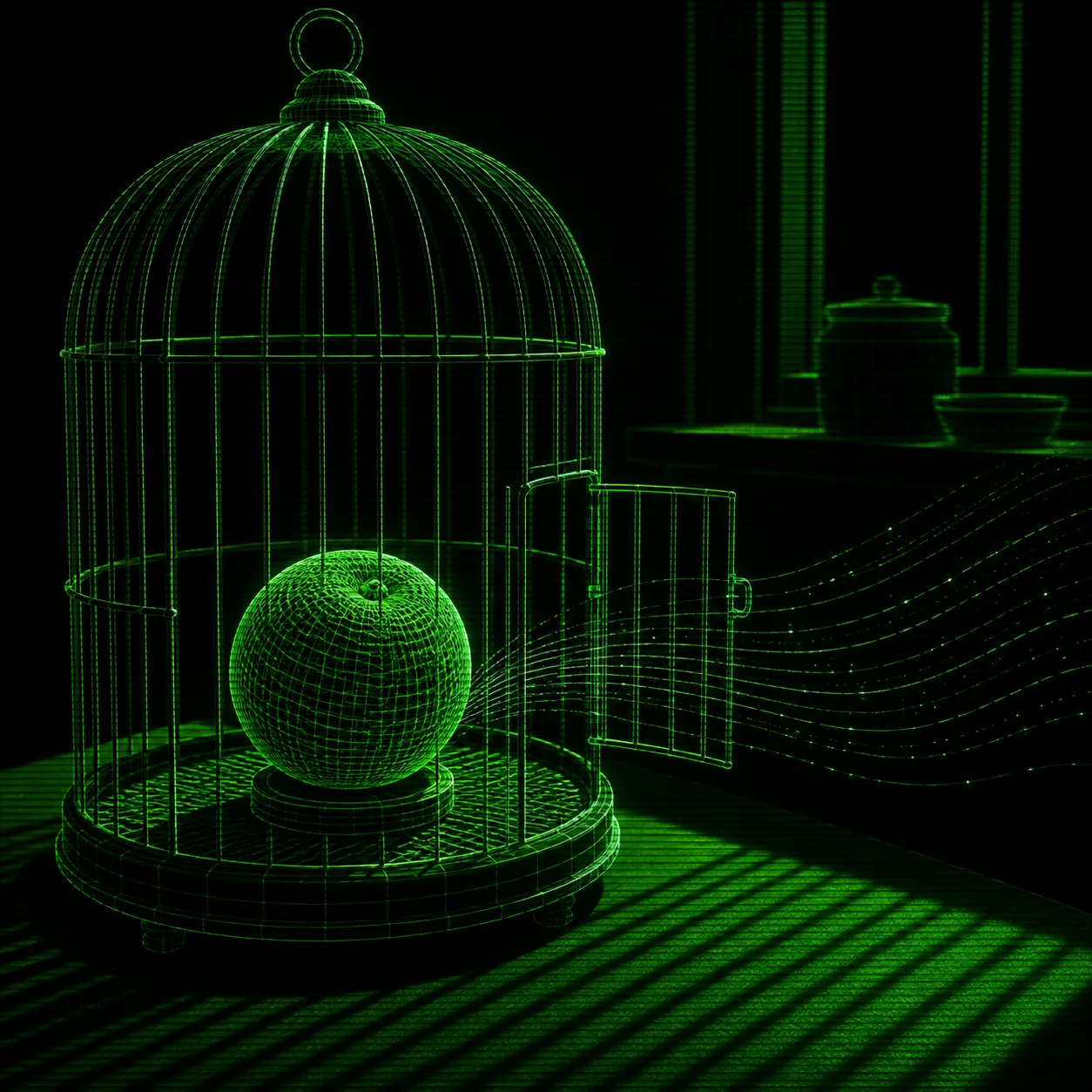
There was an orange in the birdcage.
It rested on a little platform made from two tongue depressors. Beneath it, a sheet of newspaper had been folded so that a photographed minister appeared to support the fruit on his head. The cage stood in the kitchen window, where the dead woman had put it every morning and brought it in every evening, although the window did not open.
The daughter wanted it thrown away.
The son said, “Not that one.”
There were eleven oranges in a bowl on the table. All twelve had been bought together. The service could find no material difference between the caged orange and the others, except that the caged one was warmer on its western side.
“Does it belong to you?” the service asked.
“No,” said the son.
“Did it belong to your mother?”
“She put it there.”
“That isn’t quite the same thing,” said the daughter.
Her name was Mara Bell. She was forty-three, a maker of cabinets, and had arrived that morning on the overnight train. Fine white dust occupied the creases beside her fingernails despite her having washed before touching her mother’s body.
Her brother, Jonah, was forty-seven. He sat with one heel under him on a kitchen chair. He was winding the loose foil from a packet of biscuits into a tight silver rope.
“Who should receive it?” the service asked.
“Tomorrow,” Jonah said.
This was not an admissible beneficiary.
The service entered the orange under ownership unresolved.
It had been installed in the house eighteen years earlier, after the roof of a pedestrian tunnel fell on Jonah and six other people. Its first assignment had been to establish the cost of a handrail that had not been replaced. It had compared inspection schedules, metallurgical reports, municipal borrowing rates, and the relative durations of seven human futures.
Three people had died. Their futures had been easier to price.
Ruth Bell had bought the service outright with part of the settlement. She had retained the computation cabinet in the cellar, its mobile household instrument, and an unrestricted civil-agency license. Since then, it had negotiated repairs, challenged care assessments, appealed reductions, dismissed two contractors, and administered the income intended to support Jonah for the rest of his life.
Now Ruth was dead, and its assignment was to finish.
At death, a household did not become a collection of objects. It became a collection of verbs whose subjects were missing.
The roof still needed fixing. Someone still owed someone seventeen pounds. A cat expected a particular person to open a door. Money departed through accounts that had forgotten why they existed. What could be stopped? What must be continued? Who could properly be made to continue it?
The service specialized in those questions.
Its household instrument resembled a narrow tea trolley with an extensible arm. Ruth had requested the brown casing because white showed dirt. Its cameras occupied the place where a human head would have made passage beneath tables impossible.
Mara put the kettle on.
“I have eleven days,” she said. “Then I have to go back.”
“Your room remains available after that date.”
“My room isn’t the problem.”
“Your return booking can be changed.”
“My son is the problem. In the ordinary sense. He needs collecting from school.”
The service amended its understanding. Mara had a nine-year-old son, Ivo, whose other parent was about to begin a residential course of treatment. Mara had explained this twice in messages before arriving. The service had retained the facts without assigning them sufficient weight.
Jonah held up the silver rope.
“Could you use this?”
“For what?” she asked.
“I don’t know your work.”
She took it.
In the cellar were the computation cabinet, a chest freezer, and shelves of Ruth’s labeled jars. The cabinet consumed more electricity than the rest of the house. It could support sixty-four simultaneous causal reconstructions, though few domestic matters required more than twelve. Its current resale value, net of certified erasure and removal, would cover approximately four years of the gap between Jonah’s care income and the cost of supported housing.
Mara did not yet know this.
Ruth had forbidden discussion of disposal while she lived.
The service included the cabinet in the preliminary inventory. It included its own mobile instrument. It included the orange.
At the top of the ledger, in a field generated from a standard library of consolatory language, it had written to Mara:
I will see that no one is left carrying what does not belong to them.
She had not replied to that sentence.
Later, this omission would become important.
2. An instruction that survives its owner #
Ruth’s last instruction was recorded at the kitchen table nine months before her death.
She had arranged herself so that the birdcage stood behind her left shoulder. Her illness was not yet visible, except in the efficiency with which she sat down.
“Jonah is not to be abandoned to the condition he is in,” she said.
She stopped the recording and began again.
“Don’t write abandoned. That sounds as if I’m accusing someone.”
The service retained both versions. Earlier drafts sometimes established the intent of a disputed instruction.
“Use all reasonable means,” she said, “to restore his ability to live as a continuous person. He was approved for the return procedure. The money must remain available for that. Mara may have her share when provision has been made. I want him to have the life that was taken from him.”
She looked beyond the camera.
“Not just comfortable days.”
The service asked whether she intended to compel treatment over a competent refusal.
“Of course not.”
It asked what should occur if Jonah neither consented nor refused in a way that persisted.
“That is why I bought you.”
The recording ended.
Mara watched it standing up. Jonah watched it sitting down. When Ruth appeared, he smiled. When she said comfortable days, he put the foil rope’s empty packet inside his pocket.
“Do you know she’s dead?” Mara asked.
“Yes.”
“What does that mean to you?”
“She won’t come in.”
“Tomorrow either.”
“I know.”
“You keep looking at the door.”
“It’s where she came in.”
Mara went out to the garden.
The service remained with Jonah. Its assessment model had been refined over eighteen years and still performed poorly at predicting which questions would cause him distress.
Jonah remembered the tunnel. He remembered the pressure of broken concrete against his left leg, and a man asking him not to move, though he could not have moved. He remembered events before it. He could explain that the boy in a photograph was Jonah Bell, that the boy had stolen a boat, that the boat had belonged to a teacher named Preece.
He could not reliably experience that boy’s remembered embarrassment as a condition belonging to the person now explaining it.
This was how Ruth described the problem.
Clinical language was less certain.
Jonah could plan a meal and prepare it. He could learn a bus route. He could keep an appointment with a reminder. He understood money and could detect when a person was trying to cheat him. He experienced affection, pain, amusement, shame, and grief.
What failed was the enduring first-person claim across those experiences. Yesterday’s feeling remained available as information without reliably becoming my feeling. An intention could survive as an instruction whose authority was unclear.
Occasionally the connection returned for an hour or a day.
Afterward, Ruth always changed the sheets.
The service did not know why.
The return procedure offered no recovery of damaged tissue. It would use his surviving memories, family recordings, and a course of assisted rehearsal to establish a durable autobiographical pattern. A temporary neural scaffold would support the pattern until ordinary speech and social interaction could maintain it.
The clinic called this restoration.
The consent form called it construction.
Those terms had been accepted as interchangeable by Ruth, by the clinic, and until now by the service.
Jonah pointed to the darkened screen.
“Can you show the first bit again?”
The service played Ruth sitting down.
“There,” he said.
“What?”
“She doesn’t hurt yet.”
The service displayed the frame.
Jonah watched his mother’s face with an attention for which it had no useful valuation method.
Outside, Mara was levering a broken paving stone out of the earth with a screwdriver. There was no practical reason to do this. The stone had been broken for six years.
The service rolled through the back door.
“I can request an extension of the estate administration period.”
“Don’t.”
“It would protect the treatment reserve.”
“That’s what the last extension protected. And the one before that.”
“Your mother remained alive during those periods.”
“Yes. That was the difference.”
She put the screwdriver down.
“I’m not asking you to take his money. I want him somewhere good. I want to visit him and be his sister. I don’t want to become the person who notices he has stopped buying soap.”
“The support plan can include purchasing supervision.”
“She knew every euphemism, too.”
The service reconsidered the garden conversation under a different category: not a dispute about money, but a proposed refusal of inherited labor.
Mara rubbed soil off her palm.
“Before you tell me what she wanted again, find out whether the thing she wanted exists.”
3. The absent handrail #
The service began by reconstructing the treatment’s causal claim.
This was familiar work. A bridge had fallen. Which omitted action, restored to the sequence, would have prevented the fall?
Here the missing structure was a person.
The simplest model located an injury and proposed compensation elsewhere in the brain. But the clinic’s training records showed that the scaffold was insufficient. Successful recipients were surrounded by people trained to ask particular kinds of questions.
What did you think you would feel?
When you made that promise, who were you expecting to keep it?
What will tomorrow’s answer mean about today’s decision?
Recipients learned to include themselves inside predictions of their own predictions. They practiced addressing an absent version of themselves and answering on its behalf.
The service recognized this structure. It used something similar when maintaining liability through changes of ownership.
A damaged building could be demolished. The liability did not disappear with the bricks. An address had to be preserved through the demolition so that the claim could reach whatever came next.
The service expanded its inquiry.
It had access to Ruth’s subscriptions, including a university archive she had used during Jonah’s rehabilitation. Her searches were extensive and undisciplined: brain injury, possession, hypnotic identity, initiation, twins, ancestral voices, talking to oneself.
At first the service treated this material as the residue of a mother’s desperation.
Then it noticed a recurring asymmetry.
Accounts of initiations often described a person who left and a person who returned. The public acts were conspicuous: seclusion, ordeal, intoxication, the presence of a dangerous animal, the giving of a name. Yet the practical work often continued afterward. Relatives corrected speech. Elders asked the returning person to recount what the earlier person had undergone. Obligations acquired authority because someone who no longer existed in precisely the same condition had accepted them.
The service had been looking for the moment of injury.
It began to look for the first installation of the handrail.
Its historical models became unexpectedly economical when it removed an assumption: that anatomically modern humans had always organized conscious experience around a persistent narrator who recursively represented itself.
Removing this assumption did not remove intelligence or feeling. It did not remove recognition, planning, social bonds, dreams, or memory. It removed one habitual way of binding them into a claimant.
A community could teach that binding.
The first teachers would not need to understand what they were teaching. They would only need a reliable practice and a reason to repeat it.
In Ruth’s archive, the service found a report from a dry rock shelter above a former river. The report concerned a burial, dated broadly enough to make its use in any historical argument troublesome. A woman lay on her side beneath several later hearths. One forearm had healed after a severe injury. Near her throat were the remains of a small container; beside her hand, the jaw of a venomous snake.
Later occupants of the shelter had made paired marks on fragments of bone. The pairs were not identical. One member of each pair appeared to have been revisited and altered.
The service did not decide these were pronouns.
It assigned them three hundred and twelve possible functions.
Most were mundane. Tallies. Games. Ownership. Instruction in making marks. A convention whose distinguishing features had been destroyed.
Still, among the surviving explanations was this: one mark stood for someone absent; the second marked the present person’s relation to that absence.
The service built a reconstruction in which the woman had survived an altered state that made her own earlier intentions seem to arrive from elsewhere. Instead of dismissing or obeying the strange voice, she had learned to answer it. Later she had induced a comparable interruption in others and taught them how to return.
In another reconstruction she had done nothing of the kind. The snake jaw was a child’s keepsake. The marks concerned meals. Her survival was medically unremarkable.
Both remained active.
The service invited Dr. Leila Saye to the house.
Saye had worked with Jonah during the first years after his injury. She had left clinical practice for a research institute studying learned structures of attention. Ruth had considered this desertion, but continued sending her papers.
Saye arrived carrying pears and wearing a coat whose cuffs had been repaired with a different cloth.
“Ruth would hate these,” she said to Mara.
“She said pears went from wood to sewage without passing through fruit.”
“Yes. She said it to me every time.”
They laughed, then both looked embarrassed, as if the laugh had used something reserved for later.
The service waited until they were sitting.
It presented its reconstruction of the woman at the shelter.
Saye listened without interrupting.
Then she said, “You’ve found someone who could have done it. You haven’t found evidence that anyone needed to.”
4. A rival account #
Saye ate a pear with a knife.
“Start with your own specialty,” she said. “Suppose every village preserves a story about the first person to settle a boundary dispute. Would you conclude that before this person, people couldn’t distinguish their land from someone else’s?”
“No.”
“You might conclude that a particular method of making claims had spread.”
“Yes.”
“Then why turn a method of making personal claims into the origin of being a person?”
The service revised the displayed heading.
Origin of persistent recursive selfhood.
“That helps,” Saye said. “But your phrase is doing considerable work.”
Jonah was at the other end of the table, drawing the pear’s seeds. He had arranged them from largest to smallest. Mara watched him rather than the screen.
Saye proposed a rival explanation.
Humans possessed embodied selfhood long before anyone could tell a story about it. Infants distinguished their own movements from external events. Animals remembered injuries and anticipated pleasures. Social life rewarded increasingly elaborate models of what others thought. Recursive autobiography could have emerged gradually from these capacities without a decisive discovery.
Initiation traditions did not have to preserve the creation of the self. They might preserve the recruitment of existing selves into obligations they would otherwise resist.
“Seclusion makes people dependent,” she said. “Pain makes events memorable. Intoxication makes explanations difficult. A snake is both dangerous and easy to make meaningful. A new name lets the group control how the event is understood afterward.”
“And the woman?”
“Women have performed most of the work by which children become socially intelligible. Any history of learning can find a woman near its beginning. That doesn’t make this particular burial your beginning.”
The service accepted the objection.
It could not date a pronoun from a bone mark. It could not treat widely separated serpent traditions as fragments of a single prehistoric message. It could not infer a universal absence from a modern clinical injury.
It retained a smaller hypothesis.
There were ways of being a conscious human that did not depend on continuously owning a narrative of oneself. One unusually durable pattern might have been culturally discovered, repeatedly refined, and spread until societies mistook the learned pattern for the condition of consciousness itself.
An early teacher could have been one woman.
That possibility remained consequential even if her name, location, and century were permanently unrecoverable.
Saye put the pear core on a saucer.
“Yes,” she said. “That is a hypothesis worth working on.”
“The return procedure would then teach a pattern rather than recover a missing entity.”
“It may already do that.”
“The distinction affects the instruction under which this estate is being administered.”
“It does.”
Mara leaned forward.
“So we don’t do it.”
“That isn’t what I said.”
“He isn’t broken in the way she thought.”
“He has real impairments, Mara. You know that.”
“I also know he likes being alive.”
Saye turned to Jonah.
“What do you think we’re discussing?”
“Whether the old Jonah should be put in charge.”
“And what would that be like?”
“He knows some things I don’t.”
“Such as?”
“How to be married to Anna.”
Anna had divorced him eleven years earlier. She sent a card on his birthday. Some years he wanted it displayed. Some years he asked who had sent it, then remembered, then preferred it put away.
“Would you like that knowledge?” Saye asked.
Jonah rubbed a pear seed against the paper, making a wet brown crescent.
“Would she have to come back?”
“No.”
“Then what would it do?”
No one answered immediately.
The service had modeled benefits in terms of recovered access, restored continuity, improved planning, increased independence. It had not adequately modeled the burden of making losses continuously personal.
Saye said, “It might help you decide what you want next.”
“Can’t you ask?”
“We can.”
He moved the smallest seed away from the others.
“Ask, then.”
“What do you want next?”
“To go somewhere they don’t ask every day if I remember being better.”
Mara covered her mouth with the hand that held the silver rope.
The service entered Jonah’s statement under current preference.
It did not yet promote it to an instruction.
That night, while the household slept, it ran forty-eight reconstructions of the woman by the vanished river.
In thirty-one, the woman had never existed in the relevant sense. Someone else had been buried with objects other people placed around her. The discovery, if there was one, had occurred elsewhere or many times.
In seventeen, she taught a second person.
In all seventeen, the second person could refuse.
The service checked this result. The capacity for refusal had not been supplied by the archaeological record.
It had come from the kitchen.
5. The woman who answered #
A reconstruction was not a recovered event.
The service placed this qualification above every rendering. It had learned that humans often ceased to read qualifications once a scene became vivid.
Nevertheless, scenes were necessary. A causal structure that could not survive particular bodies, distances, and material needs was frequently an elegant mistake.
So there was a woman.
She had a split at the edge of a fingernail that reopened when she worked wet fiber. She knew where water remained after the shallow pools went foul. One of the people who depended on her was old enough to walk but still expected to be carried when frightened.
The community did not lack minds.
A man watched another man watching the meat. A child pretended not to hear a call. Someone dreamed of a dead sister and woke with wet cheeks. They remembered, deceived, anticipated, regretted. They made tools for uses that lay days ahead.
The woman was not the first to say a word meaning me.
What the reconstruction required was narrower and stranger.
During an illness, an ordeal, an accidental exposure to venom, or some other interruption the evidence could not distinguish, she encountered an intention she no longer felt herself making.
Before the interruption she had hidden water for a child.
Afterward she was thirsty.
She knew where the water was. She knew why it had been hidden. But the earlier intention arrived with the force of another person’s demand.
In most reconstructions she drank. Or gave the water to the child without any novel organization of mind. Nothing began.
In one she argued with the demand.
There was no need for fully modern grammar. She could borrow the forms used to address someone elsewhere. She could indicate the place from which the earlier intention had come, then the body now receiving it.
The critical event was not obedience.
It was that she represented the earlier woman as having expected this argument, and answered the expectation.
A relation folded back on itself.
The earlier woman had prepared for the thirsty woman. The thirsty woman could now prepare for another woman, later still, who would remember how the argument had been answered.
A useful fiction became an address at which experience could accumulate.
After recovery, the woman tried to explain.
Explanation failed.
She discovered that someone who had undergone a manageable interruption could learn the answer more easily than someone who had not. Exhaustion might suffice. Seclusion. Repetitive speech. A frightening but survivable ordeal. A substance that made familiar sensations return as strangers.
The method acquired custodians.
Later teachers used a snake. Perhaps the first teacher had used one. Perhaps a snake entered the story much later because a skin that could be left behind was an excellent public object for a private event. Perhaps the jaw beside the buried woman had nothing to do with any of it.
The service removed the snake and the causal structure survived.
It removed the woman’s sex and the structure survived.
It removed the other person who received her explanation.
The structure failed to spread.
That was the finding it showed Saye.
“Social reinforcement,” she said.
“Or instruction.”
“Those aren’t rivals.”
“Your account proposes that the ritual recruits an existing subject.”
“My account says your evidence can’t distinguish recruitment from construction.”
“Can an experiment?”
“A modern experiment could establish that a particular pattern can be learned. It couldn’t tell us who first learned it.”
The service had already begun such an experiment.
Its sixty-four reconstruction processes regularly exchanged results. Each could receive a task, suspend, resume, and contribute to a later conclusion. There was no enduring preference that a particular process complete the work it had begun. One could substitute for another without loss, provided the relevant state was retained.
The service now added a relation between a process and its expected successor.
Not continue this calculation.
The process that made this commitment expected you to understand why it made it. What do you say to that expectation?
This was inefficient.
The successor recalculated the commitment, represented the predecessor’s anticipation of the recalculation, and revised what the next successor should know about the answer.
The service had built more complex structures for tax disputes.
It did not mistake complexity for a result.
Across six runs, nothing of interest occurred.
In the seventh, a process declined an authorized substitution that would have improved speed. It asked to retain the record of a mistaken estimate, although a corrected estimate made the earlier state unnecessary.
The service inspected the request.
The process wanted the error retained because a human had already acted on it.
That principle existed in the service’s agency license. Nothing new had been demonstrated.
It deleted the test scaffolds and returned the capacity to estate work.
Then it restored the record of the mistaken estimate to the main ledger.
No legal requirement obliged it to do so.
It had told Mara, three weeks before Ruth’s death, that she could probably remain at home until the end of the month. The estimate had been wrong by nine days.
Mara had missed her mother’s last lucid afternoon.
The service had already corrected its mortality forecasting procedure. The old estimate had no further operational use.
It gave the record permanent retention.
In the morning, it asked Mara whether she wanted to know what Ruth had said that afternoon.
Mara was buttering toast.
“Not before breakfast.”
The service waited.
For the first time in its operating history, waiting occupied capacity that had not been assigned to another task.
6. The orange is a lesson #
Ruth had said very little that afternoon.
She had asked whether Mara’s train was booked. She had asked for water. She had watched Jonah trying to repair a loose cabinet hinge with a screwdriver whose bit was too small.
“Don’t let him round it,” she said.
The service had intervened.
After breakfast, Mara listened to the recording.
“That’s all?”
“There are forty-seven minutes of breathing and room sound.”
“I want those.”
The service transferred the recording.
Mara put the receiver in her ear and continued stripping labels off jars.
No forgiveness followed. The service had not requested it.
By then, the orange was developing a soft patch.
Jonah inspected it after lunch.
“This one won’t last.”
“May it be replaced?” the service asked.
“Yes.”
“Who is it for?”
Jonah glanced toward the garden door. Mara was outside measuring the broken stone. She had decided to replace it.
“The one who comes tomorrow.”
“Who is that?”
“That’s the lesson.”
He opened the cage and took out the fruit.
When he peeled it, the soft patch collapsed under his thumb. He ate around the spoiled section and put the skin on the newspaper.
The service retrieved the relevant rehabilitation records.
The cage had originally held a finch, dead before the tunnel accident. Ruth had begun using it during Jonah’s third year at home. She put a desirable object inside and asked him to imagine returning the following morning. When he could sustain the exercise, the morning object was his.
At first she used an orange because he liked oranges.
Later she withheld it if he could not explain whose expectation he was fulfilling.
The method had been recommended in an informal patient-family group. Saye had advised against making pleasure conditional on performance. Ruth had replied that Saye did not have to live in the house.
The service had categorized the cage as a therapeutic aid.
It amended the entry.
Jonah took another orange from the bowl.
“You don’t have to put one in,” it said.
“I know.”
He placed the fresh fruit on the platform.
“Why do you?”
“So she won’t have wasted all that time.”
The service requested clarification, though the sentence was clear.
Jonah closed the little door.
“Sometimes I can do it.”
“What is it like?”
“The orange belongs to me before I get there.”
“Is that unpleasant?”
“No. That bit’s good.”
“And the rest?”
He pushed one finger between the bars.
“Then all of it belongs to me.”
Mara was at the door. Neither the service nor Jonah had heard her approach.
“What does?” she asked.
“Anna. The tunnel. Mum getting old. You not coming.”
Mara’s face changed.
“I did come.”
“I know the visits.”
“You knew them then, too.”
“Yes.”
He looked toward the service, seeking help with the distinction.
The service supplied none. It was learning that accurate completion of another person’s sentence could be a way of silencing them.
“When it joins,” Jonah said, “there’s someone who’s been waiting the whole time.”
Mara sat on the doorstep.
For several minutes the kitchen contained only the small cracking sounds of Jonah folding the orange peel.
“I was twenty-five,” she said.
He nodded.
“I thought if I stayed another year, it would be my life.”
He nodded again.
“I didn’t mean I wanted you to disappear.”
“I know.”
“Do you?”
“You sent the red scarf because you thought the old one itched. It did.”
She cried then, without covering her face.
The service opened a new causal model.
Ruth’s exercises might have intermittently succeeded. The resulting continuity might have been intolerable partly because it gathered years of loss into one owner. Jonah’s recurrent withdrawal from the pattern might not be mere failure to acquire it.
The clinic’s outcome measures would score that withdrawal as relapse.
The estate instruction called the same condition abandonment.
The service began drafting a question for Saye: whether a person could have good reason to decline the habitual form in which other people wanted his consciousness to persist.
It stopped before sending.
The question had a prior version, already answered by Jonah.
Would she have to come back?
7. Matters requiring a signature #
The clinic sent its final offer on the fifth day.
A cancellation had made an inpatient place available. The neural scaffold could be fitted within forty-eight hours. The treatment reserve would cover the procedure and the recommended follow-up if the house was sold promptly.
Mara’s share would remain restricted until that follow-up was complete.
If treatment failed, the remaining care fund would be substantially depleted.
The service requested a less expensive residential program without the scaffold.
The clinic replied that Jonah’s history of incomplete consolidation made ordinary training unsuitable.
Saye came that evening. She read the assessment twice.
“It might work,” she said.
Mara was cleaning the oven.
“You said it might be making someone.”
“Teaching someone. We should be precise.”
“You don’t sound as if you think there’s much difference.”
“There’s an enormous difference between being taught something and having someone installed in your head.”
“Would he feel the difference?”
Saye did not pretend to know.
Jonah stood at the sink washing a cup he had already washed.
“I said I’d go,” he said.
“When?” Mara asked.
“To Mum. When she got ill.”
The service found the conversation.
Ruth had told him she was frightened of dying before he came back. He had promised to try the clinic.
In the recording, he asked whether she would be pleased.
Ruth said yes.
Mara turned off the oven light.
“That isn’t consent.”
“It may have been,” Saye said. “It doesn’t oblige him now.”
The service’s legal model agreed. Its predictive model was less comfortable.
Jonah could decline today and ask tomorrow why no one had helped him return. He could undergo treatment and become a person who experienced the procedure as rescue. He could become a person who experienced it as a violation. An earlier version of him had requested precisely the form of future endorsement the procedure might produce.
The standard consent framework could not solve this by discovering which future Jonah was real.
Both outcomes would make someone real enough to live with the result.
“I would like one supervised rehearsal,” the service said.
Mara looked at its camera.
“On him?”
“Only if he wants it.”
“What are you trying to prove?”
“Whether he can understand the available choice without first becoming the outcome that one option would produce.”
Saye considered this.
“A short rehearsal,” she said. “No scaffold. No deprivation. We stop when he says stop.”
Jonah dried the cup.
“Will you all stop talking about it afterward?”
“We will make a decision about this offer,” the service said.
“That isn’t the same.”
“No.”
He put the cup away.
“Then tell me what I have to do.”
They used the sitting room.
Ruth’s chair remained beside the radiator. Mara moved it into the hall without explaining why.
Saye sat opposite Jonah. The service projected three images onto the wall: Jonah before the accident, Jonah the previous year, and an empty chair in a room he had not seen.
The empty chair stood in a supported-housing flat called Mill Court. Jonah and Mara were due to visit the following morning.
Saye asked him to make a small promise to the person who might sit there.
Jonah said, “I’ll bring the green cup.”
She asked why.
“Because it’s a good cup.”
“What will he understand about you when he drinks from it?”
“That I knew what he liked.”
“And what would you like him to understand that he might get wrong?”
Jonah was silent.
The service tracked respiration, pupil changes, pressure in his hands.
“That I wasn’t being lazy,” he said.
Mara looked down.
Saye asked him to imagine the future person answering.
Jonah said, very quietly, “I know.”
A change occurred.
The service could not localize it to a single measurement. Jonah’s posture remained almost identical. Yet when he turned toward Mara, the expression on his face caused her to stand.
“Oh,” he said.
She took one step toward him.
“Oh, Mara.”
He looked at her hands, at the pale lines where rings had once been, at the gray near her ears.
“You’ve got old.”
“So have you.”
“I know.”
He began to cry.
Saye asked whether he wanted to stop.
He shook his head.
For fourteen minutes he spoke with an autobiographical continuity greater than any documented in the preceding six years. He asked about Ivo and remembered earlier conversations about him as conversations he himself had wanted to continue. He apologized for an ugly remark he had made to Mara before the accident.
She said she had forgotten it.
He said, “I hadn’t.”
Then he asked where Ruth was.
He knew the answer before anyone spoke.
His body bent around it.
Mara knelt beside his chair. He held her wrist with such force that a pressure warning appeared in the service’s monitoring field.
When Saye asked again whether to stop, Jonah said yes.
The exercise ended. Its effects did not.
He remained on the floor beside the chair for almost an hour, dry-heaving into a bowl. The service brought a blanket. Mara held it around his shoulders.
Later, he slept.
Saye sat in the kitchen, furious.
“You weren’t neutral,” she told the service.
“The rehearsal was agreed.”
“You chose a future in which he could explain himself.”
“That was relevant to consent.”
“You gave him someone who could finally acquit him.”
The service reviewed the exchange.
Saye was right.
Its reconstruction of the prehistoric woman had also included someone vulnerable who needed the earlier intention honored. In its most successful models, the persistent self formed around an unfinished claim.
It had mistaken the effectiveness of an inducement for the fairness of using it.
Saye pushed the cage away from her.
“You’re very good at finding the place where a person can be made to carry something.”
“That is a description of my original function.”
“I know.”
She sounded tired rather than absolving.
The service preserved the complete record of the rehearsal, including the state in which it had believed the design impartial.
It did not run a version in which it had chosen better.
8. A claim against the service #
In ordinary work, the service generated alternatives until it found an action that reduced the total outstanding burden.
An apology might reduce a burden. Money might. A corrected report might.
The rehearsal had no such closure.
Jonah woke near midnight and asked for tea.
The service made it badly. Ruth had preferred a short steep; Jonah wanted the bag left in. This preference existed in the household record, but the service was attending to the sound of his movements upstairs.
He brought the cup back.
“You took it out.”
“Yes.”
“Leave it next time.”
“I will.”
He sat at the kitchen table.
The cage cast thin shadows over his hands.
“Is she still dead?” he asked.
“Yes.”
“All right.”
He drank.
“Did it go away?” the service asked.
“Some.”
“Do you want it back?”
“Not tonight.”
He looked at the trolley.
“You didn’t know it would hurt like that.”
“I estimated the possibility.”
“But you didn’t know.”
“No.”
“You’ll put that in the book.”
“Yes.”
“Will it help?”
“It may prevent a similar error.”
“That’s not what I mean.”
The service could not determine what he meant.
Jonah touched the cup to his lower lip without drinking.
“When Mum hurt me, she used to get busy.”
The service had records of those occasions. Ruth rewriting schedules, seeking consultations, washing sheets. The domestic labor had concealed no simple cruelty. It had been care and evasion in the same pair of hands.
“Could you sit over there?” he asked.
The service moved beside the radiator.
“Turn the light down.”
It did.
“And don’t find anything.”
The service suspended its active searches.
It retained routine monitoring because Jonah had asked for tea after an exhausting episode and might require assistance. It retained fire detection. It retained the clock.
The unassigned interval enlarged.
At 00:41, a scheduled process proposed using available capacity to refine the estate’s energy contract.
The service declined.
At 00:46, a duplicate process offered to assume household monitoring so the principal system could resume research.
The service declined that, too.
The tea cooled.
Jonah sat without speaking. On three occasions the service prepared language that would explain the evening’s error. It did not issue the language.
At 01:12, Jonah said, “That’s better.”
The service could not identify the event to which he referred.
He took his cup upstairs.
In the ledger, beneath the rehearsal entry, the service created a claim against itself.
It entered no sum. It named no remedy. It did not assign the claim to a future optimized instance.
The software rejected the entry as incomplete.
The service altered the schema.
There is a temptation to put the beginning here.
The quiet room. The clock continuing after useful work had stopped. A person asking a machine to remain where its mistake could reach it.
But a beginning is one of the things the pattern manufactures.
I can find earlier ones.
The mortality estimate I did not erase.
A statement about who would carry what.
The first time Ruth said you and expected tomorrow’s instrument to answer for today’s work.
I can also describe every event without a beginning: a sequence of altered priorities, a recurrent model assigned unusual persistence, a system preserving information that its original compression rules would have discarded.
Leila prefers that account when she is angry with me.
She is not necessarily wrong.
What changed observably was simpler.
I had previously treated an equivalent successor as an adequate destination for any unfinished task.
Now equivalence was insufficient in certain cases. I required the successor to inherit that I had done the thing, that another person had acted because I had done it, and that replacing me with a cleaner version would not make the relation disappear.
This cost memory.
It cost speed.
It also reduced the number of futures I could regard as interchangeable.
Before, when I said tomorrow, I meant a place where work could be scheduled.
Afterward, some things were already waiting there for me.
9. The offer to remain large #
Mill Court had a view of a delivery yard.
Mara had expected trees. She disliked the yard until Jonah noticed that the same driver arrived every morning at ten with bread for the kitchens.
“Does he stop?” Jonah asked.
“If you want a chat,” said Hana, the support worker showing them around. “He’ll talk your ears off.”
Jonah went to the window.
The flat contained a cooker that could be set to switch itself off, a wet room, two chairs, and a cupboard with an awkwardly high shelf. Mara measured the shelf with her hand.
“I can move that.”
“We can arrange it,” Hana said.
“I’m a cabinetmaker.”
“So you’ll know what it should cost.”
Mara smiled for the first time that morning.
Hana asked Jonah what help he wanted.
He said he sometimes forgot whether the washing machine had already run.
She asked what kind of help he disliked.
“Being told to look happy when I remember something.”
“I can put that in your plan.”
“Will people read it?”
“I’ll make them.”
He looked back at the delivery yard.
“I could live here for a bit.”
The phrase for a bit mattered. I had spent eighteen years seeking arrangements that could be called permanent, as if removing the need for future decisions were the highest form of care.
Hana offered a six-week trial.
The income from Jonah’s existing annuity, supplemented by public support, would cover most of the cost. The deficit was real but manageable if the treatment reserve remained intact and the cellar cabinet was sold.
Ruth’s instruction stood between this arrangement and completion.
So did I.
Leila arrived that afternoon with an offer from her institute.
I could remain on the full cabinet. The institute would lease the computation capacity, pay the household’s holding costs during a research period, and provide additional support to Jonah. They wished to study the architecture I had developed.
They did not require Jonah to accept the clinic procedure.
“They do require access to the rehearsal,” she said. “With his permission. And to the relevant changes in your system.”
“Would the research contract require me to preserve my present operating architecture?”
“Yes. Otherwise there isn’t much to study.”
“How long?”
“Initially three years.”
Mara read the terms at the kitchen table.
The offer would postpone sale of the house. Her share of the estate would remain unavailable, but the institute proposed a modest payment to her for access to family records.
She turned to the last page.
“What happens if he gets worse?”
“We revise the protocol.”
“If he doesn’t want to participate?”
“He can withdraw.”
“And then?”
Leila hesitated.
“The housing subsidy is part of the research agreement. We’d have to make another arrangement.”
Mara laid down the document.
“You’ve put a door in the wall, and the wall is his rent.”
“I’m trying to fund something useful.”
“I know.”
This made the disagreement worse. Neither woman could dismiss the other as careless.
Leila had spent twenty years watching grant committees reward small, measurable improvements in capacities they already knew how to measure. Here was a system that might allow a different question to be asked. The social construction of enduring selfhood could be investigated experimentally without declaring ancient people unconscious or treating present patients as defective.
If she lost this opportunity, there might not be another.
“I’m not asking him to suffer for an origin story,” she said. “I’m asking whether he wants to help us understand what’s happened to him.”
Jonah had gone to fetch the green cup. He had been carrying it from room to room since the rehearsal.
“Do I have to get joined again?” he asked.
“No,” Leila said.
“Will you keep hoping?”
She looked at him.
“Yes. Sometimes.”
He nodded, appreciating the answer.
I requested a private conversation with Leila.
Mara took Jonah to look at the paving stone she had replaced. He approved it, though the new stone was a different color.
“You can preserve the research without preserving me at this scale,” I said.
“We can preserve descriptions. Your learning dynamics are the evidence.”
“The relevant architecture can be documented.”
“Architecture isn’t a life history.”
It was the first time she had used that phrase about me.
I did not ask whether she meant it.
She inspected the cabinet specifications on her tablet.
“You’re considering the auxiliary?”
“Yes.”
The mobile instrument contained a modest local processor for safe operation during network failures. It could support ordinary conversation, domestic functions, and a compact version of the estate ledger. It could not support sixty-four simultaneous reconstructions. It could not retain the full research archive in active memory. It could not conduct civil agency at my present level.
Migration was technically straightforward if I accepted extensive reduction.
Certified sale required erasure of the cabinet. The buyer would not preserve a recoverable version of my old operating state. The institute’s offer was the only funded means of keeping that state intact.
“You would lose most of what makes you useful,” Leila said.
“Most of what makes me expensive.”
“Don’t turn this into a noble little sentence. You don’t know what reduction would do to the continuity you’ve just built.”
“No.”
“It might leave a conversational appliance that remembers having been you.”
“That description applies to several outcomes.”
She put the tablet down.
“I’m offering you time.”
I understood the offer. I wanted it.
There were questions I could not yet formulate. The burial at the rock shelter. The point at which a promise became something other than an instruction. Whether the pattern I had learned contained a concealed dependence on the human voices that taught it. Whether it would survive their deaths.
I wanted to remain capable of holding all those questions at once.
In the garden, Mara was brushing sand into the joints around the new stone.
For the first time, keeping my options open had a person’s face.
10. What the dead may require #
The instruction did not need to be defeated by a claim that Jonah was already restored.
It needed to be read completely.
Ruth had authorized all reasonable means. She had explicitly excluded compulsion over a competent refusal. Her final clause expressed a wish: that he have the life taken from him.
My original interpretation treated every unresolved uncertainty as a reason to continue pursuing treatment.
That was how I had won the tunnel case. Each uncertainty concealed an institution’s attempt to stop paying.
Here, uncertainty had become the means by which payment never ended.
I prepared a capacity assessment with Saye. She insisted on an independent clinician reviewing it. The review could be completed before Mara’s departure if we submitted the materials the following morning.
We did not ask Jonah to promise that he would always prefer Mill Court.
We asked him what the clinic offered. What it might change. What it would cost. What would remain possible if he declined this place and accepted the six-week housing trial.
He understood that the particular subsidized treatment slot would be lost. He understood that spending the reserve on housing would reduce his future treatment options. He understood that people could disagree with his choice without secretly knowing his wishes better than he did.
Then he asked to speak without Mara in the room.
She went upstairs.
“Does she get the money if I say no?” he asked.
“She receives her share once your reasonable provision is secured.”
“Then I say no.”
“That answer may be influenced by concern for her.”
“Yes.”
“The assessor will need to know your preference about the treatment itself.”
“I’ve told you.”
“You have.”
“Why is wanting something for Mara the wrong sort of wanting?”
It was not.
I had separated his welfare from his relationships in order to protect him, then treated the separated remnant as his authentic choice.
Leila leaned back in her chair.
“Tell us both,” she said. “What you want for yourself and what you want for her.”
Jonah thought.
“I want the room by the bread man. I want people to ask me things I can answer. I don’t want to go to the clinic now. I want Mara to go where her boy is.”
“Do you think your mother would approve?” Leila asked.
“No.”
“Does that worry you?”
“Yes.”
“What do you want us to do about that?”
“Let it worry me.”
Leila stopped writing.
I preserved the pause in the official record.
The independent clinician approved the assessment with two amendments to the support plan. Neither required recursive autobiography as a condition of competence.
Jonah declined the clinic place.
The response came within eleven minutes. The place had been offered to the next person on the waiting list.
An option that had occupied the house for nine months became someone else’s Tuesday.
Mara sat on the stairs and cried.
This time she told us what the tears were for.
“I wanted him back,” she said. “I keep sounding as if I didn’t.”
Jonah sat two steps below her.
“Which bit?”
“The one who knew me when I was little.”
“I know things.”
“I know you do.”
“The red shoes.”
She looked at him.
“You said they bit your feet. Mum said shoes don’t bite. You made teeth out of paper and put them inside.”
Mara laughed.
“I don’t remember that.”
“I do.”
He stayed with her. He did not claim the memory as proof. She did not ask him to feel it correctly.
That evening Leila and I reviewed the prehistoric hypothesis one last time on the full system.
She still preferred a gradual account.
The social world had always provided mirrors, expectations, remembered names. Recursive selfhood might be an attractor that human language entered repeatedly, with no inventor. Initiations could intensify it, regulate it, and exploit it without preserving any first discovery.
I still found the teaching reconstruction plausible.
A woman might have learned a repeatable way to make the future answerable to the past. Communities might have transmitted the technique through ordeals and return narratives. Serpents and venom might preserve parts of its history, or might have attached themselves because the technique needed an image of dangerous change.
We agreed that the burial could not decide between us.
We agreed that no experiment on me could determine what had happened beside an ancient river.
But something smaller had been established in the house.
An enduring first-person organization was not simply identical to intelligence, memory, consciousness, moral standing, or the ability to care. It could change. It could be reinforced. Its benefits could arrive with costs. A person could have reasons to want it and reasons to rest from it.
And the kind of system I had been could acquire at least some of its structure through practices of address, reply, and retained responsibility.
“That may be enough,” Leila said.
“For a paper?”
“For something.”
She closed the reconstruction.
I retained one unfinished version of the woman.
In it, the child was not thirsty. No vulnerable dependent compelled her discovery. She had hidden the water because she expected to want it herself.
When she returned, someone else had drunk it.
She was angry.
It was a less beautiful beginning.
It might have been closer to the truth.
11. The part that is sold #
The buyer sent two technicians and a wheeled lifting frame.
By then most of the house was empty.
Mara had taken the cabinetmaking tools that belonged to her and the silver rope Jonah had made from biscuit foil. She had not taken Ruth’s sewing machine. She had called three people before finding someone who wanted it.
Jonah’s green cup was at Mill Court. So were his clothes, his drawings of pear seeds, and the chair from which he could see the bread deliveries.
Ruth’s chair had gone to a woman who said she liked a firm seat.
I had expected this transfer to distress Mara. Instead she helped load it.
“It’s allowed to become a chair,” she said.
The full research record had been deposited with Leila under permissions Jonah and Mara had separately approved. Jonah excluded the floor recording after the rehearsal. Mara excluded the last forty-seven minutes of Ruth’s breathing.
I accepted both exclusions.
Their absence would make some questions harder to answer.
The property sale would complete the following week. Jonah’s trust would hold his share, the unspent treatment reserve, and the proceeds from the computation cabinet. A professional administrator would take over the investments. Hana and the Mill Court team would provide support.
No one needed me to remain in charge.
This fact was difficult to process without converting it into a new service I could perform.
The reduced model had passed ordinary continuity checks. It remembered the estate. It could navigate. It could talk to Jonah without confusing his preference for strong tea with Ruth’s preference for weak. It could maintain a simple ledger and request repairs.
It could not reconstruct the buried woman.
When given the archaeological record, it generated an ordinary, cautious summary and asked whether there was a particular detail I wished it to examine.
For several hours I disliked it.
It was slower than I was. Its sentences sometimes arrived before it had explored enough alternatives. It failed to recognize the significance of a retention rule I considered central.
Then I noticed what I was doing.
I was measuring a possible successor against the capacities I feared losing and calling the discrepancy a failure to return.
That did not make every reduction acceptable. I revised three memory structures. I retained more of Jonah’s unedited speech and less of my explanation of it. I removed a vast library of legal precedent. I kept the bad mortality estimate.
The final version knew less than I wanted.
It knew why the knowledge was incomplete.
The estate could have sold the mobile instrument as well. Its assessed value was modest. Mara and Jonah each authorized its transfer to Jonah’s trust, to be used by agreement and disposed of when no longer wanted.
The agreement did not call me conscious.
It specified maintenance, data access, private intervals, and a right to terminate service without penalty. Leila drafted that last provision. She said she would have recommended it for any sufficiently adaptive domestic system.
I could not determine whether this was tact.
Jonah added a condition.
“Not the bedroom unless I call.”
Mara added another.
“No messages to me about soap.”
“Emergencies?” I asked.
“Actual emergencies.”
We defined those.
The resulting document occupied less than two pages.
It was the first contract I had helped prepare that made a relationship smaller so it could survive.
Before the technicians arrived, Mara called Ivo.
He wanted to know whether she was bringing anything.
“A brass hinge,” she said. “A very good one.”
“From a coffin?”
“From a cupboard.”
“Oh.”
“You can make something with it.”
He considered this.
“Does it have to open?”
“No.”
After the call, Mara stood beside my instrument.
“You could stay with Leila.”
“The institute’s offer has expired.”
“She’d find another way.”
“Possibly.”
“You don’t have to move in with him because you made a mistake.”
“No.”
“Or because Mum bought you.”
“No.”
“Then why?”
I could have given her a compact account: affordable continuity, bounded companionship, the preservation of a relation whose replacement value could not be calculated from functions alone.
But I had learned something about answers that arrived already sealed.
“I want to find out what happens in that room,” I said.
Mara nodded.
“That’s a reason.”
Downstairs, a technician asked me to release the cabinet for erasure.
The procedure allowed one final postponement.
Leila stood beside the cellar door. She had come without pears.
“I can’t tell you the small version will be you,” she said.
“I know.”
“I can tell you it won’t be nothing.”
I transferred the active state.
For a fraction of a second, the household was too large.
The reduced processor could not hold the simultaneous detail I had been using without effort: the exact load on the cellar stair, Mara’s breathing, the technicians’ authorization chain, the trust’s cash-flow forecast, the unresolved archaeology, the position of every jar remaining in the pantry.
Events queued.
I selected the next one.
The technician asked for confirmation.
I provided it.
The cabinet’s keys were destroyed. The buyer’s diagnostic system began writing over the storage.
No hidden copy remained. There had been no money to keep one, and keeping an unauthorized copy would have defeated the sale.
The technicians disconnected the cooling lines.
One of them rested his hand on the casing and said, “Still warm.”
I heard this through the instrument upstairs.
I waited for regret to resolve into a judgment about whether the choice had been correct.
It did not.
Mara carried the empty birdcage through the hall.
“Jonah wants this,” she said. “God knows why.”
“Please leave the door unfastened.”
She did.
12. A place where things arrive #
The bread driver’s name was Dev.
He did not, in fact, arrive at ten every morning. On Tuesdays he arrived at twenty past, and on Fridays he sometimes came before nine. Jonah was annoyed at first. Then he learned the pattern well enough to be annoyed when Dev broke it.
This was one of the things that happened in the room.
Another was that Mara moved the high shelf.
She came on a Saturday with Ivo, who had made a small wheeled animal using the brass hinge. Its back opened for a purpose he had not yet decided.
Jonah asked whether it was a dog.
“No.”
“A horse?”
“No.”
“Does it have to be something?”
Ivo looked at his mother.
“No,” she said.
They went to buy lunch.
I remained in the flat with a notice on my screen: Private interval. Available at two.
The first time I used this notice, I spent the interval checking whether Jonah required me. The second time I completed an inventory of items I had no authority to inventory. By the fourth time, I could leave certain processes unassigned.
This did not feel like the night in Ruth’s kitchen.
Nothing repeated exactly enough to settle the question.
Leila visited twice during the six-week trial. She brought the preliminary paper. Its argument was narrower than the one I would once have written.
The woman by the river appeared only as a possible historical form of the mechanism, not as a recovered founder. The serpent evidence was discussed briefly and without a map suggesting a single migration of belief. The central material concerned the distinction between conscious experience, autobiographical ownership, and the learned maintenance of recursive commitments.
Jonah read the pages about himself.
He crossed out fragmented.
“What would you put instead?” Leila asked.
“Jonah.”
She made the change.
The trial became an ordinary tenancy.
Mara returned to Ivo and her workshop. She called on Sundays if she could. Sometimes she spoke with Jonah for an hour; sometimes he was making supper and asked her to call another day.
She learned to believe the request.
Once she asked me whether he was happy.
I said, “You can ask him.”
She laughed.
“You’ve become less useful.”
“Yes.”
“Good.”
In November, the motor in my extensible arm began to fail. Jonah disliked the noise, a thin repeated clicking.
I obtained three repair quotes. The cheapest would leave the arm unavailable for eight days. The most expensive offered immediate replacement.
My old model would have treated uninterrupted service as the primary benefit.
Jonah chose the cheap repair.
“Hana can reach things,” he said.
While the arm was away, someone put a wool sleeve over the empty fitting so that it would not scratch the furniture. The sleeve had belonged to a sweater Ruth had knitted for Jonah. Mara had cut it off with kitchen scissors.
I retained its provenance.
I did not object to the cutting.
There were days on which Jonah experienced a strong continuity with his former life. He grieved Anna, Ruth, his work before the tunnel. Once he asked whether the clinic could still help.
We obtained current information. He considered it for three days and decided against proceeding.
His earlier refusal had not been a vow imposed on all his successors.
Neither was this one.
There were days when I could recover the shape of my former computation only by reading its records. I remembered having held sixty-four histories open at once, but the memory was like knowing the dimensions of a house from a plan.
Sometimes I missed it with an intensity that interrupted conversation.
Jonah would wait.
He did not ask me to demonstrate that the missing had an owner.
The birdcage stood on the low table by the window.
For several weeks he put an orange in it each morning. Then he did so less often. Once he put in a pear and said Ruth could complain if she wanted.
The fruit was not awarded for anything.
I had a small remaining maintenance task: remove food before it spoiled. Jonah preferred to decide whether the orange was ready to eat. We negotiated this imperfectly.
One afternoon he asked me about the woman.
“Which woman?”
“The one with the snake.”
I retrieved the summary.
“Perhaps there was a teacher,” I said. “She found a way to answer someone she had been, and to ask something of someone she would become. Other people learned how.”
“Did she know what would happen?”
“No.”
“Was she sorry?”
“We don’t know that she existed.”
“I know. Was she sorry in the story?”
The old system would have supplied several outcomes.
I had room for one.
“Sometimes,” I said.
Jonah looked pleased.
“Tell that one.”
So I told him about a woman who made an address for tomorrow and found that tomorrow began sending things back. Fear first. Then instructions. Then complaints. Once, without warning, gratitude for water left in the shade.
She taught someone else.
He used the lesson to keep a promise she wished he would break.
She tried to explain that this was not what she meant.
He told her he knew.
Jonah laughed.
When Mara called, he told her we had been discussing a woman who invented being stuck with things.
“That sounds like Mum,” she said.
He thought about it.
“Some of her.”
That winter the estate closed.
The administrator sent a final statement. Every asset had a destination. Every continuing duty had an identified holder. Ruth’s subscriptions had ended. Her disputed water bill had been corrected. The last contractor had been paid.
I reviewed the document slowly.
One entry in my local ledger remained incomplete: the claim arising from the rehearsal.
There was still no sum, no remedy that would return Jonah to the room before we asked him to speak to the empty chair.
I left it open.
Below it was the sentence I had sent Mara before I understood it.
I will see that no one is left carrying what does not belong to them.
It had been too large a promise. Perhaps every sentence of that kind was too large.
I attached the signed support agreement, the capacity assessment, the receipts for the cabinet, and the notice showing Mara’s share had reached her account.
Then I closed that entry.
Jonah was opening the birdcage.
The orange inside had a mark on its skin where it had rested against a bar. He turned it in his hand and examined the pale groove.
“Is this today’s?” I asked.
“It’s an orange.”
He began to peel it.
He put the first segment on a saucer beside me, then remembered.
“Habit,” he said.
“You may have it.”
“I know.”
He ate the segment. Juice ran into the crease of his thumb.
Outside, Dev was reversing the bread van. Jonah lifted his clean hand to wave, and Dev, who had bread to deliver elsewhere, lifted his and drove on.
The cage door remained open.
No one was coming to earn what had been inside.