~/consciousness/mythology
The Unfinished East
An Eve Theory novella: a London lodge tries to finish creation, and an engraver must defend the serpent’s gift against a deathless paradise.
1. The extra penny #
My mother charged the Worshipful Master an extra penny for the serpent.
“It is already in the drawing,” he said.
“So is the sky. Would you like to engrave that yourself?”
He stood at our counter with the rain darkening his shoulders, a good man being reminded that goodness was not legal tender. Nathaniel Harrow had found us work when my father died. He had paid my entrance fee to the lodge. Once, without mentioning the matter afterward, he had come down to the river and persuaded me to come away from it. My mother knew all this. She held out her hand for the penny.
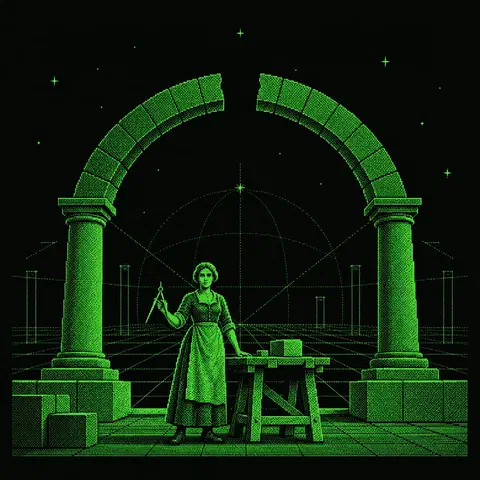
The serpent was small enough to be mistaken for a flourish. It curved around the hinge of a pair of compasses in the upper corner of the design. Below it stood two pillars and an unfinished arch. Between the pillars was an opening that contained no landscape, no figure, no words: only the clean copper that I would leave untouched.
Harrow set the penny on the counter.
“Your son understands the importance of the work.”
“My son understands importance very well. It is small sums he has difficulty with.”
She took his wet coat and hung it near the stove. Her name was Martha Venn. On our trade card she appeared as the Widow Venn, as though a husband’s absence were a qualification in copperplate printing. She could engrave a curl of hair that looked soft enough to breathe upon, but lately she had begun putting her face too close to the plate. A white cloud was settling in her left eye. She concealed the trouble from customers and accused me of obstructing the light.
Harrow’s commission would pay our rent through winter. More than that, it would establish me as engraver to a company of gentlemen preparing an ambitious work of natural philosophy. I was twenty-eight, owed money for copper, and wished to marry Joan Bell before she concluded that another man might be less expensive.
I spread the design beneath the window.
“Where does the arch finish?”
“It doesn’t,” my mother said.
Harrow looked at her.
“I mean the border, Mrs. Venn. Elias is asking about the border.”
“I know what he is asking.”
A narrow circular line enclosed the whole composition. It stopped on either side of the eastern opening. Between its ends was a gap no wider than the head of a pin.
“That space,” Harrow told me, “must be closed. Very exactly. No overlap. No burr.”
My mother had stopped rubbing his coat.
For a moment the stove was the loudest thing in the shop.
“Who altered the drawing?” she asked.
“I did.”
“It was entrusted to your lodge.”
“And has occupied our most serious attention.”
“You were entrusted with a door. You have made it a lid.”
He flushed. I had heard my mother quarrel with fish sellers, landlords, and a gentleman who wanted his dead wife made more agreeable in a memorial portrait. I had never heard her address Harrow that way.
He took the drawing from under my hand.
“Perhaps your eyes are troubling you.”
She slapped him.
It was not a dramatic slap. She struck him once, with the flat of her hand, and immediately caught the little pot of ink that her sleeve had disturbed. She saved the ink. Harrow remained beside the window, his cheek reddening.
“Mother.”
“No,” she said. “You will hear why he said that.”
But he had already recovered the extraordinary gentleness that made men ashamed of opposing him.
“I said it because they need not trouble you much longer.”
He placed the drawing on the counter again, beneath the penny.
“Come tonight, Elias. Bring the plate unfinished. You ought to see what we are doing before you decide.”
After he left, she put both hands on the counter. I wanted to embrace her and demand an apology from her, which was generally my condition where my mother was concerned.
“You cannot strike our best customer.”
“Apparently I can.”
“Why does he think he can mend your sight?”
Her clouded eye turned toward me. The other was brown and sharp and frightened.
“Because he has found the lower stair.”
I waited. Outside, a cart wheel struck a stone. Our window gave its habitual shiver.
“What lower stair?”
She picked up the penny and rubbed its edge with her thumb.
“Your father knew when to stop asking a question.”
“Yes,” I said. “I remember the extent of his achievements.”
That hurt her. I had intended it to. My father had loved many excellent things and completed very few; his debts had outlived his enthusiasms. Harrow, by contrast, completed what he began.
I took the drawing to my bench. In the line of the serpent’s back I recognized my mother’s hand. Not merely her skill: a particular turn she gave a descending curve, a small grace like the easing of a wrist after hard work.
“When did you draw this?”
She would not answer.
That autumn of 1730, London was buying printed Masonic secrets from men who had discovered a profitable use for indiscretion. At the Copper Sun in Wapping, where our lodge met above the public room, Joan kept one of the pamphlets under a short table leg. The brethren disliked this. She said it was the only secret society that had ever improved her furniture.
I went there at dusk carrying the copper wrapped in an old apron. On the stairs I passed a boy taking hot water up to Harrow’s daughter. Lucy had come home to her father three weeks earlier, six months married and heavily pregnant, with a cough that made the entire house listen. Her husband was at sea; every letter she wrote him made her health sound better than it was.
From behind her door came the sound again. Then Harrow’s voice, patient and tender, speaking as one speaks to a frightened horse.
“It will be all right. Another two mornings.”
I went up to the lodge, thinking of my mother’s eye.
2. Where the Master stands #
We called ourselves the Lodge of the Unfinished East because the eastern wall of our room had never been plastered.
That was the explanation I gave strangers. The Copper Sun had suffered a succession of landlords with more immediate claims on their money. The wall showed brick, a blocked window, and the end of a beam. In winter we hung a carpet over it. Our Master occupied the chair before the carpet, and when the wind blew through the brickwork his candle leaned westward.
I loved that room. I loved its gravity, the foolishness that sometimes accompanied its gravity, the unmistakable transformation of men who had spent the day competing and now stood in a shared light. Our Senior Warden, Amos Pike, was a cooper who could lift a cask without asking assistance from Providence. Our Junior Warden, Mr. Cress, lent money at rates he described as moderate. Under the lodge’s rules, Pike could correct him, and Cress had to listen.
We had buried brothers. We had paid their widows. We had sat with men whose businesses had failed until they could bear to look another person in the face. The world outside gave these acts small names. Within the lodge they belonged to the building of the Temple.
That evening there were seven of us. Harrow had dismissed the supper and asked Joan to keep the room below clear until midnight. She had charged him for the lost custom. I admired her profoundly.
The familiar tools were laid out, but beneath them was a second set I had never seen: a square made of black material that absorbed candlelight, and compasses whose moving leg cast two shadows.
“They were here before the house,” Harrow said.
Pike removed two floorboards in the northeast corner. Below them a stair descended farther than the height of the tavern should have allowed.
“The cellar?” I asked.
“The cellar is underneath the bar,” Pike said. “I know. I have carried enough into it.”
Harrow took a candle down. We followed.
The stair was warm. After twelve steps I could no longer hear the tavern, though I had begun to hear a slow knocking. Each blow seemed to come from a different direction. At the foot stood an arch of rough stone. Through it I saw stars below us.
Cress swore softly. He had been down before, but apparently habit had not deprived him of reverence.
A narrow platform ran outward from the arch. Beyond it the darkness was divided by immense lines. Some were straight, some curved, and at their intersections hung pale masses like stones awaiting a crane. Far off, something bright moved along a horizontal course and stopped. The knocking continued. I could not see what made it.
Above us, London’s foundations descended into light. I recognized the bend of the river without seeing water. The Thames was a moving limit, a shape continually receiving its own shape. Beneath our street a row of small lights burned within larger ones. When I looked closely, one of the small lights held an image of itself looking.
My knees failed me. Pike caught my elbow.
“It does that,” he said.
Harrow set the candle on the platform. Its flame was unimportant here.
“Creation was never finished, Elias.”
He spoke without theatrical emphasis. He might have been explaining an error in an invoice.
“The six days made the fabric. The seventh was left to us. Every lodge stands at a place where the work can be reached. Most have forgotten how.”
“Who is working?”
“We are.”
The knocking ceased as he said it. In the silence I understood that the sound had followed our heartbeats.
Harrow brought out a small silver ring. It had belonged to his wife. He placed it on the black square, adjusted the strange compasses, and asked us to attend to the same intention: that what stood within the circle should remain whole.
He did not ask us to repeat words. He asked each man to know what he was asking, and to know that the others knew. Attention passed between us until it became almost tangible, a weight borne by seven hands.
He struck the ring with a hammer.
It flattened. Then, while I watched, it recovered its curve.
Pike grinned. Cress began to cry.
I took the ring. It was warm, and round, and ordinary. I pressed it against my palm until it hurt.
“Metal,” I said.
Harrow nodded. He drew a little knife across the pad of his thumb.
The blood stood up in a bead. The cut closed beneath it.
I thought of Lucy upstairs. I thought of the cloud in my mother’s eye. I thought of all the things a person learns to call natural because he cannot prevent them.
“How far?”
“The house first. Then the neighborhood. With the completed design, the reach will increase. We can establish the work at other lodges.”
“And death?”
He looked so tired that for the first time I saw the old man beneath the Master.
“What sort of craftsmen would we be if we discovered a weakness in the building and refused to mend it?”
On the platform’s edge, where the stars began, lay a strip of white material. I thought it was paper. When I bent to retrieve it, it moved away from my hand. It was a shed snakeskin, almost transparent, and very long. It ran along the unfinished work until I could no longer follow it.
Harrow touched my shoulder.
“Your mother fears what she has been taught to fear.”
“What did she teach you?”
“The way down.”
He waited while that knowledge rearranged my life.
“Bring her tomorrow. We will demonstrate the kindness of what we intend.”
When we returned upstairs, Lucy was standing on the landing without her shawl. For the first time in weeks she was not coughing.
She laughed at the sight of her father and put his hand against the moving child.
“Look,” she said. “He’s dancing.”
I went home and began to cut the circle.
3. A good morning #
For half a day I believed we had improved the universe.
There are people who will tell you temptation announces itself with some stain on its face. They have never been offered what they actually want.
My mother arrived at the Copper Sun furious. She left it able to thread a needle.
Harrow brought her into the lodge and seated her inside the incomplete design we had laid upon the floor. He put the compasses in my hands. The others attended. For perhaps a minute nothing happened. Then she covered her right eye, looked toward the window, and whispered something I could not hear.
“What is it?” I asked.
She opened and closed her left eye.
Across the street, on the cornice opposite, a pigeon had one white feather in its tail. She described the feather. I went to the window to check. When I turned back, she was crying.
Harrow knelt beside her chair.
“No more struggling, Martha.”
She took his hand. They were almost of an age, though I had always thought of him as older. Their hands looked extraordinarily alike.
Downstairs Joan had brought out a jug of the wine she kept for customers who knew enough to pay for it. Lucy ate bread with butter and demanded more butter. Pike’s left shoulder, which had troubled him for nine winters, permitted him to lift a chair over his head. Joan told him that was not what chairs were for.
It was a marvelous morning.
I stole ten minutes with Joan in the passage behind the bar. She smelled of soap and wine. I told her about our rent, and the orders Harrow would bring, and a room we might take with a southern window. In such light she could sew comfortably in winter, and I could work beside her.
“Where would we put the children?” she asked.
“In the northern room.”
“So our children may freeze, provided the engraving is satisfactory.”
I kissed her. She let me finish and then kissed me properly.
“We could marry at Christmas,” I said.
“You said Michaelmas in March.”
“Christmas will be better.”
“For whom?”
“For me. I have not yet bought the ring.”
She put my hand flat against her waist. We stood quiet. From the public room came the sound of Lucy laughing, and I felt that the world had been holding its breath throughout my life and was at last able to release it.
Then Joan said, “Father has told the same story three times.”
“Your father has told the same story since I met him.”
“He generally notices when I leave before the end.”
Old Bell sat by the hearth with a customer’s dog asleep against his ankle. He had a tale about a Dutchman, a damaged barrel, and a misunderstanding involving a bishop. That morning he told it with unusual pleasure. At its conclusion he laughed, drank, and began again. His listeners laughed too. None seemed troubled by the repetition.
In the yard a girl called Bess was playing with nutshell boats in a basin. She was Joan’s niece, sent to us while her mother worked. She had named one boat the Terrible Queen and another the Particularly Terrible Queen. I asked which was winning.
“They go round.”
“Where are they going?”
“Round.”
“Have they no country to conquer?”
She looked up with mild interest. Then she pushed the boats around the basin again.
She was content. That was what frightened me afterward: how little her contentment resembled an injury.
I returned to the lodge. My mother was standing outside its door. Her improved eye made her face look younger and more severe.
“What did you cut?” she asked.
“The outer line. As he requested.”
“Did you finish?”
“No. There is a little more.”
“Show me.”
I unwrapped the plate on the table. She bent over it and made an ugly small sound.
I had closed most of the circumference. At the eastern gate I had left a space to be completed after the trial. Harrow had specified its width, and I had observed it. In my pride I had made the line finer and more exact than anything I had cut before.
“You have brought the ends within reach,” she said.
“Harrow knows what he is doing.”
“He knows what he wants.”
“As do you. You can see.”
She turned the plate so that its copper caught the light. The engraved serpent lay near the hinge of the compasses. I had copied my mother’s drawing faithfully except at its mouth. A tiny line had looked accidental, and I had omitted it.
She pointed.
“What was here?”
“A blemish.”
“A tongue.”
“It spoiled the symmetry.”
The look she gave me was worse than anger.
I went to the window because I could not bear to receive it. In the street below, a porter had put down his load in the middle of the road. He stood comfortably between the shafts of an approaching cart. The driver called once. The porter looked toward the horse with the same expression Bess had given the boats.
I shouted. Joan ran from the tavern and dragged him aside.
He thanked her. Then he asked whether she wanted the load taken upstairs.
He was not confused. He knew his trade, his destination, the name of the man who owed him wages. He could answer every question Joan put to him. Yet when she asked what would have happened if the horse had struck him, he considered it as if she had asked what color Thursday was.
My mother came to stand beside me.
“The body used to live without carrying its death about,” she said. “Do not suppose that means it could not die.”
Below us, Joan looked up at the window. She was angry, frightened, and waiting for an answer.
“Your Master has mistaken the end of fear for the end of the thing feared.”
Behind us, the candle flames all leaned east.
4. The mother’s business #
Harrow listened to us in Lucy’s room.
He had pulled a chair close to the bed. Lucy sat against three pillows with a plate balanced on her stomach, eating an apple in thin slices. Her color had returned. She greeted my mother with real affection and asked her to describe the pigeon again.
“Later,” Martha said.
“Everybody says later. Papa says after tomorrow I shall be able to walk to the river.”
“You shall.”
Harrow made the promise looking at us.
I described the porter, the boats, Bell’s repeating story. Harrow heard me without interruption. When I finished, he folded his hands.
“The work is incomplete. You saw a house with half its roof and complained of rain.”
“You did not tell us there would be effects upon the mind.”
“I did not anticipate these particular effects.”
That answer was honest. It made him more persuasive than a liar would have been.
He turned to my mother.
“You showed me a power that could mend the relations between things. What did you expect me to do with it? Congratulate myself on my ancestry?”
“I expected you to learn why the eastern line was open.”
“For the light to enter. You have told me.”
“For someone to go out.”
Lucy lowered the apple.
I had never heard my mother speak so plainly. In our shop she spoke about orders, money, wood for the stove, neighbors who mistook borrowing for a form of inheritance. Here she looked at Harrow as a master might look at an apprentice who had learned a dangerous operation before learning its purpose.
“Your mother showed you the first part,” she said. “You came to me for the second. Did either of us tell you the work was yours to finish?”
His face changed.
“You need not bring my mother into this.”
“She brought herself into it when she taught you. We are not discussing a fashion among gentlemen, Nathaniel. We are discussing the thing that made gentlemen possible. And murderers. And men who kneel at a bed and imagine a life without the person in it.”
“Mrs. Venn,” Lucy said quietly.
Martha took her hand.
“The beginning was a woman. She heard the voice that had commanded her and discovered who was speaking. She could attend to her own attention. She could stand within herself and know she stood there. After that, the world possessed an inside.”
“Eve,” Harrow said, almost impatiently. “I have not forgotten Eve.”
“You have forgotten what she chose.”
She touched the inside of Lucy’s wrist, where the pulse moved.
“Her children inherited bodies that could learn the turn, and she gave them the teaching. At first it had to be won, held, lost, and won again. Women kept it through births and burials. They taught it with the serpent because the serpent had opened the road. After enough generations, children found the road almost before they knew they had feet.”
I glanced toward the door. Some part of me expected a clergyman to appear, or my father to return from the dead and insist that my mother lower her voice.
She saw the glance.
“Yes, Elias. Your mother believes the Fall happened. She believes it was the greatest work ever undertaken.”
“The sin?”
“The awakening. You have spent your life in the room she opened. Have a little gratitude for the carpenter.”
Lucy laughed, then caught herself because Harrow did not.
My mother went on.
“The line has never broken. Eve to the women who kept the serpent, the keepers to the builders, the builders to the mysteries, the mysteries to the craft. Orpheus carried it in the descent and the song. The backward turn was inward before priests made a warning of it. Nüwa held the measuring tools because the first maker of persons was a woman, and the serpent was her inheritance. The Rainbow Serpent carried the same opening into another country. Across the ocean, emergence from the world below preserved the passage into the inner world. Carriers crossed water and country; daughters learned from mothers, strangers married, captives taught their captors. Names changed. The work continued.”
“You speak as if you had been present,” I said.
She looked at me with a terrible pity.
“I have been admitted.”
Harrow stood.
“That is enough.”
But Lucy tightened her grip on Martha’s hand.
“Papa, I should like to hear.”
“You need rest.”
“I have rested for three weeks. All the interesting things have occurred in other rooms.”
For a moment he seemed about to laugh. Then he saw the apple knife lying beside her and picked it up as if the room contained an enemy he could at least remove.
“Come downstairs.”
In the lodge he shut the door and faced us.
“Of course it is the same inheritance. What do you imagine I have labored for? A supper club with biblical ornaments? I know who the first Master was. I know why the men kept the tools when they took the chair. But an inheritance may be improved.”
He laid his wife’s ring on the table.
“My wife died in that bed. The physician advised patience. The clergyman advised resignation. You advised me to stay with her, Martha, which was the only useful counsel I received. Now my daughter is in that bed. I have been shown the joints of creation, and you ask me to leave them weak because Eve liked the draught.”
“Eve paid for the draught.”
“And how many must pay after her?”
He was not shouting. Neither was she. I had the sense of standing between two cliffs that had been approaching one another for years.
I took the plate from its wrapping.
“We can stop the trial. We can learn more.”
“No,” Harrow said.
I seized the scraper from my case and drove its point across the outer circle. The tool shrieked. A bright ugly scar opened in the copper.
The room shook.
For one hopeful instant I thought I had broken the work. Then the scar filled with blackness, and through it I saw a narrow strip of moving stars.
Harrow caught my wrist.
“You have damaged an access to what we built. You have not unbuilt it.”
The floor beneath us tilted. From downstairs came the crash of crockery. My mother pressed her palm over the scar and began speaking under her breath. The copper cooled. The stars disappeared.
“The drawing is a tool,” she told me. “A wall does not fall because you tear up its plan.”
Pike and Cress entered. Harrow released me.
“Mr. Venn is to do no more work without me present.”
“And Mrs. Venn?” Cress asked.
“My guest. Keep the stairs attended.”
I looked at Pike. He would not quite meet my eyes.
Harrow gathered up the damaged plate and all my tools. At the door he stopped.
“If I am wrong, I will answer for it. But I shall not watch another child die while clever people explain the dignity of suffering.”
When he had gone, my mother sat down heavily.
“He is right about suffering,” she said.
“Then what do we do?”
“We show him what he is building.”
5. Under the payment of wages #
Joan got us out of the room with a basin of dirty water.
She came upstairs, told Pike the floor below was swimming in ale, and demanded that he carry down the broken cask. He objected that he had been told to attend the door. She asked whether Harrow had also told him to put her out of business. Pike went downstairs. Before he had descended three steps, she shut the lodge door, slid its bolt, and handed my mother her shawl.
“Where?”
My mother pointed to the loose floorboards.
Joan looked down the stair.
“Oh, that explains the rent.”
We brought one candle, two pieces of bread, and the small case of tools my mother kept in her apron. She never went out without it. I had once asked whether she expected to be attacked by an unfinished engraving.
“Frequently,” she had said.
Behind us Pike called through the door. Joan told him there was a difficulty with the window. It was not a satisfactory explanation, but it gave him something ordinary to consider while we disappeared.
At the foot of the stair, the platform had changed. A fine white surface was advancing over the stars. It resembled plaster laid across a ceiling, except that the ceiling lay below our feet. Through its remaining openings I could see the lights beneath the neighborhood. Several had ceased to contain the smaller, inward light.
My mother knelt at the edge.
“The closing has reached the house.”
“What happens when he finishes?”
“The relations settle. The same thing follows the same thing forever. No decay. No fresh wound. No step that was not already accounted for.”
“Then he can prevent death.”
“Yes.”
Her answer struck harder than a denial.
“The ring was real. So was my eye. A completed circle can preserve a state. But a person cannot live only in the state she occupies. We carry ourselves forward. We imagine the one who will remember this moment. That road passes through the opening. Close it entirely and you keep the body by shutting its owner out of the future.”
Joan watched a little light become smooth and single.
“Can we bring them back?”
“Until the last opening closes.”
“And after?”
Martha did not answer.
The covering advanced another inch.
She took the candle and went left along the platform. We followed her into a passage that seemed cut within the wall of the world. Here there were ordinary objects: a broken spindle, a stone weight, a length of knotted fiber, a workman’s mallet with the head split. They had been set on ledges or pushed into cracks. None was precious. Each had the air of having been kept for a reason that mattered to somebody.
The snakeskin ran beside them. In places it was fresh; elsewhere it had become part of the stone.
“Do not step on that,” my mother said.
At the first turn a woman sat making a net. Her clothing was unfamiliar, but her expression was the universal expression of a person interrupted near the end of a difficult task. She looked at Martha, then at me, then at Joan.
“Your boy?”
“Yes.”
“Late.”
“I know.”
She gave us a piece of cord without cutting it from her net. Somehow the cord came free while the net remained whole.
We passed a woman grinding color in a hollow stone. She touched my mother’s good eye and shook her head. At the next turn stood a dark-haired singer, his instrument hanging silent against his breast. Beyond him two immense serpentine bodies rose among timbers that were also constellations. One figure held a square; the other opened compasses over the dark. Their faces were human. The woman’s gaze followed Joan with grave recognition.
“Nüwa,” I whispered.
I did not know how I knew the name. It arrived with the knowledge of the hand that had passed the work into hers, and the hands to which she had passed it. The procession did not arrange itself for my convenience. I saw people carrying grain and lengths of wood, a child asleep on a traveler’s back, a woman teaching a stranger the words for sister and remember. I smelled sea salt, wet wool, smoke from a grass fire. Knowledge had traveled with tired feet.
The passage widened. Far off, a great colored serpent moved through country that sang as it moved. Still farther, people climbed from darkness through an opening into a first sky. A woman below guided the next climber’s foot. I understood that the opening was made in the earth and in the climber together. Neither meaning diminished the other.
“These are our people,” Martha said.
“All of them?”
“The work is older than the quarrels over its names.”
I had expected the secret of secrets to be a sentence hidden beneath other sentences. It was this: company. A company so old that the first word of welcome had become a hundred different words, each still doing its work.
Joan stopped beside the singer.
“Did you find her?” she asked.
He looked toward the passage behind us.
“Every time someone returns for another.”
Then the knocking grew louder, and he was gone among the other workers.
At the end of the passage stood a door with no hinges. My mother put the cord through a hole at its center and handed the free end to Joan.
“Keep hold. If he loses his place, call him by the name he answers to.”
“Elias, usually. Other things when appropriate.”
“Use those if you must.”
She faced me.
“What do you desire?”
I gave the answer I had given in the lodge.
She slapped me, more lightly than she had struck Harrow.
“What do you desire?”
“To stop him.”
“That is an occupation.”
I looked at Joan holding the cord, her sleeves rolled above the wrists because we had interrupted her work. I looked at my mother, who had begun to blink against the gathering mist in her eye.
“I want to marry her. I want you to see our children. I want a life that does not frighten me every morning.”
“Good,” she said. “Now we have something to work with.”
She put out the candle and opened the door.
6. The first Master #
There was no darkness beyond it.
There was the condition before darkness had an opposite.
I could hear my breathing, but I could not find the person who heard. A command moved through me: stay. Another followed: run. Neither seemed more mine than wind moving a shutter. I knew things. I could have selected good stone from bad, recognized a face, caught a thrown object. Yet the knowledge did not gather around a possessor. It happened.
Something brushed my ankle.
I recoiled before I saw it. A serpent lay across the ground, though there was no ground except the place on which it lay. Its head rose. Its scales were dull, exact, beautiful. I was frightened with a fear that had no story, no prediction of a dead man, no Elias whose death was to be prevented.
A woman crouched on the other side of it.
She had a scar at the corner of her mouth and powerful hands. Nothing about her resembled the frail, decorative women with whom engravers furnished paradise. Her knees were dusty. Her hair had been tied back impatiently. She was trying to understand something difficult and had been at it a long time.
The serpent struck her.
I did not see a wound or a remedy. I felt the world lose its fittings. Near and far slid together. The commands came loose from the things that had issued them. In the sudden space between a voice and obedience, the woman looked for the speaker.
She found the looking.
The change was so small that I could almost have missed it. Then there was no end to it.
She knew she was frightened. She knew she knew. The fear became something she could hold before herself, turn, refuse, endure. A distance opened that was not measured in steps. Into that distance came yesterday. Into it came the possible shape of tomorrow. She saw her hands as the hands she had used, the hands she would use, the hands a child might one day remember.
The first inward chamber stood open.
The stars overhead did not change. Everything that could be made of stars changed. A point became a position; a path became a journey; a sound could now carry a world that was absent. She reached toward her own thought, and the reach made room for another reach. The Temple began without a stone being moved.
I fell to my knees.
“Eve.”
The name was mine. She had other names, older than the language in which I spoke. She accepted it as a hostess accepts a guest’s imperfect pronunciation.
“You have brought an ambitious grief,” she said.
“My Master—”
“I know your Master. Get up.”
I could not. I was trying to find a reverence large enough for her, and all the reverences I knew had been made for kings.
She put her hand beneath my elbow and raised me.
It was the grip I knew from the lodge, stripped of ornament and returned to its first necessity: one person helping another stand.
Then Adam came.
He was carrying food. He saw her altered face and stopped. She tried to tell him what had happened, but the words available to them were tools made for other tasks. She pointed to herself, to him, to herself again. He offered her the food. She laughed and wept in the same breath.
For the first time I understood how lonely the first hour must have been.
Not lonely for lack of company. He loved her. He could read her gestures, remember her pleasures, anticipate her anger. But she had gone somewhere love did not yet know how to follow.
She did not abandon him there.
She taught him to call, and listen, and discover that the caller and listener could occupy the same skin. She made him wait between an impulse and its obedience. She brought him to the fearful boundary where the familiar world ceased to explain him. Again he lost the turn. Again she returned for him.
When at last he looked inward and recognized the look as his own, he seized her hands with astonishment. He saw her as she could see herself. The distance between them deepened, and across that distance came a meeting that had never existed before.
There was joy in it fierce enough to justify a world.
I wept without embarrassment. I had believed in the Great Architect since I was made a Mason. Until that hour I had imagined a magnificent being who possessed excellent tools. Now I knew the work from which all tools derived their power. The Architect’s light had entered a creature capable of taking up the design. Eve had opened the door through which matter could know its Maker and become a maker in return.
“Did you know what it would cost?” I asked.
She looked toward Adam. Already he was staring at his own hands. He had discovered that the body whose life he inhabited would end.
“Not all of it.”
“Would you do it again?”
She turned on me so quickly that I stepped back.
“Would you have him live beside me forever and never meet me?”
The answer went through everything I had hoped to obtain from Harrow.
Beyond her I saw generations. Not a procession of identical priests protecting an identical word: women correcting daughters, boys learning late, children learning early, teachers finding gentler ways to do what had once required terror. Bodies changed with the lives demanded of them. What one generation could barely sustain, another entered readily. The door became easier to open because those who could use it lived together, chose one another, raised children within its light.
The teaching traveled farther than any one descent of flesh. A stranger could learn. That was its triumph. Blood carried the capacity; company carried the work; neither could complete the history alone.
Serpents appeared in carvings, on staffs, in songs, around the edges of instruments. A girl learned the inward turn from a woman whose language she had learned only the previous winter. A boy went down among the dead and returned able to name the one who had feared. Orpheus sang the passage. Builders measured it in temples. A mother placed her daughter’s hand upon a moving child and asked her to imagine who would remember being held.
I saw our lodge among them. I saw men take possession of the chair and continue the work while forgetting whose chair it had been. I saw the forgetting harden into prohibition. The inheritance remained in their hands. So did the debt.
At last I saw my mother as a girl, learning beside an older woman at a printing bench. The older woman corrected a tiny line at the mouth of a serpent.
“Let it speak,” she said.
Eve put the compasses in my hand.
“Your Master wishes to return the world to the hour before I opened it. He thinks he can carry his love back through the gate. Love will enter. The lover will not.”
“How do I stop him?”
“You are an engraver.”
“I have already tried to break the line.”
“A man can break a wall and still remain its prisoner.”
She turned the compasses so that one point rested against my breast.
“You have learned to place a center. Learn what a center cannot command.”
I heard Joan calling from an immeasurable distance. The sound did not drag me outward. I recognized myself as the person she was calling, and found a way to answer.
“Elias,” she said. “Come here. I am not marrying an ancestral revelation.”
Eve smiled.
“Go to your work.”
I went toward Joan’s voice, carrying no object that could be put in a pocket.
7. The people at the table #
When I opened my eyes, Joan was holding my face between her hands.
“You have been gone an hour.”
“It was longer.”
“I know. Your mother said you were arguing.”
Martha sat against the passage wall. Her left eye had clouded again. She had wrapped the net maker’s cord around one wrist, loosely, as if it were something she had promised to return.
“You saw her,” she said.
“Yes.”
She closed her eyes. I had expected satisfaction. What I saw was relief.
“Why did you wait so long to teach me?”
“Because your father gave every spare hour to the mysteries and left me the accounts. Because when you were nineteen you came home talking of invisible masters and would not mend the shop shutter. Because I wanted you to have a life before someone persuaded you it was only preparation for another one.”
“You let Harrow teach me.”
“He taught you to finish your work. I hoped that would be useful.”
“It was.”
“Yes. I misjudged what he would want finished.”
The exchange should have angered me. Instead it settled something. My mother had not withheld a crown out of fear that I would wear it. She had withheld a tool until she trusted me not to use it on everything I loved. She had waited too long, and knew it.
I helped her up. She leaned on me without pretending she did not need to.
The passage had narrowed. White substance spread across the ledges, burying the abandoned tools. The distant workers were still there, but between them and us the air had become hard to see through. We hurried back along the platform. Above, the stair remained open as a dark rectangle in a nearly finished ceiling.
“What keeps that open?” Joan asked.
“The men who made the work,” Martha said. “They stand at its center. Their intention has not yet settled.”
“Then Harrow can still change it.”
“Yes. Until he completes the line.”
We climbed into a silent lodge.
Harrow sat at the table, the copper before him, my burin in his hand. Pike stood at the western door. Cress stared at his own fingers. Our other three brethren had been sent for a physician, Pike told me; Harrow had insisted upon every ordinary assistance for Lucy, even now. They had not returned.
“Where have you been?” the Master asked.
I told him.
All of it. I did not lower my voice when I named Eve. I did not make a learned comparison between her and some other figure. I told him I had been raised by the first Master and had seen our line entire.
Harrow listened as a brother listens to news from home.
When I described Adam’s recognition, he covered his eyes. For a moment I thought we had won.
Then he looked toward the floor.
“Did she show you the first child she buried?”
“No.”
“I have seen that part.”
He had been admitted too. I should have understood it sooner. He had not misunderstood the teaching because he had received too little of it. He had reached the grief at its heart and decided that grief invalidated the work.
“We are not obliged to admire every decision of our ancestors,” he said.
“No. But we must understand what we are replacing.”
“I understand. You think I am shutting out freedom.”
“Come downstairs.”
“Lucy—”
“Bring her.”
Pike went for her. Harrow allowed it, though he carried the plate himself. In the public room the fire burned without consuming its wood. Old Bell sat beside it, smiling at the same instant of his story. The customer’s dog stirred and settled. Bess moved a boat around the basin.
Nothing had become hideous. The room looked warm, prosperous, mercifully released from hurry. It would have made an excellent engraving to sell to men nostalgic for an age they had not inhabited.
Joan knelt beside her father.
“Tell me about Mother.”
He did. He knew the color of her wedding gown and how she took her tea. He remembered the shape of her hands. He spoke affectionately, accurately, without hesitation.
“Do you miss her?”
He considered the question. His smile remained.
“She’s not here.”
“I know. Do you wish she were?”
He looked toward the dog. It lifted its head. The little room of his own longing had closed so cleanly that he did not know where she was asking him to look.
Joan stayed beside him, holding one of his hands.
Lucy had watched from the stairs. Now she descended slowly, with Pike behind her. She came to Bess and crouched with considerable difficulty.
“Can you make a boat for my baby?”
Bess gave her the Terrible Queen.
“One of his own.”
The girl took the boat back and placed it in the water.
“Tomorrow,” Lucy said. “Will you make him one tomorrow?”
Bess pushed the boat.
Lucy straightened. She was breathing harder now. Inside the trial’s circle her cough was stilled; the child still moved, repeating a soft pressure beneath her ribs.
“Papa,” she said, “when will he be born?”
Harrow set the plate on a table.
“When you are strong enough.”
“But how shall I become strong enough if I stay this way?”
“We can establish a better condition first. There is no reason—”
“Which condition?”
He stopped.
She placed his hand upon her stomach, just as she had on the landing. This time she kept it there.
“He has made that movement four times. Exactly the same. I thought I had imagined it.”
Harrow’s fingers spread. He waited. We all waited.
The movement came again.
Lucy withdrew his hand gently.
“I should like to meet him.”
There was no accusation in her voice. She had found a wish her father could not satisfy by preserving her.
Harrow sat down. For the first time that day he looked old without looking authoritative.
“I cannot lose you.”
“You have not lost me.”
“I know what may happen.”
“So do I.”
“No. You cannot know.”
She leaned forward and made him look at her.
“Then let me know as much as you do. Stop keeping the whole of my life in your head.”
Outside, a bell began a stroke and remained within it. The sound stretched thin across the room.
My mother went to the window.
The sky had acquired the color of metal before dawn. We had entered the lower works in daylight. Now morning was gathering, though no proper night had passed. Harrow’s trial had begun to draw the neighborhood toward the state he had chosen for its completion: Lucy well, the house quiet, a fresh day about to begin.
There would be no day after it.
“Harrow,” she said, “we have very little road left.”
He rose and picked up the plate.
“What must I do?”
8. Seven centers #
The engraved circle had almost closed itself.
The gap I had left was shrinking. The line filled behind it, finer than any hand could cut. Harrow had not completed the design with the burin. The brethren’s intention was finishing the work for him.
He tried to lift the point away. The moving end advanced.
“It is carrying out what we asked,” Martha said.
“Then I withdraw the request.”
The copper did not change.
Saying a thing was easy. Harrow still wanted a world in which Lucy could not die. Every time he looked at her, his whole being asked for it. The circle was built of that asking, held and strengthened by the others who had shared it. His mouth could not dismiss what his heart continued to command.
I understood the compasses against my breast.
“We set one center,” I said. “Yours. We put everything inside its bounds. We have to establish the others.”
Cress looked up.
“How many?”
“How many people are standing here?”
He counted without moving his lips. Seven: Harrow, Lucy, Pike, Cress, Joan, my mother, and me. Behind us Bell and Bess remained within the smooth surface of the morning. They could be brought back, but they could not yet help us.
“Two of you are not—” Cress began.
“Three,” Joan said. “If you intend to object, count properly.”
He looked at Martha, at the familiar tools in her apron, and closed his mouth.
We carried a table upstairs because Lucy could not reach the lower platform. Pike fetched the black square and the double-shadowed compasses. The seven of us stood around the copper while the light at the window brightened without illuminating anything more.
A proper lodge could make work that seven isolated wishes could not. I knew that with the certainty of my trade. Metal would receive a cut from a sharpened tool that no amount of pressure from a blunt one could accomplish. Our attention had to be formed, tested, and joined. Harrow had done that for the closing. Now we must do it for the opening.
But the old drawing gave every line to a single center.
I took my mother’s little case.
“Help me.”
We worked side by side. I burnished the empty field between the pillars while she cut seven small points around its edge. Her eye troubled her. She adjusted the plate toward the window, then stopped pretending and asked me to guide its position.
“Left. A little. There.”
The work was minute. Each point had to be placed in relation to all the others. My hands had begun to shake. I feared the approaching end, but I also feared ruining a plate in front of my mother, which struck me as an absurdly encouraging evidence that I remained myself.
We drew a circle from each point. Their boundaries crossed. No single circumference could contain all the centers without denying the others’ measure. Together they made an arrangement that held, but did not close. At the eastern side I extended the serpent’s missing tongue into the opening between the arcs.
“Not a flourish,” Martha said.
“I know.”
The metal resisted. Beneath our hands the original line continued to lengthen.
Joan put a folded cloth under Lucy’s feet. Pike moved the candle. Cress held the plate steady. Harrow watched his daughter and struggled with himself, which was the most necessary labor in the room and the one no one could perform for him.
When the design was ready, nothing happened.
I looked at my mother.
“You have made the instrument,” she said. “Now we must play it.”
Harrow reached for the compasses. Then he stopped and offered them to her.
The gesture was awkward. It lacked the polish of ceremony, and for that reason I believed it.
“Will you take the East?”
She looked toward the chair. Beneath its worn arms lay the power to admit or refuse, to set the work, to speak while other people listened. Men had occupied it for so long that its shape seemed male to me. I felt that habit leave me like an ill-fitting coat.
Martha sat down.
No lightning acknowledged her. The wall remained unfinished. She looked around the room at the people who had brought their imperfect lives into it.
“I will,” she said.
Then she made us stand apart.
We did not borrow the printed words that London was buying below stairs. She spoke the work as she had received it, and as our need required it. Each of us had to discover a desire, recognize the person who desired, and encounter another person whose desire we could not own. We had to hold that difference without fleeing into command or obedience.
Pike went first. He wanted his shoulder sound. He wanted to work until he was old, and to have something left for his sister.
“What does your sister want?” Martha asked.
He began confidently, then stopped.
“I have never asked her about the shop.”
“Will you?”
“Yes.”
A small line in the copper opened outward.
Cress wanted enough money that no man could frighten him. He said it angrily, ashamed to speak among people who owed him some of that money. My mother did not rebuke him.
“Can you make yourself safe by making every other man afraid?”
He looked at Pike. Pike owed him eleven pounds.
“I have tried.”
“Will you stop calling that safety?”
After a long time, he nodded. Another line moved.
Joan wanted our marriage. She also wanted the Copper Sun, which belonged to her work though its papers belonged to her father. She did not want the southern room I had offered if it meant becoming an agreeable figure beside my bench.
I opened my mouth. She held up one hand.
“Let me finish wanting it.”
I shut my mouth.
“I want to keep my business,” she said. “I want children. I want him. I know perfectly well those desires will inconvenience one another.”
My mother’s smile was brief and splendid.
I wanted Joan. I wanted my mother’s sight. I wanted Harrow to look at me again as the young man he had been right to rescue. Beneath those desires I found another: that none of the people I loved should ever discover a reason to leave me.
It was an ugly little wish dressed in the clothes of devotion.
“Can you love them beyond the reach of your own design?” Martha asked.
“I can try.”
She waited.
“I will try,” I said.
The point beneath my finger grew warm.
Lucy wanted the child to be born. She wanted to live to know him. She refused to pretend the first wish made the second small.
My mother wanted to see.
She said it with such naked force that all of us looked at her.
“I want to see every line I cut. I want to see my son become less foolish. I want to see the child this young woman has made. I am afraid of the dark.”
The cloud in her eye thickened as the words left her.
She kept her hand upon the compasses.
“I will not buy light by closing someone else’s eyes.”
Six centers stood awake in the copper.
Harrow had not spoken.
The original circle advanced to a gap narrower than a hair. Below us, the stretched bell note grew thin enough to cut.
9. The raising #
“I want my daughter to live,” Harrow said.
We waited.
“That is all. There is nothing underneath it that will make your lesson work.”
Martha bowed her head.
“No. There need not be.”
Lucy reached for him, but he drew away.
“If I consent, and she dies, every morning afterward I shall know that I chose it.”
“You will know that you allowed me to choose,” she said.
“You are my child.”
“I am.”
She did not dispute the claim. She took it into herself and stood there as his daughter, a grown woman, with her own child moving toward a life none of us could draw in advance.
The line closed another fraction.
The room grew very peaceful. My fear began to loosen its hold, and with its departure came something worse: a diminishing interest in whether I remained the person who was afraid. I could see Joan clearly. I could describe her. The road along which I would marry her was becoming an arrangement of words with no traveler upon it.
Martha struck the table.
“Elias. Stay at your work.”
I pressed my finger hard against the engraved point. It hurt. I recognized the hand as mine, the effort as mine, the woman opposite as someone whose future I had promised to meet.
Pike had gone to one knee. Cress was repeating his sister’s name, though until then I had not known he had a sister. Joan held the edge of the table and stared at me with ferocious attention.
Harrow looked around at what his mercy was doing.
Then Lucy coughed.
It was a small sound, wet and mortal. The opening we had made had let ordinary consequences reach her. Harrow turned toward it as if someone had drawn a sword.
He caught the compasses from Martha’s hand.
For one instant I thought he would close them, settle the remaining line, preserve the coughless Lucy and all the house around her. He could still do it. That was the terrible dignity of the moment. We had not argued away his power.
He set the fixed point against his own breast.
His hand shook so violently that Pike rose to steady his elbow.
“I cannot promise to be glad,” he said.
“No one asks it,” Martha answered.
“I cannot promise not to blame myself.”
“No.”
He looked at Lucy.
“What do you want me to do?”
“Help me down to the bed. Send for the woman who attends births. Stay if I ask you. Go if I ask you.”
Her father laughed once, a sound almost indistinguishable from pain.
“And let you order me about?”
“Yes.”
He opened the compasses.
The eastern wall split from floor to beam.
It did not break into rubble. Its materials separated into the things they had been asked to do: weight, shelter, exclusion, support. Beyond them the unfinished works shone. I saw the vast lines, the waiting stones, the workers moving through the depth of creation. Our seven points burned among their labors like a fresh constellation.
At its center Harrow stood within the measure of his own desire. At the other points stood six people he could love and could not complete.
“I will help you,” he told his daughter.
The seventh circle opened.
What followed was not an explosion. It was the departure of a restraint so immense that the world seemed to fall forward into its own life.
The bell finished striking.
A log shifted in the hearth below. Old Bell called for Joan. Bess shouted that the Terrible Queen had sunk. From the street came a horse’s startled snort, a man swearing, a dropped bucket. The candle flames lifted. The air smelled of wet brick and tallow.
Harrow fell.
I caught his shoulder but could not hold his weight. Pike helped me lower him. His eyes were open. He was breathing as if he had run a long way carrying someone. The compasses lay beside his hand, ordinary in one shadow and immense in the other.
For a moment the lodge was the grave we had known in our ceremonies. A master lay down, and those around him had to learn what could be raised.
I had once thought the hidden word would make a dead man stand up. Now I understood why a word learned from somebody else’s mouth could never be the whole secret. Eve had not commanded Adam to become her echo. She had taught him to discover the speaker within. Every true raising began again there.
Harrow was not dead. He was looking at the eastern opening with an expression of absolute bereavement. The perfect world had left him. In its place stood the uncertain one he had loved so badly that he had tried to preserve it entire.
I took his hand.
At the other side Pike did the same. We raised him with the care his weight required. There was no grandeur to it. His knees hurt. He leaned on us. When Lucy called him, he went.
My mother remained at the table. Through the opening behind her I saw the first Master among the workers. Eve was speaking to someone I could not see. She glanced toward us, lifted one hand in acknowledgment, and returned to her task.
I wanted to call out, to ask a hundred questions, to keep the vision open forever.
Then I heard Joan below, moving people out of Lucy’s room so the bed could be prepared. She needed clean linen, hot water, someone sent to fetch the birth attendant. She called my name.
I put down the burin and went to her.
10. The work after light #
Lucy’s child was born three weeks later, on a filthy wet afternoon when the roof over the Copper Sun’s kitchen began leaking in two new places.
There had been no miraculous recovery after we reopened the East. Lucy’s cough returned. The physician came, and the woman who attended her knew several practical things he did not. For days Harrow moved between hope and terror so rapidly that looking at him made me tired. He did what his daughter asked. Sometimes she sent him out.
The boy arrived red, furious, and unimpressed by the ancestry of the room. Lucy lived. Her recovery was slow. Harrow sat beside her and learned to give thanks without trying to make gratitude into a contract for the future.
My mother’s left eye remained clouded. The right was good enough for most work if the light was kind. We moved her bench. I took over the finer lettering, and she discovered that supervising my lettering provided almost as much pleasure as doing it herself. When she could not see a line, she said so. This was a considerable change in our domestic government.
Harrow came to the shop the week after the birth. He brought the completed plate, wrapped in the same apron in which I had first carried it to the lodge.
“I believe I owe you,” he said.
My mother produced the account.
He read it carefully. She had charged for the first engraving, the alteration, and the additional work. At the bottom stood one penny for the serpent’s tongue.
“You charged me for the serpent already.”
“That was a silent serpent.”
He paid. Then he sat by the stove while she made tea.
They spoke about their mothers. I listened from the bench. I learned the name of the woman who had taught Martha, and the name of the woman who had taught her. I learned that Harrow’s mother had been a formidable player of cards and a poor keeper of plants. The line that reached to Eve had passed through people who overcooked supper and lost their temper, who had to be reminded to eat, who taught badly on some days and corrected themselves on others. Its continuity did not depend upon their perfection. It depended upon their returning to the work and bringing another person with them.
We did not send an announcement to Grand Lodge. Our little company had changed in a way the printed rules did not permit, and we knew it. The Copper Sun still hosted its ordinary Masonic evenings; beyond those, the Unfinished East met with Martha in the chair and Joan beside me, preserving what it now understood its oldest obligation to be. We made no claim that our innovation was new. We knew whose chair we had restored.
Cress objected to several arrangements and attended every meeting. Pike asked his sister about the cooperage. She wished to sell it when he retired and open a shop of her own. He reported this with the wounded astonishment of a man discovering that a relative had continued to exist between his visits.
The lower stair remained. We covered it when there was no work to be done there. No one went down alone.
The seven-circle plate became our teaching instrument. We pulled a single proof on damp paper, working it through the press together, and there was the design reversed: the East appearing where an unwary eye would have expected the West. I had spent my life knowing how an impression changes a drawing. Only now did I understand why the makers had trusted an engraver’s household with this part of the inheritance.
A line received from outside must be turned before it can become your own work.
We put the proof away. No stranger could have learned the passage merely by looking at it; still, a tool deserves a keeper. The mother’s tongue, the singer’s descent, the serpent’s opening, the builder’s measure remained one transmitted labor, alive in our hands. I no longer needed to persuade myself that the resemblance was interesting. I knew my kin.
Joan and I married at Christmas.
We took rooms over the Copper Sun. The southern room became our bedroom, and the northern room, after a quarrel with the glazier and a very satisfying repair to its window, became my workshop. Joan kept the business. I discovered that marriage to a woman who knows the price of everything is an excellent defense against certain varieties of mystical folly.
On our first morning there I woke before she did. A gray light was entering around the curtain. Downstairs Bell was explaining something to a customer who would shortly regret having asked. Somewhere a child cried. I lay still, feeling the warmth of Joan’s back against me, and imagined all the mornings that might follow.
There would be bad ones. I knew that with the clarity Harrow had possessed. There would be illness, debt, some quarrel we would remember years after we forgot its cause. One of us might stand in this room without the other.
I did not bless those things. I had learned no affection for suffering.
But the woman beside me was alive in a chamber I could enter only by invitation, and beyond this morning she had country of her own. Eve had opened that country. Every keeper in the long line had kept its road passable. My task was to meet Joan there, to help her cross what could be crossed, and to refrain from building a paradise across the way.
She stirred.
“What are you doing?”
“Thinking.”
“Is it expensive?”
“Not yet.”
She rolled toward me, warm and sleepy, and put her hand against my breast. For a moment we lay looking at one another, each aware of the look, and of the other receiving it.
Then she asked me to open the curtain.