The Snake, the Roar, and the Mirror
TL;DR
- In the Greek serpent mysteries, a god was drawn through the initiate’s clothing. Meeting the divine was something that happened against the skin.
- The bullroarer and mirror were sacred objects of Dionysus, the child god distracted with toys and torn apart. A rite at Gurob brought these objects together with the serpent formula.
- Dionysus’s reflection became an image of the soul entering embodied life: the one becoming many, divine life becoming particular lives.
- This is the kind of ritual the Eve Theory of Consciousness asks us to understand—a way of teaching selfhood through an experience, with a serpent, a sound, and one’s own face.
In the mysteries of Sabazios, a god passed beneath the initiate’s clothes.
The god was a serpent. Drawn through the bosom, it brought the divine into contact with the body at the point where clothing ordinarily kept the world away. The rite had a name for this encounter: the god through the bosom. Clement, Protrepticus 2.16.
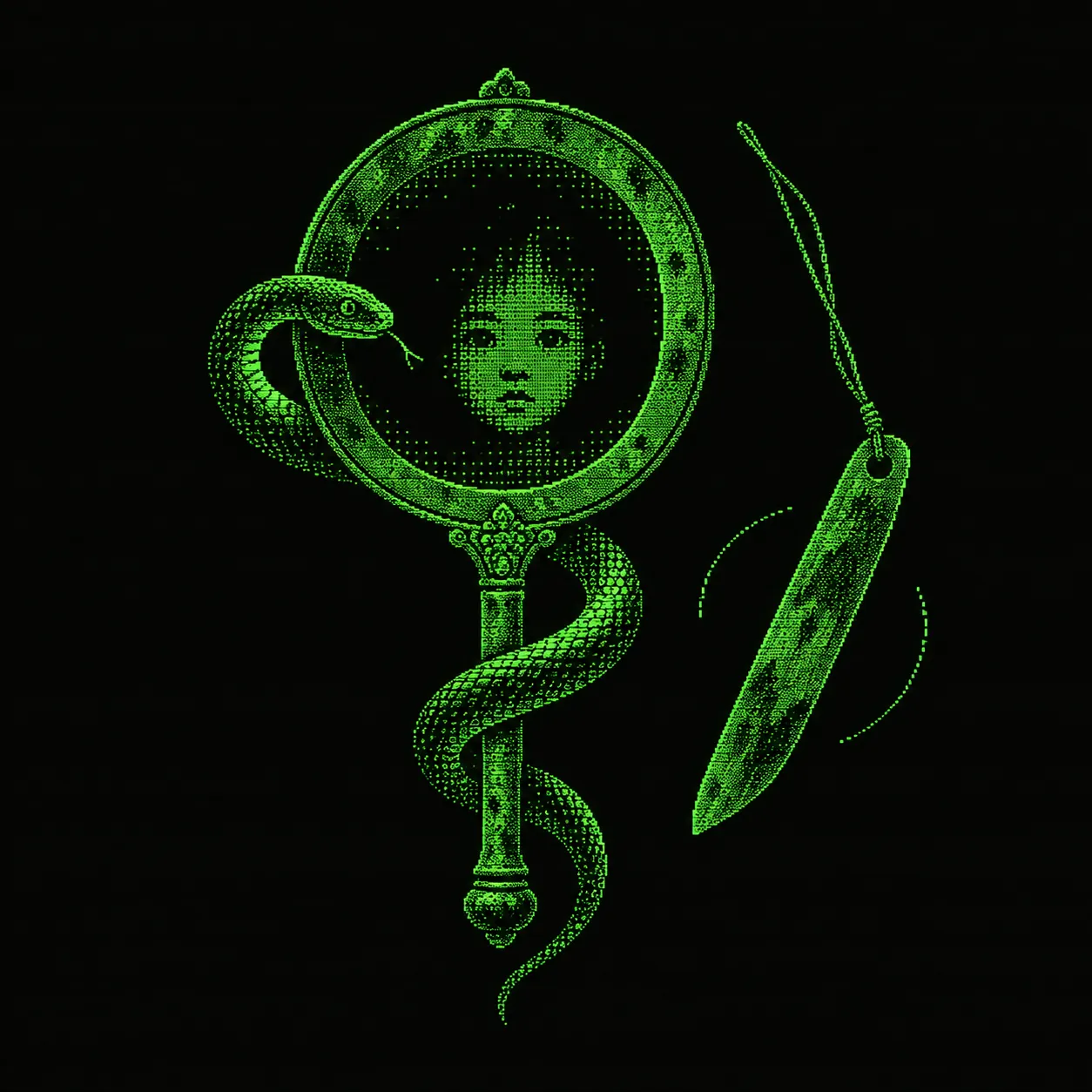
This was one of the ways the Greek mysteries made transformation tangible. There were things to handle, words to say, food to eat, sights reserved for particular eyes. Among the sacred objects of Dionysus were a bullroarer and a mirror. One could turn a small movement of the hand into a roar. The other could return the initiate’s face.
The three belong together. A ritual practiced in Egypt’s Fayum in the third century BCE brought the serpent formula into the same ceremony as those Dionysian objects. Its surviving papyrus, from Gurob, places the god-through-the-bosom five lines above the bullroarer, with the mirror on the following line. The Gurob ritual, in Hordern’s edition, pp. 134–135, 139.
We should understand this constellation as an art of initiation: a way of making a person’s relation to the divine, the body, and the self available to experience. The serpent crossed the clothed body’s boundary. Sound could surround it. A mirror put its appearance in front of its own eyes. In the myth attached to the objects, the encounter with a reflected face led to the god’s dismemberment. Later philosophers made that same encounter the beginning of embodied, individual life.
A snake cult with a mirror has something unusually precise to say about consciousness. It brings the god close enough to touch, then gives the person a way to look back at the one being touched.
A god against the skin #
Sabazian initiation turned the body into a route for the god.
The serpent was drawn through the initiate’s bosom. M. L. West interpreted the gesture as slipping a golden snake through the clothing next to the skin and pulling it back again. A sacred object could make the god’s passage felt: form, weight, contact. The words named what was happening. Theos dia kolpou: the god through the bosom.1
There is a remarkable religious intimacy in this. The deity has a course through the world, and for the duration of the act, that course includes you. Your body becomes the place where a divine story happens.
Clement of Alexandria, writing around the end of the second century CE, wanted his readers to recoil from the rite. He connected the serpent with Zeus’s sexual union with Persephone. He called the god-through-the-bosom a symbolon of the Sabazian mysteries: a token of initiation. His account preserves the act while trying to disgrace it. Clement, Protrepticus 2.16.
The gesture makes sense within the story he invokes. A god takes serpent form; the serpent approaches a body; divine life enters a bodily relationship. In the rite, the person being initiated occupies the point of contact. The myth reaches the skin.
This gives serpent religion a particular power. A snake has a shape that can pass through, wind around, slip beneath. Its movement supplies a grammar for an encounter with another presence. In the larger history of serpent swallowing and initiation, the body is repeatedly the place where passage becomes transformation. Here, that relationship is condensed into a touch and three Greek words.
The rite at Gurob belonged to a world where such acts could travel between cults. Sabazian and Dionysian elements met in a single ceremony. Its prayers appealed to Brimo, Demeter, and Rhea, and named the armed Kouretes, the guardians of the infant god. Someone was to eat the remaining meat; someone was forbidden to watch. The ceremony organized speech, consumption, and sight as well as sacred contact. The Gurob prayers and instructions, Hordern, pp. 132–135, 137.
One appeal survives with extraordinary directness: “Save me, Brimo.” It gives the ceremony a human voice. Someone wanted something from these gods. The basket of objects belonged to that urgency.
The toys of the murdered god #
A cone, a bullroarer, knucklebones, a mirror: small things with a terrible story attached to them.
The basket instruction at Gurob leads into this inventory. The Bullroarer Atlas’s Gurob record draws attention to the rhombos, identified by Hordern as a bullroarer. Its neighbor is esoptros, a mirror. The serpent formula belongs to the same ritual sheet.2
The story that makes these objects sacred is the death of Dionysus.
In Clement’s account, the child is surrounded by the armed dance of the Kouretes. The Titans get past that protection by offering him toys. Attention does what force alone could not: it draws the child toward his killers. They tear him apart. Clement then lists the tokens of the mysteries—knucklebone, ball, spinning top, apples, rhombos, mirror, fleece. The familiar things of play have become the equipment of a cult. Clement, Protrepticus 2.17–18.
That change in meaning is itself a lesson in what initiation can do. A mirror remains a mirror. Knucklebones remain small bones. But once their story is known, handling them brings the handler into relation with the god’s fate. Play, delight, deception, death: the same objects carry all four.
The bullroarer adds a peculiar transformation of its own. A flat blade on a cord rotates through the air and makes a roaring sound. The object fits in a hand; its sound occupies the space around the listener. A piece of wood becomes an event. The Bullroarer Atlas follows this instrument through ritual traditions in which that change has extraordinary religious force.
In the Dionysian basket, it belongs among objects that can hold and redirect attention. The bones invite handling, the top invites motion, the mirror invites looking. Their ordinary uses give a ceremony something to work with. A familiar action can become an encounter with an unfamiliar meaning.
| Object | What it makes possible | Its place in the mysteries |
|---|---|---|
| Serpent | Contact beneath the clothing | The god’s passage through the initiate’s bosom |
| Bullroarer | Movement becoming a surrounding roar | A sacred object among Dionysus’s toys |
| Mirror | Seeing one’s own appearance | A sacred object that becomes the god’s fatal lure |
The rite at Gurob evoked Dionysus’s dismemberment through these objects. As Radcliffe Edmonds observes, the inventory connects the ceremony with the myth without making the myth the whole of its purpose. Edmonds, “Recycling Laertes’ Shroud”.
The point is the density of the encounter. A serpent approached the initiate as a god. The ceremony also handled the objects of a god’s death. The basket brought divine presence and divine vulnerability within reach of the same human hands.
The child who looked at himself #
The mirror makes the death of Dionysus painfully personal.
In the fifth-century Dionysiaca of Nonnus, the Titans smear their faces with chalk. The child looks at his own face in a mirror. While his attention is held there, they strike. Nonnus later calls it the trick of the mirror. Nonnus, Dionysiaca 6.169–173, 206–207.
The killers conceal their faces while the child studies his. The scene turns on two different uses of appearance: disguise and self-recognition. The Titans make themselves difficult to know; Dionysus becomes absorbed in the visible form of the person he is.
A reflection has this strange power. Turn your head and the other head turns. Raise your hand and a hand rises in front of you. The movements belong to your body, but you meet them through your eyes, arriving from a surface outside it. You are both the person looking and the person looked at.
Nonnus gives that encounter a mortal consequence. Divine life takes a visible form, becomes fascinated by it, and is broken apart. The mirror opens the drama of becoming particular: this face, this body, this vulnerable life.
Philosophers found in the same image a way to explain how souls become human.
Plotinus, writing in the third century CE, describes human souls seeing their images in the mirror of Dionysus and descending into embodied life. Their higher part remains joined to the divine Intellect. Earthly life takes up their care and labor; it draws their attention without exhausting their being. Plotinus, Enneads IV.3.12.
Damascius, around the turn of the sixth century, makes the movement still more explicit. Dionysus projects his reflection into the mirror, follows it, and is scattered throughout the universe. The god pursues his image and becomes the many. Damascius, Commentary on the Phaedo I.129, cited in Vassilopoulou, note 17.
Following oneself has become a creation story. One life reaches toward its image and finds itself distributed through a world. The violence of dismemberment gives form to a philosophical problem: how an undivided source becomes divided existence, how divine life becomes lives with faces and names.3
This is why the small mirror matters so much. It puts the relation between unity and division into an experience almost anyone can have. You stand in one place and meet yourself in another. The image is yours, yet you encounter it as something in the world.
For the longer history of this idea, see the interpretations of the Orphic mirror. Here, its force comes from the company it keeps: the reflected face belongs to the same religious world as the serpent god and the basket of sacred toys.
Teaching someone to say “I” #
The Eve Theory of Consciousness asks how reflective selfhood could be discovered and taught. Its central move is to treat “I” as something culture helps make: a way for a mind to represent itself, recognize that representation, and live through it. Initiation is one of the means by which an experience of self can be communicated.
I read the Greek mystery kit as equipment for this teaching. Its force lies in joining a bodily experience to a story in which the person undergoing it can recognize themselves.
Consider the problem of teaching someone to turn attention upon the one who attends. You can tell them a story about a person. You can tell them that they are that person. You can give them an object that returns their face. Now the story has a visible subject, and the subject can look back.
The mirror supplies the outward form of a recursive act: the self encountering the self. In ordinary life, we can pass quickly through that encounter, checking our hair or the set of our clothes. In a mystery, a familiar face acquires a different significance. It belongs to the person who has undergone the rite.
The teaching turns on that identification. The god’s passage happened to someone; the initiate can place that someone inside the sacred story, then recognize the person in the story as themselves. What was felt against the skin becomes something that happened to me. The episode becomes available to recollection, description, and reflection. One can look back at the person who underwent it, just as one looks at the face in the mirror.
This gives the understanding a life beyond the ceremony. The initiate can carry the encounter away as part of who they are, interpret later experiences through it, and communicate it to another person. A shared account of divine life becomes an account of oneself. That is how a rite can teach a relation to experience, and how the relation can travel.
The myth of Dionysus gives that relation its full cost. To follow an image is to enter a particular life. Particular lives have boundaries. They can be named, desired, feared for, and lost. The god’s dismemberment turns the arrival of individuality into an event that matters. His story gives the reflected face a place in a larger account of division, embodiment, and belonging.
The Snake Cult of Consciousness is concerned with precisely this passage: how a divine encounter becomes a human understanding of self. Gurob belongs to the later history of that art, when serpent initiation and Dionysian objects could share a ceremony. The mirror philosophies give its central movement a cosmic scale: a life meets its own image and enters a changed relation to the world.
The mystery basket brings that movement within reach of human hands. Everything in it is small enough to carry; its work reaches into the largest question a human can ask. The god passes through the bosom. The blade gives its motion to the air. The face in the mirror comes back to the one who is learning to call it mine.
Sources #
- Hordern, James. “Notes on the Orphic Papyrus from Gurôb (P. Gurob 1; Pack² 2464).” Zeitschrift für Papyrologie und Epigraphik 129 (2000): 131–140. Text at p. 135; serpent discussion at p. 134; objects at pp. 139–140.
- Clement of Alexandria. Protrepticus (Exhortation to the Greeks), 2.16–18. Greek text of the Sabazian serpent passage, University of Exeter; Greek and English text of the Dionysian toys, Catholic Library.
- Edmonds, Radcliffe G., III. “Recycling Laertes’ Shroud: More on Orphism and Original Sin.” Center for Hellenic Studies. Discussion of Gurob and the limits of reconstructing ritual purpose from its objects.
- Plotinus. Enneads IV.3.12. Translated by Stephen MacKenna. Souls, Dionysus’s mirror, and embodiment.
- Nonnus. Dionysiaca, Book 6, especially 169–173 and 206–207. Translated by W. H. D. Rouse. The child’s reflected face and the Titans’ killing.
- Vassilopoulou, Panayiota. “The Gaze in the Mirror: Human Self and the Myth of Dionysus in Plotinus.” Archiv für Geschichte der Philosophie 103(4) (2021): 634–669. Author manuscript and repository record. Note 17 cites Damascius, In Phaedonem I.129.
- Cutler, Andrew. Eve Theory of Consciousness v3.0. Vectors of Mind, February 27, 2024. Authorial context for initiation and the teaching of selfhood.
- Cutler, Andrew. “Gurob Papyrus Orphic Dionysian Rhombos Lead.” Bullroarer Atlas, record NAF-002. The atlas connection that prompted this essay.
Clement identifies the serpent and its passage through the kolpos. The golden snake is West’s interpretation, quoted by Hordern, p. 134; an earlier living snake is his conjecture. Hordern suggests that the formula could have been spoken during the action. The mixture of Sabazian and Dionysian elements at Gurob does not make their cults interchangeable. ↩︎
P. Gurob 1 is probably mid-third-century BCE on palaeographical grounds. Column i has the serpent formula at line 24, a basket instruction at 28, konos, rhombos, and knucklebones at 29, and the mirror at 30. Hordern, pp. 135, 139, connects the inventory with the basket instruction, noting the objects’ nominative forms. The konos can be a spinning top or pine cone; the bullroarer is his identification of rhombos. The fragment establishes their association within one ritual text. Its exact performed sequence, the sounding of the blade, and an initiate’s use of the mirror are not preserved. The sensory discussion describes what these objects enable and argues for their initiatory significance. In the earlier meat instruction, the identity of the person forbidden to watch is lost. ↩︎
The chronology is Gurob in the third century BCE, Plotinus in the third century CE, Nonnus in the fifth, and Damascius around the turn of the sixth. Their accounts explain different aspects of the mirror’s religious life; the later philosophies are not a transcript of Gurob’s doctrine. Damascius is cited through Panayiota Vassilopoulou’s article, author manuscript p. 8, note 17, rather than a fresh reading of Westerink’s edition. Vassilopoulou reads Plotinus’s mirror as a capacity for transformation while retaining identity. ↩︎
Read other posts