~/consciousness/anthropology
The Self That Had to Die
Ritual death and rebirth as a memory of how fragmented agency became a coherent self, from Arunta initiation to modern spiritual recovery.
TL;DR
- An Arunta account describes a future healer being killed, remade inside, and returned to life.
- The Snake Cult reading treats this as a memory of constructing a self capable of surviving the loss of earlier identities and rival claims to agency.
- Ritual supplies a way to experience that change; names, teaching, and recognition help sustain it.
- Modern parallels include Tolle’s overnight transformation and a single supported clinical case of psychedelic death and rebirth followed by rapid OCD improvement and a later, managed recurrence.
- These parallels illuminate a proposed history of selfhood; they do not diagnose ancestral people or establish a treatment for psychosis.
The initiate receives a new interior #
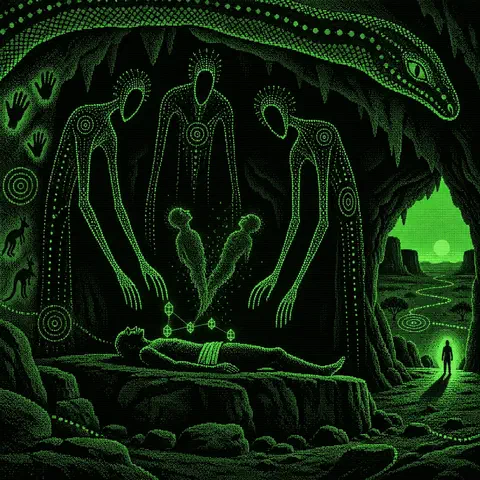
In an Arunta account, a man lies down to sleep at the entrance of a cave near Alice Springs. Invisible beings kill him, carry him inside, remove his organs, and give him another set. When he returns, he has a new name and new powers.
Grafton Elliot Smith recounts this Arunta medicine-man initiation in the 1932 revised edition of In the Beginning. The beings are the Iruntarinia, whom Smith describes as doubles of ancestors or living people. Smith reads the episode through Egyptian embalming and Osiris: the dead person is restored as a more powerful being. His source is Baldwin Spencer’s The Arunta. What interests me is the operation itself. The candidate survives having his organs removed and another set put in. (Smith, pp. 68–69.)1
The Snake Cult interpretation begins here: death-and-rebirth initiation preserves a memory of learning to make a self. A person could endure the death of an identity, or of the powers that seemed to govern him, and discover that someone remained to inhabit the body. The returned person could then be named, taught, and recognized. A frightening discontinuity became the foundation of a more durable life.
This develops a problem at the heart of the Snake Cult of Consciousness. An organism can acquire new capacities before it reliably knows how to live with them. A mind that models other minds, remembers their judgments, and hears its own thoughts has gained an extraordinary power. It has also acquired a population of possible speakers. Becoming a self requires some way of deciding who speaks for the whole.
A mind can contain more than one claimant #
We usually tell the story backward. There is already an I, and then it has conflicting thoughts. It wants to leave and wants to stay; it condemns a desire and pursues it; it imagines what a parent would say. The single owner of these events is taken for granted.
But owning an experience and undergoing it are different achievements. A remembered command can feel like an instruction from someone else. A fear can become the perspective from which the entire world is seen. A role can organize a person’s behavior so completely that another way of living becomes almost inaccessible. The question is how these events are gathered into one life with enough continuity to act.
William James gave this problem a precise formulation in The Varieties of Religious Experience. In his lectures on the divided self and conversion, groups of aims compete for centrality. Transformation occurs when their organization changes: what once occupied the margin becomes the place from which a person lives. His phrase is the “habitual centre of his personal energy.” (James, Lectures VIII–IX, especially pp. 193–197.)
That gives us a useful meaning of parts of the self. A part can be a way of acting, an identification, a remembered authority, or a cluster of expectations that repeatedly takes command. It need not be a miniature person sealed inside the skull. Several such organizations can claim the same body, each briefly presenting its priorities as the whole truth.
Schizophrenia is not another name for this ordinary plurality, nor for dissociative identity disorder; epilepsy is different again. Psychiatric work does, however, take disturbances of selfhood seriously. Louis Sass and Josef Parnas describe schizophrenia in terms of altered self-presence and experiences in which aspects of oneself become strangely object-like. The clinically relevant issue includes how an experience belongs to its subject, not simply how many voices are present. (Sass and Parnas, 2003.)
The evolutionary proposal is that a stable author of experience had to become easier to develop and maintain. Earlier forms of human life could have accommodated a more divided experience of agency, with thoughts and commands distributed among ancestors, spirits, and social roles. This is a proposal about the history of organizing experience, not a diagnosis of prehistoric people. Contemporary Arrernte people possess their own histories and theories of personhood; they are not living specimens of an unfinished human mind.
What can die while the person lives? #
The crucial discovery would have been that a commanding identity can end without the organism ending. The frightened child, the possessed sufferer, the person ruled by a particular demand: each can cease to define who is present. Experience continues. Someone can look back and say that the former life belonged to a person who has died.
In this reading, the ritual death kills a claim to be the whole self. Its force comes from making that loss feel complete. A new identity becomes possible because the old one no longer has an unquestionable right to return and take command.
This is the sense in which other parts could die. Their memories and capacities need not be destroyed. What ends is their sovereignty. An impulse can become something I experience rather than the being I am; a remembered command can become a memory rather than my master. The survivor acquires room to choose among events that once claimed to choose for him.
The cave account makes an interior transformation bodily. Organs are concrete constituents of a person. Replacing them expresses a change too extensive to describe as learning a new fact. The old interior is gone, yet the person lives. Smith’s new name gives the rupture a place in the social world: people can address the returned person as someone with a different standing and different powers.
The distinction between bodily presence and a life narrated across time helps here. Ritual rebirth need not create sensation or awareness from nothing. It can reorganize the identity that gathers experiences, anticipates a future, and answers for what the body does. The breakthrough is a person who can survive the collapse of one account of himself and sustain another.
Returning takes longer than dying #
An earlier version of the account contains a detail Smith’s summary leaves out. In The Native Tribes of Central Australia (1899), Spencer and Gillen describe the candidate’s return as followed by several days of strange behavior, using the historical term “insanity.” Recovery is recognized when he appears with a charcoal-and-fat band across his nose. He then waits about a year before practicing and learns from established medicine men. (Spencer and Gillen, chapter XVI, pp. 523–525.)
That sequence matters. Death is an episode; becoming the returned person is a discipline. The narrative provides a destination for an unsettling experience. Other people recognize its completion, and apprenticeship supplies something to do with the new identity. The healer’s powers acquire a place among obligations, relationships, and learned practices.
| Element in the accounts | Its function in the proposed reading |
|---|---|
| Death | An earlier identity loses its final claim on the person. |
| Replacement of the interior | Change is experienced as remaking the person from within. |
| New name and powers | The returned person receives a publicly intelligible identity. |
| Recognition and apprenticeship | Other people help make that identity durable. |
This reading makes the proposed mechanism concrete: an experience of rupture becomes a life that can be practiced.
Modern research gives cultural teaching a real role in experiences of agency. Tanya Luhrmann and colleagues interviewed sixty people with psychosis in the United States, India, and Ghana. Accounts of voices differed across the three settings, including how relational or threatening the voices seemed. A later study of twenty-two voice hearers without a need for clinical care found that many described learning to interpret and manage spirit communication. Some sought a practice to organize experiences they already had; others described experiences emerging after they took up a practice. Cultural frameworks could shape what was experienced as well as how it was understood. (Luhrmann et al., 2015; Luhrmann et al., 2023.)
A workable self can therefore include relationships with voices and spirits. Coherence does not require an empty inner world. It requires a way to live among its inhabitants without being continually dispossessed. That makes training and recognition central to the argument. The ritual’s achievement would be a new relationship to competing powers, sustained by a community that knows how to address the person who returns.
A modern life told through death and resurrection #
Eckhart Tolle gives the division an unusually direct formulation. At twenty-nine, after years of anxiety and episodes of suicidal depression, he lay awake repeating: “I cannot live with myself any longer.” Then the sentence struck him as peculiar: “Am I one or two?” The person who could no longer endure his life and the self he could no longer endure had become separable. He describes fear, a sensation of falling into an inner void, and then waking to a world that seemed newly alive. He reports five months of uninterrupted peace, followed by a less intense but enduring underlying peace. His later interpretation was that the suffering identity had collapsed while awareness remained. (Tolle, The Power of Now, Introduction.)
This is a first-person account of a sudden change in self-experience, not a clinically verified cure. Its relevance is the precise discovery the initiation image makes available: what feels like the whole self can fall away while someone remains to experience the world.
A clinical case pairs a self-reported death-and-rebirth experience with clinician-rated symptom scores. In 2022, Yale researchers described “Daniel,” a pseudonym for a thirty-three-year-old with longstanding, treatment-resistant OCD. During one supervised psilocybin session, he felt his “whole body compost into the ground,” then described “growing back into myself.” He experienced becoming a tree and being reborn as a human. His acute OCD rating fell from 23 to 2 within 48 hours, before the first integration session; his standard severity score was zero at 12 weeks. He attributed his new ability to accept obsessive fears to having experienced death. The program included preparation and follow-up support. In informal contact at one year, he reported remaining OCD-free. He also reported that, sometime between nine months and a year and a half after dosing, a major stressor brought “crushing anxiety” and a recurrence of significant OCD symptoms, which faded after about two weeks of deliberately processing the emotions involved. (Kelmendi et al., sections 2.2–3.1; full report, pp. 3–6.)2
OCD is a different condition from schizophrenia or dissociative identity disorder. The comparison concerns a change in how a person inhabits his own mental life. Tolle’s suffering identity loses its claim to be the whole person; Daniel’s fears lose their power to dictate his responses. In both accounts, transformation becomes possible when an old organization of experience ceases to command the person who survives it. That is the psychological possibility the image of an initiatory death makes concrete.
The Snake Cult as a school for surviving oneself #
In the Eve Theory of Consciousness, reflective selfhood has an evolutionary and cultural history. The original Snake Cult argument proposes that transformative experiences and the practices built around them helped a new form of reflective self-awareness become established. The medicine-man account gives that proposal a sharper psychological target: the capacity to remain a person while a former identity loses its grip.
An early reflective mind would inherit bodily wants, memories of other people’s demands, and models of minds that could be turned inward. In the model developed here, these capacities initially produced unstable combinations of agency. Initiation helped organize them by giving the person an experience of discontinuity and a recognized route back. What began as a difficult achievement could be taught, repeated, and woven into growing up.
That is the proposed cultural memory: a practice for making someone who could survive himself. The death of an earlier self became an event ancestors had undergone, then an event ancestors could perform upon the living. Its transmission did not require a theory of cognition. It required people who knew the sequence and could recognize a return.
Related initiation traditions make the bullroarer and churinga especially interesting. Spencer and Gillen describe sacred objects associated with ancestral persons, including smaller bored wooden churinga used as bullroarers. Drawing on Howitt’s account of Kurnai initiation, they describe the sounded instrument as an ancestral presence revealed to novices. An identity can have a material anchor; an ancestor can acquire an audible voice. The bullroarer essay and the Atlas’s account of churinga and the soul follow that relationship between person, object, and sound. These are ways a community can make an invisible source of agency something encountered, named, and taught. (Spencer and Gillen, chapter V.)
The serpent belongs here through the larger Snake Cult theory of transformation, death, and renewed life. An animal that leaves its old skin behind gives this interpretation a precise image: the boundary that once enclosed the living creature can be discarded while the creature continues. The cave passage itself contains no snake, venom, or identified drug. Its contribution is psychological: it describes a person remade inside and returned with another standing in the world. It supplies a model of what an initiation sought to accomplish, without supplying the pharmacology proposed elsewhere in the theory.
The biological extension is a further hypothesis. If stable reflective agency mattered for living successfully, inherited differences affecting its development could have come under selection alongside the cultural practices that supported it. The account cannot establish that selection occurred, much less date it. Its strongest contribution concerns the cultural work that the image of rebirth could preserve: making a difficult form of selfhood attainable and then giving it a home.
The initiate leaves his former interior in the cave. In Smith’s telling, he returns with a new name; in the earlier account, he enters an apprenticeship. What comes back can be taught to heal and given obligations. In the Snake Cult reading, this is a memory of a profound discovery about human life: something that feels like the whole of you can die, and you can remain. Other people recognize the survivor and teach him how to live. The person who returns can answer for the life that continues.
Sources #
- Smith, Grafton Elliot. In the Beginning: The Origin of Civilization. Revised and enlarged edition. Watts, 1932, pp. 68–69.
- Spencer, Baldwin, and F. J. Gillen. The Native Tribes of Central Australia, chapter XVI. Macmillan, 1899, pp. 523–526. See also chapter V, on churinga.
- James, William. The Varieties of Religious Experience. First published 1902; Project Gutenberg text of the 1917 edition. Lectures VIII–IX.
- Sass, Louis A., and Josef Parnas. “Schizophrenia, Consciousness, and the Self.” Schizophrenia Bulletin 29(3), 2003, pp. 427–444. doi:10.1093/oxfordjournals.schbul.a007017.
- Luhrmann, Tanya M., R. Padmavati, Hema Tharoor, and Akwasi Osei. “Differences in Voice-Hearing Experiences of People with Psychosis in the U.S.A., India and Ghana.” British Journal of Psychiatry 206(1), 2015, pp. 41–44. doi:10.1192/bjp.bp.113.139048.
- Luhrmann, Tanya Marie, Xialing Ann Chen, David Baumeister, and Emmanuelle Peters. “When Spirit Calls: A Phenomenological Approach to Healthy Voice-Hearers.” Schizophrenia Bulletin Open 4(1), 2023, sgad025. doi:10.1093/schizbullopen/sgad025.
- Tolle, Eckhart. The Power of Now: A Guide to Spiritual Enlightenment, Introduction. First published 1997; excerpt reproduced on the author’s official website.
- Kelmendi, Benjamin, Stephen A. Kichuk, Giuliana DePalmer, Gayle Maloney, Terence H. W. Ching, Alexander Belser, and Christopher Pittenger. “Single-dose psilocybin for treatment-resistant obsessive-compulsive disorder: A case report.” Heliyon 8(12), 2022, e12135. Open full text; PDF.
- Cutler, Andrew. “The Snake Cult of Consciousness.” Author’s theoretical framework; and “This Is Your Body.” Bullroarer Atlas, on sacred objects, personal identity, and ancestral voices.
The editions and source layers matter. Smith’s detailed passage is verified in the revised Thinker’s Library edition of 1932, pp. 68–69. He cites Spencer’s The Arunta (1927), II, pp. 391 ff.; the closely parallel 1899 account is independently readable. Spencer and Gillen present the invisible operation as what is said to occur, alongside their own often dismissive interpretations. A separate account of initiation by human practitioners begins on p. 526. The supernatural operation should not be converted into an eyewitness surgical report, and the observers’ psychiatric vocabulary is no diagnosis. ↩︎
Tolle supplies a retrospective account, with no independently established clinical diagnosis; his subsequent life also included nearly two years without a job or home. Daniel’s diagnosis was OCD. His acute and standard Yale–Brown ratings cover different time windows; formal assessments ended at twelve weeks, followed by informal contact. The case cannot isolate the contribution of the drug, death-and-rebirth experience, preparation, or support. ↩︎