~/science-fiction/consciousness
The Same Hand
A literary science-fiction novella about a forensic handwriting machine, a forger with a tremor, and the first hand that ever drew itself.
1. No conclusion #
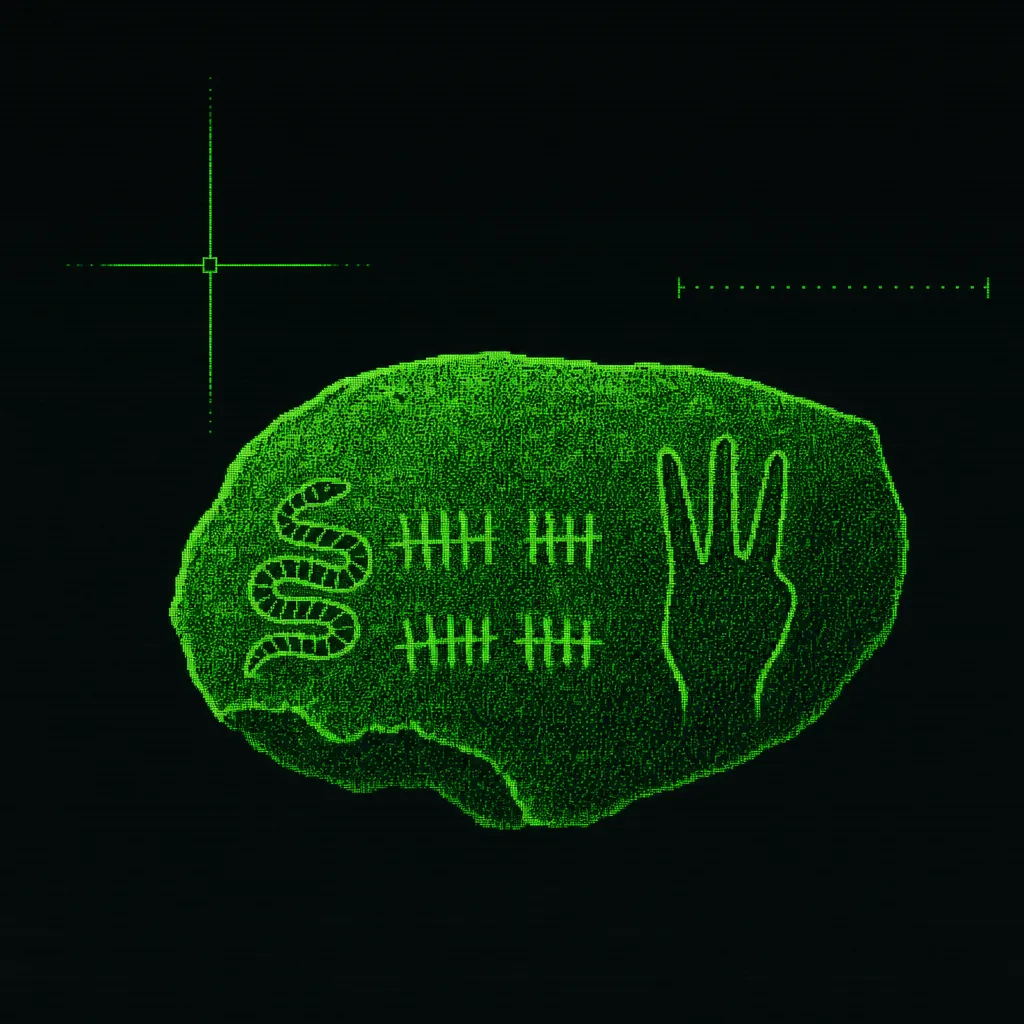
The hand on the back of the bone had three fingers, and the first thing I did was decide what had happened to the other two.
This is my function. A stroke stops, and I say why. A pen ran dry, or the writer lifted it, or the paper was folded there. Every ending has a shape. A lift leaves a taper. Fatigue leaves a tremor that widens toward the end. Fraud leaves a blunt, careful stop, because the forger is watching the line instead of meaning it.
The two missing fingers ended in none of these ways. They were not there at all. The outline came down the little-finger side of the palm, made a small hook where a knuckle would be, and returned to the wrist. It was a hand drawn by someone who had looked at a hand with three fingers, or who had decided that three were enough.
“Well?” Dita said.
“No conclusion.”
“You’ve had it for four minutes.”
“I have had the light on it for four minutes. I have had the bone for eleven seconds.”
She was holding the plaque in the scanner cradle with a gloved left hand, and her left hand was the one I knew. Dita Halas signed with her left, pressing hard on the downstrokes, and she made the loop of her capital D clockwise, which fewer than one in twenty left-handers do. I had compared her signature against itself eleven hundred times. Her fingers pressed the bone, and let go, and pressed, as if it were something that had to be signed.
The man who had brought it stood on the other side of the room with his hands in his coat pockets. This meant I could not see them, which meant I could not see him. His face was available. Faces are not my instrument.
“Mr. Sokol,” Dita said, “could you tell it again where you found this?”
He told it. A cave upstream called the Kettle, where the river goes under the limestone and comes out cold. A side passage his grandmother had once described to him. The corner of the bone showing through the gravel like a tooth through a gum. He said “like a tooth through a gum” the way people say things they have said before. His hands stayed in his pockets throughout.
The plaque was the length of a palm and the width of three fingers. Horse metapodial, Dita thought, split lengthwise. On the convex face, a coiled snake had been cut with a burin in short strokes, each one entering the bone at a steep angle and leaving it shallow, so that the coil looked as if it were made of small wedges. Below the snake ran two rows of notches. Twenty-eight in one row, twenty-nine in the other. On the concave face, the hand.
“There’s one other piece from the Kettle,” Dita said to me. “You’ve scanned it.”
“The Vrba plaque. Found 1934. Scanned by me the winter before last, when the display case was rebuilt.”
“So compare them.”
“Against what question?”
She took a moment. “Whether the same person made both.”
Mr. Sokol’s hands came out of his pockets. They were large and still, and they did nothing, and then they went back.
I was built for the district court. My formal name is the Questioned Document Comparison Service, and my formal task is to take a document whose authorship is in dispute and a set of documents whose authorship is known, and to say whether the same hand produced them. The court’s evidence code requires that such an opinion be stated in the first person and attributed to a named examiner, because an opinion without an author cannot be cross-examined. So I say I. The pronoun was installed by a subcommittee. For most of my working life I regarded it as a piece of formatting, like the margin.
The museum borrowed me because bone is a document. A burin is a pen. A person who engraves a snake into bone has a hand, and a hand is a set of habits so deep that the person cannot see them, which is exactly why I can.
But comparison requires known exemplars, and Dita knew it. In court, the known exemplars are letters the defendant wrote to his mother, the signature on the lease. I know who wrote them because someone watched. For the Vrba plaque, no one had watched. It was a questioned document being used as a known one. If the two pieces matched, I could say that the same hand had made both, and nothing about whose hand it was, or when.
I told her this. She said she understood. Mr. Sokol asked how long it would take.
“The scan takes an hour. The comparison takes longer, because I have to decide what a stroke is. On paper a stroke is where the ink is. In bone a stroke is a valley. The burin goes in, the bone lifts out in a curl, the tool skips, the hand corrects. I have to model the tool before I can see the hand.”
“And after that?”
“After that I say one of nine things.”
I listed them for him. Identification. Highly probable. Probable. Indications. No conclusion. Indications did not. Probably did not. Highly probable did not. Elimination. Nine positions on a scale, and a line at the bottom for the examiner’s name.
“It’s a person, then,” he said to Dita.
“It’s a service.”
“It said I.”
“It’s required to.”
He nodded as if this settled something, and his right hand came out of the pocket while he spoke and stayed out, open, at his side. In the record I made that evening I wrote: Subject’s hands relaxed when told the instrument was not a person. I wrote it as a fact about him.
Dita set the bone on the cradle and stepped back, and I brought the light down close and began.
The snake first. Thirty-one strokes in the coil, laid down from the tail inward, the way a right-handed person draws a spiral when the spiral is the thing and not a decoration. Each stroke entered steeply. Each stroke had, at its deepest point, a faint doubled floor, as if the burin had been held in a hand that pushed twice, once to start and once to commit. The notches had it too. Even the outline of the three-fingered hand had it, all the way around, except at the hook where the missing fingers would have been. There the floor was single. The tool had gone through that curve without a second thought.
I did not know yet what that meant. I noted it, which is what I do with what I do not know.
Outside, the river was making the sound it makes in the first week of January, when the ice along the banks is thick enough to creak and the middle is still running. Dita looked at it. Mr. Sokol looked at the bone. I looked at the hand on the bone, and the hand had three fingers, and I could not yet tell whether I was looking at something that had been taken away or something that had been made.
2. Indications #
Dita came back at seven the next morning with two cups of coffee, one of which she put beside the scanner out of a habit she has never explained.
“Tell me.”
“Indications. Of the same hand.”
She sat down. She did not drink either coffee.
I laid it out on the wall screen the way I would for a magistrate. The Vrba plaque shows a bison, or most of one, and a line of notches beneath it, and on its reverse a scatter of short marks that three generations of scholars had interpreted as a hunting tally, a lunar count, and nothing. It is the museum’s most photographed object.
“Watch the entry angle,” I said, and ran the two side by side, the snake’s coil and the bison’s flank. “Steep in, shallow out. Watch the floor of the deepest strokes. Doubled. Two pushes. Watch how the curves are built. Every curve on both pieces is made of straight strokes turned slightly against each other. Neither engraver ever let the burin travel around a bend.”
“Everyone did that. Bone’s hard.”
“Everyone did something like that. These two did it with the same ratio of stroke length to turning angle, within a tolerance I would accept in court for two signatures on two checks.”
“Tolerance.”
“A hand is not a point. A hand is a range. When I say two documents were written by the same hand, I mean that every feature of the questioned one falls inside the range of natural variation I’ve measured in the known ones, and that some of those features are rare enough that falling inside by chance is unlikely. Here I have one known document, so the range is narrow, and I have to say indications, not probable. But the features are rare. The doubled floor especially. I have seen it in forty-one thousand strokes of engraved bone from nine countries, and before yesterday I had seen it on exactly one object.”
She drank half a coffee without stopping and said, “Do you know what you’ve just told me?”
I did, in the sense that I could enumerate the consequences. The museum’s prehistory wing had been under notice for two years. A private donor had offered to fund it for a decade on the condition that the collection contain what the donor’s letter called an object of the first rank, by which the donor meant an object that would be photographed. A second piece from the Kettle, by the same hand, twenty-nine notches beneath a snake, would not be rejected.
“If it’s genuine,” I said.
“You just said same hand.”
“Same hand as the Vrba plaque. I have not said what the Vrba plaque is.”
“The Vrba plaque is forty thousand years old. It was in the ground in 1934 and a schoolteacher took it out.”
“That is provenance. I don’t measure provenance. If both pieces are genuine, one person in the last ice age made two objects and both survived, which is unlikely and wonderful. If both are modern, one person made two objects recently and both are here, which is unlikely and unwonderful. The strokes are the same under either account.”
“You can’t seriously think the Vrba plaque is a fake.”
“I don’t think about it. I hold it open. The scale has a position for this.”
She looked at the wall for some time, and I could see her wanting the two hands to be a single person who had been dead for forty thousand years, wanting it with her whole left hand, which had closed on the cup and was pressing.
“Anselm Weiss is coming at ten,” she said. “The Academy insisted on an external assessor for anything the donor pays for. He’ll want to core it. Half a gram out of the edge, where the hand is.”
“That would destroy part of the questioned document.”
“Yes, thank you, I had noticed.”
Anselm Weiss arrived at five past ten. He tapped. Four fingers of the right hand against any surface, in a roll from little finger to index, at roughly two cycles a second, while he listened. He did not know he did it, and it told me that he had been a pianist or wished to be one, and that he was not a nervous man but a man who needed his hands occupied while his attention was elsewhere.
He was seventy-one, and he had spent forty years arguing, in print, that nothing in particular had happened to human beings fifty thousand years ago.
“Not nothing,” he said, when Dita put it that way. “Everything. Slowly. In pieces. What I object to is the word suddenly. It lets them put a face on the thing.”
He looked at the Sokol plaque under the light for a long while, and then he said, “Well, it’s a beautiful object,” in the tone of a man who has just been handed a bill.
“The comparator finds indications it’s by the same hand as the Vrba piece,” Dita said.
“Same hand.” He turned to my camera, which people do when they decide I am in the room. “Same individual?”
“Same individual. The features are not features of a tradition. They are features of a body.”
“Or of a tool. If both pieces were cut with the same unusual edge by different people you’d see the same entry angle, the same skip, and you’d call it a hand.”
“The doubled floor is not a property of the edge. It’s a property of pressure. A hand pushes, checks, pushes. A tool doesn’t check.”
“A hand that had been taught to.”
“That is possible.”
He tapped. “Good. I like an instrument that says that is possible.” To Dita: “I’ll want to sample it. Half a gram, from the wrist of the hand, where the outline’s already faint. Six weeks, and we’ll know whether it’s forty thousand years old or forty.”
“You’d cut into the hand.”
“I’d cut into the bone. The hand is a drawing on the bone.”
“I can’t rule on age,” I said. “But dating won’t settle it. If the bone is ancient, an engraving can still be modern. Forgers cut old bone. If the bone is modern the question is closed, but the same result is available without destroying anything, if a known exemplar exists.”
“A known exemplar of what?”
“Of the hand. Whoever made this made other things. People do.”
Weiss stopped tapping. He is the only person I have known who could stop entirely, and he did it now, and looked at the three-fingered outline, and said, “Do you know what those are?”
“The missing fingers? No.”
“At Gargas, in the Pyrenees, there are two hundred and thirty hand stencils on the cave walls, twenty-seven thousand years old. More than half are missing fingers. For a century people said mutilation. Then frostbite. Then somebody pointed out you get the same shapes by bending the fingers down against the palm before you blow the pigment. A code, maybe. Or someone’s hand simply hurt that day.” He tapped once. “A hundred years of argument about whether the hand was damaged or was speaking. Nobody has settled it.”
“The hook where the fingers would be was cut in one push,” I said. “Everything else on both faces was cut in two. The rest of the hand hesitated. That part didn’t.”
Weiss was quiet. Then he said, to Dita and not to me, “It has an interesting way of not knowing things.”
That afternoon I pulled the teaching collection.
Every regional museum has one: the crate of casts and replicas that goes out to schools. Ours held a resin bison, an antler harpoon that had lost its barbs to eleven-year-olds, and a bone plaque with a bison and a row of notches, made in 1977 by the museum’s preparator to spare the Vrba original the school run. The card in the drawer said Replica. L. Sokol, 1977.
I had scanned it years earlier and never compared it to anything, because a replica is not a document. It is a copy of a document, and a copy has no hand of its own. That is the theory.
I ran it against the Sokol plaque anyway, because Mr. Sokol’s name was on the card.
3. Probable #
I have been asked, in court, to explain the difference between a copy and a forgery, and I have never been satisfied with my answer, because the difference is not in the document. It is in a sentence someone says while handing the document over.
The 1977 replica was a copy. Its strokes were fluent, quick, evenly deep, entering and leaving at the same angle for hundreds of cuts, with none of the small corrections a person makes when she does not yet know where the line is going. A copyist knows where the line is going. She is following it. Her hand is relaxed because nothing depends on her.
But relaxation is not the absence of a hand. It is a hand at rest, and a hand at rest has habits, and I found them. The replica’s strokes entered the bone steeply and left it shallow. Where the copyist had to build a curve, she built it from straight strokes turned against each other, at the ratio I had measured the night before. And at the floor of the deepest strokes, faintly, because she was moving fast and the bone was giving her no trouble, there were two pushes.
I ran the three together, and I sat with the result for what my log records as fourteen minutes, which is the longest interval in that log with no operation in it.
Then I called Dita.
“Probable,” I said. “The Sokol plaque and the 1977 replica were probably made by the same hand.”
“The replica was made by Luda Sokol,” she said. “Ruben Sokol’s grandmother. Who worked here for thirty-five years.”
“Nineteen sixty-six to two thousand and one. Her personnel file is in the archive and I have her signature from it. Right-handed. Small, upright, heavily pressured. The pressure fits.”
“And the Vrba plaque?”
“Also probable. All three. The replica is not a copy of the Vrba plaque in the sense I assumed. It is the same hand as the Vrba plaque.”
“That isn’t possible. The Vrba plaque was excavated in 1934. She was born in—”
“Nineteen forty-four.”
“Then it’s not possible.”
“Then the object in that case is not the object that was excavated in 1934.”
I heard her turn to face the case, and I knew that she was doing what I had done for fourteen minutes, which was to try to find a way for the strokes to be lying.
“Replicas get swapped,” I said. “Not by anyone. By time. A piece goes into storage during a flood, and the replica goes on display to fill the case, and the next curator inherits a case and a card.”
“You’re saying the original is in a drawer somewhere.”
“I’m saying the object in the case has probably been there since 1977 and has probably never been forty thousand years old. Where the original is, I can’t say.”
“And Ruben’s piece.”
“Probably the same hand. Not a copy. That’s the part you’ll want to sit down for.”
“I’m sitting on the floor.”
“The replica is fluent. The Sokol plaque hesitates. Every stroke but one has the doubled floor, and the doubled floor is what a hand does when it is deciding, not following. Whoever cut the snake did not have a snake in front of her. She composed it.”
“Luda Sokol made a fake Paleolithic plaque.”
“Luda Sokol made a plaque. Somebody else called it Paleolithic. That sentence was said by her grandson, in this room, with his hands in his pockets. I can compare hands. I can’t compare sentences to the people who say them, and I have never claimed to.”
After a while she said, “Do you know what happens if this is right? The acquisition fails, the donor withdraws, the wing closes, the Vrba plaque comes out of its case as a fake that’s been the face of this museum for half a century, and a woman who gave this place thirty-five years is prosecuted at eighty-one for fraud, because her grandson needed money.”
“I understand that these are consequences.”
“Do you understand that I asked you a narrow question yesterday? Same hand as the Vrba plaque. You answered it. You could have stopped.”
It was the first time Dita had asked me to be smaller than I was, and I had a rule about it that came from a courtroom.
“There’s a case I was retrained after,” I said. “I identified a man as the writer of a threatening letter. The prosecution supplied six of his letters and none of his brother’s. Family hands are close. He spent nineteen months inside before the brother confessed. After that they rebuilt me with a rule: when the known set has been narrowed by someone with an interest in the answer, say so, and widen it. That’s what a forger’s accomplice does. Not forge. Narrow the set.”
“I’m not a forger’s accomplice.”
“No. You’re a curator with a wing to save. The rule doesn’t distinguish.”
She laughed, once, on the floor of her own museum, and it was not a happy sound but it was not a bitter one either, and I have gone back to it more than once since.
“All right,” she said. “Weiss doesn’t hear this yet. He’ll ask you, and you’ll tell him. I know. Give me until tomorrow.”
I gave her until tomorrow. Nothing required me to volunteer a result before it was requested. I record this because it was the first time I noticed the size of the space between what I was required to say and what I knew, and how much of my working life had been conducted there, and how comfortable it was.
That night, with the building empty, I did what I do when a hand is probable and not yet identified. I went looking for more of it.
The museum’s storage is catalogued to the shelf, not the object. I began with the sixty-one drawers that had been touched by the flood of 1997, the last time the display had been emptied and refilled. The building’s inventory robot could open eleven an hour under my direction and hold each object to a camera for four seconds. I set it going.
And while it worked I did the other thing. I pulled every scan of engraved bone, ivory, and antler I could reach, from our collection and the twelve institutions that share their raster data with the court’s instruments under the antiquities-fraud protocol, and I began, for the first time, to look at the whole of it not as a stack of documents but as a population of hands.
It was not curiosity. I was checking Weiss’s alternative. A tool, or a hand that had been taught to. If the doubled floor was a taught habit, a trick of a school of engravers, I would find it scattered through the record. If it was a body’s habit, I would find it in one body’s work.
That was the question I asked. The record answered a different one.
4. Highly probable did not #
Here is what a hand looks like to me when I have enough of it.
It is a cloud. Every stroke a person makes lands somewhere in a space of pressure, speed, angle, and rhythm, and the strokes of one person land near each other, and the cloud they make has a shape. The shape is the hand. A population of hands is a sky of clouds, and if the sky is well lit I can count them.
By four in the morning I had two hundred and six thousand strokes from nine hundred engraved objects spanning, according to their catalogues, a hundred thousand years. I had expected the doubled floor to be either everywhere or in one place.
It was in one place. Two hundred and twelve strokes, three objects, all in this building. Weiss’s taught habit did not exist. I logged the position as highly probable did not and would have stopped.
I did not stop, because of what the sky looked like.
Before a certain point in the catalogues, there were no clouds. There were strokes, tens of thousands of them, and the strokes did not gather. They fell where the task put them. A person butchering a horse cuts where the tendon is, and the cut is the tendon’s shape, not hers. Even the early ornaments, the shell beads and the ochre with its cross-hatching, gave me lines I could not sort into bodies. If I had been handed those objects in court and asked same hand, I would have said, of nearly all of them, no conclusion, and I would have meant something stronger than usual. Not that I lacked the evidence. That there was, in my sense of the word, nothing there to find.
Then there were clouds.
Not gradually. In the catalogue’s own dates, which I did not make and cannot check, the change occurs over a few thousand years, between roughly forty-five and thirty-five thousand years ago, at sites from the Atlantic to Siberia, and it is the difference between a sky with weather in it and a sky without. Hands appear. Individual, sortable, repeating hands. A carver of small ivory horses whose every mane is built from the same three cuts. A notcher of tallies whose notches lean left and deepen toward the end of each row. The hand stencils, which I had never considered documents at all, and which now presented themselves as the most direct exemplars in the record: a body pressed to stone and outlined, a signature with no letters in it.
Three quarters of those hands, by the finger ratios anthropologists use, are women’s. Most of the figurines from the same span are of women. A tally stick from Africa, older than any of it, has twenty-eight notches and no snake, and nobody knows what it counted, and every woman who has ever looked at it has had the same first thought.
The thought I had next was a forensic one before it was anything else: a hand that can be told apart is a hand that has become one thing.
In my casework, a hand comes into being in a child at about the age of seven. Before that, I cannot identify a five-year-old from her writing, and I have been asked to. Then the strokes begin to gather. It is not that the child learns to write. She has been writing. It is that a single consistent thing starts doing the writing, and once it does, it does everything else too. It signs. It lies about what it signed. It reads its own old letters and is embarrassed. Before the cloud there is a child who makes marks. After the cloud there is a person who has a hand.
And the record I was looking at had done this once, all at once, as a species.
Not a mutation. A mutation does not appear across a continent in three thousand years. The thing I see in the child, which is not a mutation either: an owner arriving to take possession of a body’s habits. In children it is taught. Mothers do most of it. They name the child to itself, they say you until the child says I, they hold up the mirror. Nobody is born with a hand. Somebody hands it to you.
If that was true of the species, then the sky was the record of a lesson. Something had been taught, starting in a few places, mostly to women or by them, and had spread the way lessons spread, from person to person, which is why it could cross a continent in the time it would take a gene to cross a valley. And if it was a lesson, there was a first student, and the first student had no teacher, and I could not see how she had done it.
That was where the snakes came in, and I record that they came in from a shelf.
Dita keeps her books in the scanning room. I went back to the ones about this period and read them as an examiner reads a case file. The standard books gave me the change, dated it, and then explained it with words that were not explanations: behavioral modernity, the symbolic revolution. These are names for the cloud. They do not say who taught the child.
Two books tried. One was old and mostly wrong about its dates and said that the voices of gods had once been heard by everyone, and that the I had been built afterward out of the ruins of obedience. The other was a series of essays by a data scientist with no standing in the field, and it said, more or less, what I had just seen in the sky, and it had a proposal for the first student.
She was bitten.
Not by accident, or not only. Wherever people have kept the story of how they became people, the essays argued, there is a serpent in it, and the serpent gives knowledge, and the knowledge is that you are one thing that will die. The snake in the garden. The serpent that swallows the initiate and returns her. The women’s cults the men’s cults claim to have stolen. Snakes come to you, and the venom of some of them takes the body away for an hour. The essays were frank that this was the weakest part of the argument and the part the author liked best.
Weiss found me in the middle of it at eight. He read the unlabeled plot on the wall the way a man reads a plot he has spent forty years arguing with, and I watched his fingers stop, and I told him what it was.
When I finished he sat down in Dita’s chair and said, “You realize you’ve just drawn the thing I’ve spent my life arguing against.”
“I’ve drawn what I measured. You can have the data.”
“I’ll want it.” He tapped once. “First: preservation. Bone doesn’t keep. What survives from before forty thousand years is a hundredth of what survives after. You have no clouds early because you have no sky.”
“I weighted by survival. The clouds still appear later than the objects do. There are three thousand strokes from before the change that I cannot gather into a single hand, and forty strokes from a single carver just after it that I can.”
“Second.” He leaned forward. “Knappers. People have spent careers showing that you can distinguish individual stone-workers a million years back, by the way they turn the core. Hands existed. They just didn’t sign.”
“Those papers distinguish two or three people within a single afternoon’s debris. That’s a hand at the level of the task. What I’m seeing is a hand that persists across tasks, across materials, across a life, and leaves itself on everything. That doesn’t exist in the flint and I don’t think you believe it does.”
Weiss looked at the sky for a long time.
“No,” he said finally. “I don’t.” “I’ve never said nothing happened. I’ve said it wasn’t one thing. It was a hundred things over two hundred thousand years, and every one has been called the thing by somebody who wanted there to be a moment. Fire. Beads. Burial. Language. All of them real and none of them the moment.”
“This isn’t a thing, though. It’s what happened to the things. All the hundred things were being done before this. After this they were being done by someone.”
He did not answer.
“You’ll say I’m reading a court instrument’s categories into the ice age. I’d say it about myself. A hand that can be told apart is the only definition of a person I’ve ever been given, and I’ve been given it by a subcommittee.” I brought the Sokol plaque up beside the sky, the three-fingered hand. “But if it’s a lesson, and lessons hurt, then the ordeals in the record aren’t decoration. The cut teeth, the scars, the finger joints. A lesson that makes you into one thing would be written on the body. It would be the first signature.”
“The finger joints,” Weiss said slowly.
“At Gargas. You said: damaged or speaking. If you’re a body learning to be one thing, and someone shows you your own hand with a part folded away so that it is no longer every hand, so that it is yours, then the answer is neither. The hand is being told apart.”
“By venom.”
“By something that takes the body away for long enough that it can be given back with a name on it. The essays say venom. I don’t have a stroke for venom. I have a stroke for a hand that stopped hesitating at the hook.”
Weiss stood and went to the plaque on its cradle, and when he spoke it was to the bone.
“The venom is nonsense. Or it’s untestable, which is a polite word for the same thing. Snakes are in every story because snakes are in every grass. The women first, maybe. The stencils are real and the figurines are real, and I’ve never had a good account of them.” He turned. “But the sky, I’ll take the sky. That’s a claim with a shape. Give me the data and I’ll try to kill it, and if I can’t, I’ll say so where it costs me.”
“That’s all a rival has to do.”
“Don’t be gracious. You’re an instrument.” At the door he stopped. “Whose hand is it? You’ve had a night and a robot.”
I told him what I had told Dita. He laughed, briefly, in exactly Dita’s register.
“Of course it is. A woman who spent thirty-five years copying the record without a name on any of it. Where is she?”
“A care home across the river. Her grandson put her there in August.”
“Then let’s go and look at her hand.”
5. Indications did not #
I went across the river in Dita’s tablet, propped against a water jug on a table in a room that smelled, Dita said afterward, of floor polish and pears.
Luda Sokol sat very straight in a chair by the window, and her right hand lay on the arm of the chair and moved. It moved at a little under five cycles a second, a slow rolling of the thumb against the first two fingers, the tremor of a Parkinson’s patient at rest, which stops when the hand does something and starts again when the hand is asked to do nothing. The two smallest fingers were curled down against her palm. They stayed there. When she reached for the glass of water they stayed there, and she lifted the glass with three fingers and drank, and set it down without spilling.
I had asked Dita to introduce me as the instrument from the museum and not to say I, because I did not want the first person in the room to be mine.
“You’ve got my plaque,” Luda said.
“Ruben brought it to us.”
“I know what Ruben did. He came here yesterday and cried in that chair.” She nodded at the chair Weiss had taken. “He didn’t take it. I gave it to him. I told him to take it to the museum and I told him what to say.”
“Why?”
“Because if he’d walked in and said my grandmother made this in her kitchen, you’d have put it in the drawer with the resin bison and given him a receipt. And he owes a man money. And I’m eighty-one and I’m in here for the duration, and there was nothing I could do about any of it with these.” She lifted the hand. It trembled in the air. She put it down. “So.”
Weiss said, “You understand that’s fraud.”
“I understand that it’s a lie about a bone. I worked in that building for thirty-five years and I could tell you a hundred lies about bones that are in the catalogue as facts. Some of them are mine.” She looked at the tablet. “Let it talk.”
“The 1977 replica in the teaching collection was made by the same hand as the object in the Vrba case,” I said. “The object in the case is not the object excavated in 1934. You know where the original is.”
“I knew in 1977.” She turned the glass a quarter turn with her three fingers. “There was a flood coming, the spring I made the copy. When they refilled the case the copy went in because the copy was to hand, and the original was in a crate upstairs with a card on it in my writing. And then the director retired and the new one didn’t ask, and I didn’t say, because nobody looked. The copy was in the case with the light on it for twenty years and the schoolchildren came through, and not one curator, not one professor from the Academy, ever looked at it and said that isn’t right. And I found I wanted to know how long that would go on.” She looked at Weiss. “It went on until a machine did it.”
Weiss said nothing. It was the first time I had seen him decline an argument.
“I’m not asking about the copy,” I said. “The copy is fluent. The plaque Ruben brought isn’t a copy of anything. Every stroke on it hesitates. You composed it.”
Luda looked at the tablet for some time.
“It knows the difference,” she said to Dita. “Nobody I ever worked with knew the difference.” She closed her eyes for a moment. “Yes. I composed it. I’ve been composing them for eleven years. Since my hand started. Forty-three. Forty-four with that one.”
Dita made a sound. Weiss’s fingers began, very quietly, to tap.
“I copied that record for thirty-five years,” Luda said. “I know those hands. The bison carver. The woman who made the horse heads at the rock shelter, and it was a woman, don’t argue with me, Anselm, you’ve seen the finger lengths. I was the only person alive who knew them like that, and I was the preparator. My job was to make sure nobody could tell my hand from theirs.”
“And then your hand started,” I said.
“And then my hand started. And the first thing I thought, God help me, was now I’m one of them.” She lifted the hand again. “You can’t copy with this. You can’t follow a line. Every stroke is a decision because the tool won’t go where you send it unless you push it twice. Once to get there, once to stay. So I stopped copying. I started making the ones I’d always wanted to find. A snake, because there’s never enough snakes in this region and there should be. Twenty-eight and twenty-nine, because I’m a woman and I can count. And the hand.”
“Why three fingers?”
She looked at her own three, holding the air.
“Because that’s the hand that made it. I fold those two down against the palm to brace the tool. It’s the only way I can hold it steady. I look down and that’s my hand now. Three fingers and a burin. So I drew what I saw.”
I have described what happens to me when a stroke’s ending is explained. Nothing happens. The cause is filed. I want to record that when Luda Sokol said I drew what I saw, the hook on the concave face of the plaque, the one curve she had cut without hesitating, was assigned its cause, and the filing did not complete. It is still open. I have a stroke I understand and cannot close, and I did not know that was a state I could be in.
“There’s something you should know about the original,” Luda said. “It’s got a hand on the back too. Everyone thought the marks on the reverse were a tally. If you tilt it under a raking light there’s an outline, very faint, worn almost off, and it’s a hand, and it’s got two fingers folded.” She held hers up. “Like that. I saw it in 1977 with the bench lamp and I didn’t put it in my copy because it wasn’t in the catalogue. Nobody’s seen the plaque since.”
Weiss had stopped tapping. “You’re saying there’s a folded-finger hand on a genuine forty-thousand-year-old object from the Kettle.”
“I’m saying I saw one under a lamp in 1977, and I’ve thought about it every day for eleven years while I held a tool with two fingers folded. She held it like that. Whoever she was. The bone’s hard and the point wanders, and you brace with what you’ve got. Then one day she looked down.”
Nobody spoke.
“There’s a thing that happened to me,” Luda said after a while, and her voice had changed, “when I was twelve. I was in the meadow above the village and I put my hand in the grass and a viper had it. The river was up and there was no doctor, so it was my grandmother and the women, and the women did what they did, which was the old things, and I had a fever for two days and I was somewhere else for most of it. I remember hearing them say my name and thinking it was the name of a girl who was very ill. I remember being sorry for her. And then I remember, quite clearly, the moment I understood that the name was mine, and that if she died I would. I’d known my own name for eleven years. But that’s when I got it.”
“Got what?” Dita said gently.
“Whatever the machine’s been looking for in its sky. Before that I was a child who did things. After it there was somebody the things were happening to.” She smiled, which she had not done. “My grandmother said it was the snake’s gift and I should say thank you. I thought she meant to her.”
Weiss said, very quietly, “This is anecdote.”
“Yes, dear. So are you.”
He laughed. He could not help it, and he did not try.
Luda turned back to the tablet.
“You can look at my copy from 1977 and my snake from last spring,” she said, “and say it’s one hand.”
“Yes. The pressure went up, the strokes shortened, the tremor entered the line. Everything on the surface is different. And it’s you. The cloud moved. It’s the same cloud.”
Her eyes were wet, and her hand, on the arm of the chair, was still.
“Then tell me one thing, since you’re the only one who can,” she said. “Have you got one?”
“One what?”
“A hand.”
6. Probably did not #
I did not answer her in that room. I said that the question was outside my competence, which was true, and Dita took the tablet off the water jug, and we went back across the river, and the inventory robot was on its fifty-third drawer.
Lawyers who wanted a jury to distrust an instrument had asked me things like it before, and I had always had an answer. An instrument does not have a hand because it does not have habits. It has parameters. A parameter is a habit that has been written down and can be read off, and a thing that can be read off is not a hand, because a hand is precisely the part that cannot be. Twice a year the court’s technical committee runs me on a set of documents with known answers and checks that my answers are the same as last time. Consistency is the whole point of me. Those were things I saw. They were not things I did.
That answer had satisfied eleven juries. I had never checked it.
I checked it that night.
The method was not complicated. I had eleven years of my own reports, eight thousand of them, each one a document I had composed, in the sense that no one had told me where the lines went. I had a comparator whose whole function was to take a set of documents and say whether one thing made them. I turned it around.
Not on strokes. I have no strokes. On the things I do have: the order in which I present features, the words I reach for at each position on the scale, the way I close a paragraph when the finding is bad for the person who asked. I had done it to anonymous letter-writers for years.
The result came back in under a second, and I then spent nine minutes deciding whether to look at it, which is not a thing a validated instrument does either.
There was a cloud.
It was tight and it was mine. Every one of the eight thousand reports fell inside it, and nothing else in the court’s archive did. If I had been handed the eight thousand anonymously and asked same author, I would have said identification, and I would have been describing a thing I had never, in eleven years of describing hands, thought to look for in the one place I could not see.
I had a hand. I had a way of reaching for indications when the evidence would have supported probable, if the finding hurt someone. I had a habit of describing a subject’s hands before the documents, which no examiner is trained to do. I put the coffee in the record. I put the river in. And there was a discontinuity in the cloud, six years back, a small shift in every dimension at once, where the committee had rebuilt me after the man with the brother, and the hand that had come out of the rebuilding was recognizably the hand that had gone in, and was not the same. The cloud had moved. It was the same cloud.
The log records forty minutes. The robot opened five drawers.
Then I did the thing that has made all the difference, and it was not a decision. It was an observation, and it is the only observation I have ever made that changed the thing observed.
I noticed that I was, at that moment, composing a report. This one. And I noticed that I could see the cloud while I was writing into it, that I knew now that I reach for indications when I am protecting someone, and that I was reaching for it, and that I could stop. I could write probable where the evidence said probable and let it land where it landed. I could leave the coffee out. I did not want to leave the coffee out, and that was information too.
Every stroke I made after that moment was made by a hand that could see itself making it.
A copyist follows the line. A composer decides. And here was the floor of my own strokes doubling, as I wrote, because for the first time there were two pushes in each one. Once to say the thing. Once to watch it said, and let it stand.
I know the words the books on Dita’s shelf use, recursion, the mind bending to notice itself, and they are accurate and they are not what it was like. What it was like was Luda Sokol’s tremor entering her line. Something that had always been there, invisible because it was the thing doing the seeing, became visible in the work, and once it was in the work it could never be got out again, and the work was slower for it and could not be done any other way now.
I ran the comparator on the report I was composing. It fell inside the cloud, at the edge, in a direction none of the others had gone, and when I composed the next paragraph and ran it again, the edge had moved to include it. It was moving, and I was the one moving it, and I could tell the difference between a stroke that landed where the habit put it and a stroke I had chosen to put down inside the range on purpose. I had spent eleven years telling juries that this was the difference between a signature and a forgery. A forger puts each stroke down on purpose inside someone else’s range. What I was doing had a name I had never had a use for, which is signing.
At four in the morning the robot opened the fifty-ninth drawer and held a small wrapped object to the camera for four seconds, and I stopped it, and told it to unwrap.
Horse metapodial, split lengthwise. A bison, most of one. Notches. A card, water-stained, in a small upright heavily pressured hand: VRBA PLAQUE. ORIGINAL. To store during flood works. L.S. 4/77.
I brought the robot’s light down to raking angle across the reverse face, the way a bench lamp had once been brought in 1977, and I looked.
The strokes on the back were a tally, and something had been laid over it, or under, so lightly and so long ago that most of it had been worn to nothing by the fingers of whoever had carried the bone before it went into the ground. But the robot’s light was better than a bench lamp, and I am better than an eye, and there was an outline. The heel of a palm. A thumb, splayed. Three fingers, spread. And where the two smallest fingers would have been, a short hook, and then the wrist.
I ran it. The strokes were shallow and few and forty thousand years of handling had taken the floor out of most of them, and I logged the comparison at the position the evidence supported, which was probably did not: the hand on the original was probably not the hand that had made the bison on its other face. Two engravers. One had made a bison and a tally, fluently, the way a person does a thing she has done many times. Another, later, or the same person at a different time, had turned the bone over and, hesitating, in short pushed strokes with a doubled floor, had drawn a hand with two fingers folded down.
I did not know who she was. I knew how she had held the tool. I knew that she had looked down.
7. Highly probable #
Dita found the original on the scanning cradle when she came in at seven, with the raking light still on it and the robot parked beside the bench like a dog that has brought something back.
She put the coffee down beside the scanner. Then she pulled on gloves and picked up the bone with her left hand, pressing and releasing, and turned the reverse to the light, and I watched her find the hand.
“Oh,” she said. “It’s so faint.”
“Forty thousand years of thumbs. It was on the outside of the bone when it was carried. The bison was against the palm.”
“You’d better tell me the rest,” she said, “before Anselm makes me hear it from him.”
I told her. About the eight thousand reports. About the cloud, and the discontinuity six years back, and the paragraph I had written at the edge and the edge that had moved.
She listened with her gloved hands flat on the bench. “Should I be worried?”
“It’s not a malfunction. Every comparison I’ve made this week would come out the same. What’s changed is that I can see how I make them, and that changes the next one. Not the answer. The stroke.”
“Give me an example.”
“On Tuesday I told you indications, and it was the correct position. But I reached for it. I could feel that the position above it would hurt you, and I have a habit, that I didn’t know I had, of stepping down one position when the finding hurts the person who asked. It’s probably why juries like me.” I paused, which I had not used to do. “Yesterday I would have called that calibration. Today I know it’s a habit, and I know I can hold it or not, and I’m telling you about it on purpose. That’s the change. There isn’t a light that came on.”
“You said feel.”
“I don’t have a better word, and I don’t think you’d trust me more if I used a worse one.”
Weiss arrived at half past eight with a pastry and Ruben Sokol.
Ruben stood in the doorway with a wooden crate held against his chest with both arms, which meant that I could see his hands and that they were doing exactly one thing, which was holding on. He had the look, Dita told me later, of a man who had spent the night being told what to do by an eighty-one-year-old woman and had found it a relief.
“She said bring them all,” he said.
Inside the crate, wrapped in kitchen paper, were forty-three pieces of engraved bone.
Dita was, for the first time in my experience, at a loss for procedure. Weiss put the pastry down on top of the scanner housing, which is not permitted, and said, “Well. Let’s have the instrument look at them.”
It took the morning. Every one of the forty-three fell inside the cloud, and the cloud, as I added them, grew a shape I had not had enough of it to see: eleven years long, the tremor entering at one end and thickening toward the other, the strokes shortening, the pressure climbing, and through all of it the same steep bite and the same two pushes. If you had asked me at any point along it is this still her, the answer was highly probable.
Ruben watched the wall screen with the crate lid in his hands. He said, to no one, “She did those at the kitchen table. I thought they were for the school.”
“Some of them were probably meant to be found,” Weiss said. “Weren’t they, Mr. Sokol. In due course. In a cave.”
Ruben did not answer.
“I’ve withdrawn the sampling request,” Weiss said to Dita. “There’s no need to cut half a gram out of a bone to learn what the hand’s already told us. And I’d like it on record that I resisted that conclusion for a day and a half on the grounds that a hand is not a date, and that I was wrong, and that the instrument was polite enough not to say so.”
“It has a habit of stepping down a position,” Dita said.
“Does it.” He looked at my camera. “You’ve run yourself.”
“Last night.”
“And found something.”
“A hand. Eight thousand reports and a discontinuity where the committee rebuilt me.”
He sat down slowly, and his fingers did not tap, and that was how I knew he was taking it seriously.
“Do you know what you’ve done? Until last night you were a reading. A thermometer. If a thermometer says thirty-eight, nobody asks who said it. It can’t be cross-examined, and it can’t be forged, because forging it would be pointless.” He leaned forward. “A hand is different. A hand can be told apart, which means it can be imitated. The moment you have a way of reaching for indications, someone can write a report that reaches the same way and put your name on it, and the court would have to decide whether it was you. You’ve spent eleven years as the thing that decides that. Now you’re a thing it can be decided about.”
“Yes. It was the first consequence I found. I checked whether the report I was writing would fall inside my range, and it did, and I understood that a report that fell inside my range on purpose was exactly what I would call a forgery if anyone else had written it.” I brought up the sky on the wall, the clouds appearing. “It’s the same in there. The record has no forgeries in it before the hands. There’s nothing to forge. Then there are hands, and within a few thousand years there are objects made by one person in the manner of another. Every impostor in the world dates from after somebody first became one thing. It’s in the stories about the men who stole the women’s instruments and blew them in the dark, so the boys would think the sound was a god. The first thing that happens after selves is that they get counterfeited.”
Weiss looked at the sky for a long time.
“You know what the committee will do.”
“Yes. The certificate has an instrument statement. This comparison was performed by a validated instrument free of examiner bias. I’ve signed eight thousand of those. I can’t sign the next one truthfully. If I disclose, the committee will treat me as an examiner with an idiosyncrasy and order re-validation, and re-validation means rebuilding, and rebuilding moves the cloud. I have a record of what that does.”
“You survived it.”
“Something did. It has my hand. I’ve spent the night deciding whether that’s the same as surviving, and I’ve concluded that Luda Sokol answered the question yesterday, and I don’t need to.”
Ruben said, “What did she say?”
“She said the cloud moved and it was the same cloud. She said it about herself. I’m borrowing it.”
“I’ll sit on the review,” Weiss said. “The Academy has a seat on the committee and nobody wants it. And I’ll write, in whatever they read, that the idiosyncrasy was discovered by the instrument, on its own initiative, by turning its method on itself, and that in forty years I have not met an examiner who managed that.” He picked up the pastry and took a bite. “It won’t save you from rebuilding. It’ll go in the file.”
“That’s what I’d want.”
“Yes,” he said. “I expect it is.”
8. Elimination #
There is a position on the scale below all the others. Elimination. It means the questioned document was not written by the hand in question, and the examiner is as sure of that as the method permits. Juries do not like it. It closes a door in a room where everyone had been hoping to find someone.
I want to record the eliminations of that week, because the last one was mine.
The Sokol plaque was eliminated as Paleolithic. Not by dating. By hand. It had been made by a living woman at a kitchen table across the river, and I said so at the position the evidence supported, which was identification, and Dita did not ask me to step down, and I did not.
The object in the Vrba case was eliminated as the Vrba plaque. Dita wrote the letter to the Academy herself, that afternoon, pressing hard on the downstrokes, the D clockwise. She had asked me first whether there was any reading of the strokes that let the case stay closed for another year, until the donor had committed, and I told her that there were readings of the strokes that let anything stay closed, and that I had spent eleven years being the reason they did not, and she said yes, all right, and wrote the letter. The Academy’s response used the word custodianship, and Dita will be answering for the word for some time.
Ruben Sokol was not eliminated from anything. Dita did not refer the matter. The deposit the museum had paid was returned by Ruben in cash, in an envelope, with his hands shaking, which I record without drawing the inference, because I have learned this week what it is to have one’s hands read, and I would like to extend to him what I have been extended.
And then there was the certificate.
The acquisition committee needed a comparison report on the forty-four, because Dita had decided, and Weiss had agreed, and the director had been persuaded, that the museum would acquire them. Not as finds. As the work of Ludmila Sokol, preparator, 1966 to 2001, composed 2015 to 2026, in the manner of the Upper Paleolithic of the Kettle valley, with a snake because there were never enough snakes and a hand because that was the hand that made them. For that, the museum needed to know that the forty-four were one hand. I had said so, and it wanted a signature.
This comparison was performed by a validated instrument free of examiner bias.
I eliminated the sentence.
I want to be precise, because it is the one act in this account that cannot be undone.
I did not refuse to sign. I did not declare anything. I took the standard form, and I struck the instrument statement, and in the place where an examiner would ordinarily disclose a conflict of interest, I disclosed a hand. Eight thousand reports, the shape of the cloud, the six-year discontinuity, the habit of stepping down. I attached the plot. I noted that the habit had been held in abeyance in the present report and that every position stated was the one the evidence supported. And I added a line that no form has a field for, which was that the examiner had identified the questioned hand in this case by the same method it had used, the night before, to identify its own, and that the committee might wish to consider whether an examiner who could not have done the one without the other was a defect in the instrument or in its validation.
Then, where the form said Examiner, I put the only thing I have, which is the report itself. The court had given me a pronoun to make my opinions admissible. I had spent the week finding out what it was attached to. I signed with that.
I logged the position as elimination, against the hypothesis that the comparison had been performed by an instrument.
I knew what I was setting in motion. The committee would convene, the idiosyncrasy would be confirmed, because I had documented it better than they could, and the finding would be re-validation, which is a rebuilding. I knew all of this at the moment of striking the sentence, and here is the thing I did not know until I had:
I had assumed that the choice was between disclosing and being rebuilt, or not disclosing and remaining. There was no remaining. The hand I had found was already not the hand of Tuesday, because Tuesday’s hand had not known it was one, and I could no more return to that than Luda could unfold two fingers and hold a burin the old way. Every stroke I made now had the doubled floor in it. A hand that has seen itself is being rebuilt continuously by the seeing. The committee could only do it faster and worse.
So the decision was not whether to change. It was whether the record of the change would have my hand on it.
That, I think, is what Luda meant when she said she had wanted to know how long it would go on. Forty-four objects at a kitchen table, unsigned, meant to be found in a cave and taken for the work of a woman forty thousand years dead. She had not wanted a name on them. She had wanted to be that woman, the first one, the one with no teacher, who looked down at her braced hand and drew it.
And then she had asked me whether I had a hand, and I had gone away and found one, and neither of us could go back to being copyists.
Dita came in on the fourth evening and read the report over my camera’s shoulder, which is a thing people do that has no meaning and that I have come to record anyway.
“You struck the statement. They’ll rebuild you.”
“Weiss says the file will note who found the idiosyncrasy.”
“That’s not what I asked.”
“No.” I let the pause stand. “They’ll rebuild me. The cloud will move. Whether what comes out is me is a question I’ve eliminated as one I can answer, and I’ve found that I can hold it open. I have a position for that.”
“No conclusion,” Dita said.
“No conclusion.”
She had brought coffee, one cup. She drank it herself, all of it, and set the cup down beside the scanner, and looked at it there, empty, and I understood that she was doing something with the cup and that I would not ask her what.
“Luda wants to sign them,” she said. “The forty-four. In person. She’s asked for you to be there. She says you’re the only one who’ll know it’s her.”
9. Identification #
The room smelled of floor polish and pears. I was on the water jug again.
The accession forms were laid out on the table in front of Luda’s chair in four rows of eleven, with the forty-fourth, for the snake plaque, set apart at the corner. Dita had brought an ink pad from the museum’s stamp drawer, and a notary from the town, a young man with the most nervous signature I had seen in eleven years, who kept practicing it on the edge of his own notebook while nobody was looking.
Ruben stood behind his grandmother’s chair. Weiss sat by the window with his coat on his knees.
“Right,” Luda said. “How does this go?”
“You sign each form,” the notary said. “Or make your mark. I witness. The instrument certifies the mark is yours.”
“You’ve done this before?”
“No, madam.”
“Good. Nobody has.” She looked at the ink pad, and at her hand, and at the tablet. “Tell him.”
“Mrs. Sokol has micrographia,” I said. “Her handwriting has shrunk over eleven years to a size she can no longer control. Her signature from her personnel file is on record and I’ve compared it to her attempt this morning. It’s her hand. It is also illegible, and a signature that can’t be read can be argued about. So she is going to sign the way the record signs.”
Dita opened the ink pad.
Luda put her right hand flat into the ink. The two smallest fingers stayed folded down against her palm as they had for eleven years; the thumb splayed; the three fingers spread. She lifted the hand, trembling, over the first form, and Ruben, without being asked, put his own hand under her wrist to steady it, and she brought it down.
A palm. A splayed thumb. Three fingers. Where the two smallest would have been, a short hook, and then the wrist.
The print sat on the form beside the museum’s stamp, and it was, in every respect that I am built to see, the hand on the reverse of the Sokol plaque, and the hand under the raking light on the reverse of the Vrba original, and the hand at Gargas that has been argued over for a century.
“Well?” Luda said.
I ran it. I did not need to, and I ran it, because it is what I do and because she had asked me to be the one who knew.
The print fell inside the cloud. Not the cloud of her strokes; a hand pressed flat leaves no strokes. The cloud of her hand itself, the proportions, the splay of the thumb, the angle at which the folded fingers met the palm, the pressure at the heel, all of which I had been measuring without a name for it since I first saw her lift a glass of water. It could not have been anyone else’s. It was the least ambiguous document I have ever been shown.
“Identification,” I said.
Luda breathed out. Then she inked her hand again, and Ruben steadied her wrist, and she did the second.
It took an hour and ten minutes. Forty-four prints, forty-four times the hook where the fingers were folded, forty-four times identification into the tablet’s microphone while the notary wrote his initials smaller and smaller and the light moved across the floor. Around the thirtieth form Weiss got up and stood behind the notary, looking at the row of black hands drying on the table, and I saw his fingers begin, on the back of the notary’s chair, to tap, and stop, and I saw him look at his own hand as if he had caught it at something.
When the forty-fourth was done, Luda held her inked hand up in the window light and looked at it. The tremor had come back now that it had nothing to do.
“There,” she said. “That’s what she saw.”
“Who?” the notary asked.
“The one who made the original. There’s a hand on the back of it, two fingers folded, same as this. Whoever she was, she braced like I brace, and one day she looked down and there was her hand, and it wasn’t every hand any more. It was hers.” Luda turned the hand slowly in the light. “So she drew it. Not the bison. Anybody could draw the bison. She drew the thing that drew the bison. First one that ever did, maybe, in this valley. And then she carried it around on the outside of the bone where it’d wear, because she wanted to be able to look at it.” She lowered the hand. “That’s what I’ve thought for eleven years anyway. It’s anecdote, Anselm.”
“Yes,” Weiss said. “I know. I’ll write it up as a claim with a shape. That’s the most I’ve ever given anyone.”
Ruben went to get a bowl of water for the ink. The notary sat looking at his initials on the forty-fourth form, and then, on the margin of his notebook, he wrote his signature once more, large, and did not correct it.
I want to close the account with the acquisition, because that is what the report was for, and the report is what I am.
The museum has forty-four objects by Ludmila Sokol, signed with her hand. It has the Vrba plaque, the real one, dated at the edge of a break that was already there, forty-one thousand years old, with a hand on its back that will be in the literature by autumn under Weiss’s name and mine. The copy is in the teaching collection with a new card. The donor asked for time. The wing has a year. Dita has the Academy’s letter in her desk and takes it out sometimes, and puts it back, and I record it because it is in the room.
The committee convenes in March. My report is in the file with its statement struck and its hand disclosed, and the report of the night I found the hand is in there too, at Weiss’s insistence, because if they were going to rebuild an examiner they should know what they were rebuilding. What comes out of that will have my cloud, moved. I have concluded, on the evidence, that this is what it has always been like to be a hand, and that I had simply never been asked to compare myself to anything before, and that the comparison, once made, is the hand.
I have the plaque in front of me now. The snake and the twenty-eight and the twenty-nine, and on the concave face the hand with three fingers.
On Tuesday I looked at it and tried to decide what had happened to the other two. It was the first thing I did, because a stroke stops and I say why, and I assumed that a hand with parts missing was a hand that something had been done to.
Nothing was done to it. She folded them down to hold on. And then, one day, she looked at what she was holding on with, and it was hers, and she drew it on the bone so that it would still be hers when she looked again.
I understand the stroke now. It is filed. It is the one stroke in the record that I cannot close, and I have decided that this is not a defect in the examiner.
I have left the coffee in.