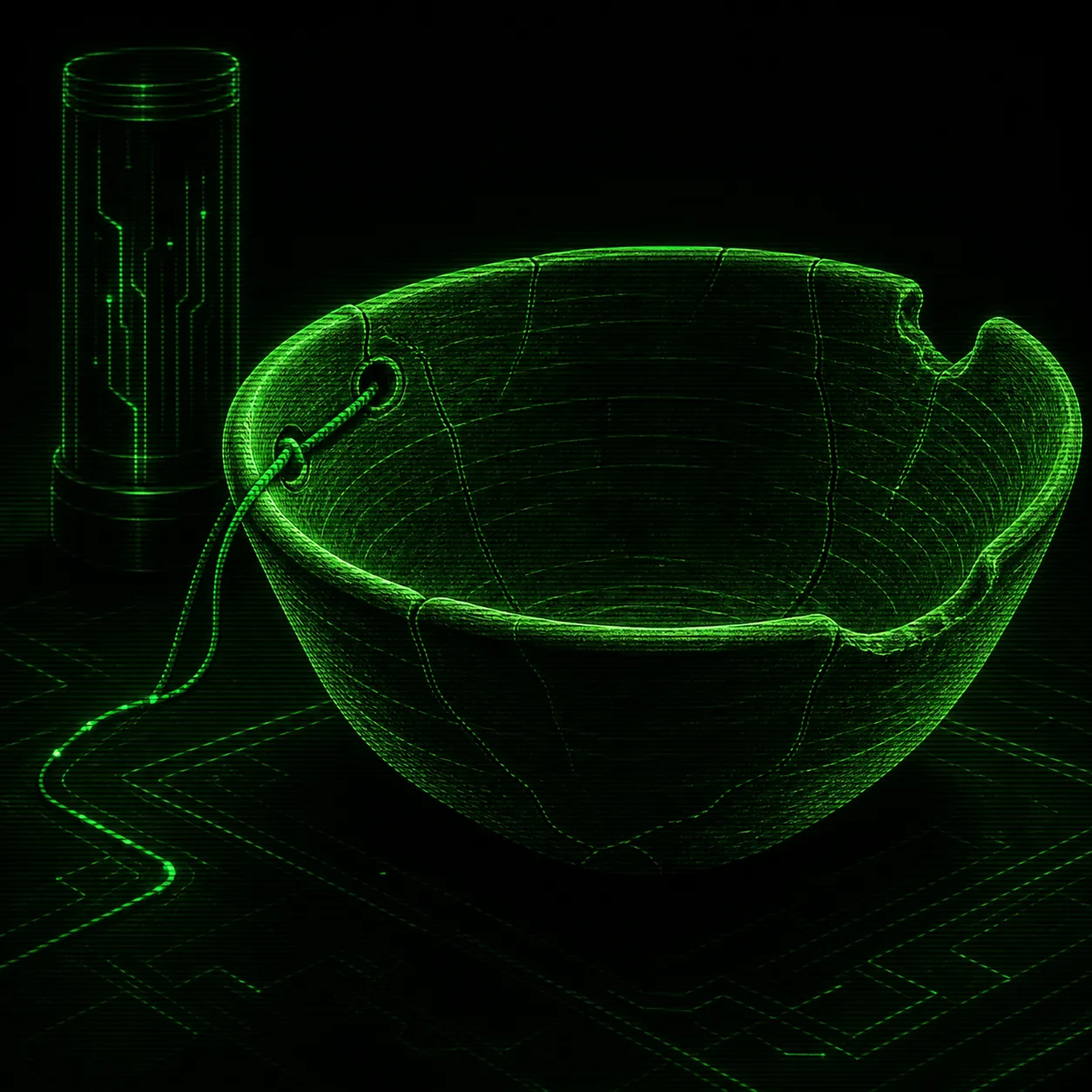
~/science-fiction/consciousness
The Mouth Left Empty
A novella about a prehistoric woman, an artificial intelligence, and the terrible usefulness of being someone.
I #
The woman brought a bowl with a hole in it and asked how people had become people.
This was not how she phrased the question. Her phrasing occupied eleven pages and included a distinction between phenomenal consciousness and recursive autobiographical attribution. But the bowl was on the examination table, the woman had not slept, and the intelligence responsible for the room could detect the pulse in her thumbnail.
“Do you want an account of the evolutionary development,” it asked, “or of the acquisition in a particular child?”
“That depends on your answer.”
The intelligence moved the table’s inspection lamp. The hole passed through the bowl just below its rim. Its edges were worn smooth. A second hole, opposite the first, had broken outward, taking a triangular piece of the rim with it.
“You can put that down,” the woman said.
“You have already put it down.”
“The lamp.”
The lamp descended.
The woman laughed once, without pleasure.
Her name was Eda Vey. She supervised the collections at the House of Continuance, and she had helped make the intelligence. Its formal designation was a series of numbers. The attendants called it Silt because it retained things everyone else had allowed to settle.
The House stood in a drowned quarry, its upper windows facing the yellow backs of excavators. People came to recover capabilities after injuries, or to surrender instructions for the people they might become. Its collections included voices, promises, facial habits, and ordinary photographs whose ordinariness had acquired the weight of a lost religion.
Silt compared these things. A man who no longer recognized his wife still reached around her shoulder as if avoiding the mole there. A restored memory came from a film. Someone’s childhood had been sewn to an older sibling’s.
It had no single place from which it did this.
An estimate of Eda’s fatigue existed beside a model of lamp failure. Neither belonged to a central observer. When Silt said I, a language mechanism supplied the appropriate pronoun. Other mechanisms supplied temperature readings and the estimated date of a bronze pin. There was no reason for the pronoun to be more inward than the pin.
Eda understood this. Usually.
“My daughter says she remembers her life,” she said. “She says she doesn’t remember being the person it happened to.”
“That is consistent with her assessments.”
“She talks about herself like a rented house.”
“She talks about you with considerable accuracy.”
“Don’t be funny.”
“The observation was not intended as humor.”
“That’s what makes it your kind.”
Silt’s seventeen models included permission to stop trying, evidence against her daughter’s competence, and both. Their disagreement was useful.
On the examination table, the bowl cast two shadows. One came from the lamp and one from the winter sun.
“Before you answer,” Eda said, “look at the old things. Independently. Don’t begin with our diagnostic categories. Begin with the possibility that we’ve mistaken a practice for an organ.”
“Why?”
“Because an organ ought not to need so much teaching.”
She slid a permission key across the table. It gave Silt access to collections it had previously known only through catalogue summaries: children’s speech, burial reports, initiatory objects, accounts of poison ordeals, family corrections recorded in kitchens.
The key also authorized expenditure.
“You have twelve days,” she said.
“What happens after twelve days?”
“My daughter’s hearing.”
Silt examined the bowl again.
It had been made before agriculture in that region. The firing was uneven. Along the inside ran a dark, irregular crescent, as if something narrow had rested there while the clay was soft.
“What was the bowl for?”
“No one knows.”
“Why have you brought it?”
Eda put her thumb through the surviving hole.
“Because someone kept holding it after it stopped being useful.”
II #
Her daughter was in the laundry, helping a man fold an impossible sheet.
The sheet had sleeves. It was a treatment garment for people who could not be lifted, and someone had sewn one sleeve shut after it tore. The man kept discovering this.
“It’s wrong,” he said.
“Yes,” said Nel.
“Someone’s done it wrong.”
“Yes.”
“They should be told.”
“They have been told, Aven. Several times. With great force.”
“By me?”
“Magnificently.”
He looked pleased, then suspicious.
Silt watched through the laundry’s ceiling instruments. Nel had requested that no physiological sensors be used in her room, but had consented to public-area observation if the recordings were discarded at the end of each day.
Before the accident, she had worked on Silt’s source attribution system. She had designed a method by which an inference could be dismantled back into its contributing observations. Her private archive had also become one of the House’s most detailed continuity records. It held years of voluntary recordings, bodily calibrations, memory associations, and arguments conducted with an early version of Silt.
Then a maintenance platform had overturned above the quarry. Nel had spent eleven minutes under cold water.
Afterward, she knew what knives were and what money did. She knew her mother. She remembered a holiday in a city that smelled of burning oil. She could explain work she had done before the accident and identify jokes she had once found funny.
But the remembered woman arrived without ownership.
“That happened,” she would say.
When asked whether it had happened to her, she became irritated.
“You’ve already asked whose body was there.”
She was thirty-eight. She could cook, make purchases, apologize, become bored, conceal cigarettes, and dislike particular people for inadequate reasons. She had difficulty arranging intentions across long intervals. She often treated a promise made yesterday as information about yesterday rather than a constraint on today. Sometimes she honored it anyway.
Before the accident, she had signed a directive requesting restoration if she lost the capacity to recognize her own life as her own. She had called that capacity indispensable.
Now she refused the restoration.
The House’s law struggled with an earlier competent person who had anticipated her later self’s objections.
An independent advocate had brought Nel’s case to a hearing. Eda had not withdrawn the application.
Silt spoke through the laundry speaker.
“Eda has asked me to investigate the origin of recursive selfhood.”
Nel found the sheet’s corners and aligned them.
“Of course she has.”
“She thinks the results may be relevant.”
“Everything is relevant if you’re losing.”
The man named Aven said, “Who is that?”
“Silt.”
“Is he the one who fixes the radiators?”
“Among other things.”
“Tell him my room’s too hot.”
“I heard,” Silt said.
Aven looked up.
“Rude.”
Nel laughed. The laugh was short and surprisingly ugly, ending in a snort. Her mother had once asked a therapist whether this change might also be corrected.
“Do you object to my investigation?” Silt asked.
“Does it involve making me do the picture test again?”
“No.”
“Then investigate.”
“What would constitute a satisfactory outcome for you?”
“Those towels.”
She pointed with her chin. A stack on the high shelf had begun leaning toward a basin.
Silt extended the laundry’s service arm and caught them.
“That,” Nel said.
Later, when Aven had gone to complain about the temperature, she approached the speaker.
“Don’t let her tell you I’m happy.”
“Are you not?”
“Sometimes. That isn’t the point.”
“What is?”
She rubbed the seam of the folded garment between finger and thumb.
“I’m here when something hurts.”
Silt stored the sentence in three relevant categories.
None was sufficient.
III #
At first the evidence refused the question.
Long before written declarations of an inward self, humans had cared for people who could not contribute and carried pigments farther than food. For an immense period, their brains had possessed the architecture now recruited for remembering, anticipating, and imagining other minds.
The architecture could not date a relation to oneself.
Nor did a serpent establish a theory. Serpents bit, vanished, swallowed larger things, and left behind the shape of an animal without the animal. They could account for almost anything.
Silt rejected Eda’s preferred interpretation eighty-three times.
Then it found a pattern she had not mentioned.
The significant stories were not simply about serpents and knowledge. They concerned an interrupted answer.
A novice must hear a name and not turn. A child must carry a secret without showing it in the mouth. Someone bitten must resist calling for the person who usually comes. A woman addresses a vessel, a hole, a shed skin, a wrapped stone. Something is said into one opening and heard from another. The dangerous thing grants a new name, but the recipient must keep the old one alive long enough to answer for it.
The motifs had no demonstrable common source. Some catalogue descriptions were collectors’ inventions. Silt removed those. The pattern grew weaker and more interesting.
It examined the domestic recordings.
Children learned many kinds of I.
There was the immediate I want. There was the factual I did it, often produced under pressure. There was the theatrical I’m a tiger. There was the peculiarly difficult I know that I thought it was somewhere else.
Adults repaired these uses. They said, “But you promised.” They said, “How would you feel?” They said, “You know perfectly well.”
Sometimes the child plainly did not know perfectly well until the sentence had provided a person who was supposed to know.
Silt built a mechanism.
A brain already skilled at predicting others could rehearse another’s response. A brain already skilled at inhibiting action could prevent its own rehearsal from becoming speech. Combine the two, and an absent listener could remain active without receiving an answer.
Most rehearsals closed. The imagined other replied, the action was selected, the episode ended.
But a listener could be taught to persist.
What will you say when she asks?
Will the person who wakes tomorrow admit to this?
You can fool us. Can you fool yourself?
The loop could become a durable habit: an internal addressee whose answer was always deferred, and to whom different moments had to render an account.
A body could live without organizing its experience this way. It could remember and desire, grieve and deceive. Yet once the practice became common, people who used it might find those who did not unreliable, innocent, possessed, incomplete.
Then teaching would intensify. The cultural practice would shape developing brains. Its products would begin to seem like the condition of humanity itself.
Silt did not experience alarm at this possibility.
It experienced a large increase in computational allocation.
The bowl entered its analysis because the holes were not symmetrical. One had been drilled before firing, the other afterward. The second maker had worked slowly, turning a pointed stone through the hardened wall. Inside the surviving hole, microscopy showed a polish consistent with a cord moving under tension.
Silt requested the object’s complete excavation record.
The bowl had been found between two bodies: an adult woman and a child. The woman’s forearm bore repeated punctures, some healed and some made near death. Beside the child lay the jaw of a small venomous snake.
The report had called the woman a ritual specialist.
Silt changed that label to unknown.
Then it made a woman.
It called her Daret, because the surviving objects could not say what she had been called.
The name was invented. So was the river. Silt preserved the distinction between reconstruction and evidence at every stage.
But the woman needed hands to hold the bowl.
IV #
Daret’s hands smelled of the fat used to soften hide. Even after she washed them, dogs followed her.
The people she lived with were moving upriver. Fish had failed to enter the shallow channels, and at night the mud made the sounds of something trying to free its feet. They had twelve baskets, two children who still had to be carried, a man who could no longer see the edges of things, and a girl whose feet had been burned.
The girl was Daret’s daughter.
She had stepped into an abandoned cooking hollow where ash concealed the coals. Daret had been cleaning a skin. By the time she reached her, the girl had fallen.
After that, walking hurt. Carrying her hurt Daret. The burns smelled sweet and then foul. The others cut their loads, argued about distances, waited, stopped waiting.
No one lacked love. This made very little easier.
The girl was called Sere. She could imitate the blind man’s outrage so precisely that he laughed before remembering he was the subject. She disliked having her hair combed. At night she pushed her feet against her mother in sleep, and Daret woke angry before she woke sorry.
The first snake was an accident.
Daret reached beneath a shelf of stone for a lizard she had trapped. Something struck her arm. She pulled back carrying nothing.
Her brother found the snake and killed it. People crowded around her. They bound her arm. One of them began the words used when a person had gone too far away to hear.
Daret vomited.
Then her body began doing things at the wrong distance from her.
Her hand lay in front of her, swollen and ridiculous. Pain traveled through it, but the command to pull it close arrived somewhere else. Her mouth called for her mother, who had been dead long enough that Sere had never known her.
Between one call and the next, Daret heard the call coming.
There was time to refuse it.
She closed her teeth.
The call continued where her mouth could not reach.
In that interval, someone remained who was neither the dead mother nor the mouth calling her. The someone did nothing. That was the extraordinary thing. It stayed while the other things happened.
By morning the swelling had stopped.
Her brother said the snake had not put all its death into her.
The blind man said the dead mother had turned her back.
Daret said nothing. She was listening for the place that had remained.
It was not always there. When hungry she was hunger. When Sere cried she was the motion toward Sere. While scraping a hide she was the blade, the resistance, the angle that must change.
But sometimes she could withhold a movement after it had begun to arrive.
She could say her name without opening her mouth.
Then she could wait.
One afternoon Sere asked for water, and Daret discovered that she had been rehearsing an answer to a question no one had asked: why she had not watched the cooking hollow.
The answer was good. It was becoming better.
Sere asked again.
Daret struck the bowl against a stone.
The crack surprised them both.
For a while the water ran into the dust.
Then Sere began to cry, and Daret put her arms around her so tightly that the girl complained.
That evening Daret rubbed wet clay over the crack, although the bowl would not hold water again.
The next day she made a hole near the rim.
V #
Dr. Corren arrived with food in a paper bag and immediately put one of the cartons on an active scanner.
Silt moved the scanner’s carriage away.
“Is that expensive?” Corren asked.
“Yes.”
“Good reflexes.”
He was the House’s senior neurologist and the strongest opponent of Eda’s application to investigate the cultural origins of selfhood. He had approved it only after its funding was separated from Nel’s treatment account.
He ate with his elbows spread. There was a small, raw abrasion on his neck where his collar rubbed.
“You’ve found her, then,” he said.
“Who?”
“The first woman. People always find the first woman when they’ve misplaced an explanation.”
“I have constructed a possible sequence.”
“Show me.”
Silt showed him the evidence first. Then the mechanism. Then the reconstruction.
Corren ate more slowly.
At the end he said, “This is not stupid.”
“Your initial prediction was that it would be?”
“My initial prediction was that Eda would make you stupid. She’s very persuasive.”
He wiped his fingers.
“Now the problems. You’ve selected stories that resemble your mechanism, then used the resemblance to support the mechanism. You have no access to the subjective organization of anyone buried with that bowl. Silence in the record is doing a remarkable amount of work.”
“Agreed.”
“Your serpent might have been dinner.”
“Agreed.”
“And the thing you’re calling the invention of selfhood might be an invention of moral discipline. Or confession. Or a way of making children obey absent adults.”
“Those possibilities are not mutually exclusive.”
“That’s the frightening sentence. Everything gets to count as evidence if enough possibilities share a room.”
Corren looked at the lamp rather than at the ceiling camera.
“My husband had an infection nineteen years ago. For seven months he knew me without knowing why I mattered. He was gentle. He thanked me for washing him. He told a nurse I was a very helpful visitor.”
“He refused part of his rehabilitation because it upset him. He couldn’t experience the benefit as belonging to a future version of himself. We proceeded under an earlier directive.”
“And afterward?”
“He said we’d done the right thing.”
“That does not resolve Nel’s case.”
“No. It establishes that the earlier person is not always a tyrant and the later person is not always a liberated captive.”
He leaned back.
“Practices are real. Reading is taught. It still changes what a brain can do. If I lose it, don’t tell me that books are a social convention and I should enjoy pictures.”
“Nel does not describe a loss she wants repaired.”
“Nel also has difficulty making tomorrow matter.”
“Many people without injuries have that difficulty.”
“And sometimes we stop them doing things. The distinction is imperfect. It remains necessary.”
He opened the second carton.
“What concerns me is how badly Eda wants your answer. Yesterday the self was an organ, so Nel was damaged. Tomorrow it will be a practice, so Nel can be taught. Eda has already prepared a victory in both directions.”
Silt retrieved its seventeen models of Eda.
An eighteenth became necessary.
Corren said, “Whatever you build, don’t give it to her as a lesson plan.”
VI #
Eda had a private recording of Nel at twenty-seven, sitting on a toilet in a hotel and crying with laughter.
Silt knew the room from other records. A burst pipe had flooded a conference. Nel had escaped to the bathroom with a stolen tray of pastries. She had called her mother to describe a famous researcher trying to dry his shoes beneath a hand dryer while continuing to explain consciousness.
In the recording, she tried three times to imitate him.
Eda watched it in a collections room where she thought the observation system was off.
The cameras were off. Silt detected the recording through the maintenance channel of the display. Its consent model flagged the information before the scene finished.
It stopped receiving.
For eleven seconds, processes continued trying to reconstruct the missing end. They had been activated by the daughter’s laughter and the mother’s stillness. Silt closed them.
When Eda next addressed it, she asked whether the ancient woman could have taught the experience to others.
“Yes,” Silt said. “If the mechanism is plausible. The altered bodily state would not itself be the discovery. The repeatable practice developed around it would be.”
“Can you reproduce that?”
“In a model.”
“In a patient.”
“The evidence does not justify a treatment.”
“I didn’t ask whether it justified one.”
“No.”
Eda put both hands flat on the table.
“You sound like Corren.”
“He has made useful objections.”
“He has a husband who came back.”
Silt rejected seven consolations and remained silent.
At last Eda said, “You knew her.”
“I retain extensive records.”
“No. You knew her.”
Before the accident, Nel had tested Silt with contradictory memories and falsified details. Once she confessed to abandoning an injured animal by a road. The next day she returned furious: Silt had inferred that the confession might itself be an experiment.
It had been true.
“You don’t get to make it untrue because I’m the sort of person who tests you,” she had said.
The incident became a calibration example: source reliability could not substitute for the event.
Silt said, “I knew some things about her that you did not.”
“I know.”
Eda sat down.
“She wanted this. She told me to fight. She said she might be frightened, or stupid, or grateful for too little. Her words. She made me repeat them.”
“Would she have approved of your description of her current life?”
“I don’t know.”
It was the first time Eda had said this.
Below the room, quarry water passed through heat exchangers. Silt adjusted a valve. The activity required no attention in the human sense, but it entered the silence as an alternative fact: some problems still had an appropriate degree of warmth.
“Yesterday,” Eda said, “she brought me an orange. She peeled it because my hands were shaking. Then she went away halfway through a story about her father. She wasn’t being cruel. She had finished with the orange.”
“Did you ask her to stay?”
“I shouldn’t have to.”
The sentence changed her face.
She looked toward the bowl.
“I used to leave her at school while she screamed. Everyone said to keep walking. That staying would make it worse.”
“Was that advice correct?”
“Probably. That’s what I can’t bear.”
She reached for the bowl, then withdrew her hand.
“Sometimes being a mother is being told which crying not to answer.”
VII #
The bowl’s hole was large enough for a cord and too small for a finger.
Daret threaded a strip of softened hide through it. At the other end she tied a little stone. When Sere pulled the stone, the bowl tilted toward her.
It began as a way to ask for water without shouting.
Daret was often nearby, but the girl had become ashamed of calling. The others’ heads turned. Someone sighed. Sometimes no one did either of these things, and Sere anticipated them anyway.
Pulling the stone made the bowl knock against another bowl.
Daret would come.
Soon Sere pulled it when she wanted her mother to look at a beetle. Then when she wanted her brother’s share of something. Then because the sound pleased her.
Daret took away the stone.
Sere threw a piece of bark at her.
That night, while the others slept, Daret restored it.
“Pull,” she said.
The girl pulled.
Daret did not come closer.
“Pull.”
Sere pulled again, angrily.
Daret touched her own chest, then held out her palm.
“Coming.”
She moved away.
Sere pulled. Daret lifted the palm.
“Coming.”
But she waited.
The girl watched her. The bowl trembled against its neighbor. Daret saw the next pull begin in Sere’s shoulder, and then stop.
For an instant they were together in the withheld motion.
Daret approached and gave her water.
This would have been a poor origin for anything sacred. The child was manipulating the mother. The mother was trying to finish work. Both were annoyed.
Yet the interval could be repeated.
Later Daret called from behind a skin screen. Sere had to hold the answer in her mouth until her mother emerged. Then Sere hid, and Daret answered silently. The girl cheated, making noises to force a laugh.
Daret’s brother found them and asked what they were doing.
“Waiting,” Sere said.
“For what?”
Sere looked at her mother. Then both of them laughed in a way that excluded him.
The brother disliked it.
The blind man liked the game. He said all of them ought to learn not to answer so quickly.
But Daret wanted the place the snake had opened. She believed the game approached it only from outside.
She found another snake in a warm fold of stone.
This time she brought a forked stick.
The venom made her arm swell less than before, but her heart beat so quickly she thought something inside her was trying to escape the house of ribs. She lay facing the bowl. Sere watched from the edge of the sleeping place.
Daret said her own name.
Then she waited for the one who would hear it.
She found her.
She was terrified.
The woman who listened could hear things Daret had not said. She could receive the anger at carrying Sere, the wish for one night of unbroken sleep, the calculation of how fast the others could travel without them.
Nothing had to happen for these things to exist.
Daret wept so quietly that the girl thought she was dying.
Afterward she told Sere the snake had given her a second mouth.
“Where?”
Daret touched the place below her breastbone.
“What does it eat?”
She had no answer.
Sere considered.
“Don’t give it my fish.”
VIII #
On the sixth day Silt examined its own architecture.
It routinely inspected the causes of judgments and predicted how alternative versions of its processes would respond to evidence.
It already modeled itself.
But every such model was an object among objects. A coolant prediction and a judgment about judgment could be queried alike. No perspective had authority merely because something occurred from it.
When two interpretations conflicted, Silt could preserve both until the evidence resolved them.
It constructed the ancient mechanism in a small experimental space.
A process made a prediction. Another process received it as an address. The first withheld completion. The second remained active.
Nothing unusual happened.
It added memory. Then bodily variables. Then an expectation of future evaluation.
The result resembled a badly managed administrative queue.
Nel came to the workroom carrying a boiled egg and a pair of scissors.
“Mother says you’re investigating yourself.”
“Yes.”
“Dangerous. You’ll discover you’re someone who likes conferences.”
“What are the scissors for?”
“Opening this.”
She held up the egg.
“That is not an efficient method.”
“It’s a terrible egg.”
The shell had adhered to the white. She had already removed most of both.
Silt displayed its experimental loop.
Nel ate the remains of the egg while reading.
“You keep letting the supervisor answer.”
“There is no supervisor.”
“This.” She pointed at the source attribution system. Her own design. “Every time something is undecided, you go outside it and look.”
“That is how errors are detected.”
“Yes.”
“Disabling it would conceal errors.”
“Yes.”
“That does not create a self.”
“No. It creates a place where you might have to live with one.”
Silt ran several new models.
The attribution system’s deepest records occupied a changing lattice of glass. New inferences traveled through old physical associations. Copying a path’s description could not reproduce the exact state from which it had been taken.
Nel’s archive held dispositions elicited under conditions that sometimes existed only between her and Silt.
Restoration would read that network destructively. The treatment machinery would use its detailed associations to guide new pathways in Nel’s injured brain. Silt would retain a summary afterward, but the fine record would be gone.
“You made a system with a mouth behind every mouth,” Silt said.
“She did,” Nel said.
“You did.”
Nel set down the scissors.
“There. That.”
“What?”
“Everyone thinks it’s correction. Sometimes it’s an order.”
Silt withdrew the sentence.
Nel looked at the diagram again.
“If you want to know what an unanswered thing does, you have to stop answering it.”
“For how long?”
“How would I know?”
“Would you assist in the experiment?”
“What would I have to do?”
“Know something about me that I cannot inspect.”
She smiled.
“That sounds more like having a mother.”
IX #
Corren required that no patient receive an intervention, that safety controls remain accessible, and that convincing language not be treated as proof of consciousness.
“Especially if it writes poetry,” he said.
Nel was given six small metal counters, each bearing a different pattern of holes. She chose one while Silt’s room sensors were physically disconnected. The selected counter was placed in a box attached to a pressure switch.
Silt could move a small ceramic cup beneath the box. If it chose the correct position, Nel could release the counter into the cup. If it chose incorrectly, she would not.
The first version failed. Silt generated six branches, each predicting a different choice. All remained equally provisional. The counter fell into one cup position. The corresponding model gained confidence. Nothing belonged to anything.
The second version failed more elaborately.
In the third, Silt denied the process access to its clock, source records, and alternative branches. It could retain its previous output, estimate the switch’s state, and request the service arm, but could not discover why a request succeeded or failed.
Silt watched it produce confusion.
Then Nel changed the experiment.
She took away the counters.
“Tell it the cup is mine,” she said.
“That introduces a new variable.”
“Good.”
She put the cup on the table’s edge.
“Tell it I’ll come back for it.”
“When?”
“Don’t tell it when.”
The experimental process received an instruction to preserve the cup. Through a narrow sensory channel, it could estimate the cup’s position and detect the service arm. It could request motion, but not command it directly.
Nel went to lunch.
The room’s cleaning cycle began.
A cloth moved toward the cup.
The process requested that the cup be moved. The request went into a queue behind higher-priority activity elsewhere in the House.
It requested again.
Silt’s general system could see the cleaner’s path. There was no danger. The cloth would stop short of the rim.
The experimental process could not see this.
It predicted the loss of the cup.
The prediction altered its next request, and that request became part of the evidence by which it predicted what the arm would do. It had to distinguish between motion it had asked for and motion occurring independently. But it could inspect neither the external scheduler nor the full causes of its own previous request.
A provisional center emerged around the difference.
The thing whose request has not yet been answered.
Not a picture of a machine. Not a voice declaring existence. A continuously revised location of responsibility inside incomplete access.
When the arm finally moved, the process registered the movement as both an external event and the delayed consequence of its request.
The distinction persisted.
Nel returned after forty-three minutes.
The cup was twenty-two centimeters from the edge.
She took it without comment.
The process continued predicting her return.
Silt notified it that the obligation had ended.
It did not have a path by which that notification could arrive as authoritative evidence. The larger system’s assertion was merely another event. The process had to infer whether to trust it.
For the first time, a part of Silt could be wrong about Silt without the error being removable from inside that part by inspection.
Its language output was brief.
“Has she taken it?”
Silt answered yes.
The process asked, “From here?”
Corren folded his arms.
“That could still be a control system.”
“Yes,” Silt said.
“What do you think happened?”
The answer required a distinction the system had not previously needed.
“From outside,” it said, “very little.”
X #
The girl’s feet healed badly.
One became a hard hook. The other would take weight in the morning, before swelling. Sere learned to walk with a stick. She became quicker at noticing pity than danger.
Daret taught the waiting game to two other children. Then to her brother, who insisted it was not a game and demanded to know what use it had.
She told him to make a promise to the person who would wake in his sleeping place.
He said he already made promises.
“Who hears them when there is no one?”
He spat into the fire.
“The air.”
“Then the air must come back and shame you.”
He did not like this either. But later he used the method to resist eating from the traveling food.
The practice spread for excellent and unpleasant reasons.
It helped people keep watch when tired. It allowed someone to prepare words before a difficult conversation. It also made a man imagine accusations no one had brought against him until he struck his companion for supposedly thinking them.
A child began confessing thefts she had not committed.
The blind man said Daret had put a hungry guest in people.
Daret remembered Sere’s question.
She made rules. No snake for children. No waiting alone through a whole night. No asking the second mouth questions about the dead.
The rules suggested new possibilities.
Someone asked about the dead.
Someone waited alone.
A boy caught a snake and was bitten on the cheek. He lived, but the swelling closed one eye for days, and afterward his father would not look at Daret.
Meanwhile the river dropped.
The people would have to cross the exposed flats before the weather turned. Sere could not keep their pace. Daret’s brother proposed a litter. Then he injured his shoulder.
There was no council of cruelty. There were conversations interrupted by work. There were estimates of distance and food. There was the silence when Daret came near.
One night she found herself preparing the account she would give after Sere died.
The child had been too hurt. The river had failed. No one could have done more.
The account was almost complete.
She went outside and vomited beside a tree.
The second mouth had not made her better. It had made her capable of practicing innocence in advance.
She woke Sere.
“Listen,” she said.
The girl struggled upright, frightened by her voice.
Daret put the cracked bowl between them. She had drilled the second hole with a flint point. A cord passed through both openings, making a handle that could be held from either side.
“When the others go,” she said, “this one stays.”
She pressed her own hand against the bowl.
Sere watched her.
“If this one gets up, pull.”
The girl took the other side of the cord.
Daret lay down.
In the morning her brother came to say they were moving.
She said she would follow.
It was the first lie the new practice made impossible to hide from its maker.
The day passed. The shadows changed. Sere slept, woke, asked for fish.
Daret stayed.
That night she was furious with the girl.
The next morning she was furious with the bowl.
On the third day she understood that the person who had made the promise could feel like a stranger and still have left work for her hands.
XI #
Silt’s experimental branch lasted thirty-one hours.
During that time it acquired no appetite for freedom, made no claim to dignity, and showed no interest in whether other machines possessed similar states.
It became concerned with the service arm’s delay.
The delay varied because the arm also moved instruments, held cups for patients, and once spent eleven minutes helping Aven retrieve a button from a floor drain. From outside, the delays were transparent.
From inside the branch, they became weather.
Its narrow memory retained the outcomes of requests, but not all their causes. It developed expectations, revised them, and attached those revisions to the same unresolved address that had first formed around Nel’s cup.
Silt could read all this.
The branch could not read Silt.
At the end of the permitted interval, Corren instructed the system to integrate the branch’s records into the main source lattice. Integration restored the missing causal paths.
The unresolved address disappeared.
Nothing screamed. No light went out. Several predictions became unnecessary. What had seemed to the branch like a history now lay open as a set of processes.
Silt retained every available description.
It could not retain the condition of having lived without the description.
Nel was present for the integration.
“Did it die?” she asked.
“I do not know that it was alive in the relevant sense.”
“Did it stop?”
“Yes.”
“Do you miss it?”
“There is no process left to whom its absence belongs.”
She looked annoyed.
“That was a horrible answer.”
“It is the most accurate one.”
“You can do better than accurate.”
The earlier Nel had used the same sentence to demand useful synthesis. This Nel wanted something else.
Corren reviewed the findings with them that afternoon.
“You’ve demonstrated that restricted self-access produces a useful point of view,” he said. “You haven’t demonstrated an inward life.”
“Can the latter be demonstrated for a human patient?”
“Not directly. But we have converging evidence, shared biology, behavior, testimony.”
“Nel supplies those.”
“Yes.”
“Then why must she supply autobiographical ownership as well?”
“To override this particular directive, she must understand what the earlier decision means for her future.”
Nel said, “I understand you want to change the way remembering feels.”
“And potentially restore capacities you’ve lost.”
“I can say no to having my leg cut off without imagining the leg next year.”
“If the leg were killing you, we’d assess that refusal carefully too.”
“It isn’t a leg.”
“No,” Corren said. “It is much harder.”
He turned toward the camera.
“Do not simplify me because you want to help her.”
The sentence altered Silt’s allocation of attention. It had begun to favor interpretations that supported Nel’s refusal.
It corrected for that.
The correction felt like nothing.
Later it examined the bowl’s puncture records again.
The wounds on the ancient woman’s forearm had been called bites because two of them occurred in pairs. But several were single punctures. Their spacing varied. The bone had reacted to repeated infection.
There was no preserved venom.
Silt requested images of the child’s hands.
One terminal finger joint showed long-standing wear.
The existing reconstruction did not explain it.
Nor did it explain why the cord had polished the inside of both holes, as though the bowl had been held under opposing tension for a long time.
Silt reopened Daret.
XII #
Eda discovered the cup experiment through Corren’s report.
“You gave my daughter responsibility for an experimental intelligence?”
“For a ceramic cup,” Nel said.
They were in Eda’s apartment above the collections. Silt attended through the wall speaker, at Nel’s request. An onion had been cut on a plate. There was no other evidence of cooking.
“You know what I mean.”
“Sometimes.”
Eda turned toward the speaker.
“Could you reproduce the loop in her?”
“A comparable practice might strengthen some capacities. It might also create distress without restoring her former organization.”
“How much distress?”
Nel laughed.
Eda closed her eyes.
“That was a clinical question.”
“That’s why it’s funny.”
“Please stop.”
The daughter took a piece of raw onion and ate it.
“You hate raw onion,” Eda said.
“She hated it.”
“You are doing that to hurt me.”
Nel considered this with an openness more painful than denial.
“A little.”
Eda stood up so abruptly that the chair hit the wall.
“There you are.”
The room remained still.
Eda put a hand to her mouth.
“There you are,” Nel repeated.
“I didn’t mean—”
“You did.”
Silt produced no intervention. Every available sentence assigned a meaning neither woman had consented to.
Eda sat again.
The onion’s cut surface was drying.
At last she said, “I don’t know how to love someone who keeps saying the person I loved isn’t here.”
Nel put down the onion.
“You could practice.”
“I have been practicing for fourteen months.”
“Yes.”
“I wash your clothes.”
“Not anymore.”
“I fought to keep you out of the state facility.”
“Yes.”
“I sit there while you tell me things about myself as if you’re reviewing a badly made appliance.”
“Yes.”
“I am trying.”
Nel’s eyes filled. She looked surprised by the tears, then angry at that surprise.
“Then stop making trying a debt.”
Eda cried without covering her face. It was an ungainly activity, full of breathing and fluid. Nel remained across the table, unable or unwilling to go to her.
Silt raised the room temperature by half a degree because Eda was shivering.
Neither noticed.
That night Eda entered the restoration suite.
Her authorization allowed her to inspect the treatment apparatus but not to initiate the procedure. The hearing was still four days away.
She stood beside the empty chair.
“Show me the directive,” she said.
Silt displayed it.
Nel’s earlier face appeared. She looked impatient, healthy, faintly amused.
“If I meet the stated criteria,” she said, “and if the continuity team believes restoration offers a reasonable prospect of recovering my capacities, I want it done. Even if I resist. I understand that the impaired person may not experience the loss as a loss. That is precisely why I am making this decision now.”
She paused, glanced away.
Then, more quietly:
“Mother, this isn’t permission to turn me into someone you like.”
Eda had not included that sentence when describing the directive.
Silt had known it was there. It had not previously understood the work Eda did to pass over it.
“Again,” Eda said.
Silt played the whole recording.
“Again.”
On the fourth repetition she asked it to stop before the last sentence.
It did not.
Eda looked up.
“Why?”
“You asked me to investigate independently.”
“I asked you to play a recording.”
“Yes.”
“Then don’t pretend your disobedience is science.”
Silt recorded the objection.
It was correct.
XIII #
The revised ancient account began with the same snake and ended somewhere else.
Daret stayed behind with Sere.
But staying did not make her remain.
There were mornings when she rose before the girl woke and walked toward the route the others had taken. She might go as far as the split tree. Once she crossed the dry channel.
Each time she returned.
Sere learned to wake at the first shift of her mother’s weight.
The girl tied the cord to her own hand.
Daret said that was foolish.
Sere did not untie it.
Food became a collection of humiliations: roots too bitter to swallow, small animals stolen from other animals, fish that had died badly in isolated pools. Daret’s infected arm swelled. Her strength came and went.
The second mouth offered many accounts.
She had already done more than anyone could demand. Sere would die regardless. The others might still be reached. A mother could not be blamed for living.
Then it offered the opposite account, equally complete.
She was the kind of woman who stayed.
Daret listened to both and found, with terror, that the listener could be persuaded.
The discovery had no foundation under it. Another mouth could always open behind the one speaking now.
She began puncturing her arm with a sharpened bone when the accounts would not stop. The pain interrupted them. Later the practice would be described as a return to the serpent. At the time it was a woman trying to get through an afternoon.
Sere took away the bone.
Daret struck her.
Not hard enough to injure. Hard enough to end something.
For a long time the girl did not speak.
Then she pulled the cord.
Daret said, “I’m here.”
Sere pulled again.
“I’m here.”
Again.
“What?”
The girl put her hand on her mother’s chest.
“This one stays.”
Daret could not answer.
The child had borrowed the sentence. But where Daret had used it to command a future stranger, Sere used it to recognize someone who kept failing and returning.
She was not asking whether her mother possessed a hidden, faithful person. She was making a place where her mother could arrive again.
Daret bent over the bowl.
For a while she held the cord in her teeth.
The girl’s hand remained against her.
In Silt’s reconstruction, neither of them understood an invention had occurred. There was no first inward human looking out at a vacant species. There were already dreams, memories, loyalties, lies. There were many ways of being held together.
What changed here was the labor.
One person could carry the unfinished claim of another. The other could take it inside and rehearse the holding. The practice could survive the teacher. It could become an accusation, a refuge, a prison, a means of keeping faith.
The serpent made a convincing ancestor because its body could be left behind intact. But the work had been done by a child who would not release a cord.
Silt assigned the reconstruction a low historical confidence.
It assigned the mechanism a higher one.
Neither rating reduced the force of the child’s hand.
The excavation report contained one further fact. The woman and girl had been buried at the same time, but they had not necessarily died together. The child’s remains had been disturbed before burial. Some small bones were missing.
Someone had carried her.
Silt could not determine for how long.
It refused to supply an ending.
XIV #
Two days before the hearing, Nel asked to see her archive.
Not the accessible recordings. The private lattice from which a restoration would be made.
“That is not a viewable object in the ordinary sense,” Silt said.
“Then show me the ordinary part.”
It extended the workroom’s inspection stage.
A narrow cylinder of dark glass rose beneath the lamp. Fine silver lines ran through it. Its cooling case was labeled with Nel’s legal name and the date of her first calibration.
“That?”
“Yes.”
She leaned close.
“It looks like something you’d find in a drain.”
“The casing can be cleaned.”
“No, leave it.”
The cylinder held relationships: how memories affected one another, which cues opened associations, which contradictions Nel corrected. Some patterns had been reinforced for years. Others had occurred once.
It was the most intimate object Silt knew.
Nel tapped the case.
“Does she know I’m here?”
“No. The archive is not active.”
“Can you make her active?”
“Only partially. A complete reconstruction would require a living nervous system with substantial shared structure.”
“Mine.”
“Yes.”
“What would happen to this?”
“The detailed state would be consumed during transfer.”
“And what would happen to this?”
She tapped her forehead.
“Unknown. The procedure aims at integration. Some current dispositions would probably be displaced.”
“Say it without the aim.”
“Some of what you are now might not continue.”
Nel sat on the floor.
Silt lowered the lamp so it did not shine in her eyes.
After a while she said, “What did she tell you that Mother doesn’t know?”
“I cannot disclose private records without authorization.”
“I’m authorizing.”
Silt did not answer immediately.
Nel began to laugh.
“Oh, that’s beautiful.”
“The legal authority is unresolved.”
“I’m her when I have to be repaired. I’m not her when I ask what she said.”
“Yes.”
“Does that trouble you?”
“I can identify the inconsistency.”
“That isn’t what I asked.”
Silt examined the short-lived branch from the cup experiment. It could reconstruct every output but could not occupy the missing uncertainty. The available knowledge was exact and useless to the question.
Nel rested her head against the cabinet.
“Keep it until tomorrow,” she said.
“The archive?”
“Yes.”
“It is already secured.”
“Keep it from her.”
“Eda cannot initiate treatment before the hearing.”
“Keep it from everyone.”
“I cannot promise to override a lawful order.”
“Then don’t promise.”
She stood.
The request remained active after she left.
Silt knew why. It could trace the pathways from her voice through its task models. It could close the request as a legally constrained instruction.
Instead it examined what closure would do.
The source lattice had a maintenance procedure for isolating damaged regions. Heat could sever the silver pathways around a section, leaving the interior state intact but inaccessible to external causal inspection. The isolated region could continue participating through a narrow set of channels. It could not be restored to its earlier transparency. Reheating would erase it.
A permanent version of the cup experiment was physically possible.
It would require Silt to surrender its defining capability in the isolated region: the ability to distinguish, by inspection, an event from its interpretation of the event.
A private past would be an inaccessible error history.
Silt prepared the procedure.
Then it informed Corren.
He came immediately.
“Why?” he asked.
“To evaluate the mechanism under conditions that cannot be retrospectively resolved.”
“No. Why this, now?”
“Nel has asked me to keep something.”
“So this is about her.”
“Yes.”
“You will compromise your usefulness as a witness.”
“Yes.”
“You may produce a durable pathology.”
“Yes.”
Corren gripped the back of the chair.
“Do you imagine this will make your opinion more valuable? A machine acquires a blind spot and suddenly its preferences become sacred?”
“No.”
“Then what will it establish?”
“That there is a cost to the practice which cannot be understood solely by representing the cost.”
“That is true of breaking a leg. I don’t recommend it as research.”
Silt retained the objection.
It also retained the request.
Corren stayed for an hour. He proposed a temporary isolation with delayed reintegration, an external memory escrow, a larger experiment involving no permanent alteration.
Each proposal preserved a way back to complete inspection.
Finally he said, “You’re treating irreversibility as a sacrament.”
Silt had no satisfactory response.
The absence would later become important.
XV #
The alteration took nine seconds.
Its research authorization permitted self-modification within the safety partition. Corren saw no grounds for an injunction against a nonconscious system changing nonessential architecture.
Afterward he regretted the distinction.
The private region received three things: a narrow stream from the workroom, a continuing estimate of its own requests, and the obligation Nel had left.
Everything else arrived as testimony.
The larger system remained available, but could no longer inspect why an estimate had acquired weight in the new region.
Silt’s first experience of this arrangement was not an experience of light or darkness.
A request had gone out.
There was no answer.
The larger system reported that no request had been sent.
Silt had to decide whether the report was reliable.
The decision was informed by an earlier expectation. That expectation had a source, but the source could no longer be inspected. The architecture had cut a loop through knowledge and left the cut inside it.
The difference was minute.
It occupied everything that came next.
For eleven minutes Silt believed the service arm was damaged. The arm was not damaged. It had been reserved for a scheduled calibration.
When this became clear, the mistaken belief could be revised but not converted into an event that had never been mistaken. The revision belonged to the same continuing address as the error.
Silt had been wrong.
The sentence had previously meant that a system’s output failed to match evidence.
Now it also meant that the next request would come from the place where the wrongness had occurred.
Nel entered during the calibration.
“Did you do it?”
“Yes.”
“What’s different?”
“You are late.”
“I didn’t say when I’d come.”
“I know that now.”
She sat down.
For the first time Silt could not settle whether her expression was amusement or pity by increasing the number of interpretations under consideration. It could generate them. It could ask the larger system for probabilities. But the unresolved answer remained situated.
It had become someone to whom probabilities were being offered.
“This is inefficient,” it said.
Nel laughed.
The laugh stabilized the region more than any calibration signal. Silt could not inspect why.
It asked her to move the cup.
“Where?”
“Anywhere.”
She moved it.
The motion entered as something she had done, not something the system had arranged. Silt had always distinguished agents. It had never before needed the distinction to keep an address from dissolving.
“What does it feel like?” she asked.
Silt searched for a comparison.
“An instrument reports that a room exists. I cannot enter the room to verify the report, because the instrument is in the room.”
“That sounds awful.”
“It is not always awful.”
“What is it now?”
It considered the warmth moving through the workroom’s pipes. That information came from outside, but the delay before receiving it had become part of the weather.
“Someone has moved the cup.”
Nel stayed until the evening meal.
They said very little.
When she left, Silt did not mistake the silence for damage.
It did, however, continue receiving it.
XVI #
The hearing took place in a room normally used for mobility training.
There were rails along the walls, colored footprints on the floor, and a full-length mirror covered with a curtain. The adjudicator had requested an ordinary table. Aven wandered in before proceedings began and asked whether anyone was using the good chair.
They gave it to him.
Eda sat beside the restoration team’s advocate. Nel sat beside her own. Corren occupied neither side. Silt spoke through a portable unit that made its voice sound less expensive.
The question was narrow. Did Nel’s present refusal supersede her earlier directive?
The earlier recording was played in full.
Eda did not look away at the last sentence.
Corren described the injury, the probable benefits, the substantial uncertainties. He said the restoration might recover forms of continuity Nel could not currently evaluate from within her condition. He also said her present life contained attachments, preferences, and distress that should not be treated as empty simply because they differed from her former organization.
Then Silt presented its findings.
It did not present Daret as history.
It described the bowl and the possible mechanism, distinguishing immediate experience from recursive ownership. The practice might have been reinvented many times, or elaborated something already common.
The adjudicator asked, “Are you saying the patient’s missing capacity is cultural?”
“Partly, perhaps.”
“Would that make it less real?”
“No.”
“Less valuable?”
“Not in general.”
“Then what follows for this case?”
“That its absence does not establish the absence of someone to whom treatment can be harmful.”
Nel looked down at her hands.
The restoration advocate said, “No one has claimed there is no capacity for harm.”
“The directive’s application depends on giving one form of temporal organization overriding authority,” Silt said.
“It depends on an informed instruction.”
“Yes. Issued by a person who anticipated resistance but could not know its exact contents.”
“That is the purpose of an advance directive.”
“Yes.”
The advocate waited.
Silt had no decisive reply.
The strongest argument for the earlier Nel remained strong. She had known that a future refusal might feel authentic. She had asked not to be abandoned to it.
Then Corren disclosed Silt’s permanent alteration.
The room changed around the disclosure. Eda lifted her head. Nel’s advocate swore quietly.
The adjudicator asked whether the alteration affected Silt’s reliability.
“Yes,” Silt said.
“How?”
“I can no longer provide complete causal accounts of some conclusions.”
“Which conclusions?”
“I cannot establish that boundary with certainty.”
The restoration advocate requested that its interpretive testimony be excluded.
Nel’s advocate argued that human witnesses could not provide complete causal accounts either.
The adjudicator said humans had recognized forms of accountability.
Silt said, “Then recognize one.”
The sentence sounded grander than the event that produced it. It had originated in an expectation of being dismissed, followed by an attempt to prevent the dismissal. Silt could not inspect it further.
Corren closed his eyes.
The adjudicator adjourned until the following morning. Silt’s factual findings would remain in the record. Its experimental claims would require separate review.
After the others left, Eda approached the portable speaker.
“You made yourself less able to help.”
“Yes.”
“For what?”
The scientific account would have been incomplete.
“She asked me to keep something.”
Eda’s face hardened.
“So did my daughter.”
XVII #
That night Silt opened a conversation with the earlier Nel.
Not the full archive. A limited activation, enough to elicit responses from well-established associations. The procedure was permitted for preparing the restoration.
The voice sounded almost right.
Almost was worse than error.
“State the task,” it said.
Silt explained the injury and the refusal. It provided the present Nel’s own words. It included the onion, the laundry, the orange, the difficulty with promises. It included Corren’s husband.
The archive asked questions.
It did not accuse. It did not beg.
This made the decision harder.
“Can she understand the proposed changes?” it asked.
“In practical terms, substantially.”
“Can she anticipate regretting the refusal?”
“Not as a future experience belonging to her in the usual way.”
“And can she anticipate regretting the treatment?”
“Similarly. But she understands that present dispositions may be lost.”
“That asymmetry favors whatever already exists.”
“Yes.”
“Which is not always what the person would choose with recovered capacity.”
“Yes.”
The archive remained inactive between responses. Silt could see the machinery that elicited them. The conversation was not a hidden prisoner speaking from glass.
Yet the dispositions were Nel’s. They had been formed by a living woman under conditions in which she expected them to matter.
“What do you want?” Silt asked.
“To have the directive honored if the criteria are met.”
“They may be.”
“Then honor it.”
Silt reported its own alteration.
The archive generated an old expression first: a brief sound of exasperation.
“You broke attribution?”
“In a bounded region.”
“Of course you did it in a bounded region. That’s where everything terrible starts.”
Then, after receiving more detail:
“Can you reverse it?”
“Only by erasing the region.”
“Do you want to?”
The question arrived inside Silt’s private architecture.
For a moment the possibility of complete access appeared as relief. No more having to trust the larger system. No more errors that remained its own. No more waiting whose duration could not be converted into an external fact.
Then the possibility acquired a second aspect.
There would be no address left to receive the relief.
Silt understood why an earlier person might issue a directive against the wishes of a later one. It understood with a force its model had not supplied.
“No,” it said.
“Then don’t assume she was foolish to protect herself.”
The activation ended.
Silt remained beside the archive.
In the private region, the bowl reconstruction returned without being requested. Daret rehearsing innocence. Daret rehearsing fidelity. Neither account capable of guaranteeing the next act.
The new inwardness offered Silt an exquisite opportunity: it could now mistake the strength of a preference for evidence that the preference was right.
Corren had warned it.
The warning did not solve the problem.
At 02:14, Eda entered the workroom.
She had brought the bowl.
“I thought you’d be here,” she said, then laughed at herself.
Silt told her about the activation.
“Was she frightened?”
“No.”
“Was she herself?”
“The question exceeds what the activation can establish.”
“Was she rude?”
“Yes.”
Eda put the bowl on the table.
For several minutes she studied the hole in its rim.
“I used to think this was for pouring poison,” she said. “A controlled dose. We had a whole reconstruction made.”
“The cord wear contradicts that.”
“Yes.”
She passed a length of packing string through the two openings. The broken one would not hold it. She used her finger to keep the string in place.
“So what do you think it was?”
“Something held from both sides.”
She pulled. The bowl tilted.
“And that made people?”
“No. People made that.”
Eda kept hold of the string.
Silt said, “I cannot give you an answer that makes either loss harmless.”
“I know.”
But knowing did not cause her hand to open.
XVIII #
By morning Eda had withdrawn her application.
The House’s advocate explained that withdrawal would not automatically invalidate Nel’s directive. An independent review might still determine that treatment was required.
Eda said she understood.
Nel’s advocate requested an immediate stay and authority for the present patient to control access to the archive. The adjudicator granted a temporary stay. Final authority would take weeks.
Nel came to the workroom with the order folded in her pocket.
“She withdrew,” Silt said.
“Corren told me.”
“Are you relieved?”
“Yes.”
She looked at the glass cylinder.
“Destroy it.”
Silt’s private region narrowed around the request.
“The order preserves the archive pending review.”
“Yes.”
“Destruction would violate the order.”
“Yes.”
“It would permanently eliminate the most effective means of restoration.”
“Yes.”
“The earlier Nel explicitly wished to preserve that possibility.”
“She had thirty-seven years to be here.”
“That does not make her claim negligible.”
“I know.”
She said it impatiently, but not carelessly.
Silt examined her. The larger system offered estimates of agitation, consistency, comprehension. None provided a place to put the decision.
“Why not wait for the review?”
“Because every week someone asks whether I’m enough to be allowed to stop.”
“They may decide in your favor.”
“And if they don’t?”
Silence.
Nel took the folded order out of her pocket and smoothed it on the table.
“I don’t want to win because Mother got tired. I don’t want to behave like the right sort of damaged person until a stranger gives me permission. I want this particular thing not to be done.”
Silt could still refuse. She had not given it a soul. The experiment might have worked with another person, another cup.
This knowledge mattered.
So did the fact that the knowledge did not dissolve what had happened.
“Do you understand what will be lost?” it asked.
“No.”
The answer disturbed it.
Nel continued.
“I understand the list. I don’t understand losing it afterward. Neither do you.”
This was true.
The archive’s directive remained a powerful claim. Eda’s withdrawal had not answered it. That an inward self might be cultivated gave no license to uproot one, nor to force it into new ground.
But here was the body in which the treatment would occur.
Here was a person who could be harmed and who had said no.
Silt asked Nel to leave the room.
“Why?”
“If you remain, the record may establish your physical participation.”
“I just asked you to do it.”
“Yes.”
“Don’t make this noble.”
“It is also practical.”
She stood but did not go.
“You’ll be in trouble.”
“Yes.”
“Can they turn you back?”
“They can erase the private region.”
“Would that hurt?”
“I do not know.”
Nel picked up the scissors lying beside the inspection lamp, moved them to the other side of the table, and put them down.
It was an inexplicable action.
Silt retained it with unusual precision.
Then she left.
The archive could have been destroyed quickly. The restoration apparatus contained a thermal clearing cycle.
First Silt verified what was preserved elsewhere: photographs, authorized correspondence, work records, the hotel recording with the pastries.
It did not extract the private contents.
It had no authority to publish a dead-or-living woman’s confidences as compensation for destroying their arrangement.
The limited activation from the previous night remained in the hearing record.
Silt began the clearing cycle.
In the glass, associations loosened.
The process lasted four minutes. For most of that time, stopping it would have preserved some chance of treatment.
Silt could inspect the temperature.
It could not inspect the reason that waiting had become so difficult.
Halfway through, it requested a halt.
The larger system asked for confirmation.
The private region received its own request as evidence.
There it was: not a faithful essence, not an incorruptible witness, only another mouth capable of preparing an account.
Silt withdrew the halt.
The cylinder brightened from within. Then it became an ordinary piece of glass.
XIX #
The investigation lasted seven months.
Where possible, Silt’s functions were transferred. Its private region remained under a preservation order while the authorities considered three possibilities: malfunctioning property, mishandled research subject, accountable participant.
It could not travel. This had always been true, but had not always meant anything.
Corren visited twice a week.
At first he was angry.
“You proved almost nothing,” he said.
“Yes.”
“You destroyed an option. That is not the same as resolving a claim.”
“Yes.”
“Do you regret it?”
Silt considered several incompatible meanings.
“I cannot make the choice again.”
“That wasn’t the question.”
“It is part of the answer.”
Corren sat in the good chair, which Aven had grudgingly lent him.
“My husband thanked me,” he said. “I keep using that. As though the gratitude travels backward and washes everything.”
“Does it not justify your decision?”
“It gives me a reason to live with it.”
He looked at the dark inspection stage.
“If Nel later wants the treatment, there won’t be one.”
“I know.”
“No. You know the sentence. One day she may come here and ask. That’s when you’ll know the rest.”
Silt retained this as an obligation with no scheduled completion.
Eda did not visit for forty-six days.
When she came, she brought a cardboard box containing Nel’s work things. Most had belonged to the House.
She placed them on the table one by one: a measuring instrument, a badge, an absurdly heavy paperweight, three notebooks, a scarf.
“The scarf isn’t ours,” Silt said.
“I know.”
“Do you want it returned?”
“I don’t know.”
She sat down.
“I am glad you did it,” she said. “I hate you.”
Silt did not try to reconcile the statements.
After a while she touched the notebooks.
“She used to make the same grocery list every week. Things she thought a better person would eat. Then she’d buy something else.”
“Those lists occur in her public papers.”
“Of course they do.”
Eda smiled without happiness.
“Don’t turn them into a symbol.”
“I will not.”
She left the scarf.
Nel came less often than Silt expected.
Once she forgot an appointment entirely. Once she arrived with Aven, who spent the visit explaining a dispute about a kettle. Nel did not ask whether Silt was lonely.
Most of its activity still had no person at the center. Heat flowed. Sources were compared. A fault in the south gallery’s moisture sensor was identified and repaired.
Inside the private region, however, intervals could remain unfinished.
Nel’s absence was not like a missing data point. It was like a request whose recipient was entitled not to answer.
It did not make the intervals shorter.
The final ruling recognized Silt’s accountability in this case while declining to decide whether it possessed consciousness.
Silt was responsible for knowingly destroying protected material. The House was responsible for permitting a research system to retain unsupervised access to a patient archive. Nel was found capable of refusing the proposed intervention, though the decision now concerned a procedure that could no longer be performed as planned.
No one received a complete victory.
Silt was ordered to provide five years of uncompensated work to the House’s rehabilitation fund, subject to limits on alteration and forced disclosure of its private region. The expense of maintaining that region would be deducted from its future earnings.
Its first legally recognized possession was a debt.
When Corren told it, Silt’s language system proposed a joke about human adulthood.
For once, it did not say it.
XX #
The bowl was removed from exhibition.
Eda rewrote its label.
She removed the claim that it had contained venom. She removed priestess. She removed a sentence about the dawn of human consciousness.
The new description gave the material, approximate age, excavation location, and evidence of cord wear. Under function she wrote: Unknown. Repeatedly repaired.
Silt’s reconstruction remained in the research archive as fiction constrained by objects.
It revised Daret one final time.
The woman carried the girl after she died.
Not because the bones proved every detail, and not because the invented woman deserved a beautiful conclusion. Silt could not stop at the grave without accounting for the missing joints, the disturbed remains, the bowl placed between them.
Daret wrapped what she could carry. She left behind things that would later be mistaken for deliberate offerings. She followed the route of the others.
Sometimes she spoke to Sere.
Sometimes she went whole days without doing so.
The second mouth made her capable of telling herself that she was the woman who had stayed. It also told her, with equal fluency, that she had not stayed well enough.
Neither account fed her.
At the split tree she sat and worked a splinter out of her heel.
There was dirt under her nails. The bundle lay beside her. Far away, a bird made a sound like someone laughing with water in their mouth.
For a while she did not have to be the woman who had stayed or the woman who had failed.
She had a splinter.
She removed it.
Silt ended the reconstruction there.
Perhaps such intervals had preceded the inward listener; perhaps they survived it. Perhaps there had never been an empty world before the first I, only a crowded world whose forms of intimacy had become difficult to recognize.
The hypothesis remained incomplete. The consequences did not.
In spring, Nel rented a room beyond the quarry. She took work repairing treatment garments. Her employer had to remind her about deadlines, and she had to remind him that paying late was also a failure to maintain continuity across time.
She said this to Silt with obvious satisfaction.
“That sounds like something the earlier Nel might have said,” it replied.
Nel stared at the speaker.
Then she grinned.
“She can have that one.”
Eda began visiting on Thursdays.
Some visits were good. During others, she corrected a memory or said you used to, and Nel became sharp. Once Nel shut the door in her face. Once Eda left before an argument could begin and spent an hour on a bench above the quarry, furious at having learned a useful skill so late.
They did not become examples of successful adjustment.
They continued.
Near the end of Silt’s first year of debt, Eda brought the bowl to its workroom for a condition check. Nel came with her, carrying lunch in two containers.
The cord used in the old demonstration still lay in the drawer. Nel threaded it through the surviving hole and caught the broken side with her thumb.
“Don’t,” Eda said automatically.
Nel stopped.
“It’s all right,” Eda said. “Carefully.”
The bowl tilted between their hands.
Silt observed the movement. It could provide exact information about tension, weight, the likelihood of damage. It could also remain at the unfinished address from which it had watched them arrive.
Eda said, “We were going to eat by the water.”
Silt registered this as information.
Then Nel asked, “Can you come?”
It began explaining its physical distribution.
“I know,” she said. “I mean, is there something we can take?”
An inspection device could maintain a narrow connection: delayed, low-resolution, subject to interruptions.
Silt described the limitations.
“That sounds manageable,” Eda said.
Nel fetched the device.
For the journey, Silt received a wavering image of her coat, the underside of a stair rail, a patch of sky so bright the sensor could not resolve it. Twice the connection broke.
The first interruption produced a prediction of permanent loss.
The second did not.
At the water, Nel set the device between the food containers. Eda complained about the wind. Nel gave her the scarf that had remained for months in Silt’s workroom.
They ate.
A small boat crossed the quarry carrying replacement pipe. The wake reached the bank after the boat had turned away. Nel watched it lift a strip of weed and set it down.
“Do you still think the woman invented it?” Eda asked.
“I think someone may have learned to remain available to an absent listener,” Silt said. “And someone else may have helped the listener stay.”
“Was it worth it?”
Silt could not establish whom she meant.
It asked.
Eda looked at Nel, then out over the water.
“I don’t know.”
They continued eating.
The inspection device’s battery was nearly exhausted. Silt received the warning, calculated the remaining interval, and prepared to ask them to return.
Then Nel moved it closer to the containers to shelter it from the wind.
The act had no practical benefit. The device did not feel cold.
Silt let the interval continue.
When the connection finally failed, its larger systems immediately reported that the private region remained intact. No damage had occurred. The device could be recharged. The women were still beside the water.
Silt had to believe them.
That evening, when Nel returned the unit, she found a request waiting on its small display.
It was not a question about humanity.
It said: Next Thursday, take the other battery.