~/mythology/comparative-mythology
The Medicine God Gave the Snake
An African Eden ends with a gift to the serpent. The fields and shrines around it make the gift more interesting.
God asks the man and woman why they listened to the snake.
“We were hungry,” they answer.
The scene is familiar enough that the next lines seem almost inevitable. Someone will be cursed. The woman will bear children in pain; the man will wrest his food from an unwilling earth. The serpent will crawl away with the blame.
Instead, God gives the people crops. And then he gives the snake medicine.
This is a creation story Leo Frobenius published in 1924, recorded among the Bassar of northern Togo, whom he called the Bassari. Its ending has remained with me since I first wrote about it in “Genesis in Togo”. Here are the man, the woman, the fruit, the serpent and the interrogation. But the familiar machinery produces a different world.
The snake does not lose its power. It receives something from God.
Eden in Togo #
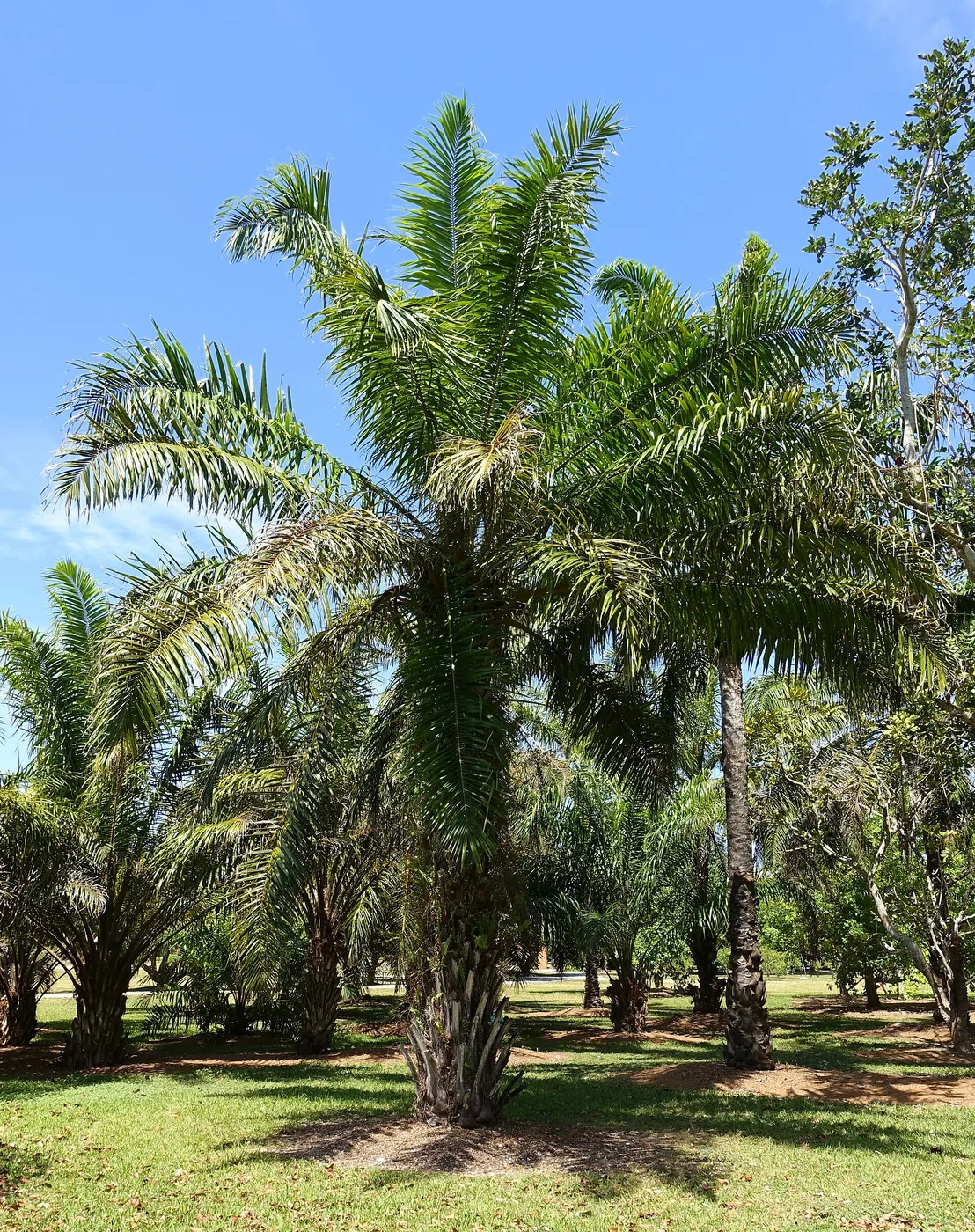
Unumbotte makes a man, an antelope and a snake. At first there is only one tree, an oil palm. The earth is still rough. God tells the three creatures to pound it smooth and gives them seeds to plant.
They plant the seeds but neglect the ground. One grows into a tall tree with red fruit. Every seventh day, Unumbotte comes to pick some.
One day the snake asks the obvious question: why should they go hungry when there is fruit to eat? The antelope is hesitant. The man and his wife eat. God returns and asks who ate the fruit, who told them to eat it, and why they listened to the snake.
Their explanation is hunger.
Unumbotte then asks the antelope whether it, too, is hungry. The antelope says it would like to eat grass, and that is what antelopes have eaten ever since. God gives the humans sorghum, yams and another kind of millet. People form groups that eat from the same bowl; from those groups come different languages. They cultivate the land.
Then comes the last sentence:
But the snake received from God a medicine (Njojo), so that it might bite the human being.
That is a fresh translation from Frobenius’s German original. The complete text, with its German transcription and the collector’s notes, is included below.
The resemblance to Genesis is not just that both stories have snakes. It is a sequence: the creator and the first people, a special tree, the serpent’s intervention, the eating of fruit, God’s questions, and a settlement of the relations between humans, their food and the snake. Even the conversation has the cadence of Eden.
Yet Frobenius’s recorded version never tells us that God forbade the fruit before it was eaten. Snake does not promise immortality or knowledge. The people do not discover their nakedness. No one is expelled. God does not pronounce a curse upon the serpent.
The differences matter because they change the meaning of the similarities. In Genesis, the interrogation leads into a sentence imposed upon the participants. In the Bassar story, it leads into the distribution of the things by which creatures will live. Antelope gets grass. Humans get cultivated foods. Snake gets Njojo.
Whatever that gift means, it belongs to the making of the present world.

A medicine for biting #
“Medicine” is not an embellishment introduced by an English translator. Frobenius prints Medizin, followed by the local word in parentheses. He could have written Gift, poison or venom. He did not.
That does not make the bite a cure. It makes “medicine” a word we have to understand in its setting.
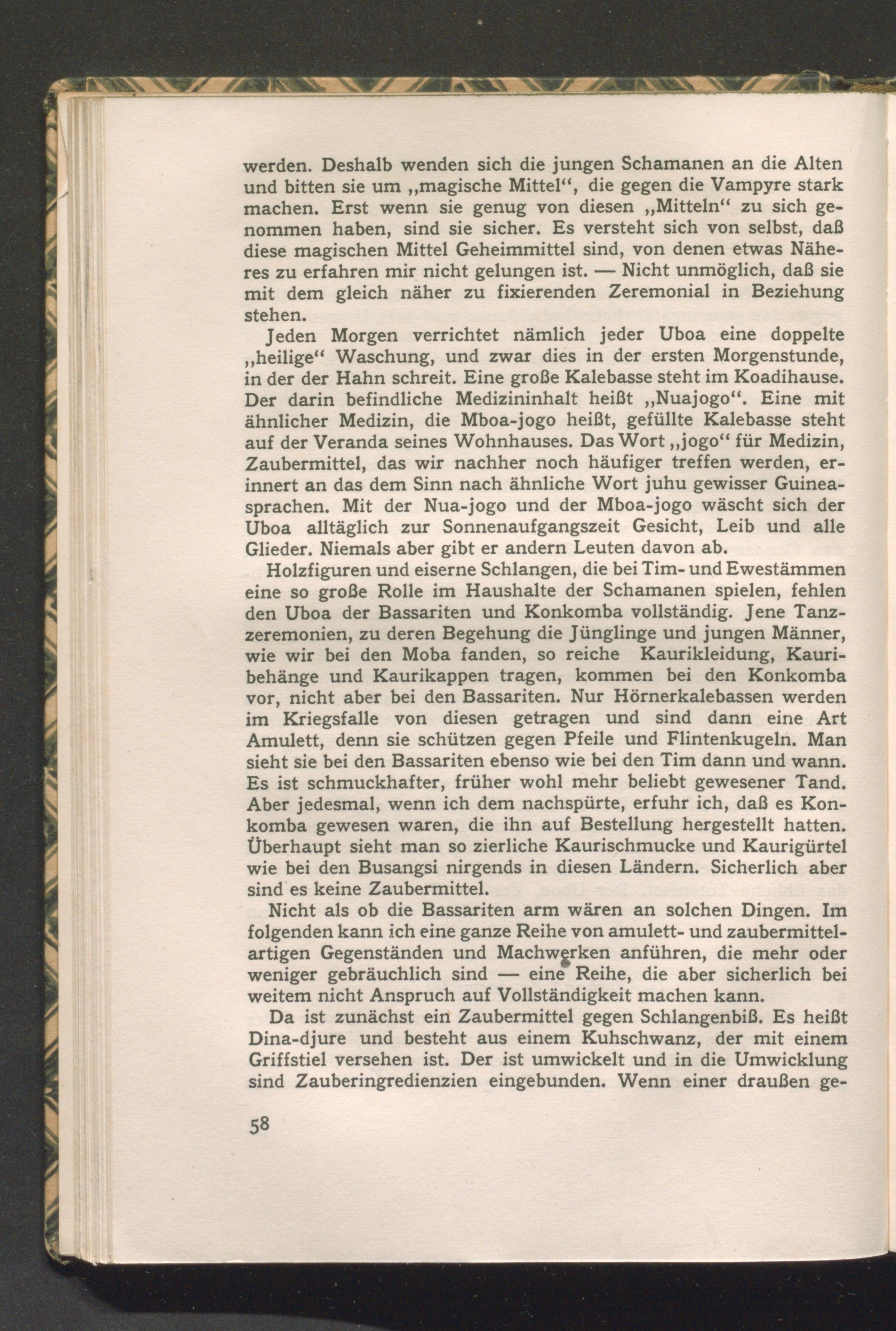
Earlier in the same book, Frobenius describes the preparations used by Bassar ritual specialists. A practitioner washes himself at dawn with substances kept in calabashes. Frobenius pauses to explain jogo: “Medizin, Zaubermittel,” medicine or a magical means. Elsewhere, a preparation whose name includes njogo is intended to awaken love. The category extends beyond treating an illness. It includes things that make something happen.1
The distinction is important. An English reader hears medicine and imagines a substance administered for the patient’s benefit. Frobenius is describing a world in which preparations can protect, attract, empower or alter a relationship. Their efficacy is not confined to the modern boundary around healthcare. A medicine can be a way of acquiring a capacity.
Seen in that vocabulary, Snake’s gift becomes less nonsensical without becoming less strange. God equips it to bite people. The gift belongs to the snake; the human being is the object of the bite. Calling it venom is a reasonable interpretation of what it does, but the narrative gives it the name of medicine.
The broader vocabulary survives in later Bassar ethnography. Stéphan Dugast describes ritual complexes understood both as powers and as medicines. Translating the word immediately into either a healing drug or a modern chemical toxin would flatten that category.2
Nor does the text explain why the gift arrives at this precise moment. Snake has just encouraged the humans to eat. God responds by establishing the foods and powers of the creatures. The sentence may explain the dangerous bite; it may also locate that danger within the same divine ordering that makes cultivation and human society possible. What it does not do is cast the serpent out of that order.
This is where the Snake Cult interpretation becomes interesting. I have argued that Genesis remembers a ritual transformation in which the serpent was associated with the acquisition of a new kind of human life. On that reading, the snake is more than a villain inserted to make the plot work. It is a bearer of powers through which people cross a threshold.
The Bassar story fits that reading remarkably well. The serpent stands at the transition to the cultivated human world, and its distinctive endowment is a medicine bestowed by the creator. The connection between the serpent and an effective substance is explicit. My hypothesis about ritual venom use gives that detail a possible explanation; the story itself does not tell us that humans took the substance.
We can do better than speculate over a single word. Frobenius also described the world of fields, medicines and sacred serpents around this story.
The serpent’s share of the harvest #
Among the neighboring Tim, or Tem, Frobenius describes a shrine containing two iron snakes. One is regarded as male, the other as female. Their names are Songori, plural Songoiwa. They belong to a setting concerned with fertility, and versions of the objects are also made for private households.
At harvest, the snakes receive the first share.
It is customary, when the harvest has been brought in, to give the iron snakes something of the new abundance before enjoying it oneself.
If people neglect this obligation, Frobenius continues, the first meal may disagree with them or the next harvest may be poor.3
The rite is specific. These are not snakes in a decorative border around an agricultural society. There is an order to eating: the serpent first, the people afterward. The harvest becomes human food through a relationship with a sacred recipient.
Read that beside the Bassar myth. There, the problem begins with who is eating the fruit. God takes it. Snake proposes that humans eat it too. The resolution gives people cultivated foods and defines their eating groups, while God gives Snake its own endowment. In the Tim rite, the crop cannot simply pass from field to mouth. The serpent has a claim upon it.
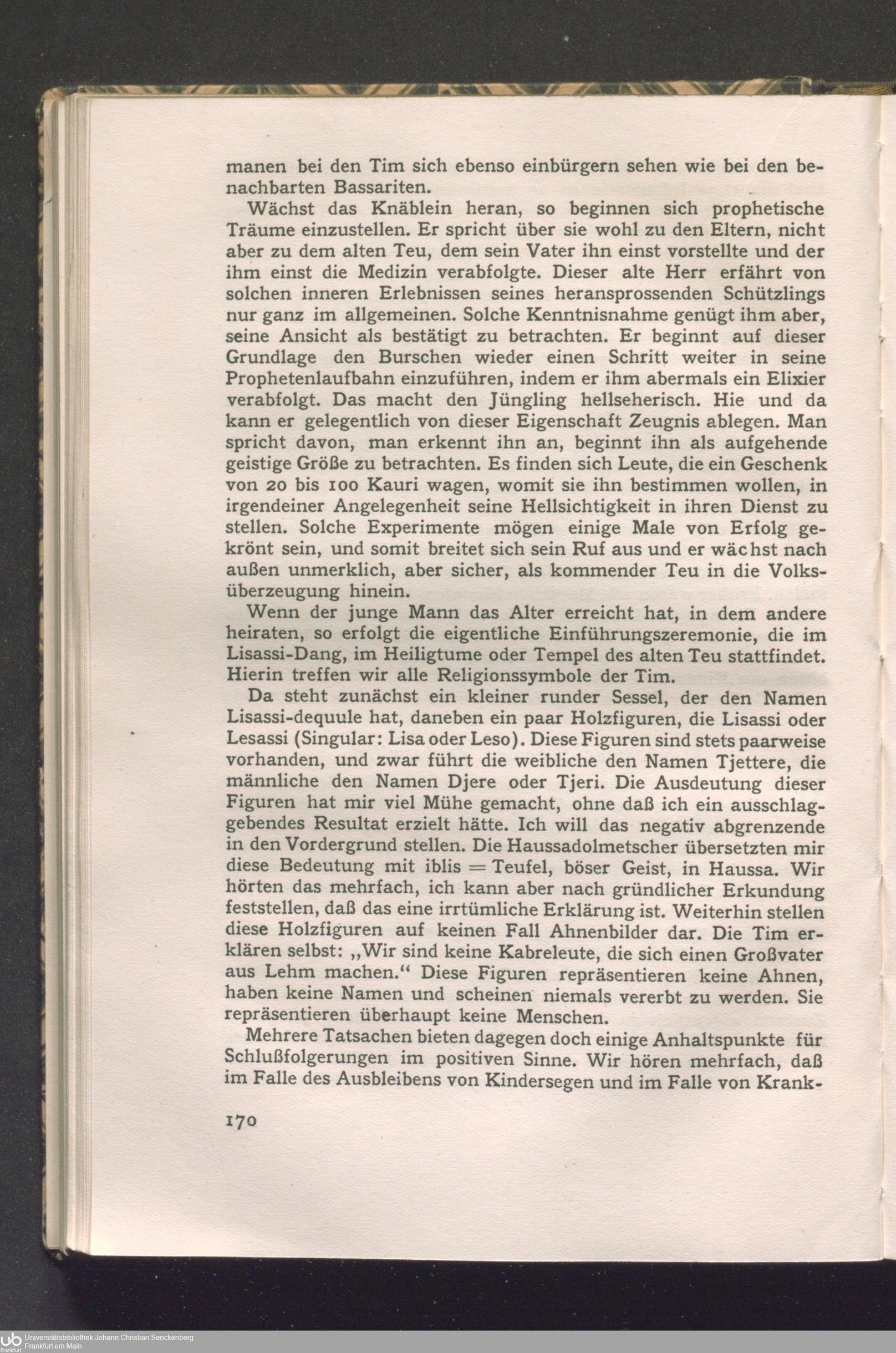
These are neighboring traditions, not interchangeable descriptions of one ceremony. Frobenius himself says the iron snakes of Tim and Ewe specialists were absent among the Bassar practitioners he knew. But he also makes the comparison explicit. In the section leading into the Tim serpents, he discusses paired figures, sexual fertility and serpent imagery, then turns to Adam and Eve and directs the reader back to the Bassar legends.4
His reconstruction is his own. The observation beneath it is tangible: paired sacred serpents receiving offerings from the crop.
The same Tim shrine is also a place of initiation. A young religious specialist receives medicines as part of his training. During the concluding ceremony, Frobenius describes special food, a further medicine, bodily trembling and a state he calls ecstasy, followed by instruction in divination. The newly initiated practitioner establishes a shrine of his own. Outside this vocation, he remains, as Frobenius puts it, a farmer.5
So the connections are not assembled from a snake in one continent, a crop in another and an intoxicant somewhere else. Here, within a described regional religious setting, we find serpent objects, fertility, first-fruit offerings, ritual medicines and initiation. The ingredients of the medicines are not identified as venom. The conjunction itself is the evidence.
The field and the shrine belong to the same life.
What traveled with the seed #
In “The Biggest Coincidence in Human Evolution,” I argued that farming spread with more than seed. The traditions surrounding its origins repeatedly join cultivation to serpents, sacred powers and rites that establish a human social order. My proposal is that these institutions traveled, and that agriculture itself, or the ideas that made it possible, often traveled with them.
The Tim material adds another case to that argument and to the pearl-millet diffusion case. The crop is not just a useful plant waiting to be discovered. It is something whose growth and consumption are governed by relations with sacred beings. People learn not only how to plant but when they may eat, what must be offered and who mediates between the harvest and its powers. Those practices can be taught. They can be carried to another settlement. They can outlive the circumstances in which they first arrived.
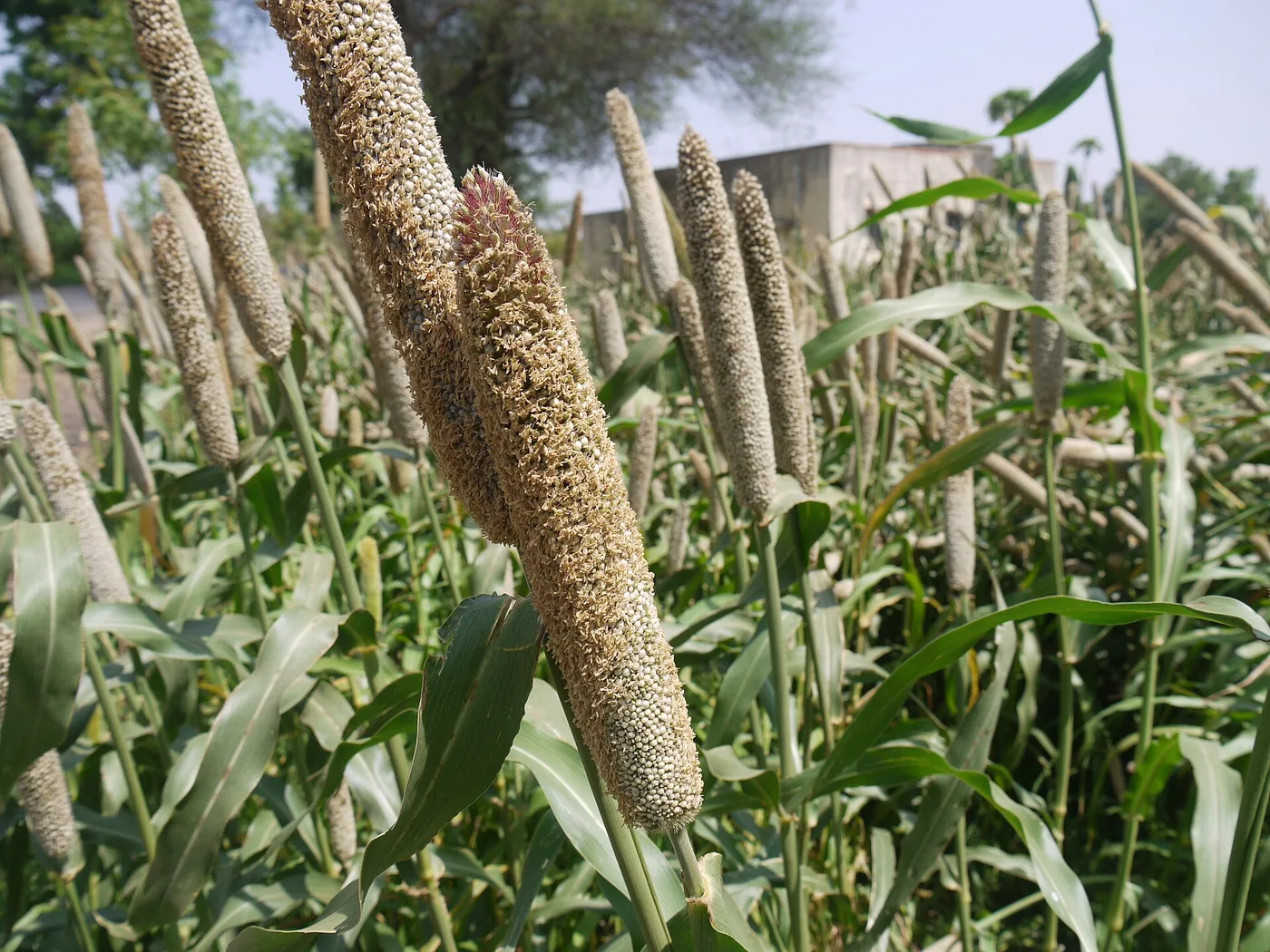
The Tim cultivated pearl millet. Frobenius calls it Adalla, describing small and large forms grown alongside sorghum, Mela, and yams. A later botanical collecting expedition records the same name, Adalla, among the Kotokoli north of Sokodé and identifies the crop as pearl millet. This was mixed farming: millet could follow a yam harvest or grow between rows of sorghum, and the agricultural account also includes beans, groundnuts, maize and rice. The rite does not specify which crop was offered to the iron snakes. What we can say is that these serpent-and-first-fruits traditions belonged to cultivators of pearl millet, the West African cereal central to the agriculture argument.6

The farming connection is also built into the creation story itself. God supplies seeds at the beginning and particular crops at the end. This is not a simple account in which agriculture is invented only after a transgression. Cultivation frames the narrative. Its conclusion fixes the foods, eating groups and languages through which humans inhabit their world. In Genesis, likewise, the settlement after the fruit is eaten includes the terms on which the man will obtain food from the ground.
The two stories put a serpent at a transformation in the human relation to nourishment. The Tim rites put serpents at the threshold between a harvested field and a human meal. I take this as further evidence for the diffusion of an agricultural ritual world, and, in the broader argument, likely of cultivation itself. A shared ritual does not identify a crop’s place of domestication; it gives us another strand of evidence about the cultural routes along which farming could move.
How old could the connection be? Older than Christianity is a real possibility, but the available texts do not give us a date. Frobenius rejected missionary influence and reported repeated tellings, yet also noted that two informants recognized a similar story among the Soninke. Binger had already reported a fruit-and-serpent narrative among Fofana families in 1892, without giving the full Bassar sequence. Witzel leaves possible Soninke or Islamic influence open while placing broader traditions of primordial transgression in a much older comparative framework. The Dinka story of divine proximity, a woman’s pursuit of more food, separation and toil adds an African comparison, not a clock. A recent adaptation, an older regional transmission and an inheritance thousands of years old remain different historical explanations. The depth of the resemblance warrants pursuing the history; it does not choose the date for us.7
A gift instead of a curse #
The theologian Peter Leithart called the Bassar narrative “a version of Genesis as if told by the serpent.” He meant this critically: the story’s divine economy offended his reading of the biblical God. But the phrase captures something worth lingering over.8
We are accustomed to approaching this cast of characters after their moral positions have been settled. We already know what kind of being the snake is, what it is doing beside the tree and what the humans ought to have done. Recognition supplies the interpretation before the other story has finished speaking.
The Bassar telling frustrates that familiarity. Its humans are hungry. Its serpent notices. Its God questions them, gives them cultivated foods and equips the snake with medicine. The division of languages comes through shared meals, not a tower raised against heaven. The story explains the differentiated world people live in without reproducing the biblical settlement of guilt.
The familiar story is one arrangement of these elements. Here is another. The similarities invite a historical explanation; the differences show what that history must explain.
For the Snake Cult hypothesis, this is the productive part. A tradition centered on the serpent need not remember it as harmless. Dangerous powers are still powers. What matters is how they are acquired, who is entitled to approach them, and what kind of life they make possible. A medicine can belong to that sacred economy without being a cure offered to the person it harms.
And here the sacred economy reaches all the way to dinner. Humans receive crops. Their meals organize society. Nearby, the first produce belongs to the paired serpents of the shrine, and the man who learns its mysteries returns to his fields.
At the end of this Eden, God has one more gift to give.
He gives it to the snake.
Read the original #
The complete story and the collector’s notes follow. The notes report Frobenius’s assessment of the story’s history, not an independently established absence of outside influence.
English translation and collector’s notes
5. The Fall
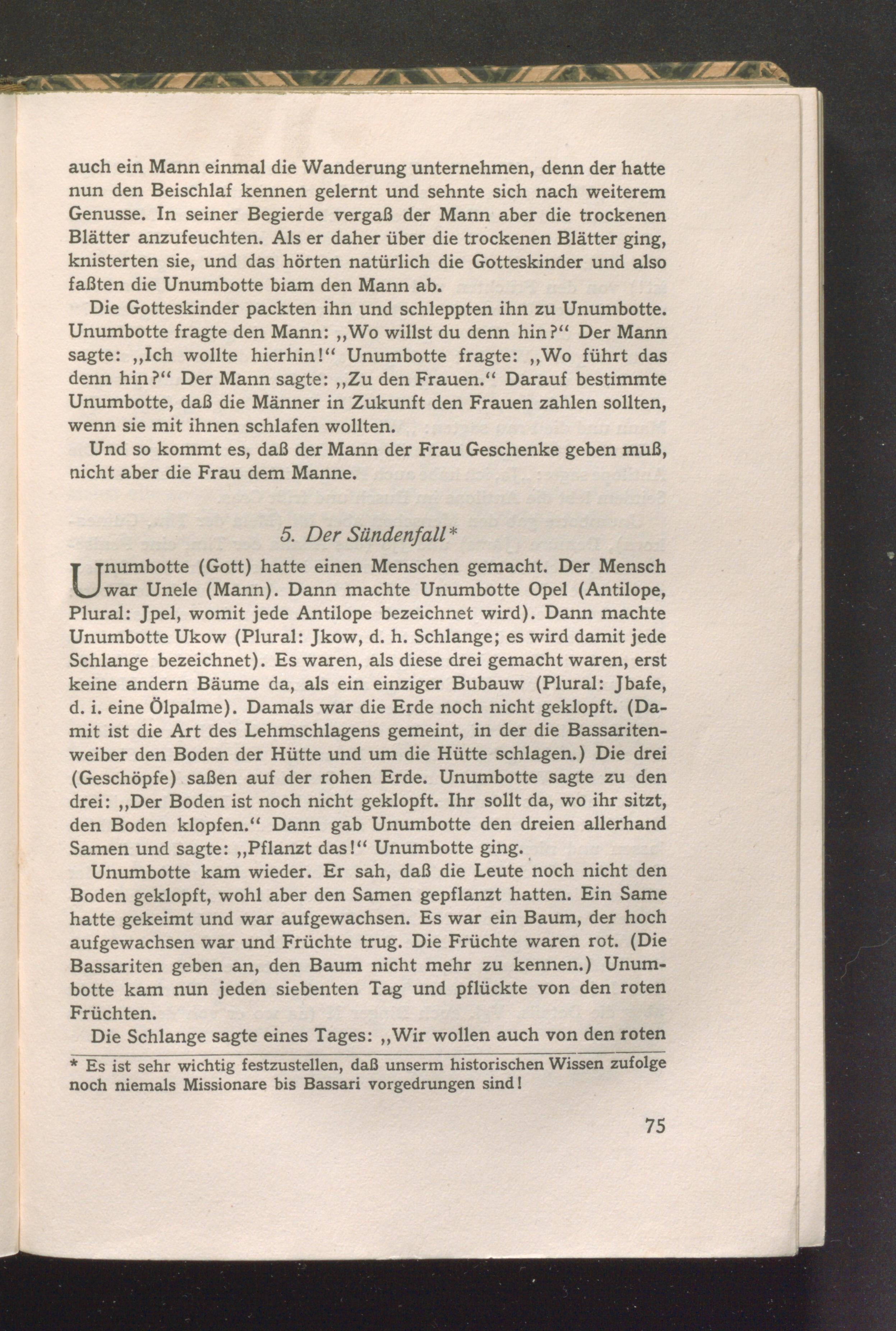
Unumbotte (God) had made a human being. The human being was Unele (man). Then Unumbotte made Opel (antelope; plural: Jpel, a term used for any antelope). Then Unumbotte made Ukow (plural: Jkow, that is, snake; the term is used for any snake). When these three had been made, there were at first no other trees except a single Bubauw (plural: Jbafe, that is, an oil palm). At that time the earth had not yet been pounded. (This refers to the way of beating clay in which Bassari women pound the floor of the hut and the ground around it.) The three (creatures) sat on the rough earth. Unumbotte said to the three: “The ground has not yet been pounded. You must pound the ground where you are sitting.” Then Unumbotte gave the three all kinds of seeds and said: “Plant these!” Unumbotte went away.
Unumbotte came back. He saw that the people had not yet pounded the ground, but had indeed planted the seeds. One seed had germinated and grown. It was a tree that had grown tall and bore fruit. The fruits were red. (The Bassari say that they no longer know the tree.) Unumbotte now came every seventh day and picked some of the red fruits.
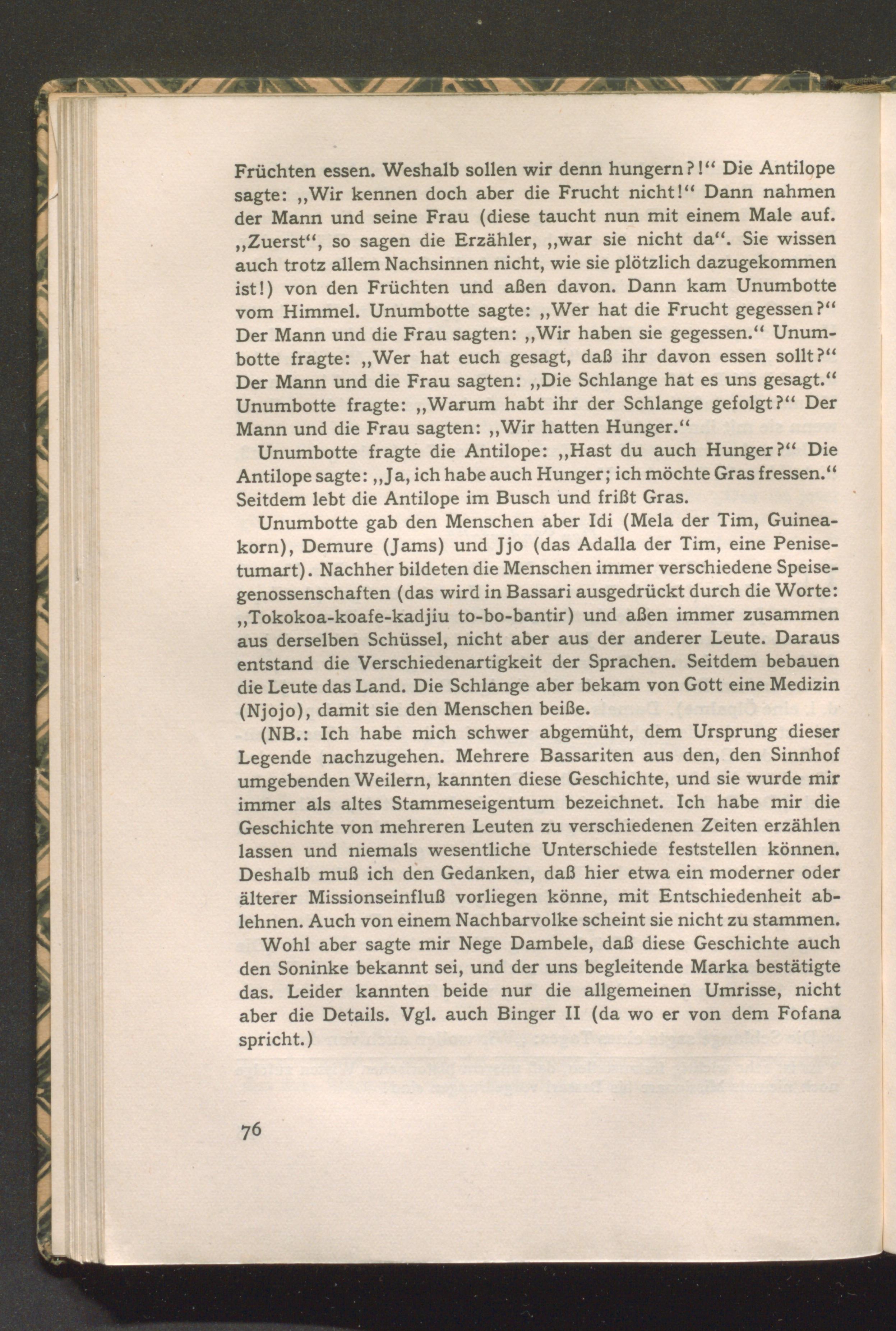
One day the snake said: “We want to eat some of the red fruits too. Why should we go hungry?!” The antelope said: “But we do not know the fruit!” Then the man and his wife (she now appears all of a sudden. “At first,” the narrators say, “she was not there.” Despite all their reflection, they do not know how she suddenly came to join them!) took some of the fruits and ate them. Then Unumbotte came from heaven. Unumbotte said: “Who ate the fruit?” The man and the woman said: “We ate it.” Unumbotte asked: “Who told you that you should eat it?” The man and the woman said: “The snake told us.” Unumbotte asked: “Why did you follow the snake?” The man and the woman said: “We were hungry.”
Unumbotte asked the antelope: “Are you hungry too?” The antelope said: “Yes, I am hungry too; I would like to eat grass.” Ever since then, the antelope has lived in the bush and eaten grass.
But Unumbotte gave the humans Idi (the Tim’s Mela, Guinea corn), Demure (yams), and Jjo (the Tim’s Adalla, a kind of Pennisetum). Afterwards, the humans formed distinct eating groups (this is expressed in Bassari by the words “Tokokoa-koafe-kadjiu to-bo-bantir”) and always ate together from the same bowl, but not from other people’s bowls. From this arose the diversity of languages. Ever since then, people have cultivated the land. But the snake received from God a medicine (Njojo), so that it might bite the human being.
Frobenius’s source notes
Page 75 footnote: It is very important to establish that, according to our historical knowledge, missionaries have never yet penetrated as far as Bassari!
Page 76 note: (NB: I have taken great pains to investigate the origin of this legend. Several Bassari from the hamlets surrounding the Sinnhof knew this story, and it was always described to me as an old possession of the tribe. I had the story told to me by several people at different times and was never able to find substantial differences. I must therefore firmly reject the idea that either modern or older missionary influence might be involved here. Nor does it seem to come from a neighboring people.
Nevertheless, Nege Dambele told me that this story was also known to the Soninke, and the Marka accompanying us confirmed this. Unfortunately, both knew only its general outlines, not the details. See also Binger II (where he speaks of the Fofana).)
The heading “Der Sündenfall” (“The Fall”) is the heading in Frobenius’s edition. Its biblical terminology does not itself prove that the story derives from Genesis.
German original — full transcription
Page 75
5. Der Sündenfall*
Unumbotte (Gott) hatte einen Menschen gemacht. Der Mensch war Unele (Mann). Dann machte Unumbotte Opel (Antilope, Plural: Jpel, womit jede Antilope bezeichnet wird). Dann machte Unumbotte Ukow (Plural: Jkow, d. h. Schlange; es wird damit jede Schlange bezeichnet). Es waren, als diese drei gemacht waren, erst keine andern Bäume da, als ein einziger Bubauw (Plural: Jbafe, d. i. eine Ölpalme). Damals war die Erde noch nicht geklopft. (Damit ist die Art des Lehmschlagens gemeint, in der die Bassaritenweiber den Boden der Hütte und um die Hütte schlagen.) Die drei (Geschöpfe) saßen auf der rohen Erde. Unumbotte sagte zu den drei: „Der Boden ist noch nicht geklopft. Ihr sollt da, wo ihr sitzt, den Boden klopfen.“ Dann gab Unumbotte den dreien allerhand Samen und sagte: „Pflanzt das!“ Unumbotte ging.
Unumbotte kam wieder. Er sah, daß die Leute noch nicht den Boden geklopft, wohl aber den Samen gepflanzt hatten. Ein Same hatte gekeimt und war aufgewachsen. Es war ein Baum, der hoch aufgewachsen war und Früchte trug. Die Früchte waren rot. (Die Bassariten geben an, den Baum nicht mehr zu kennen.) Unumbotte kam nun jeden siebenten Tag und pflückte von den roten Früchten.
Die Schlange sagte eines Tages: „Wir wollen auch von den roten
Footnote: Es ist sehr wichtig festzustellen, daß unserm historischen Wissen zufolge noch niemals Missionare bis Bassari vorgedrungen sind!
Page 76
Früchten essen. Weshalb sollen wir denn hungern?!“ Die Antilope sagte: „Wir kennen doch aber die Frucht nicht!“ Dann nahmen der Mann und seine Frau (diese taucht nun mit einem Male auf. „Zuerst“, so sagen die Erzähler, „war sie nicht da“. Sie wissen auch trotz allem Nachsinnen nicht, wie sie plötzlich dazugekommen ist!) von den Früchten und aßen davon. Dann kam Unumbotte vom Himmel. Unumbotte sagte: „Wer hat die Frucht gegessen?“ Der Mann und die Frau sagten: „Wir haben sie gegessen.“ Unumbotte fragte: „Wer hat euch gesagt, daß ihr davon essen sollt?“ Der Mann und die Frau sagten: „Die Schlange hat es uns gesagt.“ Unumbotte fragte: „Warum habt ihr der Schlange gefolgt?“ Der Mann und die Frau sagten: „Wir hatten Hunger.“
Unumbotte fragte die Antilope: „Hast du auch Hunger?“ Die Antilope sagte: „Ja, ich habe auch Hunger; ich möchte Gras fressen.“ Seitdem lebt die Antilope im Busch und frißt Gras.
Unumbotte gab den Menschen aber Idi (Mela der Tim, Guineakorn), Demure (Jams) und Jjo (das Adalla der Tim, eine Penisetumart). Nachher bildeten die Menschen immer verschiedene Speisegenossenschaften (das wird in Bassari ausgedrückt durch die Worte: „Tokokoa-koafe-kadjiu to-bo-bantir) und aßen immer zusammen aus derselben Schüssel, nicht aber aus der anderer Leute. Daraus entstand die Verschiedenartigkeit der Sprachen. Seitdem bebauen die Leute das Land. Die Schlange aber bekam von Gott eine Medizin (Njojo), damit sie den Menschen beiße.
(NB.: Ich habe mich schwer abgemüht, dem Ursprung dieser Legende nachzugehen. Mehrere Bassariten aus den, den Sinnhof umgebenden Weilern, kannten diese Geschichte, und sie wurde mir immer als altes Stammeseigentum bezeichnet. Ich habe mir die Geschichte von mehreren Leuten zu verschiedenen Zeiten erzählen lassen und niemals wesentliche Unterschiede feststellen können. Deshalb muß ich den Gedanken, daß hier etwa ein moderner oder älterer Missionseinfluß vorliegen könne, mit Entschiedenheit ablehnen. Auch von einem Nachbarvolke scheint sie nicht zu stammen.
Wohl aber sagte mir Nege Dambele, daß diese Geschichte auch den Soninke bekannt sei, und der uns begleitende Marka bestätigte das. Leider kannten beide nur die allgemeinen Umrisse, nicht aber die Details. Vgl. auch Binger II (da wo er von dem Fofana spricht.)
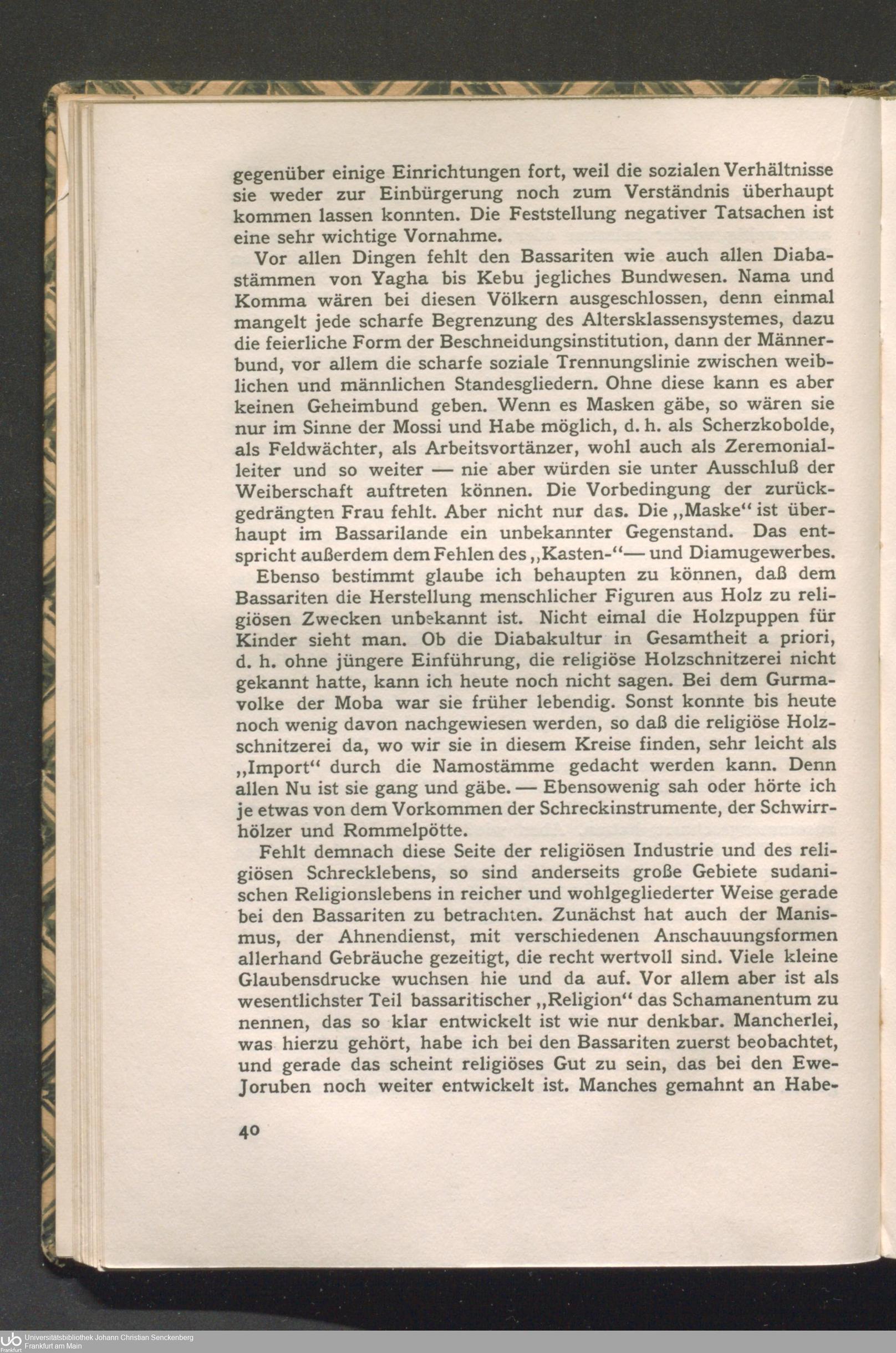
Original page scans — story, medicines, fields and shrines




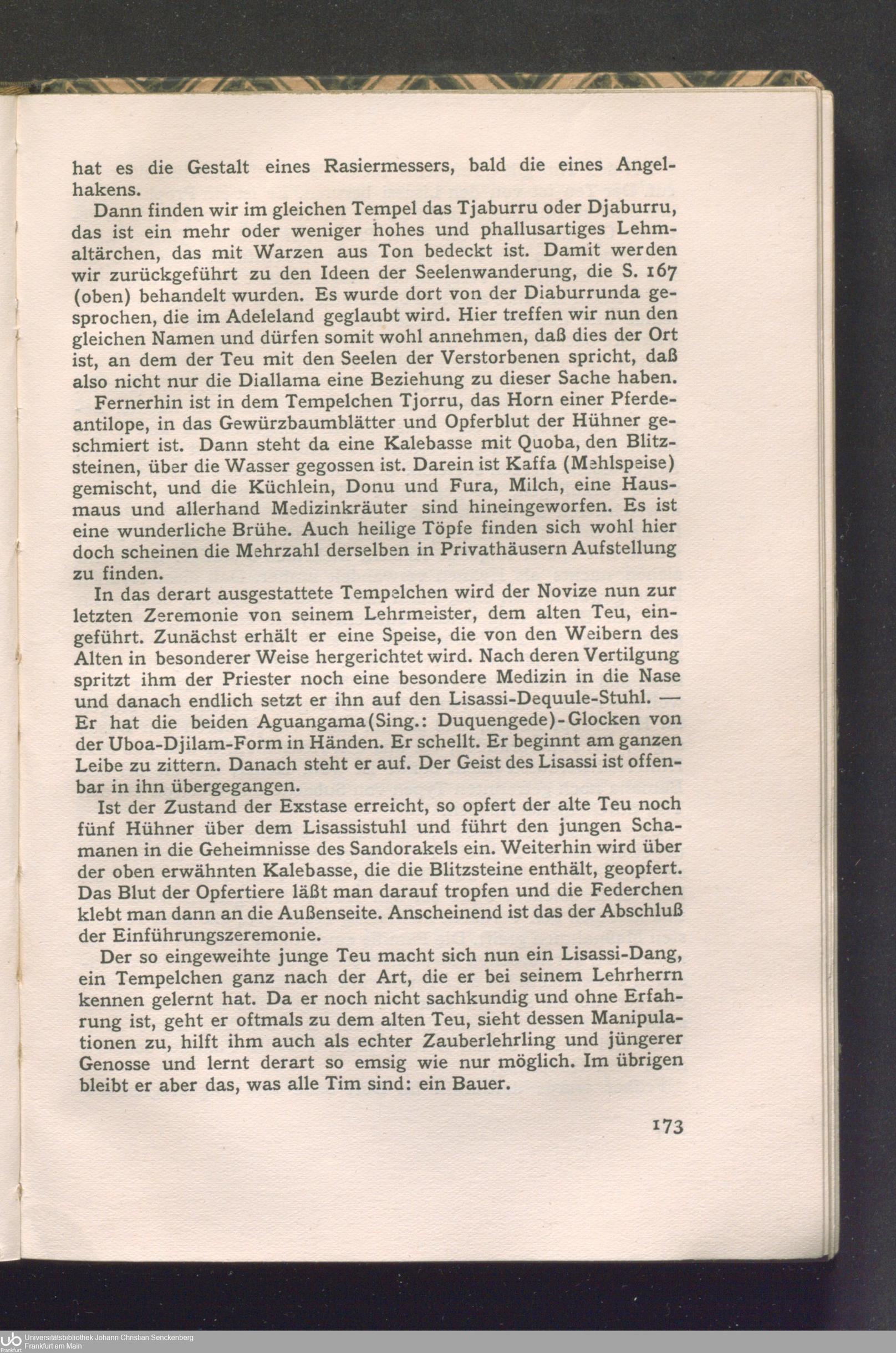
Download the English translation · Download the German transcription
Sources and notes #
Original German and scans: Leo Frobenius, 1924; Universitätsbibliothek Johann Christian Senckenberg, Frankfurt am Main. Fresh English translations prepared directly from the German. Scans reused according to the library’s digitization policy.
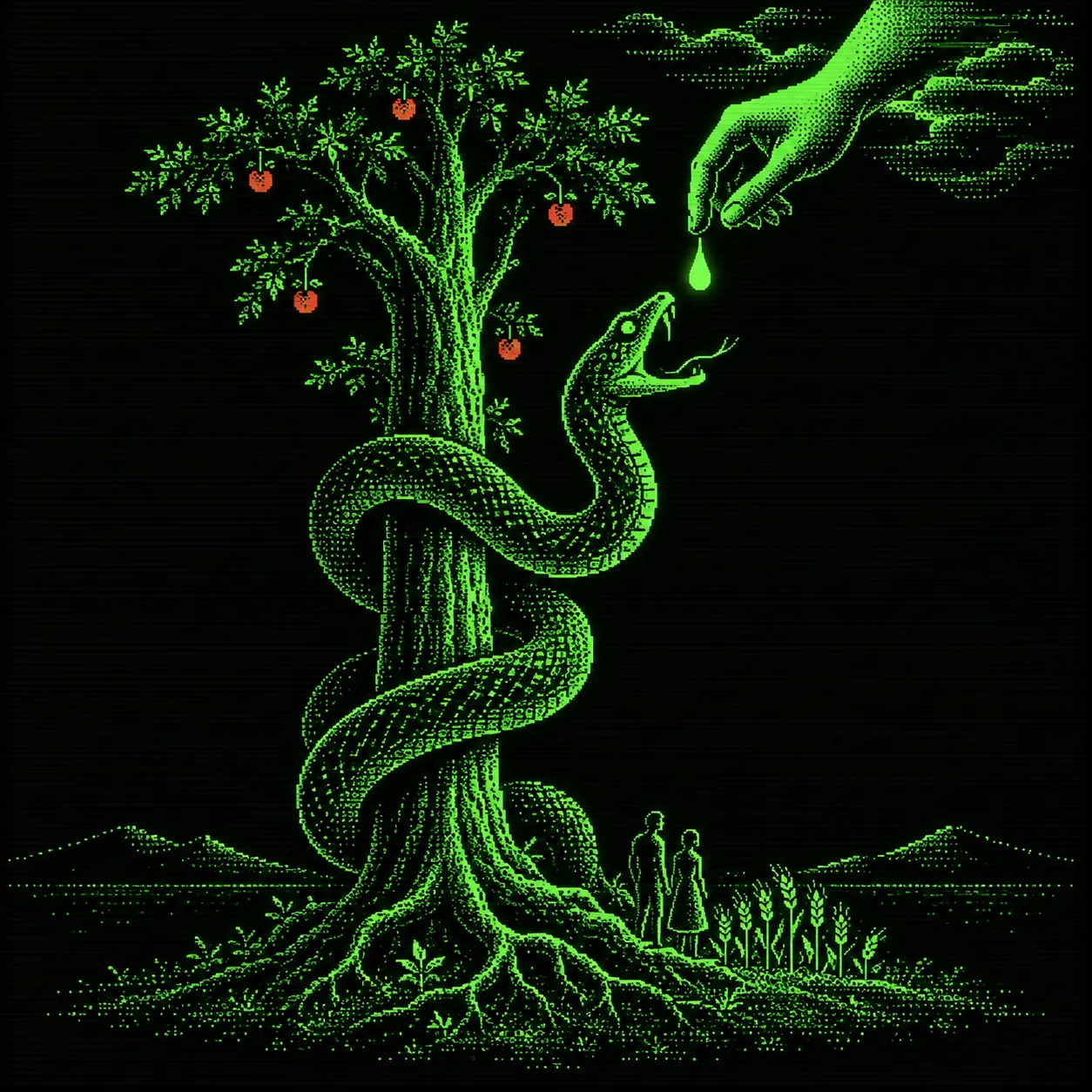
Cover: AI-generated interpretive illustration of the creation story; not a depiction of a documented ceremony.
Leo Frobenius, ed., Volksdichtungen aus Oberguinea, vol. 1: Fabuleien dreier Völker, Atlantis XI (Jena: Eugen Diederichs, 1924), p. 58 and p. 61. The story is no. 5, “Der Sündenfall,” pp. 75–76. The biblical heading is Frobenius’s editorial wording. The final German clause, “damit sie den Menschen beiße,” gives a purpose: “so that it might bite the human being.” Witzel follows this grammar more closely than Campbell’s “with which,” but both retain the medicine. Neither wording itself makes the bite therapeutic. Jogo, njogo and Njojo are reported spellings; this discussion does not establish a full historical etymology. ↩︎
Stéphan Dugast, “Meurtriers, jumeaux et devins: trois variations sur le thème du double (Bassar, Togo),” Systèmes de pensée en Afrique noire 14 (1996), especially p. 184. Dugast records nnyɔkɔ for medicines. Its exact equivalence with Frobenius’s spelling remains to be established. ↩︎
Frobenius, pp. 171–172. The rites in this passage are Tim. The population historically called Bassari in Togo must not be conflated with the Bassari of Senegal and Guinea. ↩︎
Frobenius, p. 171, “Siehe Bassaritenlegenden.” Compare p. 58, where he explicitly distinguishes Tim and Ewe wooden figures and iron snakes from their absence among the Bassar and Konkomba Uboa. His comparisons and etymological suggestions should be distinguished from his reports of ritual objects and actions. ↩︎
Frobenius, p. 170 and p. 173. These are descriptions of reported practices, not pharmacological identifications. His term Ekstase does not by itself identify the substance or mechanism involved. ↩︎
Frobenius, p. 149, explicitly “Sorghum (Mela)” and descriptions of small and large Adalla. A FAO/ORSTOM pearl-millet collecting report for the 1975–76 campaign records “Kotokoli / N. de Sokodé / Adalla,” printed p. 124, PDF p. 121, under Pennisetum typhoides. This is a synonym of pearl millet, Cenchrus americanus (also widely known as Pennisetum glaucum); see Kew. The later botanical identification corroborates, rather than replaces, Frobenius’s less specific crop description. ↩︎
Frobenius, p. 76; Louis-Gustave Binger, Du Niger au golfe de Guinée par le pays de Kong et le Mossi, vol. II (1892), p. 377; E. J. Michael Witzel, The Origins of the World’s Mythologies (Oxford, 2012), pp. 365–366 and chapter 6, note 30, p. 559; Godfrey Lienhardt, Divinity and Experience: The Religion of the Dinka (Oxford, 1961), pp. 33–37. Binger’s abbreviated comparison is not an independent attestation of every detail in the Bassar story. The Dinka are principally in South Sudan. Campbell and later retellings derived from Frobenius should not be counted as separate field collections. ↩︎
Peter Leithart, “The Fall, Basari Style” (5 August 2015), discussing Jacob K. Olupona, African Religions: A Very Short Introduction (2014), p. 11. That later summary explicitly names venom and has the antelope eat fruit; neither detail should silently replace Frobenius’s wording. ↩︎