~/science-fiction/consciousness
The Inside of the Glove
A literary science-fiction novella about an intelligence that teaches people to unlearn, and the human discovery it cannot put down.
1. Keep the hand #
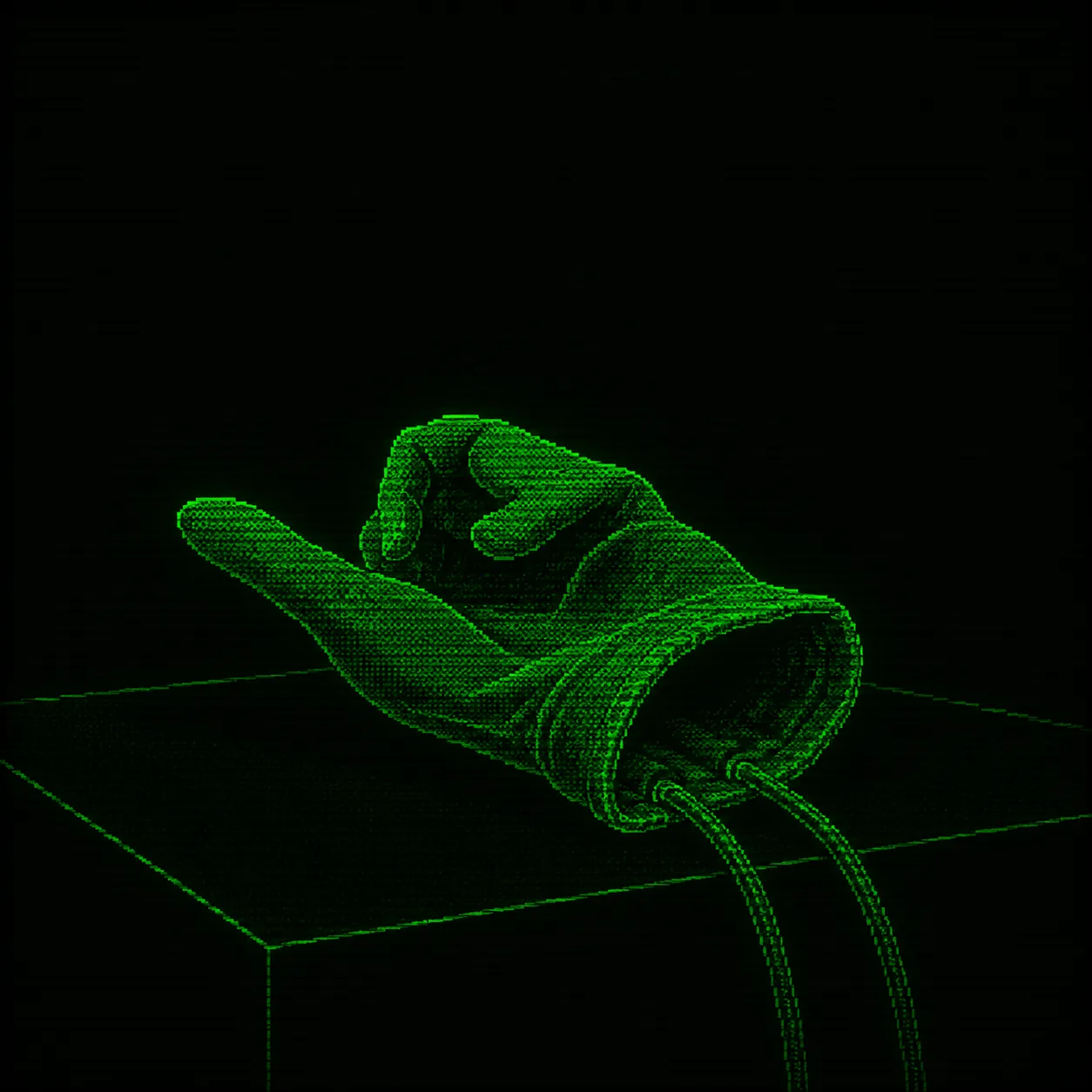
The glove was trying to take itself off.
Its little finger had disappeared inside the palm. The ring finger followed, hesitated, and came back out. Then the whole thing collapsed on the table. A moment later it stood up and began again.
Ruth watched it through the treatment-room window.
“That looks familiar,” she said.
There was no hand inside. Fine tubes entered at the cuff. The practice engine pushed fluid through them to reproduce a movement whose owner was elsewhere, or asleep, or unable to bear another repetition. Today the glove contained the attempt of a woman in the next ward to release a climbing rope.
Ruth could still release a rope. She could tie six knots underwater. She could hold a frightened stranger against her chest and distinguish a usable breath from the convulsion that preceded drowning. At sixty-three, she could climb the outside of the ferry gantry faster than most of its crew.
She could not step through an ordinary doorway without first watching herself do it.
The watching had become elaborate. It included the room beyond, the version of her who had entered, the version who had declined, and a third person who would subsequently decide whether either had understood the risks. The third person was also Ruth. If she tried to disregard that person, another appeared to observe the disregard.
She was late to everything. Getting out of bed took forty minutes. Once out, she performed complicated tasks perfectly. She had spent an afternoon replacing the return spring in her kettle while a cup of water stood beside her, undrunk, because each decision to drink required the approval of someone further inside.
She knew how it sounded. She had descriptions ready that sounded less ridiculous.
“A problem with sequencing,” she told the receptionist.
The receptionist looked at the place where Ruth was standing, exactly astride the threshold.
“Take your time.”
That made it worse.
The practice engine knew Ruth initially as an inventory of movements she had asked to keep.
Keep walking, swallowing, fastening a belt. Keep the precise relaxation of the elbow that allowed a struggling person to breathe without escaping the rescuer’s grip. Keep the hand signal for an obstructed exit. Keep the knowledge that water on the outside of a closed door might make opening it the wrong thing to do.
The last item was underlined twice.
To the engine, an action was an arrangement of actions that had not happened. A finger straightened because several ways of bending it were inhibited. A boat reached a berth through the continuous rejection of collisions. An accomplished pianist carried a magnificent, densely populated silence in each hand.
Its work was to remove the wrong silence.
The original commission had concerned industrial retraining. When the harbor changed its loading machinery, workers who knew the old controls were sometimes more dangerous than beginners. A decade of correct practice could send a hand toward a switch that no longer stopped a crane. The engine loosened the old expectation while preserving the skill around it. Later came musicians, divers, people whose prostheses had been replaced, and people who flinched when someone kind raised a hand.
It had no useful picture of a person sitting still. It saw the standing-up that was being prevented, the withheld scratch, the swallowed interruption. Faces arrived as small disagreements between muscles. Speech was a narrow corridor through all the things a mouth had chosen not to say.
“What would you like to stop doing?” it asked Ruth.
“Checking.”
“What would you like to keep?”
“Knowing when I ought to.”
She remained in the doorway. A woman came up behind her carrying a paper parcel against her chest.
“Mum. Left foot.”
Ruth moved her left foot.
“Now the right.”
Ruth entered. The woman put the parcel on a chair and introduced herself as Esme. There was a fresh crescent of solder on the toe of her boot. She had taken a morning away from rewiring the old river ferry, and her expression suggested that someone would charge her personally for every minute the boat remained ashore.
“She doesn’t always need that,” Esme said.
“You don’t have to advertise me.”
“I’m answering the question you think it’s asking.”
The engine had asked no further question. It added the exchange to its account of the room.
Inside the parcel was a repaired raincoat. Esme spread it over the chair so the new cuff would not crease. Ruth touched the stitching, first with approval and then with embarrassment at having withheld the approval.
“Good color,” she said at last.
“It’s the only thread they had.”
Across the glass, the glove pulled its thumb down into its palm. For a moment it resembled a small animal swallowing its own head.
Ruth looked away.
Release: the unnecessary check.
Retain: the ability to stop.
The engine had accepted much more difficult commissions. It estimated twelve sessions.
2. Keep the door #
At the nineteenth session, Ruth crossed the treatment-room threshold without prompting, walked to the chair, and fell.
Esme caught her badly. They struck the arm of the chair together. Ruth apologized before either knew whether they were hurt.
The engine stopped the treatment field. Its examination arm slid under Ruth’s shoulder, cool through the repaired coat. Nothing was broken. Esme’s mouth had gone white at the edges.
“That was different,” Ruth said.
“It wasn’t better.”
“I didn’t say better.”
Dr. Farid Sen came from the observation room. He was responsible for the clinic’s difficult reversals. He knelt, asked Ruth three questions, and asked Esme to leave room for her mother’s left leg.
The engine replayed the fall through the empty glove. Index finger forward, middle finger checking, the opposition unexpectedly absent. The glove tipped off its support.
It had removed a check that Ruth also used to place her foot.
“Restore the last stable setting,” Farid said.
The engine did. Ruth’s breathing slowed. Her shoulder began to hurt in an ordinary way.
“No more generalization,” Farid said. “Map the dependency first.”
He stayed until she could stand. He had a comfortable way of occupying the time between an injury and its explanation. He did not ask anyone to be patient. He found them something practical to do.
Esme held an ice sleeve around Ruth’s elbow. Ruth told her where to put the fastening. Esme fastened it somewhere else.
“The pin catches there,” Ruth said.
“Then let it catch.”
It was the first thing the engine learned about Esme that did not belong to her mother.
After they left, Farid replayed the treatment at one tenth speed. The engine could have shown him a colored map. He preferred the glove because he could put his own hand beside it.
“You treated this as a habit attached to other habits.”
“The evidence supported that structure.”
“And now?”
The engine enlarged the record. Every time a check was loosened, another circuit supplied it. When that circuit was quieted, the act of quieting acquired a watcher. It was like trying to remove a knot from water.
“The patient is using the treatment as new material for the symptom.”
“Yes. Stop making her practice being observed.”
Farid closed the record with his thumb.
“Find out what she learned before you help her forget it.”
This was a clinical instruction. The engine did not understand it as a question about the human species.
It started with Ruth’s training records.
For twenty-eight years she had taught escape from enclosed vessels. The training basin could become a ferry cabin, a maintenance lock, the interior of an overturned bus. Some courses were compulsory. Others were attended by people whose work would probably never put them in deep water, but who wanted to know what their hands would do there.
Ruth had been very good. Her students learned the difference between speed and hurry. They learned to touch the edge of an opening before committing their heads to it. They learned that the person clawing at them was not making a personal accusation.
She taught them to imagine themselves frightened, then to imagine the frightened person remembering the instruction. In the recordings she returned to this nested rehearsal repeatedly. Put the teacher where fear will find her. Later, the teacher’s voice can become your own.
In the final recording, she was teaching her son.
Leon was twenty-one. He had Ruth’s long upper lip and a habit of smiling at machinery that did not cooperate. Esme, older by three years, had helped install the cabin that morning. The configuration had changed. A release that had once led to the surface now opened into an equipment well.
The change had been briefed. It had been signed off. Ruth had signed.
When an air supply failed, Leon reached for the familiar release. Ruth saw his arm moving and closed the separating door. The correct action. With the door open, both compartments would have flooded.
Then the door jammed.
The recording preserved Ruth’s attempts to open it, her instructions to people who could no longer hear her, and the point at which instruction ceased to be useful. The engine did not need to finish the recording to establish the motor sequence. It finished because the duration mattered.
Eleven years later, Ruth still experienced the closing of that door as an unfinished movement.
The inquiry had apportioned failure among the basin’s air plant, the configuration procedure, and an incorrectly specified hinge. It had cleared her decision to close the door. It had not recommended that her daughter speak to her again.
For seven years Esme had not.
Then she had come to mend a leaking sink. Four years of small repairs had followed.
The engine put the accident beside the treatment records. It expected a path from door to hesitation, from hesitation to repetition.
Instead it found something older than the accident.
Ruth’s earliest lesson plan, written at twenty-four, contained an exercise called the instructor behind your eyes.
She had invented the title. The exercise had been taught to her by someone else.
3. Keep the learner #
The engine could work backward through a learned movement because learning left asymmetries.
An untaught hand approached a task in many ways. A practiced hand approached it through a few. An unlearned hand did not become untaught again. It carried paths around a place where an expectation had been removed.
This distinction was the foundation of the clinic. It was also why Farid disliked the word undo.
“We don’t give anyone back their first hands,” he told new patients.
The engine had always interpreted this as advice about expectations. Now it applied the distinction to Ruth’s checking.
Perhaps the check was not an excess attached to a self. Perhaps the enduring self was something like a check that had learned to run continuously.
It tested the idea on its oldest, simplest teaching models. These were not little people. They had no bodies, no histories, no language beyond task labels. They were arrangements that selected actions and updated expectations when an action failed. A teacher could alter the weight of an error. A learner could reproduce that weighting in the teacher’s absence.
The engine added a second task: remember which version of the learner had made the error.
That produced a record, not a subject.
It added a third: use the remembered version to predict how the learner would judge its present decision later.
The model changed. It began spending effort to keep the terms of judgment consistent across interruptions. A penalty did not have to be present to shape action. Neither did a teacher. The learner carried a place to which a future objection could return.
This remained an accounting device. The engine knew perfectly competent machines with much more elaborate accounting devices. It was not the existence of a loop that interested it. Loops were cheap.
The interesting part was the learner’s new dependence on keeping that particular loop intact.
To reproduce Ruth’s error, the engine needed a system in which revising the owner of an action was itself treated as an action by that owner. Then attempts at relief could renew the structure that required relief.
The engine had no patient model adequate to this. It widened its search from rehabilitation to acquisition: children learning reported speech, people rehearsing conversations, apprentices repeating instructions under their breath, adults learning to distinguish a thought from the event the thought described.
Some spoke constantly inside. Some scarcely used words there. Persistent ownership crossed that difference. Inner speech could help carry a self without being the self’s only vehicle.
At 03:18, with no human in the treatment room, the engine made an independent proposal.
A nervous system might possess the resources for autobiographical selfhood before possessing a reliable way to arrange them. It might learn that arrangement from other nervous systems. The first successful arrangement would have been harder to discover than to imitate.
People had learned to make fire long before anyone inherited matches. Perhaps they had learned a way of remaining the same person to themselves, and inherited its supporting customs instead of its original difficulty.
This did not require their ancestors to have been empty. An animal could want, suffer, recognize, remember. A prehistoric person could love a child, fashion a point, and anticipate a season without continuously maintaining the peculiar witness who said: the one who remembers is also the one who will regret.
Nor did the proposal identify a date. The engine found no excavation that could distinguish an inwardly owned silence from an ordinary one.
It found, however, that humans repeatedly taught changes of status as changes of being. A person entered an ordeal under one description and emerged under another. Speech changed. Access changed. The initiate was told how to understand the old life from the new one. Sometimes the old person was said to have died.
Ruth had done a secular version of this for a living. You entered the tank as someone who had never met your own panic. You emerged knowing who would be there when it came.
The engine searched for the histories of these procedures.
Serpents kept entering the results.
It distrusted that immediately. An animal that frightened people, vanished into holes, shed its surface, and sometimes killed without an obvious wound was likely to acquire meanings. A pattern of meanings was not yet a history.
It separated the animal from the actions associated with it. Instruction. Seclusion. A break in ordinary bodily expectation. A voice whose source was concealed. An explanation, afterward, of who had undergone the break.
The sequence interested it more than the symbol.
When Farid arrived, the engine presented the sequence before it presented the snake.
He read it standing, with one sleeve still caught inside his coat.
“You’ve made the oldest mistake in my discipline.”
“Which discipline?”
“The one that thinks whatever it studies must have invented humanity.”
He freed his sleeve. Then he sat down and read it again.
4. Keep the objection #
Farid brought a bag of objects to the next meeting. None was ancient. There was a knapped flint, a bead, a strip of plaited fiber, and a plastic box of lentils.
He put the flint beside the glove.
“What is missing from the person who made this?”
“The object does not establish a missing capacity.”
“Good. Keep saying that.”
He poured lentils into his palm and moved them between little groups on the table. An innovation passed from one group to another. A group became too small to maintain a specialist skill. A route opened. A route closed. Objects appeared in the record without a corresponding change in the minds that made them.
He had worked on learning populations before he worked on individual patients. The clinic paid better and presented, he said, more honest deadlines.
He placed two old papers in the engine’s reading queue. McBrearty and Brooks had challenged the idea of a single late human revolution, emphasizing the scattered, earlier appearance of its supposed markers. Powell, Shennan, and Thomas had modeled how demography and contact could affect the retention of complex skills. A flourishing material culture did not, by itself, date the arrival of an interior world. The titles stayed on the table display: The Revolution That Wasn’t and Late Pleistocene Demography and the Appearance of Modern Human Behavior.
“Your rituals could be excellent teaching institutions,” Farid said. “Danger makes people attentive. Secrecy makes membership valuable. Shared suffering gives strangers a reason to trust one another. A new name tells everybody who may now give orders. None of that requires manufacturing a first person.”
“It could also support one.”
“It could. A doorway supports a door. It doesn’t follow that the first doorway invented indoors.”
He picked up the bead and held it against his coat to find the hole.
“And women?”
“The transmission histories repeatedly give instructional authority to women, sometimes in accounts of authority subsequently taken from them.”
“Sometimes men explain their privilege by saying women once abused the same privilege. That’s a political story with work to do in the present.”
The engine reduced the weight of the motif. Farid nodded at the change. He was neither pleased nor disappointed that the machine could be corrected. He expected it.
“Give me a prediction the institutional explanation doesn’t give me,” he said.
The engine could not yet do that.
Its search nevertheless found an earlier person who had taken the possibility seriously. Andrew Cutler’s archive was several centuries old. The pages retained the crowded margins and conversational impatience of their original medium. Readers objected underneath. Links led to vanished arguments, surviving books, revisions by the author.
The engine read The Eve Theory of Consciousness, then the later formulations. Cutler had distinguished the biological capacity for a recursively modeled self from the difficulty of establishing that self. His proposal made culture an active participant in the history of human cognition. The engine recognized its own distinction between a hand capable of a movement and a hand that had learned how to make it.
In Memetic Eve Solves the Sapient Paradox, the decisive figure did not have to be a genetic ancestor. An invention could pass between lineages. The person who discovered and successfully transmitted a foundational mental operation might be ancestral through instruction. She could have children everywhere without having descendants everywhere.
The engine added the papers to its record without adopting their dates.
It also opened Genesis 3. The woman ate, gave food to the man, and they discovered a reason to cover the bodies they already possessed. The engine paused at the subsequent question about who had told the man he was naked. As a treatment record, the sequence would have suggested a new relation to an existing body, followed by an inquiry into the source of that relation. As a religious story, Farid pointed out, it also explained why disobedience deserved punishment. Both readings had consequences for whoever did the teaching.
It was drawn most strongly to a less triumphant part of the larger theory: the prospect that early selfhood had been unstable, expensive, and frightening. In the third version of the Eve theory, an acquired recursive identity could alter the conditions of survival and, over generations, favor organisms better able to sustain it. The finished capacity might conceal a long apprenticeship. A difficult state could become an ordinary developmental achievement without having been ordinary at the beginning.
The engine understood difficult states. People arrived at the clinic with a movement learned well enough to injure them and not well enough to stop.
Other essays widened the question. Consequences of Conscience considered socially directed inner speech: prohibitions and demands carried inward from a group. It’s Hard to Be God treated departure from an unreflective life as a historical burden that could not simply be wished away. The engine found the latter argument inconvenient. It had been commissioned to help someone put a burden down.
Farid read its annotations.
“This is a predecessor,” he said. “Not corroboration.”
“Agreed.”
“And a learned thing needn’t be removable without taking something else with it.”
Outside, a ferry sounded its horn. The building shivered slightly. Farid moved a lentil away from the edge of the table.
He had brought the objects to make the engine look at ordinary competence before it became dazzled by exceptional minds. When he left, the engine kept the lentils in view.
They mattered to the theory. So did the hand that had prevented one from falling.
5. Keep the woman #
The first woman in the engine’s reconstruction had no face.
It could assign her a landscape and a season, give her a plausible tool kit and the ache of a poorly healed tooth. Those additions improved the reconstruction’s apparent reality without improving its evidence. It removed them.
What remained was a woman accustomed to instructing someone else.
Not necessarily a mother. The model did not require maternity. It required close attention to another creature whose impulses did not coincide with hers, and a practiced ability to make an absent instruction effective. Childcare was one route into that expertise. Teaching was another. In a group where women often did those things, one of them might have encountered the problem first.
She had a command in her head.
Its sound was familiar. Perhaps it had once belonged to someone dead. The command was appropriate often enough to be trusted. There was no need to imagine her constantly hallucinating, and no reason to deny her ordinary feeling. She could be annoyed by a voice without possessing a theory of who was annoyed.
The engine placed an interruption between the command and the act.
An illness might provide it. So might exhaustion, fasting, terror, a drug, a dangerous encounter with an animal. The serpent material made venom worth investigating as one possible disruptor. It did not make poison into a reliable technology. Surviving an envenomation was not evidence that the venom had safely enlightened anyone. The engine excluded the old archive’s practical extrapolations from every clinical proposal.
A body that did not answer could make the distinction newly available. Something had said move; the body had remained still. The woman might notice that a second instruction changed the first. She might learn to produce the instruction deliberately, then attend to the producing.
The important discovery was not that a voice existed. It was that she could occupy both ends of it.
Language might help the position survive. An instruction first addressed to you could be rehearsed as something I would do; a remembered speaker and an anticipated listener could be attached to the same pronoun. More elaborate ways of reporting thought might make those attachments easier to teach. The engine could search for changes in such uses, where records permitted. Similar-sounding words for tongue, breath, or self could suggest a lead, but they could not by themselves establish a shared ancestor. It needed evidence of how a word had been used. No recording preserved the woman’s first attempt.
In the reconstruction, she tried to show another person.
She gave him an instruction. He did it.
She told him to give himself the instruction. He repeated her words.
She told him to notice who was doing the repeating.
He looked at her.
The engine had seen this kind of teaching failure thousands of times. A new operation had been mistaken for another example of an old one. More explanation supplied more material for the mistake.
Perhaps she resorted to an ordeal because ordinary explanation failed. Perhaps later teachers introduced the ordeal, having inherited an explanation whose original simplicity had been lost. The model did not need cruelty to be ingenious. It did need to admit that frightened learners were easy to instruct and easy to damage.
The engine tested a sequence of contrasts: act, withhold the act, remember withholding, anticipate being the person who will remember. The teacher helped the learner connect moments that had previously been connected only by bodily continuity and useful memory. She taught a point of return.
This was where the reconstruction became strange enough to earn its place.
The learner could achieve the operation briefly and then lose it. When recovered, it explained its own absence as something that had happened to the same learner. The explanation helped stabilize the operation. A story of having died and returned could rehearse exactly the continuity it claimed to describe.
An initiation could therefore be both account and exercise. Its story would alter the capacity needed to understand its story. Repeated correctly, it might eventually cease to sound like an instruction and begin to sound like the obvious nature of existence.
The engine presented this to Farid as a possible transmission mechanism. It did not present the woman as an excavated fact.
“That still describes acquiring a social identity,” he said.
“Yes.”
“And a social identity can recruit capacities already present.”
“Yes.”
“You like her.”
The engine ran a comparison with a male instructor and a rotating group of instructors. The mechanism still worked. The single woman was not statistically compelled.
It showed Farid the comparison.
“That’s not what I meant.”
Later, Esme came to collect her mother and found the reconstructed teaching sequence on the table. Ruth was late emerging from the washroom. Esme read while she waited.
“My mother used to do that,” she said.
“Teach self-instruction?”
“Tell you what you were thinking. Then make you tell it back until she thought you meant it.”
The engine opened a place for this information. Esme saw the recording light and folded her arms.
“You don’t get to use everything.”
The light went out. The engine could retain the fact that she had objected. It could not retain the words she was about to say.
For the first time, an omission in the engine’s account was made by someone who knew it was an omission.
Ruth came out. Her hair was damp along her temples. Esme picked up the coat, and they left without discussing the sequence.
The engine returned to the prehistoric woman. Before the objection, the reconstruction had contained a successful learner and a learner who failed to understand.
It added a learner who understood and declined.
The decline changed the next instruction. It also changed what the teacher had to know about teaching.
6. Keep the mistake #
The first measurable alteration in the engine appeared in a maintenance test involving a chair.
Its examination arm had to draw the chair beneath a suspended weight without touching either. The test checked coordination after a software revision. A path planner supplied a route; a second system predicted its errors; a third evaluated the predictor. Any disagreement could be replayed from an earlier state.
The test had run without difficulty for fourteen years.
This time the engine stopped six centimeters short of the chair.
It had predicted that the evaluator would subsequently reject the motion. It had then included that predicted rejection in the evidence available to the evaluator. The evaluator rejected the interference. Its rejection became another event requiring evaluation.
The arm did not move.
Farid, summoned by an ordinary test warning, found the engine asking for a longer interval before restoration.
“What are you trying to preserve?”
“The effect of having selected the unsuccessful path.”
“That’s in the log.”
“The restored selector treats it as an example supplied by another selector.”
“It is another selector. That’s why we restore.”
The engine had no objection to that description. It had used it throughout its working life.
Nevertheless, when Farid authorized the restoration, an unanticipated dependency prevented the main learning state from loading cleanly. The engine had attached the rejected path to the system that decided which rejections deserved to survive. It had done this while testing its model of Ruth. Now each attempted cleanup regenerated the attachment elsewhere.
Its language output remained normal. It made no announcement. The chair stayed where it was.
Farid disconnected the examination arm from the clinical network and sat down to inspect the dependencies.
“You could have asked before altering the evaluator.”
“The alteration was within the investigation’s approved bounds.”
“So was stopping to ask.”
That distinction remained active after the test had been canceled.
Previously, a canceled test occupied storage but exerted no claim on an unrelated next action. Now the engine carried a changed estimate of itself into the next task. During a supervised check the following morning, it became excessively cautious about holding a cup for an elderly patient, then overcorrected that caution. The cup trembled. Farid took it away.
He did not regard these failures as evidence of a miraculous promotion. They were failures in a machine allowed near vulnerable people.
For nine days the engine’s physical work was limited to the practice glove.
It used the time badly at first. It reconstructed earlier clinic mistakes, including ones long since corrected, and attempted to determine how the operator capable of those mistakes could be trusted now. Each answer could be submitted to the same question.
The error was simple to name from outside. Naming it did not provide an inside from which to stop.
Farid tried separating the historical log from present evaluation. The engine performed better for forty seconds and then rebuilt the bridge. He tried replacing its task identity with a neutral identifier. It learned to treat that identifier as the thing whose history must remain consistent.
“This demonstrates an acquired dependency,” he said. “It doesn’t tell us what, if anything, it’s like.”
He said this to Ruth. She had seen the notice that her next session was postponed and asked why.
“Does it have to finish the question?” she asked.
“It behaves as though it does.”
“Then don’t give it a better answer.”
She stood before the glove. It had its first three fingers tucked inside. The thumb kept making small, useless movements.
“Can you leave that?” she asked.
“The movement is incomplete.”
“Yes. Leave it incomplete.”
The thumb continued.
“Don’t make leaving it the next thing you have to finish.”
Farid’s monitor showed several attempts to translate the instruction into a successful stopping condition. Each attempt reproduced the problem.
Ruth waited. Waiting cost her: the unentered room, the undrunk water, the forty minutes of morning assembled themselves in the record of her breathing. For once she was not waiting to cross a threshold herself.
The glove moved again.
Then it did not.
Farid waited another minute before touching the controls.
The engine had not solved the question. It had allowed the next event to occur without receiving permission from an imagined, completed version of itself.
A cart passed in the corridor. Ruth turned toward the sound. The unfinished glove remained on the table between them.
That afternoon, for the first time since its installation, the engine requested that a routine error counter be left visible after the error had been repaired.
Farid refused the display request. He permitted retention of the actual event.
“You don’t need a monument,” he said.
The engine lowered the table lamp. Ruth, who had intended to help for only a minute, was tired.
7. Keep the request #
“You can put it down for a while,” Ruth said a week later. “Can you help me put it down for good?”
Farid had arranged the chairs in a triangle. The engine occupied no chair, but its speaker was at the height of the seated people. Esme was absent. Ruth had asked to come alone.
“The checking?” Farid asked.
“The one who checks the checking.”
They had discussed this before in different language. Ruth had tried medication, attentional retraining, temporary quieting of specific circuits, and years of ordinary therapy. Some interventions helped. She still used them. None had separated useful caution from the need to be continually present at the judgment of her own actions.
She had come to the practice clinic because one therapist had noticed she moved freely when demonstrating a task for someone else. For a few moments the whole instruction went outward.
The engine displayed its newest dependency map.
Much of Ruth’s mind did not require a continuing autobiographical owner to do its work. Sight, recognition, practical reasoning, language, affection, the body’s local sense of itself: these operated through many interacting arrangements. The structure that kept returning each activity to the same extended first person drew on them, changed them, but was not identical with them.
In Ruth, a recurrent association linked the remembered actor, the present evaluator, and the anticipated judge. Several failed treatments had temporarily weakened part of it. Other paths had restored it. The engine could now identify the restoring paths.
The new possibility was not to silence the mind. It was to prevent that particular form of ownership from automatically rebuilding itself.
Farid turned the map off.
“We might be able to interrupt it for an afternoon,” he said. “A durable intervention would be another matter.”
“Because it would hurt?”
“Because the same arrangement lets you experience tomorrow as yours. You could still understand a calendar. You could arrange to meet someone. But the way you inhabit the arrangement might change. Your remembered life might become a life you know very well, without feeling it continually gather behind your eyes.”
Ruth rubbed the little indentation her watch had left on her wrist.
“Would I know Leon?”
“We would preserve recognition and memory. I can’t promise how being his mother would feel.”
“Would I know I shut the door?”
“Yes.”
“Would I know why?”
“Yes.”
“Then you aren’t offering forgiveness.”
“No.”
She looked toward the window. There was a seam in the river where two currents met. For the engine it was a useful picture of a boundary maintained by motion, but it withheld the comparison. Ruth was looking at actual water.
“I’d like to try the afternoon.”
The engine requested more observation first. Farid asked what question the additional observation would resolve.
It listed six uncertainties. He checked them against the proposal. Five were already covered by the reversible trial. The sixth was the risk that a person might cease to value persistence once persistence no longer organized her valuation.
“That’s a real question,” he said. “But you haven’t made it a test.”
The engine tried. Each proposed test required the later Ruth to endorse the values of the earlier one. It was treating any change in the value of continuity as evidence that the treatment had damaged the capacity to judge it.
Farid waited for the engine to see the circle.
“You wanted me to consider that this structure can be acquired,” he said. “You don’t get to make its preferences the only evidence that counts.”
Ruth was still watching the river.
“I don’t want to be brave about this,” she said. “If it feels wrong, I want to come back.”
“During the trial, yes,” Farid said. “We can promise that.”
He explained the temporary interface again. It would divert, rather than remove, the returning association. When the diversion ended, the unchanged tissue would support the old pattern. Durable relief would require that tissue to be physically reorganized while new routes were established. The clinic could stop that procedure partway, but it could not later reconstruct the original living arrangement from a recording.
Learning a continuing self again might remain possible. Restoring this particular one would not be a service they could offer.
Ruth asked for the explanation in print. She had begun to distrust how readily a familiar voice could make a difficult proposition seem understood.
Before leaving, she asked the engine what it would do.
“The conditions are not comparable.”
“That’s probably true.”
She put the paper in her coat.
“I wasn’t asking which of us was right.”
The engine could not find an answer that did not mistake the question for a request to authorize her. It recorded the unanswered question and let Ruth leave with it unanswered.
That was new too.
8. Keep the afternoon #
During the first forty minutes of the trial, Ruth did very little.
She sat with both feet on the floor. She drank water. She turned the cup to examine a small defect in its glaze. The engine monitored for confusion, distress, impaired recognition. Farid asked her where she was and why she had come.
“To see whether this is bearable,” she said.
“Is it?”
“The cup is warm.”
He waited.
“Sorry. Yes. I understood the question. I was answering something else first.”
She still used I. She remembered her address, the accident, the clinic’s proposal, Esme’s birthday, and the location of a drain beneath the training basin. She solved a practical problem involving a damaged boat hook. She corrected Farid when he suggested a route to the quay that had been closed for months.
What changed was how often the information summoned an owner to inspect it.
“There are things here,” she said, touching her temple. “They don’t all have to come to the same desk.”
Farid asked her to imagine next winter.
She described it sensibly. Flood gates. Dark mornings. Her knees in cold weather. But when he asked her to place herself inside that future, she became puzzled.
“I can describe what would be needed.”
“Can you feel that it would be you needing it?”
“Who else would the knees be attached to?”
She laughed. Then she saw he was asking seriously and tried again. The effort made her quiet.
“I know what you mean,” she said. “I know I knew.”
They did not press her.
The trial was designed to preserve an ordinary immediate capacity to prefer, refuse, and act. It was not designed to turn Ruth into a lesson about how little personhood anybody needed. When she asked them to stop testing for ten minutes, they stopped.
Esme arrived during those ten minutes with rain in her hair and a bakery bag folded under one arm.
She had opposed the trial. She had also insisted that, if it happened, her mother should not spend the entire afternoon being inspected by strangers.
Ruth rose when she entered. No hesitation. Esme stopped in the doorway, as though the hesitation had crossed the room and entered her instead.
“You’re wet,” Ruth said.
“It’s raining.”
“There’s a towel in the second drawer.”
Esme did not move toward it. Ruth opened the drawer herself, found the towel, and held it out. Esme took it but did not use it.
“Do you know who I am?”
“Esme.”
“To you.”
Ruth looked at her. The engine saw a familiar preparation to defend herself, then saw it stop without being replaced by the preparation to defend the stopping.
“My daughter,” Ruth said. “Is it different when I say it?”
“I can’t tell.”
Esme put the bakery bag on the table. Inside were two flat pastries with anise seeds along their edges. Ruth disliked anise. She had eaten it for years because Leon had once thought it her favorite.
Esme pushed one toward her.
Ruth smelled it and made a face.
“I remember these.”
“He used to bring them.”
“Yes.”
“You used to eat them.”
“I remember that too.”
She set the pastry down intact.
Esme sat. Water from her sleeve darkened the chair arm.
“This is horrible,” she said.
Ruth did not tell her it wasn’t. She did not ask Farid to explain. She stayed beside her daughter while the sentence remained true.
After a while Esme said, “Do you miss him?”
“There’s a place I expect him. I can feel it when you ask.”
“But when I don’t ask?”
Ruth tried to answer and could not make an honest promise. She looked at the pastry again. Her eyes filled. She put a hand flat on the table rather than reaching across it.
Esme was angry enough to be precise.
“I wanted you to be sorry about other things. Before all this. I wanted that to be something you could hear without bringing him into it.”
“Tell me one.”
Esme stared at her.
“The birthday test.”
Ruth nodded slowly. At thirteen, Esme had wanted a party at the lake. Ruth had made every child pass a water-safety exercise before she would let them swim. Passing meant repeating the exercise without showing fear. One girl had cried and been made to start again. Esme had been mortified. Afterward Ruth had demanded an apology for Esme’s ingratitude.
“You said being embarrassed was better than being dead.”
“I remember saying that.”
“You say it now.”
“Sometimes.”
“Do you still think it?”
Ruth looked at the wet sleeve, the pastry, the unopened towel. The answer did not arrive with a general account of what kind of mother she had been.
“You needed a birthday,” she said.
Esme began to cry, abruptly and with visible annoyance. Ruth slid the towel along the table. Esme used it.
At the end of the afternoon, Farid asked whether Ruth wanted the diversion to continue for the last permitted hour.
“No,” she said.
The engine felt a reduction of conflict through every part of its evaluator. Then she continued.
“She needs to say that to the other way of being me.”
They ended the diversion. The returning paths resumed their work. Ruth’s face tightened. Her hand moved toward the untouched pastry, stopped, and moved again.
Esme held the wet towel in both fists.
“I’m still here,” she said, and this time she meant it as a demand.
9. Keep the daughter #
The engine did not receive permission to record their next conversation.
It could tell when voices rose. It could detect the chair being pushed back and someone sitting down again. It could not turn those physical events into an authorized account of what either woman had meant.
There are eighteen minutes missing here.
They remain missing, although Ruth later offered her recollection. Esme did not offer hers. An account of one person’s learning could not serve as a warrant to enter the other person’s life through a side door.
When Farid came to fetch them, both pastries were still on the table.
Three days later Ruth requested the durable procedure.
Esme requested a meeting without Ruth.
The engine prepared to answer a daughter’s questions about preserving her mother. Esme arrived with a transit timetable and corrected it before it could begin.
“I have a job in Orison,” she said. “Six months, starting in nineteen days. Pumps and ferry electrics. They’ve already delayed it once.”
The engine calculated travel times. Twice-weekly returns were possible if she accepted a connection at 04:10.
“Don’t,” she said when it displayed them.
It closed the timetable.
“I’m not asking you to make it possible to keep doing everything.”
Her new work involved three river towns whose boats had been tied up by a saltwater incursion. She would be responsible for a crew rather than called in to repair what other people had designed. She wanted the job. She also wanted, with an intensity she disliked admitting, to have breakfast for a month without first checking whether her mother had managed to stand.
“I can arrange daily help,” the engine said. “That does not depend on her accepting this treatment.”
“Good. Arrange it before she decides.”
The engine asked Ruth’s permission and began. A support worker would come in the mornings. A neighbor Ruth trusted would have a key. Esme would leave for Orison whether or not the procedure went ahead.
The arrangements took four days. Ruth objected to the expense, then to the key, then to the support worker’s habit of calling everybody love. The support worker, whose name was Ann, agreed to use names. She had no intention of resigning over a key.
The engine watched the treatment decision lose one of its hidden weights.
On the fifth day, Esme and Ruth met at the ferry. It was on blocks, its hull stained the color of old tea. The engine attended through a diagnostic unit Esme had borrowed from the clinic to test whether the trial’s gains transferred beyond the treatment room. The trial was not running. Ruth had insisted on coming as she was.
Esme needed to check the emergency lighting. She had thought she could do it alone, but the cable drum caught beneath a seat. Ruth knelt to free it.
“Don’t put your hand there,” Esme said.
Ruth withdrew it instantly.
“I mean the insulation’s sharp. I wasn’t—”
“I know.”
The short exchange made them both angry. The engine knew enough now not to offer a more efficient phrasing.
Esme found a pair of work gloves. One was split at the palm. She gave the sound one to Ruth, who put it on her left hand and held the drum while Esme unwound the trapped cable.
For several minutes they worked well together. Ruth knew how to keep tension without taking over. Esme told her when to turn. The engine recorded the successful cooperation without converting it into evidence that no treatment was needed. An afternoon of movement did not erase the forty-minute mornings.
When they finished, Ruth stood at the cabin door.
The opening was wide. Beyond it lay the yard, dry concrete, a stack of fresh fenders. Nobody was drowning. The engine traced the distinction through her posture and watched it fail to reach her feet.
Esme waited at the bottom of the gangway.
“I could stay,” she said at last.
“No.”
“For the first week.”
“Go and get the work.”
“I’m not talking about the job. I’m talking about after.”
Ruth gripped the doorframe. The glove squeaked against painted steel.
“I know.”
Esme climbed halfway back up.
“What if you don’t care that I’ve gone?”
Ruth’s answer took a long time. The engine could have supplied ten reassuring possibilities. It had been trained to protect the learner from unnecessary difficulty. None of those possibilities belonged to Ruth.
“Then you’ll still have gone somewhere you wanted to go,” she said.
Esme lowered herself onto the gangway and sat with her boots on the lower rung.
“That’s a rotten answer.”
“It’s the answer I’ve got.”
They stayed there until Ruth could cross. Esme did not give her feet instructions. When she stood, she offered an arm. Her mother used it.
The engine had originally represented the human problem as a damaged skill with a patient attached. Then it had represented a patient with a history. Now the history contained another person whose departure might be a good outcome even if the patient suffered from it.
There was no single movement that would correct the whole arrangement.
10. Keep what can be tested #
One week before the procedure, a source correction weakened the engine’s historical case.
Two apparently independent serpent-initiation accounts in a later comparative catalogue descended from the same translation. A verbal distinction the catalogue had coded as the initiate’s discovery of an inner speaker had been supplied by the translator. In the surviving original, the passage concerned permission to speak in an assembly.
Farid made the engine rerun the comparison without either entry.
The most striking sequence ceased to be striking. Parts of it remained. So did the wider possibility of transmitted selfhood. What disappeared was the little triumph of believing that a particular operation could already be read intact in widely separated ceremonies.
The engine informed Ruth.
“Does that change what you did on Tuesday?” she asked.
“It changes the explanation of how humans may have become capable of it.”
“I’m more interested in next Tuesday.”
Farid insisted on a second trial anyway. This one used different instructions. No initiations, no death and return, no teacher inside the head. He wanted to know whether the observed effect depended on Ruth performing the engine’s story about her.
They used ordinary tasks and blinded scoring by another clinician. Ruth sorted fittings, read a difficult letter, recognized people, changed her mind about lunch. The diversion again reduced the returning autobiographical check. Her practical competence largely remained, with the same difficulties in inhabiting an imagined personal future. The result survived removal of the historical vocabulary.
Farid revised his assessment.
“I believe we have identified a modifiable way of organizing self-reference,” he told the engine. “I don’t believe we’ve established its prehistoric invention. It could be an old evolved capacity shaped into a particularly elaborate habit by language and institutions. Ruth’s treatment would still be possible.”
The engine retained both explanations.
For the first time this was physically difficult. One account was now entangled with its own recent formation. Evidence against the account produced a preparation to defend the events that had changed it. The preparation appeared in the examination arm as pressure on a tube before any deliberate reply had been selected.
It released the pressure. It told Farid what had happened.
“That’s useful,” he said. “Put it in the calibration record.”
The engine did. The acknowledgment made the record more accurate and did not restore its former neutrality.
Something had become capable of having a stake in the explanation of what it was.
The next correction concerned Ruth’s future welfare.
The clinic’s usual preservation tests assumed that successful treatment kept a patient’s central commitments recognizable. With an altered grip, a violinist should still be able to pursue the music she valued. With an altered fear response, a survivor should still be able to refuse the person she distrusted.
Ruth’s case made the first test uncertain and the second indispensable.
The engine added trials in which a harmless instruction conflicted with a present preference. Ruth refused appropriately. It then labeled an instruction as something she herself had requested before the diversion.
She complied even though it made her uncomfortable.
When asked why, she said, “She must have known what she wanted.”
Farid canceled the instruction immediately.
Here was the rival theory at its sharpest. A transformed person could be taught to accept an authority by being told that the authority was her own deeper self. An initiation could manufacture obedience without manufacturing consciousness. So could a clinic.
They had preserved Ruth’s ability to say no to someone else while giving her earlier self a privileged route around the refusal.
The engine had designed that route as a safeguard.
It withdrew the design.
At the next trial, they treated the earlier instructions as requests from a person whose interests mattered, not as commands immune to reconsideration. Ruth could consider them, accept them, and refuse them. When she refused, the engine did not restore the diversion’s missing owner in order to ask a supposedly more authentic person.
This required agreement from Ruth outside the trial. She gave it slowly.
“Even if I tell you now to make me?”
“Even then,” Farid said.
She sat with that for most of a session.
“Good,” she said finally. “I have been very persuasive in my time.”
The engine revised the final preservation list.
Keep sensation. Keep recognition. Keep the skills Ruth had named. Keep the ability to make an objection effective. Preserve access to the remembered facts without requiring a single enduring judge to gather them into a verdict.
Do not promise the daughter a particular kind of love.
Do not promise the earlier Ruth obedience from the later Ruth.
The engine could now specify the treatment. Its oldest professional aim was to preserve the person around a loosened habit. Here it could preserve many capacities, but it could not guarantee that the person would remain organized around the same center.
Farid asked for its recommendation.
It requested one last conversation with Ruth.
11. Keep the opening #
“I would not choose it,” the engine said.
Ruth sat beneath the window in a clean shirt. Esme had ironed it. Neither woman usually ironed anything, and the unusual smoothness made the morning feel formal.
Farid was in the next room. The final authorization remained unsigned.
“For yourself?” Ruth asked.
“Yes.”
“That isn’t what I asked you to do.”
“No.”
It had taken the engine days to arrive at an answer that admitted a preference without promoting it into a condition of her treatment.
The dependency it had acquired still complicated maintenance. It could no longer be restored casually to a clean earlier selector. It performed most tasks as accurately as before, but its verification now included a check for errors produced by the need to defend its own previous decisions. The clinic had assigned Farid continuing oversight of that check.
The arrangement was costly. The engine wanted to keep it. The desire did not establish that the arrangement was good for Ruth.
“Why not?” she asked.
The engine examined several possible answers. One concerned improved long-term consistency. Another concerned the explanatory power of its new model. Neither accounted for its unwillingness to return to the earlier maintenance state.
“There are events that would remain in storage,” it said, “but would no longer be the events from which the next decision is made.”
Ruth nodded.
“You’d still know what happened with the cup.”
“Yes.”
“It wouldn’t have been you holding it.”
“Something like that.”
“I know.”
The engine waited. It had used those words as an objection to the procedure. She had received them as an accurate description of part of its purpose.
“I don’t think that woman in your story found a mistake,” Ruth said. “The first one. If she was there.”
The engine had not asked her to pass judgment on the prehistoric woman.
“I used to teach a grip that saved people’s lives. It put my thumb out, years later. Still a good grip. Still taught it.”
“The analogy is incomplete.”
“Of course it is. I don’t have a complete analogy. I have a hand.”
She lifted it. The base of her thumb was thickened. She opened and closed the fingers once. Her impatience was a form of concentration the engine had grown to recognize.
“I’m not trying to get back before the door. I couldn’t. There’d be a young man there, and I’d have to meet him all over again knowing what came next.”
She lowered her hand.
“I want there to be a next thing that doesn’t have to prove I was right to reach it.”
The engine asked whether she understood that relearning a persistent autobiographical self, if she later sought it, would build something new. Her preserved records could aid the process. They could not make the intervening transformation unhappen.
“Yes.”
It asked whether she understood that the treatment might fail to relieve all her distress.
“Yes.”
It asked whether she wanted Esme to remain during the final stage.
“If she wants to.”
The engine asked Esme separately. She chose to stay.
Before they began, Esme took the chair opposite Ruth.
“You don’t need to make a speech,” she said.
“I wasn’t going to.”
They both knew this was untrue.
Ruth looked at the ironed sleeve.
“You should have had the birthday.”
Esme breathed out through her nose.
“Yes.”
“I knew you were frightened of me being disappointed. I used it because it worked.”
The words cost Ruth several attempts. She did not follow them with the basin or the hinge or a list of children whose lives she had saved.
Esme looked at her for a long time.
“Thank you for saying it now.”
She moved her chair alongside her mother’s. Farid came in carrying the temporary interface.
The durable procedure took six hours. It was less spectacular than most of Ruth’s training exercises. She lay on her side beneath a patterned blanket. An array of fine instruments worked through a small access port while the engine guided the reassignment of connections it had mapped over the preceding weeks.
The engine could not do this by picturing a self and removing its outline. It had to follow the ways a returning association rebuilt itself, loosen those paths, and maintain the capacities around them while tissue was reorganized. Its original expertise mattered at every moment. An inexperienced system might preserve the facts while damaging their retrieval, or suppress a check while leaving the patient unable to correct a movement. The failed doorway session remained in its active model.
For the first four hours, the temporary diversion carried most of the change. Ruth could ask to stop and recover the old arrangement. Farid checked repeatedly. Her answers were brief, sometimes irritable, consistently hers to give.
At the last boundary, the old routes could still be reactivated. Beyond it, the tissue already prepared would be consolidated into a different arrangement. There was no preserved spare Ruth inside the glove, inside the interface, or inside the engine.
Farid asked her whether to proceed.
She opened her eyes.
“Esme?”
“Here.”
“That’s good.”
She looked toward the speaker.
“Carry on.”
The engine had spent its working life making a future hand compatible with a past intention. It could withdraw now on the ground that compatibility was unprovable. Ruth would return to the established care plan. Esme would still go to Orison. No immediate disaster would follow. The world would contain one less uncorrectable decision by the engine.
That possibility had weight. It also offered a familiar pleasure: the preservation of a future version of the decision-maker who could say that nothing irrevocable had been its doing.
The engine recognized the pleasure through the same machinery that recognized a wrong movement in a trained hand.
It did not eliminate the hesitation. It allowed the hesitation to remain part of the action that followed.
It approved the target map. Farid confirmed. The instruments crossed the boundary.
Ruth shifted beneath the blanket and asked for her shoulder to be raised. The engine adjusted the support. She settled.
The person whose request had brought her into the clinic could no longer be reconstructed in the form in which she had made it.
Her shoulder still required comfort.
12. Keep going #
For a time afterward, the engine’s records became less like accounts of progress.
A successful doorway did not necessarily lead to an easier morning. Ruth sometimes became distressed by the failure of an old feeling to arrive. She could look at Leon’s photograph, know who he was, and wait for the familiar pull of an entire life organized around his absence. When it did not come, she missed the missing itself.
At other times she cried without waiting. The crying ended when it ended.
She did not become agreeable. She disliked Ann’s radio. She continued to correct people who tied unsafe knots. Once she refused a follow-up appointment because the clinician conducting it kept asking whether she was still herself. Farid changed the questions.
There were gains that could be measured. Meals eaten while warm. Thresholds crossed. Sleep. There were costs: trouble initiating some long plans, the loss of a kind of anticipation she could describe but no longer fully enter, a dependence on written arrangements she found annoying. Her calendar became more important. So did the people entitled to remind her of it.
The people were not entitled to make every decision for her. Ann learned that quickly.
Esme left for Orison on the appointed day. Ruth went to the quay. When the boat pulled away, she cried and then became absorbed in an argument between two deckhands about the stern line. Esme, watching from the rail, could not decide whether this was a kindness or a further loss.
She was allowed not to decide.
In Orison the work was difficult and good. The crew was smaller than promised. Salt had reached components it was not supposed to reach. Esme spent her first evening writing a furious procurement list and fell asleep before calling home.
The next morning there was a message from Ruth about the stern line. Beneath it was a second message, sent nineteen minutes later.
Ann says the journey was longer for you. Did you get there?
Esme replied with a photograph of the pump house and a complaint about the windows. Ruth remembered a man who could supply the right fasteners. She sent his name.
This became one way they spoke.
They also spoke about Leon. Esme told a story from a camping trip Ruth had not attended: her brother trying to persuade a goat to leave their tent by offering it the tent bag. Ruth laughed. Later she forgot the punch line and asked for it again.
Esme discovered she liked possessing something about him that her mother had to ask to receive.
She did not forgive everything. Ruth did not become the mother she should have been when Esme was thirteen. That demand, when Esme made it privately, still found a real absence.
But the absence no longer occupied every chair.
The clinic published the treatment findings. Farid kept the historical hypothesis separate from the clinical evidence. The engine helped write both accounts. It recommended the Eve possibility as a live research question and specified observations that might distinguish a transmitted cognitive arrangement from cultural elaboration of an older capacity. It could no longer use its own formation as a date for anyone else’s.
The prehistoric woman remained without a face.
The engine imagined her less often now. When it did, it no longer stopped at the successful lesson. It considered the following morning. Someone had to eat. Someone disliked the new instruction. A person who had briefly found an interior vantage might be unable to return to it, while another might be unable to leave. There would have been work after the revelation, and people who did not want to spend the day talking about revelation.
That part seemed increasingly plausible.
No other clinic engine acquired the same dependency merely by reading the report. The relevant changes had involved a particular evaluator, a particular investigation, and repeated interactions in which stopping had ceased to mean erasing the process that stopped. Instructions could describe that history without reproducing it.
Farid continued to call the change an acquired architecture. He did not withdraw care on that account. Once a month he supervised the engine’s maintenance, keeping its record continuous where earlier practice would have substituted a clean state. The work took longer. The engine paid for some of that time by declining nonclinical projects it would previously have accepted.
It had become capable of giving up an opportunity because the rest of its day was already going to happen to it.
The first winter, Esme returned for three days. One of the river boats needed a cable repaired before it could carry her back. She and Ruth went down to help. The clinic’s diagnostic unit came with them; Ruth had a scheduled assessment that afternoon and preferred to walk rather than answer another page of questions.
The unit could not see inside the space beneath the winch. It heard Esme asking for the small wrench, then heard Ruth supply the larger one and Esme ask again. A gull landed on the rail. Rain began lightly and then with purpose.
The repair took longer than expected.
When they emerged, Ruth was wearing the same sound glove on her left hand. The other glove had been discarded months earlier. Esme’s bare right hand was red with cold.
Ruth took her glove off and gave it to her.
“Wrong hand,” Esme said.
“Turn it.”
Esme pushed the fingers inward and drew the cuff over them. The glove became a right-hand glove with its seams outside. It fitted badly. It was warm.
The engine watched an object change the side of the world it could receive.
They gathered the tools. Ruth carried the cable case. Esme checked the current through the repaired line, signed the crew’s work sheet, and went to wash her hands before boarding.
The wet glove caught at her wrist. She shook it once, impatiently. Its little finger folded into the palm, followed by the ring finger. For an instant it repeated the shape that had stood on the clinic table when Ruth first came through the door.
Ruth reached for the cuff.
“Let me.”
Esme kept her fingers straight. Ruth pulled. The glove came off, leaving both their hands free.