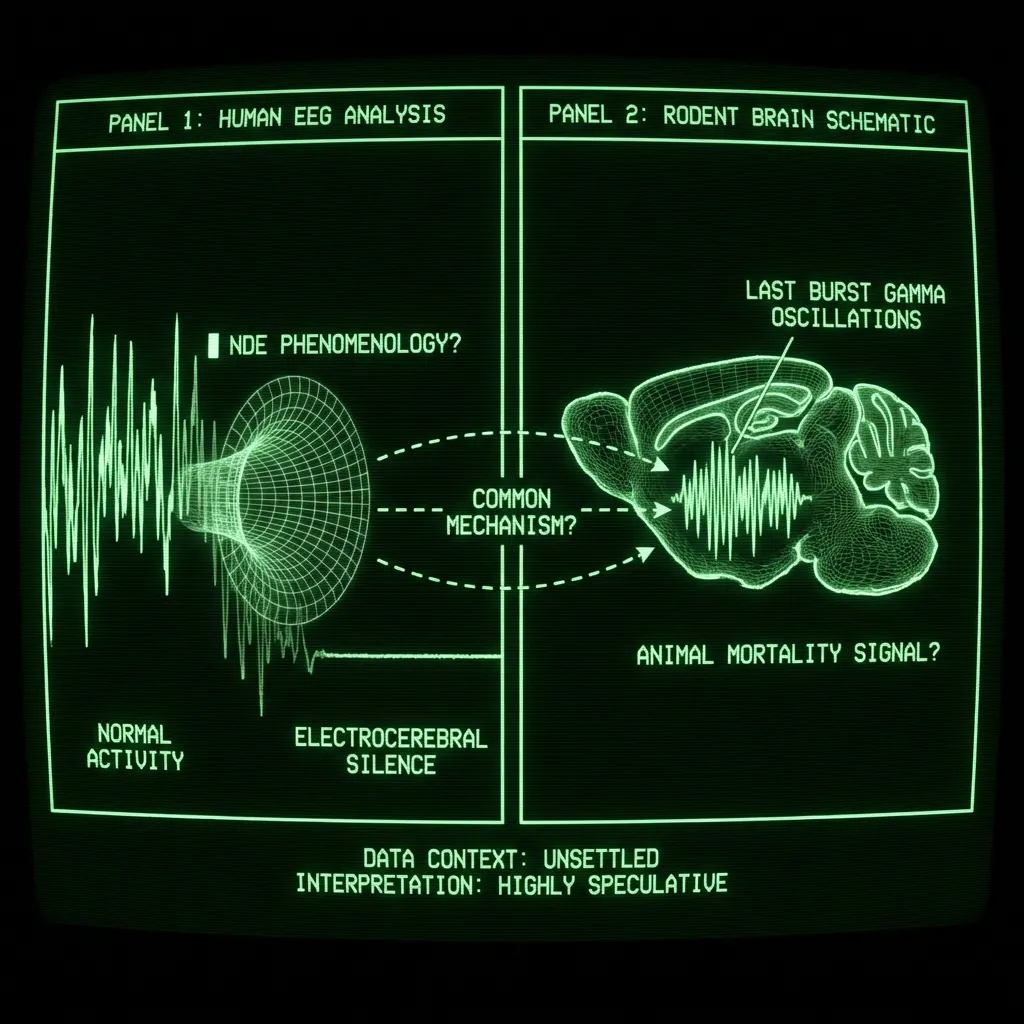
TL;DR
- “Dying” is a process, not an instant: after circulatory arrest, cortex often goes electrically quiet fast, but a second, later wave—terminal spreading depolarization—marks the start of irreversible cellular collapse (Dreier et al. 2018, doi:10.1002/ana.25147).
- Some humans and animals show brief, organized high-frequency activity near death; interpretation is tricky because electrodes, drugs, CO₂ buildup, and seizures can all confound “meaning” (Chawla et al. 2009, doi:10.1089/jpm.2009.0159; Vicente et al. 2022, doi:10.3389/fnagi.2022.813531).
- Near-death experiences (NDEs) are a reproducible phenomenology (life review, “tunnel,” presence, out-of-body motifs) with a standard scale, but they are not a single mechanism and not reliably time-locked to verified “flatline” periods (Greyson 1983, doi:10.1097/00005053-198306000-00007).
- Animals can’t report NDEs, but they do show (i) death-feigning behaviors that are not dying-brain physiology, and (ii) measurable end-of-life neural signatures during hypoxia/ischemia; conflating these is the usual category error (Humphreys & Ruxton 2018, doi:10.1111/brv.12375).
- The best current map: anoxia → EEG suppression → terminal depolarization waves → metabolic failure, with occasional transient “last bursts” whose functional significance remains unsettled (Gofton et al. 2022, doi:10.1111/ajt.17146; Borjigin et al. 2013, doi:10.1073/pnas.1308285110).
“For in that sleep of death what dreams may come…”
— William Shakespeare, Hamlet (ca. 1600)
What counts as “dying” in brain physiology#
You can die by circulatory criteria (irreversible cessation of circulation/respiration) or by neurologic criteria (irreversible cessation of all brain functions). Modern law and clinical practice explicitly recognize both categories (Uniform Determination of Death Act, text via W&L Law Review; AAN/AAP/CNS/SCCM consensus guideline, Greer et al. 2023, doi:10.1212/WNL.0000000000207740).
That matters because a lot of “dying brain” data comes from:
- Cardiac arrest (abrupt global hypoperfusion).
- Withdrawal of life-sustaining therapy (a gradual hypoxia/hypercapnia ramp with sedatives on board).
- Catastrophic brain injury progressing to brain death (ongoing intracranial pathophysiology).
These trajectories are physiologically different, so treating “the dying brain” as a single state is like treating “weather” as one temperature.
Two operational endpoints people confuse#
- Electrocerebral silence: scalp EEG amplitude falls below detection (varies by montage and noise floor). This can occur quickly after cardiac arrest in some settings (Greyson’s commentary discusses how prior literature often sees rapid flattening, though confounds exist; see also Norton et al. 2017, PubMed record).
- Irreversible neuronal injury: a cellular threshold crossed later, often associated with terminal spreading depolarization—a propagating, massive ionic collapse across cortex (Dreier et al. 2018, PMC full text).1
Those are not the same “time.”
A mechanistic timeline of a dying cortex (seconds → minutes → hours)#
Below is a deliberately schematic composite, anchored to recordings in humans and animal models. Individual cases vary with temperature, baseline brain health, sedatives, and cause of arrest.
Canonical cascade (global ischemia/hypoxia)#
- Perfusion drops → oxygen delivery collapses.
- Synaptic failure begins: ATP-dependent processes falter; inhibitory/excitatory balance shifts.
- EEG suppression (functional silence) often arrives early relative to cellular death (Norton et al. 2017, PubMed record; Gofton et al. 2022, doi:10.1111/ajt.17146).
- Terminal spreading depolarization (TSD) can begin minutes after the final perfusion drop and is strongly implicated in the transition to irreversible injury (Dreier et al. 2018, doi:10.1002/ana.25147).
- Delayed waves / prolonged depolarization may persist regionally; inflammation and microvascular failure evolve over hours (for broader spreading depolarization context: Lauritzen et al. 2016, PMC review).
Table: “When” different signals show up#
**| Marker (what you measure) | Typical timing after perfusion collapse | What it actually indicates | Notes / provenance | |—|—:|—|—| | Loss of pulse / arterial line pulsatility | 0 s | Circulatory stop | Clinical DCD protocols commonly include a “hands-off” observation period after this (e.g., ~5 min in many guidelines) (UK DCD guidance; Croome et al. 2023, ScienceDirect) | | Scalp EEG suppression / near-flat EEG | seconds–tens of seconds (varies) | Loss of coordinated cortical activity detectable at scalp | Highly montage- and noise-dependent; sedation and seizures confound (Norton et al. 2017, doi:10.1017/cjn.2016.309) | | Brief high-frequency “surges” (gamma-ish) | around arrest / just before / just after, in some cases | Could reflect disinhibition, CO₂ effects, seizure-like activity, or genuine network coupling | Reported in ICU case series and single-case EEG-at-death (Chawla et al. 2009, doi:10.1089/jpm.2009.0159; Vicente et al. 2022, doi:10.3389/fnagi.2022.813531) | | Terminal spreading depolarization (direct cortical DC shifts) | minutes after final perfusion drop | Massive ionic failure; onset of irreversible injury clock | Requires ECoG / invasive recordings; seen in dying humans with electrode strips (Dreier et al. 2018, PMC) | | Neuronal necrosis / apoptosis cascades | hours+ | Structural death, not just functional silence | Not an EEG phenomenon; depends on temperature and reperfusion |
The “last burst” problem: organized activity near death#
People love a clean story: heart stops → brain “replays life” in gamma → tunnel → transcendence. Reality is messier, but interestingly messier.
Humans: ICU case series and single-case EEG-at-death#
- Chawla et al. (2009) reported “surges” on depth-of-anesthesia style monitors around the time of death in a small ICU case series (Chawla et al. 2009, doi:10.1089/jpm.2009.0159). These devices are not research-grade EEG, but the observation is nontrivial: signal changes near terminal hypoxia show up repeatedly enough to be noticed clinically.
- Norton et al. (2017) tracked EEG alongside arterial pressure through withdrawal of life-sustaining therapy and observed that EEG inactivity often preceded circulatory inactivity, but occasional residual bursts can appear (Norton et al. 2017, PubMed).
- Vicente et al. (2022) reported continuous clinical EEG around an unexpected cardiac arrest in an 87-year-old patient and found increases in gamma-band power and coupling measures in a peri-arrest window (Vicente et al. 2022, doi:10.3389/fnagi.2022.813531). It’s a single case with substantial pathology (subdural hematoma, seizures/status context), so it is not a universal template; it is, however, a proof that “coordinated” metrics can spike during dying in humans.
Rodents: the famous “coherence surge” paper (and why it doesn’t settle metaphysics)#
- Borjigin et al. (2013) recorded rats during experimentally induced cardiac arrest and reported increased gamma power and inter-regional coherence/coupling during a narrow post-arrest period (Borjigin et al. 2013, doi:10.1073/pnas.1308285110).
- Later work extends/complicates the picture; for example, papers and commentaries debate whether these bursts reflect a “heightened conscious processing” state or simply a stereotyped network response to hypercapnic hypoxia and disinhibition (see Borjigin’s reply/commentary context around “end-of-life electrical surges,” Borjigin 2013, doi:10.1073/pnas.1316024110).
Critical point: “gamma” is not a consciousness tag. Gamma oscillations appear in anesthesia, seizures, and many non-conscious states; coherence metrics can rise when overall activity collapses because noise structure changes. So the observation is solid and worth studying; the interpretation should stay on a leash.
Terminal spreading depolarization: the wave that matters#
If the end-of-life literature has a protagonist, it’s not gamma. It’s the slow, nihilistic tsunami of ions.
Spreading depolarization was discovered as “spreading depression” by Leão in 1944 (Leão 1944, Journal of Neurophysiology). In injury contexts (stroke, trauma), depolarization waves propagate across cortex, disrupting function and worsening injury.
At end-of-life, terminal spreading depolarization is a special case: a final propagating depolarization that appears after perfusion fails and precedes irreversible damage. In humans, this has been captured with ECoG strips in dying patients:
- Dreier et al. (2018) documented terminal depolarizations beginning minutes after the final drop in perfusion, with electrocerebral silence developing in spreading or nonspreading patterns (Dreier et al. 2018, PMC).
This is one of the cleanest mechanistic bridges between “flat EEG” and “irreversible injury.” It’s also the least mystical: it’s a biophysical catastrophe you can write down in Nernst potentials and ATP budgets.
Neurochemistry at the edge: the “brainstorm” hypothesis#
One plausible route to vivid phenomenology is not “extra consciousness,” but disinhibited, noisy consciousness under severe physiological constraint: hypercapnia, hypoxia, catecholamine surge, and neurotransmitter release.
There is experimental evidence that global ischemia can drive large changes in neurochemistry:
- Rodent microdialysis studies have reported substantial increases in multiple neurotransmitters around cardiac arrest/terminal asphyxia in ways consistent with a “storm” model; these results are often discussed as a candidate substrate for intense perceptual experiences (see discussion around end-of-life neural surges: Borjigin 2013, doi:10.1073/pnas.1316024110).
- The endogenous DMT story is frequently invoked, but the primary data are narrower than the folklore: a rat study reported that brain DMT levels can rise under experimentally induced cardiac arrest, but translating that to human NDE phenomenology is still speculative (Dean et al. 2019, Scientific Reports).2
So: neurochemistry can go weird at the end. The map exists; the legend is not fully settled.
Near-death experiences: what the phenomenon is (and isn’t)#
An NDE is not “anything weird near death.” In research settings, it’s typically defined by structured reports and measured by instruments like the Greyson NDE Scale (Greyson 1983, doi:10.1097/00005053-198306000-00007). Across cultures and eras, common motifs cluster:
- altered time perception
- intense affect (peace/terror)
- life review
- perceived presence/entities
- boundary/threshold imagery (“tunnel,” “light”)
- out-of-body perspective (variable frequency)
Two widely cited interpretive camps#
- Neurophysiological models: NDE motifs can arise from known brain states—hypoxia/hypercapnia, REM intrusion, temporal-parietal junction phenomena, memory confabulation, and narrative reconstruction (Mobbs & Watt 2011, doi:10.1016/j.tics.2011.07.010).
- Non-reductionist critiques: Some scholars argue neuro models don’t cover all reported features (e.g., claims of veridical perception). Even within mainstream journals, you’ll find pointed back-and-forth (Greyson 2012 commentary, Trends in Cognitive Sciences).
What’s strong: the phenomenology is real and patterned. What’s weak: precise time-locking of experience to objective physiology in most cases. Cardiac arrest survivors often reconstruct a narrative after resuscitation, and “I was dead for X minutes” is usually a lay inference, not an electrophysiologically verified timestamp.
So… near-death experiences in animals?#
Here’s the clean answer: we can’t know whether nonhuman animals have NDEs because NDEs are defined by reportable subjective content. But we can still say useful things.
Category error #1: death-feigning is not “dying”#
Many animals perform thanatosis (death-feigning / tonic immobility): a defensive behavior with adaptive value, often triggered by capture or threat. It’s a strategy, not a terminal physiology state (Humphreys & Ruxton 2018, doi:10.1111/brv.12375). People sometimes watch a possum “play dead” and imagine it is having a tiny NDE. That’s a poetic mistake.
Category error #2: “near death” ≠ “cardiac arrest”#
Animals undergo hypoxia in many nonterminal contexts—diving mammals, turtles in anoxic ponds, hibernators. These states involve evolved protective mechanisms (metabolic suppression, receptor modulation) and are not good proxies for the chaotic collapse of terminal ischemia.
A classic example class: freshwater turtles tolerate anoxia for long periods via metabolic depression and neurotransmitter adjustments; they are not “rehearsing death,” they are surviving without oxygen (see anoxia-tolerance review literature; e.g., broad overviews in comparative physiology are summarized in major reviews, and the mechanistic story emphasizes downregulated ATP demand and protective neuromodulation).3
What animal data can tell us#
Animals can inform mechanisms that could support NDE-like human reports:
- Hypoxia/hypercapnia can produce stereotyped neural signatures and occasionally transient high-frequency coupling (Borjigin et al. 2013, doi:10.1073/pnas.1308285110).
- Terminal spreading depolarization is conserved and measurable, and may define the boundary between recoverable and unrecoverable collapse (Dreier et al. 2018, PMC).
- End-of-life EEG “surges” appear in multiple mammalian contexts (Chawla et al. 2009, doi:10.1089/jpm.2009.0159; Borjigin 2013 discussion, doi:10.1073/pnas.1316024110).
But animals can’t confirm content (“tunnel,” “life review”). At best you can say: the ingredients for intense, internally generated experience exist, and they can occur in narrow peri-arrest windows under specific conditions.
Why gamma/coherence keeps coming up (and how to not get fooled)#
Gamma oscillations (roughly 30–100+ Hz) are associated with attention and feature binding in awake brains, but they also appear in:
- seizures
- drug states
- movement artifacts and EMG contamination (especially scalp recordings)
- algorithmic artifacts in compressed monitor outputs (BIS/PSI)
So, when you read “gamma surge near death,” you need three sanity checks:
- Where were electrodes placed? Scalp EEG, depth electrodes, BIS strips, ECoG? These are not equivalent (Chawla et al. 2009 uses clinical monitors; Vicente et al. 2022 uses clinical EEG, doi:10.3389/fnagi.2022.813531).
- What drugs were on board? Sedatives, analgesics, antiepileptics: all reshape spectra and coupling.
- What was CO₂ doing? Hypercapnia is not a detail; it’s a brain-state switch, especially during ventilatory withdrawal.
A useful meta-review frame is to treat near-death electrophysiology as a signal-processing and confounding problem before it’s a consciousness problem (see systematic and narrative reviews on EEG in dying; e.g., Shlobin et al. 2023 review, Frontiers in Aging Neuroscience).
Death determination, “no-touch” intervals, and why minutes matter ethically#
In organ donation after circulatory determination of death (DCD), protocols often include a short observation (“hands-off” / “no-touch”) period after circulatory arrest to ensure autoresuscitation does not occur before death is declared. Many guidance documents cite ~5 minutes, though practices vary (UK BTS guidance, statement; Croome et al. 2023 best-practice discussion, ScienceDirect; overview example in Park et al. 2021, PMC).
This collides interestingly with the physiology above:
- Electrical silence can precede arrest (Norton et al. 2017, PubMed).
- Terminal depolarization waves can occur minutes after perfusion collapse (Dreier et al. 2018, PMC).
So the ethics isn’t about metaphysical soul-stuff; it’s about matching clinical thresholds to biological irreversibility under practical constraints.
A synthesis: a working theory that fits most of the data#
Here’s a conservative model that doesn’t require paranormal add-ons and doesn’t pretend the brain is simple:
- Approach to death (hypoxia/hypercapnia, stress hormones, medication effects) pushes the brain into an unstable regime: sensory processing degrades, priors dominate, and narratives self-generate.
- Brief organized bursts can occur as inhibition fails and networks synchronize transiently—sometimes visible as gamma/coherence increases depending on measurement and confounds (Borjigin et al. 2013, doi:10.1073/pnas.1308285110; Vicente et al. 2022, doi:10.3389/fnagi.2022.813531).
- Functional silence arrives quickly in many cases; subjective experience may still be occurring in fragmented, dreamlike, or delirious forms before this point, but hard time-locking is rare.
- Terminal spreading depolarization begins later and is closer to the irreversible boundary (Dreier et al. 2018, doi:10.1002/ana.25147).
- Memory reconstruction after resuscitation yields the reportable NDE narrative, shaped by culture, expectation, and the brain’s compulsion to make a story from shards (Mobbs & Watt 2011, doi:10.1016/j.tics.2011.07.010).
This model leaves room for:
- true peri-arrest conscious fragments,
- “life review” as a memory-network phenomenon,
- and huge individual variance,
without needing to assume that dying brains reliably run a cinematic end-credit montage.
FAQ#
Q1. Can animals have near-death experiences?
A. Animals can undergo near-death physiology (hypoxia, ischemia, terminal depolarization), but “NDE” is defined by reportable subjective content, so animals can’t be confirmed as NDE experiencers even if they show analogous neural signatures (Borjigin et al. 2013, doi:10.1073/pnas.1308285110; Humphreys & Ruxton 2018, doi:10.1111/brv.12375).
Q2. Does a “gamma surge” mean someone is conscious after their heart stops?
A. No: gamma/coherence changes can reflect disinhibition, hypercapnia, seizure activity, or measurement artifacts; the observation is intriguing, but “consciousness” does not follow automatically from gamma power (Vicente et al. 2022, doi:10.3389/fnagi.2022.813531).
Q3. What’s the cleanest physiological marker of irreversible brain injury in dying?
A. Terminal spreading depolarization is a strong candidate because it marks a propagating ionic collapse tied to energy failure and the onset of irreversible injury processes, and it has been directly recorded in dying humans with cortical electrodes (Dreier et al. 2018, doi:10.1002/ana.25147).
Q4. Is death “instant” from the brain’s point of view?
A. Function can shut down rapidly, but cellular irreversibility typically unfolds over minutes to hours depending on temperature, cause, and reperfusion; “flat EEG” and “irreversible injury” are not synonymous endpoints (Norton et al. 2017, PubMed; Dreier et al. 2018, PMC).
Q5. Does endogenous DMT explain NDEs?
A. There is evidence that brain DMT levels can rise in rats under cardiac arrest conditions, but translating that to human NDE phenomenology is still speculative and faces dose/kinetics and confounding questions (Dean et al. 2019, Scientific Reports).
Footnotes#
Sources#
- Borjigin, Jimo, et al. “Surge of neurophysiological coherence and connectivity in the dying brain.” PNAS 110(35) (2013): 14432–14437. doi:10.1073/pnas.1308285110
- Dreier, Jens P., et al. “Terminal spreading depolarization and electrical silence in death of human cerebral cortex.” Annals of Neurology 83(2) (2018): 295–310. doi:10.1002/ana.25147. PMC full text
- Chawla, Lakhmir S., et al. “Surges of electroencephalogram activity at the time of death: a case series.” Journal of Palliative Medicine 12(12) (2009): 1095–1100. doi:10.1089/jpm.2009.0159
- Vicente, Rodrigo, et al. “Enhanced Interplay of Neuronal Coherence and Coupling in the Dying Human Brain.” Frontiers in Aging Neuroscience 14 (2022): 813531. doi:10.3389/fnagi.2022.813531. PMC full text
- Greyson, Bruce. “The Near-Death Experience Scale: construction, reliability, and validity.” Journal of Nervous and Mental Disease 171(6) (1983): 369–375. doi:10.1097/00005053-198306000-00007
- Mobbs, Dean, and Caroline Watt. “There is nothing paranormal about near-death experiences: how neuroscience can explain seeing bright lights, meeting the dead, or being convinced you are one of them.” Trends in Cognitive Sciences 15(10) (2011): 447–449. doi:10.1016/j.tics.2011.07.010
- Greyson, Bruce. "‘There is nothing paranormal about near-death experiences’ revisited: comment on Mobbs and Watt." Trends in Cognitive Sciences 16(9) (2012): 445–446.
- Norton, Loretta, et al. “Electroencephalographic recordings during withdrawal of life-sustaining therapy until 30 minutes after declaration of death.” Canadian Journal of Neurological Sciences (2017).
- Gofton, Teneille E., et al. “Cerebral cortical activity after withdrawal of life-sustaining measures and circulatory arrest.” American Journal of Transplantation (2022). doi:10.1111/ajt.17146
- Humphreys, Robert K., and Graeme D. Ruxton. “A review of thanatosis (death feigning) as an anti-predator behaviour.” Biological Reviews 93(1) (2018): 40–61. doi:10.1111/brv.12375
- Dean, Jeremy G., et al. “Biosynthesis and extracellular concentrations of N,N-dimethyltryptamine (DMT) in mammalian brain.” Scientific Reports 9 (2019): 9333.
- Leão, Aristides A. P. “Spreading depression of activity in the cerebral cortex.” Journal of Neurophysiology 7(6) (1944): 359–390.
- Greer, David M., et al. “Pediatric and Adult Brain Death/Death by Neurologic Criteria Consensus Practice Guideline.” Neurology (2023). doi:10.1212/WNL.0000000000207740
- Uniform Law Commission. “Uniform Determination of Death Act (UDDA) text (archival legal source).” (1981).
- British Transplantation Society. “UK guidelines on transplantation from deceased donors after circulatory death.” (accessed 2026-01-09).
- Croome, K. P., et al. “American Society of Transplant Surgeons recommendations on DCD best practices (practice variability and no-touch times).” (2023).
- Park, H., et al. “Organ donation after controlled circulatory death: practical and ethical notes (review).” (2021).
- Lauritzen, Martin, et al. "‘Spreading depression of Leão’ and its emerging relevance to acute brain injury." (2016).
Spreading depolarization is a near-complete neuronal/glial depolarization that propagates slowly through cortex, collapsing ionic gradients and silencing synaptic activity; “terminal” versions occur when energy failure prevents recovery (Dreier et al. 2018, doi:10.1002/ana.25147). ↩︎
DMT = N,N-dimethyltryptamine, a psychedelic tryptamine. The existence of endogenous brain DMT is not the same as “DMT causes NDEs,” and dosing/kinetics comparisons are nontrivial (Dean et al. 2019, Scientific Reports). ↩︎
Comparative anoxia tolerance is a deep literature; the key point for this post is conceptual: “low oxygen” can mean controlled hypometabolism or uncontrolled energy failure, and those are different brain states. (For an entry point, start with reviews in comparative physiology and neuroprotection; turtle anoxia is a standard model organism topic.) ↩︎