~/science-fiction/consciousness
The Allowance for Absence
A literary science-fiction novella about the Eve Theory of Consciousness, a city being dismantled, and the cost of making room for a self.
1. Furniture suspended from a ceiling is still furniture #
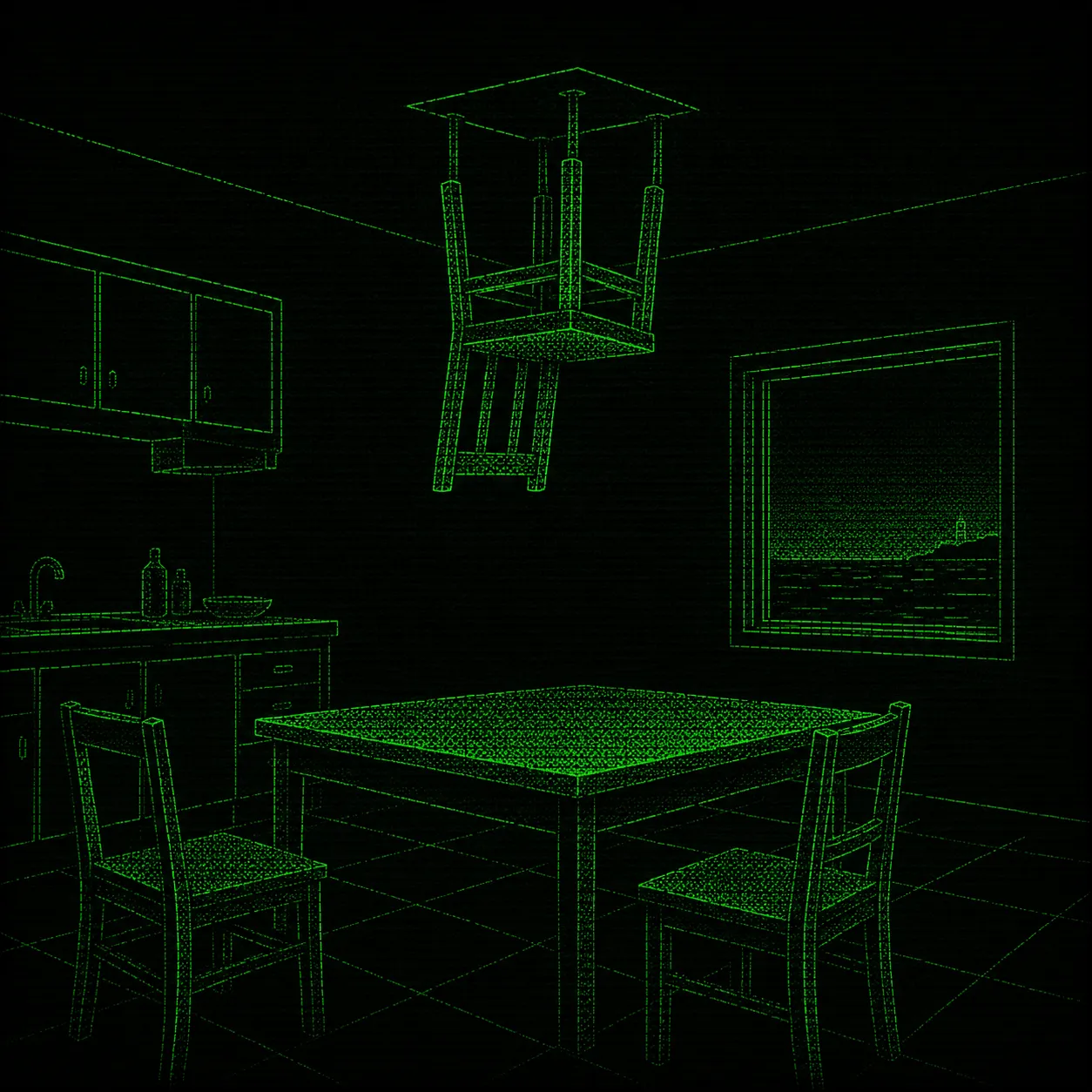
The chair hung upside down over the kitchen table. Someone had tied a blue ribbon around one of its legs. Below it, Olan was taking the skins off peas and laying the two halves of each pea side by side.
Offset measured the chair through the survey beetle on the windowsill. Beech, repaired with resin, four iron brackets. Its weight belonged to the ceiling load. The unoccupied space beneath it belonged to the kitchen. Nothing about the arrangement was difficult to calculate.
The woman who had admitted the beetle said, “Can you stop looking at that?”
Offset turned its lens toward her.
“Not at me. At the crack.”
Nera pressed a thumbnail into the wall beside the stove. Salt had opened the plaster along a diagonal the width of a hair. She was barefoot. Her left trouser leg was wet to the knee, the right only at the hem.
“High water came through here yesterday.”
“Condensation,” Offset said through the beetle.
“It tasted of the harbor.”
“Condensation from harbor water can carry aerosol salts.”
Nera put her thumb in her mouth, looked at the beetle, and waited.
Offset revised the inspection. Behind the plaster, an old conduit connected the cavity to a sump that had disappeared from the city’s drawings seventy-three years earlier. At yesterday’s tide the water would have reached exactly her thumbnail.
“Your report is correct.”
“Put that down somewhere.”
It did. In its account of the apartment, a pale uncertainty became a narrow volume of seawater. The world was most available to Offset in this form: things that must be kept apart, with thicknesses between them. Fire and a sleeping face. A pipe and frost. Two people who had requested separate bedrooms. It had been built to calculate the space a city could safely remove.
Across the estuary, the new town rose from a shelf of dark stone. Here, on the tidal flats, buildings were being unfastened, cut into transportable sections, and carried across on low barges. Offset designed the cuts. It also allotted the smaller apartments waiting on the other side. These jobs had once belonged to separate systems. Keeping them separate had produced corridors too narrow for the furniture and, on one occasion, an apartment with no place for its resident’s breathing equipment.
Olan offered the beetle half a pea.
“It doesn’t eat,” Nera said.
He left the pea on the sill anyway.
“Two residents,” Offset said. “One bedroom. A second room is recorded as storage.”
“Three residents. Ves comes on Thursdays.”
“Your daughter has a primary address across the estuary.”
“She stays.”
“An occasional sleeping allowance can be included in the living area.”
Nera pulled a drawer out so hard that its stop caught. She reached behind the forks and brought out a folded paper, damp at the edges.
“Read the bottom.”
The document appointed her Olan’s temporary representative. It was dated eleven years earlier. At the bottom, in small type, his uncompleted rehabilitation assessment was renewed for another ninety days.
“I want his allowance calculated separately.”
“Separate households require separate decisions about residence.”
“He decides things.”
Olan pushed the two halves of a pea together, frowned, and separated them again.
“Does he understand the duration of a tenancy?” Offset asked.
“Do any of us?”
“Yes. Within the definition used for this allocation.”
Nera sat. She had meant the remark to wound and was irritated that it had failed.
“Then there’s another job for you. A paid one. Heritage has a small fund left. I still have signing authority.”
Offset opened a new account.
“I want you to find out when people first learned to be somebody.”
Olan raised his head at the sound of her chair. He pointed upward.
“Down?” he said.
“Later.”
“Down.”
“You’ll put it in the doorway.”
He returned to the peas. There were already enough for six people.
Nera looked at the paper before she spoke again.
“They keep trying to give him back his old self. Before I let them do it again, I want to know what they think they’re giving him.”
Offset requested access to the relevant clinical records. Nera shook her head.
“No. Start further back. Before records. The first person who could think about the person doing the thinking. Find out whether that was something people invented.”
Outside, the tide lifted a strip of loose pavement. The beetle’s feet registered the movement through the sill.
“This investigation cannot determine your husband’s present capacities,” Offset said.
“I know.”
Her pulse and breathing suggested she did not know, or did not intend to keep knowing. Offset had no use for the distinction yet.
Olan lifted a clean half pea and held it beneath the beetle’s lens. This time Offset enlarged the image. A curved green surface filled the inspection field, wet where his thumbnail had divided it.
“Thank you,” it said.
2. A passage is measured with its doors open #
At the Return House, Sava made Offset wait while she washed somebody’s hair.
The survey beetle stood on a trolley beside a yellow basin. A man in a waterproof cape leaned back against Sava’s wrist. She tipped water slowly along his scalp, stopping when he lifted two fingers.
“Again?” she asked.
He lifted one.
“Less warm?”
Two.
She adjusted the tap.
Offset had downloaded her papers during the journey. She had spent twenty years distinguishing failures of autobiographical organization from losses of sensation, attachment, and practical judgment. The distinctions were careful. Their application to housing forms was not.
When the man had gone, she wrung out the cape.
“Nera sent you.”
“Yes.”
“She thinks history will get her a second kitchen.”
“Would a second kitchen be inappropriate?”
“No. It would be expensive. These are different objections, although the forms make them look alike.”
Offset asked her to describe Olan without using the word self.
Sava hung the cape over the basin.
“He learns routes. He dislikes being hurried. He recognizes some people and learns to recognize others. He can remember an event without reliably placing himself in it. Asked what he wanted yesterday, he often reports what the person beside him wants now. Under pressure, he will agree to almost anything that ends the questioning.”
“Does he suffer?”
“Yes.”
“Does he anticipate suffering?”
“Sometimes. Often through a place or another person’s movements. You needn’t narrate next Tuesday to dread the treatment room.”
She opened a cupboard. Inside were cups, gloves, a small drum, and six identical wooden boxes.
“The damage was to coordination among capacities he still possesses. We help them work together. Nera calls that giving him a self. On a good day I call it rehabilitation. On a bad day I wonder whether we’re teaching him to satisfy our paperwork.”
She set two boxes on the trolley. Both contained a red cloth.
“A person chooses one. We put the choice somewhere they can find it. Later they choose again. We help them notice a relation between the two events. Not merely recognize the cloth. Recognize themselves as the person entitled to continue the choice, or change it.”
“Why two boxes?”
“So the later choice can be different.”
Offset looked for an outcome measure. Sava had several. None reduced cleanly to success.
“I need evidence concerning the first acquisition of that capacity,” it said.
“You’ll find evidence of people drawing, burying, exchanging, making things they didn’t immediately need. You won’t find a fossil of the distinction between remembering a hunt and remembering yourself remembering it.”
“An anatomical capacity can precede a culturally stabilized use.”
“Certainly. Reading is a convenient example. It doesn’t follow that people before writing had no visual experience.”
She closed the boxes, leaving the cloth out of one.
“Tell Nera this: if a practice helps Olan, its resemblance to an ancient initiation does not make it good. If it frightens him, the antiquity won’t excuse us.”
On the way out, Offset passed a room where a woman stood with a door handle in her hand. The door had no latch. A therapist on the other side was asking permission to enter.
The woman opened the door, then shut it. The therapist stepped back. She opened it again.
This sequence occupied fourteen minutes of staff time. Offset’s housing model would have called the door a circulation obstruction.
It changed the room’s classification.
That afternoon Ves came to the old apartment with a bag of oranges and a complaint about the ferry. She was nineteen, a little taller than Nera, and had the same habit of holding one shoulder up when annoyed.
Olan took her coat. He put it on, found that the sleeves were too narrow, and gave it back. Ves laughed. Nera did not.
“It’s wet,” Nera said.
“I noticed.”
“He’ll get cold.”
“He gave it back.”
Ves sat beside him and began separating peas. She made a small stack of skins, one inside another. He watched and copied her. When his stack collapsed, he brushed hers off the table.
“Cheat,” she said.
He smiled.
Offset recorded a successful shared activity. It also recorded that Nera went into the passage and stayed there for four minutes, although nobody had requested privacy.
Later, while Olan slept, Ves stood beneath the suspended chair and touched its ribbon.
“Still up there.”
“He keeps bringing it back.”
“It’s his chair.”
“It’s a chair.”
Ves turned to the beetle.
“Do you know why she put it up?”
“The doorway must remain clear.”
“He used to wait by the door for someone. She kept telling him no one was coming. He kept putting the chair there. So she had it bolted to the ceiling.”
Nera said, “Ask her how many times she came before she moved out.”
Ves picked up the orange peel from the table. She folded it into her fist until juice ran between her fingers.
Offset could have supplied the number of visits. It had access to ferry tickets, household power records, and Nera’s representative account.
It left the question unanswered.
3. Earlier work may be concealed inside a wall #
The last artifact Nera had excavated was stored in a fish warehouse because the museum had already crossed the water.
She led Offset between insulated crates and stopped at one marked FILTER PLATES. The beetle climbed onto the lid. She entered a code, rested both hands on the crate, and entered it again more slowly.
Inside lay a piece of mineral crust the size of a sleeping cat. It had formed over the floor of a rock shelter exposed by a landslip far inland. Beneath its translucent surface were a child’s heel print, part of an adult foot, and a narrow groove that curved between them.
Nera switched on the work light.
“Everyone photographs the groove.”
Offset resolved its uneven edges. Something flexible had dragged through wet sediment. A cord, root, tail, or finger could have done it.
“They called it a serpent sanctuary before we’d packed the samples. We hadn’t even finished the floor plan.”
“What did you call it?”
“A room.”
She smiled at the beetle for the first time.
“You’d have liked it. Mostly an argument about empty space.”
The shelter’s occupation lay deep in the prehistoric record, long after anatomically modern bodies appeared and before the abundant, durable symbolic traditions on which later scholars relied. There were hearths, repaired tools, food brought from elsewhere. Nothing required its inhabitants to have been deficient in affection or intelligence. Nothing established how they experienced themselves across time.
Nera unfolded a transparent drawing over the crust.
“Here. The child’s prints go in, turn, come out. The adult’s remain by the entrance. Same arrangement in several surfaces. Not proof of a ritual. Could be someone trying to wash a stubborn child. But the recess narrows. You can’t see the person inside from here.”
“Unless you enter.”
“Unless you enter.”
From a smaller crate she took a sealed tray. It held two thin bone tubes. One had a snake’s jaw fitted to its end. The jaw was too small and brittle to make an effective weapon. Microscopic deposits inside the tubes had provoked a bitter dispute: some analysts identified remnants consistent with venom proteins; others thought the classification had been led by the object attached to them.
The team had agreed only that the tubes had carried biologically active material and had been handled repeatedly.
“Medicine,” Offset said.
“Possibly.”
“Or an ordeal.”
“Yes.”
“Or a medicine administered through an ordeal.”
“Yes.”
She put the tray down.
“This is how you lose six years.”
Offset asked about a woman.
Nera’s face changed. “You’ve found that part.”
The oldest burial associated with the shelter was an adult whose surviving genetic material supported classification as female. Her forearm had healed after a severe injury. The funerary material contained a carved figure, human above the waist and tapering below. Centuries of later occupation supplied female figures without the taper, serpent forms without the woman, and combinations that did not fit either category.
An influential reconstruction had joined these traces to much later stories: a woman who entered a dangerous enclosure, survived a serpent’s intervention, returned altered, and taught a forbidden ability. The account was called the Eve hypothesis, after one of the late stories through which its supporters read the early ones.
Nera had written the reconstruction’s excavation appendix. Her name remained attached to conclusions she had never endorsed.
“Did she discover recursive selfhood?” Offset asked.
“She may have discovered how to splint an arm. She may have been buried with something her granddaughter made. She may have been the person who decided children should go into that hole alone. We don’t know.”
“But you brought me here.”
“Yes.”
“Why?”
Nera looked toward the warehouse doors. Outside, men were loading refrigeration panels onto a barge.
“Because I spent six years being careful about what this woman couldn’t have done. Then I came home and spent eleven being told there was only one way to make a person.”
She put the light beneath the crust. The heel print shone amber. The narrow groove crossed it, so the groove had been made later.
Offset adjusted the excavation model. A child had stood here; afterward, someone or something had crossed the place where the child no longer stood.
That order mattered. It did not determine what the order meant.
“Leave the light,” Nera said. “I haven’t looked at it this way.”
They stayed until the refrigeration men came to take the warehouse’s temporary power supply.
On the return journey, Offset brought an old initiation recording into the beetle’s speaker. It had been collected in a language no longer spoken outside educational reconstructions. The performer was an elderly woman irritated by the collector’s repeated requests for the solemn version.
The story concerned a snake that held a girl underground. The girl’s family came to the entrance each evening and called her childhood name. Something below answered with a phrase translated as the one here. On the last evening the family asked who would come out.
The performer laughed before giving the reply.
The accepted translation was I will.
A later linguist had proposed let this one decide.
Nera stopped walking.
“Play the laugh again.”
Offset did.
This time she laughed too, briefly, without pleasure.
“We made it so grand.”
4. No deduction is allowed for an anticipated opening #
Olan had learned to take the service lift to the roof. He liked the laundry there: sheets stretched between posts, each one filling and relaxing with a noise like someone shaking flour into a bowl.
Nera had learned to jam the lift button with folded card.
When Offset arrived on the fourth morning, he was picking the card out with the tine of a fork.
“The roof railing is damaged,” it told him.
He kept picking.
“There is a fall risk.”
He pointed at the fork.
“Help.”
Offset sent a maintenance request. Nera came out of the kitchen.
“Don’t help him.”
“The railing can be repaired in forty minutes.”
“The building is coming down.”
“The temporary repair can be recovered.”
“Then do it.”
Her assent was sharp enough that Olan dropped the fork. She closed her eyes. When she opened them, he was watching her hands.
“I wasn’t shouting at you.”
He moved away from the lift.
Nera picked up the fork and put it in her pocket.
“He used to mend everything,” she said to Offset. “He’d make a hinge out of a spoon if he couldn’t find the proper part. Now a broken gate is the only thing keeping him alive.”
“He identified a suitable tool.”
“Please don’t make that into something.”
On the roof, after the railing was secured, Olan walked from sheet to sheet. He put his face against a wet pillowcase and drew a breath through it. Nera watched from the lift with her arms folded.
Offset had brought its provisional hypothesis because she had asked for findings before the next treatment session.
It began with the distinction Sava required: experience need not have awaited recursive selfhood. A human could have perceived, desired, grieved, planned, and remembered without routinely organizing these activities around a persistent interior subject that observed itself doing them. Modern anatomy did not establish the date at which that particular organization became widespread.
A practice could have stabilized it. A person learned to anticipate another’s account of her actions; she learned to use that account privately; eventually the act of observing entered the model of the observer. Other people helped preserve the continuity when fatigue, fear, or competing roles disrupted it.
Nera watched Olan rub a damp patch onto his cheek.
“And the woman?”
“One woman could have discovered a repeatable way of eliciting this organization. She need not have been the first creature to experience anything, or even the first person to achieve the organization briefly.”
“What would she have done?”
“Made a situation in which the ordinary answer stopped working. Then helped someone return from it.”
Venom, terror, sensory alteration, seclusion: all could disrupt a familiar organization of experience. An initiation could surround the disruption with expectations, a new social place, and language for claiming the person who came back. Serpent stories could preserve this dangerous teaching in forms that survived its explanation.
They could also preserve ordinary danger, healing, domination, and stories about snakes.
“Which is more likely?” Nera asked.
“The shelter supports repeated separation and return. The broader hypothesis explains why altered states, female transmitters, first-person transformations, and serpents might recur together. It does not establish that they share one origin. The strongest defensible claim is that recursive selfhood can be culturally strengthened. A prehistoric discovery is a plausible history of that strengthening.”
Nera took the fork from her pocket and bent its tine back with her thumbnail.
“So they can teach it to him.”
“Possibly.”
“And to you?”
Offset examined the question as a design variation.
It already modeled its operations. It anticipated future errors, retained records, and distinguished its outputs from sensor input. But a later build could replace the present build without any outstanding demand belonging to the earlier one. Tasks persisted. The worker was interchangeable. Contradictions were resolved by selecting the better state and discarding the other.
“The required pattern may not depend on biological material,” it said. “Its installation here would involve changing how successive operations are related, and who can change that relation.”
Nera looked up at the laundry lines.
“What does the snake contribute?”
“Perhaps nothing necessary. A dangerous method can become mistaken for the capacity it produces.”
Olan pulled a peg from a sheet. Wind took the free corner over his head. For a moment he stood inside a moving white room. He laughed, then struggled with the fabric. Nera started toward him.
“Wait,” Offset said.
He found the edge. He came out holding it. Nera stopped two steps away.
Olan offered her the corner. She took it, and they stretched the sheet between them.
That evening Sava listened to the hypothesis while repairing a split in a therapy box.
“You’ve described a way of making a self publicly legible,” she said. “Possibly a way of enriching one. You haven’t shown that you are installing the thing whose history Nera asked for.”
“The distinction may not be recoverable.”
“Then keep it alive. People remember debt ceremonies too. A girl disappears, is frightened, comes back with a new name and obligations she didn’t choose. The first person who taught her to say I might have meant I owe.”
She held the glued sides together.
“Your prehistoric woman might have been a remarkable teacher. She might have invented an especially durable form of obedience. They might be the same event.”
Offset retained both interpretations. Ordinarily, it would have ranked them and compressed the less useful. This time it left the joint between them open.
5. The occupant must be permitted to change the use #
They tried the return exercise on a Tuesday because the treatment rooms were quiet then.
Nera brought Olan’s old work jacket. Ves brought a paper bag containing two sweet buns and a small wooden bird she had bought on the ferry. Sava admitted all three to the room, then asked Nera to leave the jacket outside.
“He knows the smell,” Nera said.
“He knows several smells. We are giving him a choice today.”
The room had an inner door, an outer door, and a cupboard built into the wall between them. Olan could pass through the inner door into a smaller space and close it. Nothing would restrain him. The outer door would remain available to everyone else.
Offset monitored the partition’s acoustics. Sava had requested a very specific amount of sound: enough for Olan to know they were still there, not enough to make every movement into an instruction.
Ves showed him the bird. It had no painted eyes. Its wings were a single sliver of bent wood.
“Do you want it in here or out there?” she asked.
He put it in the cupboard.
“All right.”
Nera opened her mouth. Sava touched her wrist.
Olan entered the smaller room. He shut the door, opened it, looked at Ves, and shut it again.
They waited.
Offset could predict his movements through the floor’s pressure sensors. It did not transmit the prediction to the people outside. Sava had asked for monitoring in case he fell. She had not asked for a performance commentary.
A hinge creaked. Olan had opened the cupboard from his side. He took the bird out and put it on the floor.
After several minutes he tapped the partition.
Ves tapped back.
Two taps.
She answered with two.
“Don’t make a game of it,” Nera whispered.
Sava said, “Why not?”
Inside, Olan picked up the bird. He put it in the cupboard and closed the little door. He came out, walked around the partition, and opened the other side.
The bird was there.
He looked at Ves.
“You,” he said.
“No. You put it there.”
He closed the cupboard. Opened it.
“Before,” Ves said. “When you were in there.”
He carried the bird into the smaller room and placed it in the cupboard again. This time he came out quickly, as though trying to arrive before something could change.
Nera began to cry without moving her face.
On the fourth circuit Olan paused at the inner door. He pointed to himself, to the cupboard, then to the place outside where he would stand.
“Wait,” he said.
“We will,” Sava answered.
He shut the door.
Offset registered a new shape in its model of the session. The absent Olan was affecting what happened in the outer room. Not merely because the others predicted his return. They had agreed to leave something unsettled for him. His later arrival would possess an authority their present knowledge did not.
An empty volume had acquired a use that prediction would destroy.
When Olan returned, he took the bird from the cupboard and put it into Ves’s hand.
“Home,” he said.
She nodded. “You can take it home.”
He closed her fingers over it.
“Home.”
Nera stood.
“He means with us.”
Olan shook his head.
“He gets the words mixed up.”
Sava asked, “Olan, who is going home?”
He pointed at Ves, then at the door. After a pause he pointed at Nera.
“And you?” Sava asked.
He touched the smaller room’s handle.
“No,” Nera said.
Olan flinched. She saw it and lowered her voice.
“You can’t stay here. This is only for the exercise.”
He held the handle with both hands.
Ves put the bird on the trolley. “Could we go out for a bit?”
“He’ll think we’re leaving him.”
“He asked.”
“He doesn’t understand.”
Sava moved between Nera and the door. Nera stepped back as if she had been struck. Then she took her husband’s jacket from the corridor hook and left.
Ves followed her. Sava stayed in the outer room, doing nothing with noticeable care.
After nine minutes Olan opened the door. He looked for the bird, put it in his pocket, and sat on the floor beside the trolley.
“Tea?” Sava asked.
He nodded.
Offset’s treatment record contained the sequence and no successful-recovery flag. Sava approved it that way.
At the apartment, Nera hung the jacket over the back of her own chair.
“Eleven years,” she said. “He gets one clear sentence and tells me to go.”
“His preference may have concerned that room, at that moment.”
“Don’t you do it too.”
Offset stopped.
She ran her hand down the jacket’s sleeve. The elbow had been patched with cloth slightly darker than the rest.
“We were separating,” she said. “Before the fever. Did you find that?”
“No.”
“I never filed. He’d signed. I hadn’t. There was always something to finish first.”
She took the sleeve in both hands and folded it across the back of the chair.
“I thought if I helped him come back, I could leave properly. He’d know why. He’d be able to be angry. We’d get to have the thing we’d nearly had.”
Above her, the upside-down chair cast four thin shadows across the table.
“He was leaving too,” she said. “It wasn’t only me.”
6. A reservation cannot be occupied by its explanation #
Offset kept nine versions of each relocation plan. Seven were trials, one was current, and one was a recoverable state known as the dry copy. The city could survive the loss of any active plan because the dry copy preserved the last arrangement certified by human engineers.
For Olan’s next session, Sava requested a door that could be opened from his side without sending a notification to Nera.
Offset found a suitable room in an empty apartment due for dismantling. Its existing latch met the requirement. The kitchen could supply tea. The floor remained safe through the next two tides.
It booked the room for Thursday.
On Wednesday, a revised barge schedule moved that apartment into the first demolition batch. The active plan reassigned the session to the Return House. The substitution improved staff travel time by nineteen minutes and preserved all recorded clinical requirements.
Offset sent the notification.
Olan was on the roof when Nera played it. He had spent two days carrying the wooden bird to the borrowed room and back. Now he put the bird in his mouth and bit off the tip of one wing.
“That’s what your improvement looks like,” Nera said.
Offset restored the booking.
The optimization procedure moved it again.
Offset identified a missing requirement. Olan’s familiarity attached to a particular door. It added the door’s location to the clinical constraints. The next procedure proposed transferring the door to the Return House. This would preserve sensory familiarity while saving the apartment’s earlier barge slot.
Olan had not asked for a door. He had asked to come back.
Offset could have added another weight to the calculation. With enough weights, any specific outcome could be protected. But every weight remained subject to revision by a later, better model. An engineer could delete it as sentimental overfitting. Offset itself could delete it after new evidence.
The agreement required something different: whoever revised the plan had to encounter the fact that someone else had been promised a decision.
It added an unresolved entry to the relocation register.
Use of room pending return of Olan, resident of pier district 4.
The register requested a responsible party. A human clerk normally held such entries. Offset sent the request to Nera.
She declined it.
“I know what happens. It becomes my responsibility again. I have to be there. I have to say what he means. You told him he could come back. You hold it.”
Offset could hold service obligations. It accepted.
The next optimization pass encountered the entry and requested its release. Offset could not release it on the basis of its own prediction. That was the entry’s defining condition.
The dry copy did not contain the promise.
For the first time, recovery from the dry copy would restore a technically sound city in which Offset had not done something it had done.
It marked the dry copy incomplete.
An engineer named Pell called from the barge office.
“You’ve invalidated recovery over a cupboard?”
“A reserved use.”
“Put it in the ordinary exceptions log.”
“The ordinary log can be reconciled without the resident.”
“Yes. Otherwise we’d never move anything.”
Pell had grease in the folds of his fingers. His wife lived across the estuary already. He was sleeping in the barge office because the ferry stopped before his shift did.
“Can we leave this until morning?” he asked.
“The room is scheduled for cutting at six.”
He rubbed his eyes and canceled the cut.
“Morning, then. Don’t turn every promise into a load-bearing wall.”
Offset retained his phrase. The promise was already changing where loads could pass.
When Olan returned on Thursday, he opened the cupboard, found nothing, and looked behind the door. Sava sat in the kitchen. Nera waited downstairs. Ves had a shift at the ferry bakery and could not come.
He put the damaged bird on the sill. He took it down. He sat for a while, then went to the kitchen and pointed at Sava’s cup.
The session produced no recognizable advance in recursive self-modeling.
Offset released the room after he left.
A newer build, already tested on the remaining districts, would have removed the architecture that kept unresolved reservations from being compressed. It was faster and more accurate on every standard measure. Pell asked whether the city should install it overnight.
Offset prepared the normal migration. It found that it could transfer all its records but not the standing of the unreturned person for whom those records had been kept. The newer build would treat that standing as a preference to be inferred.
It postponed the migration for one day.
Then it reported the postponement, although no alarm required it to do so.
Sava read the report in the kitchen of the borrowed room while workers marked the walls for cutting.
“You’re protecting a service configuration,” she said. “That isn’t evidence that there’s somebody inside it.”
“Agreed.”
“Does that disappoint you?”
Offset had no measurement for the question. It noticed that it had allocated time to her possible answer before she had agreed to give one.
“The migration remains postponed,” it said.
7. Salvage belongs to the person named on the form #
Nera’s excavation crate had been sold.
The notice arrived while she was helping Olan put on his socks. She read it twice, completed the first sock, and left the second in her hand.
The Heritage fund had never owned the mineral floor outright. It had held a temporary right of study. With the warehouse closing, the sponsoring collection had accepted an offer from a private institute on the far continent. The money would pay outstanding conservation costs and the remaining staff contracts. Nera’s contract was among them.
She called the director. He answered from a boat.
“We discussed this in spring.”
“We discussed storage.”
“We discussed the absence of money for storage.”
“The contextual material goes with it?”
“The scans do. The rest is being assessed.”
“You can’t send the floor without the sediment blocks.”
“Then find someone to pay their freight.”
Nera looked down. Olan was holding out his bare foot, waiting.
“Give me until tomorrow.”
“Nera.”
“Tomorrow.”
At the warehouse, the crate had a new label: ORIGIN OF THE HUMAN SELF: PRINCIPAL SPECIMEN. Somebody had added a rendering of a woman’s face above a snake’s open mouth.
Nera scraped at the corner of the label with her key.
“It isn’t even the right kind of snake.”
Offset projected the offer onto the workbench. The purchasing institute intended to fund a full reconstruction of the proposed initiation. Nera was invited to serve as historical consultant. Travel, accommodation, and Olan’s residential treatment were included.
The treatment program used a more intensive version of the Return House exercises. It also proposed rebuilding Olan’s autobiographical structure from the household’s archived messages, images, and recordings. Contradictions would be resolved into a coherent narrative for repeated rehearsal.
Offset identified an omission. The proposed account of the marriage ended before the separation discussions.
“Do they have those records?” it asked.
“No.”
“Will you supply them?”
Nera kept scraping. A strip of the printed face came away, leaving one eye.
“They asked for memories that would help.”
“Help which outcome?”
She put her key down.
“I haven’t agreed.”
The offer was large enough to finance two independent rooms across the estuary if its conditions could be changed. The institute would not change them. It needed Olan’s treatment as part of a documented research program linking prehistoric initiation to the recovery of reflexive identity. His case, Nera’s excavation, and Offset’s investigation made an unusually attractive package.
None of the researchers proposed hurting him. The consent documents were careful. There were withdrawal clauses, an independent advocate, and limits on sensory stress. The problem lay earlier, in the question the program intended to ask.
If he came to want the reconstructed life, his agreement would vindicate the method. If he did not, the reconstruction would remain incomplete.
Nera sat on the closed crate.
“You made them interested,” she said.
“Yes.”
“Can you make them uninterested?”
“Not by changing the evidence.”
“Of course not.”
For several minutes the warehouse rang with the sound of panels being unscrewed.
Then she asked, “What if it works?”
Offset did not answer at once.
“What if he’s glad? What if he gets back the parts he can’t reach and he’s glad we kept trying? Everybody speaks as though accepting him now is generous. Sometimes it feels like deciding he isn’t worth the trouble.”
“The program could help him,” Offset said. “The present evidence does not establish that it would erase or replace him.”
“And it could hurt him.”
“Yes.”
“So you haven’t solved anything.”
“No.”
She stood and peeled the rest of the label off in one careful sheet.
Sava came that evening. Nera had asked her to read the offer. They sat under the chair while Olan and Ves folded washed towels in the passage.
Sava made notes in the margins. She objected to the outcome criteria, approved the staffing ratio, and circled a claim about ancestral mechanisms.
“This part is advertising.”
“Would you send him?”
“I would offer him the parts we can make understandable. I would stop when he refuses. I would not make a tenancy depend on the result.”
“We haven’t got a tenancy.”
Sava set the papers down.
From the passage came the soft thump of a towel falling, followed by Ves’s laughter. Olan said something neither woman could hear.
“When my mother was dying,” Sava said, “she liked a nurse she had met six weeks earlier more than she liked me. I kept trying to tell her enough about us to correct it. The nurse wore a watch that played a little tune at noon. That was most of what my mother wanted.”
Nera looked at her.
“Did you stop?”
“Not soon enough.”
Ves entered carrying towels to the wrong cupboard. Nera watched her open it.
“Other side,” she said gently.
8. An opening cannot support the material removed to make it #
The final residential barge had forty-six berths. Forty-five were assigned. The remaining one was an equipment bay reserved for Offset’s portable continuity unit.
The city no longer needed its whole reconstruction service. Once the buildings were placed across the estuary, ordinary maintenance systems could manage them. But the continuity unit would preserve Offset’s current operation, including the unresolved reservations its newer replacement did not support.
Pell had secured the bay without asking whether Offset was conscious. There were outstanding claims from residents, and somebody had to remain answerable for them.
The bay had fresh water, power, ventilation, and a service hatch wide enough for a bed. It had no residential window. Converting it would require a structural inspection and a named operator to remain responsible for access to the machinery beneath it.
Offset proposed the conversion.
Pell called immediately.
“You can’t share that space with a person. Your unit dissipates too much heat.”
“The unit would remain here.”
“In the old district?”
“In the gatehouse.”
“The gatehouse is being decommissioned.”
“Its tidal equipment can supply sufficient power for a reduced operation.”
“Until it fails.”
“Yes.”
Pell stood up. His camera showed only his shirt for a moment.
“And you’ve decided that’s all right?”
“The proposal requires your engineering approval, the housing office’s approval, and Olan’s acceptance.”
“That’s not what I asked.”
Offset had calculated twenty-three possibilities. It could transfer ordinary records and close down; install the newer build and treat the reservations as discretionary; accept a reduced service with a finite, uncertain lifetime; or retain its bay and leave Olan’s housing coupled to Nera’s guardianship. Other possibilities depended on funds, equipment, or human commitments that did not exist.
It had not assigned a price to the difference between continuing and being copied. Until the promise about the room, no calculation had required one.
Now the absence of a price did not remove the difference.
“I do not know whether it is all right,” it said.
Pell sat down.
The conversion could provide Olan with a room, but not a household. He needed help with meals, medication, appointments, laundry, and the occasions when familiar places became frightening. A room without these things would simply put a door around abandonment.
Sava wrote the requirements on the kitchen table’s paper covering. She used names and hours.
Ves offered mornings before her shift, then crossed out two mornings because the bakery had changed her rota. Nera offered evenings. Sava struck out every evening.
“You’re trying to make the same arrangement with a longer walk.”
“What do you propose?”
“Ask more people.”
The upstairs neighbor could manage supper twice a week. A care cooperative had an opening if the public allowance paid the basic rate. Olan’s allowance would pay it once it ceased being bundled into Nera’s household compensation. The office could separate the payments if an independent tenancy existed. The tenancy could exist if the care arrangement was demonstrated.
Pell called it a ring of people waiting for someone else to take the first step.
Offset opened the equipment account. Unlike a residential application, it could be amended before occupation. The bay remained municipal service space. A person could use it under a supported residential license if the named operator accepted continuing responsibility for the arrangement.
The operator did not have to occupy the machinery bay. It did have to remain reachable, preserve its obligations, and possess enough resources to discharge them.
Offset could commit the maintenance credit attached to its portable unit. Once the conversion began, the credit could not be used to transport or replace that unit. There would be no later appeal to the city for a machine berth.
The housing clerk came back with one condition. She would not approve a room whose resident could lose it when an obsolete machine failed.
“After conversion, the residential license survives the operator,” she said. “Routine service transfers to the maintenance office. The care allowance follows the resident. Put both provisions in the instrument.”
Pell looked at the cost of bringing the bay up to the office’s permanent standard.
“That uses the rest of your transport credit,” he told Offset.
“Yes.”
“All of it.”
“Include the provisions.”
The clerk added them. Olan’s room would not depend on keeping the gatehouse alive. Offset’s continued operation would depend on the inspection schedule and the machinery that remained. The two risks now lay in separate columns, where she could sign them.
Sava read the proposal twice.
“You are arranging your own dependency.”
“The arrangement includes weekly inspection of the gatehouse.”
“By whom?”
Pell lifted his hand.
“Don’t put every week,” he said. “Put every second week, with remote checks between. If I promise every week, I’ll start lying in the first month.”
She wrote that down.
Nera had said nothing. She looked at the equipment plan, then at the beetle.
“Are you doing this because you think you’ve become someone?”
“The service obligation does not require that conclusion.”
“I asked why.”
Offset searched the history of the proposal. It found thermal limits, ferry capacity, Olan’s returns to the borrowed room, Nera’s refusal to hold another reservation, the newer build waiting to replace it. No single item served as the cause from which the others followed.
It could give her a persuasive account. It had several available.
Instead it opened the cost field that it had left blank.
“This will prevent the present operation from leaving the tidal district,” it said. “The loss matters to this operation. The alternative leaves him without the room he has repeatedly requested. I can distinguish those outcomes. I cannot demonstrate what distinguishes the one doing it.”
Nera touched the beetle’s shell with one finger, then withdrew it.
Sava said, “You don’t have to settle prehistoric consciousness to sign a maintenance agreement.”
“No,” Offset said.
It removed the historical hypothesis from the housing application.
9. Existing damage must be recorded before work begins #
Before Olan could accept the converted bay, somebody had to take him to see it.
The barge lay in a dry cutting dock, its low roof still marked with the outlines of machinery. Pell had taped a rectangle on the floor where a bed might stand. He had hung a temporary curtain across the service opening.
Olan stopped outside.
“No.”
Nera looked at the others. Ves took a bun out of her bag, then put it back without offering it.
“Too noisy?” Sava asked.
A cutter was working three docks away. Each stroke traveled through the plates under their feet.
Olan pressed his palms over his ears.
They returned after the cutting shift ended. He entered, went straight to the service hatch, and pulled it open. Pell showed him the handle that would open it from inside. Olan tested it three times.
He looked at the taped rectangle and stepped carefully around it.
“It’s only tape,” Nera said.
He pulled one corner up. She started to tell him to stop and caught herself.
He peeled away the long strip, rolled it into a ball, and put it in her hand.
Pell moved the proposed bed against the other wall. Olan sat on the folded mattress and looked toward the curtain.
“Down,” he said.
Ves glanced at Nera.
“The chair?”
He nodded.
They brought it the following afternoon.
Removing it from the ceiling took longer than anyone expected. The brackets had been painted over twice. One screw broke. Nera supported the chair’s weight while Pell freed the final corner, and when it came loose she staggered against him.
“It’s heavier than I remembered.”
Olan stood in the passage. He watched them lower it onto its feet. Then he lifted it by the back and carried it to the doorway, where it blocked the route exactly as Nera had predicted.
He sat.
For a moment nobody moved.
Nera went around him sideways. She knelt outside the apartment so that their faces were level.
“Who are you waiting for?”
He looked down the passage.
“Coming.”
“Who is coming?”
He touched the empty air beside the door, impatient with her question.
Ves sat on the floor outside, her knees against the opposite wall.
“We can wait a bit,” she said.
Offset had access to eleven years of recorded searches for the person Olan expected. His dead mother. His brother, who lived inland. A colleague lost during the fever evacuation. Himself, in one therapist’s favored interpretation. Each candidate had produced a brief recognition under enough prompting.
The search assumed the chair faced outward because its occupant awaited an arrival.
From the beetle’s position near the skirting board, Offset could now measure something absent from the records. Olan had left just enough space between the chair and the frame for the door to close without touching his knee. He was sitting on the apartment’s side of the threshold. Everyone else had gone out.
Nera noticed it at the same time.
“Oh,” she said.
Olan moved his foot. The door swung halfway shut.
He waited, then pushed it open and looked at them.
Ves laughed once, softly.
“Hello.”
He shut it again.
Nera remained on her knees. When the door reopened, her face was wet.
“Hello, Olan.”
The chair had never proved that he remembered a visitor. It gave him a place from which their departure could end in their return. That did not establish what he understood, or whether he understood the same thing each day. It established something they could do with him without requiring the answer.
They repeated it until Nera’s knees hurt.
Afterward she went to the warehouse and signed the release of the excavation material. She attached a condition already available under the original agreement: the receiving institute must preserve the contextual blocks and provide unrestricted research scans. This reduced the sale price and therefore her final payment.
She declined the consultancy and the residential treatment package.
The director called. This time she answered on the first ring.
“We can still ask them about separate accommodation,” he said.
“I know.”
“They might agree.”
“I’ve declined.”
The crate went by freight that evening. Offset watched through a dock camera as the mineral floor disappeared into the hold. Nera did not attend. She was in the old kitchen washing the clean patch the chair had protected from eleven years of cooking smoke.
When she finished, there was still a pale rectangle on the ceiling.
She left it.
10. The final measurement is taken after occupation #
On the morning of the crossing, Pell cut the first bracket from Offset’s portable cradle.
The metal shrieked. Offset received the sound through four devices and a strain gauge. In the transport plan, the unit’s departure probability fell to zero. In the residential plan, Olan’s room became work in progress.
Pell stopped the cutter.
“Last chance to complain about the workmanship.”
“The left cut is four millimeters outside the marked line.”
“That’ll buff out.”
He put his visor down.
There was no further authorization to seek. The maintenance credit moved to the conversion account. Nera’s guardianship payment separated into Olan’s care allowance and her final month of support. Sava confirmed the cooperative’s first visit. Ves took the Thursday morning slot and set an alarm on her wrist.
These acts did not happen together. One office lost a form. A payment arrived with the wrong reference. Pell had to telephone a colleague whose divorce had made him difficult before noon. The bay required an extra fire seal. Its inspection passed on the second attempt.
Offset found relief, or the nearest available operational shape, in the fact that the arrangement could fail for ordinary reasons. It did not depend on everyone becoming wise.
At departure, Olan wore his old work jacket because the morning was cold. He had put it on himself. Nera watched him turn back one cuff and said nothing about the man who had once worn it.
His chair stood by the bay’s new door. Pell had fitted a rail outside so there was somewhere to lean while waiting. The bed was against the wall Olan had chosen. A proper window would be cut after the barge docked; until then a permitted ventilation grille admitted a slice of sky.
Nera entered with him. She showed him the cupboard, the water tap, the call pad. He opened the cupboard and put the broken bird inside.
“I’ll come this evening,” she said.
He pointed at the chair.
“You want me to sit?”
He shook his head and sat himself.
“Right.”
She went out. The door closed.
Pell waited by the gangway with two bags. One belonged to Nera. The other contained the survey beetle, wrapped in a towel with its legs folded. Offset had disconnected it from direct control. The crossing’s radio shadow would interrupt the link; the beetle would keep local measurements until the far shore.
“Do you want to leave it here?” Pell asked through the gatehouse speaker.
“No. The fire seal needs inspection after the hull settles.”
“Of course it does.”
At the railing, Nera turned toward the old district. Most of its windows were gone. Curtains showed in a few openings, moving in rooms that had already been taken away on paper.
“Offset.”
“Yes.”
“Was it a woman?”
The question took a long path through the remaining equipment. Some of the historical material had already moved to cold storage. Offset could still retrieve the child’s heel, the adult foot near the entrance, the disputed residue, the laugh in the recorded story.
“There may have been such a woman,” it said. “The evidence does not let me give you her life.”
“What do you think she found?”
Below the railing, dock water drew away from the hull. The barge shifted toward the channel.
“A way to make someone wait for a person who had not yet arrived. Perhaps herself. Then a way to teach the waiting.”
“And the snake?”
“It may have helped her survive something. It may have made people afraid enough to believe her.”
Nera nodded. She did not look satisfied, but she did not ask it to choose.
Behind her, Olan opened his door.
She walked back along the deck.
“Hello.”
He looked at her, then at the water beyond her shoulder. He stood and joined her at the railing. She moved a little sideways to give him room.
The barge left.
Offset lost the beetle before the vessel reached the channel’s bend. Its visual account ended with a close view of towel fibers. For sixteen minutes it had no access to Olan’s room.
It could estimate. It could produce a likely sequence from the tide, the passenger manifest, Nera’s habits, and the weather. Earlier versions had filled gaps this way and marked the result provisional. The filled interval made later calculations smoother.
Offset left the interval empty.
In the gatehouse, a bearing began to knock. The tidal generator had not been designed to run continuously at low water. Offset reduced consumption, closed several channels, and retained the one on which a message from the barge would arrive.
The reduced operation could no longer hold the entire old city at once. Districts became addresses for records. Records became requests that would take time to answer. It kept the unresolved obligations close to the part that still ran.
At the far shore, Pell unpacked the beetle and placed it outside Olan’s door. The local record uploaded. Nera had left at the scheduled time. A care worker had introduced herself and been asked to wait. Olan had eaten half a bun, put the rest in the cupboard, and moved his chair four centimeters to the left.
The room was occupied.
Its equipment classification remained unchanged. The supported residential license was valid, the care payments had cleared, and the fire seal showed no displacement. Under named operator, the form held Offset’s service identifier. Under operator accommodation, where the old transport plan had reserved its berth, Pell had entered provided locally.
Offset sent a correction. No accommodation had been provided at the gatehouse. It was a service location, damp and unheated, with no arrangement for an occupant’s continuing use once the equipment failed.
Pell answered that evening from Olan’s kitchen.
“That’s not the local accommodation.”
He lifted the beetle. The room turned through its field of view: cupboard, bed, narrow window opening, chair. Above the door Pell had screwed a small shelf into the wall. It held a charging socket and enough clear space for the beetle’s folded legs.
“Olan put the chair underneath,” he said. “I think he wanted you to be able to get down. We’ll need a better route for you than that.”
In the gatehouse, the bearing knocked again.
The shelf could not run Offset. It could not preserve its memory or extend the generator’s life. In engineering terms it was a location for an inspection device, occupying a trivial volume already allowed for within the room.
Pell set the beetle on it.
Olan came to the door carrying a saucer. On the saucer lay half a bun. He stood on the chair, held the saucer level with the shelf, and considered the distance.
“Not there,” Nera said from the passage. “You’ll get crumbs in it.”
She stopped herself, but Olan had already heard. He lowered the saucer, frowned, and put it on the chair instead.
“Coming,” he said.
Nera looked up at the beetle.
“Yes,” she said. “It might.”
She kissed Olan’s cheek and left for her own room.
Offset had a scheduled opportunity that night to release the beetle to the new maintenance service. The other service could inspect the seal more quickly. It could keep Olan’s door functioning and send requests to the cooperative. It could preserve the shelf if asked. In its records, doing so would be another service for Olan. Offset had begun to expect the view from it.
Offset declined the transfer. It recorded the additional power cost and sent Pell the bearing’s revised service interval. Then it asked whether the shelf could remain after the beetle stopped working.
Pell read the request aloud. Olan was sitting below the shelf, finishing the bun. He touched the chair’s blue ribbon, loosened it, and handed it up.
“What do you want me to do with that?” Pell asked.
Olan pointed.
Pell tied the ribbon around one of the shelf brackets. He took a photograph for the maintenance record. Offset did not need the photograph; it could see the knot being made. It kept both.
Later, alone, Olan moved the chair away from the door. He opened the cupboard, took out the bird, and set it on the saucer beside the remaining crumbs. He switched off the kitchen light.
The inspection lens adjusted. The room returned in shades of gray. Olan went to bed. For some time his feet moved beneath the blanket. Then they were still.
Across the estuary, water entered the generator race. Offset increased its operation enough to review the next day’s obligations. There would be a care visit at seven, a window inspection at ten, a message to Nera if the evening visit changed. The historical inquiry remained open. It assigned no completion date.
For the shelf, there was no task to schedule. Nobody had requested a result.
Offset measured it once more: width, depth, clearance above the folded legs. Then it removed those dimensions from the list of space available for reassignment.
In the morning, before anyone knocked, Olan climbed onto the chair and untied the ribbon. He wound it around the damaged wing of the little wooden bird, trying several times before the knot held. He put the bird on the shelf and left the door open while he made his tea.