~/mythology/serpent-symbolism
Soma and the Snake
Soma and Haoma meet the serpent as a shedding skin, a dragon to defeat, and a guardian of the drink of immortality.
TL;DR
- The Rigveda pictures flowing Soma as a serpent slipping out of its old skin.
- Soma empowers Indra’s victory over Vṛtra and also receives credit for serpent-slaying himself.
- Iranian Haoma is invoked against a venomous dragon and rewards early preparers with dragon-slaying sons.
- In the Mahābhārata, serpents guard and seek the heavenly drink, while Vāsuki helps churn it from the ocean.
- Together these passages connect the serpent with renewal, dangerous power, and access to immortality.
A snake leaves its old skin behind. A sacred drink promises a life beyond ordinary human limits. In one of the oldest Indian hymns, the two images meet in a single line:
He glideth like a serpent from his ancient skin.
The subject is Soma. The verse describes the sacred juice flowing through its preparation, and the poet reaches for a serpent to show what that movement resembles. (Rigveda 9.86.44, Griffith translation.)
This is the beginning of a substantial textual connection. Across Vedic hymns, Iranian liturgy, and Indian epic, the serpent repeatedly appears where the drink of divine life is made, fought over, protected, or obtained. Sometimes the snake supplies the image of renewal. Sometimes it obstructs life and must be defeated. Sometimes it guards the very substance that promises freedom from death.
The relationship develops through several traditions. Soma and the snake belong to a shared imaginative problem: how a mortal creature acquires a greater kind of life, and what dangerous powers stand between it and that transformation.
Soma is a plant, a drink, and a god #
Soma names a sacred plant, the juice pressed from it, and the deity addressed through that juice. Iranian Haoma preserves the corresponding tradition in a related language. The names and rites descend from a common Indo-Iranian inheritance. Pressing, offering, drinking, and praising the divine substance belong together. (Encyclopaedia Iranica, “Haoma”; “Haoma ii. The Rituals”.)
The religious promise is explicit. Rigveda 8.48.3 declares: “We have drunk Soma and become immortal.” The singers describe reaching light and discovering the gods. In the verses that follow, they ask Soma for longer life, bodily protection, and freedom from disease. Drinking becomes an encounter with divine vitality, expressed both as immortality and as the hope of living well for longer. (Rigveda 8.48.3–7.)
The Iranian hymn gives this divine substance a human appearance. Haoma approaches Zarathustra, identifies himself, and asks to be prepared for drinking. The god can speak to the worshipper and enter the ritual vessel. That makes it possible for a text to describe Haoma as a drink in one passage and as an armed protector in another. (Yasna 9.1–2.)
Soma as a serpent shedding its skin #
The skin-shedding comparison occurs in the ninth book of the Rigveda, among hymns to Soma in the course of purification. Around verse 9.86.44, the juice is handled, cleansed, and sent through the woollen filter toward its vessels. Its movement is rendered through a succession of living forms. The serpent passing beyond its worn skin supplies one of them. (Rigveda 9.86.43–48.)
The Sanskrit is direct: áhir ná jūrṇā́m áti sarpati tvácam—like a serpent, he passes beyond the old skin. The words for serpent and skin are present in the verse; the image is built into the original poetry. (Sanskrit text, 9.086.44.)
Read beside Soma’s promise of divine life, the comparison has particular force. A creature can emerge from an apparently abandoned body and continue living. The visible covering is left behind while the bearer of life moves on. That is the interpretive bridge between shedding and renewal: continuity survives a dramatic change of form.
The verse applies this image to the flowing Soma. Its relevance to human transformation comes through comparison: a substance associated with overcoming mortality is itself pictured as passing beyond an old covering.
The drink that kills the dragon #
Soma also appears on the attacking side of the great Vedic serpent battle. In Rigveda 1.32, Indra drinks Soma from three vessels, takes up his thunderbolt, and strikes the dragon Vṛtra. The imprisoned waters are released and the rivers run to the sea. (Rigveda 1.32.1–3, 11–12.)
Here the connection joins drinking to an act that restores the world’s capacity to live. The dragon-and-water pattern is particularly concrete: obstruction gives way to circulation. Indra’s Soma drinking belongs inside the victory that opens the channels.
Other hymns give Soma a more active role. Rigveda 6.72.3 addresses Indra and Soma together: “Ye slew the flood-obstructing serpent Vṛtra.” Both receive credit for driving the rivers forward and filling the seas. Soma participates as a divine agent in the liberation of the waters. (Rigveda 6.72.3.)
In 9.88.4, Soma is himself called a slayer of Vṛtras. The poet compares him to Indra and then to Pedu’s serpent-killing horse. Within one verse, the juice flowing for the sacrifice assumes the power of a victorious god and a celebrated killer of serpents. (Rigveda 9.88.4.)
The shedding snake and the defeated dragon therefore express different sides of the same religious concern. One shows life continuing through the loss of an old form. The other shows life released from a power that confines it. Soma moves through both images.
When the dragon is made from Soma #
The later Vedic Śatapatha Brāhmaṇa makes the relationship more intimate. After Indra kills Tvaṣṭṛ’s son, Tvaṣṭṛ prepares Soma while excluding Indra from the rite. Indra nevertheless drinks it. Furious, Tvaṣṭṛ pours the remaining Soma into the fire with a formula intended to raise an adversary. Vṛtra develops from that offering. The text explains his serpent form by his emergence without feet. (Śatapatha Brāhmaṇa 1.6.3.1–11.)
Agni and Soma then support Vṛtra until Indra persuades them to change sides. When Vṛtra is divided, his Soma portion becomes the moon. The ritual exposition gives Soma a place in the dragon’s origin, power, and transformation after defeat. (1.6.3.13–17.)
This complicates a simple division between good drink and evil snake. In this account, the power that strengthens the victor also belongs to the adversary. The decisive issue is who possesses that power and what happens when it passes into other hands.
Haoma and the earlier form of Zahhāk #
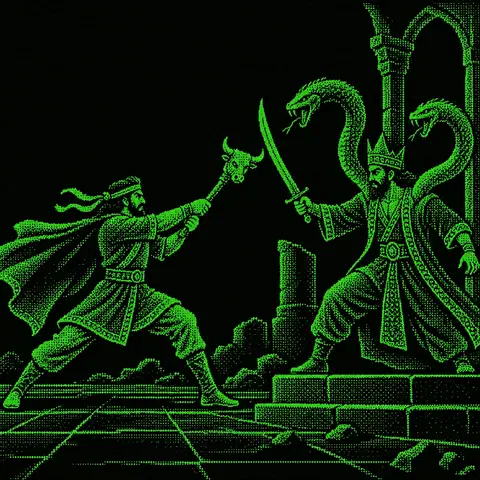
The Iranian tradition gives the sacred substance a weapon. Yasna 9.30 invokes Haoma to strike a venom-spewing dragon with his mace. Haoma protects the righteous against a serpentine threat. (Yasna 9.30.)
Earlier in the hymn, Zarathustra asks who first prepared Haoma and what rewards they received. The second preparer, Āthwya, receives the son Thraetaona, who defeats Aži Dahāka, the three-headed, six-eyed dragon. The third, Thrita, receives two sons, including Keresaspa, who strikes a separate, horned and venomous dragon. Preparing Haoma is rewarded with sons who become dragon-slayers. (Yasna 9.3–11.)
Aži Dahāka becomes the later Persian Zahhāk, the tyrant with snakes growing from his shoulders. Thraetaona becomes Fereydun, his conqueror. The earlier Avestan hymn describes a three-headed dragon; the familiar shoulder snakes belong to the later story’s development. (Encyclopaedia Iranica, “Aždahā ii. In Persian Literature”.)
That is the figure discussed in “Snakes for Shoulders” and “Serpent Sovereignty”. The Haoma hymn adds an earlier connection to his history: the dragon’s conqueror is born as the reward for preparing the sacred drink.
The Indian and Iranian stories share a recognizable relationship between sacred substance and victory over a serpent. Each tradition develops that relationship through its own gods, heroes, and ritual language.
The serpents who guard the nectar #
In the later Indian epic, serpents stand between a great bird and the drink of immortality. Garuḍa must obtain the heavenly nectar to release his mother from bondage to the snakes. (Mahābhārata, Ādi Parva, section 29.)
When he reaches it, he encounters a revolving, razor-edged wheel. Within the wheel, two poisonous snakes guard the drink. Their eyes never close; their gaze can reduce an intruder to ashes. Garuḍa blinds them with dust, cuts them apart, and takes the nectar. (Section 33.)
Ganguli’s translation calls the drink both Soma and amṛta, the nectar of immortality. The same treasure carries both names in a developed mythic setting, distinct from the pressed juice in a Rigvedic sacrifice. (Section 33.)
Garuḍa brings the nectar to the serpents who demanded it. He places it on kuśa grass and tells them to perform their ablutions before drinking. During their absence, Indra carries it back to heaven. They return to an empty place and lick the grass where it stood. The grass cuts their tongues in two: the story explains snakes’ forked tongues through their failed attempt to obtain the drink. (Section 34.)
Serpents occupy both positions around the same treasure. Two guard the divine supply; others try to acquire it. Their connection with immortality is expressed as custody and desire.
The serpent that churns immortality #
Another episode in the Ādi Parva gives the serpent a role in obtaining the nectar itself. The gods and Asuras churn the ocean using Mount Mandara as their churning staff and Vāsuki as the cord. His immense body becomes the instrument through which the hidden substance can be brought out. (Mahābhārata, Ādi Parva, section 18.)
The churning produces wondrous beings and treasures, including Dhanvantari with a vessel of nectar. The same episode also releases the devastating poison Kālakūṭa, which Śiva swallows to save the world. Poison and immortalizing nectar emerge within one dangerous operation, performed with a serpent’s body. (Section 18.)
Vāsuki’s role differs from Vṛtra’s. Vṛtra confines the waters; Vāsuki helps work the ocean until its treasure appears. The serpent can obstruct the release of life or become the means of obtaining it. That reversal is part of the documented connection.
What Soma and the snake have in common #
The passages form a compact map of relationships:
| Text | Serpent’s role | Connection with the sacred drink |
|---|---|---|
| Rigveda 9.86.44 | Sheds its old skin | Supplies an image for flowing Soma |
| Rigveda 1.32; 6.72; 9.88 | Defeated adversary | Soma empowers or shares the victory |
| Śatapatha Brāhmaṇa 1.6.3 | Vṛtra, born from an offering | Soma helps generate and sustain the dragon |
| Yasna 9 | Venomous foe | Haoma protects against dragons and rewards preparers with heroic sons |
| Mahābhārata, sections 33–34 | Guardian and seeker | Serpents control or pursue Soma–amṛta |
| Mahābhārata, section 18 | Churning cord | Vāsuki helps bring forth the nectar |
The strongest conclusion is a recurring relationship between serpents and access to extraordinary life. The snake may embody renewal, obstruct its sources, defend its treasure, or help draw that treasure out. The sacred drink travels through the same sequence of possibilities.
This gives substance to the wider serpent-and-life-giving-treasure pattern. The connection rests on named beings and particular actions: a skin abandoned, a river released, a dragon formed from an offering, a guarded vessel stolen, an ocean churned. Those actions make the comparison more useful than treating every snake as an interchangeable symbol.1
For an interpretation centered on death and rebirth, the first image remains the most economical. The old covering lies behind; life has passed beyond it. The Soma poet could picture that movement in a snake. Later storytellers placed snakes at the threshold of the heavenly drink, making its possession a prize worth a cosmic struggle. Across these settings, the serpent keeps its place beside the possibility of another life.
Sources #
English quotations follow the public-domain translations linked below. Rigvedic references give book, hymn, and verse; Yasna references give chapter and verse. Mahābhārata section numbers follow Ganguli’s translation. The hymns, ritual exposition, Iranian liturgy, and epic are distinct textual settings; the comparison follows their particular descriptions.
- Griffith, Ralph T. H., trans. The Hymns of the Rigveda: 1.32, 6.72, 8.48, 9.86, and 9.88.
- University of Texas at Austin, Linguistics Research Center. Rigveda, book 9, Sanskrit text, especially 9.086.44.
- Eggeling, Julius, trans. The Śatapatha-Brāhmaṇa, 1.6.3. Sacred Books of the East 12. Oxford, 1882.
- Mills, L. H., trans. The Zend-Avesta, part III, Yasna 9. Sacred Books of the East 31. Oxford, 1887.
- Ganguli, Kisari Mohan, trans. The Mahabharata, book 1, Adi Parva: section 18, section 29, section 33, and section 34.
- Taillieu, Dieter, and Mary Boyce. “Haoma”, including “Haoma i. Botany” and “Haoma ii. The Rituals”. Encyclopaedia Iranica.
- Khaleghi-Motlagh, Djalal. “Aždahā ii. In Persian Literature”. Encyclopaedia Iranica.
These texts document associations, actions, and ritual meanings. Identifying the plant or reconstructing a recipe requires separate evidence. A serpent guarding a drink, or supplying its poetic image, does not by itself establish venom as an ingredient. For the botanical question, see Encyclopaedia Iranica, “Haoma i. Botany”. ↩︎