~/archaeology/mythology
Snakes for Shoulders: From Ancient Gods to a Persian Tyrant
Mesopotamian gods and a Persian tyrant have snakes growing from their shoulders. Their shared image preserves an ancient tradition of serpent power.
TL;DR
- Ancient Mesopotamian gods and a Persian tyrant share an unusually specific silhouette: a human figure with a serpent rising at either shoulder.
- Shoulder serpents form a specialized branch of the Master/Mistress of Serpents image, within the wider Master/Mistress of Animals tradition.
- Other gods, including Tishpak and a Hatran underworld deity, establish a wider Near Eastern tradition of this bodily arrangement.
- Armenian and early Islamic texts carry serpent-bearing kings into the centuries before Ferdowsi.
- A regional visual formula survives changes of name and theology, turning divine serpent power into the appetite of a murderous king.
Why do gods and kings have snakes growing from their shoulders? #
Ancient Mesopotamian gods and a wicked king in Persian epic have snakes growing from their shoulders. The resemblance is no coincidence: an old regional image of supernatural power survives inside a new story about a ruler who devours his people.
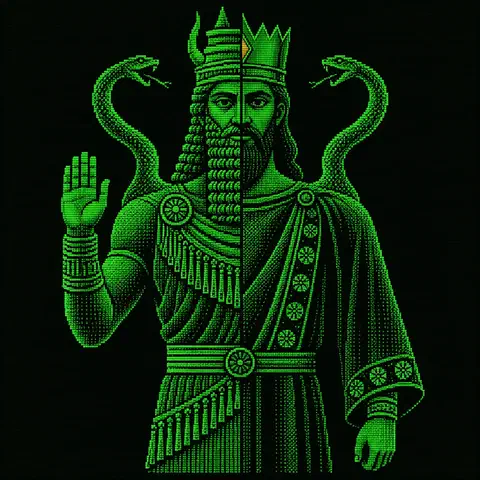
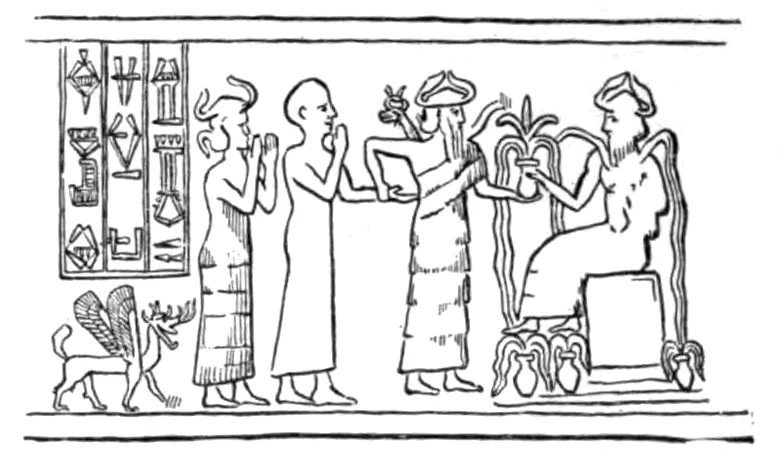
A bald ruler approaches a throne. A god takes him by the hand and conducts him forward. The god has an ordinary human body, a long garment, and a horned crown. At his shoulders, two serpents raise their heads.
The ruler is Gudea of the Sumerian city of Lagash. His guide is Ningishzida, his personal god. The scene survives in impressions of Gudea’s cylinder seal, made around 2120 BCE. The original cylinder is lost; the Louvre preserves a clay fragment bearing its impression. Louvre, AO 3541; École du Louvre, p. 7.
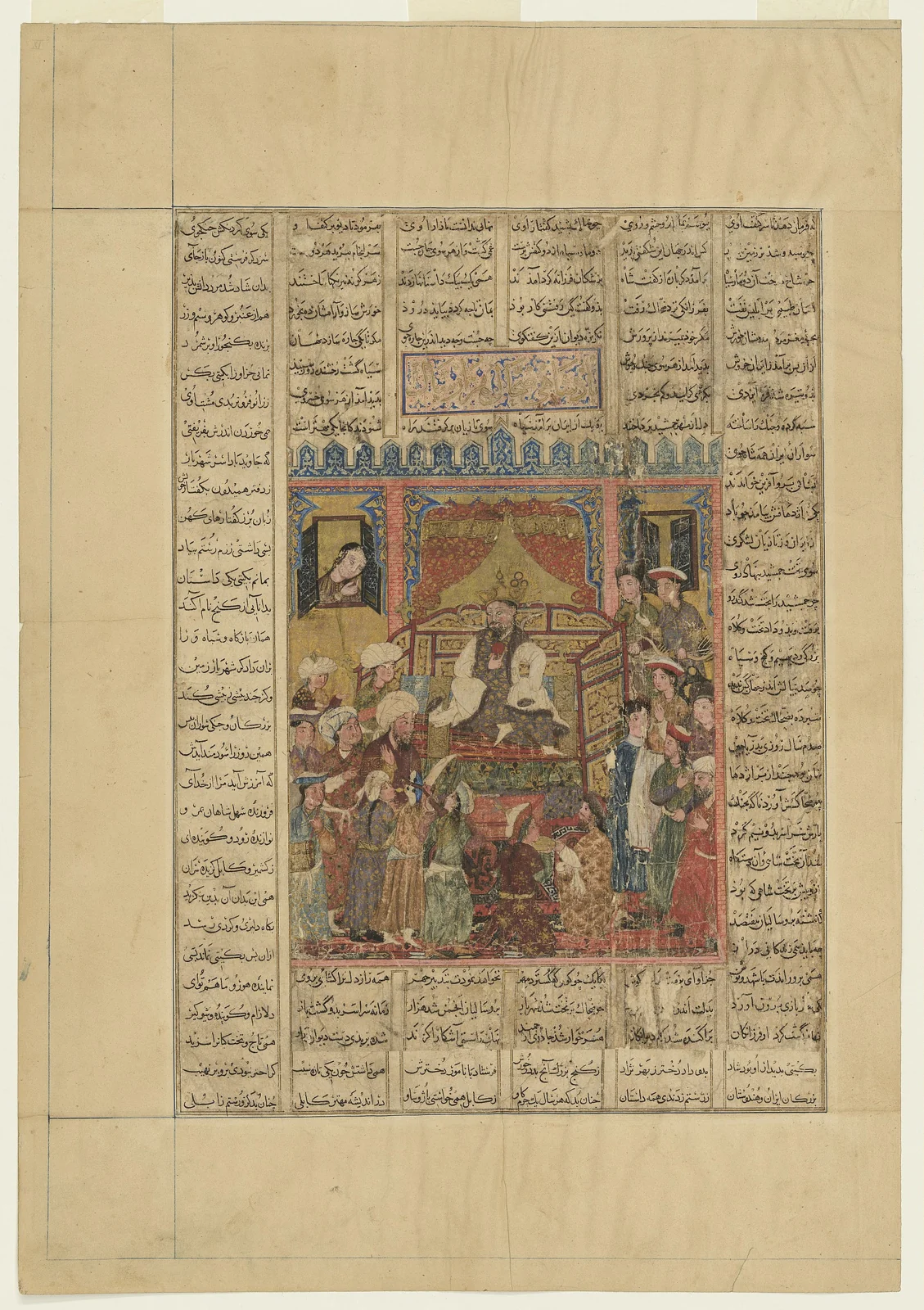
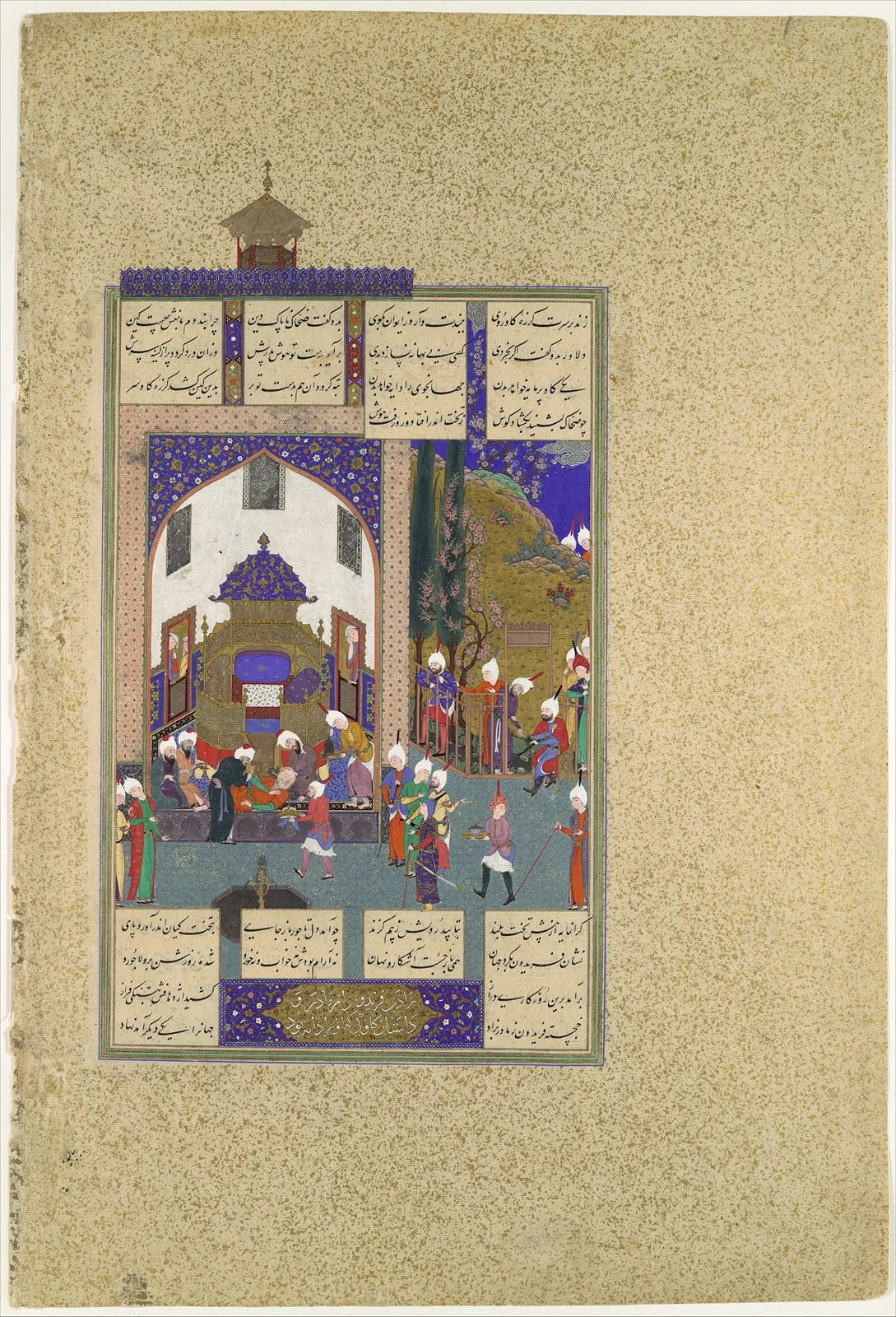
More than three thousand years later, Persian painters give another ruler the same extraordinary outline. Zahhāk, the legendary tyrant of Persian epic, sits in a palace or kneels before his conqueror, and a snake rises on each side of his head. In his story the pair are a curse: they eat the brains of the young people delivered to his court. Metropolitan Museum, Zahhak as a Prisoner.
The resemblance is too specific to disappear into the general category of snake symbolism. Cultures put snakes around staffs, beneath thrones, on crowns, in trees, and under the feet of heroes. Here the placement is the point. The serpents attach to a human figure’s upper body and rise beside the head, giving one person a strange company of additional living heads.
Zahhāk preserves an older Near Eastern visual language of serpent-bearing supernatural power. The paired shoulders are its most striking expression. Across the intervening record, that language belongs to several gods and kings, and its meaning changes from divine authority to demonic appetite. The serpent-bearing body outlives any one name or theology. A direct descent of Zahhāk from Ningishzida is unknown; the shoulder pair belongs to a tradition with many divine bearers.
What did Ningishzida’s serpents mean? #
Ningishzida’s name is conventionally interpreted as “Lord of the true tree,” with “reliable” or “right” as alternative renderings. His domain joins vegetation to the underworld: growth and decay belong to the same divine figure. Adam Stone, “Ningišzida”.
The seal makes his relationship to the ruler visible. He is the one who takes Gudea’s hand. Before the ruler reaches the throne, he passes through the protection and introduction of his personal god. The serpents identify the intermediary; they do not attack the man he accompanies. The ancient image associates this unusual body with access to divine power. Benoit, “Empreinte du sceau de Gudéa”.

A second object makes the serpent association unmistakable. Gudea dedicated a chlorite libation vessel to Ningishzida. Its decoration puts two intertwined snakes between a pair of composite dragon creatures. It is a different arrangement from the shoulder pair, but it places the god’s serpent imagery in an inscribed act of royal devotion. The vessel and seal belong to the same historical setting. Louvre, AO 190.
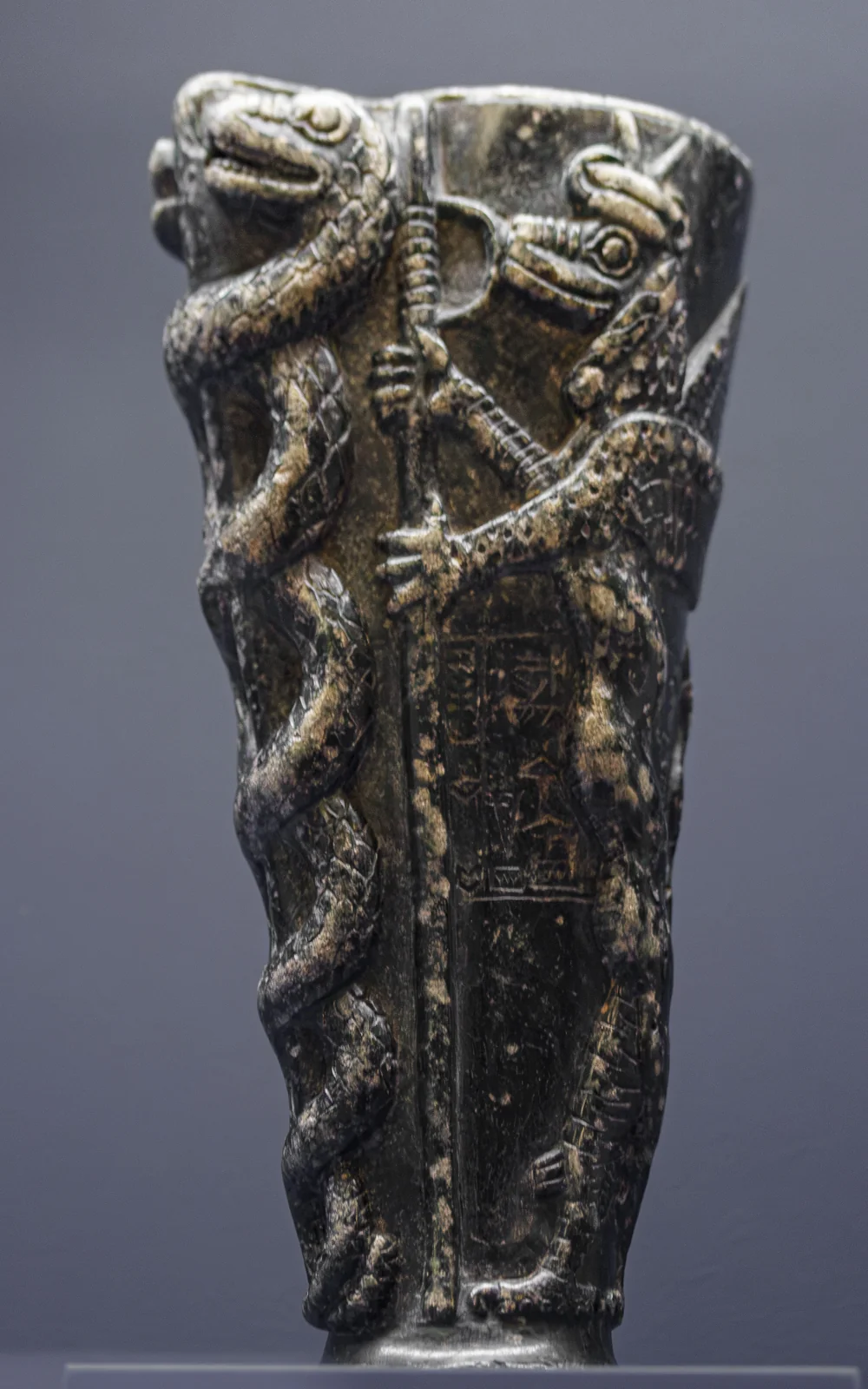

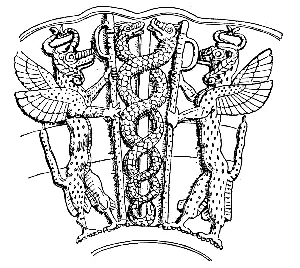
Ningishzida’s serpent emblems belong to royal devotion and the ruler’s access to the gods. Beside Gudea, the serpent-bearing figure helps a ruler approach the divine. In Zahhāk’s palace, the serpent-bearing ruler feeds his serpents the brains of the people he ought to protect.
The older Master and Mistress of Serpents #
The serpent-shouldered figure belongs within the Master and Mistress of Serpents tradition described in Venom & Valhalla, itself a specialized form of the Master and Mistress of Animals:
Master/Mistress of Animals → Master/Mistress of Serpents → the serpent-shouldered figure.
The broad composition places a human or humanlike power among animals, often gripping a creature on either side. It makes mastery visible through the arrangement of bodies. The serpent branch concentrates that power in snakes. The shoulder-bearing variant incorporates them into the master’s own anatomy: the creatures once held beside a person become powers issuing from that person. The central bearer, flanking serpents, and extraordinary authority remain recognizable as the relation becomes bodily.
An Iranian stamp seal in the Louvre takes this larger pattern back into the fourth millennium BCE, roughly five to six thousand years ago. A ram-headed hybrid extends its arms between two pairs of snakes, with small quadrupeds below. The museum classifies the composition as a Master of Animals. Here serpent mastery is already part of the wider animal-mastery image (Louvre, AO 22919).
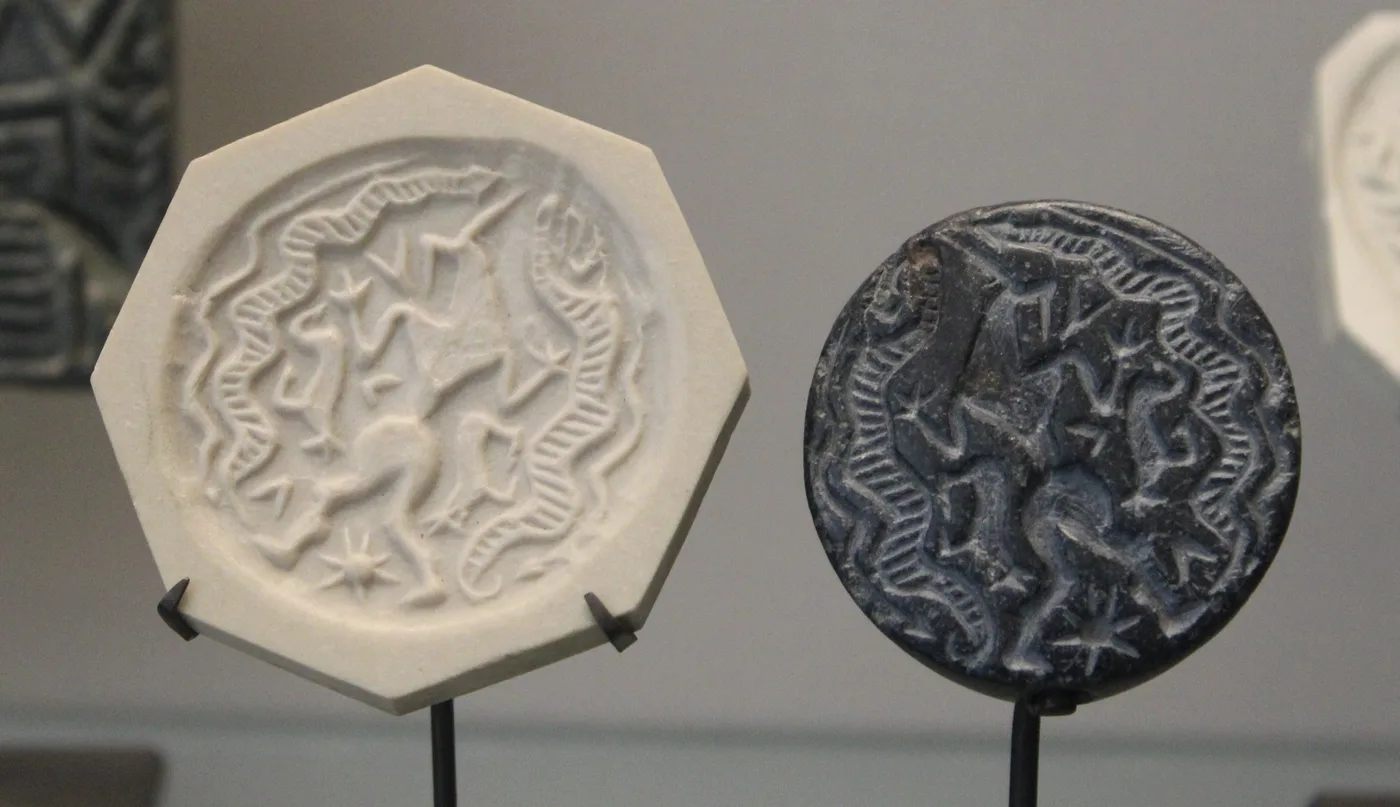
On one Bronze Age seal, a man holds snakes while two additional snake heads arise from his shoulders. One figure combines control of serpents with the shoulder emblem. Other figures grip snakes; still others have arms ending in snake heads. Sylvia Winkelmann proposes that artists fused the hand and the animal it held, turning a relationship into a composite body. Snake-holding, snake arms, and shoulder heads coexist within this tradition of incorporated serpent power (Winkelmann, figs. 7–10, online pp. 297–299).
Guitty Azarpay studied a Bronze Age Bactrian figure whose arms terminate in serpents and proposed that it might preserve a precursor of Aži Dahāka, the monster behind the later Zahhāk tradition. The figure’s identity remains unknown. Across this regional repertoire, a powerful humanlike body controls, incorporates, or emits snakes (Azarpay 1991, figs. 1–2 and pp. 6–7).
The shoulder snakes retain the serpent master’s concentrated power. Zahhāk’s story reverses the relationship: the creatures command the king who bears them. An image of mastery becomes an image of enslavement. That reversal belongs to the history of the same visual family.
Were shoulder serpents confined to one Sumerian god? #
The device already crossed divine identities in ancient Mesopotamia. On Bilalama’s cylinder seal, dated around 2000 BCE, the seated god Tishpak has two dragon heads projecting from his shoulders. The inscription names Bilalama and his father Kirikiri, ruler of Eshnunna. Archaeologists found matching ancient impressions at Tell Asmar. Here is another named god, in another city, using the same paired placement. University of Chicago ISAC, A7468; Highlights, p. 36.
Iranian material broadens the picture. The Louvre’s Bailey cylinder seal shows an enthroned figure with a serpent issuing at each shoulder, while separate human arms extend forward. Its current catalogue dates it around 1800 BCE and assigns it to eastern Iran. Louvre, AO 30254.1
The late-third-millennium Jalalabad seal, reportedly from Fars, expands the anatomy further. Its central figure has arms transformed into snakes, with additional reptiles extending from the back. In their new recording, Massimo Vidale, François Desset, and Dennys Frenez identify at least ten serpents altogether. This is a related serpent-emitting body, rather than an exact two-shoulder duplicate. “The Jalalabad Seal, a Reappraisal,” pp. 285–286.
Tishpak has a single pair of shoulder dragons; Jalalabad makes a supernatural body the source of many serpents. The Iranian plateau was already part of that visual world long before the Persian epic took its literary form.
Nüwa and Fuxi have serpent bodies below their human torsos. A serpent tail, a held snake, and a snake rising beside the neck express different relationships between the human and animal body.
How does Hatra connect the ancient and later images? #
At Hatra, in northern Mesopotamia, the serpents reappear on a monumental human body. A relief usually identified as Nergal shows a bearded underworld deity in local dress, carrying weapons and holding the leash of a three-headed dog. Snakes rise from the shoulders and waist. The pair beside the neck is especially clear: the heads turn upward on either side of the bearded face. Susan Downey, “Parthian Art”; Mosul Museum, relief record.2
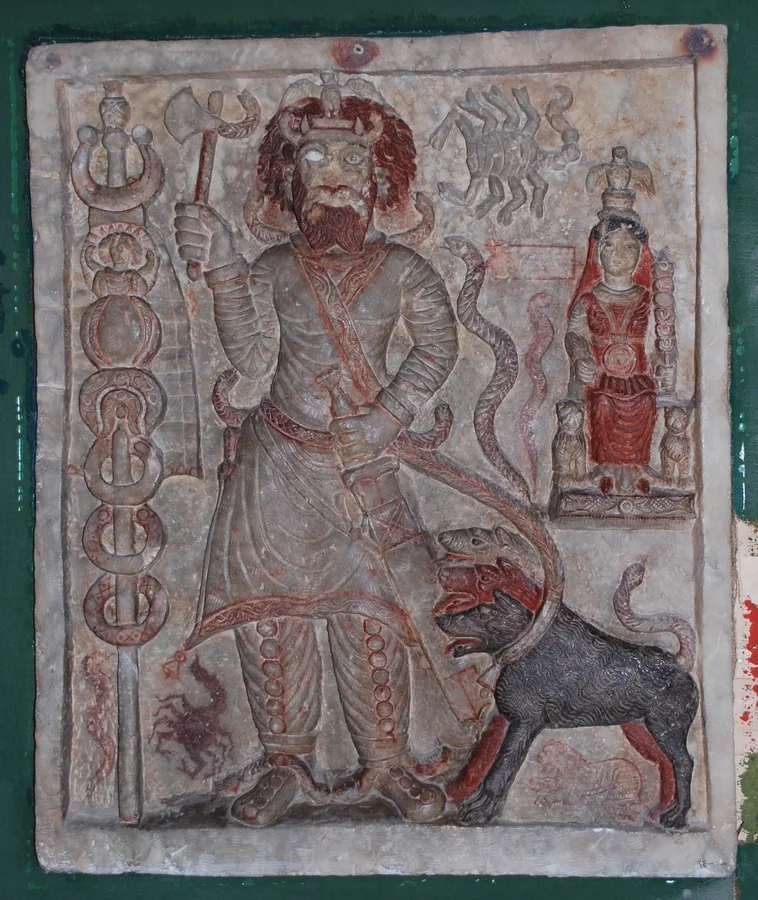
Hatra occupied the caravan routes between Mesopotamia, Syria, and Anatolia within the political world of the Parthian Empire. Its religions combined Mesopotamian, Iranian, and Greco-Roman elements. It provides a concrete setting in which an old regional form could be retained and reworked across cultural boundaries. Rüdiger Schmitt, “Hatra”.
The Hatran deity bears the shoulder pair roughly two millennia after Gudea, in a region deeply connected to Iranian history.
James Russell’s Encyclopaedia Iranica article on Armenian Aždahak explicitly connects the later Persian imagery to Mesopotamian representations such as this Hatran deity. Russell, “Armenian Aždahak”.
When did the serpents become the mark of a wicked king? #
Around 470 CE, the Armenian work attributed to Pʿawstos Buzand pictured the fourth-century King Pap with snakes arising from his breasts and curling around his shoulders. The number is not specified, and the emergence is from the chest rather than the shoulder itself. Still, the upper-body placement and the royal bearer are revealing. Here the snakes are visible demons inhabiting the ruler; they vanish in the presence of holy men. History of the Armenians, V.22; Russell, “Faustus”.
The serpent-bearing ruler was already intelligible outside the later Persian manuscript tradition.
The bodily idea also reaches farther west. In Hesiod’s Theogony, Typhoeus has a hundred snake heads growing from his shoulders. That is a literary amplification, with a different number and no demonstrated place in Zahhāk’s descent. It nonetheless shows that shoulder-emergence itself belonged to the ancient repertoire of supernatural anatomy. Hesiod, Theogony 820–835.
The Iranian name has its own history. In Yasna 9.8, Aži Dahāka is three-mouthed, three-headed, and six-eyed, a creation of the evil spirit. That passage gives us a monstrous dragon, but does not specify the familiar two shoulder snakes. Avesta, Yasna 9.8.
By the early tenth century, Zahhāk’s story includes the paired shoulder motif. Al-Ṭabarī records two painful shoulder growths treated with human brains, and also transmits accounts of literal serpents. Other reports describe viper-shaped flesh at the shoulders. The story circulated both as monstrous anatomy and as an account of abnormal growths. Ferdowsi did not invent the pair. Al-Ṭabarī, History, II, pp. 3–6.
In the Shahnameh, completed around 1010, the devil’s kisses make two snakes sprout from Zahhāk’s shoulders. Cutting them off fails: they grow again. Feeding them human brains turns a king’s private curse into a country’s daily machinery of murder. Fereydun defeats him and confines him at Mount Damavand. Ferdowsi, Shahnameh, the growth of the snakes; Aga Khan Museum, AKM155.
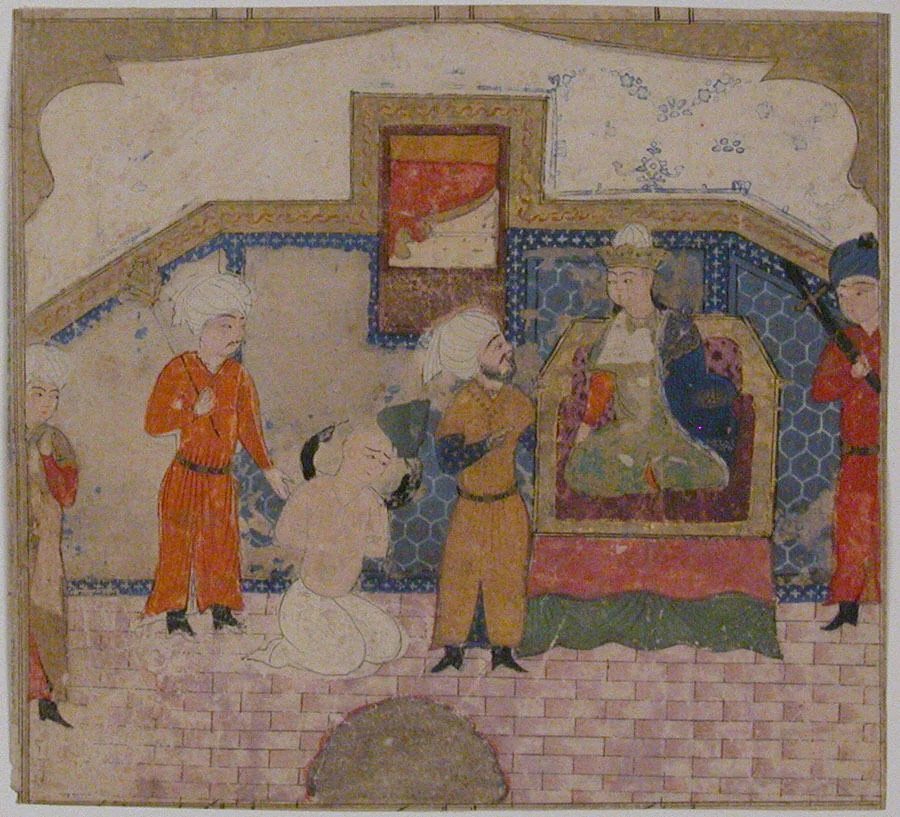
The motif now performs a moral accusation. An ancient god’s extraordinary body announced his power. The tyrant’s extraordinary body exposes the appetite ruling him. His subjects pay for what has grown on their king.
The Iranian association of serpents, authority, and resistance is written directly on the royal body.
What survives across the chronology? #
Shoulder pairs appear alongside snake arms and more elaborate serpent-bearing bodies. The anatomy survives as divine names and stories change.
| Attestation | Date of object or text | What the serpents do |
|---|---|---|
| Luristan Master of Animals stamp seal | 4000–3000 BCE | A ram-headed figure extends its arms among paired snakes: the broader serpent-mastery pattern. |
| Gudea’s seal: Ningishzida | Around 2120 BCE | Two horned heads rise at the shoulders. |
| Jalalabad seal, reportedly Fars | Late third millennium BCE | Snake arms and multiple probable back serpents: a related body. |
| Bilalama’s seal: Tishpak | Around 2000 BCE | Two dragon heads project from the shoulders. |
| Bailey seal, eastern Iran | Around 1800 BCE, current Louvre date | Two shoulder serpents accompany an enthroned figure. |
| Hesiod’s Typhoeus | Around 700 BCE | A hundred snake heads grow from the shoulders in poetry. |
| Hatran underworld relief | Approximately second century CE | Shoulder pair, with additional waist serpents. |
| Armenian account of Pap | Around 470 CE; describes a fourth-century king | Snakes rise from the breasts and coil around the shoulders; count unspecified. |
| Al-Ṭabarī’s Zahhāk | Early tenth century | Two viper-shaped shoulder growths, also reported as snakes. |
| Ferdowsi’s Shahnameh | Around 1010 CE | Two shoulder snakes demand human brains. |
| Illustrated Persian Shahnamehs | Medieval and later | Painters repeatedly give Zahhāk the paired shoulder silhouette. |
The exact motif is already shared by different gods in antiquity. Related serpent-emitting bodies occur in Iran. A later Mesopotamian deity retains the shoulder pair, and early medieval texts make serpents part of the anatomy of dangerous kings.
Did scholars already connect Ningishzida and Zahhāk? #
In 1910, William Hayes Ward put the comparison in print. After discussing Ningishzida’s seal and relief, he wrote that the shoulder-serpent idea “has been perpetuated, it would seem, in the Persian myth of the wicked Zohak.” His accompanying page placed the ancient images beside a drawing of the later serpent-bearing king. Ward, The Seal Cylinders of Western Asia, p. 130.
Ward also distinguished figures holding snakes from those whose shoulders emit them.
A much-reproduced Hermitage terracotta long identified as seventh- or eighth-century Zahhāk was reassessed in a 2021 museum study as a late-nineteenth-century forgery. A Metropolitan Museum bowl once treated as medieval was fired shortly before its appearance in 1926; its present catalogue allows either an altered medieval object or a twentieth-century manufacture. Elikhina, Lurje, and Khavrin, author-posted study; Metropolitan Museum, 64.274.3.
How can an image outlive the god who wore it? #
The most durable element here is the arrangement of bodies. It is simple enough to reproduce on a tiny cylinder, striking enough to carve on a large relief, and distinctive enough to identify a king in a crowded painted court. Two snakes rising beside a human head provide a compact sign of power beyond the human.
That sign need not keep one interpretation. At Gudea’s side it marks divine mediation. On the Hatran relief it belongs to an armed ruler of the underworld. In the Armenian narrative it expresses a king’s possession by demons. In Persian epic it makes predatory kingship visible. Those changes are precisely what inherited imagery can accomplish: a familiar form lends authority to a new story, and the new story explains why the familiar form is there.
The moral reversals of bound and demonized mythic figures likewise leave recognizable features intact. A culture can condemn an image whose older bearers it once venerated, or recruit an established divine emblem to depict power gone wrong. The route from Ningishzida to Zahhāk remains undocumented; the visual vocabulary had several possible bearers along the way.
The devil’s kiss, the demand for brains, the revolt, and the mountain prison give Zahhāk his particular story. The shoulder pair can have an older history within that story, just as a borrowed emblem can acquire a new explanation. Literary invention and visual inheritance can occupy the same body.
Gudea is led forward by a god with serpents at his shoulders. Zahhāk kneels in defeat, still wearing his serpents. Between those images lie other gods, other kings, and other judgments about what supernatural power means. The serpent pair keeps its place beside the human head through those changes.
The name, story, and moral meaning change while the ancient silhouette remains. On Gudea’s seal, the serpents accompany the power that admits a ruler to the gods. In Zahhāk’s palace, they accompany the power that devours his people. The wearer has changed. The serpents stayed.
Sources #
- Musée du Louvre. Gudea’s seal impression, AO 3541; libation vessel, AO 190; Bailey seal, AO 30254. Current object catalogues.
- Benoit, Agnès. Corrigés première année, September 2013. École du Louvre, p. 7, “Empreinte du sceau de Gudéa.”
- Stone, Adam. “Ningišzida (god)”. Ancient Mesopotamian Gods and Goddesses, ORACC.
- University of Chicago, Institute for the Study of Ancient Cultures. Bilalama’s seal, A7468; Highlights, p. 36, no. 11.
- Vidale, Massimo, François Desset, and Dennys Frenez. “The Jalalabad Seal, a Reappraisal”. Journal of Archaeological Studies 12, no. 4 (2021): 283–297 in the journal PDF, especially pp. 285–286; other versions use different pagination.
- Downey, Susan B. “Art in Iran iv. Parthian Art”. Encyclopaedia Iranica. The paragraph on the so-called Cerberus relief.
- French Ministry of Culture / Mosul Museum. “Sculpture at Hatra” and underworld relief image.
- Fowlkes-Childs, Blair, and Michael Seymour, eds. The World between Empires: Art and Identity in the Ancient Middle East. Metropolitan Museum of Art, 2019, p. 215, fig. 80.
- Schmitt, Rüdiger. “Hatra”. Encyclopaedia Iranica.
- Russell, James R. “Aždahā iv. Armenian Aždahak” and “Faustus”. Encyclopaedia Iranica.
- Pʿawstos Buzand. History of the Armenians, Book V, chapter 22. Translated by Robert Bedrosian, pp. 236–237.
- Hesiod. Theogony, lines 820–835. Translated by Hugh G. Evelyn-White; shoulder heads at lines 824–825.
- Yasna 9.8. Aži Dahāka’s three-headed description.
- Al-Ṭabarī. The History of al-Ṭabarī, vol. II: Prophets and Patriarchs. Translated by William M. Brinner. SUNY Press, 1987, pp. 3–6.
- Ferdowsi. Shahnameh, Jamshid cycle, the growth of the snakes, Persian text at Ganjoor; James Atkinson’s abridged English translation, “Zohak,” in Persian Literature, vol. 1; and Aga Khan Museum, The Death of Zahhak, AKM155.
- Ward, William Hayes. The Seal Cylinders of Western Asia. Carnegie Institution of Washington, 1910, chapter XVIII, pp. 127–131, especially p. 130; Gudea’s seal, fig. 368a, and Zohak, fig. 368e.
- Elikhina, Yulia, Pavel Lurje, and Sergey Khavrin. “The Figurine of Zahhak and Some Other Late-19th Century Forgeries in the Khotan Collection of the State Hermitage”. Proceedings of the State Hermitage 105 (2021): 375–386, in Hermitage Readings in Memory of V. G. Lukonin, 2013–2017.
- Metropolitan Museum of Art. Zahhak as a Prisoner; Zahhak Is Told His Fate; bowl depicting Zahhāk, 64.274.3. Object dating and image records.
- Smithsonian National Museum of Asian Art. Zahhak Enthroned, F1923.5. Tabriz, around 1330–1340, from the Great Mongol Shahnameh.
- Cutler, Andrew. Venom & Valhalla: The Mistress of Serpents Goes North. Vectors of Mind, November 5, 2025.
- Musée du Louvre. Master of Animals stamp seal, AO 22919. Fourth millennium BCE; Luristan attribution by style. Current catalogue.
- Winkelmann, Sylvia. “Some thoughts about the wild haired snake-man on BMAC-seals”. 2016, especially figs. 7–10, pp. 297–299 in the author-posted online pagination.
- Azarpay, Guitty. “The Snake-Man in the Art of Bronze Age Bactria”. Bulletin of the Asia Institute, new series 5 (1991): 1–10, figs. 1–2 and pp. 6–7. Scanned collection of Azarpay’s studies.
Luristan seal photograph: Zunkir / Wikimedia Commons, CC BY-SA 4.0, resized for display.

The Louvre catalogue’s current date for AO 30254 is around 1800 BCE. Sara Kuehn’s “An Unusual Large Circular Compartmented ‘Stamp Seal’ of the Goddess with Animals,” fig. 10, reproducing Amiet (1986), fig. 137, gives the same seal an earlier date, around 2200–2100 BCE. The seal’s reported eastern Iranian attribution and modern collecting history also differ from an excavated findspot. ↩︎
The name Nergal is conventional. Wathiq al-Salihi proposes Zqyqa in “Hatra: Three Notes, Historical, Iconographical, and Religious,” Iraq 83 (2021): 3–12. The approximately second-century date is given in The World between Empires (2019), p. 215, fig. 80. The Mosul Museum’s institutional account reports the relief as missing, with its present whereabouts unknown. ↩︎