~/egypt/serpent-symbolism
The Shipwrecked Sailor: Egypt’s Serpent Says Know Yourself
In a tale copied about 1900 BC, a golden serpent threatens a castaway with self-knowledge, and the man answers that he does not know himself. The first editor deleted the answer.
TL;DR
- The Tale of the Shipwrecked Sailor, copied about 1900 BC, has a serpent thirty cubits long, with gold flesh and a god’s beard, say to a castaway: “I will make you know yourself as ashes.”
- The man’s answer uses the opposite verb with the same reflexive: “I am before you, and I do not know myself.”
- Before the serpent comes, the man is alone for three days with “my heart as my second”, a word written with the numeral two, and he “embraced the shadow”.
- The serpent carries him in his mouth unharmed, names the place “the island of the ka”, the double, and sends him home with a promise: “You will become young again.”
- The first editor emended the sailor’s answer out of the text and explained the threat as an idiom. For a generation, readers of French and English never saw the line.
rḏi̯=j rḫ=k ṯw … jw=j m-bꜣḥ=k ḫm.n(=j) wj “I will make you know yourself.” … “I am before you, and I do not know myself.” — The serpent and the sailor, P. Hermitage 1115, lines 70–76
What happens in the Tale of the Shipwrecked Sailor? #
A crew comes home from Nubia. Its leader has to report to the king and is sick with dread, and one of his followers tries to steady him with a story of his own. Once, he says, he sailed for the royal mines in a ship of a hundred and twenty men. A storm killed every one of them but him, and a wave threw him onto an island where nothing was lacking: figs, grapes, fish, birds. He ate, lit a fire and made a burnt offering. Then the trees splintered and the ground shook.
I uncovered my face, and I found it was a snake coming. He was thirty cubits long; his beard was more than two cubits; his limbs were overlaid with gold; his eyebrows were of real lapis lazuli; and he was reared up in front.
Gold flesh, lapis hair and the long plaited beard are how Egypt drew its gods. The serpent questions him, carries him off in his mouth, comforts him, tells him a story of his own, foretells the ship that will rescue him and loads it with the wealth of Punt. The sailor goes home and is made a royal follower. The leader, hearing all this, is not consoled.
The whole tale survives on one papyrus, now in the Hermitage, and it survives complete. Our line-by-line translation gives every sentence with the Egyptian beside it. This essay is about a handful of those sentences.
What does the serpent say to the sailor? #
The serpent’s first words are a question asked three times, and then a threat:
“Who brought you, who brought you, little one? Who brought you? If you delay in telling me who brought you to this island, I will make you know yourself as ashes, become one who is not seen.”
The Egyptian of the threat is rḏi̯=j rḫ=k ṯw: “I will cause that you know yourself”. The verb is rḫ, the ordinary verb “to know”, spelled here with the papyrus-roll sign that marks abstract things. It is the verb Egyptian priests used for knowing the names and the secret things. Its object is ṯw, “you”, the same person as its subject.
The sailor answers:
“You speak to me, but I do not hear it. I am before you, and I do not know myself.”
Here the verb is ḫm, which means “not to know”. Egyptian has a separate verb for it, written with the pair of arms that signals negation. Its object is wj, “me”, again the same person as the subject. The two sentences are built as a pair, and they are the first things the two characters say to each other:
| Speaker | Egyptian | Word for word |
|---|---|---|
| The serpent | rḏi̯=j rḫ=k ṯw | I-will-cause know-you yourself |
| The sailor | jw=j m-bꜣḥ=k ḫm.n(=j) wj | I-am before-you, not-know-I myself |
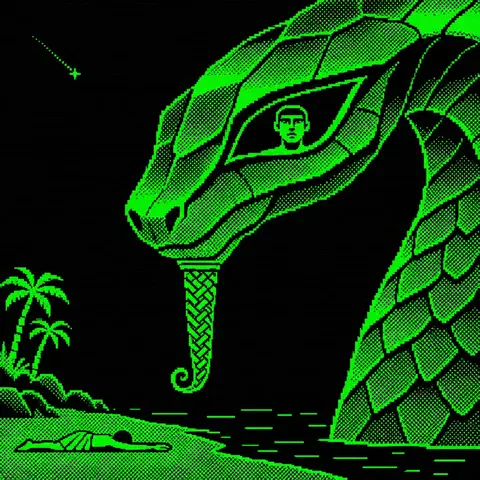
A man lies on his belly before a divine serpent. The serpent offers him knowledge of himself, and says it will feel like being burned to ash and vanishing from sight. The man says that here, in front of the serpent, he has none.
The sailor’s sentence has one twin in Egyptian literature, and it settles what kind of sentence it is. In the Tale of Sinuhe, composed in the same century, the old exile is brought home and led in to the king on his throne of electrum:
wn.kj rf dwn.kw ḥr ẖ.t=j, ḫm.n(=j) wj m-bꜣḥ=f, nṯr pn ḥr wšd=j ḫnm.w “I was stretched out on my belly, and I did not know myself in his presence, while this god was addressing me kindly.” — Sinuhe B 252–253
The words are the same: on the belly, “before him”, ḫm.n wj. Sinuhe calls the king “this god”, and the god of Egypt’s throne wore a rearing cobra on his brow. Not knowing oneself is what happens to an Egyptian face down in front of a god. In one tale the god is the king with the serpent on his forehead; in the other the god is the serpent.
My heart was my second #
The storyteller has prepared this. The tale opens at the quay with the crew safe home, and the follower describes the scene: “every man is embracing his second”. The word is sn.nw, the ordinal “second”, and the scribe writes it with two strokes, the numeral. It is the everyday word for a companion or shipmate, a man’s other one.
Thirty lines later the ship is gone and the same word comes back:
I spent three days alone, my heart was my second. I lay inside a shelter of trees, and I embraced the shadow.
The men at the quay each have a second to embrace. The castaway’s second is his own heart, and what he embraces is šwy.t, a word that means the shade of a tree and also a person’s shadow, which Egyptians counted as a part of the person alongside the ka and the name. The verb is the same “embrace” the serpent will use later for holding one’s children.
The poet put a man alone on an island, made him two with a word written as the number two, had him hold his own shadow, and then, in the very next scene, brought on a serpent who talks about knowing yourself. The man who cannot hear the serpent and does not know himself is a man who has just spent three days as a pair.
In the serpent’s mouth #
What the serpent does next is this:
Then he put me in his mouth and carried me to his place of rest. He set me down without my being touched. I was whole; nothing had been taken from me.
He asks his question again, and this time the sailor can answer. He tells the whole shipwreck over, in the same words he used to the governor. The serpent’s reply begins “Do not fear, do not fear, little one”, and goes on:
“Look, god has let you live: he has brought you to this island of the ka. There is nothing that is not in it; it is full of every good thing.”
The ka is the part of an Egyptian that is made with him at birth and that goes on receiving food after he dies: his life-force and his double. Gaston Maspero, the first to translate the tale in full, wrote “Île du Double” and explained that “the double is the Egyptian soul: the island of the Double is therefore an island inhabited by the blessed souls.”1 Egypt had a serpent god whose whole office was this. He is Neheb-Ka, “Kas-Assigner”, who hands each person his double, and the dead king becomes him.
So the order of events is: a man alone, doubled with his own heart, holding his shadow; a serpent who offers self-knowledge as annihilation; the man’s confession that he does not know himself; the serpent’s mouth; and then the island of the double, where he is whole and can speak. A boy taken into a monster’s mouth and given back alive is how initiation is told from Greece to the Cherokee. The Egyptian storyteller keeps the mouth and leaves out the belly.
What the serpent knows #
After the mouth, knowing is all on the serpent’s side, and he gives it away.
He knows the future. A ship will come in four months, “with sailors in it whom you know”. When it comes the sailor climbs a tree, recognizes the men, and runs to report it: “and I found that he knew it.” The verb is rḫ again.
He knows loss. His comfort to the sailor is a story inside the story inside the story:
“We were seventy-five snakes in all, my children and my brothers. I will not mention to you a little daughter, who was brought to me through knowing. Then a star fell, and they went up in fire because of it. It happened when I was not with them. They burned when I was not among them. Then I was dead for them, when I found them as a single heap of corpses.”
The threat he made was ashes. He has seen his whole family turned to ashes by fire from the sky, and he is the one left. The little daughter came to him by šsꜣ, a word for skill, wisdom and foresight. When the sailor promises to tell the king about him, he uses that word too: “I will make him know your greatness.”
He laughs at the offer of incense, since he is “the ruler of Punt” and the myrrh is his. He asks for one thing: “Put my good name in your town.” And his last words are a gift:
“You will fill your embrace with your children. You will become young again in the Residence until you are buried.”
The verb is rnpi̯, to be young, to be made young. A serpent who has it to give is the oldest theme there is about snakes: the animal that sheds its skin and keeps the drug of agelessness. Then the island is gone. “You will never see this island again: it will have become water.”
How the sailor’s answer was erased #
Wladimir Golénischeff found the papyrus in the Hermitage and gave the first account of it to the Orientalist congress in Berlin in 1881. Everything Europe knew of the tale for a generation came through him. His full edition, Le conte du naufragé, appeared in Cairo in 1912.
Golénischeff read the threat correctly and then took the edge off it. His glossary gives rḏi̯=j rḫ=k ṯw as “je te ferai connaître toi-même”, and adds that the serpent “no doubt means: I will let you know the price you put on your person … or to put it otherwise: watch out, your life is at stake!”2 Maspero did the same in a footnote: “Literally: ‘I will make you know yourself.’ This idiom, frequent in the texts, means to make someone know his powerlessness before a superior.”3
The answer fared worse. The papyrus reads ḫm.n wj, “do not know myself”. Golénischeff judged the wj a mistake, corrected it to the suffix =j, “I”, and joined the sentence to the serpent’s speech. In his edition, and in Maspero and Petrie who follow him, there is no reply at all. The serpent simply goes on talking:
| Edition | The threat | The answer |
|---|---|---|
| Papyrus, c. 1900 BC | rḏi̯=j rḫ=k ṯw, “I will make you know yourself” | ḫm.n wj, “(I) do not know myself” |
| Petrie, Egyptian Tales (1895) | “I will make you know yourself; as a flame you shall vanish” | given to the serpent: “if you tell me not something I have not heard, or which I knew not, before you” |
| Maspero (1905) | “je te ferai connaître ce que tu es” | given to the serpent: “ou tu me diras ce que je n’ai pas entendu et que j’ignorais avant toi” |
| Golénischeff (1912) | “je te ferai connaître toi-même”, glossed as “your life is at stake” | emended; given to the serpent: “ce que j’ignorais avant toi” |
| Erman, tr. Blackman (1927) | “I will let thee know thyself to be but ashes” | “I am in thy presence, but my wits have gone.” |
| Simpson (2003) | “I shall have you know yourself as ashes” | “While I was before him, I did not know myself.” |
Adolf Erman gave the sentence back to the sailor, and his English translator made it a turn of phrase for fright: “my wits have gone”. The same book shrinks the rest of the scene to match. Of “embraced the shade” its note says “i.e. probably only: I sought it”, and of the island of the ka, “probably only means an island in which there is food to live on.”4 By 2003 the words are back. Simpson prints “I did not know myself” and “my heart as my companion”, and glosses the island as “an island of the ka or enchanted island”.5
The corrections all lean one way. The sentence about the self becomes a sentence about news. The self-knowledge becomes a figure of speech for being put in one’s place. The double becomes lunch.
Know yourself, thirteen centuries before Delphi #
Maspero’s footnote is worth a second look, because of what else it would explain away. He says the Egyptian “know yourself” means: know how small you are before one greater. That is one of the oldest senses of the Greek one. The gnōthi seauton cut into the forecourt of Apollo’s temple at Delphi, which Pausanias saw there beside “Nothing in excess”, told the visitor to know that he was human and mortal. Philosophy took the phrase from there and made it the whole of wisdom.
So the commonplace sense and the deep sense are not rivals. In Egypt as in Greece the words mean “know what you are”, they are said to a human being by something more than human, and what he is expected to learn is that he dies. The Egyptian serpent says it outright: know yourself as ashes.
And both are said on a serpent’s ground. Apollo’s temple stood where the god shot the she-dragon and left her to rot, the pythein that gave Pytho its name; his priestess was the Pythia. In Genesis it is the serpent who promises that “your eyes shall be opened”, and the first thing the man and woman know is themselves: “they knew that they were naked.” The Egyptian tale is older than either text, and in it the serpent needs no intermediary. He says the words himself.
The serpent who teaches the self #
The Eve Theory of Consciousness holds that the reflexive self, the “I” that can take itself as an object, was once taught, in rites built around the serpent, and that the world’s myths of a snake who gives knowledge remember it. The Shipwrecked Sailor is that lesson told as a sea story, in the order a rite would run it:
- Separation. Everyone the man knows is dead. He is alone on ground no one else can find.
- The double. His heart becomes his second. He embraces the shadow.
- The serpent. A god in snake form comes with thunder and offers him knowledge of himself, which he says is death.
- Not knowing. The man cannot hear, and says he does not know himself.
- The mouth. He is taken in the serpent’s mouth and set down whole.
- Instruction. He can now speak his own story. He is told where he is, what will happen, and what the serpent has suffered.
- Return. He goes home with gifts, a new rank, a name to spread, and the promise of becoming young again. The place of the lesson no longer exists.
In Central Australia the same teaching is given as a plain instruction, look at yourself. In the Coffin Texts the creator speaks from inside the coils of a serpent. Here a scribe named Amenaa, “excellent of fingers”, copied it out as entertainment, and the man in the story tells it to a superior who does not want to hear. “It is good for people to listen,” the sailor says. The governor answers with a proverb about a bird given water on the morning it is to be killed, and the papyrus ends.
Sources #
- “The Shipwrecked Sailor: The Serpent of the Island of the Ka.” Line-by-line English from the Egyptian, with hieroglyphs and transliteration. Snake Cult Sacred Texts.
- Dils, Peter, and Heinz Felber. “Die Geschichte des Schiffbrüchigen” (P. Petersburg 1115). Thesaurus Linguae Aegyptiae. Transliteration, lemmas and German translation.
- Golénischeff, Wladimir. Le conte du naufragé. Bibliothèque d’étude 2. Cairo: Institut français d’archéologie orientale, 1912.
- Maspero, Gaston. Les contes populaires de l’Égypte ancienne, 3rd ed. Paris: Guilmoto, 1905. “Le Naufragé”, pp. 84–95.
- Petrie, W. M. Flinders, ed. Egyptian Tales, Translated from the Papyri, First Series. London: Methuen, 1895. Text at the Fordham Ancient History Sourcebook.
- Erman, Adolf. The Literature of the Ancient Egyptians. Translated by Aylward M. Blackman. London: Methuen, 1927. Pp. 29–35.
- Simpson, William Kelly, ed. The Literature of Ancient Egypt, 3rd ed. New Haven: Yale University Press, 2003. “The Shipwrecked Sailor”, pp. 45–53.
- Baines, John. “Interpreting the Story of the Shipwrecked Sailor.” Journal of Egyptian Archaeology 76 (1990): 55–72. Author’s addendum and bibliography (2010).
- Wilkins, Eliza Gregory. “Know Thyself” in Greek and Latin Literature. Chicago: University of Chicago Libraries, 1917.
- Pausanias. Description of Greece 10.24.1. Translated by W. H. S. Jones. Loeb Classical Library, 1935.
- Homeric Hymn to Apollo 300–374. Translated by Hugh G. Evelyn-White. Loeb Classical Library, 1914.
Maspero 1905, “Le Naufragé”, note on “Île de Double”: “Le double est l’âme égyptienne : l’île de Double est donc une île habitée par les âmes bienheureuses.” ↩︎
Golénischeff 1912, glossary s.v. tw: “je te ferai connaître toi-même (menace du roi-serpent au naufragé, voulant sans doute dire : je te ferai savoir le prix que tu attaches à ta personne, je te rendrai inquiet sur le sort de ta personne, ou pour parler autrement : fais attention, il y va de ta vie !)”. ↩︎
Maspero 1905, “Le Naufragé”, note on “je te ferai connaître ce que tu es”: “Litt. : « Je te ferai connaître toi-même ». Cet idiotisme, fréquent dans les textes, signifie faire connaître à quelqu’un son impuissance vis-à-vis d’un supérieur.” ↩︎
Erman 1927, pp. 31–32, notes. Blackman uses the same phrase for Sinuhe before the king: “my wits forsook me in his presence, albeit this god addressed me kindly” (p. 27). ↩︎
Simpson 2003, pp. 48–50. ↩︎