~/china/archaeology
The Lead That Came From Nowhere: Shang Bronzes and the Egypt Question
Highly radiogenic lead, a geochemist’s Egyptian theory, and a mine nobody has found
TL;DR
- More than half of the Shang bronzes analysed so far contain lead with an isotopic fingerprint that no known Chinese ore matches (Liu S. et al. 2018; Chen et al. 2019).
- The signature appears suddenly around 1450 BCE, spreads across the Shang world, and vanishes after about three hundred years.
- Geochemist Sun Weidong read the isotopes as pointing to very old rock beyond China and argued that the metal, and the founders of the Shang, came from Egypt (Sun et al. 2016; Foreign Policy 2016).
- Critics answered in the same journal, and Sun replied. Ten years on, nobody has found the mine, in China or anywhere else.
The lead that came from nowhere #
In the early 1980s a graduate student at the University of Science and Technology of China in Hefei began measuring lead isotopes in Shang bronzes from Anyang, the last Shang capital. Jin Zhengyao expected the lead to look like Chinese lead. Some of it did not. Four of his fourteen samples had isotope ratios so extreme that they matched almost nothing in the catalogue of Chinese ore deposits. The closest fit he could find was in the far southwest, in northeast Yunnan, more than 1,500 km away (Liu S. et al. 2018, p. 106; Sohu 2019).
He kept measuring. So did others. By 2018 more than five hundred Shang bronzes had published lead-isotope data, and roughly half of them carried the same strange signature (Liu S. et al. 2018, pp. 106–107).
Forty years on, nobody has found the mine. That gap opened the door to one of the boldest ideas in modern Chinese archaeology: that the metal, and perhaps the founders of the Shang, came from Egypt.
What makes lead “highly radiogenic”? #
Lead has four stable isotopes. One, lead-204, is primordial: the Earth has had the same amount since it formed. The other three keep growing, because they are the end products of radioactive decay. Uranium becomes lead-206 and lead-207; thorium becomes lead-208. Rock that is rich in uranium and thorium, and very old, builds up unusually large amounts of 206, 207 and 208 relative to 204.
When that lead is gathered into an ore body, its ratios freeze. Smelting, casting and burial do not change them. That makes lead isotopes one of archaeology’s best tools for tracing metal, provided someone has measured the right ore.
| Measure | Ordinary lead | Shang “HRL” | What it means |
|---|---|---|---|
| 206Pb/204Pb | ~18.5 | > 20 | Extra uranium decay |
| 208Pb/204Pb | ~38.5 | > 40 | Extra thorium decay |
| 207Pb/206Pb | ~0.85 | < 0.80 | Jin’s original test |
| Plotted together | Clustered | Steep line | Very old source, or mixing |
The thresholds follow Liu S. et al. 2018, p. 107 and Chen et al. 2019, p. 133. Specialists call it highly radiogenic lead, or HRL.
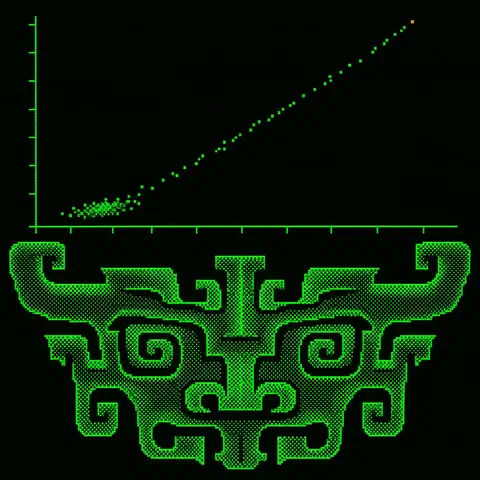
Plotted on a graph, the Shang samples string out along a steep line. Read as an isochron, a geological clock, that line points to source rocks around two billion years old or more: the ancient cores of continents that geologists call cratons. That reading is where the Egyptian idea begins.
Where the strange lead turns up #
HRL is not the quirk of one workshop. It shows up nearly everywhere Shang-style bronze was cast, and it shows up at almost the same time.
| Site or region | What was found | Source |
|---|---|---|
| Erlitou (pre-Shang) | 0 of 58 objects HRL | Liu S. 2018 |
| Zhengzhou, Yanshi, Panlongcheng | HRL from the early Shang | Liu S. 2018 |
| Anyang (Yinxu) | HRL common in Phases I–III | Li Q. et al. 2024 |
| Sanxingdui, Sichuan | Over half of bronzes HRL | Liu, Rawson & Pollard 2018 |
| Hanzhong, Shaanxi | 88 of 115 samples HRL | Chen et al. 2019 |
| Xin’gan Dayangzhou, Jiangxi | HRL in the great tomb | Liu S. 2018 |
Chen Kunlong and colleagues put the count at more than 60% of over 800 analysed Shang bronzes, used for about three centuries, roughly 1450–1150 BCE (Chen et al. 2019, p. 134). Then it “rapidly disappeared” from the Central Plains (Liu S. et al. 2018, p. 108).
That shape is what makes the problem so tempting. A sudden start, a wide spread, a sudden stop. It looks less like a slowly developing local tradition and more like a supply line that opened, ran and closed. And this was not a trace contaminant. Shang alloys usually contain several percent lead, so whoever supplied it was moving serious tonnage.
Sun Weidong’s Egyptian answer #
Sun Weidong came at the problem as an ore geologist. He trained at USTC, took his doctorate at the Australian National University, and has spent his career on subduction zones and copper and gold deposits. In 2016 he was at the Chinese Academy of Sciences’ Guangzhou Institute of Geochemistry (CAS profile).
His case, published that March in Scientific Reports with six co-authors including the American isotope geologist Robert Zartman, runs like this (Sun et al. 2016):
- The Shang lead plots on isochrons of roughly 2.0–2.5 billion years, which points to ore around ancient cratons.
- The only Chinese deposit known to carry this kind of lead, Tongkuangyu in Shanxi, is copper ore poor in lead and tin, and slag near it does not match the bronzes. It cannot be the whole answer.
- Outside China, the closest published match was metal from southern Africa, which sits on two of the oldest cratons on Earth.
- The Nile reaches deep into old crust in Uganda, Tanzania and Congo. A Bronze Age power with access to the Nile could have drawn metal from it. That power was Egypt.
Sun’s paper did not stop at the isotopes. Its conclusion allowed that people might have come to China carrying the metal. He had already made that case at full volume in public. In September 2015 the travel site Kooniao began serialising his essay, titled in translation “Explosive Archaeological Discovery: The Ancestors of the Chinese People Came from Egypt” (Foreign Policy 2016; Huang Wenzheng, via Sina, 2016).
Ricardo Lewis, writing in Foreign Policy, attended one of Sun’s lectures in Hefei on a Sunday evening in March. Sun read Sima Qian’s description of the Xia realm, where a great river divides into “nine rivers” before reaching the sea, and asked which great river flows north. Someone in the audience called out: the Nile. Sun put up a map of the delta and its many branches.1
He also told the story of how the idea began. As a doctoral student in 1996, the year the state-backed Xia–Shang–Zhou Chronology Project launched, he analysed some two hundred bronzes in a USTC laboratory and found them closer to Egyptian material than to Chinese ore. His supervisor told him not to publish. Twenty years later, he did.
His carriers were the Hyksos, the West Asian dynasty that ruled Lower Egypt in the 17th and 16th centuries BCE. They are credited with bringing the horse and chariot, the composite bow and new bronze weapons into Egypt. When their rule collapsed and they were driven out, Sun proposed, a small group left by sea and reached China, bringing the same package: bronze, chariots, writing, domestic animals. In this picture the Shang inherited the world of the Bronze Age Near East through its Egyptian frontier.
The timing is what gives the idea its pull. The Hyksos were expelled in the mid-16th century BCE. HRL appears in China within a century or so. The chariot arrives at Anyang fully formed around 1200 BCE, the kind of elite technology that travels with people. Sun acknowledged the idea might strike some as ridiculous. Chinese social media met it with outrage and fascination in roughly equal measure, and Lewis counted more curious comments than hostile ones.
The debate, and why it is still open #
The formal reply came in 2018, in Archaeometry, from Liu Siran, Chen Kunlong, Thilo Rehren, Mei Jianjun and the African metallurgy specialist David Killick (Liu S. et al. 2018). They argued that the southern African comparison samples were much later objects whose radiogenic lead came from tin, not from lead ore; that published New Kingdom Egyptian bronzes do not carry the signature; and that China was already casting tin bronze at Erlitou before HRL appeared. Sun’s team answered in the same journal and held their ground, and the critics replied again (Sun et al. 2018).
The critics’ strongest point is the Egyptian bronzes. Sun’s own paper raised it and suggested that Egypt might have lost access to the source, or that recycling diluted it. That is the place the argument now turns: either Egyptian or Nubian metal of the right age turns up with the signature, or the Egyptian route stays a hypothesis without a witness.
What the rebuttal did not supply is the alternative. The search inside China has been running for forty years, and every candidate has a gap.
| Candidate source | Case for | Gap |
|---|---|---|
| NE Yunnan | Jin’s original match | Local metallurgy starts c. 1200 BCE (Liu R. 2021) |
| Qinling / Hanzhong | HRL-rich local hoards (Chen 2019) | No Shang mines or slag found |
| Zhongtiao (Tongkuangyu) | Only confirmed HRL ore (Qin 2020) | Too little lead |
| Western Henan | Anyang-area bronzes track it (Wu et al. 2024) | No mine identified |
| Laiwu, Shandong | Shang slag with HRL (Wang 2023) | One site; copper, not lead |
| Many sources mixed | Explains the steep line (Liu & Pollard 2022) | Hard to test |
The Shandong find of 2023 is the closest anyone has come: Shang-period slag carrying the signature, next to copper ores that match it. It does not yet explain the lead in the lead-heavy bronzes of Anyang. The mixing model, championed by the Oxford group of Liu Ruiliang and Mark Pollard, would undercut Sun’s starting point by turning the two-billion-year isochron into a blend of ordinary and extreme lead. But it too awaits the extreme end of the blend: a mine.
So the state of play in 2026 is simple. A strange metal flowed into Shang China for three hundred years. Nobody has found where it came from.
An old European dream: China as an Egyptian colony #
Sun was not the first to look for China’s roots in Egypt. He is the first to do it with a mass spectrometer.
In 1667 the Jesuit polymath Athanasius Kircher published China Illustrata, arguing that Chinese characters descended from Egyptian hieroglyphs, since both were picture-writing (Internet Archive, 1668 Dutch edition). A century later the French orientalist Joseph de Guignes read a memoir to the Académie des Inscriptions on 14 November 1758, with a title that says it all: Mémoire dans lequel on prouve que les Chinois sont une colonie égyptienne (Leeds Special Collections). In 1761 the naturalist John Turberville Needham claimed that an “Egyptian” bust in Turin bore Chinese characters. The question went all the way to Beijing, where Jesuits judged the inscription not Chinese; their letters were read to the Royal Society in 1768 (Royal Society, Making Science).
The eighteenth-century version rested on resemblances between scripts. Sun’s version rests on a chemical anomaly that nobody has explained.
The real roads into Shang China #
The question deserves a hearing because early China was plainly connected to the west.
- The chariot. Paired-horse chariots appear in late Shang burials at Anyang around 1200 BCE with no local antecedents (Shaughnessy 1988; Wu 2013).
- Bronze metallurgy. Early metalworking in Gansu and Qinghai sits close to the Seima-Turbino network that carried casting techniques across northern Eurasia (Mei 2003).
- Wheat, sheep and horses. All were domesticated to the west and reached the Yellow River in the third and second millennia BCE (Liu X. et al. 2017, summary).
- Glass. Western “eye beads” reach central China by the early fifth century BCE (Gan et al. 2009).
And there is the pigment puzzle. Egyptian blue, a synthetic calcium copper silicate, was being made in Egypt by the third millennium BCE. Chinese artisans made its barium twin, Han blue, and a sister compound, Han purple, which coloured the Terracotta Army (Berke 2007; FitzHugh & Zycherman 1992). Most researchers think the Chinese pigments were invented independently, from local lead–barium glass making (Liu Z. et al. 2007). Still, two ancient civilizations arriving at the same rare synthetic chemistry is the kind of coincidence that keeps the conversation going. For the wider case that ideas travelled these roads, see How the Gods Came East and The Sumerian and Egyptian Roots of China’s Terracotta Army.
What would settle it #
A few discoveries would close the case, one way or the other.
A Shang mine with the right lead. Ancient workings in an ore body whose lead matches the Shang bronzes in all three ratios, dated to 1450–1150 BCE, with slag to prove smelting. Shandong came close for copper. The same for lead-rich ore would end the debate in China’s favour.
HRL on the Nile. A well-dated Egyptian or Nubian bronze from the same three centuries with Shang-type lead would revive Sun’s thesis overnight. So would lead-isotope surveys of the old cratons up the Nile, which have barely been sampled.
A test of the line. If high-precision work shows the Shang data form a true isochron from a single very old source, the search for one exotic mine is back on. If it shows mixing, the answer is probably plural and local.
Cargo along the way. Long-distance trade and migration leave more than isotopes: ingots, foreign styles, a shipwreck. A Hyksos voyage to China would leave footprints in between.
Until then, the lead in the Shang bronzes remains one of the best open questions in ancient metallurgy. For three centuries the Shang drew on a metal so strange that it still matches no known mine. It may lie in the hills of Henan, or in a dozen mines blended in royal foundries. Or it may lie far up the Nile, as a geochemist suggested ten years ago, and as European scholars dreamed three centuries before him. For how much evidence a long-distance contact claim has to carry, see How Wrong Would We Have to Be About Old World Contact?.
Sources #
- Sun, Wei-dong, Li-peng Zhang, Jia Guo, Cong-ying Li, Yu-hang Jiang, Robert E. Zartman, and Zhao-feng Zhang. “Origin of the mysterious Yin-Shang bronzes in China indicated by lead isotopes.” Scientific Reports 6 (2016): 23304.
- Lewis, Ricardo. “Does Chinese Civilization Come From Ancient Egypt?” Foreign Policy, September 2, 2016.
- Huang Wenzheng 黄文政. “古埃及与华夏文明起源真有关系吗?” China.com.cn, reposted by Sina Books, February 15, 2016.
- Liu, Siran, Kunlong Chen, Thilo Rehren, Jianjun Mei, Jianli Chen, Yu Liu, and David Killick. “Did China import metals from Africa in the Bronze Age?” Archaeometry 60.1 (2018): 105–117. Open PDF.
- Sun, W.-D., L.-P. Zhang, J. Guo, C.-Y. Li, Y.-H. Jiang, and Z.-F. Zhang. “Comment on ‘Did China import metals from Africa in the Bronze Age?’” Archaeometry 60.5 (2018): 1036–1039.
- Chen, Kunlong, Jianjun Mei, Thilo Rehren, Siran Liu, Wei Yang, Marcos Martinón-Torres, Congcang Zhao, Yoshimitsu Hirao, Jianli Chen, and Yu Liu. “Hanzhong bronzes and highly radiogenic lead in Shang period China.” Journal of Archaeological Science 101 (2019): 131–139.
- Liu, Ruiliang, Jessica Rawson, and A. Mark Pollard. “Beyond ritual bronzes: identifying multiple sources of highly radiogenic lead across Chinese history.” Scientific Reports 8 (2018): 11770.
- Liu, Ruiliang, and A. Mark Pollard. “Asking different questions: highly radiogenic lead, mixing and recycling of metal and social status in the Chinese Bronze Age.” Mineralogical Magazine 86.4 (2022): 677–687.
- Liu, Ruiliang, A. Mark Pollard, et al. “Two Sides of the Same Coin: A Combination of Archaeometallurgy and Environmental Archaeology to Re-Examine the Hypothesis of Yunnan as the Source of Highly Radiogenic Lead in Early Dynastic China.” Frontiers in Earth Science 9 (2021).
- Qin Ying, Wei Guofeng, and Huang Qiao. “The provenance of Yin-Shang bronzes with highly radiogenic lead isotopes.” Archaeological and Anthropological Sciences 12.5 (2020).
- Wang, Qingzhu, Siran Liu, Jianli Chen, Yanxiang Li, Jianfeng Lang, Xiaodong Guo, Xuexiang Chen, and Hui Fang. “The first discovery of Shang period smelting slags with highly radiogenic lead in Yingcheng and implications for the Shang political economy.” Journal of Archaeological Science 149 (2023): 105704.
- Wu, Xiaotong, Jinzhuo Tan, Deming Kong, Weipeng Kong, Weiqiang Li, and Zhengyao Jin. Study of the ore sources of bronzes from the Shang tombs at Xindian, Anyang (in Chinese). Kaogu 2024(5): 106–120.
- Li, Qiang, Guofeng Wei, Haiyan Huang, Jigen Tang, and Bingjian Zhang. “Lead isotope ratio analysis of lead ingots and bronze wares unearthed from Yinxu.” Archaeometry 66.2 (2024; online 2023): 368–379.
- Wang Chen 王琛. Report of Jin Zhengyao’s lecture at Shandong University (in Chinese). Sohu, May 6, 2019.
- Sun Weidong. Official profile, University of Chinese Academy of Sciences.
- Kircher, Athanasius. China Monumentis… Illustrata. Amsterdam, 1667; Dutch edition 1668.
- Guignes, Joseph de. Mémoire dans lequel on prouve que les Chinois sont une colonie égyptienne. Paris: Desaint & Saillant, 1759.
- Royal Society. “Letters on Needham’s Turin inscription”, read 1768. Making Science collection.
- Shaughnessy, Edward L. “Historical Perspectives on the Introduction of the Chariot into China.” Harvard Journal of Asiatic Studies 48.1 (1988): 189–237.
- Wu, Hsiao-yun. Chariots in Early China: Origins, Cultural Interaction, and Identity. BAR International Series 2457. Oxford: Archaeopress, 2013.
- Gan, Fuxi, Huansheng Cheng, Yongqing Hu, Bo Ma, and Donghong Gu. “Study on the most early glass eye-beads in China unearthed from Xu Jialing Tomb in Xichuan of Henan Province, China.” Science in China Series E 52.4 (2009): 922–927.
- Berke, Heinz. “The invention of blue and purple pigments in ancient times.” Chemical Society Reviews 36.1 (2007): 15–30.
- FitzHugh, Elisabeth West, and Lynda A. Zycherman. “A purple barium copper silicate pigment from early China.” Studies in Conservation 37.3 (1992): 145–154.
- Liu, Zhiyong, Apurva Mehta, Nobumichi Tamura, et al. “Influence of Taoism on the invention of the purple pigment used on the Qin terracotta warriors.” Journal of Archaeological Science 34.11 (2007): 1878–1883.
Sima Qian’s account follows the Yu Gong chapter of the Book of Documents, in which Yu the Great channels the Yellow River until it “spreads north into nine rivers” and reaches the sea. Sun’s Nile reading thus relocates the founding flood story of the Xia. ↩︎