~/serpent-symbolism/mythology
The Serpent Is the Road: Snakes and the Realm of the Dead in the Americas
From Mictlan to the River of the Dead, American myths cast serpents as bridges through death, ancestry, transformation, and rebirth.
TL;DR
- Across the Americas, the serpent is connected to death less as a god of extinction than as a body of passage: bridge, river, cave, mouth, road, or transformer.
- A Muscogee chief’s son dives into a river, is reported dead, enters the King of the Tie Snakes' cave, and returns three days later carrying knowledge and power.
- An Ojibwe map recorded in 1855 makes a great serpent the trembling bridge souls must cross on their westward journey; a Shipibo story makes the Mother Boa the bridge once crossed by all the first people.
- Cherokee storykeepers placed a rattlesnake at the first irreversible death; Maya rulers made an ancestor appear from serpent jaws; Quetzalcoatl retrieved humanity’s bones from Mictlan.
- Among the Huni Kuin, Yube swallows and returns a ritual specialist with visionary song; in a Marubo account, a snake bite at the river leads to the building of the Death-Path itself.
- In Tukanoan cosmology, the ancestral Anaconda’s river is simultaneously an origin route and a route of the dead, carrying name-souls back toward birth.
- The recurrence is too structured to dismiss as a vague resemblance. It points toward an ancient serpent-and-death tradition preserved, carried, and reshaped for many thousands of years across the Americas.
“They returned & reported his death.”
A chief’s son had lost a vessel in a river. It was the emblem of his father’s authority, given to him as he carried a message to another chief. Terrified of returning without it, the young man dived after it. His companions waited. When he did not surface, they carried the only possible news home.
But the young man was not dead. Tie Snakes seized him beneath the water and carried him into a cave. There he saw their king seated on a platform made from living serpents. Objects promised to him—a feather and a tomahawk—slipped from his grasp three times and yielded on the fourth. The king taught him how to call for help but warned him to conceal what he had learned. After three days the Tie Snakes lifted him to the surface and restored the lost vessel to his hand. He walked home to a father already mourning him.
This Muscogee story, copied by William Tuggle in the nineteenth century, was published by John Swanton as “The King of the Tie-Snakes” and is documented in Bill Grantham’s Creation Myths and Legends of the Creek Indians, pp. 225–227. It contains the whole argument of this essay. The river is not simply water. The cave is not simply a place underground. The snakes do not merely threaten life. Together they form a passage out of the human world, through a domain where ordinary rules fail, and back again with power.
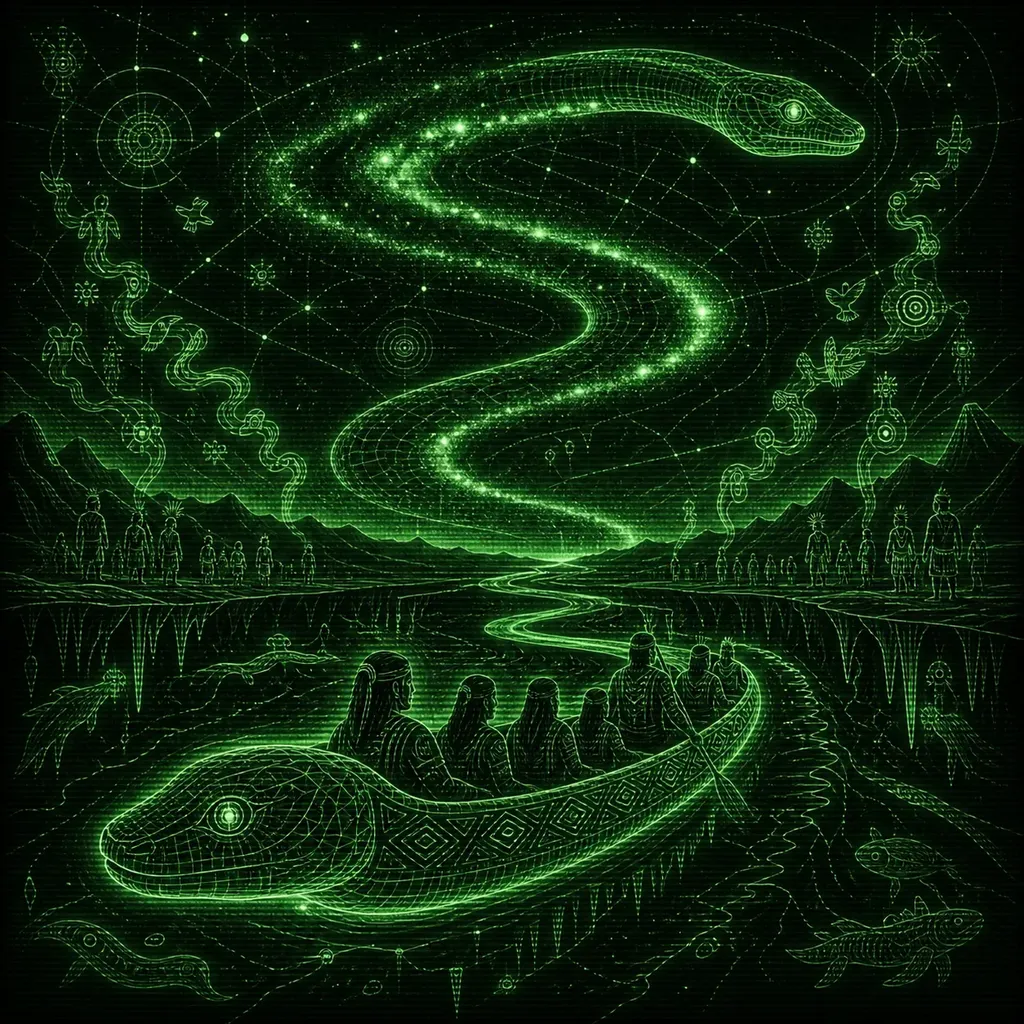
Across the Americas, snakes approach the realm of the dead in this way. They are rarely the simple equivalent of death, still less of Satan or hell. They are the living architecture of transit. A serpent becomes the bridge a soul crosses, the smoke-road down which an ancestor appears, the body that carries first people upriver, the dangerous intelligence below a spring, or the divine being who steals old bones from death and makes them human again.
The serpent belongs to death because death is imagined as movement.
Seen across the hemisphere, the repetition is too exact to remain a catalogue of local inventions: water or cave, serpent road, swallowed or vanished traveler, death-like transformation, and the return of knowledge, bones, ancestors, names, or renewed life. That sequence points toward deep inheritance. An ancient serpent-and-death complex traveled with people, ceremonies, and stories, changing its names and surfaces while preserving its structure for many thousands of years. Local variation is not evidence against the connection. It is what an old tradition looks like after millennia of use.
More diagnostic still, several stories remember the boundary as the result of a break. The dead could once be recovered; the boa once carried people; the living once traveled freely to the spirit country. A primordial act closes the route, damages it, or makes it one-way. These myths do not only explain where the dead go. They explain why a road that was once open has become difficult—and why snakes still possess exceptional access to it.
One serpent road, several otherworlds #
The English word underworld flattens an older, more intricate map. Across American traditions, everything underground, deep water, the destination of the deceased, and a Christian hell are not one place. The ancient complex instead joins several otherworldly zones along routes of movement.
In many Southeastern cosmologies, a Beneath World holds water, snakes, fish, dangerous medicine, fertility, disorder, and immense nonhuman persons. A land of the dead may instead lie westward, at the end of the Milky Way or beyond a river. A ghost may remain near its grave. A dream-soul may travel while its owner is alive. These places touch, but they are not interchangeable.
That distinction is audible in the testimony of Jackson Lewis, a nineteenth-century Muscogee informant. His horned serpent lived in water, possessed a magnetic power over game, and could supply extraordinary hunting medicine. Yet Lewis insisted: “It is not a bad snake.” The sentence is a small demolition charge under centuries of imported demonology (Grantham, pp. 25–26).
The same book preserves the words of Josie Billie, the great twentieth-century Mikasuki medicine man, on a person’s wandering spirit. A spirit might travel north in a dream and return safely before dawn. If it turned east and reached the Milky Way, the situation became mortal: “Get east then go over Milky Way to west and city of dead.” A medicine specialist could sing, blow pipes, pursue the spirit, and bring it back before the crossing was complete (Grantham, pp. 39–40).
No snake appears on this particular soul road. Its obstacles in related Southeastern accounts are more often a great bird, a shaking log, a dog, a hog, or an alligator waiting below. Yet the dangerous aquatic serpent and the westward city of the dead belong to the same layered cosmos: different stations within a world organized by passage.
This is why mythology must lead the interpretation. An artifact gives us nouns: serpent, hand, eye, bone. A story supplies verbs: dive, seize, cross, call, return, transform.
Moundville’s coiled gate #
The famous Rattlesnake Disk from Moundville, Alabama, places a hand with an eye in its palm inside the coils of paired horned rattlesnakes. It is a finely worked sandstone palette, one of a class of objects on which pigments or medicines were prepared. Jera Davis’s experiments and residue review show that such palettes had ritual lives, although the exact performance involving this exceptional disk is not recoverable (Davis 2016, pp. 234–254).
George Lankford noticed that five Moundville images—hand-and-eye, skull, bone, raptor, and winged serpent—cluster with one another instead of combining randomly with the rest of Moundville art. He argued that the cluster belongs to a death complex organized around the Milky Way as a Path of Souls. His generalized model gives the images a mythic structure (Lankford 2007).
The old stories bring the model to life. The hand-and-eye can be read as an opening; the serpents mark the charged edge of passage; the soul road lies in the night sky. The Muscogee narratives add something the disk alone cannot say: a serpent gate may lead not only to final death but also to initiation, medicine, kinship, and return.
That story remains part of living memory. Chickasaw Nation tribal anthropologist LaDonna Brown has recounted on Chickasaw.tv how her grandfather told her a horned-serpent story when she was a child living near Moundville. Her account reconnects the engraved serpent to a living tradition: the being beneath Moundville is not mute, extinct, or available only through archaeology. Native families still tell what kind of being it is.
The man who crossed the species boundary #
Other Muscogee narratives approach death from the opposite direction. Instead of a living visitor entering the serpent world, a human being becomes a serpent and can no longer remain among human kin.
In one story, a hunter eats food that should not have been eaten. During the night his legs join; his lower body becomes a tail; by morning he lies in a coil. He asks his companion to lead him to water. The small pool expands into a deep lake when he enters it. Later his parents come to the shore. Their son rises, crosses their laps, sheds tears, and returns beneath the surface. In another version he lays his head against his mother’s jaw but can no longer speak. The storyteller closes by saying that this is what people call the Tie Snake.
Nothing in the scene says that the son is biologically dead. Socially, however, his family has lost him. His body, food, language, habitat, and community have changed. He is present enough to weep and absent enough to be mourned. The myth puts transformation beside bereavement without collapsing one into the other (Grantham, “Snake Man Legends,” pp. 211–220).
This is the same grammar explored in our survey of snake-swallowing initiation: to enter a serpent is to disappear from one status and return in another. The initiation is death-like because death and initiation both break a person out of an old social body. The serpent is suited to the task because it does not merely stand at the threshold. It performs the threshold in flesh.
Among the Huni Kuin of the western Amazon, that proposition becomes explicit ritual experience. Yube names a complex of ancestral human, anaconda people, primordial anaconda, visionary vine, and transformative power. In Els Lagrou’s work with Huni Kuin specialists, a novice is swallowed and thrown up by Yube in order to be reborn as Yube. Those who undergo it return with the power to bring visions through song. Leôncio, one of the Huni Kuin teachers whose interpretations Lagrou records, said that he had been swallowed and had sought knowledge from the boa’s yuxin (Lagrou 2018, pp. 44–46).
The anaconda mouth is therefore not a metaphor applied from outside. It is the experiential route by which a person’s ordinary identity is taken apart and returned as ancestral knowledge. The Muscogee youth comes back from the Tie Snake cave with medicine; the Huni Kuin specialist comes back from Yube with song. Different ritual worlds preserve the same movement: serpent passage, death-like disappearance, altered return, transmissible power.
The rattlesnake that made death permanent #
The Cherokee “Daughter of the Sun” places a snake at another decisive boundary: the moment when the dead ceased to be recoverable.
The version James Mooney published in 1902 was gathered chiefly from Swimmer, with material from John Ax, James Blythe, and other Eastern Band Cherokee storykeepers.1 In it, the Sun grows angry at people and kills them with fever. The Little Men transform human beings into snakes and send them to stop her. The great Uktena fails. The Rattlesnake succeeds too quickly and bites the Sun’s daughter instead of the Sun.
The daughter’s spirit travels west to Tsûsginâ’i, Ghost Country, in the Darkening Land. Seven men follow and find the dead dancing as they had in their settlements. They strike the young woman with seven rods, place her in a box, and carry her east. Near home she begs for air. The men lift the lid; a redbird escapes. From then on, the story says, “when they die we can never bring them back.” (Mooney, “The Daughter of the Sun,” pp. 252–254).
The rattlesnake has a precise place in the journey. Its bite opens the road west; the seven men follow the spirit; human failure during the return makes that death permanent. The myth preserves a sequence rather than a simple emblem: serpent bite, westward passage, attempted recovery, broken taboo, irreversible separation.
The escaped box belongs to a larger family of failed-return stories, but the Cherokee ending is especially stark. Death becomes the condition in which a voice can still be heard from inside the container while the body can no longer be delivered home.
The serpent bridge on the Ojibwe soul road #
Sometimes the connection is even more literal: the serpent is the road.
In 1855, the German traveler Johann Georg Kohl asked Ojibwe people around Lake Superior to explain the journey after death. One consultant drew him a map. The soul walked for several days toward a paradise in the west until a broad river blocked the way. What looked like a tree trunk lay across the water, head on the near bank and tail on the far one. Kohl’s account delivers the revelation in seven words: “In reality, it is a great serpent.” Souls had to leap onto its head and cross its unstable body (Kohl 1860, pp. 215–219).
Kohl’s map was not an isolated report. William W. Warren, writing from Ojibwe family ties, knowledge of the language, and conversations with elders and chiefs, recorded the same crossing around 1852. He called the route Che-ba-kun-ah, the Road of Souls, and Ke-wa-kun-ah, the Homeward Road. The newly dead cross a “rolling and sinking bridge”; only after reaching the far bank and looking back do they see the vast serpent twisting its folds across the stream. Beyond it live the generations accumulated since the creation of humankind (Warren, “The Road of Souls”).
Other Ojibwe accounts say that tobacco and the right address—“grandfather”—can quiet the bridge. The Milwaukee Public Museum’s synthesis preserves the essential ritual logic: relationship makes passage possible. The soul does not defeat the serpent. It recognizes a powerful older person and crosses with permission.
This is almost a verbal illustration of the Moundville intuition: serpent, water barrier, and Path of Souls in one image. At Moundville the serpent coils around a portal; in the Ojibwe map the serpent literally spans the river on the westward road. The geography changes while the conjunction survives—serpent, water, soul-road, dangerous crossing. That is precisely the kind of structural memory an ancient tradition can carry after thousands of years of retelling.
The bridge the Mother Boa withdrew #
The Ojibwe serpent bridge has a southern counterpart so exact that it changes the scale of the comparison. On the Ucayali in Peru, Peter G. Roe heard a short Shipibo story from a man named Manuel. The huge boa was the Mother of All Water Creatures. She once held every aquatic being in her stomach. Then the story gives her body an even more astonishing function: “A boa formed a bridge over the water on which all the first people crossed from shore to shore.”
The crossing remained open until menstrual blood fell on the boa’s back. She convulsed to wash it off, threw the people into the water, and never again became their bridge (Roe 1982, pp. 120–121).2 The end of the story is the closing of a primordial road. The same being is mother, container, bridge, and withdrawn passage: life inside her, people upon her, another world beneath her.
The first people rather than the newly dead make this crossing, but a contemporary Shipibo account joins the two movements within one living cosmos. The artist and professor Harry Roldán Pinedo Varela, Inin Metsa, describes Jene Nete, the water-world, as the home of Ronin, cosmic snake, owner and mother of the beings in the water. Fish still come from her stomach. He then names Jakon Nete as the world where the dead are healed, become stars, and do not die again. All beings, he writes, must pass through the stages and interrelations of these worlds (Inin Metsa, “The Four Worlds”).
Placed beside the Ojibwe map, the parallel becomes difficult to reduce to generic snake symbolism. In both accounts the serpent’s long body lies across water; human passage depends on its stability; and the crossing is governed by relationship and ritual condition. The Ojibwe dead still face the bridge. The Shipibo first people remember the age when it was open. These are two directions on the same deep road: toward the otherworld and outward from it.
Once that parallel comes into focus, the western Amazon no longer looks like a peripheral appendix to the argument. It becomes one of the clearest places where the old serpent road was remembered in multiple forms.
The snake bite that built the Death-Path #
The Marubo of the Javari Valley preserve the closing of the road in even more explicit terms. This time we can hear a named ritual specialist at length. Armando Cherõpapa, chief of the Paraná community and a Marubo romeya and healer, told Pedro Cesarino that his own double had seen the Death-Path, Vei Vai, while “flying in the wind.” His testimony was transcribed and translated with Marubo teachers, then published bilingually as a poem-talk about posthumous fate.
In Cherõpapa’s story, a mistreated woman named Vei Maya sits alone calling for death. She calls the snakes, walks to the river, and enters the water. A snake nesting there bites her. She dies and arrives among the Spirit-Folks of the Samaúma tree. There she gives an order: “Hurry, build now the Death-Path!” The spirit peoples obey. Before this, Cherõpapa says, people died peacefully and arrived quickly at the Arboreal Abode. The newly made route is a bad path on which the “afterborn” will suffer (Cherõpapa, trans. Cesarino 2012, “The story of Vei Maya”).
Other Marubo testimony completes the change in the world’s geography. At the beginning, living people could come and go along Yové Vai to Shoko Nai. A woman mistreated by her husband closed that road with the help of spirits, separating ordinary humans from the yové. The heart-soul must now face the trials of Vei Vai. If it succeeds, it reaches a place where Roka changes its skin and it begins a well-fed, healthy, happy life. The word for the sky of this renewal, shokó, is also used for the relative whose name is given to a living person (Indigenous Peoples in Brazil, “Marubo”).
The snake is not visually stretched into the Marubo road. It does something more consequential: its bite is the event from which the road is built. River, serpent, death, closed passage, difficult crossing, new skin, and circulating name form a single sequence. Here mortality is a transport problem created in mythic time. The road used to work differently. The serpent marks the moment it changed.
An ancestor steps out of Maya serpent jaws #
At the Classic Maya city of Yaxchilan, the dead do not wait for a traveler to reach them. An ancestor comes through.
A sequence of carved lintels shows royal women performing bloodletting and confronting enormous serpent-shaped apparitions. Lady K’abal Xook draws a thorned rope through her tongue; blood falls onto paper and is burned. On Lintel 25, a serpent rises before her and a warrior-like ancestral being appears from its open jaws. Another composition, Lintel 15, shows Lady Wak Tuun before a serpent issuing from a bowl of bloodletting materials; the British Museum describes the emerging figure as an ancestor contacted in the rite.
Modern scholars call this recurring Maya apparition the “Vision Serpent.”3 The name isolates the same structure found elsewhere in the hemisphere: a serpent’s body becomes an opening through which the dead or ancestral powers cross. It takes smoke, blood, and vision and gives them a shape large enough for an ancestor to inhabit. Its jaws are not eating the dead person. They are delivering ancestral presence into the court of the living.
The images themselves carry written dates and names. A modern museum summary can therefore say more than “probably ritual”: the series is a dynastic narrative about Lady K’abal Xook, her remembered act, and the authority it gives the present. The British Museum’s account of the sequence notes that the artists deliberately make ritual time fold backward. A gesture in the present opens an encounter dated in the past.
This is the serpent as medium. Not messenger, exactly; not ancestor; not underworld monarch. It is the visible channel by which a dead or primordial authority becomes socially active again.
The Feathered Serpent steals humanity from Mictlan #
The Nahuatl Legend of the Suns makes the serpent’s traffic with death still more audacious. Here Quetzalcoatl—the Feathered or Precious Serpent—does not wait at the border. He goes into Mictlan, the Place of the Dead, and steals its most guarded substance.
The text records a Nahuatl performance dated May 22, 1558 and survives in copies associated with the manuscript commonly called the Codex Chimalpopoca. The gods have established earth and sky but have no people to inhabit them. Quetzalcoatl descends to Mictlantecuhtli and Mictlancihuatl and states his purpose plainly: “I come to take away the jade bones which you so honorably guard.” The lord of Mictlan hands him a conch with no holes and orders him to sound it while circling the realm four times. Worms bore the holes; bees and hornets enter the shell and make it sing.
Mictlantecuhtli then tries to revoke the bargain. His servants dig a pit. Quetzalcoatl, startled by quail, falls into it “as if dead”; the bones scatter and the birds gnaw them. He revives, gathers the broken pieces, and escapes to Tamoanchan. There Quilaztli—also called Cihuacoatl, Snake Woman—grinds the bones in a vessel. Quetzalcoatl bleeds over them, and the other gods perform penance. Present humanity is born (Tlamachiliztlahtolçaçanilli, pp. 174–175, trans. Willard Gingerich).
The episode is not a picturesque detour appended to creation. It defines what people are. Human bodies are the damaged remains of earlier lives, stolen from death, broken again, ground like food or seed, and animated by divine sacrifice. The Feathered Serpent crosses down and back; Snake Woman processes the dead matter; life begins as an act of successful return.
Quetzalcoatl’s journey gives the serpent road its most audacious form. The rulers of Mictlan oppose him, making the Feathered Serpent a trespasser, trickster, victim, survivor, and thief. He defeats death by carrying its bones into another form.
The Anaconda’s river carries the dead back to birth #
In the Upper Rio Negro and Uaupés of northwestern Amazonia, Tukanoan peoples give the serpent-road cosmology its most complete expression. The Anaconda is ancestor, vessel, river, house, and body at once.
Origin narratives tell how an Anaconda-ancestor entered through the eastern “water-door” and traveled upriver with the ancestors of humanity inside. At first they were spirit people in the form of feather ornaments. As the Anaconda moved through a succession of transformation houses, they acquired human bodies and emerged into their territories. Different Tukanoan peoples tell the route from their own positions, and each group has its own Anaconda ancestor. In the traditional longhouse, the roof is sky, the floor covers the River of the Dead, and the house itself repeats the Anaconda’s body (Indigenous Peoples in Brazil, “Tukano”).
The death journey reverses and renews this origin. A person is buried beneath the house floor in a canoe or canoe-shaped coffin. An aspect of the soul falls to the underworld river and returns to the group’s “house of transformation,” its place of origin. Later, that name-soul comes back to the living when a newborn receives the name of a recently dead paternal relative. The underworld river is full of the same feather ornaments in which the ancestors first traveled inside the Anaconda.
This is not merely an ethnographer’s elegant synthesis. Upper Rio Negro Indigenous authors have published their own sacred histories. In the Desana book Antes o mundo não existia, Umúsin Pãrõkumu narrated the knowledge, and his son Tõrãmũ Kehíri collected and illustrated it; the later edition was issued by the Indigenous organizations UNIRT and FOIRN. Contemporary Tukano anthropologist João Paulo Lima Barreto, writing from teachings received from his grandparents, his father Ovídio Barreto, and kumuã specialists, states the principle with unmatched clarity: “To die is to transform, not to die.” The biological body ends; another mode of the person returns to earth and enters a “new territory of afterlife” (Barreto, “Body Ground Heart”).
The Anaconda is therefore not simply waiting for souls downstream. Its primordial journey created the coordinates by which souls, names, bodies, and peoples continue to circulate. Origin and afterlife are the same route read in opposite directions.
The Yuruparí complex dramatizes this logic. In its mythic charter, Yuruparí in anaconda form swallows initiates and later returns them as bones. The parents burn the Anaconda, but its soul ascends and a palm tree rises from its ashes; ritual instruments are made from the tree. In the rite, boys are painted black, ritually killed, bathed, reborn through the water-door, secluded like newborns, and finally painted red. The myth does not borrow the language of death as a decorative metaphor. It makes death, digestion, plant growth, ancestry, and adulthood stages in one transformative process (Indigenous Peoples in Brazil, “Yuruparí rites”).
For the Anaconda’s relation to visionary plants and cross-species perception, see our study of cebil, yopo, and the ancestral serpent. The broader pattern also connects with American serpent-and-woman emergence narratives, and that recurrence is central to the deep-time case. Emergence and afterlife use the same serpent route because both preserve an older religious grammar in which persons cross between kinds of being inside, through, or over a snake.
Nine surviving forms of the serpent road #
| Tradition | Where the dead or ancestors are | Serpent form | What crosses or returns |
|---|---|---|---|
| Muscogee | Westward Soul’s Town; also an underwater realm | Tie Snake king, underwater cave, transformer | A living visitor returns with medicine and power |
| Huni Kuin | Yube’s visionary and ancestral domain | Anaconda mouth and body as initiatory passage | A specialist is swallowed, returned, and empowered to bring visions through song |
| Cherokee | Ghost Country in the western Darkening Land | Rattlesnake at the origin of irreversible death | A spirit is nearly recovered before failed return fixes mortality |
| Ojibwe | Western paradise beyond a river | Great serpent as unstable bridge | A soul crosses through relationship and tobacco |
| Shipibo | Primordial crossing; interrelated water-world and realm of renewed dead | Mother Boa as living bridge and container of water beings | The first people cross until the bridge is withdrawn; the dead are healed and become stars |
| Marubo | Death-Path to the Arboreal Abode and Shoko Nai | Snake bite at the river precipitates the building of the road | The heart-soul crosses, receives new skin, and lives again; names return among kin |
| Classic Maya at Yaxchilan | Ancestral domain activated through rite | Serpent mouth formed through blood, smoke, and vision | An ancestor re-enters the court and gives authority |
| Nahua | Mictlan | Feathered Serpent descends, falls, revives, and carries bones | The bones of previous humanity become present people |
| Tukanoan peoples | River of the Dead and transformation houses | Anaconda as vessel, body, river, and house | Name-souls return through newborns; initiates are reborn |
These correspondences are not loose enough to be explained by “snakes are frightening” or “snakes shed their skins.” The pattern is a chain of actions: the serpent occupies water, cave, or the beneath; a person dies or disappears; the serpent becomes bridge, mouth, vessel, or road—or causes the road to be made; bones, power, ancestry, song, or a name returns to the living. The recurrence of that chain from the Great Lakes and Southeast through Mesoamerica to the upper Amazon points toward inheritance rather than coincidence.
The Ojibwe and Shipibo bridges make the case especially vivid. At opposite ends of the hemisphere, a serpent is not adjacent to a crossing or pictured beside water: its body is laid from shore to shore and human passage occurs on its back. One bridge leads souls toward the western country of the dead. The other carried the first people until the crossing was withdrawn. After thousands of miles and generations of retelling, the underlying construction remains visible.
The same memory also survives as a history of breakage. The Cherokee dead could almost be brought home until the box was opened. The Shipibo boa carried the first people until the crossing was violated. Marubo living people once traveled to the spirit country until the old route closed and the difficult Death-Path took its place. In each case, present mortality is explained as damaged transport: the worlds were once more permeable, and exceptional beings still know the surviving road.
Deep inheritance does not preserve a script word for word. It preserves a mythic grammar. Over millennia, the serpent bridge can become a serpent mouth, the underwater cave a bone-filled Mictlan, the returning initiate a returning ancestor or name-soul. Languages, animals, political orders, and ritual institutions change; the underlying sequence remains recognizable. Local elaboration is exactly what we should expect if the stories are extremely old. For the wider case that the first Americans carried a common cargo of myths and rites, see the evidence for a deep Pan-American inheritance.
The serpent’s biology helped the tradition endure. Snakes enter holes without limbs. They vanish into water and return to land. They climb. They shed an intact image of themselves and continue living. They swallow an animal until one body travels inside another. A rattlesnake turns invisible stillness into sudden irreversible action. Each of these zoological facts offers myth a physical verb and keeps the ancient idea intelligible in a new ecology.
American traditions then exceed the animal. Their serpents grow horns, feathers, feline heads, human histories, houses, rivers, royal mouths, and whole societies inside their bodies. Biology supplies the memorable motion; inheritance carries it through time; mythology gives it local form.
What the Rattlesnake Disk can say after the stories #
Return now to the stone from Moundville. Two great serpents knot around a hand. An eye opens in the palm. If we begin with the object alone, the temptation is to assign each feature a fixed label: serpent equals underworld; eye equals portal; circle equals stars. The result sounds precise and may be wrong.
The stories teach a better way to see it. A portal is not only a location but an event. Someone dives, disappears, dreams, bleeds, crosses, dies, returns, or fails to return. A serpent is not a badge attached to “the underworld.” It is a dangerous relationship with the power to admit, transform, carry, restore, or refuse. The road of souls is not necessarily below the ground. It may climb the Milky Way, bend west, pass over water, or run beneath the house and back toward a child’s name.
The Rattlesnake Disk condenses this older complex into one portable image. It joins the eye that sees beyond ordinary sight to the hand that acts in this world, then coils living powers around their meeting point. The disk is not an isolated visual riddle. It makes the ancient threshold portable.
That is why snakes gather near the dead across so much of the Americas. The recurrence is the signal. Beneath changing names and geographies survives an old religious structure: death opens a road; the road is watery, cavernous, nocturnal, or celestial; the serpent guards it, becomes it, or carries the traveler through; something returns—power, ancestor, bones, name, renewed life.
The Rattlesnake Disk is one late, brilliant condensation of that inheritance. The Ojibwe soul bridge, the Shipibo bridge of first people, the Cherokee recovery journey, Huni Kuin rebirth in Yube’s mouth, the Marubo Death-Path, the Maya ancestral mouth, the Nahua bone-thief, and the Tukanoan Anaconda river are other surviving transformations of the same deep idea. Together they hint that serpent myths of death and return have been remembered in the Americas for many thousands of years.
The serpent belongs to the dead because an ancient American tradition remembered the road between worlds as a living serpent, and kept remembering it for thousands of years.
Footnotes #
Sources #
- Barreto, João Paulo Lima. “Body Ground Heart.” MESA 7. Tukano philosophical anthropology grounded in teachings from kumuã specialists and the author’s family.
- Brown, LaDonna. “At Moundville: The Horned Serpent Story.” Chickasaw Nation, Department of History & Culture.
- British Museum. “A History of Storytelling Through Pictures.” Yaxchilan Lintels 24–26; Lady K’abal Xook, bloodletting, serpent apparition, and ancestor.
- Cesarino, Pedro de Niemeyer. “Tales of the Way of Death: Ethnography and the Translation of Amerindian Poetry.” Estudos Avançados 26, no. 76 (2012), pp. 75–100. Bilingual Marubo testimony by Armando Cherõpapa on Vei Maya, the snake at the river, and the formation and crossing of Vei Vai.
- Davis, Jera R. “Crafting Moundville Palettes.” In Rethinking Moundville and Its Hinterland. University Press of Florida, 2016, pp. 234–254.
- Grantham, Bill. Creation Myths and Legends of the Creek Indians. University Press of Florida, 2002. Especially pp. 25–28, 38–41, 199–227.
- Kohl, Johann Georg. Kitchi-Gami: Wanderings Round Lake Superior. Chapman and Hall, 1860. See pp. 215–219 for the Ojibwe map of the soul road and serpent bridge.
- Lankford, George E. “The ‘Path of Souls’: Some Death Imagery in the Southeastern Ceremonial Complex.” In Ancient Objects and Sacred Realms, University of Texas Press, 2007, pp. 174–212.
- Lagrou, Els. “Anaconda-Becoming: Huni Kuin Image-Songs, an Amerindian Relational Aesthetics.” Horizontes Antropológicos 24, no. 51 (2018), pp. 17–49; swallowing, rebirth, Leôncio, and visionary song at pp. 44–46.
- Milwaukee Public Museum. “Life Stages.” Great Lakes traditional cultures; Ojibwe accounts of the four-day soul journey and serpent bridge.
- Mooney, James. Myths of the Cherokee. Nineteenth Annual Report of the Bureau of American Ethnology, Government Printing Office, 1902. Especially “The Daughter of the Sun,” pp. 252–254, and the notes at pp. 436–437.
- “Marubo.” Indigenous Peoples in Brazil. The open path to Shoko Nai, its closure, the difficult posthumous journey, new skin, and names.
- Pãrõkumu, Umúsin, and Tõrãmũ Kehíri. Antes o mundo não existia: Mitologia dos antigos Desana-Kehíripõrã. UNIRT/FOIRN, 2nd ed., 1995. Narrator/editor provenance documented by the ICAA/Museum of Fine Arts, Houston.
- Pinedo Varela, Harry Roldán (Inin Metsa). “The Four Worlds.” Translated by Sofia Puente, Latin American Literature Today 23 (2022). A contemporary Shipibo account of Ronin, the water-world, death, healing, and transformation into stars.
- Roe, Peter G. The Cosmic Zygote: Cosmology in the Amazon Basin. Rutgers University Press, 1982. See “Myth, Cosmos, and Ceremony among the Shipibo,” especially pp. 44–47, 113–121; the Mother of All Water Creatures is on pp. 120–121.
- Swanton, John R. Myths and Tales of the Southeastern Indians. Bureau of American Ethnology Bulletin 88, 1929. Creek section, “The King of the Tie-Snakes,” from the William Tuggle collection.
- Tlamachiliztlahtolçaçanilli, also known as Leyenda de los Soles. Nahuatl performance recorded in 1558, fols. 76–77. Willard Gingerich, “A Performance Translation of the Náhuatl ‘Wisdom-Discourse Fables’ from the Manuscript of 1558.” Estudios de Cultura Náhuatl 28 (1998), pp. 159–196, especially 174–175. See also John Bierhorst, History and Mythology of the Aztecs, University of Arizona Press, 1992.
- “Tukano.” Indigenous Peoples in Brazil. Northwest Amazonian cosmology, life cycle, the Anaconda-ancestor, and Yuruparí rites.
- Warren, William W. History of the Ojibways, Based Upon Traditions and Oral Statements. Written in 1852. See “The Road of Souls” for Che-ba-kun-ah, Ke-wa-kun-ah, and the serpent bridge on the homeward road to the ancestors.
Mooney’s text is indispensable but mediated. He says the principal version came from Swimmer (A’yûñ’inĭ) and identifies John Ax and James Blythe among the other Eastern Band sources. His comparison and wording are his own; the narrative knowledge is theirs. See his note to story 5 in Myths of the Cherokee. ↩︎
Roe says Manuel’s stories were recorded spontaneously among family and friends, often while people sat talking around the fire. He tape-recorded the narratives, transcribed them in Shipibo, worked through a literal Spanish translation, and published close English paraphrases rather than line-by-line translations. See The Cosmic Zygote, pp. 44–47. ↩︎
“Vision Serpent” is a modern scholarly name for a recurring Maya visual form. Ancient personal names may vary; the comparative importance lies in the stable operation of the form—a serpent body opening a route for divine or ancestral presence. ↩︎