The Serpent in the Snuff: Cebil, Yopo, and the Animal Grammar of Vision
TL;DR
- Cebil/vilca is genuinely serpent-associated, but never serpent-only: jaguars, birds, toads, monkeys, camelids, ancestors, and transforming humans share its ritual world.
- Archaeology begins around 2100 BCE with cebil seeds and puma-bone pipes in Argentina.
- San Pedro de Atacama yielded about 612 snuffing kits, not hundreds of confirmed cebil pipes.
- Aguada art puts seed-like circles on serpents and other beings; Chavín joins serpent-rich art to chemically verified vilca residue.
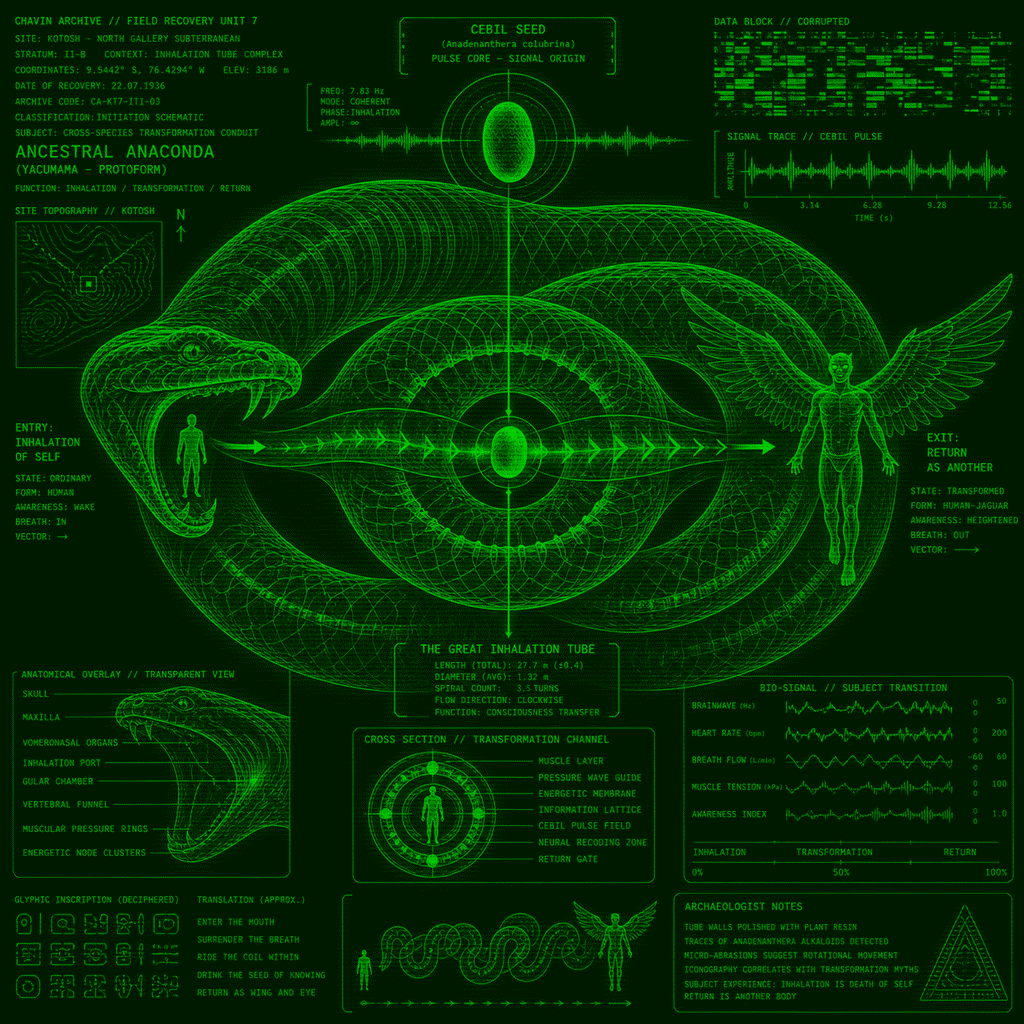
- An Amazonian snuff tradition offers the clearest image: a tray shaped as an ancestral anaconda.
Was cebil a serpent psychedelic? #
Yes—but the shortest answer is also the most misleading.
The seeds called cebil, vilca, willka, or hatáj usually come from Anadenanthera colubrina. Farther north and east, the closely related A. peregrina supplies yopo, paricá, or cohoba. Both belong to long-lived South American traditions of psychoactive snuffing, smoking, drinking, and therapeutic use. Their chemistry varies, but the molecule most closely associated with the seeds is bufotenine—5-OH-DMT, not 5-MeO-DMT.
The serpent belongs to these traditions. It appears on vessels, in Chavín bodies, and most explicitly as the ancestral anaconda built into an Amazonian snuff tray. But a claim such as “cebil was the drug of a prehistoric snake cult” compresses several species, regions, millennia, and Indigenous cosmologies into a single modern slogan.
The evidence supports a more interesting conclusion. Anadenanthera operated inside a multispecies technology of transformation. The serpent was one privileged form within it, alongside the feline, raptor, toad, monkey, camelid, and human. The central subject was not an animal mascot. It was the possibility that perception could cross the boundary between bodies.
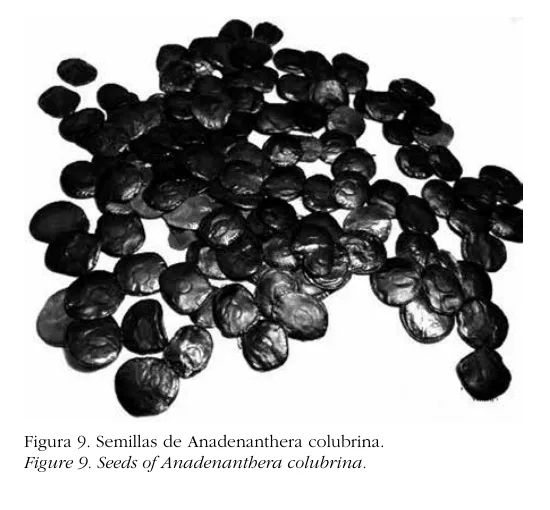
Even the botanical name seems to wink at the argument: Latin colubrina means “serpentine” or “snake-like.” That is a modern taxonomic coincidence, not evidence for ancient belief. The real case has to be built from use, context, residue, and image.
How was cebil traditionally used? #
The surviving ethnographic record prevents the archaeology from becoming a catalogue of mute objects. Among Wichí and ’Weenhayek communities of the Gran Chaco, cebil is known as hatáj. Seeds were collected, dried or roasted, stored in strung bundles, ground, and inhaled; ground cebil could also be combined with tobacco and smoked. Shamans used it to obtain visions, heal, and communicate with spirits. Verónica Lema’s open-access review documents the persistence and diversity of these practices rather than treating vilca as a vanished pre-Columbian relic (Lema 2024).
This is historical description, not a preparation guide. What matters symbolically is the purpose. Hatáj was not taken merely to generate unusual visual effects. It made diagnosis and interspecies communication possible within a ritual setting. Breath and smoke moved a plant through the shaman; the shaman’s attention moved toward spirits, patients, and other-than-human persons.
That relational purpose changes how the artifacts should be read. A tube is not just drug paraphernalia. It is an instrument for altering breath. A feline on a pipe is not necessarily an illustration of a hallucination. It can specify the kind of power, body, or perspective made available through the rite.
What does the archaeology actually prove? #
The phrase “hundreds of ancient pipes” is close enough to spread and wrong enough to matter. South America has produced a vast inhalatory archive, but it includes different objects and different standards of evidence.
| Place and date | Material evidence | Animal or serpent context | What it establishes |
|---|---|---|---|
| Inca Cueva, Jujuy, c. 2100 BCE | Anadenanthera seeds and two puma-bone pipes | The pipes themselves are feline bone | Very early cebil smoking/inhalation context |
| Chavín de Huántar, c. 800–350 BCE | Vilca and Nicotiana residues in bone tubes | Serpent-feline-raptor beings pervade major site art | Direct plant identification plus strong site-level symbolism |
| San Pedro de Atacama, mainly c. 100–900 CE | About 612 snuffing kits; some powders chemically tested | Human-feline figures, birds, staffs, severed heads | A large institutional inhalation tradition, not 612 pipes |
| Aguada, northwest Argentina, c. 600–1000 CE | Pipes, plant contexts, and multireferential ceramics | Seed-like circles mark serpents, felines, humans, and other animals | A plausible visual link between cebil and transformed bodies |
| Brazilian Amazon, date uncertain | Museum snuff tray with unknown contents | Handle is an anaconda; designs are serpentine | Explicit anaconda meaning, but weak archaeological provenance |
At Inca Cueva in the Puna of Jujuy, two pipes made from puma bone were deposited with Anadenanthera seeds around four thousand years ago. The conjunction is unusually concrete: plant, implement, date, and feline material occur together. It makes cebil one of South America’s earliest securely documented psychoactive traditions. It also shows that feline association was present near the beginning of the record (Torres 1998).
At San Pedro de Atacama, the record expands dramatically. Constantino Manuel Torres counted approximately 612 snuffing kits from 42 of roughly 50 excavated sites. A typical kit held a wooden tray, an inhaling tube, a small spoon or spatula, and leather pouches. Most belong to the first millennium CE, and some carry Tiwanaku-style imagery. Calling all of them “pipes” confuses snuffing with smoking; calling all of them chemically confirmed cebil overstates the analyses.
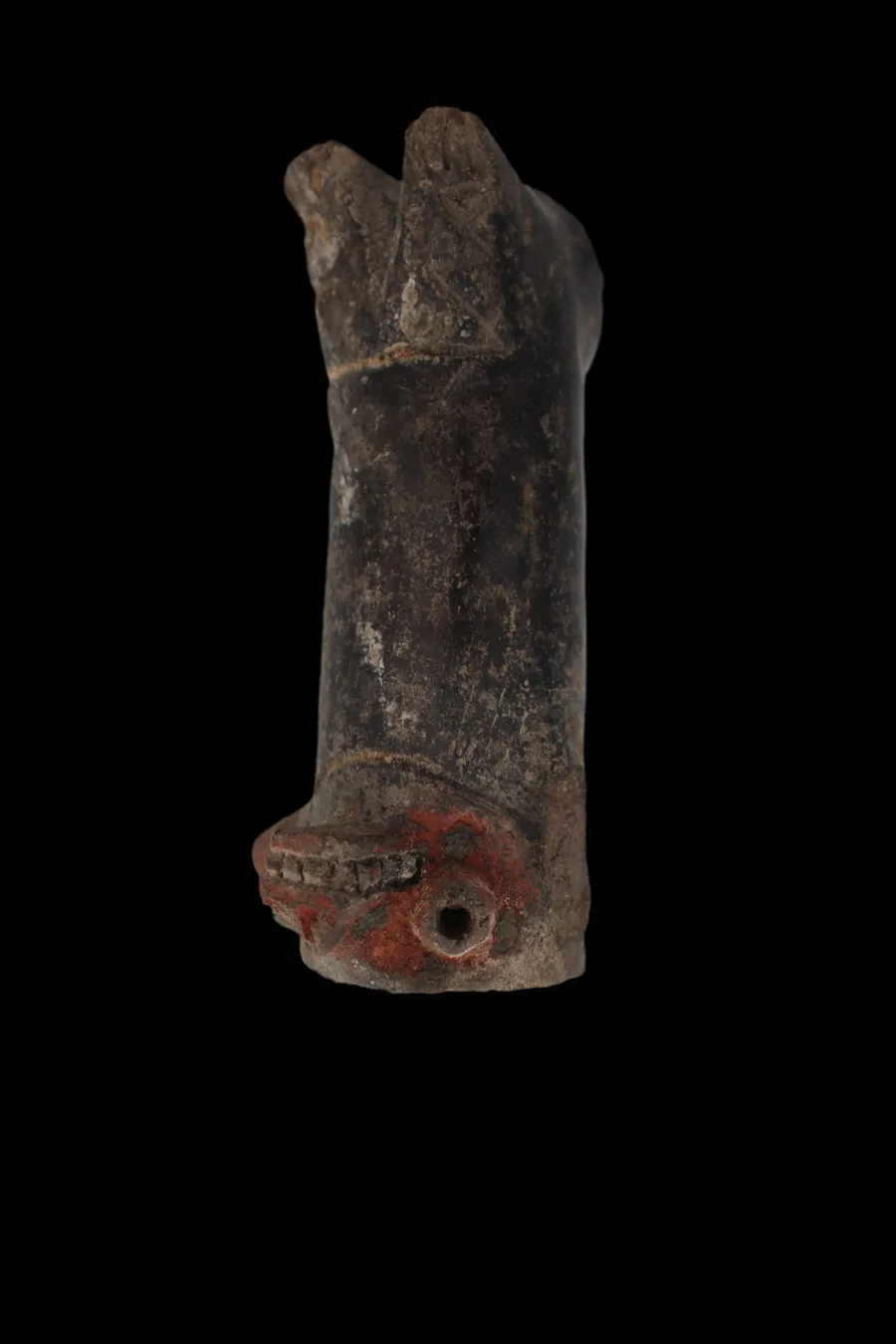
The numerical correction strengthens the argument. This was not a heap of interchangeable drug devices. It was a designed complex of containers, measures, tubes, bags, images, and bodily techniques. The image surrounded the act.
For the wider evidence on ancient psychoactive plants, see the Hallucinogenic Atlas.
Did Aguada artists place cebil seeds on serpents? #
The most provocative evidence comes from Aguada iconography in northwest Argentina, especially the sixth through tenth centuries CE. Aguada art is famous for jaguars and for bodies caught between human and animal form. Archaeobotanist María Bernarda Marconetto noticed a problem: if cebil helped mediate these transformations, why did the plant appear to be absent from the images?
Her answer was to question what counted as a picture of a plant. Anadenanthera seeds are dark, round, and often show a central depression. Aguada beings repeatedly carry concentric circular marks traditionally read as feline spots. Yet the same marks occur on humans, serpents, monkeys, toads, birds, and camelids. They also cluster around eyes, ears, mouths, and other sensory organs.
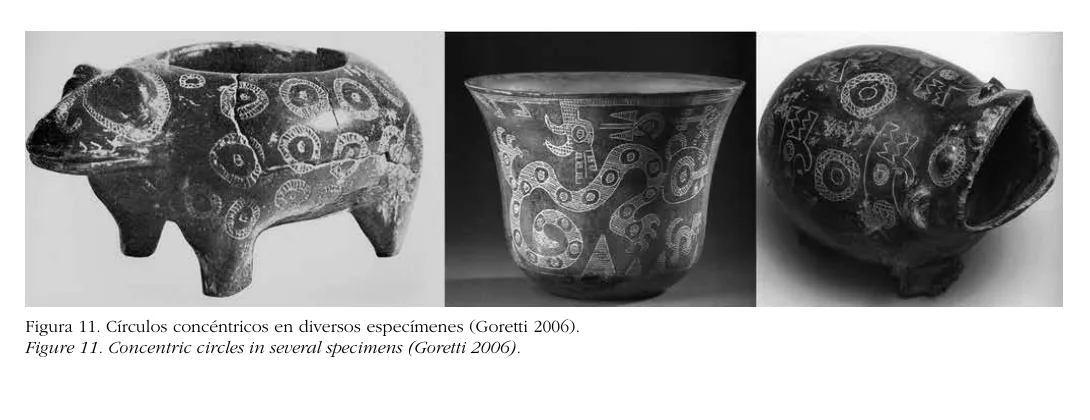
This does not prove that every circle is a cebil seed or that every marked serpent records a drug rite. Marconetto’s point is subtler. Aguada images are multireferential. A circle may be spot, seed, eye, and sensory potency at once. Modern viewers separate plant, animal, and human because our taxonomy demands it; the artifact may have been designed to defeat that separation.
The “jaguar in bloom” therefore decentralizes the jaguar without erasing it. Feline power is one phase of a network. The serpent can wear the same seed-sign because both are possible bodies in a field opened by the plant.
Cebil was not the sacrament of a single snake cult. It was one medium through which people imagined a body crossing into feline, serpent, bird, ancestor, and spirit.
What connects vilca to Chavín’s serpent gods? #
At Chavín de Huántar in Peru, the serpent connection becomes both stronger and easier to overstate. Chavín’s carved beings fuse human anatomy with feline fangs, raptor claws, and snakes that become hair, eyebrows, belts, vegetation, or staffs. The Raimondi Stela is a masterpiece of this unstable perception: its lines resolve into different faces as the image is inverted. The body is not half person and half animal. It is deliberately difficult to keep in one category.

For decades, scholars inferred psychoactive practice from this art and from mortars, spoons, and bone tubes. Richard Burger argued that a Chavín sculpture depicts parts of Anadenanthera, making vilca the likely snuff rather than the San Pedro cactus, which was normally drunk (Burger 2011). In 2025, residue analysis finally moved the argument beyond iconography.
John Rick and colleagues analyzed artifacts from Gallery 3, a small subterranean chamber near the circular plaza. Six bone objects carried chemical or microbotanical evidence for vilca and Nicotiana. The detected molecules included DMT, 5-OH-DMT/bufotenine, and nicotine; starches identified vilca seeds and leaves as well as wild tobacco roots. The gallery deposits were dated to approximately 800–350 BCE (Rick et al. 2025).
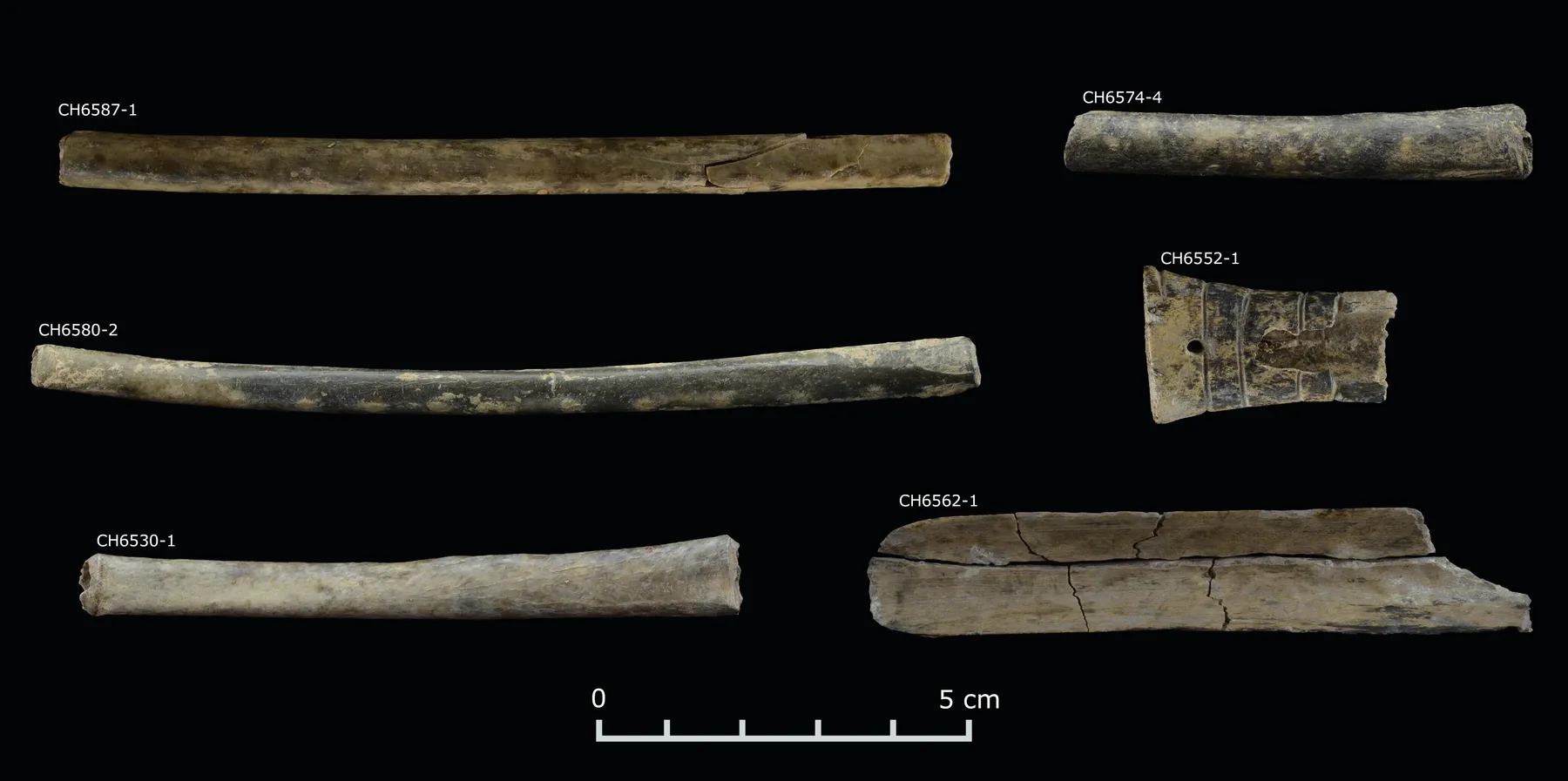
The result establishes that vilca and tobacco entered Chavín ritual space. It does not establish that the Raimondi Stela illustrates a bufotenine vision, that every snake signifies vilca, or that the pictured deity and the analyzed tubes belonged to one ritual event. The residue and the serpent art are associated at the site and religious-system level, not on the same artifact.
That distinction is the line between an argument and a meme. Chavín now provides direct plant evidence inside one of the ancient Americas’ richest serpent-feline visual systems. The relationship is real. Its exact theology remains unrecoverable.
Why is the ancestral anaconda the clearest case? #
The strongest explicit serpent interpretation comes from a comparative Amazonian snuff object, commonly discussed alongside traditions of A. colubrina’s sister species, Anadenanthera peregrina—yopo or paricá. Its contents, however, were never chemically tested.
The British Museum holds a wooden snuff tray acquired as Brazilian. Its recurved handle is carved as a snake, probably an anaconda, while serpentine designs enclose the depression that held the powder. The user faced the snake’s returning head. The museum’s associated account says shamans who inhaled the snuff journeyed back into the body of the ancestral anaconda (British Museum Am1949,22.179).
Here the serpent is neither a proposed seed-sign nor a neighboring temple motif. It structures the instrument and supplies the destination of the journey. Inhaling is being swallowed; trance is a return into the ancestor’s body. This recalls the global initiatory pattern in which a novice is swallowed by a serpent and returned transformed, but the local object deserves priority over the comparison.
The tray also imposes two limits. Its museum provenance is only “Brazil (?)”; its date is not secure; and its contents were not chemically identified. It cannot be recruited as direct proof for what an Aguada vessel or Chavín tube meant centuries earlier. It is comparative context: evidence that an Anadenanthera snuff tradition could explicitly organize shamanic travel as entry into an anaconda.
Why do serpents fit the ritual so well? #
No molecule contains a serpent. Bufotenine does not transmit a universal snake symbol from neuron to culture. The fit emerges from the meeting of pharmacology, bodily technique, ecology, and inherited cosmology.
Four properties make serpents unusually effective here:
- They cross domains. A snake moves on the surface, disappears underground or underwater, and returns. It is a ready body for a specialist who travels between ordinary and spirit worlds.
- They transform without dying. Sloughing presents renewal as a visible fact. The old body opens and a bright one exits.
- They swallow and contain. The ancestral-anaconda tray turns altered consciousness into a spatial event: the shaman goes inside another body and comes back.
- Their form belongs to breath technology. Snake, tube, smoke path, vine, and flowing line can echo one another. This is a formal affinity, not proof that every tube represents a snake.
The jaguar fits the same system from another direction. It contributes night vision, predatory force, sound, stealth, and a body capable of overpowering human limits. The raptor supplies height and distant sight. The toad adds terrestrial-water liminality. The serpent is not their rival. It is one transformation vector among them.
This is why the recurring question—jaguar or snake?—is badly formed. Aguada art can put the same circles on both. Chavín can build one being from human, feline, avian, vegetable, and serpentine parts. The images do not ask the viewer to select the correct zoological label. They stage the collapse of that demand.
For a broader comparison of this animal’s meanings, see Serpent Symbolism and Serpent Myths of the Americas.
The serpent was not a logo; it was a direction of travel #
The archaeological sequence does not reveal one unbroken snake religion stretching from Inca Cueva to the modern Chaco. It reveals recurring solutions to a ritual problem: how to give form to a human being whose perception, agency, and social identity have temporarily changed.
At the beginning of the record, cebil lies beside pipes made from a puma. At San Pedro, inhaling kits carry human-feline and political beings. In Aguada art, the supposed jaguar spot migrates onto snakes, humans, monkeys, toads, birds, and sensory organs until it also resembles the seed that enables transformation. At Chavín, residue proves that vilca entered a built world where snakes already flowed through composite divine bodies. In the Amazonian comparison, the entire act of snuffing becomes a journey into the ancestral anaconda.
So, yes: these drugs are connected to serpent symbolism. The connection is neither accidental nor exclusive. The serpent names a direction of ritual travel—underground, underwater, inside an ancestor, out of an old skin, across the border of the human. Cebil and yopo did not simply make people “see snakes.” They participated in traditions that used the serpent to think with altered bodies.
Sources #
- Lema, Verónica S. “Contemporary Uses of Vilca (Anadenanthera colubrina var. cebil): A Major Ritual Plant in the Andes.” Plants 13 (2024): 2398.
- Torres, Constantino Manuel. “Psychoactive Substances in the Archaeology of Northern Chile and NW Argentina: A Comparative Review of the Evidence.” Chungará 30 (1998): 49–63.
- Torres, Constantino Manuel, and David B. Repke. “The Use of Anadenanthera colubrina var. cebil by Wichí Shamans of the Chaco Central, Argentina.” Yearbook for Ethnomedicine and the Study of Consciousness 5 (1996): 41–58.
- Marconetto, María Bernarda. “El Jaguar en flor: Representaciones de plantas en la iconografía Aguada del Noroeste Argentino.” Boletín del Museo Chileno de Arte Precolombino 20.1 (2015): 29–37.
- Rick, John W., et al. “Pre-Hispanic Ritual Use of Psychoactive Plants at Chavín de Huántar, Peru.” PNAS 122.19 (2025): e2425125122.
- Burger, Richard L. “What Kind of Hallucinogenic Snuff Was Used at Chavín de Huántar? An Iconographic Identification.” Ñawpa Pacha 31.2 (2011): 123–140.
- Museo Chileno de Arte Precolombino. “El respirar mágico.” Chamanismo: Visiones fuera del tiempo.
- British Museum. “Snuff tray, Am1949,22.179.” Africa, Oceania and the Americas collection.
Third-party archaeological figures and museum photography retain their source licenses and are excluded from this article’s CC BY-SA text license.
Read other posts