~/mythology/comparative-mythology
The Serpents Who Founded the Human World
Serpent founders from China to Cambodia, Mesoamerica, Africa, Greece, and Australia connect ancestry, marriage, ritual law, and sovereignty.
TL;DR
- Serpents repeatedly stand at the beginning of human institutions: marriage, subsistence, ritual knowledge, royal descent, and possession of land.
- Serpents teach, become ancestors, and grant or sustain sovereignty.
- Chinese and Mesoamerican examples connect serpentine identity with making the human world; Khmer and Pallava sources put serpent marriage inside royal genealogies.
- Australian traditions connect serpent ancestry with kinship and ceremony beyond agricultural states.
- Ancestral authority passes into institutions through teaching, descent, marriage, and ritual.
Why do serpents appear at the beginning of civilization? #
When the Chinese visitor Zhou Daguan reached Angkor in 1296, he encountered a remarkable explanation of royal power. People told him that a nine-headed serpent spirit inhabited a golden tower in the palace. She appeared as a woman, and the king had to sleep with her before joining his human wives. She was the owner of the kingdom’s soil. If he neglected her, disaster would follow; if she failed to appear, his death was near. Zhou records the story in the palace section of his account.
The king ruled an enormous human society. The land still belonged to a serpent.
Snakes in mythology do much more than guard treasure, threaten heroes, or symbolize fertility. They make people, retrieve the food that sustains them, arrange marriages, establish ceremonies, and supply the ancestors of ruling houses. Across very different societies, serpentine beings occupy the point where a living landscape becomes a human order.
A serpent who determines a legitimate marriage, provides royal insignia, or stands behind a clan’s right to perform a ceremony holds authority over human relationships. Its power extends beyond the fertility of crops or the birth of children.
The civilizer gives people a technique or institution. The ancestor gives a community its origin and a lineage its legitimacy. The prior owner makes settlement or sovereignty depend on a relationship with an older power. Teaching, descent, and permission can overlap, but each answers a different question: How did we learn to live? Who are we? By what right are we here?
Fuxi and Nüwa: serpent bodies and the ordered human world #
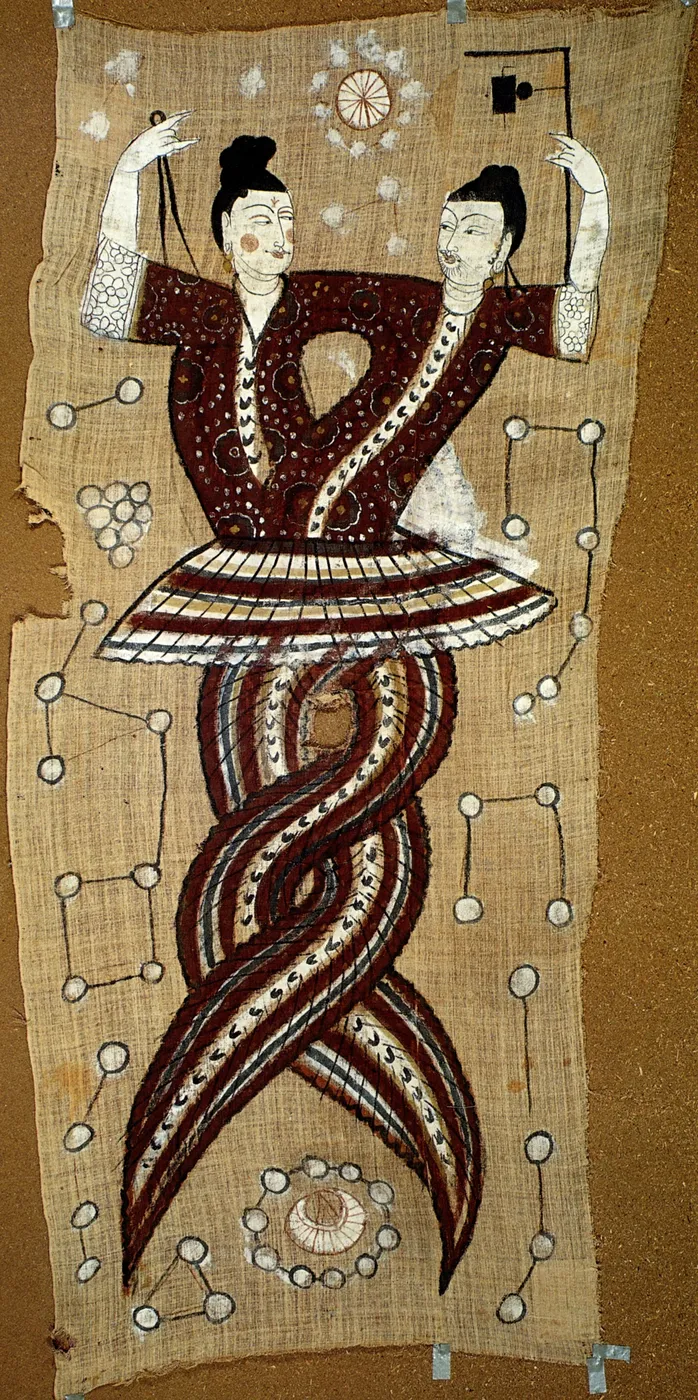

The entwined bodies make ancestry visible; the measuring tools make it an act of ordering. Astana banners present Fuxi and Nüwa as humanity’s ancestors, with serpent form built into their identity (British Museum catalog).
The Changes, in the second chapter of the Xici’s lower section, describes Fuxi observing the sky, earth, animals, and his own body. From these observations he establishes the eight trigrams, a system for understanding and classifying the world’s powers. He also knots cords into hunting and fishing nets. The traditional commentary identifies this founder as human-headed and serpent-bodied (Zhouyi Zhengyi, chapter 2). The Taiping yulan also preserves an attribution of marriage rites to Fuxi (chapter 78, Fuxi section).
Fuxi teaches people to secure a livelihood and to render the world intelligible. Subsistence and interpretation arrive from the same ancestral source.
Nüwa works on another scale. A fragment of the Han-period Fengsu tongyi, preserved in the later Taiping yulan, describes her making humans from yellow earth. The account distinguishes people made by hand from those made by splashing mud with a cord, using the distinction to explain social rank (chapter 78, Nüwa section).
The Huainanzi gives her a different task: repairing the ruined world. She patches the sky with stones of five colors, replaces its supports, and checks the flood. She also kills a dangerous black dragon. A serpentine benefactor can therefore defend human life against another serpentine being; the role matters more than a uniform moral meaning assigned to every snake (Lan ming xun).
These traditions join bodily ancestry to institutional origins. The beings who explain human existence also explain why people have tools, classifications, marriages, and ranks. Human life and ordered life have serpentine founders, paired in the Fuxi–Nüwa image.
Quetzalcoatl and 9 Wind: making people and founding lordships #
In the Nahua Legend of the Suns, Quetzalcoatl goes into the realm of death to obtain the bones of earlier humans. He escapes with them, suffers a fall that damages them, gathers them again, and brings them to Tamoanchan. There Quilachtli grinds the bones, Quetzalcoatl sheds his blood over them, and the gods perform the acts through which people come into existence (Leyenda de los Soles, pp. 120–121; León-Portilla, p. 243).
Blood gives new life to the bones of the dead, joining human creation to serpent blood rites.
Those people need to eat. The next episode sends Quetzalcoatl after an ant carrying maize. He becomes a black ant, enters the Mountain of Sustenance, and brings maize back. The gods feed it to humanity. He is a retriever of indispensable food, working within a larger divine enterprise; the episode gives him no solitary invention of agriculture (Matos Moctezuma’s discussion).
The name means Feathered Serpent, and the identity extends beyond a name. An Aztec stone image in the British Museum combines his human face with feathered serpent coils. His ability to act in human or other animal forms belongs to the deity’s range of transformations. His serpentine identity persists across those transformations.
The Mixtec figure 9 Wind brings sacred authority to earth. On page 48 of the Codex Vindobonensis, he descends from heaven with sacred objects and symbols of power. Manuel Hermann Lejarazu reads this descent as preparation for the foundation of towns and lordships. The same painted tradition joins primordial events to the sacred authority of ruling houses (Hermann Lejarazu, figure 3 and discussion).
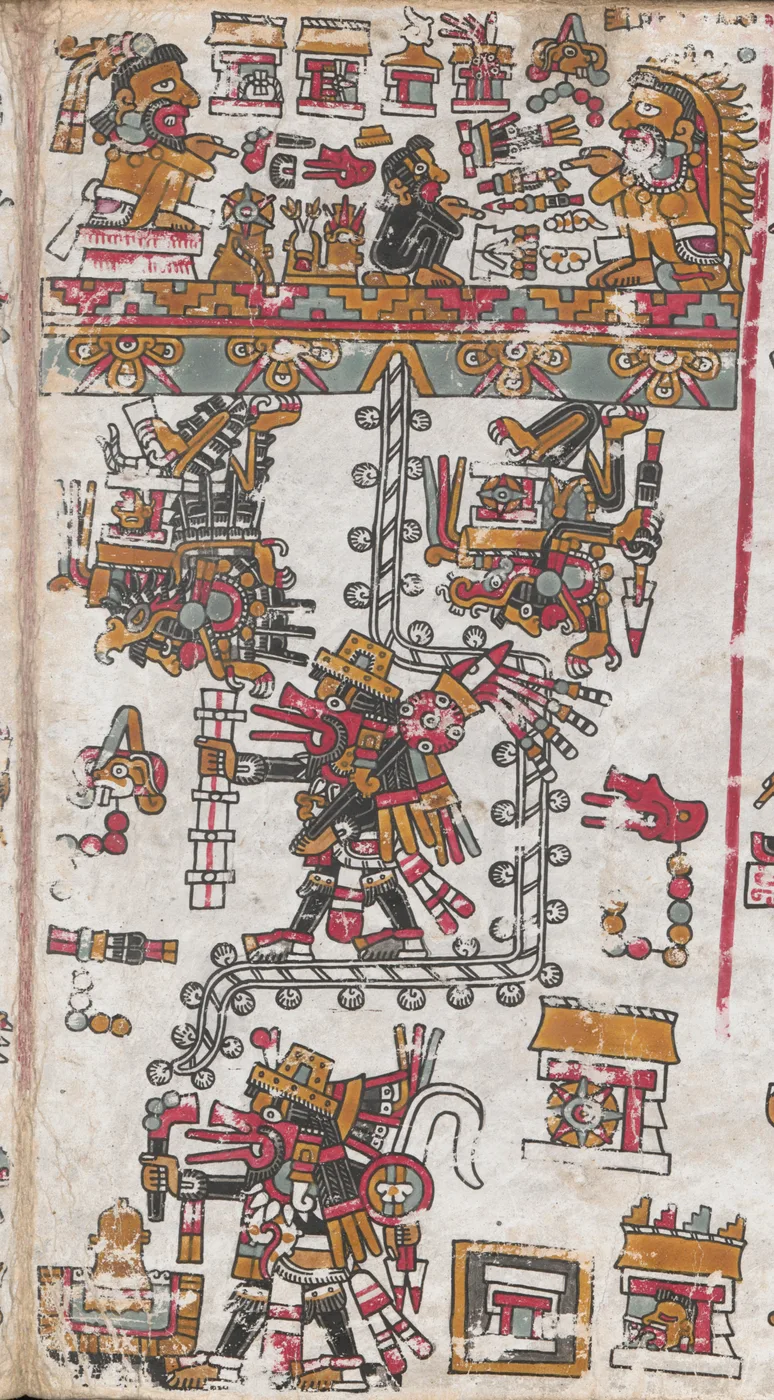

John Pohl’s reading follows the account from 9 Wind’s descent and separation of sky, waters, and earth into named kingdoms, tree-born ancestors, royal marriage, and the establishment of rituals. Cosmology becomes political geography (Vindobonensis, obverse pp. 52–24).1
The family of Feathered Serpent traditions also includes the K’iche’ Popol Vuh’s Qucumatz, who deliberates with other divine powers in creation, and Yucatec accounts of Kukulkan, whom Diego de Landa associates with Mayapan’s political foundation and distribution of lordships. These are distinct narratives with distinct actors, rather than chapters of a single biography (Christenson translation, pp. 56–58; Landa, “Kukulcán. Fundación de Mayapán”).
Across these accounts, the serpent’s creative power reaches into the things a community must reproduce: bodies, food, ceremonies, settlements, and legitimate rule. Creation continues inside social life.
Nāga princesses: marriage brings the right to rule #
The Sanskrit inscription C.96 at Mỹ Sơn, in present-day Vietnam, is dated to 658. Within a Cham king’s genealogy, it recounts Kauṇḍinya’s marriage to a serpent king’s daughter, conventionally called Somā. The story connects the couple with Bhava or Bhavapura in the Khmer world. Its position in a public royal inscription makes serpent ancestry an assertion of dynastic standing (Finot’s edition, verses XVI–XVIII, pp. 922–923).2
South India supplies an unusually explicit parallel. The ninth-century Vēlūrpāḷaiyam plates of the Pallava king Nandivarman III describe the ancestor Vīrakūrcca obtaining the full royal insignia together with the serpent chief’s daughter. Marriage and sovereignty arrive in the same sentence (DHARMA edition, verse 6, lines 11–12).
The bride provides more than a marvelous pedigree. In this political logic, marriage admits the founder into a source of authority he did not create. The ruler can inherit a right to govern through a relationship with the powers already established there.
Later Cambodian traditions turn that logic into a landscape. Preah Thaong marries a nāga princess, and her father drinks away the waters to supply land for the kingdom. Other versions give the new ruler a capital. Wedding traditions recall the prince’s entry into the serpent realm while holding his bride’s garment (Gaudes 1993, pp. 335–337).
The land is a gift from the bride’s family. Political foundation becomes a marriage settlement between the human newcomer and an older, watery world.
Zhou Daguan’s palace story extends this dependence into the reigning king’s present. The serpent landowner must be approached again each night. Sovereignty remains conditional on maintaining the relationship that makes it possible. A human king can command people while acknowledging a deeper owner of the earth.
Sanskrit genealogies and royal marriage operated across courts connected with India, Cambodia, and Champa. Goodall documents marriages between Indian Brahmins and Khmer royal women from inscriptions. These are concrete channels through which ritual and genealogical ideas could travel, even when the itinerary of a particular serpent story cannot be recovered (Kālidāsa’s Kingship among the Khmers, p. 11).
Athens and Scythia: the serpent establishes kinship #
Greek tradition gives Athens a founder who combines human and serpent bodies. Apollodorus calls Cecrops earth-born and the first king of Attica. He also makes Cecrops witness Athena’s planting of the olive tree during her contest with Poseidon (Library 3.14.1).
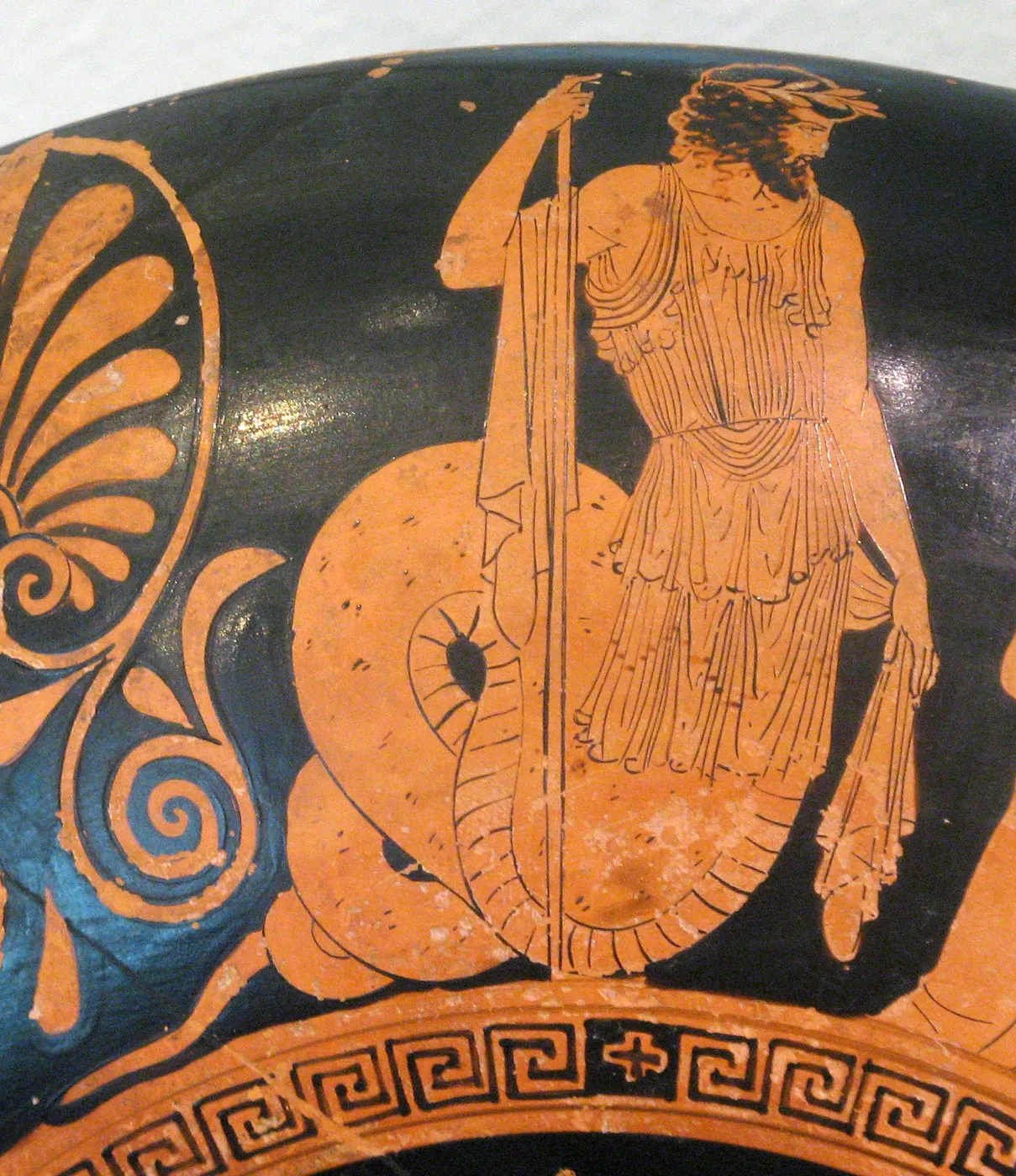

Athenaeus, citing Clearchus, attributes a social invention to the same king: pairing one man with one wife. The story explains Cecrops’s double nature through the new recognition of both parents, since earlier sexual relations supposedly left paternity unknown (Deipnosophists 13.555d).
This is a founding myth about marriage and identifiable descent, rather than a record of prehistoric Athenian sexual customs. Its choice of founder is still striking. A serpent-bodied king stands behind the institution through which people acquire a socially legible parentage.
In the origin story told by Greeks around the Black Sea, Heracles encounters a woman whose lower body is a serpent. She possesses his missing mares and requires him to sleep with her before returning them. She bears three sons and says she alone has power over the land (Histories 4.9).
Heracles leaves a bow and a belt as a test. The youngest son, Scythes, passes; his mother keeps him in the country, and subsequent Scythian kings descend from him (4.10). The traveling hero departs. The serpent woman remains, raises the heirs, and determines who stays.
The story combines divine ancestry, a local female power, a qualification for kingship, and possession of territory. Like the Cambodian nāga bride, the mother links the new dynasty to the land she already commands.
Wagadu: a kingdom sustained by a serpent covenant #
In Soninke foundation tradition, Wagadu—the kingdom known in historical writing as ancient Ghana—depends on a covenant with the serpent Bida. The IFAN archive’s account of Dinga and Wagadu describes the founder bargaining with this protective power: an annual maiden sacrifice in return for the kingdom’s prosperity. Breaking the agreement brings the serpent’s death, drought, ruin, and the people’s dispersal (IFAN, Légende de Dinga et du Wagadu, LEG-LK-0001).
The kingdom exists under the terms of its relationship with Bida. The end of that relationship explains the end of its prosperity.
This changes the meaning of killing a serpent. A heroic slaying can remove a threat; in the Wagadu story, rescuing the intended victim also ruptures the covenant sustaining the polity. The serpent’s danger and beneficence belong to the same obligation. Political order has a price, and the narrative makes that price visible in a terrible form.
Australian serpent ancestors: marriage and ritual law before the state #
Australian traditions place serpent ancestors at the origins of kinship and ritual law. Ancestral animals, human ancestors with animal totems, and powerful landscape beings can have different roles within one tradition.
In Baldwin Spencer’s 1901 expedition journal, an account recorded under Binbinga describes an Ulanji snake-man of the Paliaringi division establishing proper marriage. He meets a kangaroo-man, exchanges kinship terms with him, and receives his daughter as a wife. Each ancestor belongs to a named place; the snake’s waterhole is Walania. Spencer’s later published version calls the founder a man of the snake totem (journal 2, pp. 78–80).3
Proper marriage is enacted through naming relations and joining families, within a geography of ancestral places. A snake-totem ancestor helps establish the rules that distinguish a legitimate union.
Like Cecrops and Fuxi, the snake-totem ancestor establishes marriage. Serpent authority over kinship appears in societies with radically different political forms, including those without irrigation or monarchy.
Yolngu material reveals another arrangement. The Djungguwan ceremony brings boys into Law, linking them to earlier clansmen and their ancestral origins. The public account prepared around filmed ceremonies of the Rirratjingu and Marrakulu clans credits the Wawilak Sisters with traveling through country, creating clans, and giving them Law (NFSA, “The Wawilak Sisters’ journey”).
Their encounter with the great python belongs to the narrative enacted in ceremony. Swallowing, storm, and emergence connect ancestral events with the initiation of living people (Film Australia’s public background material). The women give the Law; the serpent participates in the story through which its power is renewed in Yolngu ceremony.
A serpent can authorize an institution through the ancestral drama surrounding it, without being its sole inventor. Foundation may be distributed among a mother, sisters, an animal power, and the people who inherit the rite.
Spencer and Gillen also describe an Anula Ulanji ceremony at Karrimurra whose ancestral episode concerns a snake’s meeting with a kangaroo-man and the offer of his daughter as a wife. Before the ceremony begins, a bullroarer sounds to warn women and children away from the ground (Northern Tribes, pp. 223–224). Here snake ancestry, marriage, ceremonial performance, and a restricted instrument occur together. The account gives the bullroarer a role in protecting the ceremonial gathering; it does not identify this particular sound as the snake’s own voice.
The Bullroarer Atlas’s McIvor River record supplies a separate regional connection: the instrument’s local name also means snake.
Ritual makes inheritance audible and visible. An ancestral act becomes a ceremony; a ceremony becomes the means through which another generation enters the human order.
Oannes: a fish-bodied teacher of civilization #
Berossus’s account of Oannes describes a fish-bodied being with human features emerging from the sea. By day he teaches writing, mathematics, cities, temples, laws, boundaries, and cultivation; by night he returns to the water (Berossus, fragment 1, translated by Verbrugghe and Wickersham, p. 44).
Enki or Ea occupies the divine sphere of wisdom, crafts, and subterranean freshwater. In Inana and Enki, powers including kingship and skilled occupations pass from him to Inana and her city (Oxford’s ETCSL translation, segments E–F). His conventional artistic form is a bearded god in a horned cap. The fish-cloaked sages once misidentified as Ea represent the apkallu (Oracc, “Enki/Ea”).
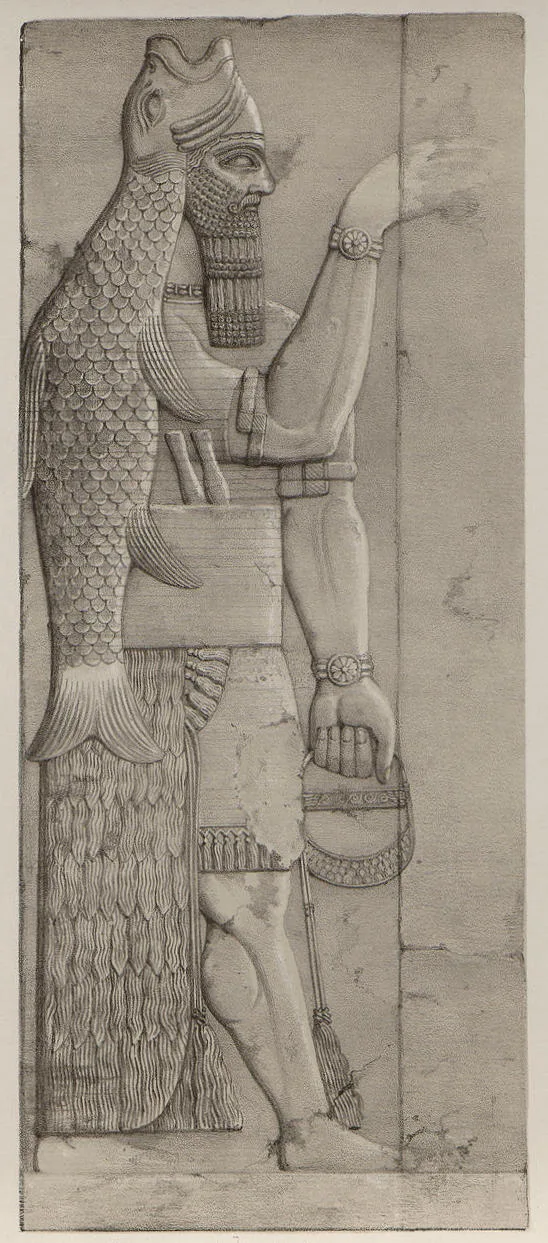

Mesopotamian traditions also give institutional beginnings to more-than-human teachers. Oannes is a fish-being, and Enki’s conventional form is human. Their civilizing roles resemble those of serpent founders without giving them a serpentine identity.
Ancestral authority passes into institutions #
In The Evolution of the Dragon (1919), Grafton Elliot Smith assembled a vast complex of water, restored life, the Great Mother, divine kingship, and dragons. He understood that the serpent’s significance could lie in a connected religious system. His preface links the beneficent dragon with water and kings, then tries to derive far-flung traditions from Egyptian developments. He even treats a supposed Indian elephant in American imagery as evidence of transmission across the Pacific (Evolution, preface, pp. vi–xii).
Serpent founders embody ancestral authority transferred into human institutions. Nets and maize sustain bodies. Marriage organizes reproduction. Ceremonies reproduce recognized membership. Genealogies reproduce ruling rights. A relationship with the land’s prior owner makes settlement legitimate. The serpent can connect several of these operations in one ancestral figure.
| Tradition | Serpent connection | Founding role | Authority carried forward |
|---|---|---|---|
| Fuxi and Nüwa, China | Serpent-bodied ancestors | Human life, nets, classification, marriage | Ordered human society |
| Quetzalcoatl, Nahua | Feathered Serpent with multiple forms | Human restoration and maize retrieval | Life sustained through divine action |
| 9 Wind, Mixtec | Wind deity related to the Feathered Serpent | Sacred regalia and foundations | Lordships and ritual authority |
| Kauṇḍinya’s bride, Khmer–Cham genealogy | Serpent king’s daughter | Royal marriage and ancestry | Dynastic standing |
| Vīrakūrcca, Pallava | Marriage to serpent chief’s daughter | Acquisition of royal insignia | Sovereignty |
| Cecrops, Athens | Human–serpent body | Kingship and marriage institution | Recognized parentage |
| Scythian mother in Herodotus | Human–serpent body; territorial power | Mother of the royal ancestor | Kingship and possession of land |
| Bida, Wagadu | Protective serpent | Covenant sustaining the kingdom | Prosperity conditional on obligation |
| Ulanji ancestor, Binbinga record | Snake-totem identity | Proper marriage relations | Kinship rules |
| Wawilak cycle, Yolngu | Sisters’ encounter with python | Ancestral charter of ceremony; sisters give Law | Clan membership and ritual inheritance |
An ancestral serpent power can become the source through which new institutions claim legitimacy. When a kingdom forms, that authority can appear as a serpent bride or royal ancestor. Where ceremony and kinship organize collective life, it can remain attached to marriage divisions, ancestral places, and initiation. The surviving records do not establish a dated sequence of these changes across every region.
Snake images occur across many kinds of tradition. Serpent ancestry joined to marriage rules, territorial power, specific ritual acts, and inherited custodianship forms a more distinctive combination. India and Southeast Asia had connected courts and recurring genealogical language preserved in inscriptions. The worldwide recurrence of serpent founders does not establish that all these traditions share a historical origin.4
Civilization as an ancestral inheritance #
The serpent’s founding work extends beyond monumental cities, writing, and kings into smaller and more fundamental arrangements: finding food, naming relatives, entering adulthood, recognizing descent, and living on a particular piece of earth.
The stories repeatedly give those arrangements an origin beyond the current generation. People did not simply decide how to marry; an ancestor established the relation. A ruling house did not simply occupy a country; a serpent woman joined its founder to the land. A ceremony is powerful because it brings inherited Law into the present.
The Eve Theory of Consciousness describes serpent traditions as carriers of a new human form of life. In these foundation stories, ancestral power passes into teachable, inheritable ways of being human, joining royal descent to serpent initiation.
The serpent founder embodies a striking idea about social origins. Human order grows out of a relationship with powers that precede us. The teacher can be a serpent, the ancestor can be a serpent, and the landowner can be a serpent. Civilization begins when people enter that relationship and learn to carry its authority forward. In these traditions, the snake belongs at the foundation because the human world is something received, enacted, and passed on.
Notes #
Sources #
- Zhou Daguan. Zhenla fengtu ji (A Record of Cambodia), palace section. Account of his 1296–1297 visit.
- British Museum. Fuxi and Nüwa funerary banner, 1928,1022,0.203. Astana, sixth–seventh century.
- Kong Yingda et al. Zhouyi Zhengyi, Xici xia, chapter 2. Canonical text and traditional commentary on Fuxi’s inventions and form.
- Li Fang et al., compilers. Taiping yulan, chapter 78. Nüwa section preserving the Fengsu tongyi fragment.
- Huainanzi, Lan ming xun. Nüwa’s repair of the world.
- Leyenda de los Soles, dated 1558. In Códice Chimalpopoca, translated by Primo Feliciano Velázquez, UNAM, third edition, 1992, pp. 120–121.
- León-Portilla, Miguel. “Los merecidos por el sacrificio de los dioses”. Estudios de Cultura Náhuatl 53 (2017): 241–244.
- Matos Moctezuma, Eduardo. “Mito del robo del maíz del Tonacatépetl o Montaña de los Mantenimientos”. Arqueología Mexicana, special edition 81, pp. 32–33.
- British Museum. Stone image of Quetzalcoatl, Am1825,1210.11. Aztec, 1325–1521.
- Hermann Lejarazu, Manuel A. “Manuscritos, historias y herencias”. CIESAS, Ichan Tecolotl. Vindobonensis, page 48 and figure 3.
- Pohl, John. “Ancient Books: Mixtec Group Codices”. FAMSI, reading of the Vindobonensis obverse.
- Christenson, Allen J., translator. Popol Vuh: Sacred Book of the Quiché Maya People, pp. 56–58.
- Landa, Diego de. Relación de las cosas de Yucatán, “Kukulcán. Fundación de Mayapán.”
- Finot, Louis. “Notes d’épigraphie XI: Les inscriptions de Mi-Sơn”. BEFEO 4 (1904): 897–977. C.96, especially verses XVI–XVIII.
- Francis, Emmanuel, digital editor. Vēlūrpāḷaiyam plates of Nandivarman III, year 6. DHARMA, Sanskrit verse 6.
- Gaudes, Rüdiger. “Kauṇḍinya, Preah Thaong, and the ‘Nāgī Somā’”. Asian Folklore Studies 52.2 (1993): 333–358.
- Golzio, Karl-Heinz. “Kauṇḍinya in Southeast Asia revisited”. Journal of Global Archaeology (2023): 122–137.
- Goodall, Dominic. Kālidāsa’s Kingship among the Khmers. Twenty-ninth J. Gonda Lecture, 2022, pp. 11, 16–17.
- Apollodorus. Library, book 3, 3.14.1. Translated by J. G. Frazer.
- Athenaeus. Deipnosophists, book 13, 555d, citing Clearchus. Translated by C. D. Yonge.
- Herodotus. Histories 4.9 and 4.10. Translated by G. C. Macaulay.
- IFAN Cheikh Anta Diop. Légende de Dinga et du Wagadu. Fonds Lylian Kesteloot, LEG-LK-0001, undated archival account; catalog description.
- Spencer, Baldwin. Expedition journal 2, 1901–1902, pp. 78–80. Spencer and Gillen digital archive. See also Spencer and Gillen, The Northern Tribes of Central Australia, 1904, pp. 223–224, 438–439.
- National Film and Sound Archive / Film Australia. “The Wawilak Sisters’ journey” and Ceremony: The Djungguwan of Northeast Arnhem Land, public background material.
- Berossus. Fragment 1 in Gerald P. Verbrugghe and John M. Wickersham, Berossos and Manetho, Introduced and Translated. University of Michigan Press, 1996, p. 44.
- University of Oxford, ETCSL. Inana and Enki, segments E–F. Horry, Ruth. “Enki/Ea”, Oracc, 2019.
- Smith, Grafton Elliot. The Evolution of the Dragon. Manchester University Press, 1919, preface.
- Cutler, Andrew. Eve Theory of Consciousness v3.0. Vectors of Mind, 2024. Bullroarer Atlas: McIvor River Koko-yimidirr dunggul. Authorial interpretation and comparative record, respectively.
Image credit: Cecrops photograph by Mark Landon / Wikimedia Commons, CC BY 4.0, resized for display.
9 Wind is a Mixtec divine figure commonly compared with Ehecatl-Quetzalcoatl. He often appears in anthropomorphic wind-god dress. The codex’s later dynastic and ritual scenes extend beyond his own exploits; divine authorization does not make every ruling family his biological descendants. ↩︎
C.96 is a Cham inscription discussing Khmer connections, not a first-century Funan record. Its serpent marriage, Chinese accounts of Hùntián and Liǔyè, and later Preah Thaong stories are distinct witnesses. The interpretation of Somā and lunar-lineage language remains contested; see Golzio 2023, pp. 129–133 and Goodall, pp. 16–17. The inscription securely dates the public use of this genealogy, rather than the events narrated in it. ↩︎
The journal records this account under Binbinga, using Spencer’s historical spelling. The later account specifies a man of the Ulanji snake totem: Spencer and Gillen, The Northern Tribes of Central Australia (1904), pp. 438–439. The landscape-making Ulanji belongs to a separate narrative from this marriage founder. His totemic identity also differs from the literal serpent bodies of Fuxi–Nüwa or Cecrops. ↩︎
Dates of surviving texts, inscriptions, and images are dates of witnesses. They do not automatically date a story’s invention or the institution it explains. Australian examples establish that serpent-associated institutional authority occurs beyond states; their modern recording does not by itself establish a prehistoric chronology. ↩︎